
#65
Leon Trotsky: The Last Prophet — Part 5
29 August 2026 · 58 min · Season 1
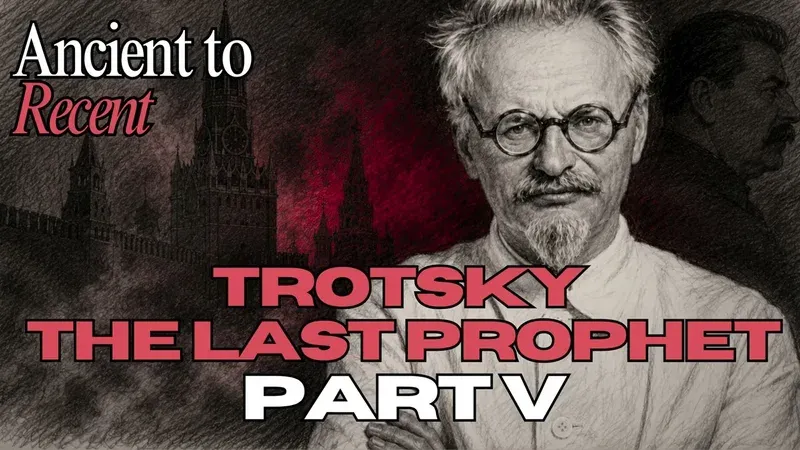 Watch on YouTube →
0:0058:33
Also on
Rate the show
Ratings are how new listeners find the show. It takes a minute and it makes a real difference.
The assassin is already in position.
As Leon Trotsky settles into his fortified compound in Mexico, Stalin's campaign to destroy him enters its final and most dangerous phase.
In this fifth episode, we follow the NKVD's hunt for Trotsky and the extraordinary operation designed to penetrate his inner circle.
We meet Ramón Mercader, the young Spanish communist who would eventually become one of the most notorious assassins of the twentieth century.
Under the identity of "Jack Mornard", Mercader begins a carefully constructed romance with Silvia Ageloff, a Trotskyist who unknowingly becomes the key to his access to Trotsky.
As Mercader slowly works his way towards Mexico, the NKVD prepares multiple teams and infiltrates Trotsky's organisation from within.
But while Stalin's agents close in, Trotsky himself begins to confront a more personal enemy: doubt.
The revolutionary who once believed Marxism was an inevitable scientific truth now looks around the world and sees capitalism surviving, fascism advancing and the Soviet Union transformed into the Stalinist dictatorship he had spent years fighting.
For the first time, Trotsky is forced to ask whether the revolution, and perhaps his entire life's work, had been a mistake.
Yet his faith survives.
As Trotsky writes his final testament and reflects on his life, the NKVD prepares to strike.
In May 1940, an armed force led by the Mexican muralist David Alfaro Siqueiros launches a daring assault on Trotsky's compound.
Machine guns tear through the house.
The guards are overwhelmed.
Trotsky and Natalia hide beneath the hail of bullets.
And yet, somehow, Trotsky survives.
The first attempt has failed.
But Stalin is not going to give up.
The next assassin will not come with twenty men and machine guns.
He will come alone.
He will come as a friend.
🎧 New episodes every Saturday
📲 YouTube, Spotify & Apple Podcasts | @AncientToRecent
#Trotsky #RussianRevolution #HistoryPodcast #SovietHistory #Stalin #Mexico #NKVD #RamonMercader #Trotskyism #SpanishCivilWar #Siqueiros #GreatTerror #HistoryDocumentary
Read transcript
This transcript is automatically generated, so it may contain typos and misheard names.
You may not be interested in war, but war is interested in you. Leon Trotsky Tall and tanned Jack Bonnard swaggered into the hotel. He had a calm and confident demeanour and movie star good looks to match his impeccable dress sense. Jack. He heard about the din of clinking glasses, an easy chatter of the Ritz bar. He turned to see a familiar face, Ruby Weil, American journalist and old friend. After a brief chat, Ruby insisted that Jack come sit at their table and meet her travelling companion, Sylvia Ageloff.
Sylvia was petite, with dark brown hair, soft features, a pretty but serious face. Though from a wealthy family. Sylvia had been drawn to left wing politics, but though she frequently associated with communists, found the rigid orthodoxy of the Stalinist faith off putting. Stalinism left no room for independent thought, debate and certainly no room for doubt. She was inspired by Marxist ideas that wanted something other than the regimented ranks and mouthed slogans on offer. From Moscow she read avidly and travelled widely, including to Mexico City, where she lent her youthful idealism to the service of Leon Trotsky.
But she never managed to establish herself in Trotsky's inner circle and soon found herself back in New York before taking a trip to Europe with her on and off again. Friend Ruby. Sylvia knew that Ruby was a sympathizer with the Soviet Union, but in Brooklyn intellectual circles in the 1930s, Soviet fellow travellers were 10 a penny. What she did not know was that sympathy was not where Ruby's attachment to Moscow ended.
And the good friend Jack, who so coincidentally happened to be in the same bar at the same time, brought to the table and within moments showering Sylvia with attention whilst buying expensive drinks and oozing effortless charm from every dimple of his Hollywood good looks. There was more to him than charisma. Jack presented himself as a Playboy, living the high life, fast cars, fancy dinners and exciting parties. He had supposedly not a care in the world and certainly no interest in politics that consumed Sylvia's life.
Flattered to receive the attention of such a handsome and charming man, Sylvia found herself instantly drawn to Jack. Jack was fun and his world was carefree. Every day was another adventure. Champagne, romantic walks through the leafy streets of Paris, cabarets with the best seats in the house and lazy Sundays with a picnic in the countryside. Soon enough, Sylvia was won over. As the two spent more time together and grew ever closer, Sylvia began enquiring about Jack's life, his history and his work.
How is it that Jack could afford the finer things in life when he seemed to do no work at all? Jack explained that he was the son of a Belgian diplomat, independently wealthy you see, and worked as a sports journalist from time to time. But Jack seemed to know very little about journalism, nor pay any attention to sports. With a Tour de France racing through the streets of Paris, Jack never suggested going to watch, or to any sporting events for that matter.
Nor did Sylvia ever see Jack put pen to paper. He explained that he wrote under an alias and that rugby was his primary focus. It didn't make sense. But then why ask so many questions? After all, he's tall, dark and handsome, in great shape, well dressed and had money to spend. He's so charming and funny and obsessed with Sylvia. When being whisked through an endless parade of fine dining cocktails and romantic evenings under the Parisian stars with an effortlessly handsome partner, it was all too easy to silence the doubts, to allow oneself to surrender. Which is of course, exactly what was intended for Jacques Mornard, Belgian diplomat, son, Playboy and occasional sports journalist was actually Ramon Mercader, agent of the NKVD. Welcome to Ancient to recent, my name is Joseph Parkinson. Today we continue the story of Leon Trotsky, the last prophet to support the show.
Please subscribe today and leave a rating and comment. Episodes of Ancient to Recent are out every Saturday and are available on YouTube, Spotify and Apple Podcasts. Jaime Ramon Mecca, Deir Del Rio, born on the 7th of February 1913 in Barcelona, Spain, was likeable. He was charming, he knew a little about a lot, which made him easy to converse with. He was physically impressive, tall, strong, with naturally curly black hair.
His only noticeable defect was his eyesight, for which he wore glasses. He had a talent for languages, speaking perfect French, English, Spanish, and his native Catalan. He possessed A remarkable memory, able to remember and repeat even complex information. And above all, he had a talent for acting. He was not just good at it, he loved it. He enjoyed playing a role, sometimes performing more than one in a single theatrical production with great skill.
He was, in other words, a natural born spy. But Rahman was something else. He was a fanatical communist. Ramon came from a nouveau pour family. His mother, Caridad, had been born to aristocratic parents in Cuba, the last of Spain's colonial possessions, at the twilight of the Spanish Empire in 1892. His father, Pablo was from a Catalan family whose wealth was built on a textile empire. Pablo and Caridad were an odd mix. She was free spirited and a child of the world. He was a Catholic conservative and Catalan nationalist. They set up home in Barcelona But the family business was badly run and the Mecca dares were left with nothing to make ends meet.
Carried had started giving private tuition to the children of well to do families and ended up falling in with middle class intellectuals. She was ushered into a new world of political radicalism fuelled by hard drugs. Her decline in status, small minded husband and new intellectual environment soon led to a breakdown of their relationship. Pablo retaliated by ascribing his wife's new interest to a collapse in her mental health and having her sectioned. Whilst incarcerated, she was subject to abuse that fired a growing resentment of everything her husband stood for, the Catholic Church, the nation state and capitalism. When Ramon was 12, Caridad took her children and moved to France.
By the 1920s she was living in Paris where she encountered the ideas of communism and had first contact with the NKBD. When Roman returned to Barcelona in the early 1930s, Spain was in a state of political turmoil. The Spanish Republic was declared in 1931 and the Spanish monarchy abolished. Spain became increasingly divided between reactionary right and radical left. Two armed camps engaged in a 0 sum winner take all game. In 1933, the Spanish right was returned to power and set about undoing many of the reforms passed by the previous government.
Fearing that all would be lost. On the 1st of October 1934, Spanish leftist launched an uprising that was brutally put down by the Spanish army. With each assassination, the hatred and bitterness between left and right grew ever deeper. With every martyr to the cause of Holy Spain for the right or the Workers Revolution for the left, the middle ground disintegrated. Compromise became treason. Understanding became betrayal. For both left and right, there could be only victory or death. Ramon had adopted his mother's radical politics and converted to the one true faith of Marxist Leninism. The Spanish right may have turned to crown and cross for guidance, but for Ramon and millions like him, they found their salvation elsewhere in the Soviet Union, the workers Paradise, the world's first state, where the huddled masses had taken with their own bare hands the fruits of their labour.
The workers had risen as one and smashed their oppressors. Also, the story goes, to Ramon, the Soviet Union was his Jerusalem. It was a new world free of want or exploitation, a world of dignity and honour where the working man no longer stooped under the weight of humiliation or bowed before the bourgeois. It was heaven on earth, not tomorrow, not in the next life like the priests and popes promised, but today, now in existence, already present and ready to carry its message of fraternity, liberation and dignity under the red banner of the hammer and sickle to every corner of the globe. Ramon, strangely for a left wing radical, found himself drawn to the Spanish army, a hotbed of right wing reaction, but his politics blocked his path to career advancement. He was deeply resentful and found solace increasingly in the communist underground, which led to a stint in prison. In 1936 the left wing Popular Front narrowly won election in Spain and returned to power On the 17th of July. The Spanish army in Morocco rose in rebellion against the government in Madrid, time to coincide with similar uprisings throughout the Spanish mainland.
Spain's Cold War had come to an end. Now the two sides no longer exchanged insults, but rather bullets. Rahman was involved in the action immediately fighting in the streets of Barcelona to successfully put down the right wing rising in the city. The right now called Nationalists, had hoped to overturn the government in one felled swoop. They failed. Instead, Spain endured nearly 3 long, hard, bloody years of brutal warfare.
Whilst fighting in the Spanish Civil War, Ramon came to the attention of the Soviet intelligence services. Leon Trotsky was an acute observer of international politics. He had a sixth sense for changes of the wind, though it must be said his talent for observation rarely led to the correct conclusion. In January 1933, a Bohemian corporal and former vagrant by the name of Adolf Hitler led his National Socialist German Workers Party, known as the Nazis, into power.
Hitler immediately began tearing up the Treaty of Versailles and launching into a program of mass rearmament. Remilitarisation at home soon led to aggression abroad. Hitler reoccupied the Rhineland in March 1936, forced Union or Anschluss with Austria in 1938, and soon began making demands on neighboring Czechoslovakia, home to a large German community living in the Sudetenland. The western allies of France and Britain had emerged victorious from the Great War, but the cost of victory had been enormous. Both nations had lost an entire generation of men and been forced to borrow eye watering amounts of money to finance an entirely new form of warfare.
Peace abroad was soon followed by social turmoil at home, with strikes, unemployment, and the rise of the radicalism of the far left and far right. Both Britain and France were led by men in the 1930s who had often experienced the trenches of the Great War and seen countless of their friends and family cut down in the flower of youth. Desperate to avoid another suicidal conflict, the Allied powers set upon a policy of appeasement, giving in to Hitler's demand and standing by as the restraints placed upon German rearmament were first loosened and then cast aside.
When Hitler's eyes turned to the Czechs and nation both Britain and France had pledged to defend, the timidity of the Allied leaders got the best of them. Honour was exchanged for peace as the British and French betrayed their Czech allies in the hope that the surrender of the Sudetenland would finally satisfy the German eagle. After all, as the British Prime Minister Neville Chamberlain said of Germany's demands of Czechoslovakia, the whole thing was a quarrel in a faraway country between people of whom we know nothing. Returning from Munich in 1938, Chamberlain assured the adoring crowds that he had achieved peace in our time. On the 1st of October 1938, the German Army to cheering tearful cries of joy from Sudeten Germans entered the Sudetenland. But it soon became apparent that Hitler had little intention of honouring any promises made to the Allies, and on the morning of the 15th of March 1939, the German Army violated the Munich Agreement by completing the invasion of Czechoslovakia. As the German Army entered Prague on the 15th of March, the cheering crowds were a thing of the past, replaced by the sullen stares of newly conquered subjects. The last democracy in Central Europe was swallowed in one great gulp with the disappearance of Czechoslovakia. Any illusion that Hitler could be satisfied with a few choice cuts from Germany's neighbor.
Banished during the Munich Crisis, the Western Allies had approached Stalin's Soviet Union to gauge his willingness to take a stand against Hitler. But again, the British and French dithered and allowed the moment to pass, taking the easy option of simply betraying the Czechs rather than allying themselves with Stalin. It seemed like the right choice at the time. After all, in 1938 Hitler had abolished democracy and personal liberty in Germany and enacted many racist laws against Germany's Jews.
But the laws discriminating against Germany's Jewish community were not much more restrictive than the ones already in place in Poland, Hungary and Romania, and comparable to similar laws against black citizens of the American South. And Hitler seemed small compared to the threat of Stalin and international communism in 1939. Hitler hadn't killed many people. Stalin on the other hand, he played his part in the bloody massacres of the Russian Civil War, the brutal reprisals that had forced Georgia and Ukraine into the Soviet Union, complete with mass executions and then unleashed man made famines largely on the minorities of the USSR in the 19 30s that had killed 1,000,000. After all, what were the expansionist claims of Germany compared to the worldwide ambitions of communism? So, British and French statesman looking to assuage guilty consciences told themselves within the Soviet Union, the terror that had consumed so many of the elite of the Soviet Communist Party was also being unleashed against many of the members of other sister parties.
Members of the French, Italian, German and Polish Communist parties who'd come to call Moscow home were being arrested and executed en masse. The purges didn't stop with party members. They extended to all parts of the Soviet states. Mass arrests swept through the ranks of the Soviet military. 154 of the 186 Division commanders, 50 of the 57 Army Corps commanders, 8 of the 9 Admirals, 13 of the 15 army generals, Three of the five marshals of the Soviet Union were arrested, tortured and shot alongside thousands of officers of the middling and junior ranks also arrested, shot, or sent to the Gulag.
But the purges were not limited to the Communist Party and the Red Army. The NKBD, the instrument of Stalin's terror, was not spared Stalin's paranoia. Nikolai Yeshov, People's Commissar for Internal Affairs, the head of the NKBD, was himself arrested on Stalin's orders when taken into the basement of the Lubyanka for execution in February 1914. Yeshov, the sadistic killer who took so much pleasure in carrying out Stalin's orders, wept hysterically and begged for mercy before being dispatched with a single shot to the back of the head.
Thousands of NKBD agents were arrested and executed, including many foreign volunteers. NKBD teams in Berlin, Paris, London and Madrid, almost entirely comprised of local recruits with themselves not spared, cut back to Moscow. Many never returned. Many of these foreign NKBD agents noted the sudden disappearance of their comrades, men and women. They had shared not just a revolutionary face, but the struggle of a life of espionage.
And now their comrades, one by one, were disappearing. But for these true believers, no doubt could be allowed to enter their mind. They had already committed themselves to a life of service to the working class. If the execution of their closest friends suddenly denounced as agents of British, Japanese, German intelligence, or indeed as acolytes of Trotsky, was required, then so be it. If Comrade Stalin says that my close friend, who I have known from the Communist Party for the last decade, is secretly an agent of British intelligence and has been executed, then it must be true.
After all, the Communist Party, the vanguard of the working class, the vehicle of the international revolution, cannot be wrong. By 1938, so great was the harvest of NKBD agents eliminated that it was hampering the NKB DS own intelligence gathering abilities and some of the most important centres of operation outside the Soviet Union, such as Paris, Tokyo and London were operating skeleton crews. As the NKBD consumed itself, some even began to do the unthinkable and questioned the wisdom of communism. Defections began to rise and NKBD officers called home began to go underground.
In response, Stalin signed a decree that stated that should an NKBD officer refused to return when called upon, their close relatives within the Soviet Union, wives, husbands and children will be subject to arrest, deportation and even execution. Many, certain of their own deaths, made the trip back to Moscow in a last desperate effort to save the ones they loved the most. Stalin had yearned to destroy Trotsky. He regretted allowing him to leave Soviet Kazakhstan in 1929 and as soon as Trotsky was out of the country, said the NKBD to shadowing him. But Stalin soon moved from wanting Trotsky silenced to wanting his old foe dead.
This desire was given fresh vigor by events unfolding on the Iberian Peninsula. In 1936, Nationalist officers of the Spanish army rose against the Republican government in Madrid. The nationalists soon found eager patrons in Berlin and Rome willing to lend material support to bring a friendly government to power in Spain. The Spanish Republicans, however, received little assistance from the great powers of the day beyond fine words, and even those were in short supply.
But the Spanish Republicans could still call upon plenty of international sympathy. A fraternal effort was organised by left wing supporters of the Republican cause under the banner of what became known as the International Brigade. Soon volunteers from Californian gold miners to New Zealand shepherds were enlisting in the brigades to fight against the Spanish falangis led by General Francisco Franco. The Spanish Communist Party, though small, found itself a leading light in the Republican coalition, and it's power and influence were greatly bolstered by the willingness of the Soviet Union to lend practical support to the Republican cause, the only great power to do so. Soon Soviet weapons were arriving in Barcelona, along with Soviet military advisers and NKBD agents. Stalin styled himself as the leader of the international communist movement.
But he was surprised to see the emergence of Marxist anti Stalin brigades such as the Poom, which George Orwell would enlist in fighting alongside pro Soviet forces on the Republican side. To Stalin and his devotees, anti Stalinist Marxism was a contradiction in terms. Those who espoused this position were little better than the fascists they claimed to be fighting. But there was a further worry for Stalin. In the event of a war, once Stalin was sure was on the horizon, the Soviet Union would need the support of a unified international effort.
But the emergence of an international workers movement that rejected and in some cases was even hostile to the Soviet Union could have serious implications for Soviet security. Stalin could see the hand of only one man behind this fresh anti Soviet conspiracy. It was, of course, Leon Trotsky. He denounced the POOM and other organizations as Trotskyite fronts, just as the tectonic plates of the international left seem to be grinding against each other. Further news from Mexico underlying the danger Trotsky posed to Stalin.
For you see, Trotsky was writing a book. And this was not just any old book. It was a biography of Stalin, one written by someone who had known Stalin worked by Stalin's sight and Stalin could not control. Trotsky now threatened to take a sledgehammer to the carefully constructed image of Stalin as the wise visionary leading the working class to a better tomorrow. The threat from Trotsky, already implicated in every disaster within the Soviet Union, had now grown from annoyance to existential.
With the downfall of Yezhov, Stalin appointed a new head of the NKVD, Lavrenti Berrier. Bald, diminutive and bespeckled, Berrier hailed from Georgia. Much like Stalin himself, Berrier brought a new intensity and a new vindictiveness to the Soviet secret police that surpassed even that of Yezhov. Barrier possessed a relentless work effort, much like Stalin, but also a chilling demeanour and sadistic nature, often abusing his position of power to fulfill his insatiable sexual desires. He would cruise through the streets of Moscow in his party limousine looking for women to force himself upon. He would have men arrested knowing their pleading wives and young daughters would make their way to his office, offering themselves sexually to spare their loved ones, and after taking full advantage, he would have the prisoners shot. By 1939, the relentless purges of the NKBD were seriously affecting the capacity of the organization to carry out espionage.
Barrier suggested to Stalin that the purges needed to be halted to allow the organization to regenerate itself. Stalin, who had a tendency to push his policies to absolute breaking point, finally relented. One of the reasons for this letter was that the purges were even affecting the team charged with silencing Trotsky. The constant and arrest of NKVD agents closing in on Trotsky led to operational failure, thus buying Trotsky time to continue to wound the Red Tsar. Stalin instructed Berrier to accelerate Trotsky's liquidation.
Berrier appointed a new commander to take charge of the operation, Pavel Pseudoplatov. Pseudoplatov was a long serving Soviet intelligence officer. He was born in 19 O 7:00 and had joined the Red Army in 1919 at the age of 12, being recruited into the Chequer precursor of the NKBD at the age of 14. He soon became an expert in foreign operations and earned his reputation within the NKBD for the assassination of Ukrainian nationalist leader Yevhen Konovalot in Rotterdam 1938 by delivering in person a bomb disguised inside a box of candies. Life may indeed be a box of chocolates, but if it's delivered by the NKBD, you know exactly what you're about to get.
But his loyal service did not protect him and he, like many NKVD agents, watched as one by one his friends disappeared into the gulag or the grave. So great was the Terror that when Tsudoplatev was summoned to his meeting with Stalin, he was shocked to discover he was being given a new assignment. Having been certain he was being summoned to his arrest, Pseudoplatov was given a year to eliminate Trotsky. Pseudoplatov, much like Mercader, was a true believer, certain the Soviet Union was the best hope of humanity for a better world and determined to do what it took to crush those who stood in the way. He had no qualms about The Dirty business needed to silence the enemies of the revolution.
But he did have a single concern. Trotsky was living in Mexico and Pseudoplatov. He did not speak Spanish. As such, native Spanish speakers would be essential to the success of the operation. The mission code, named Operation Duck, faced two major challenges. Firstly, Trotsky was living in a fortified compound and surrounded by guards. However amateurish his protection may be, and they were amateurish, they would still pose A considerable challenge.
The second was possibly of even greater consequence. It was one thing to kill Trotsky, quite another to make sure the Soviet Union wasn't blamed for his untimely demise. So the Platov began putting together A-Team. He would need a native Spanish speaker, one not known to Trotsky but close enough to him to be bounced for by a trusted third party, and preferably not known by the local NKVD to prevent defections bringing the operation down.
Someone who could gain access to Trotsky's inner circle. Someone a skilled actor, but also someone physically imposing with a razor sharp memory and easy charm. He would need Ramon Mercader in Paris. Sylvia Ageloff was in love. She had nagging doubts about her boyfriend, but in the heat of passion they were but a small voice in the back of her mind as she was swept along in the throes of romance. Jack and Sylvia at first really spoke of politics, but politics was her world, and slowly the topic, though it seemed to bore Jack, began to seep into their conversation. She discussed the theories of marks with Jack and told him that she was a Trotskyite.
Jack expressed little more than puzzlement at these abstract concepts, that he gave every impression of being of little currency in his world. As weeks turned to months, the obvious holes in Jack's story began to play louder in Sylvia's mind. She lay next to him, watching him as he slept, observing his chest and back Criss crossed with Nick's indentations and scars. Hardly the body of a European Playboy. He dismissed the Marxist old sporting injuries or the results of a childhood accident that some were more difficult to explain away than others, such as the deep bruising on his right shoulder that some more suspicious minds might assume was the result of the repeated recoil of a rifle.
Gradually, politics became a fixture of their conversation. They talked of the injustice of capitalism and the ongoing struggle in Spain, but also they discussed an upcoming event in Paris that Sylvia was to be involved with and would be sure to draw the attention of the NKVD. The 4th International was a body set up by Trotsky supporters in Paris to give direction to socialist and Marxist organisations that sought the overthrow of capitalism whilst rejecting both fascism and Stalinism.
It directly challenged Moscow's leadership of the international socialist movement and sought to compete with Moscow for the loyalty of socialist and communist parties around the world. The upcoming conference offered a major opportunity for the beleaguered remnants of the Trotsky sympathising movement to reorganise, regroup and begin to plan a way forward. But the conference was already being overshadowed by ominous events.
Rudolf Clement, a German Trotskyite, had disappeared in Paris and his headless corpse was pulled from the River Seine on the 28th of July. Security would be tight, secrecy was of the utmost importance and the delegates feared the ever watching eye of the NKVD. In the end, despite a last minute change of venue to throw off Soviet attention, the 21 delegates from 11 countries might as well have held their conference on the Chan's Elysee after all.
One of the principal organisers of the event was Mark Zabrowski, former close ally of Lev Sedov, editor of the Bulletin of the Opposition and NKBD agent. Before the conference even began, many sensitive documents had gone missing and the findings were being reported back in minute detail to the Kremlin. Jack attended with Sylvia, doing everything he could to give the impression of a clueless and bored boyfriend, dragged along to an event of little interest, all the while memorizing the names of everyone he met and every detail of what was said. In February 1939, Sylvia made the decision to return to the United States.
Her doubts about Jack continued to grow, but he did everything he could to maintain her in a fairy tale of hopeless romance. They exchanged letters across the Atlantic, but he pledged his undying love to Sylvia and his desire to be reunited in New York. Sylvia's departure, however, came as a relief to Jack or Ramon. Now freed of having to wine, dine and romance Sylvia, he could commit himself to his true passion, espionage in the service of international communism.
He was soon joined by Pavel Pseudoplatov, fresh from Moscow, and began intense training for his next mission, infiltrating Trotsky's inner circle. Pseudoplatov was taking no chances when it came to the success of the mission. After all, when Joseph Stalin tells you to kill someone, you best get the job done. He assembled 3 teams, each unaware of the other, each tasked with the job of eliminating Trotsky. He was to be part of 1 alongside his mother Caridad, then still only in her mid 40s.
Ramon needed some way of securing entry into the United States from where he could earn an invitation, with Sylvia's help, to Trotsky's inner circle in Mexico. But as he was working under an assumed identity, he lacked the necessary paperwork to complete his application. Rahman or Jack explained the situation away to his bemused girlfriend that as he was supposedly A deserter from the Belgian army, he could not travel under his own passport and would need to assume a fake identity.
This, however, would be no problem for an NKBD agent as the Soviet Secret Service ran a cottage industry of false documents and stolen passports. Many documents could be forged and the Soviet secret police possessed experts nicknamed Cobblers due to their use of sewing machines to to create fake passports. But even better than a false passport was a real 1, and the Soviets had ample access to the real thing provided by the Spanish Civil War.
As foreign volunteers poured into Spain to enlist in communist battalions, they were required to hand over their passports on completion of their tour of duty. They were often informed that unfortunately, their precious documents had sadly gone missing. Many of the volunteers were killed in action and not around to ask questions about their missing papers. The NKVD could then keep the passports Dr. them and with the change of a picture and a few lines of type, the NKVD had a fresh passport to be handed to one of their agents looking to slip unnoticed over international borders.
One such volunteer was Tony Babich. Born in Yugoslavia but a naturalized citizen of Canada, he enlisted to fight for Republican Spain before being killed in action in 1939. Now Canada at the time did issue its own passport, but legally speaking there was no such thing as a Canadian citizen. Canadians were considered British subjects, and as such Canadian passports were viewed with considerable prestige as belonging to citizens of the world's largest empire. Perfect to be waved in the face of overworked border officials in NKVD hands.
Tony Babich's passport was altered to read Frank Jackson. Sylvia knew that her boyfriend was travelling under false papers, but yet again she allowed her love of Jack to silence any doubts. Rahman boarded a ship in Lahav in August 1939 and set sail first by Southampton and then on to New York. But he was presented with a problem. What story to tell his girlfriend that would convince her of his need to suddenly arrive unannounced and travelling on fake papers?
For that, Jack could thank the best friend of the Soviet Union, Adolf Hitler. Only days later, on the 1st of September, the forces of Nazi Germany crossed the border into Poland. The Second World War had begun. Frank Jackson, formerly Jack Bernard, arrived at Ellis Island on the 9th September 1939. He passed through immigration control and made his way to 601 W on 110th St. Sylvia Ageloff Apartment. He was waiting outside when, hours later, she returned to his unexpected presence.
He told her he had acquired a fake passport with funds provided by his mother to avoid conscription into the Belgian army. A good thing too, with war now breaking out in Europe. She, as always, silenced any doubts and chose to believe him. Soon enough, he moved in. Sylvia introduced Jack to her friends and family, who were taken in by his elegant appearance, good looks and easy charm. Today, like Sylvia asked few questions about his background and accepted at face value his story. It seems credulity run in the Ageloff family. He seemed to be wealthy, but with no obvious source of income.
With Sylvia at work, he ventured out to explore the city. So, he claimed, apparently passing 1 long autumn day after another in cafes and art galleries. This seemed to raise a few eyebrows. But who really knew anything about Jack? And it is, after all, rude to question people too keenly on their personal finances. Who's to say Jack wasn't independently wealthy? After all? Someone has to be. But Jack was doing a little more than taking in the sights. As Sylvia worked, Jack met up with NKVD contacts and received the latest instructions, including that of his mother, Karidad, who joined him in New York. Karidad cared little for America, and even less were Americans, viewing New Yorkers as rude and uncultured sometimes.
For all of Jack's NKVD training, the mask slipped just a little. He expressed surprising knowledge of New York and an ease of getting around the sort one would associate with someone familiar with the great metropolis. He assured Sylvia that he had simply read off about the city ahead of his visit. As always, Sylvia chose to believe. Jack told Sylvia that he needed to take a trip and he would be away only temporarily.
He had received an offer of employment in Mexico from a wealthy businessman. When Sylvia asked Jack what he would be doing for this entrepreneur, Jack replied that he would be reployed in a general capacity. Yet again Sylvia accepted the vaguest of explanations, but Jack assured Sylvia that soon enough he would be back and they would be reunited once more. Jack boarded the train and two waves from the Ageloff family headed South to Mexico.
The train pulled into Mexico City Central Rail Station on the 12th of October 1939. Frank Jackson, or Ramon Mercader stepped off on the final leg of a journey that had led him from his native Catalonia to the other side of the world. Checking into his hotel, he sent a letter to his girlfriend urging Sylvia to join him as soon as possible, and then met up with colleagues from the NKBD team gathered together to complete the historic mission. They were of mixed nationality, Spanish like Ramon and his mother Caridad, but also Soviets and local Mexican communists. But they shared one thing, an absolute commitment to the cause of the Stalinist faith many had experienced in the Spanish Civil War, where they had played their role in the the bloody sectarian fighting between factions loyal to Stalin and apostates faithful to Trotsky.
With contact established with other team members, they immediately set about mapping out their operation. They needed to understand the layout of the compound, the nature of its defence, and those who were defending every scrap of information would be vital. They knew that every day counted and no mistakes that would be tolerated. A pair of local Mexican women, both communist sympathisers, rented a house opposite the compound and began flirting with the police on guard in a hope that some vital secret essential to the revolution. By slip between the bed sheets, Ramon, ever the method actor, now took on his most challenging role. Feigning ignorance of Spanish in a Spanish speaking country, he limited himself to a few phrases that would be familiar to any travelling tourist.
See No Gracias Manana whilst writing to Sylvia that he was learning intensely. I assume that this task must have tried his patience, because by the time she arrived, only three months later, he was conversing fluently and even reading Mexican newspapers. Again he explained this away, and again she believed. With a team in place, the compound mapped out agents inside, feeding every detail. At last, the noose was closing on Stalin's great rival.
Trotsky's world grew smaller by the day. Mexico that once seemed like a land of liberty, of endless possibilities, was now starting to take on a distinctly Norwegian flavour. The excursions that once brought so much excitement hunting in the country, scrabbling up hills, shooting rabbits and picking cacti, became increasingly a distant memory. He received anonymous warnings, telegrams that the NKVD were trying to kill him.
The Trotskyites in Paris had been compromised. Allegedly someone by the name of Mark was an agent of Moscow. They were all correct, but Trotsky only knew Mark Zaporowski by his nom de guerre Etienne, and he assumed the warnings were half NKVD prank and half self-evident truths. The NKVD had been trying to kill him all along, he still wrote, but his mind turned to other matters. The garden was his world, The chicken coops and rabbit hutches, his fortresses. They're feathered and the wiskered inhabitants his battalions.
A greater concern to Trotsky was not the contraction of his physical world, but the pressure on his intellectual life. As the world turned without him, events unfolded in a manner that made less and less sense. Emerging was a new foe for the first time in his life, a force he had never reckoned with doubt. The Great Depression, the existential crisis of capitalism that should have awoken the workers from their slumber, produced Roosevelt, not revolution. When the revolution in Germany came, it was in the form of Hitler's brown shirted thugs with their pseudo intellectual Babble about the supposed purity of German blood. The Spanish workers were on the verge of defeat as Franco's legions marched ever forward.
The only successful workers revolution, that of Russia, had collapsed into the death cult of Stalinism. How could this be? How is this possible? Marxism, Trotsky believed and eagerly told others, was not a theory, a school of thought, or a belief. It was a reality, a science, as true as the rotation of the earth around the sun or the descent of man from 8. And yet the wheels of history seem to be turning in the wrong direction. What could possibly be the explanation? Was it a failure of leadership?
If so, then every Marxist institution established so far, all those decades of sacrifice and labour, had been so much chasing up a blind alley. But more troubling, what if it was not the leadership? What if it was the proletariat themselves? What if the workers were incapable of seizing the means of production and building the paradise foretold? What then? If that was the case, then Marxism, even socialism, was just another half baked theory by a long dead philosopher.
And what of Trotsky's role in history? What of his labours, his endeavours, his sacrifice? What of his life's work? Should he have just stayed on his father's farm in Ukraine? Was it all of it just a waste of time? A misplaced adventure? But he had given so much. He'd given everything. He passed night after night in the garden of Gethsemane. Carry his cross for so long called that this cup pass him by, only to drink time and again.
He had laid such great sacrifice on the altar of the world revolution. How many friends and comrades and his family, his wife, his brother, his nephews, his children, Sergei, Lev, Nina, Xena, Yuri, Alexandra, All gone, all offered a sacrifice. Was it for nothing? This unbending, unshakable faith had been the light that guided him through the long nights of Siberian exile, that sustained him through the trial of 1905, drove him forward through 1917, and steady his hand through the horrors of the Civil War.
The truth of Marxism justified everything. Every broken law, every crushed opponent, every firing squad, every cruelty, every brutality. Every family of thesaurus officer shot, every deserter executed, every crunch. That sailor, every priest, an aristocrat, an opponent of the Bolshevik sent to the grave with a bullet in the head. It was all worth it. It. It must have been worth it. It had to have been necessary. Ugly, brutal, horrible. But necessary.
Because if it wasn't, if he had been wrong, what did all that, all that blood, all that death, all everything that he had done, the system of mass terror that he had helped build, what had all of that been? For in the midnight of the soul, he faced his doubts, his faith was shaken, and yet it did not break. He did not give in. The historical process is long and hard. There is much sacrifice, great weeping and gnashing your teeth.
But he told himself the triumph of socialism is inevitable. He was a Marxist revolutionary. He had converted 42 years before and though the great tree of his faith may bend, it would not break. Sylvia was troubled by the nagging doubts about Jack's story that seemed to resurface from time to time. Every detail that didn't quite make sense, every story that seemed too good to be true, every coincidence explained away with yet another more fantastical tall tale was a pinprick jabbing the inner thigh of her conscience for the next letter or phone call from her loving boyfriend. Expressing his deepest yearning for her and desire that they should be reunited in Mexico was enough to silence any doubts. Sylvia, taking a medical leave of absence from her job, boarded a plane for Texas before connecting flight to Mexico City, arriving in January 1940.
Reunited, she stayed in Jack's hotel before they moved into a nearby flat. Paris and New York had all been a dream, a whirlwind romance that swept her from her feet and silenced her doubts. Mexico City would be a different setting for the same movie. Sylvia had previously worked in Mexico City, as Jack well knew, and soon made contact with her friends in Trotsky's entourage. Meeting Sylvia's friends, Jack poured on the charm. He became the man they wanted him to be. An effortlessly funny, handsome, athletic friend. Friendly and helpful man.
The sort of man people are flattered to have as a friend. But for all his easygoing bonomie, there was one subject he made sure to avoid, politics. When the subject came up, he changed it. When asked his opinion, he professed to have none. Jack seemed unusually helpful for a near total stranger, with endless free time to spend socializing or running errands for his new friends, always eager to take them for a car ride into the country or trip around the city. They were soon enough and Nam it with him. Sylvia sent a message to Trotsky that she was in town and willing to help if anything were to come up, and by chance, one of the typists at Trotsky's compound was taken sick. Sylvia, who spoke fluent Russian, a rarity in Trotsky's entourage, was invited to help with dictation. Jack or Amon, the charming but harmless boyfriend of Sylvia, now had a reason to visit the compound. It all started so innocently.
Jack would drive Sylvia to work before dropping her off and then heading on his way. At first the visits were short, but soon they grew longer. He struck up conversation with the guards, the Mexican police officers and enthusiastic Americans. He chatted about sports, the theatre, the weather, offered them cigarettes, let them take a look at his car. Introductions soon became friendships, accompanied by warm greetings, back slapping and cups of coffee, a small event in the long hours of those charged with guarding Trotsky to be looked forward to.
But to Sylvia, Jack seemed to be somewhat off in Mexico. He was tense in a way he hadn't been before, and suddenly busy with his new job, for which he never quite seemed to explain exactly what it was that he did. Sylvia's suspicions grew further. When she needed to make a phone call after being told her sister in New York had been taken I'll she realized that she was not far from the office Jack told her he worked at. Deciding to swing by, Sylvia arrived at the address Jack had provided.
Edificio Amita, the 8th floor Office 820. Only Edificio Amita, one of the most iconic Art Deco buildings of the Mexico City skyline, didn't have an eighth floor, or for that matter, an office 820. Her suspicions grew. Could it be that Jack is not who he says he is? Is it possible that Jack is some sort of agent of influence? If so, there's only one group for whom Jack could possibly be working. Only one who's sinister, underhanded treachery would explain such deviousness.
Yes, you guessed it. The light finally turned on for Sylvia. Jack was an agent of the British. So close, yet so far. Sylvia decided, astonishingly, not to share her concerns widely. Her absence from work was coming to an end, and she would have to return to New York. She made Jack promise not to visit the house in her absence. Robert Sheldon Hart was born into a wealthy New York family in 1915. Like many scions of the affluent classes, he was ushered into a world of wealth and privilege.
That, of course, came with a stay at a prestigious university, in young Robert's case, Duke in North Carolina. Robert Trent of becoming a writer, perhaps a playwright. But Robert had a conscience, and he was troubled by the suffering unleashed for the 1929 stock market crash and the subsequent Great Depression. All of a sudden the American Dream, the hopes of prosperity for all who pulled themselves up by their bootstraps, seemed. It's like a bad joke.
But for some the party never stopped. As the soup kitchen sprang up and the bread lines form for the wretches of the earth, for people from the upper classes, the champagne kept blowing and the party rolled on. Robert was outraged by the obvious injustice of the capitalist system and whilst the university found himself drawn to the ideas of the international communist movement, perhaps another world was possible. Robert was also stunned by the rise of a new threat, that of fascism. Mussolini had seized power in Italy, followed by Hitler and soon Franco.
Fascism to Robert meant war, racism, injustice and exploitation. It was a natural outgrowth and logical conclusion of the capitalist system. To oppose 1 without opposing the other is to treat the symptom but ignore the disease. Robert was recruited by the NKVD in New York and given the code name Cupid. He was instructed to infiltrate Trotsky's bodyguard and soon took up a position responsible for the alarm system. But Robert seemed to be everything his comrade Ramon was not. Rahman was subtle, allowing himself to take whatever form his victim so desired, but Robert was clumsy. Robert peppered members of Trotsky's entourage with questions that soon raised eyebrows. What is the old man's routine?
Does he like to go for walks? What is he working on at the moment? Robert, supposedly charged with protecting Trotsky, left the compound gate open for 15 minutes, earning A reprimand from Trotsky himself and further irritating the ageing revolutionary by interrupting him to check the wiring of the alarm or peer through the door whilst Krotzky was away, supposedly looking for a misplaced pen. In the spring of 1940, tension in the house was rising. The atmosphere within Mexico had changed. Mexico, once welcoming, now Stalinist, rallied in Mexico City along with guest speakers bussed in from the American Communist Party come to do the bidding of Stalin by denouncing Trotsky to frenzied crowds.
Graffiti appeared near the house calling for Trotsky's death, and the Mexican communist press carried ever more shrill headlines denouncing the ageing revolutionary. It all seemed to be building to a terrible crescendo, and inside the compound the guards watched nervously. The house opposite had new inhabitants who seemed to peer through the curtains ever too long. Cars with black tinted windows rolled past, cruising slowly, long enough to take a picture or note a license plate.
Like the final moments before a thunderstorm, the air was thick with static. On the evening of the 24th of May 1940, in an apartment in central Mexico City on Republica to Cuba St. around 20 men gathered for instructions from their team leader. They checked their Thompson machine guns and slipped on their shambling ensemble of uniforms, some stolen from the Mexican military, others copied. They chatted and studied their nerves with copious amounts of tequila. They were writers, poets, artists, farmhands and miners, but hardly a soldier between them. Their task was simple.
Storm the compound, kill Trotsky and escape in the night. They were led by an eccentric muralist, as if there's any other sort. Alfaro Siqueiros, sometimes rival of Diego Rivera, but always Soviet sympathizer. Siqueiros may have possibly taken his artistic flair for the dramatic one step too far, dressed as he was in full military uniform, complete with a pickle hauber, the pointed Prussian helmet worn by the German army in the early days of the Great War. After final instructions were given and one last drink of the local liquor, they set off for their date with destiny. At 3:30 in the morning, two men dressed as police officers and another in military uniform approached the police guard outside Trotsky's compound.
Of the five officers on duty, three were fast asleep, the other two, thinking they were being visited by their superior, ventured out to enquire as to what they owed the honour. They were immediately disarmed and told not to make a noise or their lives would be forfeit. The visitors explained that a coup had broken out and they had come to secure the compound. Quietly they cut the alarm and severed the telephone lines before knocking on the gate in the dead of night.
The knock was answered by Robert Sheldon Hart, the secret password was given, and the compound gates swung open. Crouching low, Thompson machine guns in hand, the team rushed into the compound. They instantly divided into groups, each with an assigned target to sweep the compound. The dining room, the bedroom, the library, the guard quarters, each was assigned ahead of time. The house, still dozing, was awoken by a sudden burst of machine gunfire.
In an instant, the night sky was illuminated by muzzle flash, the air filled with the thick smoke of gunpowder as plaster and glass peeled from the walls. Trotsky and Natalia had been fast to sleep. Trotsky, A notorious insomniac, an affliction he shared with Stalin, had taken a sedative. Jolting from their slumber, they initially thought it was no more than fireworks from yet another of the city's interminable fiestas. Natalia, realizing this was no celebration, pushed her still half asleep husband onto the floor as glass and plaster showered down.
Bullets ricocheted off the ceiling, peppering the walls and dissecting books, furniture, and anything else caught in the way. The room was a cloud of dust, the air filled with smoke. Natalia and Trotsky huddled together, Natalia covering her husband with her body as they signal to each other to keep quiet. Trotsky stayed calm. This was not the first time someone had unloaded a machine gun in his direction. The reinforced door was punctured with bullet holes and a single man illuminated in the flames of the burning compound entered the room.
Trotsky could not make him out. Trotsky for a moment must have thought he was hallucinating, for he was certain he absolutely swore. The figure was wearing a a pickle halber. Had Kaiser Wilhelm come to avenge the death of his cousin, the Tsar? The figure scanned the room and emptied his revolver in the direction of the bed before fleeing. And in a moment it was all over. They lay motionless, caked in dust and glass, choking on fumes.
Silence descended. If they moved, would it all be real? What if the guards, the police officers, their comrades, what fate had befallen them? Wounded, kidnapped, or worse yet, dead. The guards had not put up a fight. They've been caught slumbering. When the fire broke out, they sheltered in their quarters. In perfect English, a voice barked that the intruders quarrel was not with them and should they not intervene, they would be spared.
The guards did not fire a shot. Confusion reigned, but slowly the smoke cleared and clarity was restored. The room had been riveted with bullets, the walls pocked marked with deep grooves from the machine gun No2 items moments earlier, in precise order, left untouched, emerging into the courtyard. Miraculously, only two of the household had suffered any injury at all, Trotsky himself slightly cut by falling glass. But they soon noticed that two of the cars, always kept fully fuelled, with keys in the ignition to aid a sudden escape, had disappeared, and so too had Robert Sheldon Hart. The whole thing had lasted barely a few minutes. And the attempt on Trotsky's life had failed. But Trotsky was deeply troubled.
Whoever the intruders were had passed the police, penetrated the perimeter and isolated the guards without trouble. The intruders were familiar with the layout of the house, even trying to destroy Trotsky's archive with an incendiary bomb that did not detonate. But for all the planning and preparation, the NKBD had failed. Weeks of planning, dozens of men, hundreds of bullets and 5 minutes of sheer carnage. And yet Stalin's old foe remained defiant. If the NKVD were to finally destroy Leon Trotsky, they could not be so clumsy.
This was a job not for amateur enthusiasts, not half drunk peasants wielding machine guns. They barely knew how to reload. This was a job that required cunning, stealth and a professional. A job where there could be no mistakes. A job for someone who could get close to Trotsky without raising any suspicion. It was a job for Ramon Macadir. Thank you for listening to Ancient to Recent. My name is Joseph Parkinson. Next week we tell the final dramatic chapter of the story of Leon Trotsky. To support the show, leave a comment or rating. Episodes of Ancient to Recent are out every Saturday and are available on YouTube, Spotify and Apple Podcasts.