
#66
Leon Trotsky: The Last Prophet — Part 6
6 September 2026 · 57 min · Season 1
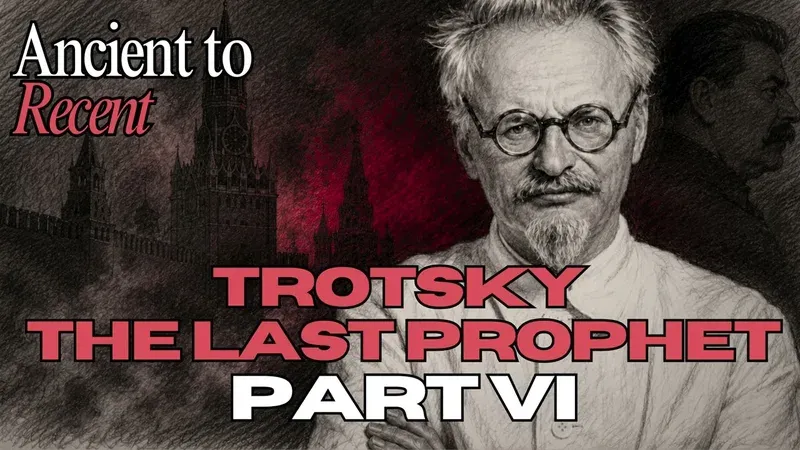 Watch on YouTube →
0:0057:14
Also on
Rate the show
Ratings are how new listeners find the show. It takes a minute and it makes a real difference.
The first attempt has failed.
Trotsky has survived the machine-gun assault on his home. But Stalin's campaign to destroy his old rival is entering its final stage.
In this final episode, we follow Ramón Mercader as he moves deeper into Trotsky's inner circle, slowly gaining the trust of those closest to him.
As Trotsky's world contracts behind fortified walls, he begins to reflect on the revolution he helped create, and the extraordinary path that brought him to Mexico.
Meanwhile, in Moscow, a new plan is taking shape.
This time, there will be no army.
No machine guns.
No dramatic assault.
Just one man, one carefully constructed identity, and one final opportunity to silence the last prophet.
🎧 New episodes every Saturday
📲 YouTube, Spotify & Apple Podcasts | @AncientToRecent
#Trotsky #RussianRevolution #HistoryPodcast #SovietHistory #Stalin #NKVD #RamonMercader #Trotskyism #Communism #SovietUnion #MexicanHistory #HistoryDocumentary
Read transcript
This transcript is automatically generated, so it may contain typos and misheard names.
Natalia, I love you, Leon Trotsky. As the alarm blared in, the muzzles flashed the hit team in their collage of Mexican uniforms, some army, some police, some real, some forgeries fled the scene. The air was thick with the smell of gunpowder and the sense of nervous excitement mixed with sheer and all panic. 5 minutes of tequila fueled anarchy had reigned as the 20 men unloaded their Thompson machine guns in the direction of the apartment where Trotsky slept before losing their nerve and disappearing into the night like wild Buffalo.
Spooked by the sight of a predator, they stampeded for the gate they had only moments before burst through with the assistance of an agent placed at the heart of Trotsky's bodyguard. Some fled on foot, making for the backstreets of Mexico City to swap tall tales over glasses of beer or thick Mexican coffee, surely to ascribe every scar to battle wounds earned in the service of the revolution. Others bungled into Trotsky's waiting cars, keys in the ignition ready at a moment's notice to facilitate Trotsky's getaway now utilized by his attackers.
They had riddled Trotsky's house with bullets, peppered his bedroom and library, and turned the old man's bed into Swiss cheese. He must surely have been carved into pieces in the hail of bullets. They had, of course, done their duty for the international proletariat. An inscripted message sent to Moscow via New York carried the news operation carried out results unknown. In Moscow, Buria and Pseudoplatov held their breath. In Stalin's Soviet Union, failure was not tolerated. But amidst the chaos of the boozefield bedlam, Trotsky had survived.
When word finally reached Moscow days later, a new plan took shape. Gone was the mass enthusiasm of a crowd of machine gun wielding peasants. Now the NKVD would turn to one man. Someone who could get close to Trotsky. Someone who could pass unnoticed. Someone to silence the last prophet. Welcome to ancient, to recent. My name is Joseph Parkinson. Today we conclude the story of Leon Trotsky, the last prophet to support the show. Subscribe today and leave a comment or rating. Episodes of Ancient Recent are out every Saturday and are available on YouTube, Spotify and Apple Podcasts. In the nervous hours of the morning after the night before, nobody knew if the hit had been successful or not. Crackling through the radio, the news announced Trotsky attacked Shia Bedlam.
Assailants unknown, Trotsky unhurt. The raid had been led by Alfaro Sicarios, muralist and rival to Diego Riviero. Sicarios had fled the scene with little idea of what to do next. He was eventually discovered sleeping on a grass embankment on a country Rd. The communist press in Mexico, ever loyal to Stalin, began an immediate smear campaign against Trotsky. The whole thing had been a setup. Trotsky had staged the supposed assassination, A pathetic attempt to win sympathy for the great traitor to the revolution, the headline shrieked. Pablo Neruda, Chilean ambassador to Mexico, an internationally famous poet, convinced that Sicarios should not face serious punishment for such a minor offence as attempted murder, petitioned the Mexican government for his release. Within months, Sicarios was released from prison and started a new life in Santiago, Chile, as if nothing had happened. Amidst the confusion, there was one question that loomed over everything.
Nobody had been seriously injured in the attack, but Robert Sheldon Hart, the young American enthusiast in Trotsky's entourage, had suddenly disappeared. What had happened to Bob? The question was answered. A month later. Robert was found in a shack in the desert, a single bullet in the head, his body partially decomposed. Hart had been an NKVD agent recruited in New York with the code name Cupid, but it appears he did not seem to understand the intention of the NKVD operation he was involved in. After opening the gate, he was shocked to discover he was party to an assassination attempt and appears to have protested. The NKVD team had then bungled him into the car and made the snap decision to terminate Sheldon. The poor, naive man ended his days alone in the desert, far away from home.
Sheldon's fate was, however, not known to Trotsky, though some in Trotsky's entourage had long harboured doubts about Bob, who did little to hide his attempt to gain information about Trotsky's routine. Trotsky had been almost as naive as Sheldon himself. Trotsky believed in his own power of persuasion, even dismissing credible reports that those close to him were NKBD agents on the basis that if they were, then surely proximity to him would win them over.
Trotsky's own personal brand of naivete mixed with his astounding vanity made for a deadly and delusional cocktail. Trotsky, for all his undeniable brilliance, had an inability to face hard truths, preferring instead to live in the world he wanted to inhabit. Admitting that Sheldon was an NKVD agent would mean admitting that Trotsky had been taken in by a young man, and not a very subtle one at that. Better to believe something more convenient that young Sheldon had given his life for Trotsky in a desperate but hopeless and romantic struggle, so great was his commitment, so profound, his faith so won over. Was Bob by Trotsky's evident genius. Yes, that was more comfortable, more comforting to believe. But perhaps there was another reason for Trotsky's self deception.
How many of his friends, even his own brother, had betrayed him? How many had taken the stand to outline their supposed role in Trotsky's crimes? Perhaps Trotsky simply could not take any more betrayal. The experience of seeing his close allies and comrades turn on him had the perverse effect of making Trotsky not paranoid but credulous. Trotsky was unhurt by the attack, but he also seemed energized. After years of exile and two decades removed from the events where he had made his name, Trotsky had so recently seemed like a figure from a bygone age. The once flood of well wishers, acolytes and enthusiasts who'd made the pilgrimage to Koyawa Khan or stuffed his mailbox had slowed down to a trickle.
Now he was the centre of attention once again. Again came the journalists, dignitaries, police officers and romantic enthusiasts looking for a quote, a comment or a moment of prescience delivered from one of history's true great men of action. But not all who made their way to the house were well wishers. Frank Jackson or Jacques Mornard or Ramon Mercader, boyfriend of Miss Sylvia Ageloff, now became a regular visitor. He came to express sympathy and to offer his services. In their haste to escape, some of the assailants had stolen Trotsky's car.
Trotsky was now reliant on others to facilitate the movement of his entourage, and Frank or Jack had come to offer the use of his own automobile. Having sworn to Sylvia that he would not visit the house amidst her growing suspicions, he now had the perfect alibi. Frank had visited the house before and become a familiar face to the inhabitants on his trips to drop Sylvia off for work. Now his visits were solo and he began to get closer to Trotsky, chatting about the correct way to feed the old man's rabbits.
But Frank made a point not to linger, to be as helpful as he could without overstaying his welcome and drawing suspicion. He presented himself as just a cheerful face, a friendly acquaintance eager to do a good turn for a friend. Frank heard that some of Trotsky's entourage were looking to take a trip to the port of Veracruz, some 240 miles east on the Atlantic Coast. Frank said that he would be happy to take them, as he visited Veracruz every few weeks on behalf of his employer. He already intended to travel in just a few days, and the trip would be no inconvenience at all. Natalia, Trotsky's wife, came along and the two spent several hours chatting amiably.
She found him likeable, easy to converse with, even charming. But also there was something else, something odd about Frank. He claimed to frequently visit Veracruz, but at one point stopped to ask a local directions to the port, a small incident, but odd for someone who insisted they made the trip regulate. She put it out of her mind. It was nothing after all, we can all get lost. And he was a kind face, helpful and charming.
And at times like these, kindness was in short supply. Ramon or Jack returned to New York, quickly reconnecting with Sylvia, the two taking up residence in a hotel during the day she worked, whilst he claimed to be running errands on behalf of his employer in the evening. They continued to display every impression of the perfect romance. Sylvia's suspicions of Jack had grown, but she continued to silence her doubts. Now, yet again, strange occurrences raised uncomfortable questions over his story. He received unexplained packages, some stuffed with money.
Who was the money from? What was it for? But again she silenced her doubts and Jack returned to Mexico via a circuitous route. On the 30th of June he set off from New York, travelling first in New Orleans and then on to San Antonio. He crossed back into Mexico via one of the international bridges that linked the two countries on foot, knowing that carrying a Canadian passport, it would be unlikely that the border guards would make an official note of his entry into the country. Frank Jackson, having left Mexico via plane and his passports stamped on exit, according to official records, had never returned.
He arrived back in Mexico City on the 5th or 6th of July and rented a hotel room. Sylvia, meanwhile, had become anxious. He had not contacted her in weeks. He had made his trip and dropped completely off the map without so much as a letter or call. Finally, Jack made contact, telling Sylvia that he had been taken sick and urged her to join him as soon as possible. Sylvia dropped everything and the next day boarded a flight before arriving in Mexico City on the 9th of August.
It took several days for the first confused messages to get back to Moscow. An encrypted transmission from Mexico to Moscow via New York had simply read OPERATION carried out results known later for hours. Barrier and Pseudoplatov must have waited nervously for the final answer. Their wait was made more anxious by the NKVD in Mexico City, who sent the second message, complete with news of the failure of the operation via a different channel. Perhaps hoping to savor a last few days on this side of the grave, the NKVD NVD operatives sent news of their failure via a Soviet ship to New York before the message was passed on to Paris, where NKVD agents, not realizing its significance so they claimed, delayed in passing the message on. Stalin found out about the failure of the assassination attempt like everyone else from the news, with reports of Trotsky's survival soon broadcast around the world. On the 26th of May, the dreaded call came. Pseudoplata was summoned to Beria's Thatcher to explain how the operation had failed.
He must have kissed his wife goodbye and hugged his children before steadying himself for what he feared would be a final voyage. Beria berated Pseudoplata for the amateur nature of the operation, but Pseudoplatov avoided arrest for now. 2 Further days passed before official word finally arrived from Paris detailing the failure of the operation. Now Harm Eitingen, the chief NKVD agent on the ground in Mexico, took full responsibility for the failure of the operation, but also promised that if given more time and a few $1000, he would atone for his error. It was Eitingen who suggested a different approach. A single agent, someone who could get close to Trotsky, someone he trusted.
Such a change of strategy came with a huge risk. NKVD agents had assassinated targets before, but rarely was this task left to the same agents entrusted with infiltrating enemy circles. NKVD agents charged with gathering intelligence figures such as Mark Zabarowski facilitated the demise of the enemies of Stalin, but they rarely wielded the gun or blade themselves. This change of strategy came with great risk. If Ramon was captured that he could possibly expose other NKVD agents. Years of meticulous planning and careful cultivation of assets, some now buried deep in the governments of the US and Mexico, could be exposed.
The Soviet Union had spent two decades carefully building networks of influence in the US, recruiting, influencing, feeding information back to Moscow. Everything from production to military preparedness to public opinion were carefully transcribed and sent to the Kremlin. But now, something new, something different. Whispers reached Soviet agents of something being developed by the United States, the likes of which had never been seen before. A new weapon, one that could unleash the power of the atom itself.
A weapon so powerful, so destructive, that if harnessed, it could level cities and wipe nations off the face of the earth. At the heart of this program, Soviet agents passed information to Moscow. It was not just updates on American wonder weapons these agents passed on, but technical details too. Information acquired by these agents allowed the Soviets to kick start their own atomic project and shorten the time to the development of a bomb to years rather than decades.
To allow the camp of imperialism exclusive access to atomic weapons would leave the working class defenseless. Even the assassination of such a deadly foe as Trotsky could not justify such a risk. The decision play with Stalin barrier brought Pseudoplatov to outline Eitigen's plan. Pseudoplatov assured Stalin that the NKBD was suitably compartmentalized and that no such breach would compromise the efforts of Soviet agents working on the US atomic project.
Stalin brooded, sucked on his pipe and gave the mission the green light. With the go ahead from Stalin, Itingen began to plan the operation in earnest. He started with a brainstorming session. Ideas were thrown out. Each were stress tested before being dismissed. The plan has several major pressure points, how to carry out the operation with a maximum chance of success whilst also facilitating the agent's escape and avoiding any blame being directed at the Soviet Union.
For the operation to be successful, an agent of exceptional skill would be required. One quick witted, physically imposing, with a sharp mind and an ability to function under pressure. One who could get close to Trotsky, close enough to slip something into his food or find the gap between his shoulder blades. Ramon had not been trained as an expert assassin. His skill was manipulation, winning confidence and gathering information.
But he was no stranger to violence. He had seen action in the Spanish Civil War. He had taken life in the name of the revolution. His life had been dedicated to the dream of a better tomorrow, a dream only communism promised to make a reality. He owed everything he was, everything he hoped to be to the Soviet fatherland. It was, after all, Stalin and Stalin alone, who had stepped forward to offer material help to the Spanish workers as they battled the forces of reaction.
Ramon yearned to play his role in the defence of the working class and the victory of a just pure new world over the sins of the past. He was, as he had always been, prepared to do what it took to make that world a reality. It was through this deed, he told himself, that the countless generations born into the blissful socialist future, generations never to know hunger or poverty, fear, war or racism, would enter paradise. They would thank those who have been willing to pay the price, to make the sacrifice, to make a better world possible. Ramon volunteered iting and settled on the use of a knife. A gun was too loud and would attract attention, poison too complicated and might fail.
But a knife was small enough to slip past the guards and could be wielded in a controlled manner with a minimum of noise. In skilled hands, a knife could be used to kill Trotsky and the assailant be out of the compound. Before the alarm was raised, a suggestion was made that a second attempt could be made to storm the compound. This could create a distraction, allowing Ramon to strike in the confusion. But this idea was dismissed.
In the event of an assault, the guards would surely not react in a shoddy way they had previously and would rush to protect Trotsky. The operation had to be subtle, quiet, over in a second before Ramon disappeared in the night. The operation was planned in minute detail. A car would be stationed around the block. Ramon would first enter his own vehicle before quickly changing to the new 1A plane would be waiting at the airport to carry him to a safe country. Fresh papers were prepared, provided by Communist agents working inside the Mexican government. If all went well.
Frank Jackson would simply disappear without a trace. History would have no idea who the mysterious man who took Trotsky's life was. He would just vanish. To many in Trotsky's entourage, the bungled assassination attempt had been a final straw. They pleaded with Trotsky to go on the run to Europe, or perhaps to Latin America. Efforts could be made. Fake passports forged, safe houses established, networks of support constructed that could hide the old man, help him avoid the Assassin's dagger.
To live, to lead the revolution to victory, he was needed by history, by the working class, by the revolution itself. But Trotsky refused. He'd been on the run for over a decade. He'd experienced exile in Paris, Norway and Constantinople, constantly suffering from one hotel to the next, life always in a state of endless turmoil. For a man of 60, this was no way to live. And it was, above all, pointless. Soon enough, his circle would be penetrated by the NKVD.
Soon enough his movements reported back to Moscow. And soon enough, they would come for him. He refused. Instead, financed by donations from American supporters and the sale of some of his archives and military engineer was brought in to fortify the compound. The walls ascended to 6 meters high. New bodyguards were brought in. Towers complete with flashlights, alarms and bulletproof walls rose above the compound. The police presence was increased. Petrotsky was fatalistic in the end. What was the point?
Arranged against him was a system vastly more ruthless and determined than that of the czars. The NKVD could call upon legions of agents, billions of dollars and weapons of destruction so deadly no walls, sandbags or guard towers could ever stand against them. For the Soviet secret police, they could try, and try again. They had to be lucky only once. But Trotsky had to be lucky every day. And what sort of life awaited Trotsky in his fortified bunker, his refuge now turned to a prison? Once he had enjoyed excursions to the city and trips to the country.
Once he ranged freely, haunted and picked wild cacti. Now he could venture no further than that garden. He was now old, tired. He drifted, allowing his mind to wander. His biography of Stalin sat unfinished. He stared at the pages, hardly able to put pens to paper. More and more, his time was spent with the chickens and rabbits, his mind fixed in the past. Old comrades, old adventures, friends long dead, victories long forgotten.
He wondered to himself, with his high blood pressure and fickle health, would Stalin finally reach him? Or one day, would his heart simply stop? Either way, he knew he was running out of time. Sylvia's doubts of a Jack story were now matched by her alarm at his physical deterioration. She had noticed the shift in his demeanor in their first day in Mexico. Now after the assassination, she noticed a further lurch. Something seemed to come unmoored in her boyfriend.
He lost weight. The carefree Playboy was suddenly unattentive, distracted and short tempered. Once the talk of the town and center of attention, he now hung back in conversation, his mind wandering. He had reacted violently to the attempt on Trotsky's life. Strange for a man who was not that close to Trotsky and had apparently no interest in politics. But still he spent time in Trotsky's entourage. His visits became ever more frequent.
He seemed especially attentive to Natalia, who he drove not just to Veracruz for chaperoned around Mexico City on shopping trips. He bought her gifts, flowers and chocolates. Jack discovered a sudden interest in politics. Sylvia had tried many times to introduce Jack to the world of Marxism with no success. Suddenly he became engaged, even animated in his opinions. Jack suggested to Natalia that the couple paid the Trotsky's a visit. It was the first time both Jack and Sylvia would come to the house as former guests.
Natalia felt uneasy. Her concerns about this strange, suddenly helpful man who didn't know the way to cities he supposedly visited frequently, had endless time for social gatherings but also limitless cash whilst hardly ever doing any work, grew. But she silenced her doubts. On the 10th of August Sylvia and Jack, or Frank as he was known to the Trotsky's, called upon the residents of the compound. The visit started pleasantly enough with Jack and Sylvia chatting at ease about their future plans, but soon enough the conversation, as always turned to politics.
In 1940 there was a major disagreement hotly debated in Trotsky out circles. Trotsky argued that the Soviet Union was a degenerated worker state, a state that had gone off the rails but still 1 freed from capitalist exploitation. When the Soviet Union invaded the Baltic states of Latvia, Lithuania and Estonia as reward for its role in the carve up of Poland in 1939 with the blessing of Hitler, some within the anti Kremlin Marxist left argued that the Soviet Union had now joined the ranks of global imperialism and was not worth defending.
Trotsky, though he did not support the annexation of the Baltic states, still believes that however brutal Soviet occupation may be, the workers of the Baltic states had now been freed from capitalist exploitation. The bourgeoisie, land owners and priests were now being liquidated through the usual combination of deport and firing squads, and this could only be a good thing. Trotsky insisted that whatever the flaws of the Soviet Union, it was still a better society than countries like Britain, France or the United States, whose democratic systems were a sham, a mirage to legitimize the exploitation of the working class. Sylvia favoured what was called the minority position, which dissented from Trotsky's view.
As the conversation turned heated, Jack sided with Trotsky. He then stunned the room by offering to write an article to further explore the issue, which, to the further amazement of Sylvia and Natalia, Trotsky agreed to read. To others this may have seemed rather suspicious that Sylvia's Playboy boyfriend, uninterested in politics, was suddenly taking the time to write a paper on the finer points of the foreign platform of the 4th Internationale.
But to Trotsky, ever susceptible to his own manatee, this seemed like a natural progression. After all, Jack had spent time in Trotsky's company long enough to be inevitably won over to the self-evident brilliance of Trotsky's worldview. No conversion on the road to Damascus was too miraculous when exposed to the one true faith of Trotsky's ego. On the 17th of August, Jack visited the Trotsky's house to drop off his article and seek the old man's editorial advice.
He'd scraped his car. When he arrived, he seemed to be acting strangely. He told the guards, who he knew on first name terms, that he felt ill passing through the gates. Trotsky, who'd been working in the study, came out to see him. Jack told Trotsky he would be leaving Mexico for good, which Trotsky registered with surprise and slight disappointment, before Jack removed the article from his pocket and handed the pages to Trotsky.
Trotsky beckoned Jack into his studio and offered his editorial opinion. After skipping the pages, Jack seemed nervous, perched on the edge of the desk and eager to leave. Jack was behaving oddly. His eyes shifted. He took Trotsky's advice and promised to return in a few days with improved editions. Two days later, Jack woke early. He went to the carpenter's shop and brought with him his ice pick, asking if the handle could be shortened. The blade was 8 inches long, sharpened to a point on one end and with a thick hammer like blunt edge on the other, perfect for crushing rocks or other solid objects. Jack returned to the room he and Sylvia rented. The couple were barely speaking.
Natalia had spoken of marriage a few days before when taking tea with the Trotsky's. That seemed like a distant dream. As Jack Drift further and further from Sylvia, his mind was always fixed on some point in the future. He seemed burdened, distracted, nervous, smoking one cigarette after another. He slept little, ate less and all the while staring in silent contemplation. It was the night of the 19th of August 1940, after his trip to the Carpenter.
Earlier that day, he had met with his NKVD contacts. Final instructions were issued, he was informed the operation had been given the green light for the next day. Ramon was no stranger to violence, but what he was preparing to do was different from anything he'd experienced in the past. This was not street fighting in Barcelona or the fields of Spain. Then combat was impersonal, conducted at a distance, a figure dozens of meters away, a blur of blue and Gray moved.
His rifle rose to his shoulder and he pulled the trigger. The Mirage to the ground, silent. But this would be different. This was someone he knew, someone he had spent hours talking to, and this time there would be nothing impersonal about the experience. He would see the lights go out in the old man's eyes. He would live with every sensation, every sound and every smell. For the rest of his days he sat and stared, the tip of his cigarette glowing in the dim night. Next to him, inches away, sat Sylvia, wondering who this man was and where her Jack had gone.
On the morning of the 20th of August, 1940, Leon Trotsky rose to face the world. He'd slept soundly, a rare occasion for the old man. Perhaps the double dose of sleeping powder had done the trick. He had a cheery demeanor, a spring in his step. He fed the rabbits, admired the flowers of the garden, washed and sat down for breakfast. The post was brought in and he flipped through his correspondent from admirers and well wishers. He planned to write an article on military mobilization in the US and retired to his study to begin the day's labour. If Trotsky was well rested for Ramon, he had not slept at all. As night turned to morning, he got dressed and went for breakfast.
He informed Sylvia that he had errands to run. What he didn't tell her was meeting Eiting, and his NKBD contact was one of them. Eitigen handed over an envelope that contained a typed alibi Ramon signed in pencil before returning to the hotel. At noon, Sylvia and Jack went for lunch. They were due to visit the compound once more to say their final farewells before departing for New York the next day. At lunch, Jack seemed so agitated that he hardly touched his food.
They returned to their hotel room where he informed her again that he had to fulfil some errands and he would meet her at 4 before their visit to Trotsky. He took from their room his long ring coat with his knife sewn into the lining, along with a loaded gun in his pocket and an axe pick attached to a rope. He left the hotel at 2:30 PM. For several hours he seems to have wandered the city. What he did during those long hours, we do not know. Perhaps he steadied himself, the enormity of what he was about to do.
Perhaps he had doubts. But whatever happened, whatever passed through his mind, he set them aside and committed himself to his task. At 5:00 PM, he stopped at the edge of Mexico City to burn his Canadian passport and any other documents that might identify him before continuing on to his date with destiny. On a bright Tuesday evening at 5:20 PM, Ramon pulled up outside the compound. The day was mild, with few clouds in the sky, but it was the rainy season, a convenient excuse for Roman to carry his raincoat slung over his arm, perfect for disguising a weapon.
As he passed through security, greeting the guards, he asked if Sylvia had arrived. They informed him she had not, just checking, just making sure that she hadn't made an unannounced visit to the house, which would throw his plan into turmoil. He crossed the threshold. He was not searched, after all, he was a regular visitor, a family friend and close confident. Why search? Miss Sylvia's charming boyfriend Trotsky was feeding his rabbits. Jack approached him.
Trotsky was a little unnerved by his previous visit. Jack asked Trotsky if he had a few minutes to look over a revised version of the article. Reluctantly, Trotsky agreed. Natalia also greeted Jack and inquired as to his attire. Dressed as he was in full suit, complete with hat and the raincoat cast over his arm, Jack nervously answered that it may rain a strange answer on a clear day. Trotsky and Jack said they were waiting for Sylvia, and Trotsky informed Natalia that Jack and Sylvia would be leaving for good the next day. Natalia seemed surprised, and Trotsky suggested that Jack and Sylvia stay for dinner, or at least tea. They chatted with Jack again.
He seemed nervous, replying in short, clipped answers. Jack removed the revised article from his coat and handed the papers to Trotsky, who sighed, reluctant to spend time reading the amateurish prose of Jack. Nice guy, but no intellect. They walked together to the studio. Natalia watched as the doors closed behind them. Trotsky's studio was functional, neither Spartan nor ornate. It was filled with books, magazines.
A map of Mexico hung from the wall, and a loaded gun sat on the table. Piled high were works by Marks, Engels and Lenin, naturally, but also Freud and Nietzsche. The library carried volumes on everything from poetry and novel to ancient history and modern economics. Trotsky sat in his armchair with Ramon, positioning himself to the old man's left, the spot chosen exactly as it would place him between Trotsky and the newly installed alarm.
As Trotsky leaned forward, he began to read, scanning the first page, then turning to the next. In that second, Trotsky's full attention fixed on the pages in front of him, Ramon Mercader's heartbeat slowly, his eyes fixed on the crown of Trotsky's head, his hand reaching under his raincoat to grab the ice pick and gripping it tightly with all his might. As adrenaline flooded his veins, he swung the ice pick. For the working class, for the world revolution, for every starving child in broken labourer, for the dream of a socialist tomorrow, for Lenin, Marx and Engels, for the Soviet Union, for Stalin.
In one mighty blow he brought the blunt edge of the ice pick down on the back of Trotsky's head. Blood spurted in the air. Trotsky's body seemed to shudder under the impact, the vibration shaking through Ramon's body. But just as Ramon made contact in that split second, Trotsky shook his head. The stationary target, perfect for an exact strike, shifted, and the impact became a glancing blow. Ramon's own poor prose seemed to have summoned something in Trotsky that caused him to move at the exact moment Trotsky, instead of crumpling to the floor, let out a guttural streak along ah, as the old man, stunned for a second, hurled himself at Ramon.
Ramon, tall, athletic, was taken by surprise at the ferocity with which the 60 year old man fought, sinking his teeth deep into Ramon's hand, hurling books and ashtrays, anything he could find to fight his assailant. The plan had not survived first contact with the enemy. Trotsky was neither dead nor could Ramon escape without being confronted. Ramon fled from the room, desperately looking for an exit, but in confusion took a wrong turn.
Natalia heard her husband's sudden cry and rushed into the room. She found him stood by the doorway, propping himself up, one arm limp, blood streaming across his face. Jackson. He gasped. Soon Natalia was joined in the room by Trotsky's guards, who found Trotsky now on the floor, cradled by Natalia, trying desperately to put pressure on the wound, mumbling softly. Trotsky said. Jackson shot me with a revolver. I'm seriously wounded.
I fear this is the end. Trotsky turned to his wife. Natalia, I love you. His voice grew faint, but he was still breathing, still alive. The police guard had called an ambulance. Trotsky tried to speak. Natalia tried to ask Trotsky what had happened. Ramon was still loose in the house. What should they do with him? Again he spoke. Impermissible to kill, must be forced to talk. From an adjoining room the tally could hear the sound of struggle. Ramon had been cornered in the dining room. 1 of Trotsky's guards had tackled him.
Soon joined by others. They set about beating the would be assailant, aiming kicks and punches into his rib cage, stomach and face. Ramon was soon a bloody mess, his eyes swelling up, lips split, teeth shattered and mouth filling with the blood. He howled in pain as the guards peppered him with questions and fists. He garbled his alibi. Trotsky had tried to stop Sylvia and I from marrying. He wanted to kill Stalin. The alibi was an incoherent jumble and the guards believed not a word. You are an agent of the Gru, the NKBD. Who do you work for?
Answer, answer, they demanded. Rahman stuck to his story and denied ever more frantically that he was a Soviet agent. As the blows rained down, as fist met face and boot met stomach, Rahman claimed he was disillusioned with Trotskyism and Trotsky had tried to recruit him to assassinate Stalin, but he acted out of nothing but personal resentment. As Trotsky lay cradle by Natalia, the guards tried to assure him his wound was only light, but in a faint voice he pointed to his heart and said no, I feel here.
This time they have succeeded. Take care of Natalia. She has been with me many, many years. With these words, he turned to Natalia, looking deeply into the face the woman he had loved so passionately these past 30 years. Perhaps he thought back to the day they met in Paris in 19 O2. He looked at her as if trying to take in every curve, every dimple, every inch of her lips, the white of her teeth, the point of her nose, the blue of her eyes, as if trying to travel through the pages of their memories to their most perfect moment together and will live their happiest seconds one last time to drink in the face of his one true great love. His eyes filled with tears.
His hand gripped hers. She kissed him as he slipped from consciousness. Sylvia was waiting for Jack. He had told her he would be back at 4, but 4:00 PM came and 4:00 PM went, and no sign of Jack. She called the hotel, but he was not there. She was with a group of friends, all associates of Trotsky, and she suggested they visit an address he had given her for a work colleague. But when the taxi pulled onto the street with the address, the building Jack claimed his friend worked at didn't exist.
Again she called the hotel and again they insisted he was not present. She then called the bank that Jack told her friend worked at, only to be informed that no such person was employed there. A friend told Sylvia to call Trotsky's house to see if Jack was present, but she dismissed the idea. After all, they were both set to go that day. He wouldn't go without her. One of the friends, popping into a shop to buy cigarettes and seeing a phone, asked if he could make a call.
Dialling the number of the house, he was informed that Jack had indeed visited, but he'd attacked Trotsky. The party rushed to the house, with Sylvia weeping hysterically, unable to make sense of what had happened. When they arrived, she was told that Jack had attempted to murder the old man, who was in a critical condition. Trotsky was put in an ambulance and taken to a nearby hospital. As the doctors tried to attend to him, Trotsky turned to one of his guards and asked for him to take a dictation in English.
I am close to death from the blow of a political assassin struck me down in my room. I struggled with him. We entered. Talk about French statistics. He struck me. Please say to my friends, I am sure of the victory of the Fourth International. Go forward. He tried to continue to speak, but his words trailed off. The doctors, working frantically to save his life, removed his clothing. Turning to Natalia, he said. I don't want them to undress me, I want it to be you. She leaned down and pressed her lips to his. He kissed her back once, twice, a third time, and with her lips on his, he slipped from consciousness once more. Natalia stayed by his side all night. His breathing remained calm, but by noon the next day he was gasping for air, slipping from this world into the next. At 7:25 PM on the 21st of August 1940, Leon Trotsky died. Caridad and Eitigen had sat nervously in the escape car outside the compound.
As the minutes passed and the unmistakable sound of commotion came from inside, they realized something had gone terribly wrong. Realizing Ramon would not be joining them, they drove off to make their escape from the country. Within days both had slipped abroad on their journey back to the Soviet Union. Ramon, badly beaten, was taken to the same hospital as Trotsky. He denied any connection to the NKVD and insisted that he had acted out of personal business towards Trotsky with no connection to the Soviet Union. When Sylvia was brought to the hospital, she was crying, utterly shattered.
In a daze of incomprehension, she came under suspicion. Had she been part of the plot all along? But it soon became evidence that she was simply a robe who had come under Jack's way. She demanded an explanation from Jack. Jack repeated his alibi to her, and she became overcome with emotion, spitting, swearing and trying to attack her former lover. He turned passively away from her, coldly asking the police to have this woman removed. Ramon was interrogated intensely. He was subject to hundreds of hours of psychological cross examination to try and understand his motives and identity.
But he clung to his story doggedly refusing to admit any involvement with the NKBD. In 1941, he was sentenced to 20 years in prison. With Trotsky dead, the NKVD closed the file on the Fourth International, considering the ragtag bunch of Marxists, too caught up in their petty squabbles, too absurd for even the NKVD to consider a threat to state security. Stalin was told of the success of the operation and the elimination of his old rival.
Stalin, who had yearned, plotted and dreamed of Trotsky's death, who once boasted that revenge was the sweetest of life's pleasure, showed no emotion at all. I suppose after the 1st 10 million the joy must somewhat come out of killing. The Soviet state's only recorded reaction was an obituary Improvda issued on the 24th of August 1940. The obituary was titled The Death of an International Spy, proud to describe Trotsky as a man whose name is spoken with contempt and disgust by working people all over the world and claimed Trotsky fell victim to his own web of intrigue. Sylvia was soon released and moved back to the United States where she returned to New York, took her mother's maiden name and committed herself to the running of a kindergarten. She did everything she could to put both Jacques Mornard and Leon Trotsky behind her.
She lived as a private citizen, refusing all requests for interviews, and died at the age of 86 in 1995. Mark Zabarowski ended his involvement with the 4th International and emigrated to the US in 1941 after Germany invaded France. He continued briefly to work for the Soviets, but in 1945 was considered to have outlived his use. He embarked on a career in academia, working at both Harvard and Cornell before being granted US citizenship in 1947. Later in life he confessed to several people close to him to being an NKBD agent for 20 years. He died in 1990 at the age of 82, mere months before the dissolution of the Soviet Union.
Now Harm Eitigen rose to the ranks of the NKVD, being deeply involved in Soviet partisan warfare during the Second World War and pacification of the reconquered Baltic States and Ukraine. After the war, Eitigen as Jewish was swept up in the anti-Semitic Doctors plot where prominent Jews were purged from Soviet government positions and arrested. With the death of Stalin in 1953, Eitigen was released, only to be rearrested as a close confidant of barrier. He was given a 12 year prison sentence and stripped of all rank and medals.
With Khrushchev's fall in 1964, Eitigen was released from prison and allowed to work as an interpreter. He died in 1981 at the age of 81. Caridad received the Order of Lenin and Hero of the Soviet Union on her son's behalf. She was given an apartment in Moscow and remained an active NKVD agent, spying on her fellow foreign communists in the Soviet capital. But she disliked her life in she found life in the workers paradise she had done so much to bring about.
Overwhelmingly depressing. Sometimes her bitterness overcame her and she was prone to angry rants. Expressing deep disillusionment with communism. She was haunted by the damage done to her family, especially her son Ramon, sentenced to two decades in prison and her impoverished and restricted life in the USSR. She petitioned to be allowed to leave and was granted permission to move to Cuba on the condition that she not attempt to return to Mexico immediately after leaving the Soviet Union.
She disregarded any instruction, travelled to Mexico and tried to arrange a prison break for her son that only served to ensure he stayed behind bars. She never quite lost her Stalinist faith and died in 1975 at the age of 83. Pavel Pseudoplatev had narrowly avoided the bullet so many of his NKBD comrades received during Stalin's purges. After Stalin's death, Barrier, who like Eitigen Pseudoplatev was closely allied with, was seen as the natural successor, only to be removed from power, arrested and executed by Barriers Politburo rivals led by Khrushchev.
Pseudoplatev, closely associated with Barrier, was arrested and faced death for the second time. This time he feigned madness and was sentenced to 15 years in prison. After his release in 1968, he worked as a translator and wrote a number of books on his experience in the Second World War. In 1994 he published an autobiographical book called Special Tasks, detailing Soviet espionage and penetration of Western institutions during his years of service, which was a major commercial success, becoming a New York Times bestselling author.
Though in subsequent years the book has come in for considerable scrutiny and there are assertions that some of the claims may be fabrications. Pseudoplatev born in 1907 and enlisted to fight for the Red Cause in 1919 at the age of 12, who had given his life to the Soviet. The cause lived to see the Soviet Union's disintegration in 1991 before passing away at the age of 89 in 1996. Natalia stayed in the house for several more years.
She had little money and never recovered from the murder of her husband. She travelled to France and visited Paris to relive the happier days from decades before with the man she loved so much. To ease her financial plight, the Mexican government bought the house that she had shared with Trotsky and turned it into a museum. Eventually she left the house and we settled in Paris. She died at the age of 79 in 196222 years after the murder of her husband. Her ashes were buried next to Trotsky in Mexico. Ramon Mercader served his full 2 decade prison sentence in Mexico.
He refused to deviate from his story, never revealing his real identity or acknowledging the role of the NKBD in Trotsky's murder. Even when offered $50,000 by Life magazine to the rights of his biography on the condition he revealed his true identity, he still refused, tearing the check up and throwing it away. He may have professed to be a private citizen, acting on his own accord, but it seemed that he still had friends. The NKVD did not forget his service and Ramon was granted special privileges.
The most expensive lawyer in Mexico was hired to defend him in prison. He lived like a mafia wise guy with good quality food and drink, fine suits, fresh bed sheets, cigars and his servant hired to clean his room. He was given a large bright single room with all the reading material he could want to while away his sentence. It certainly helped to have friends in high places. On the 6th of May 1960, Ramon, or Frank Jackson as he served his sentence, was finally released.
He travelled to Moscow, where he was given the rank of a retired KGB general, a pension and Soviet citizenship. He divided his time between Cuba and Czechoslovakia, living quietly with his wife and children. He seemed on the surface, to be fine, but he slept badly, often had nightmares, read books obsessively about the man he killed, and confided in close friends that still, after all these years, he heard the scream.
The long gutter role. Ah, the sound followed him to his grave. He privately expressed a close confidence, doubts about communism. They tricked us, the Communists, with their Babble about a better tomorrow. They fooled all of us. In 1978, at the age of 65, he died of lung cancer and was buried in Moscow. Left Ivanovich Bronstein. Known to the ages as Trotsky, he's one of history's most romantic, controversial and mesmerizing figures.
During his life he was a journalist, activist, agitator, revolutionary general, prisoner, exile, dissident and dictator. He was in so many ways, a remarkable man. To travel from a small farm in Ukraine to the heart of a global revolution, to take history by the scruff of the neck and bending its course to his own will, is an achievement beyond that of mere mortals. He was the indispensable man of the revolution. Without Leon Trotsky, the great organiser, the Bolsheviks would not have been able to seize power in 1917. Without Trotsky, they would almost certainly have lost the Russian Civil War.
It was his boundless energy, exacting standards and relentless determination, coupled to his utter ruthlessness that saved the Red Army and drove it on to victory. But as brilliant as he was as a speaker, a writer, a general and administrator, he was also a deeply flawed man. In the 1960s, Trotsky was rehabilitated somewhat in the eyes of those who wanted to believe in Marxism but could not accept the repression of the Soviet Union.
Trotsky was reimagined as the true heir of Lenin, the man who would have made the Soviet Union the society that so many Western Marxists so wanted it to be, but felt they had been cheated by Stalin. Under Trotsky's leadership, they told themselves, there would have been no famines, no show trials, no gulags and no NKVD. Sadly, this is a comforting myth. First of all, Trotsky never really had a chance of defeating Stalin.
There was no Titanic struggle between the two. Stalin didn't so much as best Trotsky. Rather, he simply dismissed him, with Trotsky barely putting up a fight. But Trotsky also was not the man so many Western admirers imagined him to be. Trotsky represented a less repressive version of communism. It is seriously doubtful that Trotsky would have relentlessly purged the Communist Party, NKVD or Red Army in the way Stalin did. There would have been less paranoia, certainly less anti-Semitism, and Trotsky would not have collaborated with Hitler in the way Stalin did.
But he was not by any imagination a believer in a pluralistic society. He absolutely believed in a one party state. He absolutely believed that those who opposed the Communist Party had no rights that he needed concern himself with respecting. Trotsky was utterly convinced that he was right, that his Marxist faith was undeniable, that the promised land of socialist plenty was just over the hill. He had no time for those who lacked faith, and certainly did not believe that they had any right to argue for a different vision of society other than the one on offer from Marx, Engels and Lenin. Would Trotsky have been as brutal as Stalin? Absolutely not, but brutality was part of the vision of a society that Trotsky believed in. Many of the worst crimes the Soviet Union committed were whilst he was not only in power but was more influential than Stalin.
Trotsky absolutely supported the abolition of free elections, the banning of opposition political parties, the censoring of opposition newspapers, the dismantling of free trade unions, and the crushing of personal liberty. Trotsky was at the height of his power when the Russian legal system was torn apart, to be replaced by the arbitrary violence of the Bolsheviks. When the Bolsheviks began their reign of terror, not simply arresting those who opposed them, but arresting those who even might oppose their rule and deporting them to concentration camps, Trotsky lent his support to these repressive measures. Trotsky sat in the same meetings with Felix Traczynski, the psychopathic leader of the Checker, as the Checker was arresting and shooting those even suspected of opposition in their thousands.
Did he object when the Chequer were hunting and murdering Ukrainian nationalists, anarchists, journalists, monarchists, priests, anyone who did not fit in with the Bolsheviks vision of a perfect society? Did he denounce the oppression? No, far from it. Not only did he approve, he went so far when the crescendo of criticism from European socialists was building at the height of the Terror to take the time to write a book about how dictatorship and mass violence were not unfortunate expedience but were actually essential and desirable tools of the revolution. He personally commanded the crushing of the Crunch Start sailors when they demanded the very freedoms they had been promised they were fighting for, and interestingly, in exile. What's really telling about Trotsky is not just what he wrote about, but what he didn't write about. Trotsky spent endless hours over his dictaphone picking apart the accusations made against him and against his supporters. He had limitless energy for the Dewey Committee to offer a defence of his own record in government and refute the charges made against him in Moscow. But what about the man made famines at that very moment, tearing through Ukraine and Kazakhstan and the Caucasus? What are the fields of dying and emaciated peasants? What are the towns and villages entirely depopulated by the cruelty of the Soviet state?
Trotsky had nothing to say about this. Why? Because he believed the peasants were a reactionary class lacking in class consciousness and that they had no right to oppose the revolution. If the peasants had to be smashed, then so be it. In the early 20s Lenin, with Trotsky by his side, had used man made famine as a tool to suppress Ukraine. Stalin simply took the playbook Trotsky and Lenin had used and applied it on a bigger scale. And here lies the great irony of Trotsky's life. Everything he does to others in the end is done to him at the height of power.
He mocked the very idea of liberal rules based systems and then found himself subject to arbitrary rule. He unleashed terror on others and then had terror turned on him. He is part of a government that constructs A gulag system of mass persecution and then sees his own friends and family descend into its depths. He dismissed the idea of an independent judiciary and watched as his friends are forced in show trials to betray him. He crushed dissent and then his descent was crushed. He justified the killing of the families of Cyrus officers and the children of the Romanovs, and then watched as one by one, his sons and brother and nephews were arrested and murdered. He was a brilliant might, a fantastic orator, A perceptive analyst of global politics, a devoted husband, emotionally unavailable father.
He was prickly, vain, arrogant, self obsessed, hypocritical, naive, brutal and tragic. And he shaped the world we live in today. Thank you for listening to Ancient to Recent. My name is Joseph Parkinson. To support the show, please leave a comment or rating. Episodes of Ancient to Recent are out every Saturday and are available on YouTube, Spotify and Apple Podcasts.