
#64
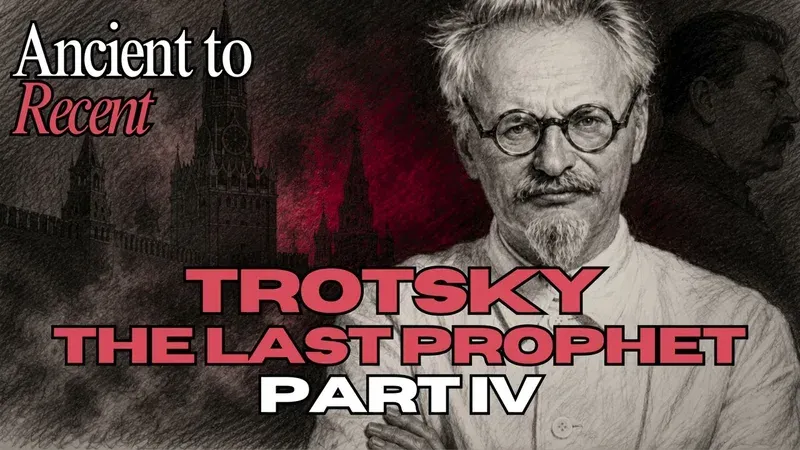
Leon Trotsky: The Last Prophet — Part 4
23 August 2026 · 49 min · Season 1
 Watch on YouTube →
0:0049:51
Also on
Rate the show
Ratings are how new listeners find the show. It takes a minute and it makes a real difference.
Trotsky has finally found refuge.
After eight years of exile, the former leader of the Red Army arrives in Mexico, welcomed by President Lázaro Cárdenas and embraced by a circle of artists, intellectuals and revolutionaries.
But safety is not the same as peace.
In this fourth episode, we follow Trotsky from his arrival in Mexico in 1937 as he attempts to build a new life far from Stalin and the Soviet Union.
We explore Mexico’s own revolutionary history, why Cárdenas was willing to grant asylum to Stalin’s most famous enemy, and Trotsky’s extraordinary relationship with Diego Rivera and Frida Kahlo.
As Trotsky begins writing, lecturing and rebuilding the international Left Opposition, the NKVD is already closing in.
We follow the infiltration of Trotsky’s organisation by Soviet agents, including Mark Zborowski, who gains the trust of Trotsky’s son Lev Sedov and provides Moscow with vital information about the movement.
Then comes tragedy.
Lev Sedov dies suddenly in Paris, in circumstances Trotsky immediately suspects are suspicious.
As Stalin’s campaign reaches deeper into Trotsky’s family and supporters, the former revolutionary begins to realise that nowhere is truly safe.
Finally, Trotsky leaves the Casa Azul and moves into a fortified compound in Coyoacán.
The walls are strengthened.
The windows are bricked up.
Guards are posted.
Weapons are stockpiled.
But the greatest danger may already be inside.
As Trotsky grows older and increasingly isolated, Stalin has not forgotten him.
The order has been given.
Now the hunt for Leon Trotsky enters its final chapter.
🎧 New episodes every Saturday
📲 YouTube, Spotify & Apple Podcasts | @AncientToRecent
#Trotsky #RussianRevolution #HistoryPodcast #SovietHistory #Stalin #Mexico #MexicanRevolution #FridaKahlo #DiegoRivera #NKVD #Trotskyism #HistoryDocumentary
Read transcript
This transcript is automatically generated, so it may contain typos and misheard names.
To Leon Trotsky, with all my love, I dedicate this painting. Frida Carlo N1937. In the distance, the coastline slowly emerged. For weeks, Leon Trotsky, once the commander of the Red Army, the architect of the October Revolution, the heir to Lenin's Red Crown, had peered out of the decks of the Norwegian tanker roof at the vastness of the Atlantic Ocean. His future was uncertain, his destination, alien Mexico, was about as different from Russia as could be imagined. How would he adjust?
What would he discover? Would he find a new home, a place he could write, work and direct the efforts of his beleaguered band of supporters? Would distance rejuvenate the old revolutionary? Or instead, would Mexico be just another prison, another stop on his long wandering, just like Turkey, France or Norway? Would he find New Hope and purpose or disappear here into the pages of history? Welcome to Ancient Recent, my name is Joseph Parkinson.
Today we continue the story of Leon Trotsky as he seeks to begin a new life in Mexico, away from the glare of Joseph Stalin and the relentless pursuit of the NKVD. To support the show, subscribe today and leave a comment or rating. Episodes of Ancient Recent are out every Saturday and are available on YouTube, Spotify and Apple Podcasts. The ship docked in Tampico in the Gulf of Mexico on the 9th of January 1937. Perhaps it was some disappointment to Trotsky that he had not arrived at Veracruz like Hernán Cortés, the Spanish conqueror, some 400 years before.
But then Trotsky had come as exile, not as enslaver, as Liberator, not as conqueror. But like Cortés, Trotsky was venturing into the unknown. And like Cortés, he knew there could be no going back. For eight years he had been in exile, constantly pursued, haunted by the feared Soviet secret police, the NKBD. Now, half a world away, perhaps he could find somewhere to settle down. To Trotsky and his wife, Natalia, fear was something they had grown accustomed to. Their life in Norway had started well, but they soon found their world growing ever smaller.
They've been confined to their home, their every movement watched not just by the Norwegian police tasked with guarding them, but also by the NKBD who sought their annihilation. They had left Norway under growing storm clouds. The government in Oslo had bowed to pressure, both from local fascists and also to the Kremlin, to remove Leon Trotsky. They had been given barely a few hours to gather what possessions and, crucially, documents they could and head to the waiting ship.
As the long days at sea rolled by, Trotsky had spent his time trying to familiarise himself with his new home, its revolutions, its history, its politics, trying to understand the strange country that had agreed to give refuge to a man whom almost every government in Europe had rejected. Natalia was less optimistic. She had watched governments turn against them before. She knew that every country meant new officials, new police, new restrictions and potentially new enemies. But then, as the roof approached Tampico, something happened that neither of them had seen in a very long time. People had come to meet them.
Supporters were waiting on the shore. Amongst them was a woman who could hardly have looked more different from the grey European officials who had overseen their final days in Norway. Freda Carla. She had come to welcome Trotsky on behalf of her husband, the great Mexican muralist Diego Rivera, who had played a crucial role in persuading President Lazaro Cardenas to grant Trotsky asylum. And for the first time in years, Trotsky saw something that resembled genuine enthusiasm.
Mexico had not merely agreed to tolerate him, it appeared to be welcoming him. Trotsky and Natalia were taken from the roof and after a brief stay in Tampico, travelled to Mexico City aboard the presidential train. And as the train carried them towards the capital, Trotsky was entering a world unlike anything he had experienced since his exile began. The cold of Norway was gone. The silence was gone. In their place came the heat, colour and noise of Mexico. When they finally arrived in Mexico City, they were taken to Coyoacán, to the home of Diego Rivera and Frida Carla, the Casa Azul.
For Trotsky, it must have seemed almost impossible. Only weeks earlier, he'd been confined to a Norwegian farmhouse, watched by guards and prevented from freely writing or communicating with the outside world. Now he'd been brought into the home of two of Mexico's most famous artists. He had a room, a desk, books, visitors and, most importantly, a country that had agreed to let him stay. Mexican government had granted him political asylum on humanitarian grounds, despite the enormous diplomatic pressure surrounding his arrival.
And Trotsky understood just how fortunate he was. His Soviet citizenship had been revoked years earlier. The Soviet government wanted him silenced. European governments had repeatedly refused to take him in. Norway had finally expelled him. Mexico was different, for the moment at least, and Mexico wanted him. After eight years of exile, Lee and Trotsky had finally found somewhere that looked like home. If Mexico and Russia may have seemed different on the outside, beneath the surface there were profound similarities.
Mexico itself had been through a revolution, and it's recent history was one that Trotsky would have found remarkably familiar. At the end of the 19th century, Mexico was ruled by Puffiero Diaz. Diaz brought stability after the tumultuous decades that followed Mexico's independence from Spain in 1821. Diaz encouraged foreign investment, expanding the railways and modernizing the Mexican economy. But there was a price. American and European capital poured into Mexico, and foreign companies acquired enormous interests in the country's mines, railways, oil, land and industry. Under Diaz, foreign enterprise came to dominate important parts of the Mexican economy.
Mexico was becoming richer, but much of that wealth was concentrated in the hands of a small elite. For millions of Mexicans, particularly peasants and indigenous communities, the new prosperity brought little improvement at all, and beneath the surface, resentment was growing. Then, in 1910, Mexico exploded. The Mexican Revolution began as a revolt against Diaz's dictatorship and developed into one of the great revolutionary conflicts of the 20th century. Presidents were overthrown.
Generals Fort generals, peasant armies marched across the country. Mexico was consumed by revolution, civil war and political violence. By the time the revolutionary struggle began to settle in the 1920s, Mexico had been transformed. The old dictatorship was gone, the country had a new constitution, and the Mexican state increasingly presented itself as the defender of workers, peasants and national sovereignty. But Mexico's revolution did not produce a Soviet style government.
It did not create a Marxist dictatorship. Instead, it produced something rather different, a nationalist revolutionary state that borrowed from socialism while retaining its own distinctive political traditions. And by the time Trotsky arrived, Mexico was being governed by one of the most radical presidents in its history, Lazaro Cardenas. Cardenas had redistributed enormous amounts of land to peasants, strengthened organized labour, and asserted greater control over Mexico's natural resources.
In 1938, he would go even further, nationalizing the country's foreign owned oil industry. Mexico under Cardenas was therefore fiercely protective of its sovereignty and deeply suspicious of foreign powers attempting to exert influence. And that mattered when Leon Trotsky came knocking because Stalin wanted Trotsky silenced. The European government had repeatedly refused his refuge, Norway had effectively forced him out, and now the Soviet government wanted other countries to understand that taking Trotsky in would come at a price.
Mexico could have said no. Instead, Cardenas said yes. The decision was not simply an act of personal sympathy. Mexico had a long tradition of granting political asylum, stretching back into the 19th century, and the Cardenas government explicitly presented Trotsky's admission as a humanitarian act and a defence of the rights of political asylum. But there was something else. Mexico was a revolutionary country. Not a communist country, not a Soviet satellite, but a country whose political culture had been shaped by revolution, civil war, land reform and resistance to foreign interference.
He was arriving in a country that had made revolution it's own. Mexico was almost as far from Norway culturally as it was geographically. The cold grey skies of Scandinavia were gone, and their place was heat. The smells were different, the food was different, the colours were different. Even the earth beneath their feet seemed alive. And then there were the tremors. Mexico City sat in a land where the ground itself could suddenly move beneath your feet.
For Trotsky and Natalia, almost everything about their new surroundings was alien. They were staying at the home of Diego Rivera and Frida Carla, the Casa Azul in Coyoacán. Here there was colour, space, people coming and going, and finally, something Trotsky had been denied for years. Time. Time to breathe, time to read, time to write, time to work without a Norwegian policeman standing over his shoulder, telling him what he could and could not say. And there were other luxuries too. Servings attended to the household he was now living rather better than many of the workers whose liberation he claimed to be fighting for.
But Trotsky had never been particularly troubled by these contradictions. After all, nothing is too good for the working class, and he embraced his new surroundings with enthusiasm. He discovered Mexican food, the spices, the unfamiliar flavours. He travelled into the countryside. He went hunting. He explored on what excursion he encountered something that must have seemed almost absurdly exotic to the old Russian revolutionary, a cactus. Trotsky picked one.
It was a small thing, almost meaningless. But after years spent being told where he could live, where he could travel and what he could write, perhaps there was something liberating about simply being able to walk into Mexico's countryside and pick a cactus. And then there was Mexico City. Chaotic, crowded, noisy. A world of people, traffic, markets, and movement. Perhaps amidst all the noise, Trotsky could see something strikingly familiar. The streets of his childhood, the bustle of Odessa, the world he had known before revolution and exile had consumed his life. For perhaps the first time in years, Leon Trotsky was beginning to live rather than merely survive. But freedom did not mean that he was safe. He still had to consult the authorities about his movements. He still knew that the Soviet government wanted him silenced. Mexico had no lack of Communists, devotees of the cult of Joseph Stalin.
To them, Trotsky was not a distinguished revolutionary in exile. He was a traitor, an enemy, the man who had to be defeated. So even as Trotsky began to enjoy his new freedom, even as he explored the countryside, tasted the food and settled into his new home, he knew that somewhere in Mexico, Mexico City, there were men who had not forgotten him. Trotsky was the guest of one of the most famous and eccentric figures of the 20th century, Diego Rivera. It is hard to imagine two men more different. If Trotsky was formal, disciplined and almost obsessively regimented, Rivera was the exact opposite. Bohemian, erratic, eccentric, and almost incapable of telling a story about himself without endless embellishment, Rivera was prone to exaggerating claims about his own life. He embellished his political adventures. He even claimed to a force in the very same Russian Revolution as Leon Trotsky.
He had not. One of Rivera's more outlandish claims was to have been the secret father of the German Field Marshall Irwin Rommel. Now considering Rivera was born in 1886 and Rommel in 1891, it would have made Rivera 5 at the time of Irwin Rommel's birth. I will leave it up to others to decide the veracity of that particular claim. But Rivera was genuinely committed to radical politics. He joined the Mexican Communist Party in 1922 and his politics became inseparable from his art. His enormous murals transformed walls into political manifestos. Workers, peasants, revolutionaries, Marx, Engels and Lenin, the Mexican Revolution and the struggle against capitalism and imperialism were all transformed into images on an enormous GAIL Rivera. Relationship with Soviet communism, however, was rather less straightforward.
He traveled to the Soviet Union in 1927, invited to participate in the celebrations marking the 10th anniversary of the October Revolution, and the experience left him disillusioned. Rivera was simply too independent, too eccentric, and too unwilling to submit to the discipline of the Red faith. Eventually, his relationship with the Mexican Communist Party became so dysfunctional that he was expelled. But in a typically outlandish twist, Rivera himself was one of the leading figures of the Mexican Communist Party when the time came to decide on his expulsion.
The man who sat in judgement was Diego Rivera himself. So Diego Rivera expelled himself from a political party that he was one of the leaders. To Rivera, Trotsky was an outlet. Rivera could continue his revolutionary politics without accepting the brainless strictures of the Stalinist cult. He could still denounce capitalism, still proclaim himself a revolutionary, still attack the bourgeois order. But he did not have to bow before Stalin.
Rivera also provided something more practical, money. He helped financially support Trotsky and his household during the early years of his Mexican exile. And Trotsky, for his part, at first enjoyed Rivera's company. He enjoyed the attention of such a global and famous figure. Perhaps he even enjoyed the contrast between his own personality and that of his Mexican host. Trotsky was disciplined. Rivera as chaotic. Trotsky dressed and behaved like a revolutionary statesman.
Rivera lived like a bohemian artist. And through Rivera, Trotsky was introduced into a world of artists, intellectuals and political radicals very different from the regimented experience he had known at the Kremlin. It was a world in which the old rules no longer applied, and that extended to something Trotsky had always been rather less disciplined about than politics. Women. The Kremlin years had been remarkably austere in many respects. The Bolsheviks talked a good game when it came to sexual liberation and women's rights, and did introduce a number of very meaningful reforms.
But in the private world of the Kremlin, the communist in a circle had attitudes towards extramarital affairs that were so much to the right of the Roman Catholic Church. This had been stifling for Trotsky, but now he was on the other side of the world and mixing in very different circles. Accounts from people around him describe a man who could be remarkably forward, or some could say inappropriate, in his behaviour towards women, sometimes making unsolicited advances or touching women in ways that have not been invited. The bohemian circle around Rivera offer Trotsky a social world in which his private appetites could be indulged more freely than would ever have been acceptable in the almost Victorian world of the Kremlin.
And so in Mexico, Trotsky found something he had been denied for almost a decade, room to breathe and the freedom to be something other than just an exile. For a man who'd spent years being watched, restricted and isolated, it must have felt intoxicating. But there was a darker side to this new freedom, because the closer Trotsky became to Rivera's circle, the more complicated his relationship with the people who had given him refuge would become.
Of all the charms that Mexico could offer, one of the most enchanting was the local Signor Eaters, and one particularly stood out for Leon Trotsky, Freda Carla herself. Carlo, born in 19 O 7, was 29 when she met Trotsky and was already an accomplished artist. She had a striking appearance, her long dark hair pulled back, eyebrows joined together, and upper lip adorned with a thin Ridge of black hair. She was well read, witty, had an infectious laugh and littered her conversation with swear words.
But she was also charismatic, charming and sexy. Trotsky and Freda had instant chemistry. Freda had married Rivera in 1929, and their relationship was, as with all things to do with Rivera, unconventional. They both enjoyed their nocturnal adventures away from the married home and interspersed passionate love with tempestuous arguments. But there was a sadness to Carlo too. For everything afforded by fame and wealth, she could not possess the one thing she craved the most, a child. In 1925 she'd been badly injured in a traffic accident. The accident had left her body frail and incapable of having children.
She had three miscarriages and numerous abortions necessary on medical grounds, so she was told by her doctors as carrying a child to term could prove fatal. She used her art to express her grief and deep sadness of loss for the children she yearned to have, but tragedy had denied her. Trotsky and Freda were drawn to each other. Their at first expressed itself through small gestures. Trotsky, then in his late 50s, slipped notes into books he lent her and slid letters under her door, which whispered of his affection. Soon flirtation turned to passion. Natalia, Trotsky's wife, was deeply hurt. She had given her life for Trotsky fled her home and seen her children hunting down and murdered, and all on account of him.
And yet her sacrifice was not enough for him. He paid her loyalty back with heartbreaking infidelity. The budding romance caused tension in Casa Azul. The tension was heightened by Trotsky's notorious prickliness. Trotsky was keen to highlight the flaws of others and point out when their behaviour fell short of that expected of those toiling for the emancipation of the international working class. But his standards suddenly slipped when it came to his own needs to scratch an itch or quench an insatiable thirst.
Those in Trotsky's entourage warned him that his dalliances with Frida could be used against him by Moscow. But there are few is impervious to reason. As an aging man engaged in a passionate affair with a much younger woman, Trotsky was smitten, taken by an almost schoolboyish obsession for Freda. Freda enjoyed her time with Trotsky, but this was not her first rodeo and she soon got bored of the coring attention of the ageing revolutionary. Trotsky, heartbroken, sent Freda long letters pleading with her not to leave him.
But it was no use. Freda had lost her interest. They remained cordial, even friendly, but there would be no more secret rendezvous, no more stolen kisses and no more bed shaking nights of passion. Once Trotsky had settled into his new surroundings, his mind returned to the cause of his life, the revolution. Mexico might have given him refuge, but it had not given him peace. Trotsky set himself to work. He began writing, producing books, articles and pamphlets attacking Stalin and attempting to preserve his own version of the revolutionary history he believed Stalin was systematically destroying.
But writing books took time, and exile had to be paid for. Trotsky supplemented his income wherever he could. He wrote articles for newspapers. He gave interviews. He lectured to visiting American students, and he sold his own memorabilia, including perhaps the most valuable possessions he had carried out of the Soviet Union, his correspondence from the years when he had stood at the very summit of Soviet power. There was something almost fitting about it. The former commander of the Red Army was now selling pieces of his own past to pay the bills.
And yet Trotsky remained suspicious of the journalists who are now helping to support him. He had spent his life denouncing the bourgeois press. Now he found himself sitting across the table from journalists in a country where newspapers could actually criticize the government without expecting a knock on the door from the secret police. It must have been an uncomfortable experience for a man who had himself played a role in destroying the independent Russian press as the Bolsheviks seized power. Petrotsky's principal concern was not impertinent journalists, but rather the revolution that had been stolen from him, and for that purpose he had his own weapon, the Bulletin of the Opposition.
The Bulletin was designed to keep alive what remained of the organized opposition to Trotsky and to cultivate Trotsky's ideas amongst those still trapped inside the Soviet Union. It was printed on extraordinary thin paper, deliberately designed to make it easier to conceal and smuggle across the Soviet border. The idea was simple. Get Trotsky words into Russia. Get them into the hands of workers and party members. Keep the flame of opposition alive. But there was a problem.
Trotsky was fighting an enemy whose methods he perhaps still underestimated. But the 1930's, the NKVD had created a system in which even the faintest suspicion of political opposition could be enough to condemn someone and every single person they knew to life in a gulag or a bullet in the back of the head. To be suspected of corresponding with Trotsky could mean arrest. To be accused of Trotskyism would mean the Gulag. So the bulletin remained a dangerous thing to possess. It's circulation was tiny, individual print runs rarely exceeded 1000 copies, and very few copies actually made their way into the Soviet Union.
Trotsky imagined his words reaching the underground, Opposition workers secretly reading his articles, old revolutionaries raising secret toasts in hushed voices to the true leader of the workers revolution. The reality was rather different. Much of the Bulletins readership inside the Soviet Union consisted of the very people Stalin had tasked with hunting Trotskyites and KBD Asians. But there was at least one reader who never missed an Issue 1 subscriber who followed every word Trotsky wrote, who knew every accusation, every insult, every denunciation, every attempt to dismantle the Stalinist version of history, Joseph Stalin himself.
And with every issue of the Bulletin that reached Moscow, Stalin's hatred grew ever deeper. Trotsky was also preparing for another battle, a battle that would take him directly into the heart of the accusations Stalin had been throwing at him. The Moscow trials had presented Trotsky as the mastermind of a vast conspiracy, a terrorist, a sabotage, A traitor, a man supposedly responsible for crimes from murder to industrial sabotage.
Trotsky knew that words alone would not be enough, so an investigation was organized to examine the charges. It became known as the Dewey Commission. It was named after its chairman, the American philosopher John Dewey. Dewey was no communist, but he agreed to lead an independent inquiry into the accusations made against Trotsky. The commission's purpose was simple. To find out whether the charges were true, the Commission questioned Trotsky at length.
They examined documents. They heard his testimony. They cross examined him about the specific allegations made during the Moscow trials. And slowly, charge by charge, they began pulling apart the case that Stalin's prosecutors had constructed. But there was something deeply unsatisfying about the entire affair. The inquiry had been organized with the assistance of Trotsky's American supporters and because of the impossibility of bringing witnesses from the Soviet Union, much of the investigation took part on Trotsky's terms and even in Trotsky's own house in Koyakan. To Stalin supporters, this was proof enough that the whole thing was a charade, a trial staged by Trotsky in Trotsky's house, with Trotsky himself as a principal witness. But Trotsky had another problem.
He needed help. The endless correspondence, documents and transcripts required someone capable of keeping up with the extraordinary volume of material. And then a new assistant arrived. She was young, highly competent, and spoke fluent Russian. She was an excellent typist, exactly the sort of person Trotsky needed. Just as the NKVD intended, she had been placed inside Trotsky's household as an agent, and whilst Trotsky was preparing his defence against Stalin, she was quietly passing information back to Moscow. Trotsky believed he was assembling the evidence that would expose Stalin's lies, but if he worked frantically, fearing the NKVD were closing, little did he know they were already in the room.
For Joseph Stalin, political rivalry, even ones that existed largely in his own mind, was a blood sport, a contest without rules to be fought to the finish. For Stalin, there were no spectators, only participants. After driving Trotsky from the party, forcing him into internal exile and then expelling him from the country, Stalin had set about systematically destroying anyone who had any connection to his great rival. First Trotsky's allies and supporters, then his friends, and then his family. 1 by 1 Trotsky's relatives, his elder brother, first wife, nephews and son woke to the knock on the door.
His daughter Nina was denied medical attention and died from TB. His other daughter, Zina, was driven mad and committed suicide. Some of Trotsky's associates descended into the frozen hell of Siberia. Others spent their last moments in the dungeons of the Lobianca, the feared prison of the NKVD, with specially constructed sloped basement floors perfect for allowing brains and blood to be more easily washed away after the customary single bullet to the back of the head.
But there was 1 relative of Trotsky still at large, one Rook that needed to be removed before the final checkmate. Trotsky's oldest son, Lev Sedov, had left a wife and child behind to be with his father in exile in 1929. He had initially joined Trotsky in Turkey, but much like his other children, Trotsky could not be the father his children needed him to be. All of Trotsky's offspring adored toward their father and wanted nothing more than to be close to him, or suffered from his cutting Commons, thoughtless behaviour, exacting standards, and inability to show them love.
Lev said of sought to earn his father's love by making himself indispensable to his father's cause. No exertion was too great, no sacrifice too demanding for the father whose approval Lev yearned for. But as always, it was never enough. Lev began a relationship with a married woman in Turkey by the name of Jan Martin Trotsky, as always, disapproved. The relationship with Jan was tempestuous, with Lev threatening to commit suicide if she did not leave her husband.
In the end, the drama was too much for the small house in Constantinople, and Lev left for Berlin in 1931. After Hitler came to power in 1933, Lev and Jan were on the move again, this time to Paris. Paris was both an obvious and obviously dangerous choice for Lev to set a base. Lev needed a HQ at the heart of European Communism to communicate with the shattered remnants of the left opposition. But swapping Moscow for Paris was to exchange the fire for the frying pan for the enemies of Stalin.
If Moscow was the Rome of the Red Face, then Paris was it's Jerusalem, the spiritual centre of the universe for those who worshipped in the Church of Stalin. France had Europe's largest and most active Communist Party in the 1930's. The French Communist Party could call upon some 300,000 members and at it's best electoral showing in the 1936 legislative elections won 1.5 million votes, some 15% and returned 72 members.
The French Communist Party was as committed to the cult of Stalin as any of it's sister organizations around the world. To them, Lev Sedov, the son of the hated Trotsky, was a figure of unimaginable revulsion. The communist press attacked Lev, spreading wild rumours, including claims that Lev plan to assassinate the King of Belgium during an upcoming state visit. Many loyal communists who had known Lev from his time in the USSR stayed away, simply having known Lev was a potential death sentence.
Associating with Lev would be suicide. Lev threw himself into his work, corresponding with Trotsky supporters in trade unions and those imprisoned deep within the gulag, editing and writing the bulletin, haggling over print runs and suppliers, trying to cut every corner and save every penny for the revolutionary cause. And all the while, Lev lived with the certainty that the NKVD were never too far away. Paris was a fertile recruiting ground for the Soviet secret police, with any number eager to come forward to sacrifice themselves for the one true faith of Stalin. Paris was also home to one of the largest communities of White emigres, the defeated remnants of the anti Bolshevik Army of the Russian Civil War.
These Whites were often the targets of Red retribution. The Whites had attempted to organize themselves into a mutual support societies for white veterans and a government in exile. But their efforts at opposition were as amateurish as had been their attempts at civil war. Soon these White emigre bodies were riddled with NKVD agents passing on information and arranging the kidnap and transportation back to Russia of prominent White generals and officials. Many White emigres arriving back in Mother Russia bound and gagged, were surprised by how perfunctionary their interrogation and cross examinations were before being sent straight to the firing squad. But why would the NKBD waste their time interrogating these prisoners?
After all, so penetrated by Soviet agents were white organizations. There was little the NKVD didn't know. Renata Steiner was a school teacher who embedded herself in the White Russian emigre community in Paris. She befriended Lev and Yan and was soon spending time walking, swapping books, and chatting in Parisian cafes. What Lev did not know is that Renata was no Russian emigre, but rather an NKVD agent. Every evening she and her team filled page after page of their reports detailing the life of Lev Sedov and what information she could gain about his Trot Care association, before sending the reports to Nikolayezhov, head of the Soviet secret police. Soon Lev noticed strange comings and goings. Letters his father insisted having sent never appeared, and shadowy figures moved into the same building Lev was living. Soon Renata Steiner was not the only one of Stalin's disciples with intimate access to Lev Sedov. In 1935, Lev was introduced to a young Polish medical student by the name of Mark Zebrowski.
Savarowski had become friends with Lev's partner Jan, and through Jan had been introduced to Lev. Zebrowski impressed Lev with his hard work, dedication to the course, and in social circles dominated by French and German speakers. It was a relief for Lev to be able to speak to Zabarowski in his native Russian tongue. Zabarowski was unassuming and soon made himself essential to the Trotskyite operation. He gained Lev's trust, who rewarded Zabarowski with ever more challenging tasks and with it, ever greater access to the inner secrets of the Organization. Lev trusted Zabarowski with the keys to the organization's letterbox and a little black book that contained the names and addresses of all Trotskyites throughout Europe, including those still active in Soviet embassies. The book also contains something else the address of Leon Trotsky in Koyukan.
Sabarowski seemed an unusual member of a tiny far left splinter group. Radical left wing politics is unusually sectarian, personal and riven with bitter rivalries and factional power struggles. But Sabarowski seemed to be above it all. He caused few rows, focused on his work, and dedicated himself to the greater good of the cause quietly in the background, avoiding the gaze of those around him. Zabarowski, who went by the nom de guerre Etienne, seemed like the perfect foil to take some of the burden of the organization from Lev's exhausted shoulders.
Perfect indeed. Almost as if some vast bureaucracy had honed Zabarowski to make himself indispensable to Lev. Which, you guessed it, is exactly what the Soviet secret police had done. Saparowski was born in Oman, present day Ukraine, in 1908 to prosperous parents who fled the Bolsheviks to neighboring Poland during the Russian Revolution. But he did not share his parents. Anti communism and fired by the dream of a better world on offer, he converted to the Church of Marxist Leninism. Estranged from his family, he, like left before him, moved first to Berlin and then on to Paris. With neither support not connections. He descended into a life of grinding poverty, working menial jobs for measly wages.
Through the experience of poverty, want and endless nights sleeping on an empty stomach, he was sustained by his faith in the better tomorrow promised by the socialist motherland, A land of peace, brotherhood and plenty, where all would be well and those responsible for the injustices of today would weep bitter tears tomorrow. Impatient for the coming revolution, he decided to move to the land of his birth, where supposedly the new tomorrow was already in existence, where he could build socialism with his bare hands.
But there was a problem. One could not simply emigrate to the Soviet Union, especially if you came from a family that had fled during the revolution. Zabarowski needed to account for himself. He needed endless documents and signatures before entry through the pearly gates of communism could be granted. In 1932, he was approached by a contact who said he could assist Zabarowski if he would merely perform a few simple tasks in service of the revolutionary fatherland. Zabarowski accepted and was ushered into the Monastic order of the NKVD.
It was a different world, a secret brotherhood, the sword and shield of the international working class, ready to pay any price, smite any foe, bear any burden to build a better tomorrow. It was a word of code, names, passwords, clandestine meetings, instructions to be memorized and then immediately destroyed. He had to learn it's language, customs and rituals. Never ask a comrade his or her real name, never visit their home, always meet in a public place and never, no matter what, question the wisdom of Comrade Stalin. All of this was in service of the great 'cause the noble struggle for the proletariat, the emancipation of the human race, what was on offer was nothing less than paradise on earth.
For such a goal, what sacrifice could be too great? Those willing to do what had to be done would surely be lauded as heroes by future generations. Savorowski was given the code name Tulip. Silently, I could tick. He bore his way into the heart of the Trotsky organization. He began piercing together the jigsaw, pulling together the threads 1 by 1 to create a single picture, mapping out every single person, every safe house organization front that made-up what remained of the Left Opposition inside and outside the Soviet Union. The information was reported back to Moscow and evidence in hand, the NKVD struck.
The experience of arresting people actually guilty of something must have been a novelty to the NKVD, so used to arresting and shooting hundreds of thousands on purely trumped up charges. It was Zavarowski who even provided the NKVD with the news that Trotsky was departing Norway and his address in Mexico. If the small band of Trotsky loyalists were amateurish, they were at least not completely deluded. They knew the NKVD were onto them and actively trying to penetrate their circles, but caught up in their own petty rivalries, they looked everywhere.
Other than Zebrowski, Lev struggled with his father's relentless demands. Trotsky, who could lighten his son's burden with a kind word or thoughtful gesture, did no such thing. But it was not just fear of Soviet assassins, relentless work and a distant parent that was bearing down on Lev. Lev's relationship with his partner Jan was always tempestuous. In an effort to escape from his personal and professional struggles, Lev began having an affair behind Jan's back.
Lev was now cheating on the woman he was cheating on his wife with whilst running a secret organization that was being hunted by the most feared Secret Service. Those around Lev became concerned. Even Trotsky, a man who rarely troubles the Father of the Year shortlist, began worrying about Lev. Trotsky gave thought to inviting Lev to come and stay with him in Mexico, but Trotsky changed his mind. He needed Lev in Europe, and the NKBD could just as easily kill Lev in Mexico as it could in Paris, or anywhere else for that matter. Plus, if the NKBD got to Trotsky first, then someone would be needed to keep the organization alive and Left would be required.
If they were together, then the NKBD could bag two birds with one stone. Also, Trotsky was concerned that more guests staying in the Casa Azul could strain his relationship with Rivera. The stress grew ever more intense for Left and began to manifest itself physically. His health took a turn for the worse. Lev suffered from an acute attack of appendicitis. He began looking for medical attention as it became apparent that an operation was required. Zavarowski, ever the dutiful companion, arranged for Lev to go to a clinic to seek treatment. The clinic in question happened to be owned by a doctor connected to the Russian Emigre community by the name of Doctor Boris Giromanski.
Dr. Boris Clinic had been purchased with a sum of money suddenly made available to the good doctor that would otherwise have been well beyond his means. The source of the funds was the NKVD. The clinic was a Soviet front organization and the doctor a Soviet agent. Soon after the operation, Lev's condition seemed to suddenly worsen, slipping into a coma. On the 16th of February 1938, Lev Sedov, the last of Trotsky's four children, died at the age of 31. The autopsy report said that Lev died of natural causes, but then natural causes was the preferred method of execution for the NKVD in Mexico.
Rivera heard the news of Lev's death on the radio. He informed Trotsky, who collapsed physically, forcing Rivera from the room for eight days. Natalia and Trotsky shut themselves away yet again. Stalin had reached out and struck at those closest to Trotsky. With the Death of Lev, the Trotskyite apparatus needed a new leader. If the Opposition was to be maintained, if the revolutionary cause was to be saved, then someone would have to step up the Bulletin of the Opposition. Trotsky's paper, the most valuable weapon in the fight against Stalin, would need a new editor. And who better than Mark Tulip Zabarowski? The relationship between Diego Rivera and Leon Trotsky was always going to be a struggle.
It's hard to imagine two men as fundamentally different in temperament and lifestyle. Trotsky was stern, austere, disciplined. He craved routine, had absolute faith in Marxism, which he insisted was not an opinion but a scientific reality beyond questioning. Trotsky did not take other people's opinions seriously. He waited to speak rather than listening, and that's if others were lucky enough to get a word in. Trotsky didn't have conversations.
He delivered lectures, he didn't engage. He instructed the correct place for others. So Trotsky thought, was to respectfully listen to his words of wisdom and to accept his teachings, preferably without comment. Rivera was erratic, flamboyant and somewhat unserious. He lived a bohemian lifestyle, without and beyond routine, devoid of order and shape. Day and night, morning and evening were arbitrary concepts to Rivera, rules, conventions and routines utterly meaningless. For days he would shut himself away, lost in a trance of painting.
When not working, he indulged his passion for lovemaking, dancing and tequila fuelled parties till early in the morning and late the next day. With Freda. Having now traveled to Paris and Trotsky ever more focused on monastic writing and reading that required unbroken concentration, focus and above all silence, the relationship between Trotsky and Rivera grew strained. And then broke down completely. Trotsky decided to move from the Casa Azul to a walled compound a few streets away.
He had to borrow money to buy the house, which was registered in Natalia's name. The move happened in May 1939. The Trotsky entourage soon set about fortifying the new property. The street facing windows were bricked up, a watchtower was constructed, doors reinforced, weapons stockpiles and cars kept permanently fully fuelled with keys in the ignition for a quick escape. The house was spacious and more importantly it was quiet.
Soon the steady drum beat of devotees began making pilgrimage to sit at the feet of the Red Prophet. It was the usual mix of well wishers, journalists and students who hoped to imbibe a few words of revolutionary wisdom from Trotsky's ever flowing font of knowledge. But not all who came calling did so out of admiration and respect. Trotsky was now drawing more sinister attention. The NQVD had been watching Trotsky since his arrival in Mexico.
They had staked out his house and observed his movements. Files piled high in the Lubianca, complete with documents smuggled out by agents already working in the compound, complete with pictures of Trotsky, Natalia and other members of the entourage. Now the attention grew more overt. An intruder claiming to be a veteran of the Spanish Republican Army attempted to bluff his way passed the guards. The guards asked the man questions that he was incapable of providing straight answers for, raising suspicion he was sent on his way.
Soon, mysterious call started being made to the house. Unexplained construction on nearby properties. Tensions within the house began to simmer with the death of each comrade, betrayal of each friend, and murder of each family member. Trotsky began to realize that though he could play for time, the odds of winning his deadly game of cat and mouse with Stalin were long indeed. By 1939, Trotsky, aging and overcome by personal tragedy, lacks some of the vigor that had once carried him.
Bounding from one theatre of combat to the other during the Russian Civil War, the man who once commanded armies and demanded perfection allowed standards to slip, most notably with his personal security. The house had been fortified, but there was a decided lack of attention paid to the guards themselves. Those charged with ensuring that Trotsky saw another dawn were almost entirely inexperienced amateurs, students, romantics and travellers with neither military nor police experience. Some of them had never even held a gun. They underwent little training and even less background checks, often references from an aide or friend being more than enough to gain access to Trotsky's personal bodyguard. Trotsky exacerbated the situation by his characteristic thoughtlessness.
The young men who volunteered to risk death defending Trotsky did so out of youthful idealism. They romanticized and idealized him as the tribune of all their hopes and dreams for a better tomorrow. They often spoke of being awful struck when they first met the legendary commander of the Red Army, But rather than going out of his way to cultivate their admiration and affection, Trotsky treated those charged with fending off the NKBD's bullets, potentially with their own lives, with the same condescending contempt he treated everyone. In the end, Trotsky was Trotsky.
He could not be anyone else. He was simply incapable of changing, even when his own life was at risk. These young radicals who his life depended on, he had his little interest in who they were, their opinions or patience for their disagreements with him, as he had for the teachers of his youth, the senior Bolsheviks during the revolution, or even his former host, benefactor and financial backer, Diego Rivera. As ever he spoke, they listened.
Soon the romance of revolution gave way to the tedium of guard duty and housework, and the lectures on the finer points of Marxist dogma, for which others input was neither sort nor welcome, got pretty old really quickly. Many fresh faced recruits soon drifted away. Once the shine wore off. Many saw Trotsky not as the revolutionary hero of decades before, but as a tired, defeated egomaniac, as a figure somewhere between deluded and pathetic.
For these young men, the appeal of the local Tavern services and Mexican senoritas became far greater than that of another evening listening to an old man droning on. The churn was constant. But so was the quality. With one raft of excited, untrained amateurs replaced by another before they too became disillusioned, the number of visitors began to decline. Fewer journalists came by seeking Trotsky's thoughts of the great events of the day.
By 1939, some 2 decades from the earth shattering and era defining events, Trotsky had stood at the center of. Trotsky seemed like yesterday's man, a relic of a bygone era, His own personal tribute act. The house became a museum to his fading glory, echoing with the names and memories of old friends and comrades from the glorious battles of yesterday, now long gone. But there was one person who hadn't forgotten about Leon Trotsky.
One person for whom Trotsky stood not as a figure from a lost age, but as an all consuming obsession. Joseph Stalin. He had neither forgotten nor forgiven. And now Stalin had given his final instruction to the NKVD agents waiting for their orders. No longer could Trotsky be allowed to brood in exile. Stalin had given the order to kill Leon Trotsky. Thank you for listening to Ancient to Recent. My name is Joseph Parkinson. Next week, the net will close as Stalin's assassins seek to finally settle the score with the lost profit of the revolution.
To support the show, subscribe today and leave a comment and rating. Episodes of Ancient to Recent out every Saturday and are available on YouTube, Spotify and Apple Podcasts.