
#63
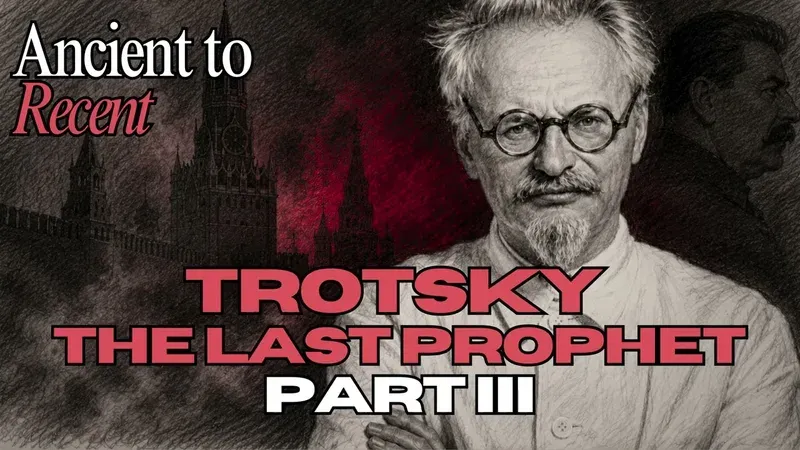
Leon Trotsky: The Last Prophet — Part 3
15 August 2026 · 43 min · Season 1
 Watch on YouTube →
0:0043:19
Also on
Rate the show
Ratings are how new listeners find the show. It takes a minute and it makes a real difference.
Trotsky has lost his struggle with Stalin for leadership of the Soviet Union
But his revolutionary fire still burns bright.
The man who helped seize power and build the Red Army is now a political exile, hunted by the regime he helped create.
In this third episode, we follow Trotsky from exile in Kazakhstan to Turkey, France and Norway as Stalin's campaign against his former rival intensifies.
We explore Trotsky's bitter confrontation with the liberal democracies that refused him entry, the contradiction between his demands for political freedom and his own defence of revolutionary dictatorship, and his growing isolation from the Communist movement.
But Stalin's vengeance reaches far beyond Trotsky himself.
As the Moscow Trials and Great Terror begin, Trotsky watches helplessly as his supporters, friends and family are arrested, imprisoned and executed. His name becomes the centrepiece of Stalin's vast conspiracy theory.
Finally, Norway withdraws its protection and Trotsky is forced to leave Europe.
Across the Atlantic, an unlikely refuge awaits.
Mexico.
But as Trotsky sails towards his new home, Stalin's most dangerous enemy is about to enter the final and most terrifying chapter of his life.
Can Trotsky survive when the full power of the Soviet state is determined to destroy him?
🎧 New episodes every Saturday
📲 YouTube, Spotify & Apple Podcasts | @AncientToRecent
#Trotsky #RussianRevolution #HistoryPodcast #SovietHistory #Stalin #GreatTerror #MoscowTrials #Trotskyism #RussianHistory #HistoryDocumentary
Read transcript
This transcript is automatically generated, so it may contain typos and misheard names.
The greatest delight is to choose one's victim, to prepare one's plans, Minuteley to slake an implacable vengeance, and then to go to bed. There is nothing sweeter in the world. Joseph Stalin In the depths of the Norwegian winter, Leon Trotsky, the once mighty leader of the victorious Red Army, sat powerless. He had waited nervously for his housekeeper to deliver the day's papers. Pravda, the organ of the Soviet state that had once carried his words to the world, now carried a very different message. He scanned the pages with a mixture of fear and disgust. The hysterical headlines shrieked the latest outlandish accusations, the latest crimes that he was supposedly guilty of.
No misdemeanor was apparently beneath him, no outrage beyond him. The accusations ranged from the absurd to the ludicrous, from eggs allowed to spoil to industrial accidents that claimed hundreds of lives. He was apparently guilty of it all. In Moscow, the trial of the Old Bolsheviks continued. Once mighty Titans of the great October Revolution were now reduced to pitiful figures of contempt of derision, desperately flagellating themselves for their supposed complicity in Trotsky's outrageous men who had once endured the glare of the Okrana and faced down the mighty Czar now meekly pleaded for mercy from the ever benevolent Stalin.
Trotsky turned the pages. He scanned the names for a sign, a hint, the slightest indication he had received a letter from his son, Sergei, from the depths of the gulag. They are taking me to the north for a long time. Goodbye, I embrace you. Months had passed since the last communication. Since then, no word from his son or sister or brother or nephews. Each in turn had disappeared, another piece removed from the chess board, another act of Stalin's insatiable rage. Welcome to Ancient Recent, my name is Joseph Parkinson. Today we continue the story of Leon Trotsky, the last prophet to support the show.
Please subscribe today and leave a comment and rating. Episodes of Ancient Recent are out every Saturday and are available on YouTube, Spotify and Apple Podcasts. When the train finally pulled into Alma-Ata, the capital of Soviet Kazakhstan, on the 31st of January 1928, Trotsky stepped down onto the platform and into a world almost unimaginably distant from the 1 he had known only a few years earlier. He stood at the centre of the Russian Revolution, addressing vast crowds and commanding armies.
Now he was a political exile, sent thousands of miles from Moscow to a remote corner of the Soviet Union, close to the Chinese border. There were no cheering crowds. There were no packed halls, no Red Army soldiers awaiting his orders. Instead, Trotsky was given a life of isolation. Yet he did not believe his political career was over. Trotsky saw himself as a man of destiny, and nobody was more convinced of his place in history than Trotsky himself. Trotsky had no intention of retiring to the life of a private citizen.
From his small compound on the edge of the city, he continued to write, sending a string of letters to his supporters battered through the Red Empire. Trotsky believed Stalin's triumph was temporary. The revolution, he thought, would still turn against this new master. And Trotsky still had his supporters inside the Soviet Union. For Trotsky, exile was a set back, but hardly a new experience. After all, how many times have the Okrana cast him into the depths of the Siberian wilderness, only for him to emerge stronger? But what he did not understand is that Trotsky was not fighting the Tsarez regime with it's half hearted and amateurish application of state violence.
Yes, the Roman of Tsars were no stranger to the Jack boot and the male fist, but the system now ranged against Trotsky, the very system he had so eagerly wielded against his enemies, was of an entirely different character. In the Soviet Union. There were no second chances, no repeat offenders, no room for an underground to slowly gather strength. There was instead the determination of Soviet state to smash every possible vestige of opposition and control every aspect of its red subjects lives. And Trotsky of all people should have known this. For the system he was not fighting, he was one of its architects.
If Trotsky believed his exile was temporary, Stalin had reached a very different conclusion. Exile in distant Kazakhstan was supposed to remove Trotsky from the political life of the Soviet Union. Instead, it had become a new headquarter for the Opposition. Letters travelled back and forth across the USSR. Supporters continue to communicate with Trotsky in secret. Trotsky continued to write. And despite the enormous pressure being brought against them, there were still men and women inside the Communist Party who refused to accept Stalin's victory for Stalin.
This could not continue. Trotsky had already been removed from the Politburo. He'd been cast out of the Central Committee and exiled from the Communist Party itself. Now Stalin wanted him expelled from the country. The Soviet government accused Trotsky of organizing an illegal anti Soviet movement and preparing to use political violence against the regime. Trotsky rejected the accusations. He insisted that he was not conspiring to overthrow the Soviet state.
He was trying to save the revolution from what he regarded as its betrayal by Stalin. But by now the distinction meant very little. The Soviet Union was controlled by the Soviet government. The Soviet government was controlled by the Communist Party. The Communist Party was controlled by the politburo, and the Politburo was controlled by Joseph Stalin across the USSR, the methods once reserved for the enemies of the Bolsheviks were now being unleashed against those within the party who opposed Stalin. As Stalin concentrated more power, some within the Communist Party had tried to organize a fight back. Senior party officials and Trotsky himself had issued declarations decrying the suppression of internal democracy, the slow pace of industrialization, and moves away from supporting international revolution. This group became known as the Left Opposition, but ultimately, with Stalin as the General Secretary of the Communist Party and thus able to control appointments to all party positions, the Left Opposition was isolated, stripped of their power and increasingly vulnerable. Stalin was able to outmanoeuvre his opponents and have them driven from the party and into the waiting arms of the NKBD, the feared Soviet secret police.
But Trotsky was a figure of worldwide renown. He was one of the most recognisable faces of the Russian Revolution, and Stalin was not yet the all powerful leader he would become by the eve of the Second World War. Stalin could not simply kill Trotsky, not yet, not without risking his own position. Nor could Stalin ignore Trotsky, who continued A relentless campaign against him. If exile were in the Soviet Union was not enough, then perhaps expulsion from the USSR would do the trick.
In January 1929 the decision was made. Trotsky was to be deported. Trotsky had spent his entire adult life fighting for the creation of the Soviet state, and now that system was turning against him. Trotsky refused to leave quietly. He protested. His expulsion was illegal. He demanded to know where he was being sent. But now there was no longer anyone in Moscow prepared to listen. On the morning of his departure, Soviet agents arrived to take him away.
Trotsky was bundled into a waiting vehicle and driven to the railway station. The man who had once crisscrossed the fastness of the Russian Empire in a special armoured train, directing armies and deciding the fate of nations, was now a prisoner being transported out of his own country. As the train pulled away, Trotsky left behind the state for which he had sacrificed almost everything. He believed he was leaving Russia temporarily. He believed the Stalin's regime would surely collapse. He believed that history would eventually vindicate him, but Trotsky was never to return.
Trotsky had been expelled from the Soviet Union. For a man who had spent his life dreaming of revolution, exile was supposed to be an interlude. Surely a non entity like Stalin could not hold onto power. After all, to Trotsky, Stalin was a provincial peasant. He had bad table manners, litters whose conversation with swear words told coarse jokes and couldn't even speak French. How could such a man lead the workers revolution? After all, to the dandy intellectual Trotsky, Stalin was a little bit, well, lower class.
And Trotsky could still call on his supporters inside the Soviet Union. The Left Opposition had not simply disappeared. Stalin might control the state, but he did not control history. And as a devout Marxist, Trotsky believed the wheels of history may turn slowly, but they turned nonetheless. Trotsky's exile began with a journey S his first stop was Turkey. For a short time, Trotsky stayed inside the Soviet consulate in Constantinople, still yet to be officially renamed Istanbul, before moving on to a nearby hotel.
Trotsky may have believed that his exile would be a repeat of similar experiences before 1917. But times had changed, and so had he. Before the October Revolution, Trotsky had been an obscure radical unknown outside of Marxist circles. Now he was one of the most famous men in the world. As Trotsky began his search for a new home, governments across Europe watched him nervously. They feared that if Trotsky were allowed to establish himself in one of the great European capitals, he might become a rallying point for communist opposition and perhaps even help inspire another revolution. Trotsky may have been cast out of the Soviet Union, but his worries were only just beginning. Trotsky eventually settled on the island of Prinkupo, just off the coast of Constantinople.
The Turkish authorities allowed him to remain, but they kept him under constant surveillance from his isolated island. Trotsky began searching for somewhere else to live. He saw permission from 1 government after another Belgium, Germany and the United Kingdom, but each in turn declined his appeal. Germany was particularly important to him in the 1920s. Berlin was one of the great intellectual centres of Europe and home to one of the largest socialist movements in the world.
Trotsky would have found himself right at home in the smoke filled halls of the German socialist movement. And yet the German government declined his appeal for asylum. Then came an invitation from London, not from the British government, but from the Independent Labour Party, a small socialist offshoot of the much larger and more centrist Labour Party. But His Majesty's Government intervened to prevent Trotsky, who had been a leading member of the Politburo when the Romanovs, cousins of the British royal family, were murdered, from taking up residence.
Trotsky was furious. He raged against what he saw as the hypocrisy of the Western democracies. These were countries that presented themselves as defenders of political liberty. And yet when a famous political exile asked to enter their territory, those principles suddenly appeared to have limits. That was how Trotsky saw it. But there was, however, an uncomfortable question lurking beneath Trotsky's outrage. Wasn't Trotsky being a bit of a hypocrite?
After all, hadn't he spent much of his political career arguing that Liberal Democratic systems were little more than a mask for bourgeois power? He had helped lead a government that abolished political freedom in the name of the revolution. He had supported the dissolution of the Constituent Assembly when the Bolsheviks discovered that the Russian people had not voted for them. He'd helped build a state in which political opponents could be imprisoned, exiled, or even executed. Trotsky did not believe in political liberty as an absolute principle.
He believed in revolutionary liberty. And those were not necessarily the same thing. Trotsky expressly defended the use of political terror, including in print. In 1918, the Austrian Marxist Carl Kutsky publicly criticized the government of Lenin. Kutsky accused the Bolsheviks of crushing freedom, democracy, and fermenting a civil war. Trotsky replied in 1920 by writing a book called Terrorism and Communism, where he expressly defends both the creation of a dictatorship and the use of political violence against the enemies of the Bolsheviks. Trotsky goes beyond the tired old adage, later coined by defenders of Soviet communism, that one cannot make an omelette without breaking a few eggs.
Trotsky instead insisted that dictatorship and terror were not just necessary, they were desirable. For me, this is one of the most hypocritical episodes of Trotsky's life. He demands freedom and protection from his opponents that not only would he never have granted them in return, but expressly stated that he opposed. And this was the contradiction that would follow Trotsky throughout the rest of his life. He believed passionately in freedom for Marxists and internal debate and democracy within Marxist institutions.
But what about those who didn't agree with him to Trotsky, those who didn't see the light of Marxist revelation? Well, they were simply wrong and he was not going to waste time respecting the so-called rights of the enemies of the revolution. If you were living in 1920s Russia and you came up to Trotsky at the height of his power walking down the street and said, comrade, I've been thinking about this revolution stuff and got to say I'm not convinced. I think we should get the czar back and maybe have a constitutional monarchy and I'm going to go and set up a newspaper to argue for it and a political party to campaign for it.
Trotsky would not have replied. Well, that's a very interesting perspective. I disagree with you, but hey, best of luck with that. Instead Trotsky would have said, sorry, can you just wait here a second while I go make a call to the checker because I believe they've got a one way ticket to Siberia with your name on it. Ultimately, he was not a Liberal Democrat, he was an authoritarian. His objection to Stalin's dictatorship was the Stalin bit, not the dictatorship. In July 1933, after years of searching for somewhere that would accept him, Trotsky was finally offered asylum in France.
But France did not exactly welcome him with open arms. He was forbidden from living in Paris and placed under constant surveillance. Trotsky, once the heir apparent of Lenin, now found himself living the life of a fugitive. He was forced to move repeatedly, sometimes changing his place of residence 5 or 6 times in a single month. But it was not just inconvenience that plagued him. He knew that Soviet agents were watching.
His correspondence was intercepted. His movements were monitored. He knew he was being hunted. In an effort to make himself less recognizable, one of the most famous men on the planet shaved up his signature beard. For a man who valued routine, order, and intellectual work, life in exile was becoming increasingly chaotic. Yet Trotsky continued to write. He continued to correspond with his reporters. He continued to believe that history had not finished with him.
But the political situation in Europe was changing rapidly with the storm clouds of war gathering. France wanted to maintain good relations with the Soviet Union, and the presence of Stalin's greatest political enemy of French soil was becoming increasingly inconvenient. Trotsky was informed that he had outstayed his welcome and would need to find a new place of refuge. He moved once again, this time to Norway, and once again the same pattern repeated itself. At first the Norwegian government allowed him to stay. Then pressure began to build from Moscow. The Soviet government demanded restrictions on Trotsky's activities and Norway, fearing the Russian bear, increasingly gave in to Soviet threats.
Trotsky was forbidden for making political statements and placed in the house arrest for 108 days. He was effectively a prisoner. He felt powerless, that whilst Trotsky was isolated in Europe, the net was tightening around the people he had left behind in the Soviet Union. His remaining supporters were being systematically destroyed. They were dismissed from their jobs, expelled from the Communist Party, arrested, exiled and increasingly executed. Trotsky's political movement within the Soviet Union was being dismantled piece by piece.
But Stalin's repression did not stop with Trotsky's political supporters. For Stalin, there was no distinction between civilian and combatant, no such thing as collateral damage, no lying between political rivalry and personal vendetta. For Stalin, the personal was political. The family of Trotsky were fair game. Trotsky had two daughters from his first marriage, Nina and Zinaida. Trotsky had never been what we would today call an attentive father. Trotsky was far more concerned by the workers paradise than domestic bliss.
For him, there was always another rally to address, meeting to attend, an article to write. He had little time to spend with children and often went years without seeing them. After Trotsky was sent to Kazakhstan, Nina became I'll with tuberculosis. Her condition worsened as many doctors, fearful of treating the daughter of Trotsky, declined to care for her. It was almost as if contact with Trotsky was an infectious disease and those exposed was certain to perish.
Nina continued to deteriorate and on the 9th of January 1928, at the age of just 26, she died. Soviet officials deliberately delayed correspondence between Trotsky, then still in Alma-Ata, and Nina. For several weeks. Trotsky was unaware his daughter was sick when he received the news that she had succumbed to her illness. Trotsky was shattered by the loss of his daughter, but the tragedy was only beginning. His elder daughter, Zina, had always loved her father, yet she had hardly known him.
She craved his affection and attention. But Trotsky's life had never left much room for domestic intimacy. Their relationship was complicated, distant and painful. In 1931, Zina was eventually permitted to leave the Soviet Union and join her father in Turkey. But exile did not bring her peace. She was deeply troubled. She suffered from severe depression and became increasingly unstable. There were strange incidents in the house, including a number of unexplained fires. And beneath it all was an overwhelming sense of guilt and rejection.
She had lost her home. She had been separated from her husband. Stalin, the master of human misery, did everything he could to twist the knife. Zina was told she could leave the Soviet Union to be with her father, but only if her husband and one of her children stayed behind. She decided to take her son with her husband, caring for their daughter back in Moscow after her departure, her husband was swiftly arrested and her daughter sent to be raised by her grandmother.
Zina's mental health deteriorated further. Torn between guilt over the fate of her husband and daughter and desperately yearning for the love of her father, the Trotsky struggled to give her what she needed. He loved his daughter, but he was a man far more comfortable discussing politics and expressing emotion. The best he could do was offer practical advice. He urged her to seek psychiatric treatment in Germany. Eventually, Zina left her young son with Trotsky and travelled to Germany to get the help she needed.
Yet again, in 1932, Stalin twisted the knife. The Soviet government revoked Trotsky's citizenship. Zina lost hers too. She would never be able to return to the Soviet Union. She would never again see her husband or daughter in Berlin. Zina continued to spiral. She had lost everything and was unable to deal with the emotional pain both of the distance from her father and her children. And on the 5th of January 1933, Zina took her own life. She was only 32 years old.
For Trotsky, the news was devastating. The revolutionary who had endured the hardship of oppression and civil war, struggled to deal with personal tragedy. He had lost his daughters. Trotsky withdrew into himself. For perhaps one of the first times in his extraordinary life, the great revolutionary was confronted with a personal tragedy against which his politics offered no defence. And while Trotsky mourned his daughters, Stalin's shadow continued to grow ever longer.
The Soviet state had followed him from Russia to Turkey, from Turkey to France, and from France to Norway. Wherever Trotsky went, Stalin's reach seemed to follow. And eventually, Trotsky would discover just how far that reach extended. Trotsky wrote furiously from exile. Books, pamphlets, articles, editorials. One after another they poured from his pen, each one of fresh assault. And the man who now ruled the Soviet Union, Stalin.
Trotsky mocked it, sneered at him, attacked his policies, and perhaps most dangerously of all, challenged his version of history. Stalin read Trotsky's writings. He was a voracious reader, a self educated intellectual who could spend long nights reading in his Dutch outside Moscow. And now, late into the night, Stalin could read the words of the man he had driven from the country. Trotsky, who Stalin insisted on referring to as live Davidovich so as to emphasize his Jewishness, was gone.
But he was not silent, and Stalin would soon have reason to regret allowing him to leave the Soviet Union alive. Because Stalin was engaged in a project of his own. He was not simply building a dictatorship. He was building a mythology. Lenin in death had been deified, and Stalin was positioning himself as Lenin's greatest disciple. The official history of the revolution was being rewritten within the Soviet Union, Stalin's role in 1917 was increasingly presented not as that of a secondary figure who had risen through the party machine, but as the indispensable right hand of Lenin. Photographs were altered.
Enemies disappeared from official histories. The past itself was becoming another battlefield. But Stalin had a problem, Trotsky remembered, and Trotsky had taken considerable quantities of his personal papers and political documents with him. When he left the Soviet Union from exile, he began publishing documents, correspondence and his own account of the revolution, file after file, page after page. The mythology of Stalin was being attacked by one of the few men alive who possessed both the knowledge and the authority to challenge it. Trotsky could not defeat Stalin through a party vote, not anymore.
But he could wound him with words, and beneath the political struggle was something more personal. Stalin's old rival had spent years treating him as an intellectual inferior. The man Trotsky had dismissed as the outstanding mediocrity was now the ruler of the Soviet Union, And Trotsky, even from exile, refused to accept that Stalin had earned the place he occupied. The old revolutionary hierarchy was not supposed to look like this. Trotsky had been the brilliant the theorist, the organizer of the Red Army, the celebrated hero of October. Stalin had been the party organizer, working in the background.
Now the supposedly mediocre man sat at the summit of the Soviet state, and Trotsky was writing about him from exile. Stalin could not simply erase him, Not yet. So instead, Stalin began erasing everyone around him. With Trotsky out of the way, his attention turned towards two of the most prominent remaining Old Bolsheviks, Grigory Zinoviev and Lev Kamenev. Both had once been allies of Stalin. Both had helped defeat Trotsky.
But Stalin had little useful allies. Once they'd served their purpose, he isolated them, humiliated them, forced them into political submission, and eventually they were expelled from party and arrested. Then came the next stage. They were accused of belonging to a vast terrorist conspiracy supposedly directed by Trotsky. The accusations were absurd, but for the Stalinist cult, the more absurd the claim, the more fanatically the faithful believed. The very act of accepting accusations too fantastical to possibly be true became a declaration of faith in the Dear Leader, the ever wise, ever just, ever merciful Comrade Stalin.
In August 1936, Zinoviev and Kamenev were placed on trial in Moscow. Subject to relentless sleep deprivation, beatings, threats to their families, and assurances that all would be well if they played along. They broke, they confessed, to their role in a fantastical global conspiracy that reached the very heart of the Soviet state. And who was the leader of this international conspiracy against the people of the Soviet Union?
But of course, there could be only one, only one devious enough, only one wicked enough, only one sinister enough. It must be. It had to be Trotsky. And after this theatrical performance, Kamenev and Zinoviev, great heroes of the revolution, promised clemency. If they simply mouth the words the gentle Stalin demanded of them, then all would be forgiven. Were taken from the courtroom and shot. The message was unmistakable. Trotsky was no longer simply a political opponent. He was becoming a fictional monster at the centre of an enormous conspiracy.
And then Soviet Union descended into something even darker. In December 1934, Sergey Kirov, one of the most prominent Bolshevik leaders, was assassinated in Leningrad. Stalin used the murder as the pretext for an enormous expansion of repression. What followed became known as the Great Terror. Hundreds of thousands were arrested. Many were tortured or threatened until they confessed to crimes they had never committed, and those confessions were then used to arrest other people.
A name was extracted. That person was arrested. The victim was broken in the dungeons of the Lubianca, the feared prison of the NKBD. Another name was extracted. Another arrest, another trip to the Lubianca. The chain seemed endless. Executions followed. Prisons filled. The gulags bulged with ever greater numbers of fresh inmates. Fresh grist for the mill, a Stalinist terror, fresh fuel for Stalids paranoia. And everywhere the same name began appearing in the accusations.
Trotsky, Trotsky, Trotsky, the invisible hand behind everything. Sabotage, industrial accidents, missed targets. Trotsky was supposedly everywhere. The man who had been expelled from the Soviet Union was now being portrayed as the secret mastermind behind an international conspiracy dedicated to destroying it. Trotsky had become Stalin's Great Satan, the ultimate enemy. And there was another reason Stalin could not tolerate it. Trotsky had a place in the mythology of the revolution that Stalin could not simply manufacture for himself. For millions of communists around the world, Trotsky was inseparable from the story of October 1917. He had stood beside Lennon.
He had helped organize the seizure of power. He had built the Red Army. He had helped defend the revolution during the Civil War. Stalin could rewrite the history books, but he could not change the fact that Trotsky had been there, and Stalin wanted a pantheon of his own. Marx, Engels, Lenin, Stalin, the great founding fathers of the Soviet religion. There could be no rival, no competing prophet, no other revolutionary allowed to stand on the same Mount Olympus. But while Stalin was destroying his political enemies, he was also transforming the Soviet Union itself. In 1928, Stalin launched the First Five Year Plan. The objective was extraordinary.
Russia, still overwhelmingly poor and largely agricultural, was to be transformed into a modern industrial power at astonishing speed. Coal, steel, electricity, machinery, chemicals, factories. Everything was to expand, and everything had a target. The targets were enormous, often wildly ambitious. The Soviet Union would industrialise in years rather than decades. But industrialisation required money. It required machinery. But how to get the money needed to purchase the machinery the Soviet Union lacked?
Stalin it upon a plan to solve all his problems at once. Collectivisation. Millions of small farmers would be consolidated into collective farms controlled by the state. Officially, collectivisation would modernise agriculture. Larger farms could more efficiently use fertiliser and tractors, and thus, in theory, production would soar. Grain would be collected by the state and used to feed the rapidly expanding cities, and grain exports could generate the foreign currency needed to purchase industrial machinery from abroad. But there was another reason Stalin wanted collectivization. The Soviet peasant was still, to a large extent, an independent producer.
He owned land. He controlled his own labour. He decided what to grow, what to sell, what to keep. Stalin wanted to change that. The countryside was to be brought under state control. The campaign became extraordinarily violent. Peasants resisted. Livestock was slaughtered rather than surrendered to collective farms. Grain was hidden. If the peasants would not comply, they would be crushed. Entire communities were branded as enemies of the state.
Grain was taken by force. The disruption of agriculture, combined with impossibly high procurement demands, repression and other disastrous policies contributed to catastrophic famines across the Soviet Union. In Ukraine, the famine of 1932 to 33 became known as the Holodomor. Millions died. The exact number remains debated by historians, but the scale of the catastrophe was enormous. The force collectivization and settlement policies destroyed the traditional pastoral economy.
Life numbers collapsed. Hunger spread across the Republic. Yet Stalin did not abandon his program. The factories continue to rise. The targets continue to increase. Ever higher production figures were demanded, ever stricter deadlines. But there was a problem. The Soviet Union was intempted to industrialize at breakneck speed. Many of the people running the new factories were inexperienced. The new machinery was unfamiliar.
Working conditions were often appalling. Safety standards were frequently inadequate. Accidents happened. Production targets were missed, factories fell behind schedule. But in Stalin, Soviet Union, failure could never simply be failure. There were no accidents, only conspiracies. Someone had to be responsible. If the target had been missed, that someone must have caused it. If machinery broke down, then someone must have sabotaged it.
Someone was working for the enemies of socialism, and only Trotsky could be so devious. Trotsky was in Norway when the steady drum beat of arrests and trials began. At first he seemed almost numbed by the enormity of what was happening. Then the accusations began to appear in the Western press and in Pravda. One after another, Old Bolsheviks appeared before the court and confessed to increasingly fantastical crimes, always pointing the finger squarely.
And Trotsky? Trotsky read everything. He stayed awake late into the night, listening to Radio Moscow. Following the latest developments. He wrote constantly, article after article, denunciation after denunciation. He dissected the confessions, challenged the accusations, and insisted that the entire process was a monstrous fabrication. But while Trotsky fought the accusations with words, the machinery of repression continued, and slowly his world began to contract. The letters from supporters became fewer, then fewer still, eventually almost nothing.
Communists across Europe and America who had once written to him now kept their distance. To correspond with Trotsky was becoming dangerous. Inside the Soviet Union. The net was tightening around the people who remained loyal to him. And then it reached his family. There were no speeches, no trials, no explanations. Just another name on another list. Alexander Bronstein, Trotsky's elder brother, expelled from the Communist Party, exiled, forced to publicly denounce his brother. And then, when there was nothing more to extract from him, when he was of no more use to Stalin, just like Kamenev, just like Zinoviev. 25th of April 1938.
Executed, aged 68. Alexander Sokolovskaya, Trotsky's first wife, Arrested, 1930. Five. 29th of April 1938. Executed, aged 65. Olga Kamenev, Trotsky's younger sister, wife of love Kamenev. 11th of September 1941. Executed, aged 57. Alexander Kamenev Trotsky's nephew, son of his sister Olga. 15th of July 1939. Executed, aged 33. Sergey said off Trotsky's son. Arrested. 3rd of March 19, 3520. Ninth of October 1937 executed, aged 29.
Yuri Kamenev, Trotsky's nephew, son of his sister Olga, arrested 1930. Seven. 30th of January 1938, executed, aged 17. One name, then another, then another to Stalin. Just pieces to be removed from the chess board. Not victims of a great struggle, Not soldiers in a heroic last start, Not casualties of some glorious but hopeless battle. Just bureaucracy, just paperwork. Just another name on another list. Years later, Hannah Arendt would popularize a phrase in writing about the crimes of the Third Reich, the banality of evil. And perhaps there was something chillingly banal about the destruction of Trotsky's family.
The names were entered, the orders were signed, the prisoners were taken away, the orders were carried out and the bureaucracy just moved on. Whilst this was happening, all Trotsky could do was read about it. In Pravdon there is again, as is always the case with Trotsky, a certain irony. Trotsky had been a leading member of the Bolshevik government in 1918 when the Romanov family was murdered. So Nicholas the Second, his wife Alexandra and their five children.
The eldest, Olga was just 22, the youngest Alexi just 13. The Romanov children were murdered for nothing more than having the wrong parents. Trotsky did not give the order himself, but there's no evidence that he opposed it, and in his later writings he rationalized the executions as politically necessary because the Romanovs remained a powerful symbol around which the counter revolution could rally. Well, now it was Trotsky who'd become the symbol, and it was his family who were paying the price for his actions.
Trotsky himself saw the correlation. He wrote about the execution of the Roman children in his diary. I wonder, in those long nights of exile, reading of the destruction of his own family, did he ever think back to 1918? Did he ever think back to the five Romanov children, just as innocent as his children and his nephews were? And did he ever feel sorry for what the government he had helped lead had done to them? The strain was beginning to show on Trotsky. The man who had once been infamous in Bolshevik circles for his sharp suits and neatly quaffed hair now appeared tired. His clothes were no longer carefully pressed. His hair, once dark, was turning grey. His face, now riveted with deep grooves, seemed to carry the accumulated weights of years of exile, political defeat, and now something far more personal, the destruction of those he loved the most.
But through it all, there was one person who remained by his side, his second wife, Natalia Sedova. Natalia was no stranger to revolution herself. Born in 1882 in Romney in what is now Ukraine, she came from a relatively prosperous family. Her father was of Cossack background and her mother was of Polish ancestry. But Natalia was hardly interested in the comfortable life that her upbringing might have offered her. As a young woman, she became involved in the revolutionary movement and was expelled from an institution for girls in Kharkiv after taking part in political protests.
She continued her education abroad, becoming involved with Russian Marxist emigres and the revolutionary newspaper Iskra, which means Spark. And it was in Paris in 19 O2 that her path crossed with that of a young man who had just escaped from Siberian exile, Leon Trotsky. He was 23 years old, already intensely ambitious, already consumed by revolution. Natalia was drawn into his world, and the two soon became inseparable.
She had a unique effect on Trotsky, so often dismissive of others, so often capable of wounding deeply with a careless or indeed deliberate turn of phrase. Trotsky was always careful how he spoke to Natalia. He went out of his way to be attentive to her, to soothe her, to listen to her, even if he could never quite take the opinions of anyone else completely seriously. Their relationship would last the rest of Trotsky's life.
Together they would experience almost every chapter of the revolutionary saga. Natalia would follow Trotsky from country to country as the Soviet state turned against him. For Trotsky, politics had always been the great love of his life. His revolutionary work had consumed him, his books, his articles, his speeches. Domestic life had rarely been able to compete with his political mission. But now there was no left for him to go.
Yet Natalia remained together. They lived with the knowledge that they were being watched, that their correspondence were being intercepted, that their loved ones were disappearing, and that they were powerless to do anything about it. Norway had initially seemed like salvation. Trotsky and his wife had been taken in by Conrad Knudsen, a Norwegian socialist politician and journalist. At first, it seemed as if Trotsky had somewhere he could finally call home. The Knudsen family lived in Nordahov, in the Norwegian countryside, and for a while, Trotsky was able to live something approaching a normal life. He wrote, he read, he received visitors, he walked in the countryside.
He continued the political struggle from his desk, producing articles and pamphlets attacking Stalin and defending himself against accusations being hurled at him from Moscow. But Stalin was never going to let Trotsky rest, and increasingly Norway began to discover what Britain and Germany had feared. Giving Trotsky asylum meant giving him a platform and drawing the anger of the Kremlin. In 1936, strikes and demonstrations erupted across France.
Trotsky penned articles urging the French workers on. French newspapers accused him of encouraging revolutionary unrest from the safety of Norway. The Norwegian government began to feel the pressure, and not just from abroad, but also from within Norway itself. The Norwegian far right was furious that such a prominent communist would be granted asylum in Norway, and began making Trotsky's present a political issue. The leader of the Norwegian fascists, the future Nazi collaborator Vidkun Quistling, demanded Trotsky's removal. As is often the case, the far right and the far left found they had more in common than they would like to admit. To both fascist and Soviet sympathizers, the presence of Trotsky was intolerable.
To fascists, Trotsky was everything they loathed, intellectual, cosmopolitan, communist, and worst of all, a Jew. To the Soviets and their pro Kremlin Norwegian allies, Trotsky was the embodiment of all that was wicked, a dissenter, an apostate, the one who dared challenge the image of the Soviet Union as a shining city on the hill and New Jerusalem, with kindly Father Stalin to lead the broad shouldered proletarians towards a beautiful tomorrow. On the 5th of August 1936, the controversy became much more sinister.
Trotsky and Italia were away from the house when fascists broke into the Kunitzen home. They were looking for Trotsky's papers. The raid was largely frustrated by Kunitzen's daughter, but some documents were taken. For Trotsky the meaning was obvious. Even here he could not rest. Then came the Moscow trials. The pressure on Norway became unbearable. Stalin wanted Trotsky silenced, the Norwegian far right wanted him expelled. And the Norwegian government increasingly wanted the entire problem to disappear.
On the 26th of August, police arrived at the Knudsen home. They brought new conditions. Trotsky would not be allowed to write about current political affairs. He would not be allowed to give interviews. His correspondence would be intercepted. Trotsky. Refused from the Norwegian government. The situation was growing alarming. On the 2nd of September 1936, Trotsky and Natalia were transferred to a farm at Horum. They were no longer simply political refugees.
Now they were prisoners. They were confined indoors for 22 hours a day. They were surrounded by guards, their correspondence was restricted. Visitors were almost entirely forbidden, and by October even their walks outside have been stopped. Trotsky, who had once commanded armies across an entire continent, was now a prisoner in a Norwegian farmhouse. His weapon was the pen, and even that was being taken from him. But Trotsky continued to write, and on the 18th of December he managed to smuggle out an article attacking the Moscow Trials. It was one last attempt to breakthrough the walls that were being built around him.
But the Norwegian government had made its final decision. Trotsky was no longer welcome. The country that had opened it's doors to him now wanted him gone. And so Trotsky once again was forced to move. But where? Who would take in the radical profit of revolution, knowing the soon enough the Soviets would come call him? At last, out of the blue and across the Atlantic, an answer came. An invitation arrived from President Lazaro Cardenas of the Republic of Mexico, inviting Trotsky to make Mexico his new home. On the 19th of December 1936, Trotsky and Natalia were taken aboard the Norwegian tanker Ruth. They were escorted under guard as the ship pulled away into the vastness of the Atlantic.
They must have hoped that they could leave at least a portion of their troubles behind them. But Trotsky still burned with indignation. For all his suffering, his fire for the revolutionary cause still burned brightly. He had no intention of letting Stalin claim leadership of the revolutionary cause. Nor, for that matter, would Stalin allow his great enemy to slip away. As the lies about Trotsky grew ever more fantastical, so too did Stalin's obsessive hatred of his old rival grow ever more all consuming. Before Trotsky had even stepped aboard the ship taking him to Mexico, secret messages flashed between Moscow and Mexico City. Soviet agents of the feared organ of Stalin's vengeance, the NKBD, were put on high alert.
By the time Trotsky arrived on the shores of Mexico, the NKBD were already watching, waiting for Stalin's orders. Thank you for listening to Ancient Recent My name is Joseph Parkinson. To support the show, subscribe today and leave a comment or rating. Next week we will continue our story on Leon Trotsky as he tries to build a life in Mexico, all the while at every step being watched by the NKBD as the decision is finally made to silence Trotsky permanently. Episodes of Ancient Teresa are out every Saturday and are available on YouTube, Spotify and Apple Podcasts.