
#62
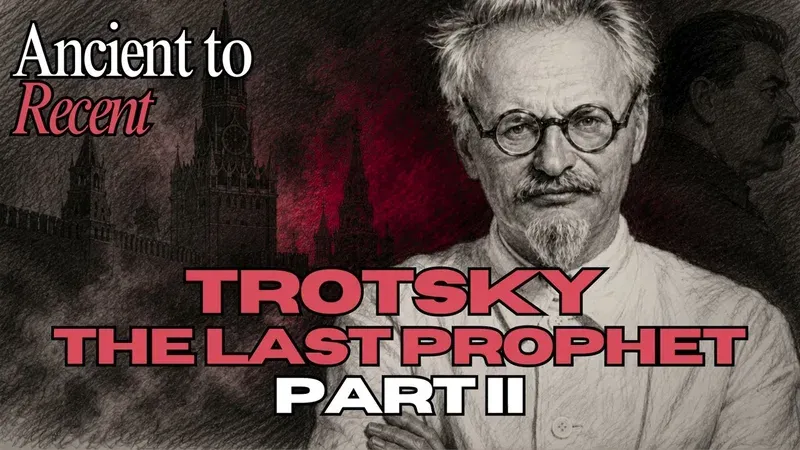
Leon Trotsky: The Last Prophet — Part 2
8 August 2026 · 44 min · Season 1
 Watch on YouTube →
0:0044:57
Also on
Rate the show
Ratings are how new listeners find the show. It takes a minute and it makes a real difference.
Leon Trotsky has helped seize power, built the Red Army, and defeated the enemies of the Bolshevik Revolution.
Now he is about to lose everything.
By 1927, the man who had once stood beside Lenin at the centre of the Russian Revolution has been transformed from revolutionary hero into Stalin's most dangerous political rival.
In this second episode of our series, we follow Trotsky through the Russian Civil War and the violent birth of the Soviet state, as he attempts to save the revolution he helped create.
We explore the Bolshevik seizure of power, the dissolution of the Constituent Assembly, the creation of the Cheka, and the brutal campaign of terror unleashed against the revolution's enemies.
We examine the Treaty of Brest-Litovsk, where Trotsky's vision of worldwide revolution collided with Lenin's determination to preserve the fragile Soviet state.
As Russia descends into civil war, Trotsky transforms himself from revolutionary intellectual into military commander.
Travelling across the country aboard his famous armoured train, he builds the Red Army, recruits former Tsarist officers, imposes ruthless discipline, and helps turn the tide against the White armies.
But victory comes at an enormous cost.
The episode also examines the Kronstadt Rebellion of 1921, when sailors who had once been celebrated as heroes of the Revolution rose against Bolshevik rule. Trotsky and Lenin responded with force, crushing the uprising and revealing just how far the revolution had travelled from the ideals of 1917.
Then, with the Civil War over and Lenin dying, a new struggle begins.
Joseph Stalin is quietly building a network of loyal supporters throughout the Communist Party, while Trotsky assumes that his revolutionary reputation and intellectual brilliance will make him Lenin's natural successor.
It is a fatal mistake.
As Lenin's death approaches, Stalin steadily isolates his rival. Trotsky loses influence, his supporters are removed, and his role in the Revolution and Civil War is increasingly rewritten.
By the Fifteenth Party Congress in 1927, the outcome is no longer in doubt.
Trotsky is expelled from the Communist Party, arrested by the Soviet secret police, and sent into exile in Kazakhstan.
How did the revolutionary who helped create the Soviet state become its most famous exile?
Why did Trotsky underestimate Stalin so catastrophically?
And how did the man who helped build the Red Army become the greatest political enemy of the man who would eventually rule the Soviet Union?
Join Joseph Parkinson as Ancient to Recent continues the extraordinary story of Leon Trotsky, the revolutionary who helped make the Soviet Union, only to find himself hunted by the regime he had helped create.
🎧 New episodes every Saturday
📲 YouTube, Spotify & Apple Podcasts | @AncientToRecent
#Trotsky #RussianRevolution #HistoryPodcast #SovietHistory #RussianHistory #Stalin #Lenin
Read transcript
This transcript is automatically generated, so it may contain typos and misheard names.
You are pitiful isolated individuals. You are bankrupt. Your role is played out. Go where you belong from now on into the just bin of history. Leon Trotsky, October the 25th 1917. The 15th Party Congress in December 1927 was standing room only. The men gathered there had overthrown the Provisional Government, defeated the White armies, survived assassination attempts. They had together done the impossible. But few had contributed quite as much to the revolutionary 'cause as the man who was about to speak, Leon Trotsky.
Once, when Trotsky spoke, audiences fell silent. Now they erupted in jeers as he tried to begin his defence. Delegates shouted him down. Traitor. Enemy of Lenin, Counter revolutionary, bourgeois spy. Every sentence was interrupted, every argument drowned beneath the storm of insults. The former commander of the Red Army strained to make himself heard. His voice cracked. For 10 years, he had stood at the summit of Soviet power. He had helped seize the Winter Palace. He had created the Red Army almost from nothing. He had saved the Bolshevik revolution when it seemed certain to perish.
Now his own comrades would scarcely allow him to finish a sentence. The abuse intensified. Paper balls, books, whatever laid to hand were hurled across the chamber. Some laughed, delighting in the spectacle. Others stared silently ahead. Few dared intervene. Watching it all sat Joseph Stalin, expressionless, patient, surrounded by his supporters. His only action was to occasionally fiddle with his pipe. This, for Stalin, the UN fancy provincial from the backwater of the Tsarist Empire, was a crowning moment. It was a moment that for years he must have dreamed of, yearned for, and beneath the stern exterior befitting the Man of Steel, he must have relished.
The years of careful preparation were almost complete. Every ally cultivated, every rival isolated, every committee quietly brought into his influence. Trotsky had always believed revolutions were won by ideas. Stalin knew they were won by power. When the vote was finally taken, the result had never truly been in doubt. Leon Trotsky, hero of the revolution, tribune of the people, commander of the victorious Red Army, and heir apparent of the great Lenin, was expelled from the Soviet Communist Party.
Trotsky's defeat had been long in the making, but for Stalin, the defenestration of Trotsky was only the beginning. Within months, Trotsky would be driven into exile. Within years, he would become the most haunted political refugee on earth. Welcome to ancient to recent. My name is Joseph Parkinson and today we continue our series Leon Trotsky, the last Prophet. To support the podcast, subscribe today and leave a comment or rating.
Episodes around every Saturday and are available on YouTube, Spotify and Apple Podcasts. 10 years earlier, in 1917, the world was experiencing A seismic shift the likes of which few could have imagined possible only years before. Europe had been plunged into conflict in 1914, and soon the early optimism brought about by a surge of patriotism gave way to the brutal reality of warfare. Gone were the glory days of the 19th century, where their brightly coloured uniforms, gallant cavalry charges and grand armies fighting sweeping campaigns of movement.
In their place was modern, industrialized, impersonal mass slaughter, the grind of attritional, static battles fought over months, with hundreds of thousands cut down for the taking of mere feet. In the cities of Petrograd and Moscow, the workers laboured in dangerous conditions for meagre pay. They lived lives of hunger, poverty and disease under the strain of war. Assailed by hunger and want, the workers took to the streets demanding land, bread and peace. Troops sent to control the starving masses turned their weapons, not only striking workers, but on their own offices.
In the blink of an eye, the authority of the Romanov czars that had ruled Russia since 1613 evaporated. As the Romanov dynasty collapsed, Leon Trotsky found himself thousands of miles away. When the first demonstrations erupted in Petrograd, he was living in exile in New York City. He had spent the previous years drifting across Europe, in America, London, Paris, Vienna, Zurich, New York, always writing, always organizing, always waiting for history to call him home.
That call finally came in February 1917. The czar was gone. Russia stood balanced between democracy and revolution. Trotsky scarcely hesitated. He boarded a ship bound for Europe, determined to return before the moment passed. The journey itself became an adventure. British authorities, suspicious of the fiery revolutionary travelling across the Atlantic in wartime, intercepted his vessel in Halifax, NS Trotsky was arrested and briefly interned.
Only after protests from the new Russian Provisional Government, the very same one Trotsky was intent on overthrowing, was he released and allowed to continue his journey. In May 1917, he finally arrived back in Petrograd. The city was electric. Workers crowded the factory. Soldiers debated politics in the barracks. Meetings spilled into every square and street corner. Everywhere, people argued the same questions. Who would rule Russia? The Provisional Government attempted to govern from the Winter Palace, but real authority increasingly lay elsewhere in the Petrograd Soviet. Trotsky threw himself into the struggle with astonishing energy.
He spoke endlessly. He wrote articles at a frantic pace. He organized committees, addressed mass meetings, debated rivals late into the night. Every ounce of his formidable intellect was devoted to one purpose, revolution. By now, the differences that have once separated him from Lenin had largely disappeared. The Provisional Government, determined to continue Russia's disastrous participation in the First World War, seemed to Trotsky incapable of solving the country's mounting crises.
Like Lenin, he now believed only the Bolsheviks possessed both the will and the organization to seize power. During the summer of 1917, Trotsky formally joined the Bolshevik Party. It was an extraordinary reversal. For years, Trotsky had criticized Lenin's authoritarian methods. Now he had become his closest ally. Lenin provided the vision. Trotsky provided the organization. Together they formed one of history's most formidable revolutionary partnerships.
But not everyone welcomed Trotsky's meteorite rise. Amongst those watching with growing resentment was Joseph Stalin. Unlike Trotsky, Stalin had remained a loyal Bolshevik throughout the years of exile, arrest and underground work. He had robbed banks to finance the party, endured repeated imprisonments, carried out assassinations, accepted Siberian exile without complaint, and defended the party when others, like Trotsky himself, had criticized it. As he saw it, he had been there during the difficult years when the revolution seemed an impossible dream. Trotsky, by contrast, has spent years quarrelling with Lenin, flirting with the Mensheviks, and living comfortably in the capitals of Europe.
Yet within months of joining the Bolsheviks, Lenin increasingly relied upon Trotsky above almost everyone else. For Stalin, it was a slight he neither forgot nor forgave. As autumn approached, events accelerated. Russia was collapsing, the army disintegrating, The economy faulted. Food shortages worsened. Confidence in the provincial government evaporated. Lenin urged immediate insurrection. Trotsky agreed. As chairman of the Petrograd Soviet, he quietly prepared the machinery that would make revolution possible. On the night of the 25th of October, according to the old Russian calendar, 7th of November by the modern calendar, the Bolsheviks struck.
Red Guards occupied bridges, railway stations, government offices, and Telegraph exchanges. In subsequent Soviet films, the moment was mythologized as a Titanic struggle, with Red Guards bravely charging into a hail of bullets to seize power for the people. The reality was somewhat different. The government melted away with hardly a shot fired. More people were actually hurt in a 1920 reenactment of the storming of the Winter Palace than the 1917 events themselves.
Mythology aside, the following morning the Winter Palace had fallen. The Provisional Government had ceased to exist. The Bolsheviks had seized power. Trotsky had become one of the principal architects of the second Russian Revolution of 1917. Standing beside Lenin was another victorious revolutionary, Joseph Stalin. Neither man yet realized that their greatest battles still lay ahead. It would not be fought against the Tsar, nor his generals, but against one another. The seizure of power in Petrograd had been swift and altogether rather easy, but holding on to power would prove considerably more challenging.
The Bolsheviks had taken power in the name of the people, but there was only one problem. They'd never actually asked the people whether they wanted Bolshevik rule. Not to worry. The opportunity came only weeks later. In November 1917, elections were finally held for the long promised Russian Constituent Assembly, the body that was supposed to decide the future of the Russian state in the post Czarist era. The Bolsheviks entered the campaign supremely confident.
Surely the workers, soldiers and peasants would rally behind the party that had overthrown the old order in their name instead. The result was a humiliation. The moderate Socialist Revolutionary party emerged as the largest force, winning around 40% of the vote. The Bolsheviks, self appointed vanguard of the proletariat, secured an embarrassing 23% for a movement that claimed to embody the will of the people. The people had an unmistakable message for the Bolsheviks and the message was who are you? Lenin, however, was not prepared to surrender power because of the small matter of an inconvenient election result. If the people had failed to hand power to the Bolsheviks, then the party would have to dissolve the working class and elect a new one.
On the 18th of January 1918, the newly elected Constituent Assembly met for the 1st and as it transpired last time, its members debated through the night, but the following morning armed Bolshevik guards had entered the chamber. The deputies were ordered to leave. The Assembly was dissolved. It would never meet again. There would not be another even semi free election in Russia until 1989. Power now rested firmly in Bolshevik hands. The revolution had overthrown one absolute government. It was already constructing another The new regime wasted little time dismantling the remaining pillars of political freedom.
Non Bolshevik newspapers were shut down. Freedom of the press disappeared almost overnight. The old tsarist courts were abolished and replaced by revolutionary tribunals whose purpose was not impartial justice but the defence of the revolution. The death penalty, abolished by the Provisional Government, was reinstated. Opposition parties found themselves increasingly harassed, suppressed and before long outlawed. But then on the 7th of December 1917, the Bolsheviks created a new organization, the All Russian Extraordinary Commission for Combating Counter Revolution and Sabotage. History remembered it by a much shorter name, the Chequer. It's head was a fanatically devoted Polish revolutionary by the name of Felix Draczynski.
Quiet, austere and utterly uncompromising, Drasinski believed mercy towards the enemies of the revolution was itself a crime. The Chequer was given extraordinary power. It could arrest without warrant, in prison without trial and execute without appeal. It's mission was simple, to hunt down and destroy anyone who stood in the way of the Bolshevik Revolution, the Chequer said about its work. Immediately. Aristocrats, priests, industrialists, bankers, journalists, political opponents, moderate socialist trade union leaders and uncooperative peasants dubbed culacks. Anyone deemed an actual or merely potential enemy of the revolution was to be crushed.
Directives flowed from Lenin and the Bolshevik leaders demanding ruthless action against counter revolutionaries. The message was unmistakable. The old Russia was to be swept away, not gradually, not peacefully, but by force. For the Bolsheviks, violence was not an unfortunate necessity. It was an indispensable instrument for the creation of a new world. If the old order was ever to return, it would have to rise from the ashes, and the Bolsheviks intended to leave nothing but ashes behind.
One such example of Lenin and Bolsheviks attitude to dealing with opposition came in the form of an order issued by Lenin to communist officials in the Penzar government of the Volga region dating the 11th of August 1918. The order reads in full. Comrades, the insurrection of five kulak districts should be ruthlessly suppressed. The interests of the whole revolution require this. Because the last decisive battle with the kulaks is now underway everywhere an example must be made.
One hang, absolutely hang in full view of the people. No fewer than 100 known kulaks. Fat cats, blood suckers. 2 Publish their names. 3 seas, all grain from them. 4 Designate hostages in accordance with yesterday's telegram. Do it in such a fashion that for hundreds of verse surrounds the people. See tremble and no Note that Lenins Telegraph does not urge that guilty party should be punished for committing crimes. He simply stipulates that an arbitrary number of people should be selected for public execution. The purpose of this action was not to punish wrongdoing, but instead was to pacify the population by suing terror. The Bolsheviks had seized power promising the Russian people two things above all else, bread and peace. Bread was proving difficult enough, but peace presented an even greater problem.
Russia had been fighting the First World War for more than three years. Millions of Russian soldiers have been killed, wounded or captured. Russia's continued participation in the war had been one of the largest factors that had undermined the legitimacy of the Provisional Government. For Lenin, there was no doubt if the Bolsheviks were to have any hope of staying in power, they would have to get Russia out of the war, and soon.
But there was a problem. Germany knew perfectly well that the new government in Petrograd was desperate. And so in December 1917, negotiations began at the town of Breslitovsk, what is now Belarus. The Germans arrived at the negotiation table with enormous leverage. The Russian army was vanquished, the German army was victorious, and the Germans intended to take all advantage. They demanded huge territorial concessions. Russia would effectively surrender control of Poland, the Baltic territories and much of Ukraine, whilst recognizing the independence of territories that had previously belonged to the Russian Empire, such as Finland.
To many Bolsheviks this was intolerable. They had not overthrown the Tsars regime, only to sign away enormous chunks of the Russian Empire to the German Kaiser. And amongst those opposed to the surrender was Leon Trotsky. Trotsky was appointed head of the Soviet delegation at Bresla. Tsk. He had arrived determined to find another way. His solution was characteristically revolutionary, neither war nor peace. Trotsky argued that the Bolsheviks should simply refuse to continue fighting, but also refused to sign the humiliating terms the Germans insisted on.
He believed that revolution was spreading across Europe. The German working class, he argued, would soon rise against its own government. The Russian Revolution would spread like wildfire and was sure to set the German Empire ablaze, and when that happened, the German Empire itself would collapse. The Bolsheviks therefore had only to hold their nerve. But Trotsky was gambling on events yet to unfold, and Lenin thought it was madness.
Lenin understood something Trotsky did not. The German Revolution would surely come, but it might not come soon enough. And while the Bolsheviks waited for the workers of Germany to rise, the German army could simply continue marching. E Lenin repeatedly demanded that the Bolsheviks accept the German terms. Trotsky resisted. Trotsky did everything he could to drag the negotiations out in the hope of the long-awaited German revolution. Then, in February 1918, the Germans finally lost patience. Their armies resumed their advance. The Russian army offered almost no resistance. Town after town fell.
The Germans advanced rapidly through territory that only months earlier had been part of the Russian Empire. Trotsky finally realized that his gamble had failed. The Bolsheviks have no army capable of stopping the Germans and there was no sign of the revolution in Germany. To save them. The party was forced to choose. On the one side stood the idealism of Trotsky and the revolutionaries who believed the history would rescue them.
On the other side stood the Co practicality of Lenin, who believed the revolution had to survive the present before it could shape the future. In the end then, in one Stalin was not involved in the negotiations, but initially sided with those who opposed signing peace with the Central Powers, believing that the war would lead to a revolutionary situation within Germany. But when Lenin won the debate, Stalin dutifully fell in line. Trotsky did not.
Trotsky firmly believed that the global revolution, for which events in Russia were merely A prelude, was just around the corner. But on the 3rd of March 1918, the Bolsheviks signed the Treaty of Bresla. Tosk The terms were brutal. Russia surrendered enormous territories and millions of people. The new Soviet government had agreed to a Carthaginian peace to escape the war. For Lenin, however, the humiliation was worth it. The new Soviet government had been given breathing space. The Bolsheviks could now turn their attention to the enemies gathering inside Russia itself.
For Trotsky, Bresla Tosk was a profound lesson. Revolutionary conviction could not substitute for military power. Ideas could inspire millions. But armies still marched, and within months Trotsky would find himself confronted with an even greater problem. The Bolsheviks had survived the German threat. Now they had to survive the brewing civil war. And to do that, Trotsky would build an army of his own, an army that would ultimately #1,000,000 an army whose creation would transform the and Trotsky from revolutionary theorist into man of action Outside of Petrograd.
As the Bolsheviks Titan negra from power, those who opposed the new government began to organize. Former Czarist officers, liberals, moderate socialists, Czech prisoners of war, Cossacks, regional nationalists, foreign interventionists, men who agreed on almost nothing except one thing. The Bolsheviks had to be destroyed. Their forces became known collectively as the White Armies. Russia was no longer fighting one war.
She was fighting dozens across the vast lands of the former Russian Empire. Old loyalties collapsed. Finland seized its independence. The Baltic people fought for freedom. Ukraine descended into a bewildering struggle involving nationalists, anarchists, Bolsheviks, White armies and foreign powers. Peasants seized estates. Cossack cavalry rode across the steppe, leaving trails of plunder and massacre behind them. Villages changed hands again and again. The Russian Empire had not merely fallen apart, it had dissolved into one of the bloodiest civil wars in modern history.
And standing at the centre of the gathering storm was Leon Trotsky. So, amidst the carnage, what did Leon Trotsky make of all this? To Trotsky, the revolution was about far more than simply replacing 1 government with another. Socialism as he understood it was not merely an economic system or a political program. It was the beginning of an entirely new stage of human history. The old world of exploitation, greed, religion and nationalism would disappear and it's place would emerge. A new civilization, even a new kind of human being. Trotsky imagined the future in which mankind itself would be transformed, liberated from poverty and oppression. People would become healthier, wiser, more cultured. The average man, Trotsky wrote, would rise to the level of Aristotle, A Girta, or a Marx.
It was nothing less than the promise of heaven on earth for such a future. What sacrifice could possibly be too great if hundreds had to die? If thousands, If hundreds of thousands, or even millions, then so be it. History, Trotsky believed, demanded sacrifice, and future generations would thank those willing to make it. Yet paradise seemed a long way off. But there was 1 inconvenient truth the Bolsheviks could no longer ignore.
They were losing. Outside the industrial heartland around Petrograd in Moscow, Soviet authority was rapidly collapsing on every front. White forces seemed to be on the March. From Siberia came Admiral Kolchak. In the South, General Danikin advanced relentlessly towards Moscow. General Udonich threatened Petrograd from the West, foreign armies landed at Murmansk, Archangel Odessa and Vladivostok. The young Soviet state appeared surrounded in what seemed like a repeat of 1905.
The revolution was about to be extinguished. Now was the time for Trotsky, journalist, intellectual and activist, to play his greatest role. It was at this moment that Trotsky was appointed People's Commissar for Military and Naval Affairs. He was given and almost a possible task to create an army. When none existed. He attacked the problem with customary, inexhaustible energy. Dressed in his trademark black leather uniform, Trotsky transformed himself into the public face of the newly formed Red Army.
A special armoured train became his travelling headquarters. It crisscrossed the collapsing front lines, carrying him thousands of miles across the former empire. Inside were Telegraph offices, a library, a printing press producing revolutionary newspapers, even a projector showing propaganda films to raise the morale of exhausted soldiers. Wherever the front line was close to collapse, Trotsky appeared. He addressed soldiers from the roofs of railway carriages.
He inspired wavering units with speeches that appealed to their deepest convictions and promised a better tomorrow. But Trotsky was not merely A travelling morale officer. When stirring words failed, Trotsky did not shy from the application of terror. As Trotsky himself declared, we must put an end once and for all to the Papist quake of Babble about the sanctity of human life. The Red Army, he insisted, would be built not in sentiment but on discipline. Iron discipline.
Perhaps his most controversial decision was to recruit thousands of former tsarist officers into the Red Army. Many Bolsheviks were horrified. How could the revolution entrusted survival to men who'd spent their lives serving the old order? Trotsky ignored them. The revolution needed professionals. Idealism alone would not win battles. To guarantee their loyalty, political commissars were attached to every major commander.
Many officers also knew their families remained firmly in Bolshevik hands. Should they defect, their wives and children would pay with their lives. It was a brutal system, but Trotsky considered it necessary. The defining test of this method came during the summer of 1918. The young Soviet Republic appeared to be collapsing to the east. The Anti Bolshevik Czech Legion, so named as it was comprised of soldiers from the former Habsburg army, had seized vast stretches of the Trans Siberian Railway. One by one the cities of the Volga fell into White hands. Then came the gravest blow of all. The ancient city of Kazan was captured by White armies. It's fall was catastrophic.
Not only had the Reds lost one of the great gateways to central Russia, they had also lost much of the former Imperial Gold Reserve. Panic spread through Bolshevik ranks. Retreat followed retreat. Entire units dissolved before the enemy had even appeared. If the Whites across the Volga in strength, the road to Moscow was wide open. Trotsky immediately boarded his armoured train and raced E. He established his headquarters at the small railway junction of Sviatska, perched on a hill overlooking the Volga. From there he surveyed what remained of the Red Army. The site filled him with disgust. The Red Army was in utter disarray. The revolution, he concluded, was not being defeated by superior White armies.
It was being defeated by cowardice. Trotsky's response was immediate and merciless. Deserters were to be haunted down. Cowards were arrested. Commanders who abandoned their position were threatened with execution. Political commissars washed every officer. Then came the episode that would become legendary. A Bolshevik regiment broke under pressure and fled. Trotsky ordered the men and rounded up. He revived an ancient Roman punishment decimation.
Every 10th soldier was selected by lot, regardless of personal guilt, regardless of bravery, regardless of innocence. The condemned men were marched before their comrades, and on Trotsky's orders, they were shot. The message was unmistakable. The enemy might kill you, but if you ran your own side, certainly would. The executions sent a chill through the Red Army. Many were horrified. Others quietly admitted that discipline returned almost overnight.
Trotsky remained entirely unapologetic. For him, military necessity overrode every moral objection. A revolution that refused to defend itself deserved to perish. Yet terror alone did not explain the transformation of the Red Army's fortunes. Trotsky reorganized shattered formations, shifted reinforcements with remarkable speed by rail, ensured ammunition reached the front, dismissed incompetent commanders regardless of political connections.
Standing atop his armoured train, spectacles flashing in the sunlight, he convinced exhausted soldiers that behind them lay the old world ahead, the future. If they failed, the revolution would die. Slowly, the tide began to turn. The Red Army stiffened. Fresh offensives pushed the Whites back from the Volga. In September 1918, Kazan was recaptured. For the Bolsheviks, it was proof the revolution could survive. For Trotsky, it cemented his reputation as the architect of the Red Army. Over the next two years, the White offensive stalled. One after another, the White generals were driven back and defeated.
By late 1920, organized resistance in European Russia had largely collapsed, though fighting would linger on for a number of years, due in no small part to the decisive leadership of Trotsky. Victory had been secured, but it was a victory that came soaked in blood. And even with triumph over the Whites, the killing was far from over. In March 1921, one of the most controversial chapters in Leon Trotsky's life was about to unfold. Just 20 miles West of Petrograd, beyond the frozen waters of the Gulf of Finland, stood the mighty naval fortress of Crunch that for centuries it had guarded the approach to the Russian imperial capital.
Now it guarded something altogether different, the Bolshevik Revolution. The sailors stationed there were no ordinary servicemen. The Kronstadt sailors had become legends. When the Romanov Empire collapsed, they had thrown themselves enthusiastically behind the revolution. They had fought on the barricades During the October Revolution. It was they who had stormed the Winter Palace. During the Civil War they had served as some of the Bolsheviks most fanatically dependable soldiers, earning A fearsome reputation for courage and revolutionary zeal.
In Bolshevik propaganda they were portrayed almost as mythical figures, broad shouldered, bearded revolutionaries, rifles slung over their backs beneath fluttering red banners. To Lenin they were once described as the pride and glory of the revolution. Yet revolutions have unfortunate habits of devouring even their most devoted children. Four years of warhead left Russia exhausted, and yet the freedoms promised in 1917 seemed increasingly distant. The sailors who'd once fought to destroy dictatorship now began to wonder whether they were merely replacing 1 dictatorship with another.
Delegates from Kronstadt travelled to Petrograd to investigate rumours, strikes and unrest. What they found disturbed them. In the pre revolutionary days, workers demanding bread and better conditions were often dispersed by force with the Bolsheviks in power supposedly in the name of the workers. These old Tsaris methods were not just being repeated, they were being exercised with a level of brutality well beyond anything used by the Okrana.
Meetings were broken up, independent trade unions outlawed, elected bodies replaced by ones comprised of members exclusively of the Bolshevik Party, political opponents were arrested and in many cases lists of those merely suspected of anti Bolsheviks sentiment were being drafted and without even the pretence of a trial, taken and shot. Returning to the naval base, the delegates reported what they had seen. The response was immediate.
On the 1st of March, nearly 16,000 sailors, soldiers and civilians gathered in Anchor Square. There they passed a resolution that would shake the Bolshevik leadership to its core. They demanded fresh elections to the Soviets, freedom of speech for workers, peasants and socialist parties, freedom of assembly, the release of political prisoners and an end to the privileges enjoyed exclusively by the Communist Party. In short, they demanded that the revolution returned to the ideals in which they believed the hit fourth in 1917.
To many observers, the Kronstadt sailors appeared not as council revolutionaries but as a revolution attempting to reclaim its own soul. Lenin and Trotsky saw things very differently. Russia remained exhausted by civil war. White emigres waited abroad for any sign of weakness. Foreign governments still dreamed of overthrowing Soviet power. If Kronstadt succeeded, two would rise next. A single crack in Bolshevik authority, they believed, by bring the entire revolutionary edifice crashing down.
Lenin therefore reached a grim conclusion. The rebellion had to be crushed immediately. Trotsky issued an uncompromising ultimatum. The sailors were to surrender unconditionally, lay down the weapons or face destruction. No negotiation, no compromise. The Kronstadt sailors refused. As winter tightened its grip upon the Gulf of Finland, Red Army units assembled along the frozen shoreline. Across the vast sheet of ice, they prepared to launch one of the most desperate assaults of the Civil war. The attack was a nightmare.
With almost no cover, the advancing soldiers were silhouetted against the snow as machine guns and artillery tore into their ranks. Many fell where they stood. Others disappeared beneath shattered ice into the freezing waters below. The first assault collapsed in bloody failure. Trotsky, unconcerned by the loss of human life, ordered another. Fresh troops were brought forward. Political commissars drove reluctant soldiers over the ice. After days of bitter fighting, the Red Army finally broke into the Fortress.
Street by St. Barrack by barrack, the resistance was crushed. Some of the surviving sailors escaped across the ice into newly independent Finland. Many others were not so fortunate. Thousands were arrested, hundreds executed. Many more disappeared into prisons and labour camps. The fortress that had once been celebrated as the cradle of the revolution fell silent. For Trotsky, there was no remorse. Years later, he continued to defend the decision. The revolution, he argued, had faced mortal danger. Sentimentality would have destroyed everything they had fought to create.
Better to sacrifice one fortress than lose the revolution itself. To his supporters, Kronstadt was seen as a tragic necessity. To his critics, it marked the moment the Bolshevik Revolution openly turned its guns upon the ferry workers and sailors in whose name it claimed to rule. The revolution had survived, but increasingly it was surviving by destroying those who had first carried it to power. By the time the guns of the civil War finally fell silent, a new struggle had already begun.
Not a battle against white generals, nor foreign intervention, but a struggle for the soul of the revolution itself. Leon Trotsky and Joseph Stalin had fought on the same side of the civil war. Yet beneath the surface, the rivalry had grown ever more bitter. Stalin quietly persecuted Trotsky supporters. He had some removed from influential positions. Others found themselves under investigation. Through Pravda, the parting newspaper, Stalin waged a relentless campaign against his rival. He criticized Trotsky's military decisions, interfered with his orders, whispered against him into Lenin's ear. Trotsky responded in kind.
He denounced Stalin's growing power and criticized his methods. At one point, Trotsky even urged Lenin to remove Stalin from the post of general secretary. But Trotsky made one fatal mistake. He never truly took Stalin seriously. He dismissed Stalin as intellectually second rate and outstanding mediocrity. It was the greatest miscalculation of his life. By 1922, the civil war had largely been won. Yet victory had come at an enormous cost, and Lenin, the architect of the Bolshevik state, was dying. Years of relentless work, combined with the effect of an assassination attempt in 1918 in which he had been seriously wounded, had taken their toll.
Lenin's medical condition was worsened by a series of strokes that left him confined to a wheelchair and hardly able to talk. Increasingly, Lenin disappeared from public life. The question hung over every conversation in Moscow. Who would succeed Lenin? To almost every outside observer, the answer appeared obvious. Of course, it could be no other than Leon Trotsky, the brilliant orator, intellectual giant, the hero of the civil war, the creator of the Red Army.
Who else could possibly wear the red crown? But whilst Trotsky had been winning the war, Stalin had been winning the peace. As General Secretary, Stalin controlled appointments throughout the Communist Party, patiently, methodically. He promoted loyal supporters, placed allies in key positions, cultivated friendships. Stalin had something that Trotsky utterly lacked. He was a people person, a charmer, the master of the thoughtful gesture. Stalin would remember the names, birthdays and biographies of even minor party functionaries.
He would enquire about their children and sick parents. He would give them thoughtful gifts and spend hours listening to their complaints. Stalin listened, flattered, promised and built a power base. Trotsky did none of the above. He had little patience for endless committee meetings, little interest in cultivating friendship, little time for the opinions of others. He never mastered the small rituals of politics, pressing the flesh, sharing endless glasses of tea, laughing politely at bad jokes, making mediocre men feel important. He believed such things beneath him. Surely Trotsky thought his intellect alone would carry the day.
Surely everyone could see who the obvious heir to Lenin was. But Stalin understood something Trotsky never truly grasped. The Game of Thrones is rarely won by the most intelligent, wise or deserving. Rather, it is won by the most ruthless. Stalin tailored his message to every audience. To moderates he appeared calm and practical. To radicals he became the uncompromising revolutionary. Whatever his audience wished to hear, Stalin became bit by bit. Trotsky found himself increasingly isolated. His supporters disappeared from influential positions. His many achievements during the civil war were quietly downplayed in the press.
The newspaper spoke less of Trotsky and more of Lenin, and increasingly of Stalin. When Lenin died in January 1924, Stalin seized the moment. Stalin appointed himself organizer of Lenin's funeral and chief mourner. Against Lenin's own wishes and those of his widow, Stalin oversaw the embalming of Lenin's body and the creation of what became an almost secular religion centred upon the dead Revolutionary. Lenin in death became God.
He became part of a holy revolutionary. Trinity marks the Father, Lenin the Son, Engels the Holy Spirit. His preserved body became a relic, his writings the sacred text of revolution, and Stalin presented himself as the high priest, the Pope of the One true Faith of Leninism. Trotsky, meanwhile, failed to attend the funeral after receiving misleading information about the date and travel arrangements whilst recovering from illness in the Caucasus, an error Stalin was only too happy to exploit.
It was political theatre of the highest order. Stalin portrayed Trotsky as disloyal, ungrateful, an apostate who abandoned Lenin in death just as he had supposedly abandoned him in life. All criticisms Trotsky had made of Lenin before 19/17 were dredged up and published in the Soviet press. The message was clear. Stalin was Peter, and upon this rock Lenin had founded his church. Trotsky was Judas. Gradually Trotsky sensed the ground shifting beneath his feet, gone with the standing ovations, gone with the crowd seeking his approval. In their place came cold indifference. Another man.
He might have adapted, He might have embraced the grubby realities of politics. But Trotsky did not. He could not. Trotsky wasn't a politician, he was a prophet. He remained convinced that if only he could present the better argument, quote Marx more accurately, interpret Lenin more faithfully, if he could just find the correct page of Das Kapital that would support his arguments, then all would see that he, not Stalin, was the man of destiny. Victory would naturally follow.
Trotsky fundamentally misunderstood the nature of the struggle he was engaged in. This was not a seminar. It was not a theological debate over the true meaning of Marx. It was a fight for power, and Stalin was fighting to win. When Trotsky finally realized the danger, it was already too late. His health deteriorated. He suffered bouts of illness and exhaustion. He withdrew to recover. When his supporters needed him the most, he wrote, reflected and analysed.
While Stalin ruthlessly manoeuvred at the 15th Party Congress in December 1927, the final act unfolded. Trotsky rose to defend himself. He spoke passionately, his voice cracked with emotion. But the outcome had already been decided. Delegates interrupted him with cheers, insults, laughter. Objects were hurled across the hall. Stalin watched impassively. Only a few years earlier, these same delegates had applauded Trotsky as the saviour of the revolution.
Now they shouted him down. Trotsky hoped one final weapon might save him. Lenin's Testament, written shortly before his death. Lenin had warned that Stalin had accumulated unlimited authority and suggested Stalin be removed as general secretary. Yet Trotsky had earlier agreed to suppress the document to preserve party unity. Now, when he desperately needed it, it could no longer save him. Once again, he believed the facts alone would triumph.
They did not. Blow by blow, Trotsky lost his influence. In October 1926, he was expelled from the Politburo, the executive decision making body of the Communist Party. In October 1927 he was removed from the Central Committee, the equivalent of the Communist Party's legislative body. And on November the 14th, 1927, Leon Trotsky, once the indispensable man of the revolution, barely 10 years since he had organized the seizure of power, was expelled from the Soviet Communist Party.
The struggle between Stalin and Trotsky is often portrayed as a Titanic duel. In truth it was astonishingly 1 sided. Trotsky believed ideas determined history. Stalin believed people did. One studied books, the other built loyalties. 1 argued. The other counted votes. One sought to persuade, the other simply crushed his enemies. In January 1928, Trotsky was placed under arrest by the OGPU, the Soviet secret police. Still in his pyjamas, he refused to recognize the order. He barricaded himself inside his apartment whilst bewildered officers telephoned Moscow for instructions. Some of the men sent to arrest him had once served under him during the civil war.
Now they avoided his gaze. Eventually, the doors were forced. Trotsky was bundled into a waiting car, then onto a train, his destination Alma-Ata in Soviet Kazakhstan, thousands of miles from the centre of power. His long exile had begun. Yet Leon Trotsky, a man of extraordinary intellect, boundless energy and unshakeable self belief, would knock her quietly. Nor, for that matter, would Joseph Stalin allow his vanquished foe to disappear into obscurity.
Their struggle had now entered a new and far more deadly chapter. Thank you for listening to Ancient to Recent. My name is Joseph Parkinson. Next week we will continue the story of Leon Trotsky as he enters exile and Trotsky in Stalin begin their battle for the soul of the revolution. To support the podcast, subscribe today and leave a comment and a rating. Episodes of Ancient to Recent are out every Saturday and are available on YouTube, Spotify and Apple Podcasts.