
#61
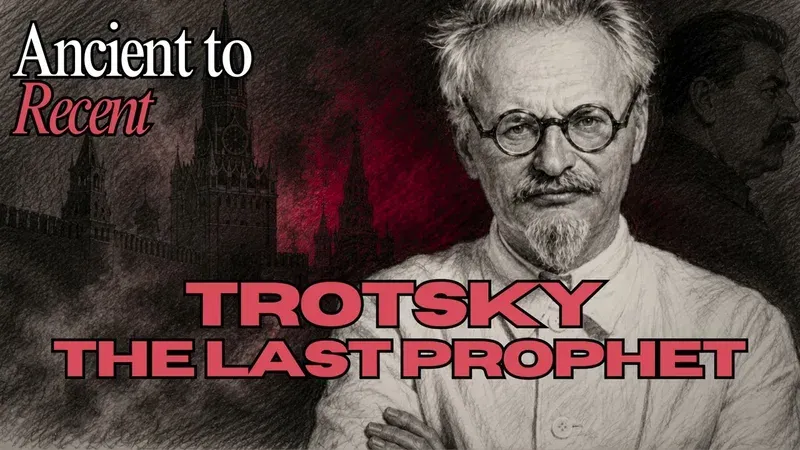
Leon Trotsky: The Last Prophet — Part 1
1 August 2026 · 41 min · Season 1
 Watch on YouTube →
0:0041:52
Also on
Rate the show
Ratings are how new listeners find the show. It takes a minute and it makes a real difference.
One of history's greatest revolutionaries awaits his assassination.
As Leon Trotsky sits inside his heavily guarded villa in Mexico City, he knows that Joseph Stalin has not forgotten him.
Once hailed as Lenin's brilliant lieutenant and commander of the Red Army, Trotsky has become the Soviet dictator's most dangerous enemy. His extraordinary journey began decades earlier on the vast plains of the Russian Empire.
In this opening episode of our new series, we trace Trotsky's life from his childhood as Lev Bronstein on the Ukrainian steppe to his transformation into one of the most influential revolutionaries of the twentieth century.
We explore the world of the Romanov Empire, the reforms of Alexander II, the rise of industrialisation, and the social tensions that pushed millions towards radical political ideas.
As Russia hurtles towards crisis, the young Trotsky embraces Marxism, endures imprisonment and exile in Siberia, escapes to Western Europe, and encounters Vladimir Lenin for the first time.
The episode also examines the failed Revolution of 1905, the growing divisions within the socialist movement, Trotsky's first meeting with the little-known revolutionary Joseph Stalin, and the outbreak of the First World War, which would bring the Romanov dynasty to the brink of collapse.
How did the son of a prosperous farmer become history's most famous revolutionary exile?
Why did Trotsky believe that only revolution could save Russia?
And how did the First World War create the conditions that would transform both Trotsky and the twentieth century?
Join Joseph Parkinson as Ancient to Recent begins the extraordinary story of Leon Trotsky, the revolutionary who helped change the world before becoming the greatest enemy of Joseph Stalin.
🎧 New episodes every Saturday
📲 YouTube, Spotify & Apple Podcasts | @AncientToRecent
#Trotsky #RussianRevolution #HistoryPodcast #SovietHistory #RussianHistory #Stalin #Lenin
Read transcript
This transcript is automatically generated, so it may contain typos and misheard names.
Life is beautiful that the future generations cleanse it of all evil, oppression and violence and enjoy it to the fall. Leon Trotsky The afternoon sun hungover the quiet streets of Choikan on the southern edge of Mexico City. Behind high walls topped with watchtowers and steel gates, stood one of the most heavily guarded homes in the world. Every precaution had been taken. Armed sentries patrol the grounds. Steel doors barred the entrances.
Windows were protected behind thick shutters. Just three months earlier, Soviet agents had stormed the billa in a hail of machine gunfire, riddling the bedroom with bullets. The target? Lyon Trotsky, the communist revolutionary, former right hand man of Lenin, once hailed as the brightest star in the Red Galaxy, hero of the revolution and commander of the victorious Red Army. But Trotsky was a fallen star. He had butted heads with Joseph Stalin, a man Trotsky underestimated and dismissed as the outstanding mediocrity of the party. Against all odds, Trotsky had survived the assassination attempt.
But Trotsky knew Stalin would never relent. It was only a matter of when and in what form. That afternoon, a familiar visitor arrived at the gates. The guards recognized him. He'd been here many times before. He carried no obvious weapon. His manner was calm. His papers appeared in order. After a brief surge, he was waved inside. The visitor crossed the courtyard and entered the house. The man greeted the old revolutionary politely.
He brought with him an article, he explained, and hope Trotsky might do him the kindness of sparing a few minutes to read it. It seemed an ordinary request. Trotsky agreed. The two men walked together towards the study. Outside, the guards resumed their watch inside the doors close behind them. For a moment, the room fell silent. Trotsky lowered himself into his chair and reached for the manuscript. Behind him, the visitor stood motionless, patient, waiting. The floorboards creaked as the man stepped closer. Time slowed.
His hand reached into his coat, gripping the weapon he had concealed from the guards. His eyes fixed, his breathing calm, his hand steady, Trotsky, the great prophet of the revolution, had foretold the future yet again. One day Stalin would indeed have his revenge. Welcome to Ancient to recent, My name is Joseph Parkinson and today we begin a brand new series, The Last Prophet, The Life of Leon Trotsky. Episodes of Ancient to Recent are out every Saturday and are available on YouTube, Spotify and Apple Podcasts. Leon Trotsky or as he was born Lev Devinovich Bronstein entered the world on the 7th of November 1879. He was born on his parents farm in Yanovka, modern day S Ukraine, then part of the Russian Empire. It was a place of immense skies and endless horizons. In every direction stretch the great black earth of the Ukrainian steppe, amongst the most fertile farmland on earth. During the summer, the wheat rippled like a golden sea beneath an immense blue sky.
In winter, the landscape disappeared under a blanket of thick snow, the icy winds sweeping unhindered across hundreds of miles of open country. Lev's father, David Bronstein, had risen from poverty through relentless determination. Illiterate for most of his life, he nevertheless became one of the most successful farmers in the district, leasing hundreds of acres of land, employing labourers and building a prosperous estate almost entirely through hard work and fierce ambition.
His mother, Anna Bronstein, was of a rather different temperament. She was educated, loved literature and ensured that books occupied an honoured place within the Bronstein household. If David represented industry and practical success, Anna introduced her son to the world of ideas. It was an unusual upbringing. The Bronstein's were Jewish but not especially religious, nor were they impoverished. In later life. Trotsky would reject attempts to portray him as a child of misery. His family lived comfortably by the standard of the day. There was food on the table, servants worked the farm and the household wanted for little.
Yet beyond the boundaries of the estate, they another world entirely, the vast domain of the Romanov SARS. In 1879, the Russian Empire stretched from Poland to the Pacific Ocean. It covered 1/6 of the world's land surface and was home to more than 100 million people, speaking dozens of languages and practising countless religions. It was an empire of astonishing diversity. Under the leadership of czars, repeated the great Alexander the Second, the Russian Empire had experienced rapid and violent expansion. The Baltic states were added in the early 18th century. In the late 18th century, Russia began pressing into the Caucasus.
Georgia was added in pieces between 1801 and 1867, Ukraine was annex slice by slice over a period of 150 years, and the Central Asian steppe was subjugated in the mid 19th century. As Russia expanded, it also ascended to ever greater levels of power, once viewed as a provincial backwater by the courts of Europe, one for which no European royal family would allow any of its children to marry into. By the late 18th century, things were beginning to change. Saint Petersburg, named after Peter the Great, was a glittering modern capital built to show off the new ascendant power to the world.
Russia was increasingly important on the battlefields of Europe, playing a crucial role in the defeat of Napoleon. Napoleon invaded in 1812, but by 1814 Russian Cossacks were watering their horses in the Seine SAR Alexander The First was, by the conclusion of the Napoleonic War, the most powerful monarch in continental Europe. But it was not all plain sailing for the aspiring superpower. As Russia expanded it acquired minorities who chafed under the ever spreading wings of the double headed eagle.
Poland carved up between Russia, Prussia and Austria in successive partitions between 1772 and 95 before being re established briefly by Napoleon was then guzzled almost whole by the Russian eagle at the Congress of Vienna in 1815. If the Russian eagle had stomach problems then was perhaps something she had eaten. Poland gave Russia repeated bouts of indigestion with bloody uprisings in 17941830 and 1863. But it was not just troublesome and ungrateful minorities unwilling to be civilized by the tsars that were giving Russia problems. Russian officers returning from the Napoleonic Wars had encountered the ideas of the French Revolution with the passing of Alexander the 1st in 1825. Some viewed this as the opportune time to press for political reforms.
The officers demanded the abolition of serfdom, a constitution and limits to be placed in the power of the monarch. Perhaps believing they could intimidate the news on Nicholas the First, the reformers, known as Decemberists, was soon to be be disappointed. Nicholas listened to their demands and then turned the cannons on them. The Russian Empire was what was called an autocracy, an absolute monarchy. The state was run by the Tsar, who commanded with the authority of God, with no limits on his power.
His will was law. There was no place in this system for the petty squabbles of parties and politicians. There was only obedience. But the 19th century was a time of rapid change and even continents moved with the correct application of force. After Russia experienced disastrous defeats to France, Britain, Piedmont and the Ottoman Empire in the Crimean War of 1853 to 56 and the death of Tsar Nicholas the 1st in 1855 and new Tsar came to the throne under Alexander the Second, a program of widespread and much needed reforms was launched. Serfdom, the physical owning of peasants by the aristocracy in a system similar to, though nowhere near as harsh as slavery, was done away with in 1861, two years before Abraham Lincoln issued the Emancipation Proclamation. Alexander the Second proved to be a rarity in the history of Russia, either in it's Romanov or Soviet era. He combined competence with vision and human decency. Further reforms followed in 1864. The Zempsva.
Local councils for administering infrastructure were created, the legal system was rationalised and some restrictions, though admittedly not all, on Jews and other minorities were lifted. Education was expanded and the 25 year mandatory draft for military service was abolished. These reforms were accompanied by the creation of banks and rapid economic modernisation and investment in railroads. But for all of his farsighted reforms, Alexander the Second was still a Romanoff.
He never fully committed to truly passing power from the crown to an elected parliament, as it happened in places such as Britain, though, the Tsar was committed to reform. These reforms took place within The Tempest social and economic pressures on Russia in the late 19th century. As investment and economic development set in, so too did industrialization. Millions of many newly freed serfs flooded into the industrial boom towns of Moscow, Kiev and Saint Petersburg. These former peasants had been promised a bright new future after the abolition of serfdom.
What they found instead was poverty, debt and often ruin. Angered by the disappointment of new found freedoms, they were sucked into the black mills of the industrial heartland. There they found squalid conditions, long hours and meagre pay. Millions of people, blackened by soot and ground down by heavy labour, found themselves drawn to new ideas. The old world of Thrones and dominions, of crown and church seemed to offer little to the huddled masses of the slums of Saint Petersburg.
To them, new ideas spoke of an entirely different world. Fiery prophets like Marx, Engels and many others spoke of socialism, brotherhood and equality. Others sang a different song. Some spoke of democracy, others of appeals to nationalism. Others still pointed the finger at ethnic minorities or spoke of sinister were conspiracies hatched by shadowy cabals of Freemasons and Jews. The Romanov system replied with repression.
Newspapers were censored. Speech was limited. Police spies infiltrated dissident groups and send troublemakers to prison or Siberian exile. Radicals struck back, turning their words into deeds. They began lashing out, assassinating government officials, and even targeting the royal family. Faced with growing violence, Alexander appointed General Mikhail Loris Melikoff in 1880. Melikoff produced a quote UN quote constitution that was really a series of conservative reforms it fully implemented. The reforms would fall well short of transforming the Russian Empire into a British style constitutional monarchy. However, they were a step small but essential towards the path of limited executive power and potentially democracy. That is, they would have been if they were ever implemented. As tensions rose, Sir Alexander the Second, one of the few Russian rulers whoever tried to sincerely bring about significant reforms, was subject to numerous assassination attempts.
On the morning of the 13th of March 1881, Alexander gave his consent to the implementation of what would be called the Laurice Melinkoff Constitution. Hours later, as Alexander was riding his carriage through the streets of Saint Petersburg, he was assassinated. A bomb was hurled under his carriage. The explosion gravely wounded the Tsar. Alexander was carried into a study. Doctors worked frantically to save the life of the Tsar, but his wounds were too grave.
For a few short hours, Alexander lingered his wounds beyond the repair of any doctor. His life slipped away and as he passed into the next World, so too did any hope of a peaceful transition of Russia from autocratic absolutism to constitutional government. If Alexander the Second was decent, competent and compassionate, the news are his son Alexander the Third was none of the above. A small minded reactionary with a tendency for outlandish conspiracies, Alexander the Third believed his father's reforms were naive, if not dangerous.
The news OP believed he knew what was wrong with Russia and how to make things right. Again. The problem wasn't deep seated economic inequality and antiquated government systems. No, no, no, the problem was the Jews and other rabble rousing troublemakers. These sinister forces needed to be put in their places and the preferred method of persuasion was to be the first and the hangman's noose. A new professional secret police called the Okrana was formed in 1881.
Soon enough, they set to work on the enemies of the state. Newspapers were shut down, striking workers were fired on, dissidents were arrested, and a wave of violent pogroms unleashed against the Jews of the Russian Empire sent millions heading for emigration. One of the Akrani's most long lasting effects was the creation of a hoax document purporting to be the notes of a secret meeting of a cabal of Jewish businessmen recounting a global conspiracy to subvert government around the world to Jewish interests. The document was called the Protocols of the Elders of Zion. It would be tremendously influential, including having a profound effect on a failed Austrian artist by the name of Adolf Hitler.
It is the foundational document of modern anti-Semitism and still poisoning our society to this very day. And As for the lorries Mellenkopf constitution that was to be deposited in the dustbin of history? Yet the Bronstein family seemed to be all together separated from The Tempest of changes that was sweeping through the Tsarist empire. Their comparative wealth and physical isolation spared them much by way of contact with the social forces tearing the empire apart.
Young Lev was able to grow up experiencing comparatively little by the way of persecution. Instead, his childhood was one of optimism and confidence. This was a confidence that soon shaped his personality, imbuing him with a deep sense of his own abilities. Teachers quickly recognized a remarkably intellect. He devoured books, absorbed new ideas with astonishing speed and display, the sharp tongue and fiery self-confidence that would later make him one of the greatest revolutionary orators of the 20th century. But the lonely farm at Yunovka could never contain such a restless mind.
Soon his parents would send him away to school. There, amid the bustling streets of the port city of Odessa, Le Bronstein would encounter something far more dangerous than poverty or oppression. He would discover ideas, and ideas before long would change not only his life but the history of the world. The optimism of Lev Bronstein's childhood could not last forever. Odessa's busy docks echoed with the cries of sailors speaking Russian, Ukrainian, Greek, Italian and Yiddish.
Steamer ships crowded the harbours. Factories belched black smoke into the sky. Banks, cafes and theatres lined elegant boulevards, whilst only streets away dock workers and labourers lived in grinding poverty. It was a city where wealth and misery existed side by side. Lev excelled almost immediately. His teachers regarded him as one of the brightest pupils they had ever encountered. He possessed an extraordinary memory and insatiable curiosity and, perhaps most importantly, supreme confidence in his own intellect.
But that confidence was not always accompanied by humility. Even as a boy, he relished debates, disliked being contradicted, and quickly acquired A reputation for believing he was the cleverest person in the room. It was a trait that would carry him to extraordinary heights and make him many enemies. After completing school, Lev moved to the city of Nikolayev in 1896, intending to prepare for university. Instead, he found himself drawn into an altogether different education.
Russia's industrial boom had transformed cities like Nikolayev. Shipyards, engineering works and factories had attracted thousands of workers from the countryside. Many found themselves enduring 12 hour days, dangerous machinery, miserable wages and cramped, disease ridden housing. To young intellectuals searching for answers, it seemed obvious that something was profoundly wrong. Like many students of his generation, Lev first fell in with circles influenced by the Narodniks, the populist revolutionaries who believed Russia's future lay with the peasantry rather than the factories. But another set of ideas began to eclipse them, the writings of Karl Marx.
Marx argued that history itself followed discoverable laws. Society was driven not by kings or great men, but by economics. Every age was defined by a struggle between those who owned wealth and those whose labour had created it. Under capitalism, Marx argued, the industrial working class would eventually overthrow the old order, sweep away exploitation and build a socialist society. To let Bronstein these ideas possess an almost mathematical elegance, Marxism seemed to explain everything.
The poverty of the workers, the wealth of the aristocracy, the brutality of the tsar estate. History itself appeared to have a direction, and Lev became convinced that he had discovered it. He threw himself into revolutionary activity with characteristic intensity. He helped establish the South Russian Workers Union, organizing discussion circles, printing illegal pamphlets, and secretly distributing socialist literature amongst factory workers. He was only 18 years old, and it did not take long for the Zara secret police to notice.
In January 1898, the Okrana struck. Le Bronstein was arrested alongside dozens of fellow revolutionaries. Months of interrogation followed before he was transferred from prison to prison. Eventually the young revolutionary was sentenced, like so many enemies of the Romanovs state before him, to exile in Siberia. It was there, in captivity rather than freedom, that led Bronstein's transformation truly began. The quiet farmer's son from the Ukrainian steppe was about to become a symbol of revolution. 4 long years passed beneath the endless skies of Siberia to the Tsarist authorities. Exile was intended to extinguish revolutionary zeal. Instead, it often refined it.
Lev Bronstein spent his years reading voraciously, writing constantly, and debating politics with his fellow exiles. He married another revolutionary, Alexandra Sokolovskaya, and together they had two daughters. Yet even in the frozen wilderness, Lev never imagined exile would be the end of his story. And in the summer of 1902, he escaped. He concealed beneath a load of hay, travelling under forged papers and adopting a false surname taken from one of his former jailers, he slipped through the fastness of the Russian Empire before crossing into Western Europe.
From that moment onwards, Lev Bronstein would become known to history as Leon Trotsky. His destination? That was London. At the beginning of the 20th century, the British capital had become a refuge for political exiles from across Europe. Revolutionaries, anarchists and socialists crowded into smoky cafes and cramped meeting rooms, arguing endlessly over how to remake the world. It was here that Trotsky first met the man who would shape the rest of his life, Vladimir Ilitch Ulyanov, better known simply as Lenin. Trotsky immediately recognized that Lenin was no ordinary political activist.
He was utterly consumed by revolution. Patient, disciplined, and possessed of an iron determination, Lenin approach politics not as an intellectual exercise but as a military campaign. Every alliance, every newspaper article, every debate served only one purpose. The seizure of power, mercy, compromise and sentimentality have the place in his. Calculations To Lenin, the revolution mattered more than friendship, more than principles of personal loyalty, and, if necessary, more than human life itself.
He had become one of the leading figures within the Russian Social Democratic Labour Party, a small underground Marxist organization committed to the overthrowing of the Romanov dynasty. Despite its grand ambitions, the party numbered only a few 1000 members. Against them stood one of the largest empires on earth, the vast bureaucracy of the Tsar, the army, the police, the Okrana. At first glance the struggle appeared hopeless. Yet the revolutionaries possessed another problem. They could scarcely agree amongst themselves. In 19 O3, the party split into two bitterly opposed factions. Lenin's supporters became known as the Bolsheviks, meaning the majority, although the name soon became something of a historical accident.
Lenin argued that the coming revolution required an elite organization of professional revolutionaries, tightly disciplined and absolutely obedient to the party leadership. Success would depend not upon numbers but upon unity, secrecy and iron discipline. His opponents became known as the Mensheviks or the minority. They believe socialism could only emerge after Russia's development into a modern industrial democracy.
Rather than a tightly controlled revolutionary vanguard, they favoured a broad or Democratic Party that would cooperate with liberals and other opponents of the czar. The disagreement appeared technical. In reality, it reflected profoundly different visions of how history itself should unfold. Trotsky initially found him so closer to the Mensheviks. Although he admired Lenin's intellect, he recoiled from what he regarded as Lenin's authoritarian instincts.
Trotsky feared that a party demanding absolute obedience might one day substitute its own dictatorship for the freedom it claimed to seek. For several years, Trotsky attempted to bridge the widening gulf between the two factions. He failed. The division would shape the future of Russia, and history was about to intervene. On the other side of Europe, the Romanov Empire was drifting towards catastrophe. In 19 O 4, Zarnicholas the Second LED Russia into a war against Japan.
Few Europeans believed an Asian power could defeat one of the great empires of Europe. They were spectacularly mistaken. Russia suffered humiliation after humiliation. It's armies were defeated, it's fleet destroyed. Confidence in the Tsar began to crumble. Then, on a freezing Sunday in January 1905, thousands of workers marched peacefully through the streets of Saint Petersburg, carrying icons and portraits of Nicholas the Second.
They came not to overthrow the Emperor, but to beg for his help. Instead, Imperial troops opened fire. Men, women and children fell beneath a volley of bullets. The snow ran red with blood. The massacre remembered as Bloody Sunday, shattered forever the myth of the benevolent song. Across the Empire, strikes erupted, universities emptied. Mutiny spread through the armed forces. And for the first time, the Roman of Thrones seemed to tremble.
After years in exile, Trotsky believed the revolution he yearned for had arrived at last. Trotsky wasted no time. A strike spread across the Russian Empire and the authority of the Czar faltered. He slipped back into Russia under a false identity. The country he returned to was almost unrecognisable. Factories stood silent, railways had ground to a halt, universities emptied, peasants attacked the estates of their landlords, whilst mutinies broke out within the armed forces. For the first time in centuries, it appeared that the Romanov autocracy might actually fall.
Yet this revolution was unlike the great revolutions of France. There was no single leader, no central command, no organised revolutionary government waiting in the wings. Instead, workers themselves began creating new institutions across the empire. They elected councils to coordinate strikes, distribute food, and maintain order. These councils became known by a Russian word that would soon become famous across the world. Soviets, the most important, emerged in Saint Petersburg, the imperial capital itself.
Trotsky arrived just at the moment it reached its zenith. Barely 26 years old, possessed of extraordinary energy and an electrifying gift for oratory, he rapidly became one of the Soviets most influential voices. When it's chairman was arrested, Trotsky emerged as the council's leading figure. Each day he addressed enormous crowds of workers. His speeches blended intellectual brilliance with revolutionary passion. Witnesses later recalled that he seemed capable of holding thousands spellbound.
To many workers, he embodied the revolution itself. But Trotsky understood something even more important. The Saint Petersburg Soviet was more than a strike committee, it was becoming an alternative government. Orders issued by the Soviet increasingly carried greater authority amongst workers than those issued by the SARS ministers. For a brief, intoxicating moment, it appeared as though 2 governments now existed inside Russia. 1 old one new one resting upon tradition, the other upon revolution. Trotsky believed history itself was unfolding before his very eyes.
Yet the Romanov state had not collapsed, it had merely staggered. SAR Nicholas the Second had brought himself precious time. In October he issued what became known as the October Manifesto, promising civil liberties and the creation of an elected parliament, the Duma. Many liberals celebrated. Some believe Russia had finally begun the long journey towards constitutional government that had been thwarted by the fascination of Alexander the Second. Trotsky was unconvinced.
He dismissed the concessions of little more than a tactical retreat. The czar, he argued, had yielded only because he was a weak Once he regained his strength, he would reclaim every concession he'd made. History would prove Trotsky right. As strikes subsided and royal troops return from the disastrous war against Japan, the balance of power shifted 1 by 1. The centres of resistance were isolated. Then in December 1905, the government struck. Soldiers surrounded the headquarters of the Saint Petersburg Soviet.
The leaders were arrested without a fight. Amongst them was Leon Trotsky. The revolution was not yet entirely over. In Moscow, workers erected barricades and fought desperate St. battles against government troops. Artillery blasted whole districts into submission. The last pockets of resistance were crushed beneath overwhelming military force. The first Russian Revolution had failed once again. For Mr. Trotsky, prison beckoned.
Exiles marched east towards Siberia. The Czar had survived. Trotsky was placed on trial alongside the other leaders of the Saint Petersburg Soviet. Even there in the dock, he refused to moderate his words. The courtroom became another platform from which he denounced the regime. He was sentenced once more to exile in Siberia. It was the second time the Romanovs had attempted to bury him in the frozen wilderness. It would not be the last For a 19 O 7.
Displaying the same audacity that had already become his trademark, Leon Trotsky escaped. Once again. The revolution had been defeated, but for Trotsky it had been a revelation. The workers Soviets had shown him what a revolution could look like. The Tsar had shown him that autocracy would never surrender power peacefully. The next revolution, Trotsky concluded, would have to be more organized, more disciplined, and far more ruthless. The lessons of 19 O 5 would haunt both Trotsky and Russia for the next 12 years.
In the spring of 19 O 7, delegates from across the Russian Empire gathered in London for the 5th Congress of the Russian Social Democratic Labour Party. They met in a rather damp church in Islington, watched closely by British police, but otherwise left to conduct their arguments in peace. The future of the revolutionary movement was to be debated. Amongst hundreds of delegates sat two men who had one day determined the fate of millions.
Leon Trotsky was one, the other a relatively obscure Bolshevik organiser from the Caucasus. He was born Yoshif Virianovic Deshugeshvili. As a revolutionary he had many names. So, so the priest, the milkman poked Mark Joseph Koba. But history would remember him by one name, Joseph Stalin. If the two men notice one another, neither could possibly have imagined that one day only one of them would survive. Trotsky later claimed he scarcely remembered the encounter.
Perhaps he genuinely did not. Compared to Trotsky, Stalin cut an unremarkable figure. Short in stature, dressed plainly, his face deeply pitted by childhood smallpox, his left arm permanently weakened from an earlier accident, he lacked the commanding presence of many of the party's celebrated intellectuals. Trotsky, by contrast, was impossible to ignore. Immaculately dressed, articulate and devastatingly clever, he possessed one of the finest speaking voices in European politics.
When Trotsky entered a debate, people listened. When he rose to speak, Halls fell silent. He carried himself with the unmistakable confidence of a man convinced history had marked him out for greatness. Stalin projected something altogether different. He was no great orator. His low tone and thick Georgian accent did not lend itself to theatrics. His speeches rarely stood emotion. But his brilliance lay elsewhere. Patient, observant and remarkably adept at understanding people, he quietly cultivated friendships, remembered personal loyalties and built networks of obligation that others scarcely noticed. Stalin was the master of the subtle gesture that forged deep bonds of loyalty and commitment.
Where Trotsky dazzled audiences, Stalin won over individuals. Trotsky inspired admiration, Stalin inspired trust. Trotsky struggled with falling friendships, and his need to assert his intellectual superiority cost him many. As an ally, he could not resist caveating every compliment with the criticism. His ability to wound with a thoughtless phrase or cutting comment contrasted deeply to Stalin's daft touch. When Trotsky dismissed even senior Bolsheviks as not worthy of his time, Stalin would go out of his way to remember the names and personal stories of even minor party functionaries. When Trotsky would rudely dismiss those whose conversation might drift to any topic other than revolution, Stalin would enquire about comrades, parents, stay up all night telling stories, and took sleeping children into bed. Stalin possessed an altogether different power. These differences were greater than mere style where Trotsky was finally spoken.
Stalin was coarse. Where Trotsky was the epitome of the bourgeois dandy, Stalin was the salt of the earth. Where Trotsky was a metropolitan international, Stalin was a deeply rooted provincial. Yet beneath their contrasting personalities, they striking similarities. Both believed utterly in the revolutionary cause. Both were prepared to employ violence in its service. Both viewed compromise as it best a temporary expedience.
Both possessed an unwavering belief that history could be bent to human will. Neither man doubted that Russia's future belonged to the revolution. The only unanswered question was who would lead it. Neither Trotsky nor Stalin could yet know that within little more than a decade they would stand shoulder to shoulder at the head of the greatest revolution of the 20th century. Nor could they know that soon afterwards they would become the bitterest of enemies. Their struggle would not simply determine the fate of two men, it would determine the fate of millions. These differences need not have added up to much. Stalin and Trotsky are hardly the first people to fail to see eye to eye.
Have things worked out differently than the personality clashes of an obscure group of Russian Marxists might have been lost in the unread Diaries of yet more devotees for one of the many causes that history has long since passed by. But Trotsky was a man born for the centre stage, and history had plans for him. On the 20th of June 1914, Franz Ferdinand, heir to the throne of the Habsburg Austro Hungarian Empire, paid what would have been an otherwise routine visit to Sarajevo, the capital of the recently acquired Austrian province of Bosnia. The Irish Duke was subject to a failed assassination attempt by Serb nationalists and speed off to the safety of the Governor's palace, but royal privilege has its responsibilities and the archuk insisted on visiting those wounded in the day's events.
As the chauffeur speed through the streets of Sarajevo, he took a wrong turn down a one way St. stopping to reverse the royal car. Happened by 1 of histories most unlucky of consequences to have stalled immediately in front of Gabriello Princip, one of the members of the Serb Suicide Squad sent to assassinate the Archduke. Not believing his luck, the 19 year old Princip pulled his revolver and shot the Archduke and his wife Sophie dead.
It was the spark that ignited the Great War. Diplomatic messages flashed between the great capitals of Europe. Vienna sought assurances from Berlin. Belgrade turned to Saint Petersburg and Saint Petersburg to Paris. The tangled web of European alliances dragged a continent into the abattoir of the First World War. As Sir Edward Gray, foreign Secretary of the British Empire, said at the time, the lamps are going out all over Europe.
We shall not see them lit again in our lifetime. Soon Azaz armies were pressing against the borders of Habsburg Galicia and marching into E Prussia. At first it seemed all too easy. The great Russian bear would put the humiliation of the 19 O 5 Russo Japanese War behind her and make short work of the puny Austrian and German foe. Alas, it was not to be. Despite early successes against Austria, the Russian advance into E Prussia was checked and the Russian army smashed at the Battle of Tannenburg by the Germans in August 1914. It was the first of a series of humiliating, bitter and highly costly defeats that bled the Russian army white over the years to come.
More poorly trained, poorly fed and poorly LED Russian soldiers would be hurled against German machine guns and barbed wires, only to be slaughtered in ways. With the war going badly, the bunglings are Nicholas the Second made a fateful decision. He put himself in charge of the army. Now. Nobody else could be blamed for the slaughter except the Tsar. Things were made worse by the Tsar's deeply unpopular and unfortunately, German life.
Serena Alexandra stayed behind and played a hand in the running of domestic affairs. She was unfairly slandered for having an affair with an eccentric monk for the name of Rasputin. Her very Germanness, coupled with lurid cartoons appearing in the press depicting her supposed sexual adventures with Rasputin and the growing shortages in cities fuelled anger. Hunger and the weekly butcher's bill of war LED to revolution which spilled into the streets.
And in February 1917, with the workers of Petrograd, the renamed St. Petersburg Downing Tours and taking up the Red Banner, the Czar was forced to abdicate. A new provisional government was formed and led by the moderate socialist Alexander Kerensky. But as Kerensky sought to command the state from the Winter's Palace, the workers and soldiers formed their own power base, the Petrograd Soviet. The fall of the Romanovs had transformed Russia almost overnight. The old order, which for more than three centuries had ruled 1/6 of the earth's land service, had collapsed with astonishing speed.
Yet the revolution that so many dreamed of had sold remarkably little. The war still raged. The economy was disintegrating. The countryside was in anarchy. The cities were starving, the army was melting away. And across the empire, dozens of political movements now competed to decide what kind of Russia would emerge from the ruins. Liberals dreamed of parliamentary democracy. Moderate socialists hope to build a fairer society through compromise. National minorities demanded independence. Generals plotted to restore the old order, and waiting in exile was Vladimir Lenin.
Within months, he would return to Russia, carrying a program so radical that many dismissed it as a political fantasy. Yet it was a program that Leon Trotsky would soon embrace with all the force of his extraordinary intellect. Trotsky, at the time of the February Revolution, was in New York, half a world away. He scrambled to get back to Russia as soon as possible. 12 long years had passed since the dashed hopes of 19/05/12. Years of bitter recrimination, endless arguments and relentless organizing.
Now at last their moment had arrived, the inevitable crisis of capitalism that presented untold opportunities. But without the correct leadership and proper vision, this opportunity would be squandered, just like 1905. If left to their own devices that the moderate socialist like Kerensky and the Russian liberals will construct a moderate capitalist state, they would turn to bourgeois liberty and parliamentary democracy. To Trotsky, Lenin and the Bolsheviks, this would be worse than a crime.
It would be a blunder. Now was not a time to compromise with capitalism, but to kill it, to seize the moment that history had thrust into their hands, to answer the call of destiny, to forge a new world. Now was the time for the workers themselves to take into their own hands the fruits of their labour. Now was the moment for the huddled enslaved masses to speak clearly with one voice, to stand straight with dignity and defiance.
To do this, there could be no mercy, no pity, no room for sentimentality. There could be only ruthless action. And those who stood in the way of the creation of a new world, a heaven on earth, the workers paradise would be crushed. As the Bolsheviks gathered in Petrograd to plan their seizure of power, another coup was being prepared. Joseph Stalin also rushed to Petrograd. The man Trotsky would later describe as the outstanding mediocrity of the party now glowered at Trotsky across committee tables and quietly whispered against him in the shadows.
Trotsky held audiences spellbound with the brilliance of his oratory. Stalin chaired committee meetings, cultivated alliances and patiently built his influence within the party. As Trotsky ascended towards the summit of the revolution, his fate was already becoming entwined with that of Joseph Stalin, the man who would one day bring about his downfall. Thank you for listening to Ancient Recent. My name is Joseph Parkinson.
To support our work, subscribe today and leave a comment and rating. Episodes of Ancient Recent are out every Saturday and are available on YouTube, Spotify and Apple Podcasts.