
#60
500 Men vs an Empire: Hernán Cortés and the Conquest of Mexico — Part 4
25 July 2026 · 48 min · Season 1
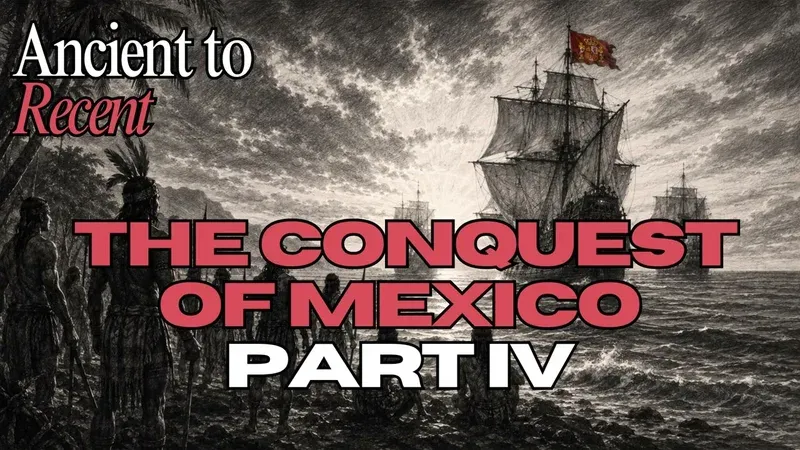 Watch on YouTube →
0:0048:16
Also on
Rate the show
Ratings are how new listeners find the show. It takes a minute and it makes a real difference.
The conquest reaches its devastating conclusion.
As Hernán Cortés launches his final assault on Tenochtitlan, one of the greatest cities on earth becomes the scene of one of history's most brutal sieges.
Thirteen brigantines dominate the waters of Lake Texcoco, while tens of thousands of Spanish and indigenous allies advance along the great causeways. Street by street, canal by canal, the fate of the Mexica Empire hangs in the balance.
This episode explores the final months of the siege of Tenochtitlan, where starvation, disease and relentless warfare reduce a magnificent civilisation to ruins.
Despite overwhelming odds, Emperor Cuauhtémoc and the Mexica fight with extraordinary courage, refusing every offer of surrender as the city is systematically destroyed around them.
But the story does not end with military victory.
Following the fall of Tenochtitlan, we examine how New Spain was built upon its ashes.
As missionaries sought to convert millions to Christianity, indigenous communities adapted, resisted and reshaped the new colonial world in ways that continue to influence Mexico today.
We also follow Hernán Cortés after his greatest triumph, as political rivals, royal officials and the Spanish Crown gradually stripped the conqueror of the power he had fought so hard to obtain.
Was the conquest truly won by 500 Spaniards alone?
How much did indigenous allies determine the outcome of the war?
And what lasting legacy did the fall of the Mexica Empire leave for Mexico, Spain and the modern world?
Join Joseph Parkinson as Ancient to Recent concludes the extraordinary story of Hernán Cortés and the conquest of Mexico.
🎧 New episodes every Saturday
📲 YouTube, Spotify & Apple Podcasts | @AncientToRecent
#HernanCortes #ConquestOfMexico #AztecEmpire #Tenochtitlan #Cuauhtemoc #HistoryPodcast #Conquistadors #MexicanHistory
Read transcript
This transcript is automatically generated, so it may contain typos and misheard names.
The broken spear lies on the road. We have torn our hair in grief. Florentine Codex. For days smoke drifted above the waters of Lake Texcoco. Great black columns rose from the charred Timbers of what had once been the Rome of the Americas. The broad avenues that had bustled with merchants, nobles and priests they buried beneath shattered stone. The canals, once crowded with thousands of canoes carrying flowers, food, and every luxury imaginable, were choked with rubble, broken timber, and the dead.
Where the beating of the temple drum had once echoed across the lake, there was now, under the crackle, the smouldering ruins. The Great Pyramid still stood, but scarred by cannon fire, blackened by smoke, and surrounded by streets reduced a little more than fields of broken masonry. The smell was beyond description. Burned wood, rotting flesh, stagnant water, the sweet sickly odour of death hungover the valley. Those few inhabitants who remained wounded, starving, weakened by disease that caused fits of coughing and left great marks upon their body that left them writhing in agony.
Those that could still summon the strength to pull themselves to their feet wandered silently through the ruins, searching for missing relatives, gathering what little food could still be found, and trying to make sense of a world that had ended in the space of a few terrible weeks. Only months earlier this had been a great metropolis, a city that had astonished the strange man who's coming, had thrown the cosmos into anarchy.
The gods who drank daily of the blood sacrifice required to maintain the order of the universe had fallen. The 5th sun had risen. The world had ended. Welcome to Ancient to Recent. My name is Joseph Parkinson and today we complete our story of Hernán Cortés and the conquest of Mexico. Episodes of Ancient to Recent are out every Saturday and are available on YouTube, Spotify, and Apple Podcasts. Only a few short weeks before, 2 great civilizations prepared for battle.
Like prize fighters, they had stalked each other, watching for weaknesses, waiting for the moment to strike. Now the waiting was over. The time for war had arrived. For months, the hills around Lake Texcoco had echoed with the sounds of axes. Thousands upon thousands of indigenous labourers swung picks into hard earth and drove their shovels into the dry lake bed. Others hauled enormous Timbers across the mountains on their shoulders.
Day after day, week after week, an immense procession stretching for miles carried the raw materials of Conquest towards the lake. There they laboured beneath the spring sun, digging a broad canal from the workshop of the water's edge. Nearby, Spanish shipwrights fitted together the strange wooden vessels whose individual pieces had first been fashioned hundreds of miles away in the coast before being dragged inland over mountain passes.
Again and again, Mexica raiding parties attempted to burn the unfinished ships. Again and again they had been driven back. At last, on the 28th of April 1521, the work was complete. Priests celebrated Mass beside the canal, the brigantines were sprinkled with holy water, and blessed banners bearing the arms of Castile fluttered in the breeze. Then, amid the sounds of trumpets and drums came the cries. Long live Castile, Long live King Charles, Long live Christ our Saviour. 1 by one the 13 Brigantine slipped into the waters of Lake Texcoco. For the first time, European warships sailed upon the lakes of Mexico.
Cortés had transformed an island sea into a battlefield. His army was divided into 4 commands. Three would advance overland along the great causeways leading towards Tecnopticlan. Musketeers, crossbow men and cavalry would March beside 10s of thousands of indigenous allies. The 4th division would fight upon the water. Cortés reserved that command for himself. The brigantines would sweep the lake clear of Mexica canoes, protect the land columns and cut the capital's remaining life lines.
On the 22nd of May, the great advance began. 3 days later the army reached the approaches of the city. Almost immediately, the fighting commenced. The Spaniards attempted to seize and destroy sections of the Causeway, hoping to isolate Tenochtitlan and prevent Mexica counter attacks, but the defenders resisted with extraordinary determination. Again and again, the assault was thrown back. Meanwhile, the brigantines found themselves supported by thousands of allied indigenous canoes, transforming the lake into a vast floating battlefield. Before launching his final assault, Cortés noticed columns of smoke rising from settlements along the Lee shore. Signals fired.
Someone was warning the capital. He wasted no time marching into the nearest settlements. He ordered a brutal assault. The inhabitants were cut down and the town put to the torch. It was a grim reminder that Cortés intended to crush not merely the city itself, but any community that aided it's defence. Yet even this failed to halt the Mexica. Small bands of warriors struck without warning. They appeared from canals, Reed beds and causeways, showering the invaders with arrows before disappearing as quickly as they had come.
The Spaniards found themselves fighting an enemy who knew every canal, every dyke and every hidden approach. Cortés quickly realised his original plan was not fit to survive first contact with the enemy. Rather than concentrating his brigantines along the advancing land columns, he shifted much of his fleet towards the eastern waters bordering the southern Causeway, allowing the ship to support threatened sections whilst freeing experienced infantry for fighting ashore. Fresh Spanish reinforcements was summoned, but the Mexica showed no sign of weakening.
Every advance was met with another determined counter attack. The siege of Tenochtitlan had begun. The Spaniards had not come to besiege a helpless city. They faced an emperor every bit as determined as Cortés himself. The young Mexica ruler called Cuauhtémoc threw himself into the defence of Tenochtitlan with remarkable energy. Messengers raised constantly between the districts of the city. Commanders reported the enemy's movements.
Fresh warriors were dispatched wherever the fighting crew. Fascist. Every Spanish advance was studied, every weakness exploited. The Mexica had learnt much from their previous encounters with the invaders. Captured Spanish swords and lances stripped from the dead during the Noche Trieste Cortés's desperate escape from the city only months before, were now turned back upon their former owners. The city itself became a fortress.
Bridges were torn up behind withdrawing defenders, forcing the Spaniards to halt, whilst portable crossings were dragged into position. Barricades, roads, across streets and causeways. From rooftops and temples came showers of arrows, stones and darts. On the lake. Thousands of walk canoes darted between the canals, landing fresh contingents of warriors wherever the pressure was greatest, before melting away again into the maze of waterways.
It was a masterpiece of improvisation. The Spaniards might possess steel, horse and cannon, but the Mexica possessed something equally formidable. They knew every street, every canal, every Causeway, every inch of the city for which they fought. Spanish progress became painfully slow. Every yard was purchased in blood. An advance made in the morning was often contested again before nightfall. Causeways seized an enormous cost, frequently had to be abandoned, only to be fought over once more in the same day. The bodies of fallen comrades perished hours before fought over as their eyes, motionless, stared out as if calling for vengeance.
By the middle of June, however, the pressure was beginning to tell. 1 by 1. The great 'cause ways leading into the capital fell under Spanish control. Only the northern approaches remained open. Spanish commanders quickly recognised it's importance. So long as that narrow artery remained in Mexica hands, men, weapons and precious food could still reach the city. A ferocious struggle followed. Again and again the defenders counter attacked with desperate determination.
At last, after days of savage fighting, the Spaniard severed the final route. Techno Ticlan was cut off. The noose was tightening. Cortés had never intended to reduce Techno Ticlan to rubble. Quite the opposite. He had dreamed of presenting the city intact to King Charles the 5th, a jewel for the emperor's growing domains, a capital more magnificent than any possession Spain had yet acquired in the Americas. Its markets, its palaces, its temples, its wealth, all with the monuments to Spanish imperial glory. A shining city on the hill from which Spain's imperial power and the Christian faith would radiate out. But the Mexica had no intention of surrendering such a prize. The tightening of the siege did not persuade them to flee. It strengthened their resolve.
If the city could not be saved, then neither would it be surrendered. Every district, every canal, every bridge, every rooftop, every house would become a battlefield. The Spaniards would not inherit A thriving capital. They would have to earn every stone with blood. But the third week of June, Cortés abandoned any lingering hopes of negotiations. He ordered a series of determined assaults into the city itself. Twice his soldiers forced their way forward. Twice they were driven back.
The deeper they advanced, the greater his unease became. Technotic Clown was unlike any city European soldiers had ever fought through. It's narrow streets ended abruptly at canals. It's high walls concealed hidden courtyards. It's flat rooftops formed elevated fighting positions. Behind every doorway, another ambush. Behind every corner, another barricade. The city itself seemed to sound like a snake ready to swallow an invading army.
Cortés feared that this was precisely what the Mexica emperor intended, to lure the Spaniards ever deeper into the maze, see all the streets behind them and destroy them piece by piece. If that was to be avoided, the city itself would have to disappear. Buildings were to be demolished, barricades levelled, canals filled. The Spaniards advanced only after reshaping the landscape around them. It was no longer merely an assault upon an army, it had become the destruction of an entire civilization.
There remained 1 objective whose capture might finally break the deadlock. The vast marketplace of Tlatelolco. It was the beating heart of the city, its principal source of food, its greatest commercial centre. If Cortés could seize it, the defenders would face an impossible choice, fight their way out or slowly starve behind the ruins of their once magnificent capital. But reaching the marketplace would mean driving his battered army deeper into the heart of Techno Ticlan than ever before. One final gamble.
If it succeeded, the empire would fall. Mexico would be his, a jewel, a present to be presented to the king himself. If it failed, then for the Spanish, the living would envy the dead. The dawn of the 30th of June 1521 broke of a Technotic clan. Exactly 1 year had passed since the Spaniards had fled the city in terror during the Noche Trieste. Now they returned not as fugitives and as conquerors. Cortés ordered simultaneous assaults from both the West and southern causeways, driving straight to the marketplace.
At first, everything seemed almost unnervingly easy. The defenders gave ground. Streets that had previously been fought over inch by inch now appeared strangely deserted. The Spaniards pressed forward too quickly, too competently. Then the trap was sprung. Warriors burst from rooftop side street and concealed canals. Bridges the Spaniards believed secure had once again broken apart, their retreat vanished. Spanish troops and their indigenous allies, pressing along the southern causeways found themselves cut off entirely. Surrounded on every side, the fighting descended into chaos. There was no room for cavalry, no space for discipline formations, only desperate men hacking and thrusting at one another from feet away.
Mexico warriors hurled themselves into the melee with astonishing ferocity. Many Spaniards were cut down where they stood. Others were seized alive, bound, beaten, dragged the streets towards the temple Mayo below. Their comrades could only watch in horror upon the summits of the Great Pyramid. Priests forced the captives onto the sacrificial stone. 1 by 1 the dagger rose into the sky. One by one it plunged down. Their chests were open, their hearts torn free and lifted towards the heavens before their lifeless bodies tumbled down the temple steps.
Soon their severed heads appeared upon the racks above the city. Even the brigantines proved vulnerable. Several grounded in the shallow waters surrounding the city. Mexica canoes swarmed over them from every direction. Savage fighting erupted upon the decks as warriors sought to drag yet more prisoners back to the temple. The defenders shouted taunts across the battlefield, reminding the Spaniards that exactly 1 year earlier, these same streets had witnessed their greatest debate. The psychological impact upon the Spaniards was immense. The Mexica seemed incapable of fear. Again and again they charged directly into cannon fire, into crossbows, into cavalry, straight into steel. Some warriors entered battle having consumed sacred intoxicants as part of religious rituals, whilst all fought with absolute conviction that the survival of their world depended upon victory.
No sacrifice seemed too great, no loss too terrible. The Spaniards paid back blood with blood. Wounded Mexico were hacked to pieces. When the fighting subsided, the murder began. Spanish soldiers shattered the skulls and opened the stomachs of stricken Mexica warriors and civilians standing over their prey. Their eyes are flame with bloodless AS2 civilizations clawed at each other. The Spaniards had expected the defendants to eventually break.
Instead, they found themselves confronting an enemy whose determination appeared only to deepen with every passing day. Yet appearances could be deceptive. For all the triumph proclaimed from the temples called, Tamak understood the terrible reality confronting his people. Yes, the Spaniards had suffered grievously. But inside the city another enemy proved far more relentless hunger. The food stores were almost exhausted. Disease stalked every district.
Freshwater had become desperately scarce. The dead lay where they had fallen. Still, the emperor refused to yield. Severed Spanish heads were dispatched in neighboring cities as grim warnings of the fate awaiting those who sided with the invaders. It was intended as a demonstration of Mexica strength. Instead, it revealed desperation, for the surrounding cities could see what the emperor could not conceal. The Mexica still fought magnificently, but they fought on the defensive. The empire no longer expanded.
It struggled to survive. Some indigenous allies did drift away from Cortés, but many more remained. Others, themselves under renewed attack by Mexica forces, pleaded urgently for Spanish assistance. Cortés responded immediately where the Mexica emperor could not. Spanish reinforcements drove back relief forces attempting to reach the capital, inflicting heavy losses before returning to the siege. Small Spanish and indigenous raiding parties crossed into the city almost daily, testing the defences, capturing prisoners, searching constantly for weaknesses.
The Spaniards themselves advanced with increasing caution. There would be no more reckless charges, no more costly surprises. Every canal was filled before the army moved forward, every barricade dismantled, every captured position secured before the next assault. Fresh Spanish soldiers continue to arrive from the coast, along with precious supplies of gunpowder. Now the conquest became brutally methodical. Rather than fighting for individual houses, the Spaniards simply destroyed them.
Walls were blasted apart by cannons fired from almost point blank range. Buildings that had stood for generations collapsed into clouds of dust. Combat engineers followed behind, levelling what remained and filling the canals with rubble. If Technopticlan could not be preserved, then like Sodom and Gomorrah, it would be erased. Within the shrinking city, the suffering became almost unimaginable. Food disappeared, clean water vanished.
Disease spread unchecked through an already starving and weakened population. Bernal Diaz later wrote that the streets were filled with the dead. Survivors searched desperately for anything that might sustain them. Roots, leather, weeds, rats, anything. Meanwhile, many of Cortés's indigenous allies suffered no such shortages. Spanish chroniclers recorded that some consumed the bodies of fallen Mexico warriors, a practice that horrified even many of the conquistadors themselves.
Still, the Mexica refused to surrender. Again, the Mexica emperor withdrew into yet another district. Again, the Spaniards followed. The same terrible process repeated itself. Advance demolition, the canals filled, Bring forward the cannon, reduce another neighborhood to ruin. One of the greatest cities on Earth disappeared house by house. Yet even as starvation hollowed their faces, even as disease weakened their bodies, the Messica continued to fight. Every ruined St. became another battlefield, every collapsed house another fortress, every surviving warrior another obstacle to conquest.
Cortés made repeated attempts to end the bloodshed. Envoys crossed the shattered city, carrying offers of negotiation. The envoys never returned their fate. The sacrificial altar. There would be no compromise, only victory or annihilation. At last, the defenders were compressed into the neighborhood city of Tall Taluko. There, amid the ruins, the surviving Mexica nobles gathered for one final council. The decision was made. If the city could no longer be saved, the Emperor himself must escape.
On the 13th of August 1521, the Mexica Emperor attempted to flee across Lake Texcoco by canoe. Spanish brigantines gave chase. Before long they overtook him. The last emperor of the Mexica was brought before Hernán Cortés. According to the Spanish chronicles, Kao Tamoc stood proudly before his conqueror. He neither begged nor pleaded. Instead he is said to have declared. I have done all that I was bound to do in defence of my city. Take this dagger at your belt and kill me. Cortés refused.
He spoke instead of his admiration for the courage for which the Mexica had defended their capital and assured the defeated emperor that his life would be spared. Yet no display of magnanimity could conceal the reality surrounding them. The city that only months before had astonished the Spaniards with its splendor had become a wasteland. Smoke drifted above black and ruins. The canals would choke with rubble and corpses. The air hung heavy with the stench of death. The silence of what had once been one of the greatest cities on earth was broken only by the crackle of smouldering buildings, the cries of orphan children beside the bodies of the parents, and the faint moans of those still waiting to die. Cortés permitted many of the surviving civilians to leave the shattered city.
Only then did the Spaniards finally withdraw from the ruins. They had achieved what few had thought possible. An empire had fallen. The impossible had been accomplished. Yet triumph felt strangely hollow. For Techno Ticlan had joined the ranks of history's greatest lost cities, like Troy, like Carthage, once the centre of the world, now a wasteland. I wonder if in that moment any of the officers and gentlemen in the ranks of Cortés's army, their minds might have wandered back to ancient Rome. Some 1666 years earlier, another conqueror had stood over another burning city.
When Carthage fell to the Roman general Skippy Amiolanus in 146 BC, he did not celebrate. He wept. And as the flames rose over the city that once rivalled Rome itself, he is said to a turn to the words of Homer, the fall of Troy echoing in his mind. A day will come when sacred Troy shall perish. Even in victory, Skippio feared that Rome Two would one day share Carthage's fate. Perhaps standing amid the ruins of Technocticlan, some among Cortés's officers felt the same. On ease, the Mexica empire had fallen. But for Hernán Cortés, the great uncertainty of his life had only just begun.
The smoke still drifted above the ruins of Technocticlan. Yet one question haunted the Conqueror more than any surviving Mexica army. What would King Charles the 5th make of it all? For more than a year after the city fell, no definitive word came from Spain. Across Europe, events of enormous consequences competed for the emperor's attention. In Castile, unrest simmered in the aftermath of the Revolt of the Commune eras, a rebellion that had only recently threatened royal authority itself. Beyond Spain, an obscure German monk named Martin Luther had ignited a religious revolution.
Luther's attacks upon the papacy, his demand that the Bible be translated into the language of ordinary people, and the rapid spread of his ideas through the newly invented printing press threatened to tear apart the religious unity of Christendom. Meanwhile, the Ottoman Empire continued to press against the frontiers of Christian Europe. Compared to these crises, astonishing though Cortés's achievements were, the conquest of a distant Kingdom across the Atlantic was not the emperor's only concern.
Yet while Charles remained silent, others did not. Across the ocean, Cortés's enemies continued their assault. For most, amongst them was Diego Velasquez, the governor of Cuba, who had never forgiven the man who had ignored his orders and sailed away to conquer an empire. Let us cross the Atlantic, accusing Cortés of rebellion, of treason as stealing a conquest that belonged to another royal Officials were dispatched to investigate.
Others arrived claiming authority over the new lands. Cortés refused to acknowledge them immediately. Instead, he delayed. He received them with courtesy, sent trusted representatives in his place, and once again relied upon the legal arguments that it served him so well. He maintained that he had not rebelled against the Crown. His loyalty, insisted, had always been to the king himself, not the governor of Cuba. The matter would be decided in Spain. Finally, in the autumn of 1522, the decision arrived. The accusations against Cortés had failed. His conquest was recognized.
Charles confirmed him as governor, captain general and Chief Justice of New Spain. It was an extraordinary vindication. The Spanish crown soon began reshaping the government of its rapidly expanding overseas possessions. In 1524, Charles established the Council of the Indies, a permanent body charged with overseeing Spain's growing empire across the Atlantic. The emperor was determined that no subject, however brilliant, should ever become too powerful. Alongside the honors Kim Royal officials whose purpose was as much to watch Cortés as to assist him. the Conqueror had won an empire, but now he would have to share its government. Yet another arrival would soon prove far more consequential than any royal administrator.
A small band of barefoot Friars was preparing to cross the Atlantic. They carried no swords, no cannon, no horse. But they would transform New Spain just as profoundly as the conquistadors who had conquered it. The conquest of the Michigan Empire had been won with steel. The conquest of its people would require something altogether different. For that task, the Spanish crown turned not to the sword, but men of the cross. The men who arrived in New Spain belonged to the Franciscan order.
Unlike wealthy bishops or powerful abbotts, they had taken a vow of poverty. They travelled on foot, owned almost nothing, and dedicated their lives to preaching. In 152412 Franciscan Friars landed in Mexico. They would later become known simply as the 12 Apostles of Mexico. To them, they had entered not merely A newly conquered land, but a battlefield between God and Satan himself. They looked upon the temples of the Mexica with horror. The idols that adorned them were not, in their eyes, harmless statues or alternative gods.
They were demons. The blood the stained the temple stairways, the human sacrifices offered upon the pyramids, the skull racks that lined the ceremonial precincts. These were to the Friars unmistakable signs that the Devil had established his Kingdom in the New World. Yet remarkably, for all of their religious conviction, many of the Franciscans did not look down on the indigenous people. On the contrary, they often spoke warmly of them.
The so-called Indians, they argued, had not embraced human sacrifice because they were naturally cruel. Rather, they had been deceived. For centuries Satan held them captive through fear. Their task was not to destroy these people, it was to liberate them. The Friars travelled from village to village. They learned the local language, nuathol. They preached through interpreters before eventually speaking directly to the indigenous audiences.
Churches and monasteries rose where temples had once stood. Thousands of indigenous Craftsman devoted themselves to constructing these new buildings, displaying extraordinary skill in carving stone, painting murals, and producing religious art. The Friars wrote enthusiastically of entire communities embracing Christianity, some claiming to baptize thousands of converts in a single week. Many indigenous people adopted Christian names. Ancient ceremonies appeared to vanish almost overnight. Reading the Franciscan accounts alone, one might conclude that the conversion of Mexico have been swift, enthusiastic, and almost complete.
But indigenous sources tell a more complicated story. For many communities, conversion coincided with catastrophe. Wave after wave of epidemic diseases swept across New Spain. Smallpox have been followed by measles, influenza and other unfamiliar diseases. Entire towns disappeared. Families collapsed. Ancient traditions were broken not simply by preaching, but by death itself. To many indigenous peoples, the arrival of the Christian God appeared to coincide with unprecedented suffering.
Did some therefore question whether abandoning the old gods have brought disaster upon them? Almost certainly. Yet the Friars interpreted these events very differently. To them, the hardship of conversion was understandable. The Mexico religion, they believed, had encouraged humanity's darkest instincts, human sacrifice, ritual warfare, and cannibalism. Abandoning such practices would never be easy. The road to salvation demanded sacrifice. Temporary suffering, they believed, was a small price to pay for eternal life.
By 1540, central Mexico had suffered one of the greatest demographic collapses in recorded history. Modern historians estimate that the indigenous population had fallen dramatically, though the exact scale remains debated. And disease was overwhelmingly the principal cause, compounded by warfare, famine and forced labour. To many Spaniards, however, this devastation seemed part of God's providential plan. The heathen world was dying.
The new Christian world was being born, and like childbirth, there was no lack of pain. Yet perhaps the greatest obstacle to conversion was not resistance, It was misunderstanding. To the Mexica, there was nothing inherently contradictory about accepting Christ. Their religious world contained many divine beings, each possessing different powers and responsibilities. Why should the God of the Spaniards not simply become another member of the great supernatural order?
Christ would be honored without abandoning the old gods. But to the Franciscans, this was impossible. Christianity demanded exclusivity. There could be only one God. To place Christ alongside the Mexica gods, such as Witselepotle or Slacklock was not devotion. It was blasphemy. As the years passed, the Friars early optimism gradually gave way to frustration. The people they had once described as innocent children, eager for instruction, increasingly appeared stubborn and ungrateful.
All customs survived beneath Christian ceremonies. Ancient rituals continued in secret. The idols they thought destroyed reappeared. What the Friars regarded as deliberate backsliding, many indigenous people probably regarded as perfectly natural. The misunderstanding became even more profound when the missionaries attempted to explain the concept of the devil in Christian theology, Satan with the embodiment of absolute evil, the enemy of God, the source of sin, to be utterly rejected. But many indigenous religious traditions did not divide the supernatural world into absolute good and absolute evil. Powerful beings could possess both creative and destructive qualities.
Order depended upon balance. When Christian missionaries proclaimed that the Old Gods were, in truth the devil, some listeners reached an unexpected conclusion. If this mighty being you call Satan possesses such power, surely he too deserves reverence. Far from being turned away from Satan, the missionaries descriptions could unintentionally elevate his position within an indigenous worldview. To the Franciscans, such misunderstandings confirmed their darkest fears. The Devil still held Mexico in his grasp. The struggle for the soul of New Spain was far from over, and increasingly persuasion would no longer be considered sufficient. In the decades that followed, the colonial authorities and church began establishing institutions to root out idolatry and religious descent.
Although the Spanish Inquisition itself had limited jurisdiction over indigenous converse, ecclesiastical campaigns against native religious practices intensified, and those accused of secretly preserving the old beliefs based investigation and punishment. The Mexica Empire may have been militarily defeated, but the campaign for hearts, minds and souls had a long way to go. The fall of Techno Ticklan did not bring peace, it merely opened a new chapter.
From the smoking ruins of the Michigan capital, the Spaniard set about building New Spain. The land was divided amongst the conquerors. New settlements were founded. Churches rose where temples had once stood. Spanish authority spread steadily across central Mexico. Yet the Spaniards remained astonishingly few. Their rule depended not upon numbers, but upon thousands of indigenous allies who continue to March besides them.
For many native communities, the destruction of the Mexico Empire had not ended the war. It had simply created new opportunities. Old rivalries resurfaced. Ancient feuds were reunited once again. Indigenous armies fought alongside the Spaniards, helping to extend Spanish influence far beyond the Valley of Mexico. Resistance, however, never truly disappeared beyond the old Mexican heartland. Dozens of kingdoms and peoples refused to submit, some for desperate campaigns from forests and mountains. Others rose in rebellion after discovering the realities of Spanish rule.
It became a long and brutal process of campaigns, revolts and reprisals that would continue for decades. Disease, meanwhile, remained the Spaniards most devastating ally. Epidemic swept through communities already weakened by war, undermining resistance and shattering political authority long before Spanish armies arrived. It was the combination of military force, indigenous alliances, political division and epidemic disease that gradually allowed Spain to establish it's authority across much of Mesoamerica. Yet for the man central to the spreading of Spanish imperial power throughout Central America, Hernán Cortés, the age of conquest was already drawing to a close. By the mid 1520's, the conquest of Mexico appeared complete. Yet thousands of miles away in Spain, the greatest question surrounding conquest had only just begun. In November 1526, Emperor Charles the 5th assembled his councillors to consider the future of Spain's growing American empire.
The conquest had brought unimaginable riches, but it also brought disturbing reports. Again and again, officials, missionaries and royal inspectors wrote of abuses committed against indigenous peoples. Forced labour, illegal enslavement, brutality. The emperor found himself confronted by an uncomfortable question. How could Spain claim to be bringing the light of Christianity if those carrying the cross behave little better than the pagans they condemned?
The result was a fresh round of royal ordinances. Future expeditions were to make clear that they came in the name of the emperor and for the spreading of the Catholic faith. No expedition was to proceed without at least two clerics accompanying it, both to preach Christianity and to act as witness against injustice. War against indigenous peoples was no longer to be undertaken simply at the whim of ambitious conquistador, but rather royal authority.
Those who abuse the native populations face punishment under the law. On paper, it was an impressive program of reform. Yet such declarations were hardly new. Ever since the days of Columbus, Spanish monarchs had repeatedly proclaimed that the peoples of the New World were to be treated as subjects of the Crown, not simply as a source of labour. The difference now was that these orders came directly from the Emperor himself.
Charles was at last turning his attention towards the Americas. Not because Europe had become peaceful. Quite the opposite. The year 1526 found Christendom in turmoil. Only months earlier, the Ottoman Sultan Suleiman the Magnificent had annihilated the Hungarian army at the Battle of Mohawks, leaving much as central Europe exposed to Ottoman expansion. Charles's brother Ferdinand now claimed the Hungarian crown, drawing the Habsburg dynasty into yet another dangerous conflict on the very front lines of the battle between Christianity and Islam.
Elsewhere, Charles had recently humbled his great rival Francis the First of France, capturing the French king at the Battle of Pavia in 1525. Many regarded the astonishing victories as proof of divine favour. But new triumphs brought new burdens. Italy remained contested. France sought revenge. The ultimate advances continued. Maintaining the vast Habsburg Empire required enormous sums of money, and increasingly that money was expected to come from America.
The treasures arriving from New Spain therefore carried significance far beyond the Atlantic. Gold and silver did not merely enrich the crown. They financed armies, paid mercenaries, built fleets, and helped sustain Charles's struggle to defend and expand his empire. It is hardly surprising then, that whilst insisting upon the humane treatment of indigenous peoples, Charles also authorized further expansions. Spain's empire would continue to grow.
Back in New Spain, however, Hernán Cortés discovered that his greatest enemies were no longer indigenous rulers, but fellow Spaniards. Foremost amongst them stood Nuno de Guzman. Where Cortés had at least attempted to justify his actions through royal authority and legal arguments, Guzman acquired a reputation for ruthless exploitation. Guzman was keen to use the Emperor's new found attention to the well-being of his indigenous subjects against Cortés. Entire indigenous communities had been enslaved, brutality was commonplace, and worse still, such atrocities had been carried out in the name of His Majesty King Charles the 5th, by the Grace of God, Archduke of Austria, King of Castile, and Emperor of the Holy Roman Empire. In 1528, Guzman was appointed president of the first Audencia, the highest Royal Court in New Spain. His elevation presented A deliberate attempt by the Crown to curb Cortés's enormous personal influence. Realizing his position had become increasingly precarious, Cortés decided to travel to Spain in person, arriving in 1528.
He did not come alone. Accompanying him was an impressive entourage, including indigenous nobles from New Spain. Intended to demonstrate both the wealth of his conquest and the loyalty he commanded, Charles received the Conqueror graciously. The emperor honoured him with the title Marquis of the Valley of Ochaka, confirming both his immense prestige and extraordinary wealth. Yet Charles remained cautious. He had no intention of allowing another great feudal Lord to emerge across the Atlantic. Instead, he carefully balanced Cortés against his rivals, rewarding him but never restoring the near independent authority Cortés had once exercised. When Cortés returned to Mexico in 1530, he found a country transformed.
Guzman dominated the colonial administration. So bitter had the rivalry become, the Cortés was reportedly prevented from immediately entering his own palace in Mexico City. Soon investigations began. Accusations multiplied. Witnesses appeared. Charges ranging from corruption to murder were levelled against the Conqueror. Many accusations proved impossible to prove. Others dissolved in scrutiny. But the legal battles seemed endless.
By now. Cortés possessed fast estates, immense wealth and unrivalled fame. Such success attracted admiration and envy in equal measures. The crown had little desire to destroy the man who had won an empire. Neither did it wish to leave him in a position where he might build another. The solution was elegant. Years earlier, Charles had granted Cortés the right to govern any new lands and islands he might discover. Rather than ruling Mexico, perhaps he should seek fresh horizons. For Cortés, the offer was irresistible. The age of conquest was not yet over. Once again he would turn his eyes towards the unknown, this time to the barren coast of what is now Baja California, still hoping to uncover new kingdoms and new riches, and perhaps at last, the elusive passage to Asia. By the time Hernán Cortés returned from the barren shores of Baja California, the age that had made him famous was already passing.
The kingdoms that remain beyond the Spanish frontier promised hardship rather than glory, and New Spain itself had outgrown the man who had won it. The crown no longer wished to entrust vast territories to ambitious conquistadors. Instead, lawyers, judges, and royal officials steadily replaced soldiers. For a man who had once commanded armies and negotiated with emperors, it was an uncomfortable transformation. They were immensely wealthy and honoured with titles. Cortés found himself increasingly excluded from the government of the colony he had created. His later years were consumed less by war, conquest and exploration than by petitions, lawsuits and endless attempts to recover the influence he believed was rightfully his. Occasionally, opportunity seemed to beckon once more. In 1541, despite advanced age, he accompanied Emperor Charles the 5th on the great expedition against Algeria, hoping to distinguish himself one final time upon the battlefield. Instead, the campaign ended in disaster. Violent storms scattered the fleet. The invasion collapsed.
The army was forced into a humiliating withdrawal. It was a sobering reminder that fortune, which had once smiled so often upon Cortés in youth, no longer favoured him. His health gradually declined. Then, on the 2nd of December 1547, at the age of 62, Hernán Cortés died near Seville. It was a remarkably quiet end for a man whose arrival in the shores of Mexico nearly 3 decades earlier had altered the course of world history. His body was eventually returned across the Atlantic to Mexico, the land where he had won his greatest victories and earned his greatest notoriety.
But while Cortés was fading from history, the world he had created was only just beginning. Upon the ruins of Techno Ticlan rose Mexico City, the capital of New Spain. It would become the greatest centre of a vast Spanish colonial empire stretching across much of North America, governed not by conquistadors but by the Spanish crown. For the indigenous peoples of Mexico, America, the conquest did not bring a single shared future.
Some of courses as allies, like the Trash Kalan, secure privileges and statuses within the new colonial order. Others found that one imperial master had simply been replaced by another. Together, however, they helped bring down an empire that had dominated central Mexico for centuries. Without their armies, the conquest would almost certainly have failed. A Spanish imperial power spread, so too did Christianity. Missionaries followed closely behind soldiers, churches replaced temples, and millions were baptized into a faith entirely unknown to their ancestors.
Whilst many indigenous traditions endured beneath the surface, the religious landscape of the Americas have been transformed forever. Yet no force reshaped the continent more profoundly than disease. Smallpox had arrived before Technoticlan fell, but it was only the beginning. Waves of measles, influenza and other European diseases swept through communities with devastating effect. In many regions, populations collapsed by more than 90% over the following centuries.
Countless languages, traditions and ways of life disappeared before Europeans had even encountered them. At the same time, New Spain became one of the greatest crossroads of an emerging global world. Silver mined in Mexico crossed the Atlantic to finance the ambitions of the Spanish empire, while other ships sailed across the Pacific to the Philippines, linking the Americas, Europe and Asia in a single network of trade.
Goods, ideas, crops, and people now moved between continents on a scale the world had never seen before. The conquest of Mexico was therefore more than the fall of an empire. It marked the beginning of a new chapter in world history, one whose consequences are still with us today. Yet to speak only of conquest is to tell only half the story. The fall of the Mexica Empire did not mark the end of the indigenous peoples of Mexico.
Far from it. They endured, they adapted, and they continued to shape the course of history. The people who had fought alongside Cortés did not suddenly become passive subjects of a European story. They pursued their own interests with the same determination they always had petitioning the crown, defending ancient rites, forging new alliances, and, when necessary, resisting Spanish authority. Nor did indigenous culture disappear beneath Spanish rule. It changed.
It blended. It survived. Languages such as Noarthal continue to be spoken by millions. Ancient agricultural practices endured. Indigenous artists, Craftsman and traditions became woven into the fabric of colonial society. Even Christianity itself developed in a uniquely Mexican form, shaped as much by indigenous communities as by European missionaries. Over the centuries, a new society emerged, neither wholly Spanish nor wholly indigenous, but something entirely new. When Mexico fought for independence in the 19th century, it was not a Spanish colony simply casting off European rule.
It was a nation whose people were the descendants of both conquerors and conquered, drawing upon traditions from each to build a new national identity. Modern Mexico is in many ways the product of that encounter. It's language bears the imprint of Spain. It's cuisine, art and customs carry deep indigenous roots. It's history belongs to both. This is why the conquest of Mexico cannot simply be understood as Europeans acting upon indigenous people. Indigenous communities were never mere spectators in their own story.
They made alliances, they fought wars, they negotiated treaties, they resisted, they adapted, and they survived. To tell the story as one of European conquest alone is to overlook the choices, ambitions and resilience of millions of indigenous men and women whose decisions shake events at every stage. The conquest changed Mexico forever, but so too did the people who lived through it. Their descendants would go on to build the nation of Mexico that exists today. Thank you for listening to Ancient Recent, My name is Joseph Parkinson.
Next week we will begin a brand new series. Episodes of Ancient Recent are out every Saturday and are available on YouTube, Spotify and Apple Podcasts.