
#56
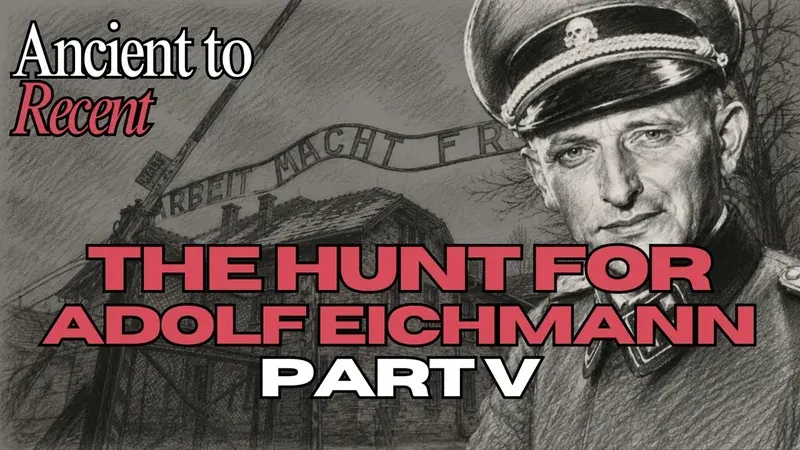
The Hunt for Adolf Eichmann — Part 5
27 June 2026 · 51 min · Season 1
 Watch on YouTube →
0:0051:39
Also on
Rate the show
Ratings are how new listeners find the show. It takes a minute and it makes a real difference.
In the conclusion of Ancient to Recent's Eichmann series, Israeli Mossad agents make their move, seizing Adolf Eichmann on a quiet Buenos Aires street and smuggling him out of Argentina under a forged identity.
Inside the Mossad safe house, Eichmann is confronted with the evidence against him and slowly admits who he is. But with his family, former SS associates and Argentina's far-right networks closing in, the operation enters its most dangerous phase.
What follows changes history. Eichmann's trial in Jerusalem, the first to place the Holocaust itself at the centre of an international courtroom, forces the world to confront the full scale of Nazi crimes and the human beings behind every statistic.
How did Israel survive the diplomatic fallout?
What did Eichmann say in his defence? And what legacy did the trial leave behind?
Join Joseph Parkinson as Ancient to Recent concludes the story of one of the twentieth century's most consequential intelligence operations.
🎧 New episodes every Saturday
📲 YouTube, Spotify & Apple Podcasts | @AncientToRecent
#AdolfEichmann #Mossad #Holocaust #WorldWarII #Israel #Argentina #HistoryPodcast
Read transcript
This transcript is automatically generated, so it may contain typos and misheard names.
Long live Germany, Long live Argentina, Long live Austria. These are the three countries with which I have been most closely associated and which I shall not forget. I had to obey the rules of war and my flag. I am ready out of Eichmann. Stepping off the number 2O3 boss, the man, tired from a day's hard labour at the Mercedes-Benz plant, made his way to the small house on 14 Garibaldi St. he shared with his family. It was a chilly evening, but the early Mayweather of Buenos Aires was something the man was used to.
A decade had passed since he slipped out of Europe under the assumed identity of Ricardo Clement, his old life, and with it many crimes left behind, buried under the ruins of the Reich, The world seems to have moved on. But he was still nervous. Could he ever truly be at ease? Were his pursuers ever to rest? Only weeks before his name had appeared yet again in the newspapers. Reports from Germany carried the story that he was in Kuwait.
Maybe the man was relieved that his hunters were looking in the wrong place. Maybe he was concerned they were still looking at all. And then there were the odd occurrences closer to home, The strangers who had chatted with a man and his son Dieter in the garden on the days before. Probably nothing to worry about, but one can never be too certain. What about the two men asking around the neighborhood, supposedly from an American company looking to build a sewing factory?
A factory in San Fernando, so far from the city centre. From water mains and regular electricity supply, it seemed a strange location to choose. Perhaps an innocent enquiry, perhaps, perhaps not. As the man made the short walk from the bus stop to his front door, a black sedan cruised down the street. He ignored it at first, his heart pounding. The driver rolled down the window, calling out. The driver asked. How do you get back to Buenos Aires?
He observed the car, 4 ominous figures inside. Each seemed to be boring their eyes into him. He gave them directions. The driver, in perfect Spanish with a Buenos Aires accent, thanked him and drove off. As the car speed away, he made note of its Buenos Aires license plate. Why would people from the city need directions back home? He told Vera, his wife. She assured him that he was putting two and two together and making five. It was nothing.
He was imagining things, yes, surely just a coincidence. He could not attribute every passing occurrence to some grand scheme to capture him. He ate his dinner in silence, retiring to bed. He struggled to sleep as a litany of incidents replayed in his mind. The stranger in the garden, the sewing factory, newspaper reports. Now a car. He tossed and turned, he was working himself up, there was nothing to worry about. Life had moved on, the world had moved on. He was, after all, too smart, too intelligent, and too careful to ever be caught.
Or so on the 10th of May 1960, that is what he told himself. Welcome to ancient, to recent. My name is Joseph Parkinson and today we conclude the story of the hunt for Adolf Eichmann. Click the subscribe button to follow Ancient to Recent episodes are out every Saturday and are available on YouTube, Spotify and our podcasts. Waking at the crack of dawn, he rose on Wednesday the 11th of May. He shaved, had breakfast, chatted to his wife and then made his way to the nearby bus stop.
His journey to the Mercedes-Benz plans would be torturous. 2 hours and 2 changes to wind his way from the working class periphery of Buenos Aires to the beating heart of the city's industrial centre. He cannot have helped but think back to his previous life. Then he was more used to riding Mercedes-Benz than to building them. In the Nazi party he had found purpose, meaning direction, an environment where his meticulous nature could flourish.
With his ascent he had acquired power, wealth and status, complete with all the accoutrement of high office of state secretaries and mistresses, underlings and lackeys, power and privilege. Now he donned overalls to shield his clothes from the grime of his work and awkwardly rubbed shoulders with colleagues. He felt beneath him. At 12:30 exactly, he clocked out for lunch, the same time eating at the same restaurant every day.
When his shift ended, he caught the first of two buses home to complete the long winding journey back to Garibaldi St. It was for this 54 year old German resident of Argentina. Like any other day in the safe house, the Mossad team made final preparations. One last discussion of the plan. Every member knew their role and also the stakes. The safe house had been prepared meticulously. A secret room had been constructed to house their soon to be captive, the windows covered with thick woolen blankets to muffle cries for help.
Each member of the team was issued with a new identity, or the easier, if things went wrong, to walk away, blend in, disappear at the final meeting. One last discussion. What would they do if the target who went by the assumed name Ricardo Clement, was not, after all, who they believed him to be? What if the police intervened? What if they were arrested? They were to claim they were Jewish vigilantes. They were told that the State of Israel would deny any connection if the operation went wrong.
If the plan fell through, they were on their own. After the final meeting, the long, tortuous hours dragged by. Some tried to sleep, play chess or chat about anything other than the operation. But soon distraction became impossible. The magnitude of their task too great, too irresistible. The weight of responsibility, the burden of history, the duty to their murdered families, too great. The team assembled in the living room. It was 6:30 PM, time to go.
The storm clouds gathered as the night sky began to show. Its fury was a justice of vengeance the elements had on their mind. Or perhaps it was both. At 7:30 PM, the Israeli team reached Garibaldi St. taking their place in accordance with the plan rehearsed till each man knew his role by instinct. For months these men had waited for this moment. Some were experienced veterans, others this was the first time. When the moment came, how would they react? Would they keep their cool or crack under pressure? The team was divided between two cars. 1A black Buick was to pop the hood close to the target's house. 2 passengers were to mimic engine trouble.
The other car was to be placed further up the street. As the target approached, the second car was to turn on its lights to blind the man, confusing him for a moment just long enough to force him into the waiting car and escape. All they needed now was for the target to show 730-6737. They knew they could not linger in the neighborhood. Every moment risked an unfortunate passerby or an inquisitive police officer disrupting their plans.
They waited. A child on a red bike rode up to the black Buick and enquired about the engine problem. The team assured him they were fine, no need for assistance. The boy rode on. A sigh of relief. 738 739 With every second the tension rose. Any moment now the lights of the 2:03 bus would show and the target would step off into the waiting tramp. 740 No boss 741-740-2743 Still no boss. Where was he? Then the lights flashed.
Quick, get ready. A boss approached the kiosk and continued. Still new target. What should they do? With every second the tension rose and the risk mounted. Seven 44745 questions began to percolate. Had they been identified? Had he been tipped off? Had he already escaped? The clouds darkened and the Thunder cracked as a crucial decision approached, even if their target did not. What to do? Wait and chance discovery or retreat and risk the targets slipping away forever. 740-4745 Once more headlights illuminated the Buenos Aires. 9 would get ready. Again it rolled on, not stopping. 740-6747 If the target did not arrive by 8, what should they do? Should they leave?
They were exposed. Every moment risked raising the alarm. 8 came, and still no target. Wait a few more minutes, just a few more minutes. 8O38-O Four. Suddenly lights penetrated the deep glue. The team held its breath. The bus slowed, pulling up at the kiosk. At 805A, man in his mid 50s stepped off the 203 bus. In an instant, the plan swung into action. The first car flicked on its lights, but suddenly the team noticed the man had his hand deep in his pocket. Was it him?
Was he armed? An Asian stepped directly into the man's pass. A momentito signor, said the agent. The man stopped, hesitated, and stepped back. In a second, the Israeli Asians were upon him. They forced him to the ground, one desperately struggling to keep the man from removing his hand from his pocket. Did he have a gun, A knife? They didn't know and they didn't want to find out. They struggled to silence the man, forcing a hand round his throat. But in the battle they tumbled to the floor and the man that had a deep shriek, A piercing cry for help, for deliverance from the fate he had spent 15 years fleeing. They were only meters from the man's house. In a second, neighbors could come rushing to his aid. The Israeli agents fought with every ounce of their strength to subdue him.
And after a moment of ferocious combat, the man suddenly relented, went limp and collapsed. They bungled him into a car, covered him in a heavy blanket and forced a motorcycle helmet onto his head, the eyes tape black. Searching in his pocket, they found no gun, no knife, just a flashlight. They cried in German. Sit still and nothing will happen. If you resist, we will shoot you. Do you understand? No reply. Again they cried.
Yet again, no reply. Was this him? Had they made a terrible mistake? Had they kidnapped the wrong person? Had months of work been ruined in a case of mistaken identity? A Mossan agent then said in Spanish, What language do you speak? After a moment, the man limp on the floor replied almost passively. I am already resigned to my fate. It was him, speeding through the dim of a Buenos Aires evening, the car pulled over. The team sprung out with automatic precision, brought about by constant rehearsal.
Like an F1 pit stop team, they swapped the license plates from civilian to diplomatic, complete with passports for each crew member, forged from the Austrian embassy. They could not guarantee that they would not be stopped, but their chances of being waved through by police checkpoints was greatly increased. They made for the safe house knowing that unreliable car may give way at any moment. The urge to drive as fast as possible, run every red light in desperation to reach safety had to be suppressed.
Instead, they kept well below the speed limit and took a circuitous route home to confuse any who may have seen them make off in the night. The man remains silent, limp on the floor of the car. At 8:55 they arrived home. The man was brought through the kitchen into the pre prepared cell. He did not. And I'll say a word. The Israeli team met his silence with their own. There was no celebration, not yet. The only person to speak to him was Ziv Aharoni, the Mossad interrogator.
In the cell, lit by a single light bulb, the team got their first look at the man who had murdered their families. He was a pitiful figure, Bald, slouched, sunken shoulders caked in mud, soaked through, long gone, the confidence smirk of a man who had decided the fate of nations. Mindful of the fate of Heinrich Himmler, the s s chief who would escape justice by cyanide, the team subjected the man to a thorough inspection. They matched scars on his body with ones from his s s medical files, including a suspicious mark where an s s man would have his blood type tattooed under his left arm, which seemed to have been burned off with a cigarette. The captive said little.
At first the man had thought he was being subject to nothing more extraordinary than a mugging. Petty theft, not high justice. It was only when he was forced into the car and addressed in German that he knew it was not common criminals that had assailed him. The Israeli interrogator, Ziv Aharoni began his questions immediately. The captive was given pajamas, kept blindfolded, and handcuffed to the bed as the interrogation began. Aharoni avoided any physical coercion. He knew violence led to suspects giving the answers that interrogators wanted, and the captive might be able to claim that the confession had been beaten out of him. Aharoni would not torture him.
He would bludgeon him with logic and lacerate him with truth till the man relented and gave up the confession. Aharoni burned for At 9:15, the interrogation began. Aharoni had memorized Eichmann's file. He knew every detail of Eichmann's life, from his birthday to his shoe size. Aharoni did not want to lose a single ounce of momentum by having to consult the paperwork. Aharoni peppered the man with questions. Name Ricardo Clement answered the man.
Son's birthday, mother's maiden name, Birthplace, shirt size, belt size. Each time the man in the chair gave the exact answer, matching the details of Adolf Eichmann. But each time Aharoni returned to the most important question. What is your name? And each time the man answered Ricardo Klement, Aharoni pressed on. When did you join the Nazi Party? 1st of April 1932. What is your Nazi Party membership number? 889885, the same as Adolf Eichmann. What is your name?
Ricardo Clement answered the man yet again. It was almost as if if the man could give every detail up, but without admitting his name, it was somehow denying A Haroni victory. A Haroni? Rephrase the question. Under what name were you born? The man pause for a second out of Eichmann. It was the final confirmation they needed. Now there was no doubt over an hour had passed since Eichmann was usually home. Eichmann's wife, Vera, was starting to grow concerned. She knew Adolf would be home late that evening. He had told her in the morning he would be attending a trade union meeting, that such meetings were short and it was now almost 9.
She had heard some noise outside a car revving its engine, but suspected nothing. Could something have happened to her, Adolf in the safe house? The team was far from out the woods. They had captured and positively identified Eichmann. But they knew they now had an agonizing 10 days wait before their flight out of the country. At any moment, something could go wrong. Soon enough, Eichmann's disappearance would be known.
Would Vera go to the police? What about the network of Nazis in Argentina? Might they come looking for Eichmann? And what if Eichmann himself? Eichmann had slipped capture repeatedly in his time in Germany, including escaping numerous concentration camps? Might Eichmann slip away yet again? If the worst came to the worst, then the plan was simple. The Israeli team were to kill out of Eichmann. But it was justice, not vengeance the Israelis had on their mind, and for that Eichmann was needed alive.
To minimize risk, Eichmann was to be kept blindfolded and watched at all times. On the morning of the 12th of May, Eichmann was subject to another round of questioning from Aharoni. The Mossad interrogator was trying to piece together Eichmann's history from the four of the Reich to present day. As the conversation progressed, Eichmann seemed to relax, offering up details of his escape, various identities, and ease by which he had slipped from his pursuers time after time.
From the moment Eichmann's fear subsided, his arrogance and vanity resurfaced. Aharoni asked Eichmann why he had not made his wife and children take on the last name Klement. Eichmann replied, bizarrely, that he did not want them to have to lie. For him, it was ego. It had always been his greatest weakness, his inflated sense of himself. This had been his undoing. Aharoni pressed on with questioning about the Nazi underground and the whereabouts of figures such as Joseph Mengler and Martin Bornman.
Each time, Eichmann insisted he knew nothing. When Aharoni asked Eichmann how his family and the Nazis in Argentina would react, Eichmann indicated that they were more likely to go underground than to try and stage a rescue. A Haroni asked Eichmann if he was prepared to stand trial. The question seemed to startle Eichmann. Trial for what? Where in Israel? For your crimes against the Jews? Israel. I'm a German citizen and resident of Argentina. Crime.
What crimes? I was a soldier. I followed orders. I'm guilty of only fulfilling my oath as a loyal German soldier, which I did to the full extent of my ability, insisted Eichmann. Aharoni wanted to get Eichmann's consent for being flown to Israel. It would smooth the diplomatic path and help with the awkward question of jurisdiction that was sure to arise. Eichmann said he would think about it. Vera's concern had grown to panic. Her husband had gone to work like any other day and not come home.
Unpredictability was not part of his character, Vera told her son Dieter, who informed his brother Nick. They turned to Carlos Fudner, a luminary in the Nancy Argentinian diaspora who had assisted getting Eichmann into the country. Fuldner outlined the possibilities for the two boys. Either their father was dead, in prison or had been abducted. They needed to move quickly to rule each option out. The boys started by visiting the local hospitals, morgues and police stations around San Fernandino, the local neighborhood of the Eichmann family, but with no luck. Vera paid a visit to the Mercedes-Benz factory and was told that Adolf had come to work as normal the previous day, but today had not turned up.
Then they began searching around the house. They looked in the bushes and the Groves for anything suspicious. In the mud they found a pair of broken glasses. The boys could have no doubt their father had been taken. The safe house was tense. The team had thought of every contingency. They had stopped the house with food and water, covered every angle and taken every precaution. But there was one challenge they had not foreseen.
Living with Adolf Eichmann, Eichmann was not as they expected him to be. Instead of a bombastic prima Donna, what the mustard team found, there's a sniveling worm of a man. He was meek to the point of pity, and his very passivity, asking permission even to go to the toilet, raised in itself difficult questions. How could this squeaking gerbil of a man, this weakling, this nothing, have sent their families to their deaths?
They had to bear the indignity of providing for the every need of a man who had taken everything from them, who had robbed them of their homes, their families and their loved ones. And here he was in his underpants, meekly asking them if he was allowed to go for a bowel movement. They found his very presence nauseating. On May the 13th, the Mossad team tuned into the news bulletins and scanned the newspapers. No mention of the kidnapping. No mention of Eichmann at all.
Surely if the alarm had been raised then it would be on the front page. Or perhaps the Argentine police were suppressing the story to convince them that they were safe so as to stage a raid on the House. The team prepared for every eventuality. Dita and Nick have found little help from the Nazi fugitive community. Many wanted to keep their heads down, hoping their turn would not be next. In desperation, Nick and Dita turned to their connections in the Argentinian far right. They could not be certain who had taken their father, but the boys, who had inherited their father's racist politics were convinced the Jews were behind the plot. The boys turned to an organization called the movie Miento Nacionalista Tukara, an extreme Catholic nationalist group with an anti-Semitic bent that made no secret of its admiration for Hitler, Mussolini and Franco. The group used the Nazi salute and trained in forest bases for the coming war they longed for and practicality. They did little more than ride around Buenos Aires on motorcycles trying to look tough. Tukara began their search, but their efforts were amateurish, little more than harassing local Jews. The boys were soon disappointed in the safe house. Everyone was on edge.
The experience of being in such close proximity to a man like Eichmann, both horrifying in his evil and at the same time pitiful, exposed the teen to emotions they could not anticipate and found hard to control. At all times, Eichmann had to be watched when he slept, when he ate, when he showered, when he went to the toilet. The escape route back to Israel was taking shape. Eichmann and his team were supposed as flight crew of an Israeli passenger jet with Eichmann to be sedated.
But this was still some days away. Still they waited. Still they had to care for the man who had sent their families to the gas chambers. Most of the team could not stand being the same room as Eichmann. However, Peter Malkin, one of the Mossad team, tried to engage Eichmann in conversation during his watch. Malkin had observed Eichmann for weeks, had seen how ordinary, mundane, unexceptional Eichmann was. Malkin wanted to know how Eichmann could have done the things he did. Malkin said to Eichmann that he had seen Eichmann with his son Dieter, and that Dieter remind him of his sister's son. Almost instinctively, Eichmann replied, What happened to your sister's son?
What happened? Replied Malkin. As if Eichmann would have been unaware of the fate of the Polish Jews, Malkin began his own informal cross examination. How did you do the things you did? Malkin asked. Eichmann shrugged. It was an order. I'm a soldier. I follow the orders of my superiors, just like you. Why did you kidnap me? Because you were ordered to. You're no different from me. Malkin balked. Yes, I followed orders to capture you, but you are a wanted criminal. You are not an innocent civilian. You went after innocent people because you hate the Jews. I don't hate the Jews, replied Eichmann. I love the Jews.
Now it was Malkin's turn to be taken aback. You love the Jews? Malkin said incredulously. If you love them so much, why did you join the S S? Why did you persecute them, steal their property, confiscate their life savings, and drive them to the gas chambers? Eichmann protested that he wanted to send the Jews to Madagascar. It had never been his intention to hurt Jews. Malkin asked Eichmann how Eichmann felt when the emphasis moved from driving the Jews out of Europe to their physical destruction.
Again, Eichmann shrugged. This was nothing to do with him. It was not his decision. It was not his place to have opinions or feelings about the orders of his superiors. He was a bureaucrat, A facilitator, not a decision maker. Malkin turned again to the document allowing Eichmann to be transported to Israel to stand trial. Encouraging Eichmann to sign, he told him that the trial would be Eichmann's one chance to truly tell his version of events. Without the trial, Eichmann's story will be told for him, his role defined by others.
This would be Eichmann's opportunity to speak to history. Perhaps it was the appeal to his vanity. Perhaps it was the chance to etch himself in the history books on his own terms. Eichmann, who'd resisted so adamantly, was handed the paper and pen and signed. Eichmann had a set pattern. Play up his role, glory in his accomplishments while simultaneously downplaying responsibility and refusing to admit guilt. When caught in an obvious lie, he would, as always, fall back on the same logic. He was just following orders.
Eichmann was empty. Not just a void of remorse or pity, but soulless like an automaton, but also oddly childlike in that he craved acceptance and validation whilst being unable to acknowledge guilt. The trial in Israel would offer one last opportunity to add another coat of glory to his otherwise dreary existence. The tension in the house was felt across the city as the country prepared to celebrate 150 years of independence.
A wave of terrorist attacks launched by loyalists to the deposed president Quan Peron, ripped through Buenos Aires. The city, already crisscrossed with checkpoints and roadblocks, was now on full alert, with military personnel and police launching citywide raids on suspect for honest hideouts. At any moment the door could cave in and the safe house would be discovered, and all the team could do was wait. Nick and Dieter, however, were not waiting.
They were a hive of activity as they searched desperately for their father. They suggested to the Tukara to kidnap an Israeli ambassador and demand his exchange for their father. If the Israelis did not agree, they would torture the ambassador. But the boy's activities and increasingly frantic behaviour was drawing attention. The Nazi community in Buenos Aires was uneasy with the local. Nazis knew their best hope of survival was not confrontation but rather to be forgotten.
Such a dramatic act as kidnapping and torturing an ambassador, but only draw unwanted attention. Under pressure, the boys dropped the idea. The following morning, the operation entered its final stage. Adolf Eichmann had now spent nine days hidden inside the Mossad safe house. Remarkably, there was still no public indication that anything was wrong. No newspaper reported his disappearance. No police search had begun.
No appeal had been issued for information. It was as though one of the most wanted men in the world had simply vanished without anyone noticing. Around the safe house, however, activity was relentless. The building was thoroughly cleaned, leaving behind as little evidence as possible of the operation. False identities were distributed. Fresh passports and travel documents were checked one final time. Escape routes to the airport were reviewed. Even the airport itself had been carefully prepared. Over the previous days, members of the Mossad team had quietly cultivated a friendly relationship with Air Force staff and security personnel, hoping their familiar faces and diplomatic credentials would help smooth their passage when the time came.
As darkness fell on the 20th of May, attention turned once more to Eichman. To leave Argentina unnoticed, he would have to become someone else. His hair was dyed make up, altered the contours of his face. A thick mustache was carefully glued into place. Finally, he was dressed in the uniform of an ally Israeli flight crew member. The disguise alone would not be enough. If questioned, Eichmann would have to appear incapable of coherent conversation. A doctor prepared a carefully measured dose of sedative. Eichmann watched nervously.
He had little choice. Quietly, he submitted. The drug took its effect gradually. The agents examined him carefully. He remained conscious but sluggish. Exactly as they hoped. Supported by two Mossad officers, Icon was led from the house into the waiting vehicle. Hidden beneath a blanket across the back seat. The final journey began. The drive to the airport was perhaps the most dangerous stage of the entire operation.
A routine police stop, an accident, a suspicious official, any one of them could unravel everything. The car moved steadily through the streets of Buenos Aires before reaching the entrance to the International Airport. The diplomatic registration plates did exactly what they had been intended to do. Without hesitation, the guards waved the convoy through. Shortly before 11:00 that evening, the vehicle pulled alongside the waiting aircraft.
The agents lifted Eichmann from the car. Still heavily sedated, he was supported on either side, as though he was an exhausted crew member who had enjoyed rather too much hospitality during the official celebrations. Slowly, they guided him of the aircraft steps. Inside, Eichmann was placed in a window seat near the rear of the cabin. A stewardess tucked a blanket around him. She had no idea who he was. Most of the flight crew did not know either.
They had simply been told that one of their colleagues was unwell. At 11:15 that evening, the cabin doors closed. Outside, the engines began to roar. The aircraft started a taxi. For the Mossad team, however, the danger was far from over. They would not truly be safe until the aircraft had left Argentinian airspace. Then, without warning, the aircraft stopped. The control tower instructed the captain to hold his position. There was a problem with the flight plan. Inside the cabin, tensions became unbearable. The agents knew nothing of the reason for the delay. Had the operation been discovered? Were the Argentinian police already on the way? For a brief moment, some even discussed the unthinkable. Should they simply take off without clearings? Outside, the mobile stairs were wheeled towards the aircraft. The cabin door opened once again. One member of the crew left the aircraft and headed for the control tower.
The Mossad agents waited in science. If he failed to return within 10 minutes, they agreed, the aircraft would depart regardless of the consequences. Inside the tower, the explanation proved almost absurd. There had been no tip off, no arrest warrant, no police operation. A simple administrative oversight. One required signature was missing from the paperwork and officials wanted clarifications for the scheduled refuelling stop in Recife, Brazil. The navigator hurried back across the tarmac. Moments later, the cabin door closed again. At 5 minutes past midnight on the 21st of May 1960, the engines surged to full power.
The aircraft accelerated down the runway. After 15 years of searching out of Eichmann was finally leaving Argentina. Back in Argentina, the operation had one final loose end. As news spread that an Israeli aircraft had departed for Recife, Brazil, Klaus Eichmann, better known as Nick, began to suspect the truth. His father had vanished days earlier. Now an Israeli aircraft was leaving South America. Nick became convinced that his father was on board.
Desperately, he contacted his friends within the Brazilian intelligence service, hoping they might intercept the aircraft before it disappeared across the Atlantic. But what Nick did not know was that the reported destination was part of the deception. The Mosser team had no intention of flying directly to Recife. Their true route LED across the South Atlantic to Dakar, Senegal. By the time anyone realized, it would already be too late.
Only after the aircraft had crossed Argentinian airspace did the atmosphere inside begin to change. For the first time since the operation had begun, the agents allowed themselves to breathe. Some embrace one another, others simply sat in silence. Exhausted by days of relentless tension, the flight crew were finally told the identity of the mysterious passenger. The reaction was one of shock. Many had lost parents, brothers, sisters or entire families in the Holocaust. Now, sitting quietly at the rear of the aircraft, handcuffed beneath a blanket, was one of the men who was responsible. The stewardess, who moments earlier had been sitting beside the sedated passenger, quietly rose and found another seat in the cockpit.
The aircraft continued across Uruguay before turning out over the Atlantic. 10 years earlier, out of Eichmann had crossed the same ocean in the opposite direction, fleeing Europe under the false identification of Ricardo Clement. Then he was sailing towards freedom. Now he was returning as a prisoner to face judgement at the hands he had once sought to destroy. Even so, the danger was far from over. The aircraft was operating at the very limits of its range.
Additional passengers and equipment meant higher fuel consumption than the planets had anticipated. A diversion caused by bad weather could prove disastrous. Mechanical failure, formal common in the early years of long distance aviation, remained a constant possibility, and should the aircraft be forced to land unexpectedly, the entire operation might unravel. Throughout the long flight, Eichmann remained heavily sedated, though not unconscious.
He'd been handcuffed, dark goggles, concealers, eyes. Occasionally he asked quietly for a cigarette, but for so aboard his presence became almost unbearable. One of the aircraft mechanics, Yehuda Friedman, had grown up in Poland. His six year old brother had been murdered by a German soldier during the war. Now, after years of carrying that grief, he found himself standing only feet away from one of the principal organizers of the Holocaust. For a moment, rage threatened to overwhelm him. The other agents quietly intervened. Eichmann, by contrast, remained passive. More than 13 hours after leaving Argentina, the aircraft finally began its descent towards Dakar.
But another crisis emerged. The fuel warning lights illuminated, blinking on and off red in the cockpit. The aircraft was rapidly running out of fuel. There would be no opportunity to divert elsewhere if the runway was occupied. If they were forced to circle, the engines might simply stop. The irony was almost unbearable. After 15 years of searching out of Eichmann could escape justice one final time, not through cunning or deception, but in the burning wreckage of a crashed aircraft.
The crew radioed ahead, explaining the urgency of the situation. Fortunately, the runway was immediately cleared. The aircraft touched down safely. It had landed with so little fuel remaining that it was barely enough to taxi. Even on the ground, the danger persisted. Had Argentina alerted foreign governments? Would police be waiting besides the runway before anyone opened the cabin door? Icon was given another injection to keep them sedated. The aircraft was rapidly refuelled. No police appeared.
Soon afterwards, the engine started once more. The second leg of the journey presented fresh challenges to avoid hostile airspace of several Arab states. The aircraft followed A lengthy route around North Africa before turning E across the Mediterranean. The detour added many hours to an already exhausting journey. At last, at 6:55 on the morning of Sunday, the 22nd of May, the aircraft landed at Lord Airport. There was no celebration, only relief. The operation was finally over.
Two waiting cars carried Eichmann away to an airport detention facility. His identity remained A closely guarded secret. The authorities feared that if prison guards discovered who their prisoner was, one of the many Israelis who had lost family in the death camps by an attempt to take justice into their own hands. When Israeli Prime Minister David Ben Gurion was informed that Eichmann was in custody in Israel, he insisted that first Eichmann's identity had to be confirmed by someone who knew him. Witnesses who had met Eichmann were found. Amongst those brought to the prison was Moshe Agame, who as a representative of the Jewish Agency in Vienna during the 1930s, had dwelt personally with Eichmann whilst desperately trying to secure permission for Jews to emigrate to Palestine. Now, more than 20 years later, the two men stood face to face. Once again, other witnesses were brought in. They independently confirmed the prisoner's identity. There was no longer any doubt the man in custody was out of Eichmann.
The following day, Eichmann was brought before a magistrate. Asked to state his name, he replied simply out of Eichmann. The judge ordered that he be remanded in custody pending trial. The afternoon of 4:00 on the 23rd of May 1960, David Ben Gurion, Prime Minister of Israel, entered the Knesset. Members sat in silence as the Prime Minister walked to the podium. Then he made one of the most famous announcements in modern history. I must inform the Knesset that not long ago the security services found one of the greatest Nazi war criminals, Adolf Eichmann, who is responsible together with the Nazi leaders for what they called the Final Solution of the Jewish question.
That is the extermination of 6,000,000 Jews in Europe out of Eichmann is already under arrest in Israel and will shortly be placed on trial in Israel under the Nazi and Nazi collaborators laws. For a moment the chamber was silent. Then came an extraordinary outpouring of emotion. Some members wept openly, others applauded. Many simply sat in stunned silence. After 15 years on the run, one of the principal architects of the Holocaust had finally been brought before the justice of the Jewish people.
Within hours of Ben Gurion's announcement, news of Adolf Eichmann's capture spread around the world. Newspapers carried the astonishing story across Europe, the Americas and the Middle East. After 15 years of rumours, false sightings and dead ends, one of the principal architects of the Holocaust had finally been captured. Meanwhile, Eichmann disappeared from public view. He was placed in a sparsely furnished 10 by 13 foot cell on the constant guard.
There would be no opportunity to take his own life. Every meal was carefully prepared and tasted beforehand. The authorities even took the extraordinary precaution of ensuring that none of the guards assigned to him had lost close family in the Holocaust, a difficult task in 1960s Israel. The temptation for revenge was simply too great. On the 29th of May, the interrogations began. The task fell principally to two members of an organization called Bureau Number Six Abner Les, assisted by Efraim Holstadter. As Eichmann entered the interview room, his composure appeared to falter.
His hands trembled. Les asked a simple question. Was he prepared to give his account of his role in the so-called Third Reich? Eichmann answered quietly. Yes. Over the weeks that followed, he spoke for hundreds of hours. At first, he proved remarkably cooperative. But the investigators soon noticed a pattern. Again and again, Eichmann attempted to minimize his own responsibility. He portrayed himself as nothing more than an obedient civil servant. Whenever documentary evidence contradicted his claim, he quietly altered his account before retreating to the same old defense.
He was just following orders. The interrogators sensed something else. Eichmann had never truly expected to stand trial. For years, he had assumed that if he were ever found, he would simply be executed. The possibility that he would instead face a public court, answer questions and defend himself had scarcely crossed his mind. Outside Israel, a diplomatic storm was gathering. Argentina reacted with fury. President Arturo Frondizi condemned the operation as a flagrant violation of Argentinian sovereignty.
The Israeli ambassador to Buenos Aires was summoned. The Argentinian government demanded Eichmann's immediate return. Israel refused. Initially, Israeli officials suggested that Eichmann had been brought to Israel by private Jewish volunteers acting independently of the government. Few believed the explanation. The dispute quickly reached the United Nations. Argentina accused Israel of violating international law and demanded condemnation. The Security Council agreed that Argentina's sovereignty had been breached and called upon Israel to make appropriate reparations, but it stopped short of demanding Eichmann's return. Diplomatic relations between the two countries deteriorated sharply.
The Israeli ambassador to Argentina was informed that his presence in Buenos Aires was no longer welcome. Across Argentina, the crisis field a disturbing wave of anti-Semitic violence. The Jewish schools and community institutions were attacked. Jewish students were assaulted in the streets. Vera Eichmann appealed to the Argentinian courts, demanding an investigation into her husband's disappearance. An inquiry was opened.
It ultimately achieved nothing. As the weeks past president from Dizi quietly sought to bring the diplomatic crisis to an end. In West Germany, the reaction was complicated. Chancellor Conrad Ardenour publicly expressed concern over the matter in which Eichmann had been removed from Argentina. Yet his government made no serious effort to secure Eichmann's return. Privately, Mennie and Bonn recognized the trial in Israel presented A deeply uncomfortable problem. If Eichmann spoke in open court, whose name might he reveal? How many former Nazis still served in the ministries, intelligence services and courts of the Federal Republic would find themselves suddenly exposed to public attention? As governments argued and diplomats exchanged protests, one question increasingly dominated the headlines around the world.
What would Adolf Eichmann say when he finally entered the witness box? The prosecution's case had been years in the making. Investigators had conducted hundreds of hours of interviews. They had examined hundreds of thousands of pages of captured German documents. The painstaking work of Nazi hunters such as Tuvia Friedman and Simon Wiesenthal had helped identify witnesses, locate evidence and reconstruct Eichmann's career inside the machinery of the Final Solution. Survivors travelled from across Europe and Israel to testify, each braw another fragment of the story. Together they formed an overwhelming case. On the 11th of April 1961, the trial of Adolf Eichmann began in Jerusalem.
For the first time in history, one of the principal organizers of the Holocaust would stand trial before a Jewish court in a Jewish state. For his own protection. Eichmann sat inside a specially constructed bulletproof glass booth. Around 750 journalists, diplomats and observers crowded into the courtroom. Many expected to see a monster. Instead, they saw an ordinary middle-aged man in a dark suit. The clerk instructed the accused to stand. What is your name out of Eichmann? The indictment was then read aloud 15 criminal counts, crimes against the Jewish people, crimes against humanity, war crimes, membership of a criminal organization. The reading alone lasted an hour. The charges describe the deportation of millions, the destruction of entire communities, persecution, enslavement, plunder and the systematic murder of men, women and children.
Finally, Eichmann was asked how he pleaded. He answered much as Hermann Goering had at the Nuremberg trials, in the sense of the indictment, not guilty. The prosecution was led by Israeli's attorney general, Gideon Hausner. Born in Lemberg, then part of the Austro Hungarian Empire, Hausner had emigrated to Palestine as a boy in 1927. However, much of his extended family had remained behind. Most would never escape Europe.
As Hausner rose to address the court, perhaps he thought of his grandmother, perhaps of his six uncles and aunts, perhaps of the 25 cousins who had perished in the Holocaust. Then he began one of the most celebrated opening statements in legal history. When I stand before you hear judges of Israel to lead the prosecution of Adolf Eichmann, I am not standing alone. With me are 6,000,000 accusers. But they cannot rise to their feet and point an accusing finger towards him who sit in the docks and cry.
I accuse, for their ashes are piled up on the hills of Auschwitz and the fields of Treblinka, washed away by the rivers of Poland and buried throughout Europe. Their graves are scattered through the length and breadth of Europe. Their blood cries out, but their voices are not hurt. Therefore, I will be their spokesman, and in their name I will unfold the awesome incident. For 56 days, Hausner meticulously presented the prosecution's case.
Document after document was produced, Transport lists, orders, minutes of meetings, official correspondence. Witness after witness entered the courtroom, placing Eichmann at the centre of the deportation of Europe's Jews. Survivors described communities that had vanished, towns emptied, families destroyed, children gone. Throughout it all, Eichmann remained outwardly composed. When his turn came to testify, he spoke at great length.
His answers often wandered into long, rambling explanations. Time and again he returned to the same defence. He was just following orders. Closing arguments concluded on the 14th of August. Four months later, on the 15th of December 1961, the judges returned to deliver their verdict. Eichmann was instructed to stand. Presiding Judge Marsha Landau began to read. The court rejected Eichmann's defence. The attention that the accused act under superiors orders cannot avail him.
These orders were manifestly unlawful. The judge concluded that Eichmann had played a central and indispensable role in the implementation of the Final Solution. Finally, Landau pronounced sentence. The degree of responsibility imposed upon the accused by the enormity of the crimes committed through his instrumentality is so overwhelming that there can be no mitigation of his punishment. The inevitable conclusion is that the accused deserves nothing less than the death penalty.
Eichmann showed almost no reaction. The man who had helped organize the murder of millions stood silently as judgement was passed out of Eichmann appealed his conviction. Whilst awaiting the outcome, he devoted much of his time to writing. Page after page, he attempted to explain, some would say justify, his actions during the Third Reich. His defense never changed. He insisted he had merely carried out orders that he had been a loyal servant of the German state. The responsibility lay elsewhere. The appeal was rejected.
During his imprisonment, Eichmann was visited repeatedly by Canadian prison chaplain Reverend William Lovell Hull. Hull urged him time and again to acknowledge his crimes, to repent, to seek forgiveness before the end. Eichmann refused. He denied personal responsibility. He expressed no remorse. Hull later recalled that he found no evidence of genuine repentance. On the 29th of May 1962, the Israeli Supreme Court dismissed Eichmann's final appeal.
His last remaining hope rested with the President of Israel. He submitted A plea for clemency. 2 days later the answer came. The request was denied. His execution would take place shortly after midnight. Eichmann spent his final hours writing farewell letters to his wife Vera and his sons. At around 11:20 that evening, Reverend Hull entered the condemned man's cell one final time. To Hull surprise, Eichmann appeared calm. Why are you sad?
He asked the minister. I am not sad. Once more, Hull invited him to repent. Once more Eichmann declined. A few minutes before midnight, the prison governor and two guards entered the cell. Without resistance, Eichmann stood. They escorted him slowly along the prison corridor towards the gallows. He stepped onto the platform. A hood was offered. He refused. The noose was placed around his neck. Then came his final words. Long live Germany, Long live Argentina, Long live Austria. These are three countries with which I had been most closely associated and which I shall not forget. I had to obey the rules of war and my flag. I am ready.
Moments later, the lever was pulled. The trapdoor opened beneath his feet. Silence filled the execution chamber. The doctor examined his body out of Eichmann was dead. His body was cremated. The following day, an Israeli patrol boat carried the ashes to the Mediterranean, beyond Israel's territorial waters. They were scattered into the sea. No grave would mark his resting place. No shrine would ever bear his name. The man who had spent 15 years fleeing justice had disappeared forever.
Only history and the memory of his victims remained after the Second World War. With European ruins and a new Cold War already beginning, much of the world was desperate to move on. Governments look towards rebuilding shattered economies. Nations turn their attention to new alliances and new enemies. For many Holocaust survivors, there was a new life to build, and for some, a new Jewish state to defend. Behind them lie only the graves of those they had lost. Too many to count, too painful to comprehend. Many Nazi war criminals found the post war world far more welcoming than they could ever have imagined. Some disappeared into safe havens stretching from Beirut to Buenos Aires.
Others simply returned home under their own names, resuming ordinary lives as though nothing had happened. For years, too few people start to ask how such a catastrophe had been possible. How could a modern, educated society descend into genocide? How could ordinary men become willing participants in extraordinary evil? The trial of Adolf Eichmann changed that. For the first time, the Holocaust itself stood at the center of an international courtroom.
More than 100 survivors gave testimony. Millions around the world listened. The trial transformed public understanding of the Holocaust, ensuring that the stories of its victims would no longer remain in the shadows. It reminded the world that behind every statistic was a human being, a family, a life, a future that had been stolen. As Simon Wiesenthal later reflected, the capture of Eichmann was justice of vengeance. Thank you for listening to Ancient to Recent. My name is Joseph Parkinson.
Subscribe today New episodes of Ancient to Recent are out every Saturday and are available on YouTube, Spotify and Apple Podcasts.