
#57
500 Men vs an Empire: Hernán Cortés and the Conquest of Mexico — Part 1
4 July 2026 · 44 min · Season 1
 Watch on YouTube →
0:0044:04
Also on
Rate the show
Ratings are how new listeners find the show. It takes a minute and it makes a real difference.
Out of the eastern horizon, strange white shapes drift across the water. Not canoes. Not trading vessels. Floating mountains. What the peoples of the Americas witness that day will change their world forever, and it begins nearly three decades before Hernán Cortés ever sets foot in Mexico.
This episode traces the origins of one of history's most consequential collisions: Christopher Columbus's desperate campaign to win royal backing for a voyage into the unknown, the fall of Muslim Granada and the expulsion of Spain's Jewish community that reshaped a kingdom's finances and ambitions, and the brutal, disease-ravaged colonisation of Hispaniola and Cuba that followed.
Along the way, a young adventurer named Hernán Cortés cuts his teeth in the conquest of Cuba, before defying his own governor's orders and sailing west into legend.
What began as rumours of gold and vast stone cities beyond the horizon becomes the opening act of the conquest of Mexico.
Why did Spain gamble everything on Columbus's voyage? How did Europe's first moral debates over indigenous rights take shape? And what drove Cortés to risk disgrace, poverty, or death rather than turn back?
Join Joseph Parkinson as Ancient to Recent begins the story of Hernán Cortés and the conquest of Mexico.
🎧 New episodes every Saturday
📲 YouTube, Spotify & Apple Podcasts | @AncientToRecent
#HernanCortes #ConquestOfMexico #AztecEmpire #ChristopherColumbus #SpanishEmpire #Conquistadors #HistoryPodcast
Read transcript
This transcript is automatically generated, so it may contain typos and misheard names.
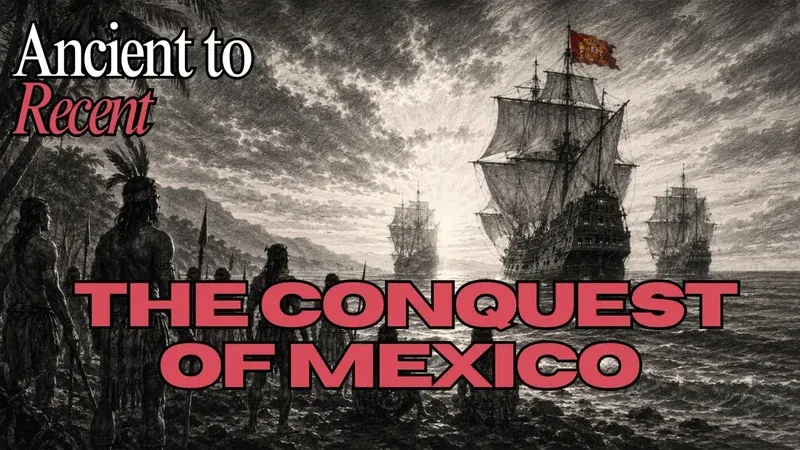
When I beheld the scenes around me, I fought within myself. This was the garden of the world. All of the wonders I beheld that day. Nothing now remains. All is overthrown and lost. Bernal Diaz del Castillo, The true history of the conquest of New Spain. The first sign was not the men. It was the mountains. Out of the eastern horizon, where the waters of the Gulf of Mexico meet the sky, enormous white shapes appeared. They seem to drift across the water, their wings catching the wind.
To those watching from the shore, they were unlike anything they had ever seen. Not canoes, not trading vessels, not fishing boats, but floating mountains. Beneath their towering white sails, dark wooden walls rose from the waters. Strange creatures moved across their decks, glinting in the tropical sun. As they drew nearer, smaller boats slipped into the sea. Men climbed down. Their skin was pale. These creatures wore thick mane of hair sprouting from their chins. Some shimmered as though clothed in polished stone, their bodies hidden beneath gleaming armor that flashed with every movement.
They carried long Spears and curious tubes of wood and metal. Behind them came animals no one on the American continent had ever laid eyes on before, terrifying beasts with throffing mouths and pounding hooves. Animals and rider moved together with such speed and grace that some believed they were a single creature. Then came the sound. A deafening crack rolled across the shorelines. Smoke burst into the air. Moments later, trees splintered apart. It was as though Thunder itself had descended from the heavens. They spoke a language none could understand and worshipped. A strange figure, they asserted, was both man and God. For thousands of years, the peoples of the Americas had built great cities, raised vast pyramids, and ruled powerful empires without even knowing that another world existed beyond the great expanse of the ocean. Now that world had arrived.
The year was 1519. The man leading the expedition was a minor Spanish nobleman by the name Hernán Cortés. Within two years, he would bring down one of the greatest empires the world had ever known. But how? That question has fascinated historians for more than 5 centuries. Was it superior weapons, Disease. Native allies, luck? Or was it the will of God? Welcome to ancient Theresa. My name is Joseph Parkinson, and today we begin the extraordinary story of Hernán Cortés and the conquest of Mexico.
Subscribe today to be sent notifications of new episodes published every Saturday and available on YouTube, Spotify and Apple Podcasts. Before the Spanish stepped ashore on the coast of Mexico, before the Aztecs caught their first glimpse of the strange ships upon the eastern horizon, before the 2 worlds collided, someone had to do the impossible. For both Europeans and Native Americans, for thousands of years, the Atlantic had marked the edge of the known world. Beyond it lay only mystery.
Ancient myths spoke of sea monsters, endless waters and lands from which no sailor ever returned. Yet towards the close of the 15th century, one man became convinced that the ocean was not a barrier, but a bridge. His name was Christopher Columbus, and persuading the rulers of Europe to believe him would prove every bit as difficult as the voyage itself. Columbus, born in Genoa in 1451, was the son of a merchant. He had been obsessed by the sea since he was a child and enticed by a new age where old certainties seem to melt away. The 15th century in Europe was a time of turmoil. In 1453, Constantinople, the last holdout, are the ones mighty Byzantine Empire was stormed by the forces of Sultan Mehmed, the second of the rising Ottoman power. The Silk Road, the great web of commercial routes linking Christendom to the regions of Asia, remained open, but it was now increasingly controlled for the expanding Ottoman Turks, both export markets and vital sources of raw materials so craved by Europeans.
We're now in the hands of the hated infidel Muslims. Centuries of crusades had done little to dislodge the followers of Muhammad, and with Ottoman armies pressing ever deeper into the Christian world, discretion would seem to be the better part of valor, especially the merchants of Europe who dreamed of riches in this world rather than salvation in the next. A second monumental event shaped the world Columbus inhabited.
As Christians were tasting defeat in the East, they were savouring victory in the West. Iberia, for 8 centuries of Muslim land under the name Al Andalus, was gradually conquered by Christian armies. On January the 2nd, 1492, Grenada, the last outpost of Muslim rules, surrendered to King Ferdinand the Second of Aragon and Queen Isabella the first of Castile. In short order the route to the Middle East was severed just as the door to the West was opened.
New possibilities presented themselves, and Europe possessed no lack of ambitious and ruthless men keen to take advantage. The state best placed in this race for riches was Portugal. Soon Portuguese ships pressed down the West Coast of Africa as far as the Cape of Good Hope. The Portuguese may have had a head start, but they were soon joined by ships from Spain, England, Holland, France, and Columbus's own Genoa. Returning, these adventurous, ambitious, and bloody men brought stories of weird and wonderful lands, exotic spices, fine Tusk, survivory and abundant slaves. But they brought something else.
With the surmounting of every obstacle, the scaling of every impossible height, their appetite grew with eating. Soon enough, hungry glances were turned, not just S to Africa, but West to the great Atlantic Ocean itself. Could she be crossed? Could she be tamed? And what riches, they wondered, lay beyond her vast expanse? There were, as ever, rumours. The island of Brazil, the legendary burial place of King Arthur, was said to be located just to the West of Ireland, just beyond the horizon.
Brazil was, of course, wealthy beyond imagination, a land where gold could be scooped from the streams, where diamonds and rubies the size of ostrich eggs could be found at every turn. Such wealth was surely waiting for an eager adventurer with bravery in his heart and Christ by his side. And all in the name of one of Europe's many monarchs. There was, however, one problem. Christopher Columbus could not simply sail W If he discovered new lands, by what right could he claim them? He needed more than a ship.
He needed a king. Only a crowned monarch possessed the authority to lay claim to newly discovered territories. Without royal backing, Columbus would merely be another adventurer wandering into the unknown. He first appealed to the court of John the Second of Portugal. The Portuguese listened. They consulted their experts, and then they declined. Portugal was already making remarkable progress around the coast of Africa.
Why gamble on an untested voyage into the Atlantic when an established route to Asia seemed within reach? Undeterred, Columbus turned elsewhere. He sought support from the courts of England and France. Again he was refused. Europe's monarchs were not patrons of exploration for its own sake. Ships cost money, every expedition represented an investment, and every investment was expected to yield a return. Columbus promised exactly that. He assured Isabella, Castile and Ferdinand the Paragon that by sailing W he would reach the immense markets of India and China, opening a direct route to spices, silk, and unimaginable wells beyond the grasp of rival Christian kingdoms and the Muslim powers controlling the eastern trade. The riches he acquired, Columbus declared, could even finance a new crusade.
Jerusalem itself, he suggested, might one day be reclaimed for Christendom. The proposal was bold. The monarchs referred it to a panel of learned advisers. Columbus's adventure was considered and again declined. Columbus had underestimated the size of the earth. His calculations, they concluded, were hopelessly optimistic. The voyage would fail. For a time, it seemed the dream was over. Yet years of warfare had left Spain exhausted and the coffers empty. If the Spanish crown was to be restored to solvency, the new sources of revenue would need to be found. Spain's finances were further worsened by the decision of Ferdinand and Isabella to expel the Spanish Jewish community in 1492.
Ferdinand and Isabella had sought to force a conversion of Spanish Jews, but soon it was feared that newly converted Christians or conversos were secretly practicing their old faith behind closed doors. This marked, interestingly, an important point in the development of Spanish cuisine with it's heavy focus on shellfish and pork produce such as hamon, iberica, chorizo and the use of pork lard in baked goods. Suspicion of foreign Jews and Muslims who professed a new found faith in Christ could now be tested through a simple act of hospitality and offer to dine. Those who refused would come under suspicion. Spain's Jewish community had been key financial backers of the Reconquista.
But theology trumped finance and Spain's Jews were forced into exile, leaving behind a black hole the size of the Atlantic in the public finances of Isabella and Ferdinand's Kingdom. With the Reconquista complete that the crown's finances under considerable strain, the monarchy could finally turn its attention beyond the peninsula. A court influential supporters urged the queen to consider Columbus's proposal. There was a further ideological motive, motivation for the Spanish monarchs. A route directly to Asia could, Sir Columbus argued, allow Spain to ally itself with the Asian kingdoms against the supposed common foe, the Muslims.
So, the logic went, Spain would be able to join forces with these Asian States and drive the Muslims from the Holy Lands and restore Jerusalem to its rightful Christian rulers. The promises of wealth, new trade routes and potential Christian allies in Asia proved increasingly difficult to ignore. Religious zeal and hard headed financial ambition had become inseparable. At last, Ferdinand and Isabella agreed to take the gamble.
Preparations now began in earnest. The small port of Palace de la Frontera became a hive of activity. Carpenters hammered at weathered holes. Barrels of freshwater, salt, meat, hard biscuits and wine were rolled aboard. Ropes were coiled, sails repaired and anchors inspected. Recruiters searched for sailors willing to venture into waters no European fleet had ever crossed before. Some came willingly, lured by the promise of riches.
Others required rather more persuasion. There was no shortage of scepticism. Many regarded Columbus's calculations as hopelessly optimistic. His estimates of the earth's circumference were dramatically too small. If no land lay between Europe and Asia, many believe the expedition was sailing towards certain death. None of this deterred Columbus. On the 3rd of August 1492, three small ships slipped their mooring at Palace de la Frontera in southwestern Spain, the Santa Maria Columbus flagship alongside the Pinta and the Nina.
Together they carried around 90 men into the unknown. The fleet first sailed South of the Canary Islands, where repairs were completed and favourable winds awaited. Then, on the morning of the 6th of September, the ships left the last familiar shore behind. Ahead stretched only the Atlantic. For days they sailed W beneath cloudless skies. Then weeks. Every morning brought the same endless horizon, every evening the same empty sea. As mile after mile disappeared beneath the keels, confidence slowly gave way to anxiety.
The sailors watched. Fox of bird, floating branches and patches of seaweed. Each seemed to promise nearby land. Again and again, the cry rang out. Land again, disappointment followed. Whispers spread through the fleet. Had Columbus miscalculated? Had he led them into an endless ocean from which none would ever return? By early October, nerves were beginning to fray, provisions steadily dwindling, the crew openly questioning whether they should turn back.
Sensing the growing discontent, Columbus made a crucial decision. On the 7th of October, he altered course, steering further to the southwest following the flight of migrating birds, which he believed were heading towards land. It was a gamble, one that would change history. Then, after 36 days at sea, salvation appeared in the darkness. Before dawn on the 12th of October, a sailor aboard the Pinter spotted a faint outline on the horizon.
Land relief swept through the fleet. The men had survived. The island Columbus, named San Salvador in today's Bahamas, became the first point of contact between Europeans and the peoples of the Americas. The inhabitants were the Tino people, and they greeted the strangers peacefully, but to Columbus's annoyance that China seemed to know nothing of China, India, or the Great Khan. Columbus, however, remained convinced.
He had reached islands lying just off the coast of Asia. Weeks later, the expedition reached Cuba. Certain that the court of the Great Khan could not be far away, Columbus dispatched an emissary inland, carrying gifts and letters from Ferdinand and Isabella. The Great Khan, of course, was nowhere to be found. Instead, the Spaniards encountered villages unlike anything described by Marco Polo. Still, Columbus refused to doubt.
On the 5th of December, the expedition reached another island, which he named Hispaniola. There they found traces of gold. The discovery electrified Columbus. Surely this confirmed he had reached the fabulous wealth of the East. The expedition also encountered plants and produce unknown in Europe, pineapples, maize and leaves that when dried and smoked, produced a most pleasant sensation. The leaves, named choba, were smoked in AY shaped pipe by the Taino natives of Hispaniola called a tobacco.
Soon the name of the pipe was adopted for the leaves themselves, hence the first introduction of Europeans to tobacco. Convinced he had achieved exactly what he had promised, Columbus prepared for the journey home on the 16th of January 1493, leaving 39 men behind to establish a small settlement. The expedition sailed east, but the return voyage proved every bit as perilous as the initial foray across the ocean, with violent storms scattering the tiny fleet.
Columbus eventually reached Portugal, where he landed at Lisbon on the 4th of March. King John the Second, the Very Monaco had once rejected Columbus's proposal, briefly detained him before allowing the voyage to continue. Finally, on the 15th of March, Columbus sailed back to Palos. He was received as a hero. Soon afterwards. He appeared before Ferdinand and Isabella. He presented exotic birds, unfamiliar plants, gold ornaments, and several indigenous captives brought back from the islands to Columbus. There could be no doubt he had reached Asia. In truth, he had discovered something altogether different. Within weeks, the Spanish crown ordered a second expedition. This time there was to be no uncertainty. When the fleet departed Cadiz on the 25th of September 1493, it consisted not of three ships, but 1700s of volunteers rushed to join the enterprise.
The voyage was no longer 1 of exploration, it was the beginning of colonization. On the 3rd of November, the expedition reached the island of Dominica before continuing N to Guadalupe, where the Spanish recorded stories of warfare and ritual cannibalism amongst some of the Caribbean peoples. Then, on the 22nd of November, Columbus returned to Hispaniola. The scene awaiting him was horrifying. Every one of the 39 men left behind the previous year were dead. During Columbus's absence, the Spaniards had abused the hospitality of the local town of people, stealing food, seizing women and searching obsessively for gold. Eventually the Tinos struck back. The tiny settlement had been wiped out. It was the first bloodshed in what would become one of history's greatest collisions between 2 worlds. Despite everything, Christopher Columbus remained convinced he'd reached Asia.
Every island, every river, every village. He interpreted them all through the lens of the world he expected to find. Pressing further along the coast of Cuba, he searched constantly for signs that would vindicate his great theory. His journals became increasingly extraordinary. He reported strange creatures unlike any known in Europe. He listened eagerly to tales of distant kingdoms and convinced himself that somewhere beyond the horizon lay the great empire of the Khan.
At times he even wondered whether the legendary Christian king Prester John might be found somewhere in the eastern lands, waiting to join Christendom in a final crusade against Islam. Reality, however, was becoming far less accommodating. The tropical climate proved unforgiving. Disease spread quickly through the settlements. Supplies remained desperately short. If the colonies were to survive, reinforcements and provision would have to arrive regularly from Spain.
Nor, Columbus concluded, could indigenous people remain entirely independent. The settlements would require labour. Above all, they required gold. Again and again, he found it disappointingly little. As frustration mounted, relations with the Tino deteriorated. Columbus resorted increasingly to violence. Villages were subdued, many Islanders killed. Others were forced into labour as forts and settlements spread across Hispaniola.
Here Columbus found himself at odds with the very monarchs who had financed his voyage. Ferdinand and Isabella expected their new subjects to embrace Christianity. Queen Isabella in particular insisted that the inhabitants of the newly discovered land were now subjects of the Spanish crown and not to be enslaved. Indiscriminate enslavement, she feared, would make genuine conversion impossible. By the summer of 1496, Columbus returned once more to Spain, arriving in Cadiz on the 11th of June.
This time, the reception was notably cooler. His discoveries remained impressive, however, the wealth he had promised was proving far more elusive. Summoned before Ferdinand and Isabella, Columbus found himself answering uncomfortable questions. Reports of unrest, complaints from colonists, accusations concerning his treatment of both Spaniards and indigenous peoples. Yet Columbus remained as confident as ever. Gold was there, he insisted.
Asia lay just beyond the next horizon. His critics simply lacked patience. The monarchs, though increasingly sceptical, agreed to support another expedition. On the 30th of May 1498, Columbus departed on his third voyage. This time he divided his fleet. Some vessels sailed directly for Hispaniola, carrying desperately needed supplies. Columbus himself sit for the South, determined to prove once and for all that he had reached the Indies.
The decision almost ended in disaster. The ships ensured suffocating tropical heats. Freshwater grew scarce. The crew suffered terribly. Then, almost by accident, Columbus became the first European commander of the Age of Discovery to reach the South American mainland. That the first land he encountered was the island of Trinidad, whose 3 prominent peaks inspired its name. Nearby, he entered the mighty waters of the Gulf of Pariah. The immense volume of freshwater pouring into the sea astonished him.
No ordinary island, he reasoned, could produce such rivers. Surely this must be the edge of an enormous continent. Even then, Columbus refused to abandon his central belief. Rather than concluding he had found a new world, he convinced himself he had reached the eastern extremities of Asia. His theories grew increasingly elaborate. The earth, he suggested, was not perfectly round at all. Instead, it resembled the shape of a pear, swelling towards the Garden of Eden itself. Years of hardship were also beginning to take their toll. Columbus suffered from painful inflammations of his eyes, leaving him partially blind for periods. Returning at last to Hispaniola, he discovered that his authority had almost collapsed.
The decision to divide his fleet had proved disastrous. Many settlers had already turned against him. Letters denouncing Columbus flooded back to Spain. The promised riches had failed to materialize. The colonies were plagued by disorder. Complaints of tyranny, corruption and brutality multiplied. Eventually, the Crown lost patience. A royal commissioner was dispatched to restore order. After investigating the accusations, the royal commissioner took an extraordinary step. Christopher Columbus, Admiral of the Ocean Sea discoverer of the Americas and one of the most celebrated men in Europe, was placed under arrest.
Loaded aboard a ship in chains, he was sent back across the Atlantic to stand trial before the monarchs who once placed such faith in him. Yet even then, Columbus never doubted his mission. He believed himself chosen by God. The wealth of these newly discovered lands, he still insisted, would one day finance the liberation of Jerusalem and complete Christendom's triumph over Islam. Meanwhile, the discoveries continued. Spanish and Portuguese ships increasingly explored the coast of what is now Brazil, forcing the two great Catholic powers to confront an unexpected question.
If an entirely new world existed, who owned it? Spain and Portugal had spent decades competing for control of the Seas. Portuguese Mariners had pushed steadily down the coast of Africa, whilst Castile now claimed vast new territories across the Atlantic as the Iberian crowns led the race for empire. Without some agreement, conflict between the two Catholic powers seemed inevitable, and with Muslim armies pressing ever deeper into Christendom, the last thing the Pope needed was a war between two of Europe's most powerful Catholic states.
In 1493, Pope Alexander the 6th issued a series of papal bulls drawing an imaginary line through the Atlantic Ocean. Land discovered to the West would belong to Spain. Those to the east would belong to Portugal. The Portuguese were dissatisfied, the landlady too close to Europe, and threatened to exclude them from any further discoveries across the Atlantic. Negotiations followed the following year. In 1494, Spain and Portugal signed the Treaty of Tortesilas. The line was moved some 370 leagues West of the Cape Verde Islands.
Neither Kingdom fully appreciated the consequences. By sheer chance, the eastern shoulder of South America now fell on the Portuguese side of the line. When Portuguese sailors reached those shores a few years later, they claimed the territory that would one day become Brazil. Almost all the rest of the Americas fell within the Spanish sphere. With the stroke of a pen, 2 European kingdoms had divided a landmass that stretched from the Arctic Circle in the north 14,500 kilometers to Patagonia in the South. No representative or ambassador from any of the many nations, kingdoms or the countless other peoples of the Americas was invited to give their consent.
As far as Spain and Portugal was concerned, the New World was theirs to divide. The Treaty of Torda Silas would thus direct further Spanish exploration north and West towards Mexico. Columbus returned to Spain in chains. Although Queen Isabella ordered that the irons be removed, the damage to his reputation had been done. The promises of limitless wealth had failed to materialise, yet Columbus refused to abandon his great idea. He remained utterly convinced that he had reached Asia. His critics, he insisted, simply lacked the vision to understand what he had achieved.
Remarkably, Ferdinand and Isabella granted him one final opportunity. On the 9th of May 15, O2 Christopher Columbus departed Spain on his fourth voyage. This time he commanded 4 small Carabelles and around 140 men. His instructions were deliberately limited. He was forbidden from returning to Hispaniola, where his authority had collapsed. Instead, he was to continue the search for a passage to the riches of Asia. If only he could find the straits he believed must exist, Spain would possess a direct route to India and China.
Crossing the Atlantic once more, Columbus reached the coast of what is today Honduras before turning S. For months, he painstakingly explored the coastlines of Nicaragua, Costa Rica and Panama. Again and again, he became convinced that the elusive passage lay just beyond the next horizon. It never appeared. Instead, Columbus encountered violent storms, hostile communities, and tropical diseases. His ships, already old when they left Spain, became riddled with termites.
Timbers weakened. The holes began to leak. Eventually, all four vessels were abandoned. Stranded on the island of Jamaica, Columbus and his men remained marooned for almost a year. Food became scarce. Relations with the local inhabitants deteriorated. At one point, Columbus used his knowledge of an approaching lunar eclipse to convince the Islanders that God would punish them unless they continue to supply the expedition with food. Eventually, after months of desperate waiting, rescue arrived.
Columbus returned to Spain in November 15 O four. He was exhausted, health declining, running out of allies, and still convinced that he had reached the fringes of Asia. He would never know that he had stumbled across an entirely new continent. On the 20th of May 15 O 6, Christopher Columbus, believing to the very end he had opened a route to the Indies, died. In reality, he had opened the door to something altogether different. Within a generation, thousands of adventurers, missionaries and soldiers would follow in his wake. Amongst them was an ambitious young Spaniard named Hanan Cortés.
If Christopher Columbus had opened the door, Hernán Cortés intended to walk straight through it. Cortés was born in 1485 in the small town of Medellin in the rugged Spanish province of Extremadoria. It was a hard land, dry summers, poor soil, little opportunity. It's people possessed few riches but no shortage of ambition. For generations, the frontier wars against the Muslims had shaped the character of Extremadoria.
Courage, endurance and military skill were valued above everything else. It was no coincidence that so many of Spain's future conquistadors would emerge from this harsh landscape. Cortés was born into the lesser nobility. His father had fought in the campaigns of the Re Conquista, whilst his mother belonged to another respectable, the far from wealthy noble family. They possessed honour but very little money. As a young man, Cortés could expect to inherit a noble title and little else. His parents hoped that education would provide the opportunities noble birth could not.
At the age of 14, he was sent to the University of Salamanca, one of Europe's greatest centres of learning, where he briefly studied Latin and law. If his parents dreamed of a distinguished legal career, they was soon disappointed. Cortés found lectures dull, books a little attraction, adventure that can far more strongly than the courtroom. At little more than two years he abandoned his studies and returned home. For a time he drifted.
He considered going to war in Italy and reportedly injured himself whilst attempting to climb into the bedroom of a married woman. Whether true or embellished by later writers, the stories capture something of the young Cortés. He was intelligent, restless, ambitious, and possessed of a confidence that often bordered on recklessness. In 1492, when Cortés was only 7 years old, Christopher Columbus had returned from the Americas.
Spain had, quote UN quote, discovered a new world. Suddenly, opportunities existed that no previous generation could have imagined. For men with little wealth but limitless ambition, the Americas promised everything that Spain could not Land, fortune, glory, perhaps even immortality. In 15 O 4, at the age of 19, Hernán Cortés boarded a ship bound for the Caribbean. He left Spain with little more than his sword, his education, and an unshakeable belief that he was destined for greatness. Within 15 years, he would stand before the gates of one of the greatest cities on earth.
As Hispaniola prospered, the Spanish settlement steadily expanded. The son of Christopher Columbus, Diego Columbus, was appointed governor, inheriting an island that had changed beyond recognition. What had begun as a handful of precarious settlements was becoming the administrative centre of Spain's growing empire in the New World. Yet beneath this appearance of success lay an increasingly serious problem. Major gold deposits had at last been discovered.
The promise wealth Columbus insisted upon was now at hand. But mines required labour. The Spanish had pressed the indigenous Tinos into the depths of the earth to pay for the privilege of the embrace of the Spanish crown. But as gold began to flow across the Atlantic, the people extracting it were disappearing. For two decades, the Tino population had endured forced labour, famine, European diseases for which they possessed no immunity, and repeated military campaign against those who resisted Spanish rule. Entire communities vanished.
Villages that had once supplied thousands of labourers have stood abandoned. The solution proposed by many colonists was brutally simple. In port more labour. In February 1510, the first recorded shipments of enslaved Africans arrived in Hispaniola. Around 200 men and women were unloaded from Spanish ships and marched into the mines and plantations. It marked the beginning of the transatlantic slave trade that over the next three centuries would transport millions of Africans to the Americas.
To many settlers, the decision appeared entirely practical. To others, it raised profound moral questions. How, they asked, could an empire claiming to spread Christianity reconcile itself with such suffering? Those questions became even sharper when reports reached Spain describing conditions on Hispaniola. Some conquistadors regarded the indigenous people as little more than a source of labour. Under the Encomeda system, native communities were allocated to Spanish settlers, who extracted tribune and compelled the tiners to work in the mines and fields. In return, at least in theory, for protection and Christian instruction.
In practice, many Encomidas demanded impossible quotas, imposing savage punishment and working their laborers to death. Not everyone approved. Queen Isabella had insisted that the inhabitants of the newly described lands were her subjects, not chattel to be bought and sold. Conversion to Christianity, she believed, had to be sincere. Enslavement, she feared, would only breed hatred towards the faith Spain claimed to bring. Her concerns were echoed by an unexpected group. The Dominican Friars who arrived on Hispaniola witnessed the treatment of the Tynas first hand. Many were horrified.
On the 4th Sunday of Advent in 15111, Dominican Antonio de Montesinos delivered a sermon that stunned the colony. Standing before many of Hispaniolis most powerful settlers, he demanded. Tell me, by what right or justice do you keep these Indians in such cruel and horrendous servitude? The congregation was outraged. Some stormed from the church, others demanded the Friars retract their words. Instead, the Dominicans refused.
The sermon crossed the Atlantic and reached the core in Spain, forcing Ferdinand's government to confront a question it had hoped to avoid. What exactly was Spain building in the New World? An empire dedicated to spreading the one true faith of Jesus Christ? Or one built upon conquest, forced labour and exploitation? The debate would shape Spanish policy for decades to come. It would also produce one of the earliest and most remarkable arguments for universal human rights in European history.
By around 1511 through 13, Spain found itself at a crossroads. Columbus had promised immense wealth, easy conversion, and thrive in Christian kingdoms. The reality was for messier gold production remained disappointing compared to expectations, Many settlements struggle to survive, disease and conflict was constant, and reports of shocking abuse against the indigenous people were troubling consciences at the Royal Court. This was one of the first great moral and political crises of Spain's American empire.
For a moment, it even appeared possible that the entire enterprise might be abandoned. The richest Columbus had promised proved elusive. Thousands of Spaniards had crossed the Atlantic dreaming of fortune, only to find disease, hunger, and endless conflict. Maintaining settlements so far from Europe was ruinously expensive. Ships had to be supplied, soldiers paid, colonists fed and officials appointed. Many at court began to ask a simple question. Was America worth it?
Some argue the crown should cut its losses and simply withdraw. The islands have brought little profit, constant bloodshed and growing criticism from churchmen horrified by reports of Spanish brutality. Others insisted the opposite. To abandon the colonies would hand victory to the Portuguese. It was scorned a years of investment and surrender, land that might yet contain unimaginable wealth. Above all, they argued, Spain had accepted a divine mission.
The purpose of its empire was not merely to gather gold. It was to bring Christianity to people who had never heard the gospel. If Spain abandoned the New World, millions of souls would remain outside communion with the Church and thus ignorant of Christ, condemned to eternal damnation. It was this argument that ultimately carried the day. Yet if Spain's presence could only be justified through conversion, then the treatment of the indigenous people would have to change.
Queen Isabella had made her position clear years earlier. The so-called Indians were not slaves. They were three subjects of the crown. They possessed souls capable of receiving the Christian faith and were therefore entitled to the protection of Christian law. The problem, of course, was persuading conquistadors on the other side of the Atlantic, Men who had crossed an ocean in search of wealth were rarely inclined to sacrifice profit for principle. The Crown therefore sought a compromise. The encomeda system would remain, but it's excesses would be curtailed.
Missionaries would accompany expeditions. Native communities were to be instructed in Christianity before force was employed. Most remarkably of all, Spanish jurists devised a formal declaration that would be read aloud before military action against indigenous peoples. Known as the Requiriamento. It explained that God had granted authority over the world to Saint Peter and his successors, the Popes. The Pope, in turn, had granted these newly discovered lands to the monarchs of Castile.
The inhabitants were therefore invited to accept Christianity, recognize the authority of the Spanish crown, and live peacefully as loyal subjects. If they agreed, they would receive protection. If they refused, the proclamation warned, Spain would make war upon them, seize their lands and hold the indigenous people responsible for whatever bloodshed followed. Fascinating as this legal nicety may be, there was one obvious flaw.
The declaration was written in Spanish and was read to startle people who understood not a word of it. Sometimes it was delivered to empty beaches in the middle of the night, simply so. Legal formalities had been observed before an attack commenced. It was one of history's great legal fictions, a document designed not so much of A sway the indigenous people as to reassure the consciences of the conquerors themselves.
Expeditions pushed steadily West and South, probing unfamiliar coastlines in search of gold. Along the shorelines of present day Colombia, they encountered fierce resistance from indigenous communities unwilling to welcome the newcomers. Violence quickly became the language both sides understood. Then in 15 O 8, the explorer Sebastian de Ocampo completed the first circumnavigation of Cuba, proving that what many had believed to be part of Asia was in fact an island.
The discovery transformed Spanish ambitions. Attention shifted W if Cuba could be conquered, perhaps still greater riches lay beyond. In 1511, the governor of Hispaniola, Diego Velasquez de Coela, launched the invasion. Amongst the young adventurers who volunteered was Hernán Cortés himself. The conquest of Cuba was swift but brutal. Spanish cavalry, steel weapons and war dogs overwhelm native resistance. By 1513 the island had been largely subdued.
Yet victory bought something even more enticing than gold rumour. Again and again the Spaniards heard remarkable tales from the island's inhabitants. They spoke of traders who arrived in enormous canoes after journeys lasting many days across the sea. They came, the indigenous people said, from lands not to the east but from the West, lands richer and more populous than anything the Spanish had yet encountered. Once more, the imagination ran wild. Perhaps these were the wealthy kingdoms Columbus had searched for all his life.
Perhaps Asia really was close at hand. Or perhaps there existed an entirely new world waiting to be claimed. Events in Europe added fresh urgency. In 1516, King Ferdinand the Second of Aragon died, leaving the Spanish Kingdom to his young grandson, Charles the 5th. Unlike Queen Isabella, Charles inherited not merely Spain but the Habsburg lands of central Europe. Three years later, he secured election as Holy Roman Emperor, placing a crown upon his head that came at an extraordinary financial cost.
Wars against France, rivalry with the Ottomans and the burden of empire demanded money. Lots of it. Gold from the Indies was no longer simply desirable. It had become essential. Amongst those whose imagination was captured by rumours was Cortés himself. By now he had established himself as one of the leading figures in Cuba. He owned land, held an encomida and enjoyed the confidence of the island's governor, Diego Velasquez de Coela. Yet comfort was never enough for Cortés. Gold had transformed Hispaniola.
Gold had transformed Cuba. Now whispers spoke of kingdoms still richer beyond the western horizon. In 1517, the Spanish explorer Francisco Hernandez de Cordoba returned from the West with astonishing stories. Unlike the scattered villages the Spanish had encountered in the Caribbean, he described large stone buildings, organised towns and peoples adorned with finely worked gold. The following year, another expedition confirmed the reports. Spaniards traded for gold ornaments and heard repeated rumours of unbast and wealthy empire further inland. The discoveries electrify Cuba.
If such a Kingdom truly existed, whoever reached them first would win wealth and glory beyond imagination. Governor Velasquez resolved to send a third expedition. He selected Cortés to command it. On paper, the mission was straightforward. The expedition was to explore the coastline, establish friendly relations with the inhabitants and continue trading for gold. Conquest was not authorized, but Cortés had rather different ideas.
He threw himself into the preparations with remarkable energy. Money was borrowed, property mortgaged, friends persuaded to invest across Cuba. Soldiers flocked to join the venture, whilst horses, cannons, swords and supplies were assembled in unprecedented quantities. The expedition grew larger by the weak. Soon so did Governor Velasquez's anxiety. He had known Cortés for years. He admired his intelligence, his courage and his ability to inspire men, But he also knew him to be fiercely ambitious.
Rumours soon reached the governor that Cortés intended to exceed his instructions. If great kingdoms were discovered, many believed he would conquer them in his own name rather than that of the governor. Velasquez began to panic. Only days before the fleet was to sail, he revoked Cortés's Commission and ordered the expedition cancelled. Messengers hurried to the harbour carrying instructions for his arrest, but Cortés moved faster. Before the governor's orders could be enforced, he slipped his mooring and put to sea.
On the 18th of February 15, 1911, ships carrying around 600 soldiers, sixteen horses and a handful of cannons sailed West. As the coastline faded into the distance, there would be no turning back. Cortés had defied his governor. If he failed, there would be dire consequences. What would await him would be disgrace, poverty or death. But if he succeeded, he would carve his name in history in blood, gold and steel. Thank you for listening to Ancient to Recent. My name is Joseph Parkinson.
Next week, we will continue the story of Cortés and the conquest of Mexico. To support Ancient to Recent. Subscribe today to get notifications of new episodes every Saturday, available on YouTube, Spotify and Apple Podcasts.