
#55
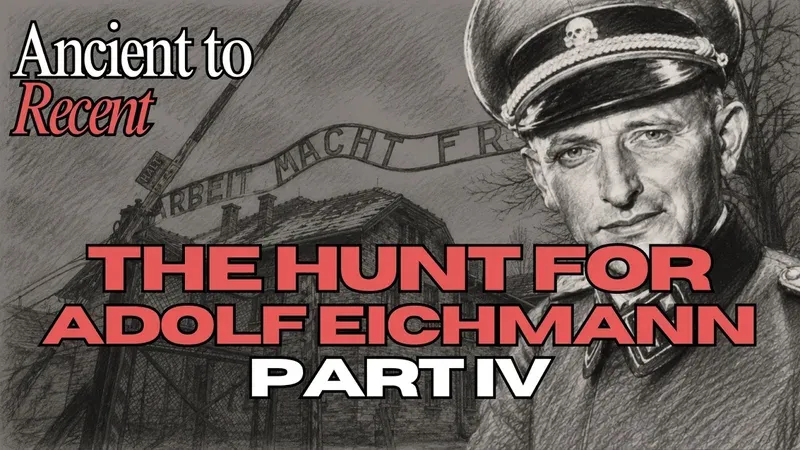
The Hunt for Adolf Eichmann — Part 4
20 June 2026 · 36 min · Season 1
 Watch on YouTube →
0:0036:30
Also on
Rate the show
Ratings are how new listeners find the show. It takes a minute and it makes a real difference.
In this episode of Ancient to Recent we continue the story of the hunt for Adolf Eichmann as Mossad agents close in on one of the most wanted fugitives in the world.
After years of rumours, false leads and dead ends, investigators finally begin to uncover compelling evidence that Adolf Eichmann is living in Argentina under the alias Ricardo Klement.
What follows is a tense race against time as Israeli intelligence works to confirm his identity before he can disappear once again.
In this episode we follow the remarkable detective work that leads Mossad from a modest house on Chacabuco Street to the dusty suburb of Don Torcuato, where a series of small breakthroughs gradually transforms suspicion into certainty.
Meanwhile, investigators uncover crucial links between Eichmann's family, his hidden past and the life he has built in exile.
Through covert surveillance, secret photography and painstaking intelligence work, the net slowly begins to tighten around one of the principal architects of the Holocaust.
As Mossad director Isser Harel, investigator Zvi Aharoni and prosecutor Fritz Bauer push the operation forward, difficult questions emerge.
Can Israel legally capture Eichmann on foreign soil? What risks will the operation pose to relations with Argentina and West Germany? And what happens if the mission fails?
The episode follows the final preparations for one of the most daring intelligence operations in modern history, as a small team of agents arrives in Buenos Aires and begins planning the capture of a man who has spent fifteen years evading justice.
With surveillance complete, safe houses secured and the operation date set, the hunt enters its most dangerous phase.
Join Joseph Parkinson as Ancient to Recent continues its series on the hunt for Adolf Eichmann, following the extraordinary events that led to one of the most famous captures in intelligence history.
🎧 New episodes every Saturday
📲 Follow on YouTube, Spotify & Instagram @AncientToRecent
#AdolfEichmann #Mossad #Holocaust #WorldWarII #Argentina #HistoryPodcast #TrueHistory #AncientToRecent
Read transcript
This transcript is automatically generated, so it may contain typos and misheard names.
Hope lives when people remember Simon Wiesenthal, 4261 Jacobuco St. the small bungalow the Eichmann family had called their home as they began rebuilding their lives thousands of miles from the ruins of the Reich lay empty. Had he been warned? Was Eichmann being protected by powerful friends? Was Eichmann perhaps a double agent in the pay of the Soviets or Americans? Or maybe the underground network of ex Nazis that has facilitated his escape, hand in hand with clergy from the highest reaches of the Catholic Church had warned him that the net was closing. Or perhaps worse yet, it was sheer dumb luck for the Nazi hunters, many of whom had seen the entire families condemned to the gas chambers of Auschwitz, to come so close. And yet again, see Eichmann get away. The frustration must have been unbearable. Haunted by the memories of their loved ones, burdened by the need to avenge their families, certain of the righteousness of their cause, yet their hopes dashed once more, Eichmann seemed to be a master of preparation, deception and intrigue.
For years, Eichmann was always that one step ahead, always thinking, always planning, always anticipating every angle. He had taken precautions that no ordinary man would have even thought of. He avoided being photographed, not even allowing his parents or wife a single picture of their Adolf. He had shunned the limelight that so many senior S S officers had found irresistible at the height of the power of the Thousand Year Reich.
And his caution yet again had paid off. If Eichmann, one of the masters of the Holocaust, was to be caught, then his pursuers would need to be better than good. They would need to be lucky. Welcome to ancient, to recent. My name is Joseph Parkinson and today we continue our story on the hunt for Adolf Eichmann. Episodes of Ancient Theresa are out every Saturday and are available on YouTube, Spotify and Apple Podcasts. With Eichman having vanished, the question loom for his would be pursuers.
What next? For all they knew, Eichmann could be anywhere. Rumours of his whereabouts had circled for years. With just a few hours notice he could be trekking over the Andes into Chile, on a plane to Cuba or sailing for the safety of Syria. If Eichmann was to be found then the men sent after him would have to start again, strip the search back, return to 1st principles. The next clue lay not in the dim midst of a Buenos Aires dusk, but the rolling hills of Eichmann's native Austria. After the war, Adolf Eichmann had tried to blend into the mass ranks of demobilised and defeated German soldiers. He had sought to escape justice, but before departing he had assured his family he would contact them when he had settled.
Years went by, but one day a letter arrived from one Ricardo Clement informing Eichmann's wife, Vera, that her distant uncle was alive and well, living in Argentina. The message was unmistakable. Adolf Eichmann was alive. Vera applied for travel documents under her maiden name, Vera Liebel, and with the children travelling on her passports, slipped out of Austria to a new life in Latin America. Before departing, she had told her family she was remarrying, a story then passed on to investigators that came looking for Vera after her disappearance. For years the trail went cold.
But then, back in Austria, an obituary was published following the death of one of Vera's relatives. If Vera had remarried, she would be listed under her new husband's surname. Instead, there it was in black and white, Vera Eichmann. The logic was simple. Find Vera and the boys and they would find Adolf Eichmann. The search eventually LED across the Atlantic to Argentina. Information supplied by Lothar Hermann pointed investigators towards a family living under the name Clement at 4261 Chacabuco St. in Buenos Aires. Initial surveillance, however, ended in disappointment. The family had moved.
The Israelis were not ready to give up. Receiving a tip from workmen at 4261 Chaka Buko St., Mossad agents began quietly searching the San Fernando and Don Tucato districts on the northern outskirts of Buenos Aires. The decisive break came from the Municipal Land Registry. Zev Aharoni, one of Israel's most experienced investigators, LED a discreet check of property records for homes in the area. In the files for a modest brick house on Garibaldi Street, they found a plot registered to Veronica Katarina Liebel de Eichmann, Vera's full maiden name combined with that of her husband's. It was the slip they had been waiting for. After years of using the alias Clement, Vera had registered the family home under her real married name. The long story that she had remarried after the war was false.
This was unmistakably the Eichmann family home. The discovery transformed the investigation. Within hours, massage agents were scouring the neighborhood and establishing surveillance on the small brick house standing largely alone on Garibaldi St. separated from its neighbors by stretches of open ground. At first, some within the Mossad team could be forgiven for finding the new information. Hard to believe the address was not one of Buenos Aires prosperous German enclaves. There were no grand villas or manicured gardens. The roads were unpaved, the house modest, the district working class.
Everything about the property contradicted the image Mossad had built of out of Eichmann, the man who had once moved amongst the senior leadership of the Reich and helped organise the deportation of millions. Could this humble dwelling really be Eichmann's home? Yet the evidence continues to point in only One Direction. Still, suspicion was not enough. Aharoni understood that if Israel was going to launch a covert operation on foreign soil, they would need proof beyond reasonable doubt. Yet even as the Mossad team closed in on Eichmann, a far more complicated question loomed over the operation. What would happen if they actually captured Eichmann? Israeli Prime Minister David Ben Gurion and West German Chancellor Konrad Adenauer had recently met in New York. Relations between Israel and West Germany was still in it's infancy, but was growing steadily closer. The two states were negotiating reparation agreements, intelligence corporations, and the foundation of what would eventually become a strategic partnership. Both leaders had much to gain and both had much to lose. Ben Gurion needed financial assistance to help build and secure the young Israeli state.
Ardenour, meanwhile, was determined to demonstrate that West Germany had broken with it's Nazi past and deserved to be welcomed back into the community of nations. The pursuit of out of Eichmann threatened to complicate all of this. The legal situation was murky. Eichmann was technically a W German citizen residing in Argentina. Israel had no jurisdiction over him. If Israeli agents seized Eichmann on foreign soil, they could be violating Argentine sovereignty and potentially provoke a major diplomatic crisis. There were other concerns as well. Would Adenauer be willing to tolerate such an operation? Or would the abduction of a German citizen by a foreign intelligence service damage the fragile relationship between Bonn and Tel Aviv?
Perhaps most worrying of all was the possibility of what Eichmann might reveal if he were put on trial. The Federal Republic had worked hard to distance itself from the Third Reich, but many former Nazi still occupied influential positions throughout the West. German state ministries, courts, intelligence services, and diplomatic missions all contain men whose careers had begun under Hitler. If Eichmann began naming names from the witness stand, the consequences could be explosive. For Ben Gurion, the decision was not a simple one. Capturing Eichmann might bring justice to one of the principal architects of the Holocaust.
It might also jeopardise one of the most important diplomatic relations Israel possessed. The risk was enormous. Yet as reports continued arriving from Argentina, the opportunity to bring Eichmann to justice appeared too good to ignore. The surveillance continued. Mossad agents now had strong reasons to believe that they had located the Eichmann family. But belief was not enough. They needed proof. One possibility was to obtain a photograph of Eichmann and compare it to the photographs investigators already possessed from Austria.
To achieve this, the agents adopted a new cover story. Posing as representatives of an American sewing machine company looking to establish a factory in the area, they began making discreet enquiries amongst local residents. One operative carried a camera concealed inside a briefcase, hoping for an opportunity to photograph the occupants of the house. Without attracting much attention, the operation nearly unravelled.
Whilst canvassing the neighborhood, one agent found himself confronted by a suspicious woman demanding to know why strangers were asking questions about a local residence. The encounter was brief but deeply unsettling. If the woman spoke to the occupants of the house, years of investigation could be undone. In an instance, the agents withdrew and waited anxiously. Had they gone too far? Had Eichmann finally been alerted? The fear was not entirely unreasonable. Eichmann knew he was still being hunted. Argentine newspapers had periodically reported that out of Eichmann remained wanted for war crimes. Stories had appeared suggesting the Interpol and other authorities were searching for him. For years he had managed to dismiss such reports as distant rumours.
Now strangers were appearing in his neighborhood asking questions. But the investigation pressed ahead. They still needed a photograph of Adolf Eichmann himself. As the days went by, the agents watched and waited. Then, at last, the moment arrived. As a house was being observed by agents parked in a nearby car, a figure emerged into the garden. The man appeared to be in his 50s. He was balding, with sloping shoulders, a thin face and a prominent nose. For a moment, nobody spoke.
Ziv Aharoni, the Mossad team leader, stared through his binoculars. He knew that face. For months, he had immersed himself in the Eichmann investigation. He had studied every photograph, every report, every witness statement Mossad could obtain. He had spent countless hours examining the life and crimes of out of Eichmann. Now the man himself stood before him, older, thinner, but unmistakable. Aharoni felt a chill run through him.
It was him. It was Adolf Eichmann. A coded message was dispatched immediately to Tel Aviv. After 15 years, they had found him. Finding Eichmann and capturing him were two very different things. The question now facing the Israeli government was straightforward. What should they do next? Argentina was no longer ruled by Juan Peron, the president, who had welcomed thousands of Nazi fugitives after the war had fallen, replaced by a more liberal administration. Yet anti-Semitism remained deeply embedded within parts of Argentine society.
Only months earlier, in January 1960, the country had experienced a wave of anti-Semitic violence, with Jewish institutions attacked and tensions running high. Any operation against Eichmann would therefore carry enormous risks. There was the practical problem of arresting him. There was also the diplomatic problem of violating Argentine's sovereignty. And there was the political problem of failure. If the operation collapsed, Israel would face international embarrassment and it's agents could find themselves in Argentine prisons. Eichman himself would almost certainly disappear this time, perhaps forever.
There was also the question of extraction. Even if Mossad successfully seized Eichmann, how would they get him out of Argentina? The country was thousands of miles from Israel. The operation would require false identities, safe houses, vehicles, aircraft, and a great deal of luck. Yet there was another consideration. Ben Gurion remained convinced that Eichmann's capture wood forest the world to confront the Holocaust once again. A trial would not merely punish one man, it would remind the world of what had happened to Europe's Jews. The agents already believed beyond reasonable doubt that they had found Eichmann.
But beyond reasonable doubt was not enough. They wanted certainty. Ziv Aharoni selected 2 local volunteers and trained them in the use of a concealed camera. The objective? Simple Get close enough to photograph Eichmann's face. One of the volunteers, a young man named Redne, was dispatched to Garibaldi St. Approaching the house, he found Eichmann and his son Dieter working in the garden. The moment was tense. One wrong word could destroy the operation.
Instead, Rednee struck up a casual conversation. For several minutes he chatted with the two men as though he was nothing more than a curious passerby. All the while, the concealed camera quietly recorded its image. Eventually, Redney thanked Adolf and Dieter Eichmann and walked away. The photographs were developed and carefully examined. They were then compared against the images Moss had possessed from Eichmann's years in the s s.
The verdict was unanimous. The man living in Garibaldi St. was none other than S S Oberstdumpf Barn Fuhrer Adolf Eichmann. There was no longer any doubt the hunt was over. The operation to capture Eichmann would begin. If Eichmann was to be captured, A-Team would have to be assembled. Not a military unit, not an army. Just a handful of carefully chosen men. In total, the operational team numbered only 8. Each had been selected for specific purposes.
Some were experienced intelligence officers, skill and surveillance, covert communication and operating under false identities. Others brought practical skills. Drivers capable of navigating Buenos Aires without attracting attention. Forgers and logistics specialists able to arrange safe houses, vehicles and documents. Men who could think quickly under pressure and improvise when plans inevitably went wrong. Several were veterans of Israel's military and intelligence services. Others had spent years conducting clandestine operations across Europe and the Middle East. Some had personal reasons for volunteering. Many had lost loved ones in the Holocaust. Others were motivated by the belief the Jewish people finally possessed something that they had lacked during Hitler's reign, the power to bring their persecutors to justice. The operation would be led by Rafi Itan. Calm, practical and utterly unflappable, Etan had developed a reputation for solving difficult problems without drama or theatrics.
Alongside him were men such as Ziv Aharoni, whose painstaking investigation had identified Eichmann, and Peter Malkin, a master of disguise and close quarter operations whose skills would prove critical when the moment came to seize the target. Together, they represented some of the best talent Israel's small intelligence community could muster. Yet for all their experience, none of them could ignore the risk they would be operating illegally on foreign soil.
If caught, they could expect arrest, imprisonment and international scandal that might damage Israel's relations with Argentina and beyond. Failure was not an option. The team began arriving in Argentina separately, travelling under assumed identities and carrying forged documents. One by one, they filtered into Buenos Aires, blending into the crowds of a city that had unknowingly sheltered out of Eichmann for nearly a decade. Soon, eight men would attempt something no intelligence service had ever done before.
They would kidnap one of the most wanted men in the world and smuggle him halfway across the globe to stand trial or his crimes. With Eichmann identified beyond doubt, the operation entered it's most dangerous phase. Finding Adolf Eichmann had been difficult. Capturing him would be far harder. The Mossad team considered three possible options. The first was to raid Eichmann's house at night and seize him in bed. The second was to snatch him from the street while he travelled to or from work.
The third was to abduct him close to home, where his movements were predictable and where the agents could control the environment. Each option carried enormous risk. A raid on the House might lead to a struggle and alert neighbors. An attack in the city would expose the team to witnesses and police intervention. Whatever method they chose, one problem remained. How were they going to get Eichmann out of Argentina? Capturing him was only half the mission. They still had to transport one of the most recognisable war criminals in the world thousands of miles to Israel. Several possibilities were considered. Removing Eichmann by sea was quickly ruled out. No suitable Israeli vessel was due to visit Argentina, and a lengthy sea voyage would create countless opportunities for discovery.
A military aircraft was equally impractical. The arrival of an Israeli military transport plane would attract immediate attention and invite questions the operation could not afford to answer. Then fortune intervened. Argentina was preparing to celebrate the 150th anniversary of the May Revolution, one of the defining events in the country. Struggle for independence. Delegations from around the world were expected to attend the celebrations. Among them would be an official Israeli delegation. The occasion provided the exact cover Mossad needed. An Israeli civilian aircraft could arrive openly as part of the celebrations without attracting undue suspicion. To maximise it's range, additional fuel tanks could be fitted, allowing the aircraft to make the long journey back to Israel with minimal stops.
Whilst planners worked on the extraction, the capture team began arriving in Argentina. The agents travelled separately and under assumed identities. They used passports issued by different countries and followed circuitous routes through Europe and South America to conceal their origin. They stayed in different hotels, avoided contact and took every precaution to ensure that no observer could connect them to one another. Even so, the temptation to act was sometimes difficult to resist.
Shortly after arriving in Buenos Aires, 2 members of the team decided to pay an early visit to Garibaldi St. Driving slowly past the house, they scanned the property. Then, suddenly, unexpectedly, they saw him out of Eichmann. For a brief moment, one of the agents instinctively reached the door handle, considering whether they should stop. The opportunity seemed too good to ignore. The other immediately intervened. No, they were not prepared. The operation had not yet begun.
Any unusual activity could alert the ever cautious Eichman and send him underground once more. Reluctantly, the agent sat back in his seat. The car continued down the road. Neither man spoke. Their hearts pounded as they drove away. After 15 years of searching, Adolf Eichmann was finally within reach. Now they simply had to capture him. The special flight that would transport Eichmann out of Argentina was scheduled to depart Israel on May the 11th.
It's journey would be long, complex and carefully staged. It could not remain in Argentina for long without attracting attention. The cover story and Israeli delegation attending celebration for Argentina's 150th anniversary of independence would only provide a narrow window of legitimacy. Once the aircraft landed, the team would have just seven days to complete the entire operation, seven days to locate, capture and then extract Eichmann from Argentina without detection.
The plan itself was brutally simple in outline, but almost impossibly difficult in execution. Eichmann would be seized, held in a secure location, and kept completely hidden while the team waited for the extraction flight. Only then would he be moved to the airfield and smuggled out of the country. Any delay, any mistake, any leak could collapse the entire mission. Meanwhile, Argentina was preparing for national celebrations.
The streets of Buenos Aires were expected to fill with crowds, and security forces would be everywhere. Roadblocks, identity checks and heightened patrols would make movement across the city increasingly difficult for the Mossad team. They spent one thing every journey would carry risk. Every conversation would be watched. Every stranger would be a threat. The logistical challenge extended beyond Argentina itself. The flight to Israel had to be carefully constructed to avoid suspicion. The plane would travel via a carefully planned route, using civilian cover and minimal stops to reduce exposure at third party airports.
The crew itself would be made-up of civilians working under strict instructions. None of them would be told the full nature of their mission. Each would be required to maintain absolute secrecy, even as they unknowingly became part of one of the most sensitive intelligence operations in Israeli history. If the operation failed, every participant, agent, pilot, handler could be exposed to international consequences. But despite the risk, there could be no turning back. The decision had been made.
The aircraft would leave on May the 11th, and once it landed in Argentina, the clock would start to tick. Night after night, the surveillance team settled into position alongside the nearby railway track, watching and waiting in the dark. From that quiet vantage point, they observed the house on Garibaldi St. without interruption, slowly beginning to piece together something far more valuable than a photograph or a rumour.
They were building a pattern, they were building a routine, and slowly Eichmann's life began to take shape. Like the S S officer he was, he was dependable, predictable, organised 740 in the evening. Every day, like clockwork, the 203 bus arrived, and every day out of Eichmann stepped off the same time, the same stop, the same movements through the city. Night after night. They confirmed it, watching as the bus carrying Eichmann pulled up near the kiosk at the top of Garibaldi Street, where he disembarked into a life that, on the surface, looked entirely normal.
For men trained to track fugitives across continents, this was the breakthrough that mattered the most. Not a photograph, not a confession, but rhythm, predictability, habit. They returned to the safe house to review everything they had gathered, laying out the fragments of observations like pieces of a puzzle. Out of these details, a plan began to form. At the same time, preparations began for something even more delicate, the place where Eichmann would be held after his capture and before extraction. The team planned to rent a large flat in an affluent neighborhood of Buenos Aires, not for comfort, not for luxury, but for cover.
In wealthier districts, coming and goings were less suspicious. Multiple cars outside of property would not draw attention the way they might in a poorer area where ownership of vehicles were still limited to a small, wealthy segment of Argentinian society in the 1960s. Discretion, they reasoned, would be built into the environment itself. But nothing in Buenos Aires came easily. The city was tense, fragmented and under constant scrutiny. Buenos Aires was Criss crossed with police checkpoints. Vehicles were frequently stopped, identity papers were checked without warning.
Every moment carried risk. And there was another problem. Housing. Every property they tried to rent came with complications. Many apartments included live in housekeepers, a normal arrangement in Argentina, but entirely unacceptable for a covert operation. Too many witnesses, too many variables, too much risk of exposure. Even transportation posed difficulties. The cars available were often old, poorly maintained and unsuitable for quick or discreet movement. As the preparations continued and unexpected complication emerged, the Israeli delegation that would provide cover for the extraction flight was no longer expected to arrive on the original scheduled date.
Argentinian authorities informed Israel that the official delegation would be received later than originally anticipated. Suddenly, the operation faced a difficult choice. Either the capture itself had to be delayed, giving Eichmann more time to detect the surveillance surrounding him and disappear once again, or Mossad would have to seize him as planned and hold him for as long as 10 days before they could smuggle him out of the country. 10 days. 10 days during which his absence would certainly be noticed. 10 days during which police, neighbors, colleagues and eventually the Argentine authorities would begin searching for him. The risk was immense.
Making matters worse, the full operation team had still not arrived in Argentina. The team was assembling piece by piece. Meanwhile, the surveillance continued. The agents watched Eichmann so closely that on one occasion a Moss had operative boarded the very bus he rode home from work, sitting directly behind him, only a few feet away. The agent spent the journey studying the man who had once helped organize the deportation of millions. Eichmann ever noticed.
Day after day, the surveillance reports accumulated. His routine remained remarkably consistent. Eventually, the conclusion became unavoidable. The safest opportunity would come during the short walk home from the bus stop on Garibaldi St. That would be where they struck with the location, decided, planning intensified. Every agent was assigned a specific role. Every possible scenario was discussed. What if Eichmann resisted?
What if he ran? What if he screamed? What if neighbors appeared? What if a police patrol drove past at the exact wrong moment? Nothing is left to chance. The kidnapping was planned down to the smallest detail. The exact positions of the vehicles were mapped out. The precise location of every team member was fixed. Each man memorised his role until it became instinct. From that moment onwards, rehearsal became relentless.
Again and again the agents practised the capture. One man would play Eichmann whilst the others acted out the operation. They rehearsed approaching him, grabbing him, subduing him, forcing him into a waiting vehicle. Over and over they repeated the sequence until every movement became automatic. The goal was ambitious. No more than 12 seconds could pass between the first contact and the moment the car speed away. 12 seconds. That was all they believed they could safely afford. At the same time, another crucial piece of the operation finally fell into place.
After weeks of searching, the team located a suitable safe house. The property was stocked with food, medical supplies, and everything necessary to conceal a prisoner for days. Inside, the agents constructed a hidden room where Eichmann could be kept out of sight, or they waited for the extraction flight. As the operation drew near, the team gathered for a final briefing. Spread before them was a detailed map of Garibaldi St. the house, the bus stop, the kiosk where ICON stepped off the two O 3 bus.
Each evening, every detail was reviewed one last time. 2 cars would be positioned along the route between the bus stop and Icon's home. One vehicle would sit by the roadside with its hood raised, appearing to suffer mechanical trouble. The scene would look entirely ordinary. As Eichmann approached, one of the agents would engage him in conversation, speaking in Spanish to distract him. The moment the target was positively identified, a nearby car would switch on its headlights, momentarily blinding him.
Then the snatch team would move in. Two agents would seize Eichmann, force him into the waiting vehicle, and disappear into the night. Every foreseeable contingency had been considered. Police interventions, curious neighbors, passing pedestrians, traffic problems, mechanical failures. Each had a corresponding plan. Yet there remained one factor that no amount of preparation could control. As of Eichmann himself, the man they intended to capture was not an ordinary fugitive. He had spent years as an s s officer, rising through the ranks of one of the most feared organisations in modern history. Though now older and physically diminished, he remained a man accustomed to pressure, secrecy and danger. What if he fought?
What if he escaped their grasp? What if he sensed the trap before it was sprung? And there were other uncertainties. What if he was accompanied by someone? What if he missed the usual bus? What if, for reasons nobody could predict, he simply failed to appear? In the end, there was no answer to these questions. Some things lay beyond planning, beyond preparation, beyond control. All the Mossad team could do was prepare, rehearse, watch, wait and pray. Because if the operation failed, the consequences would be severe.
Eichmann would almost certainly vanish forever. The diplomatic fallout would be catastrophic. Israeli officials were so concerned about the possibility of a backlash that additional security was assigned to the Israeli embassy in Buenos Aires. There were fears that if the operation became public, nationalist or far right groups might attempt reprisals against Israeli personnel or the local Jewish community. Everything now rested on a few seconds besides a dark Rd. on Garibaldi St.
The hunt that had lasted for 15 years was about to reach it's climax. As the day approached, pressure within the team continued to build. They were no longer simply observers, they were participants in something irreversible. This was no ordinary intelligence operation. It was becoming history. Every one of them carried personal weight into those long nights. Some had lost relatives in the Holocaust. Others had grown up hearing the stories of those who had survived. All understood what Eichmann's crimes meant. 15 years had passed since Auschwitz and the gas chambers had taken their parents, their brothers, their sisters, their wives. 15 years of rebuilding lives that never truly healed. 15 years of silence that never erased the memories. And still, when they closed their eyes, they saw their loved ones.
Still they heard their voices. Still they carried the pain of loss with them. And now, at last, they were here in Buenos Aires, within reach of the man responsible. For the first time in 2000 years, the Jewish people were no longer powerless in the face of those who had sought to destroy them. For the first time, they would stand in judgement over their persecutors. They could never bring their loved ones back. They could never undo what was done to them.
But this time, they would make the murderers of the Jewish people pay. Thank you for listening to Ancient Theresa. My name is Joseph Parkinson. Next week, we conclude the story of the Hunt for Adolf Eichmann. Episodes of Ancient or Recent are out every Saturday and are available on YouTube, Spotify and Apple Podcasts.