
#54
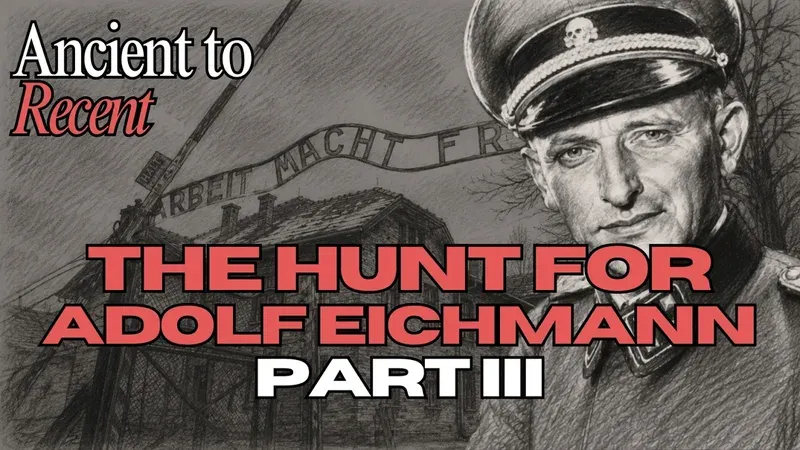
The Hunt for Adolf Eichmann — Part 3
13 June 2026 · 38 min · Season 1
 Watch on YouTube →
0:0038:13
Also on
Rate the show
Ratings are how new listeners find the show. It takes a minute and it makes a real difference.
In this episode of Ancient to Recent we continues the story of the hunt for Adolf Eichmann as a handful of determined investigators begin closing in on one of the most wanted men in the world.
As Eichmann settles into life in Argentina under a false identity, survivors, prosecutors and Nazi hunters refuse to let his crimes be forgotten. From Buenos Aires to Frankfurt and Tel Aviv, a growing network of individuals becomes convinced that one of the architects of the Holocaust is still alive and living in exile.
In this episode we explores the remarkable efforts of Lothar and Silvia Hermann, whose chance encounter with Eichmann's family provides the first credible lead in years.
Meanwhile, West German prosecutor Fritz Bauer takes extraordinary risks to keep the investigation alive, while Israeli intelligence begins to weigh whether the elusive fugitive can finally be brought to justice.
The episode follows the parallel investigations that gradually converge on a modest house in a Buenos Aires suburb, where suspicion grows that Adolf Eichmann may be hiding in plain sight. Yet as evidence remains frustratingly elusive, false leads, bureaucratic obstacles and public indifference threaten to derail the search.
As Nazi hunter Tuvia Friedman, Mossad director Isser Harel and a small group of determined investigators intensify their efforts, Eichmann grows increasingly complacent, convinced that he has escaped justice forever. But with the walls slowly closing in, the hunt is about to enter its most dramatic phase.
Join Joseph Parkinson as Ancient to Recent continues its series on the hunt for Adolf Eichmann, following the extraordinary investigation that would ultimately lead to one of the most famous manhunts in modern history.
#ad
This episode includes paid promotion in partnership with Ground News.
Go to https://groundnews.com/ancient to get 40% off the unlimited access Vantage plan and compare how different outlets report the same story.
🎧 New episodes every Saturday
📲 Follow on YouTube, Spotify & Instagram @AncientToRecent
#AdolfEichmann #Holocaust #WorldWarII #NaziGermany #Argentina #HistoryPodcast #paidpartnership #publicidad
Read transcript
This transcript is automatically generated, so it may contain typos and misheard names.
I don't regret anything. I'm not eating humble pie at all over Stumpf Bar and Fuhrer Adolf Eichmann. As the police were cleared, the conversation turned to home. Maybe it was the setting, maybe the company, but the dinner guest felt at ease and his tongue began to loosen. The guest had strong opinions, but once hardly out of place in Argentina's German community. The guest, Nick, or has he been born Klaus, was keen to make a good impression on his girlfriend's parents, who he was meeting for the very first time.
Nick boasted of his father's role as a senior varmark officer in the war, that his father was a great patriot and servant to their people, that his father had defended the Reich from the great enemy of the German folk, the eternal Jew. Nick's direction of conversation drifted from jingoistic bombast towards open anti-Semitism. This was hardly out of place amongst German emigres to Buenos Aires. In the post war era, sympathy for the lost cause of the Reich was common, Buenos Aires being one of the few cities which there were little public festivities celebrating the defeat of Hitler. In 1945 Nick had met Sylvia Hermann, also a German emigrator, Argentina, at one of the local dance halls. The two had taken a liking to each other and soon began courting.
They made a handsome couple and Sylvia had been keen to introduce Nick to her parents. Perhaps feeling himself amongst like minded people, Nick unburdened himself on the question of the Jews. Better if they'd all been finished off. They were, after all, the enemies of the Reich. What Nick did not know, what he of course could not have known, is that there was more than one sort of German emigre to Argentina. Many Germans who came to Argentina carried sympathy for Hitler, but others had quite different attitudes.
For the Hermann family, we're not refugees from the defeat of the Reich, but rather from its triumph. Welcome to ancient Theresa. My name is Joseph Parkinson and today we continue the story of the hunt for Adolf Eichmann. Episodes of Ancient to Recent are out every Saturday and are available on YouTube, Spotify and Apple Podcasts. Luther Hermann, father of Sylvia, had fled Nazi persecution in the early 1930s due to his socialist sympathies and Jewish heritage. He had spent time in Dachau and been beaten so badly by Nancy Brown shirts he'd lost sight in his left eye. Moving first to Uruguay and then on to Argentina, the Hermann family had blended into the German community. Traumatised by his experience when Sylvia was born, Lothar decided not to inform her of her Jewish heritage. Lothar had the good fortune of fleeing Europe before the outbreak of war.
But for Lothar's family, they had not been so lucky. Both of his parents and nine of his siblings would meet their fate in the Nazi death camps. As Nick expanded on the desirability of exterminating the Jews, Lothar said nothing. He had heard such talk in polite society before steering the conversation away from the topic. The night wound down before the Hermann family bid Nick, their daughter's new boyfriend, a pleasant evening and thanked him for his visit. Hermann Lothar had set up a successful legal practice in Buenos Aires.
Professional success went hand in hand with a happy family life and Lothar and his Dutch wife Martha had welcomed Sylvia into the family in 1941. Sylvia was bright and precocious, with plans to study at university in the US Months had passed since her boyfriend had offered his opinion of the desirability of exterminating the Jews. Nick and Sylvia had continued courting, though their relationship was somewhat unconventional.
Sylvia had never been to Nick's house and had to correspond with her boyfriend by sending letters to a mutual friend, as Nick would not provide his address. A few months later, the Herman family relocated to Coronel Suarez, some 300 miles southwest of Buenos Aires. They initially maintained contact, but distance soon put a strain on the relationship. One morning at the breakfast table, Sylvia read an article in the local German newspaper, the Argentinischer Tagenblat, about an ongoing war crimes tribunal in Frankfurt where a certain Adolf Eichmann, said to be a high-ranking s s officer, was wanted in connection with crimes against humanity.
Sylvia directed her father's attention to the article. Lothar had tried to put the meeting with Sylvia's then boyfriend out of his mind, but had found it impossible to entirely forget. Putting two and two together, Lothar now became convinced that the man sought in Frankfurt matched exactly the description Nick had given of his own father. 1950s Buenos Aires had no lack of Nazi war criminals, but the world seemed to have moved on in a great rush.
It had for everyone, that is, except Lothar Herman. Lothar was convinced that the crimes of the past could not be allowed to go and punished lest they be repeated. Lothar decided to act. He wrote a letter to the prosecutor's office in West Germany stating that the very Eichmann being sought in the investigation was alive and well in Latin America. The letter arrived at the desk of Fritz Bauer. Bauer, born in Stuttgart in 19 O 3, was the son of a Jewish textile dealer.
Bauer had embarked on a legal career during the Weimar Republic and rose to being Germany's youngest District Judge at the age of 26. By 1929, Bauer had seen how the failures of Weimar Germany's legal system had enabled the Nazis, with judges often handing down lenient sentences to Nazi thugs, deeming their violence worthy of lesser punishment as it was patriotic in nature. Whilst throwing the book at communist and socialist offenders for the exact same crimes. Bauer became convinced the lenience showed to the Nazis in the Weimar years had enabled them and aided their rise to power.
With Hitler's assent to the Chancellorship in 1933, Bauer was dismissed from his office before being arrested and tortured by Brown Shirts. In 1936, Bauer escaped Germany, settling first in Denmark, only to see his new home overrun. In 1940, Bauer escaped yet again, this time making his way to Sweden to see out the war before returning. After Hitler's defeat, Bauer set about trying to avoid the mistakes of the Weimar years by prosecuting Nazis and their sympathisers, including suing Otto Reimer, a right wing politician who had slandered the men who tried to assassinate Hitler in the failed July Plot of 1944.
As traitors with an iron will, Bauer set about hunting Nazi war criminals, leading him to file an arrest warrant for Adolf Eichmann in December 1956. When Lothar Hermann's letter arrived on Bauer's desk, he replied immediately, sending as much information he could to Lothar on Eichmann's appearance and war record, and pressing Lothar to secure whatever details he could on Eichmann's whereabouts. Sylvia and Lothar were certain they discover a lead to one of the most wanted Nazi criminals in the world and decided they would use Sylvia's previous relationship to gather information on the Eichmanns. Lothar and Sylvia made the 10 hour journey to Buenos Aires. The plan was to make their way to the neighborhood where Nick and Sylvia had met in the hope of bumping into some familiar faces that might know Nick's address. They got lucky running into a friend who offered the address. 4261 Chacabuco St. in the neighborhood of Olivos. Taking a deep breath, Sylvia opened the gate. Walking the small path to the door, she knocked. After several tense moments, she realized she was being watched. A figure undiscernible from the outside was observing her through the window.
After a nervous wait, the door opened and a middle-aged woman, accompanied by a small child answered. Sylvia explained that she was a friend of Nick's and was hoping to catch up with him. The woman, cheerful in disposition with a toddler at her ankle, replied that unfortunately Sylvia had just missed Nick, but was welcome to come in for coffee and cake. Sylvia, making her way into the House of a man she believed was possibly the greatest living mass murderer, sat in the living room chatting with the woman she suspected to be the wife of Adolf Eichmann.
Sylvia and Lothar had received an information package weeks earlier with all the details Fritz Bauer could scratch together the approximate age of the family members and a blurry photo of Eichman, now several years outdated, the one acquired from Eichmann's thoughtless former mistress in Austria. As Sylvia chatted to Vera, entering the room was an older man with slouch shoulders, glasses, a prominent nose, sharp features and a bald head. The figure before her matched the exact age of Adolf Eichmann. The man seemed to hover awkwardly. He was tense, as if he'd never been in the presence of a stranger before.
He exuded a level of nervous energy one would not expect from an adult man encountering a teenage girl. Sylvia greeted the man politely and asked him if he was Nick's father, Mr. Eichmann. The man did not reply. Sylvia persisted. The man snapped no and his uncle. Unperturbed, Sylvia attempted to engage the strange figure in conversation. The man let slip a few details, such as mastering a few phrases in French from his time during the war.
Before Vera could return with a coffee, Nick returned from his errand. Entering the living room, Nick was surprised to see Sylvia sat talking to his supposed uncle. What are you doing here? Nick inquired. Sylvia replied that she'd been in the neighborhood and wanted to see him, hoping she'd done nothing wrong. Nick was taken aback, but the older man, seemingly feeling more relaxed after briefly chatting with Sylvia, said not to worry. After an awkward moment, Sylvia excused herself. The man walked her to the door.
Nick turned to the man and said thank you, father, before departing to accompany Sylvia to the bus stop. As they walked, Sylvia asked why Nick had referred to his uncle as his father. Nick brushed the question off, saying it was a mere formality. Moments later, reunited with Lothar Hermann, Sylvia described in detail the encounter, especially how Nick Eichman had called the man father. They had found him, they had found Adolf Eichmann.
One of the striking themes of this story is how quickly people wanted to shape the narrative of historical events. Many former Nazis aggressively tried to make sure the story of the war was their story, to shift blame and downplay their crimes. Rumours circulated, facts became muddled, and important stories often disappeared from public attention altogether. That's one of the reasons Ancient to recent have partnered with Ground News.
Ground News gather reporting from thousands of new sources around the world and allow you to compare how different outlets cover the same story. You can quickly see political bias, ownership information, and whether a story is being under reported by one side of the media landscape. And one of my favorite features is the blind spot feed, which helps you identify stories that maybe would have slipped by you, that maybe would have been overlooked in our algorithm dominated news feeds. In an age where it's easy to get trapped inside a single perspective, Ground News helps you step back and see the bigger picture.
If you'd like to try it for yourself and support the work we do at Ancient to Recent, you can subscribe by going to groundnews.com/ancient to get 40% off the Vantage plan. That's Ground news.com/ancient. We found him. Eichmann said. Fritz Bauer Eichmann, the Adolf Eichmann replied Dr. Felix Shiner. Shiner, like Bauer, was a Stuttgart born German Jew. Unlike Bauer, he had not returned to Germany to rebuild the nation after the war. Shiner's allegiances now lay with the State of Israel. West Germany and the newly formed Jewish state had yet to establish formal relations, which would not follow till 1965.
Israel and West Germany were deep in negotiations over a reparations treaty, a small but symbolic step to begin the long journey of healing and atonement for the crimes of Hitler. China was part of the Israeli delegation negotiating the treaty that was at that very moment causing tempers to flare both in Israel and Germany. For many Germans, there was resistance to the idea of paying reparations to them. They had fought a fair fight and lost.
No need to kick a man when he's down. The enormity of Hitler's crimes had not sunk in, and many Germans were not willing, or perhaps psychologically able to come to terms with what the Nazis had done. Many W Germans distinguished between what they saw as the achievements of the Third Reich and it's crimes, convincing themselves that Hitler's mistakes rather than Nazism itself had been the problem. But other than that, there had been much to be said for the Reich.
These attitudes were added to by the myth of the good Vermont who fought a clean and noble war, versus The Dirty s s who bore responsibility for the crimes of the regime. Such attitudes persisted all the way up to perception of the Fuhrer himself. Polling carried out in post war West Germany found that as many as 48% agreed with the statement that apart from the war, Hitler was Germany's greatest ever statesman as late as 1955. A 1947 poll showed that 12% admitted to supporting Hitler to the end of the war, and in 1953 a poll showed that as many as 14% would vote for a dictatorial figure like Hitler again should one arise.
The reparations treaty was similarly controversial in Israel. Many saw the treaty as blood money, an easy way out for Germans to assuage their guilty consciences and wash the blood from their hands with gold. Riots broke out in Jerusalem and there were ugly scenes in the Knesset. But the governments of West Germany and Israel persisted in negotiations. For West Germany, it was a means of returning to the fold of civilized nations. For Israel, it was much needed capital to secure the future of the Jewish state.
Bauer told Shinar that Eichmann was in Argentina, and he even had an address. But Bauer had a problem. Worse than a problem. He had a conundrum. What to do from here. Yes, he knew where Eichmann was, but what good was that information? Bauer knew that the West German government, now a decade removed from Nazi rule, was riddled with men who had faithfully served the Reich, men who were eager to let sleeping dogs lie. Bauer had received threats from former Nazis and files had disappeared from his office. If Bauer passed the information on to the West German government, then in the best case scenario they would do nothing.
Or worse, Nazi sympathisers could tip the Eichmanns off and the last chance to catch Adolf Eichmann would be lost. Bauer took a bold decision, a decision that was not just technically illegal, it was treasonous. Bauer arranged a meeting with Shinar to share official state secrets with a representative of a foreign government. Shinar had migrated to Palestine in 1934, but his family had stayed behind in Germany. Shinar had lost both his parents and his sister to the Nazi gas chambers.
Visibly shaken and overcome with emotion at the memory of his murdered family, Shinar thanked Bauer and promised he would do what he could. Shinar passed Bauer's information onto Israeli Foreign Minister Valter Itan. Itan arranged a meeting with the head of the Israeli intelligence services, the Mossad, Issa Harel. The subject of the meeting was so secret that they met in a nearby cafe for fear foreign spies might have bugged the Mossad HQ. Itan informed Harel that Eichmann was alive and living in Buenos Aires.
Rumours of Eichmann's location had been swirling since the end of the war, but rumours concerned Harel Little. He was a man who dealt in facts, not speculation. The state of Israel was beset by enemies and had neither the time nor the resources to commit to hunting down Nazis. So little resources were given to the search for yesterday's criminals that the entire Mossad team responsible for hunting Nazis was one man. His sole responsibility was to collect information, write reports and file them in the hope that one day someone might read them.
With Arab armies on three borders, hundreds of thousands of Jewish refugees to integrate, speaking dozens of languages and coming from countries as far apart as Yemen and Belgium, settling scores was a luxury Israel did not have in the late 1950s. Mossad was a small organization. Issa Harel could call upon a dedicated staff of no more than 12 for making sense of an ocean of intelligence flooding in from around the world. The focus of Mossad was on penetrating Arab governments and rooting out Soviet and Arab agents. Though Harel was haunted by the Holocaust, it was a subject he wished to avoid, fearing that having to stare too long into the dark pit his people had been cast in, he would be incapable of crawling out again.
But with a reliable lead and so prominent a war criminal as Eichmann, Harel consented to taking on the case and immersed himself in the hunt for Eichmann. Opening the thick file on Eichmann, the evidence was every bit as terrible as he feared. Page after page of torture, mass shootings, the murder of children, death marches and worse. Every detail needed close attention, every date committed to memory, every face burned into his psyche. It was for them, all six million of his fellow Jews, that he would hunt Adolf Eichmann.
Harel built a picture of Eichmann in his mind. Eichmann was meticulous, intelligent, vain, and hard working. Eichmann was sure to have gone to great lengths to cover his tracks. Finding Eichmann would be a tremendous challenge. Before Harel could commit the meager resources of Mossad, he needed proof. Harel decided to dispatch an agent, Yurrell Goran, who had spent many years in Latin America and was fluent in Spanish, to confirm the information passed on by Bauer. Goran arrived in Buenos Aires and made his way to Olivos. At first, the houses seemed grand, in keeping with the sort of style one would expect from a man such as Adolf Eichmann. The neighborhood had a decidedly German flavour, complete with public displays of the swastika.
But as Goran approached 4261 Chacabuco St. the address given by Lothar Hermann to Fitzbauer, Goran became sceptical. The grand neoclassic architecture, manicured lawns and paved streets gave way to potholes, overgrown bushes and dilapidated shacks. Eichmann was believed to have stolen huge amounts of wealth. Surely he would be keeping himself, Maybe not quite in the style he enjoyed in the heady days of the Reich, but in considerable comfort.
What Goran found instead was a humble cottage in a poor neighborhood of a working class district. Goran snapped some photos, boarded his ship for home and reported back to Tel Aviv. Another wild goose chase. There's no way. The master of the Holocaust would live in such a humble abode. Many Nazis found not just freedom of Buenos Aires, but also fortune. The murderers of half of Europe found a welcoming government and a well integrated community, ideal circumstances for them to prosper.
Companies such as Capri Eichmann's employers after he arrived in Argentina, were set up by Nazi fugitives and often sustained by generous government contracts. Soon enough, Buenos Aires social clubs, boardrooms and fashionable cafes were abuzz with the soldiers of the Reich. But this story was far from universal. For every success, there were also failures. Eichmann had lost his job at Capri, his tense relations with his fellow Germans not helping his case.
After Capri, he turned his hands to a number of business ventures. He set up a rabbit farm, then a laundry, then a fabric shop, each a failure. By the late 1950s, Eichmann, who once decided the fates of hundreds of thousands with the stroke of a pen, was working as a factory hand for Mercedes-Benz. The indignity did not stop at professional underachievement. Eichmann had to watch as others who had once answered to him excel in business. And to complete the humiliation, at one point Eichmann had been forced to rent a flat in Buenos Aires from a Jewish landlord. Eichmann teeted on the edge of bankruptcy with mounting debts. His frustration at work spilled into his personal life. Though he welcomed a fourth son, Ricardo, his relationship with Vera was strained.
Eichmann's frustrated ambitions boiled over into heated arguments with his wife and smouldering resentment towards his sons, who he considered lacked their father's intellectual depth. Isser Harel was not quite ready to close the book on Eichmann just yet. But the window for action was narrowing. Harel dispatched Mossad agents to Argentina to interview Lothar and Sylvia Hermann to ascertain the strength of their story and see if they could gather more evidence.
The agents listened as Lothar recounted the dinner with Nick and Sylvia told of meeting the man at the Eichmann House. Intriguing, but far from conclusive. After all, the man might simply be any middle-aged German in Argentina. And there were thousands of them. And Vera Eichmann was rumoured to have remarried, a story her mother had tried to spin for investigators when she was interviewed in Austria. Could this man be a new husband? The agents pressed the Hermans to gather evidence. Something concrete was needed, fingerprints, a photograph, something they could really hang their hat on. The Hermans made their way to Buenos Aires yet again, this time to the Land Registry office to check the files for 4261 Checkabuco St.
They found the land had been owned by one Francisco Schmidt, reportedly an Austrian. Eichmann was also Austrian. Could Schmidt perhaps be an alias or perhaps an accomplice, a lead to follow that could take them to Eichmann such as they might? The hunt ran into a dead end. Communicating back to Tel Aviv, the Hermans yet again were unable to produce much more than interesting theories and tall tales. Harel was moving towards closing the file. The Middle East was in flux after the Suez Crisis of 1957, and Egypt and Syria had recently united to create the UAR United Arab Republic under the leadership of the charismatic Egyptian President Gamal Abdel Nasser. With no hard evidence, the hunt for Eichmann was halted. Eichmann had finally found stability with his job at Mercedes-Benz, though he still felt a tinge of humiliation that he had to ask Nazi comrades to put in a word for him to get the position.
He could not help his mind drifting back to the glory days of the Reich, a time when he felt his talents were truly appreciated. Eichmann's social circle was almost exclusively made-up of former devotees of the Fuhrer. One such loyalist was Dutch Nazi and journalist Wilhelm Sasson. Sasson had fled Europe at the end of the war and continue playing his vocation in the service of the Lost Cause of the Reich, writing for journals that glorified the triumphs of Hitler's empire. Through Nazi social circles, Sassen had become acquainted with Eichmann.
The two men bonded over long drinking sessions, swapping war stories and accounts of their sexual conquests. As Eichmann talked and Sassen listened, Sassen realized he had at his disposal a truly unique insight into the inner workings of the Third Reich, a font of knowledge that could make, in the hands of a talented journalist, a best selling book. Sassen took to inviting Eichmann to his house for regular interviews. As the tape rolled and the wine flowed, Eichmann, perhaps revelling in a rare opportunity to seem important, unburdened himself.
Eichmann took a contradictory approach. He both downplayed his responsibility in the Final Solution, stating the usual excuse of just following orders and holding no personal animosity towards the Jews. But he could not pass up an opportunity at self aggrandisement, presenting himself as an administrative genius, a fearless soldier in the Nazi cause and selfless warrior for the betterment of his people. Most strikingly, on the subject of guilt, he could not have been clearer. He had a duty to perform, and as a good soldier he did his duty without fear or favour.
His sole responsibility was to fulfil the orders of his superiors. As such, he felt not a tinge of remorse. Eichmann may have tried to present a dispassionate facade, but he could not help but allow for the occasional anti-Semitic flourish. When not dismissing any guilt or responsibility, he expounded on the wickedness of the Jews. The Jews were the greatest enemies of the Reich. They had brought their fate upon themselves through their wicked deeds and the inability of the Nazis to finish the job or be a burden upon their children for which they shall never be forgiven.
Eichmann had struggled to integrate as the German community in Argentina. His sense of self importance, prickliness and inability to achieve the rank in civilian life he felt he deserved and other lesser men enjoyed made him frustrated. He had immediately rubbed other Germans, including Nazis, the wrong way. A Capri. His work was poor and his attitude insubordinate, Moody and depressed, his conversation constantly drifting back to the war, a subject many wanted to forget. Eichmann found himself increasingly isolated, shunned even by his former comrades.
Tuvia Friedman was born on the 23rd of January 1922 in Radon, Poland. Like all Polish Jews, he was not spared the horrors of the Holocaust, with both his parents and two of his siblings murdered by the Nazi war machine. Tuvia had escaped Nazi captivity, killing the sleeping German guard with his own bayonet. After the war, he worked with the Hagenau in Vienna, but moved to Israel in 1952. For a society comprised 25% of Holocaust survivors, few seemed interested in tracking their persecutors down. Tuvia had promised himself that he would be like his fellow countrymen.
He would move on, let it go, not be caught in the past. But he struggled to find work, eventually landing a job at Yad Vashem, Israel's official Holocaust Memorial and Research Institute. He soon found himself drawn back into the abyss. Initially charged with registering the names of his victims, he began pushing his superiors for more documents, more evidence, more action on war criminals. His passion was seen as an embarrassment by his bosses, and in 1957 he was fired, Friedman said of his own organization with a small statement from the Israeli government. He drew no salary, leave it alone, collected files and documents.
Supported by his wife, who worked as an eye surgeon, Friedman turned his attention to finding Eichmann. To do so, Friedman began a correspondence with Irvin Schuler. In 1958, W Germany established the central office of the State Justice Administration in the investigation of National Socialist crimes, and Schuler was it's head. Schuler was a, let's say, interesting pick for the job. Schuler had not just been a Nazi party member from 1937, but a member of the Shturm of Tyloman, the SA paramilitary branch shirts, since 1933, and had served the duration of the war in the Vermont, not surrendering till March 1945. After the war, Schuler was released from Soviet captivity and began working as a prosecutor for the German state. Schuler soon proved himself brilliant in his new role prosecuting several Nazis, including members of the Nazi death squads, the Einsas Gruppen. Why would someone who is by all account a true believing National Socialist throw himself so enthusiastically into the cause of hunting his former comrades? This has been a subject of much speculation since. Was it guilt, or perhaps cover for his own involvement in the crimes of the Reich?
We will never know. It must be noted that no substantial evidence has ever been produced linking Shula with war crimes. Friedman asked if Schuler would be interested in going after Eichmann, to which Schuler stated he would indeed be keen on the venture that began sharing information. Schuler shared what felt like his strongest tip. Eichmann, according to Schuler, was in Kuwait. Friedman tried to press the Israeli government to take action on Eichmann, but again at only resistance. In desperation, Friedman took a bold step. He went to the press across the world. The headlines flashed.
Eichmann in Kuwait, living openly, government doing nothing. The Israeli government was embarrassed and the public outraged. Soon letters began pouring into Friedman's institution, some with messages of support, others offering their own outlandish sightings of Eichmann, some taunting Friedman that Eichmann would never be found. But one letter caught Friedman's attention. It was from Argentina and written by Van Lothar Hermann. The letter stated that Eichmann was not in Kuwait, but rather living in Buenos Aires, and that his address was known. Fritz Bauer, the West German prosecutor originally contacted by the Hermann family, did not stop at merely passing information on to the Israelis.
He took things a step further. Bauer had been frustrated by the lack of progress and decided to go to Israel to press the case for action against Eichmann in person. Bauer arranged a meeting with Heim Cohen, Attorney General of Israel, to reveal new information passed to him by a secret source. Bauer laid out in forensic detail Eichmann's escape from Germany with the help of the Catholic Church, that Eichmann had made his way to Argentina and had been employed by the Capri Company and lived in Tucuma before moving to Buenos Aires.
Bauer even knew Eichmann's new name, Ricardo Clement. But who was the source? How had Bauer been able to put together all the pieces of the jigsaw? Bauer would not share the name of his source, even with the Israelis. Bauer knew secrecy was of utmost importance. He had seen recently what happened when too many people found out the details of a Nazi hunt. Only months before, prosecutors in West Germany had issued an arrest warrant for Doctor Joseph Mengele, the notorious Angel of Death, who performed gruesome medical experiments on live patients in Auschwitz.
Mengele had been living in Argentina since 1949 under the name Helmut Greco. Mengele soon found that such caution was not necessary. The government of post war Argentina was so welcoming to form a Nazis that Mengele was even able to discard his alias and live openly, complete with freshly issued W German passport under his real name, Doctor Joseph Mengele. All the necessary details for extraditing Mengele, complete with home address, were known to Argentinian authorities. But when the West German government issued the extradition request, the government of Argentina insisted that as Mengele's crimes were of a political nature, there was no grounds to extradite the former doctor. Such a flagrant sheltering of Nazi war criminals provoked an international outcry that even Argentina could not ignore. You see, in the Cold War era, sheltering Nazi war criminals was fine.
Being caught sheltering Nazi war criminals was another matter entirely. As the outcry grew, Mengler need not have worried. He was kept fully abreast of developments by sources inside the West German embassy in Buenos Aires, including by Vera Juncker, the West German ambassador to Argentina and former aide to Joachim von Ribbentrov, Hitler's foreign minister. By the time the Argentinians sheepishly agreed to go after Mengler, he was long gone. Time was now of the essence.
After Friedman's visit to the papers, Eichmann was sure to know he was still being hunted. Fritz Bauer was not a man easily put off. Having been met with fine words and bureaucratic indifference, he was now determined to force action. At a stormy meeting, Bauer informed Israeli officials that if they did not take capturing Eichmann seriously, he would have no choice but to begin official proceedings through the West German authorities, fully aware that this could risk sending Eichmann underground.
The chances of success for the West German investigation into Eichmann were slim and looked like they were getting slimmer in so far as any effort at reconciling itself with Germany's recent past seem to be under way. In West Germany, it was not sympathy for the Jews, but rather renewed nostalgia for the Reich that seemed to be gaining traction. Israeli officials and German anti Nazis looked on with horror as the far right, littered with unapologetic ex Nazi party members not only took up positions of power in the post war state but began agitating for a return to political respectability.
A number of far right political parties were formed with some, like the German Reich Party established in 1950, achieving electoral success, winning seats in a number of state legislatures. Far right organisations began recruiting members, some former Nazis but also from the post war generation. Nazi newspapers mushroomed and in 1959 riots in Cologne saw synagogues to face with swastikas and Jewish graves and memorials attacked.
If this did not cause a fresh wave of Jewish migration out of Germany, it was only because of the 522,000 Jews who called Germany their home the year Hitler came to power in 1933. By 1959 only 1% remained of the other 99%. For them there had been one of two destinations, Israel or Auschwitz, with headlines across the world invoking the memory of Kristallnacht. To many in Israel it seemed that post war Germany was starting to look a lot like pre war Germany.
Prime Minister David Ben Gurion decided that the world needed a reminder of exactly what the Nazis had done to the Jewish people. What better way than to bring one of the architects of the Holocaust to trial? Within the halls of Mossad, a discussion began as to how exactly Eichmann could be brought to justice. Why not assassinate Eichmann? It would be quick, simple. Israel could deny any involvement and avoid the awkward legal question of jurisdiction.
Mr. Eichmann would simply expire. He would have a heart attack, choke on a chicken bone, fall down the stairs, or cut his throat shaving, or perhaps commit suicide by shooting himself in the back of the head twice. But Ben Gurion insisted that Eichmann had to be held accountable. Eichmann needed to stand trial in a Jewish court in a Jewish state to be confronted with his crimes so that the whole world could see what the Nazis had done.
Tuvia Friedman, by talking to the press, had refocused the world on Eichmann. But it also sent up a flair that Eichmann was sure to see. Eichmann now knew that he was still being hunted. If Eichmann went aground in, the trail could go cold in any hope of finding him lost forever. If Eichmann was to be brought to justice, then the first step must be to set the s s man at ease, to appeal to Eichmann's vanity that he had slipped the noose and could go about his life safe from the justice of his victims.
Friedman was contacted by Mossad and told to stop speaking to the press. Assured that measures were being taken to capture Eichmann, Fritz Bauer held a press conference in which he announced that he believed Eichmann was indeed in Kuwait and that an investigation was underway with Kuwaiti authorities to track Eichmann down. Or a ruse. Or a smokescreen designed to convince Eichmann that the Israelis were looking in the wrong place. All the while, Mossad agents slipped into Buenos Aires. The small Israeli security apparatus could call upon local volunteers from the Jewish community to lend expert knowledge and assist with transportation and language skills.
The agents had come to confirm Eichman's address before the full operation could swing into action. Renting a black sedan, the Mossad agents cruised the streets of Olibos, turned down Jacobuco St. They passed by Eichmann's family's small one Storey cottage. But something seemed to be off. They could not get a good look from their car. They parked up and quietly approached the house. Peering through the window, they found the home empty.
The Eichmanns had gone. Had they been tipped off by local Argentinian authorities? Or perhaps by Nazis in the West German embassy? Had Tuvia Friedman talking to the press backfired spectacularly and sent the Eichmanns underground Just as the new seem to be tightening out of Eichmann, the most wanted Nazi war criminal in the world had disappeared. Thank you for listening to Ancient to Recent, My name is Joseph Parkinson.
Next week we will continue the story of the hunt for Adolf Eichmann. Episodes of Ancient to Recent are out every Saturday and are available on YouTube, Spotify and Apple Podcasts.