
#53
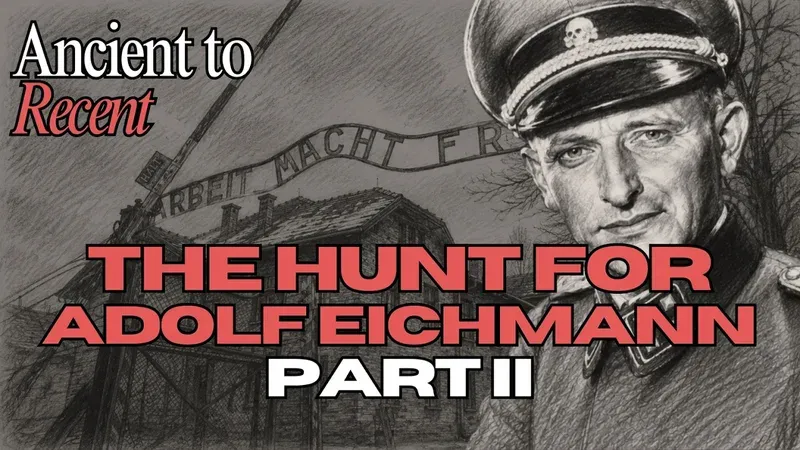
The Hunt for Adolf Eichmann — Part 2
6 June 2026 · 41 min · Season 1
 Watch on YouTube →
0:0041:54
Also on
Rate the show
Ratings are how new listeners find the show. It takes a minute and it makes a real difference.
In this episode of Ancient to Recent, we continues the story of the hunt for Adolf Eichmann as one of the architects of the Holocaust embarks on a desperate bid to escape justice and disappear from Europe forever.
As Allied investigators, Jewish organisations and survivors begin uncovering the true extent of Eichmann's role in the Final Solution, the former SS officer adopts new identities and slips through the cracks of post-war Europe. Meanwhile, Nazi hunter Simon Wiesenthal dedicates himself to tracking down those responsible for the Holocaust, becoming one of the first people to recognise Eichmann's importance.
We explores the chaotic aftermath of the Second World War, the growing tensions of the early Cold War and the debate over whether Nazi criminals should continue to be pursued as Europe struggles to rebuild. While many turn their attention to new political realities, Eichmann quietly prepares his escape.
The episode follows his journey through the clandestine ratlines that helped thousands of Nazi fugitives evade capture. Assisted by underground networks, sympathetic clergy and forged documents, Eichmann crosses Europe before arriving in Argentina, a country that had become a refuge for many former Nazis.
As Eichmann establishes a new identity and reunites with his family thousands of miles from Germany, he begins to believe that he has escaped justice for good. Yet even as the trail grows cold, a handful of determined investigators refuse to give up the search.
Join Joseph Parkinson as Ancient to Recent continues its series on the hunt for Adolf Eichmann, following the extraordinary story of how one of the most wanted men in the world vanished into exile.
#ad
This episode includes paid promotion in partnership with Ground News.
Go to https://groundnews.com/ancient to get 40% off the unlimited access Vantage plan and compare how different outlets report the same story.
🎧 New episodes every Saturday
📲 Follow on YouTube, Spotify & Instagram @AncientToRecent
#AdolfEichmann #Holocaust #WorldWarII #NaziGermany #Argentina #HistoryPodcast
Read transcript
This transcript is automatically generated, so it may contain typos and misheard names.
Justice, not vengeance. Simon Wiesenthal, the third of the axe blistered, hands aching back. It was hard work, felling trees deep in the German forest, 1,000,000 miles away from anywhere. But then that was the point, the distance, the seclusion. That was the prize, the labour, the price. It was here he could vanish into thin air. It was here nobody would ever come looking for him. His old life of chauffeured limousines, conferences, salutes, parties, mistresses and champagne may as well have belonged to someone else. The air was as crisp as his conscience clear. But sometimes the memories, the ones of smoke filled rooms, of secretaries and adjutants of deference, the good old days, they came back here.
He was nobody. But then, then he was someone. All right then he had status and privilege, power, absolute power, power over life and death itself. Nations trembled before him. The kind of power that once savoured is hard to give up. He may have found his old life hard to forget, but for some, they were just discovering his legacy. Newspapers arrived deep in the forest on the front cover, blazed in black and white. His masterpiece. His name was Otto Henningen, or, as the world would know him, Adolf Eichmann.
In the Bavarian city of Nuremberg, Rudolf Hoss, commandant of Auschwitz, had taken to the stand. Under cross examination from Allied prosecutors, Hoss outlined in exhausting detail the role of Eichmann in The Final Solution. Eichmann was no minor bureaucrats, no simple soldier, no cog in the machine. He was a force of nature, an administrative Hercules, the Michelangelo of death. Haas testifies that Eichmann directly dictated the schedule and chronological sequence of the incoming deportations from various European nations.
According to Hoss, Eichmann was personally involved in deciding how the mass murder would be executed. Hoss testified that he and Eichmann walked the grounds of Auschwitz Birkenau together to choose the location of the gas chambers. Furthermore, Eichmann was the one who approved the use of Cyclone Becas over other execution methods such as carbon monoxide or shooting, as it was deemed the most efficient for industrial scale murder.
Haas painted a picture of an obsessed Eichmann, frantic and fanatical in his determination to exterminate the Jews. With his masterpiece on display, there was no hope for Eichmann to fade away. He had to get out of Germany, out of Europe, find somewhere he could build a new life, somewhere his victims would never reach him. He had to escape. Welcome to Ancient to Recent. My name is Joseph Parkinson and today we continue our story of the hunt for Adolf Eichmann. Episodes of Ancient to Recent are out every Saturday and are available on YouTube, Spotify and Apple Podcasts. Simon Wiesenthal was liberated by the US 11th armour from Mauhausen camp in Upper Austria on the 5th of May 1945. He had survived stays in 12 concentration camps, including Janowska, Krakov, Gross, Rossen and Buchenwald. Born on New Year's Eve in Bujatsk, modern day Ukraine, then part of the Austria Hungarian Empire, his family had experienced the pogroms unleashed in Zarish, Russia, and cross the border hoping for a more peaceful life. His father had joined the ranks of the Austrian army in the First World War and died fighting the same Russians who had driven the Viesenfiles from their home. He spent most of the interwar years in Lvov, then part of Poland.
He studied architecture and began gaining a reputation as an up and coming talent. But there was only so far the Wiesenthal could progress, for Simon was a Jew. Interwar Poland was home to one of the world's largest Jewish communities, some 3.5 million in 1939. Though 10% of Poland's population Jews were emphatically second class citizens. The Polish government made little attempt to hide its loathing of Jews and maintained an official policy of encouraging Jewish immigration. To aid the process.
A series of laws enforce the subordinate status of Polish Jews, including public segregation, limited access to universities, boycotts of Jewish own shots, and dismissal of Jews from Polish civil service. Such laws were not just government policy, but public sentiment. Graffiti with the words Gigi do Palestini, or Jews go back to Palestine were common on walls in Warsaw and many Polish towns and cities. When World War 2 broke out, Simon had the dubious fortune of experiencing occupation at the hands of Nazi Germany's ally, the Soviet Union.
The war embrace of the socialist fatherland turned out to be cold indeed, as Simon soon came under suspicion from the occupying communist authorities. Many Soviet officials made no distinction between concepts of race and class. To Russian communists, a Pole was an aristocrat and a Jew a capitalist. Simon's family coming in for double persecution. In June 1941, Hitler double crossed his most loyal of allies and invaded the Soviet Union.
Eastern Poland was overrun within a matter of days and Simon traded international socialism for its national sibling. Soon enough, Simon and his wife Cynthia were in the hands of the Nazis and subject to back breaking labour over the course of German occupation. Of the 3.5 million Polish Jews in 19393 million, including 89 of Simon Wiesenthal's direct relatives, would be murdered by the Nazis. By liberation, Wiesenthal was living on a diet of only 200 calories a day, weighing only 41 kilograms. Wiesenthal had seen both his family and community subject to decades of hatred, only to then be herded into gas chambers and exterminated.
A line had to be drawn. The Nazis had to be haunted down and punished. Wiesenthal approached the Americans and offered his service in going after the war criminals. He offered a wealth of information, including names and even ranks of Nazis who participated in the slaughter of Jews. Wiesenthal was soon hired by the Allied investigation teams and went to work in Lintz for the OSS, or Office of Strategic Services, the precursor to the CIA.
It was in Lintz that Eichmann came to Wiesenthal's attention for the first time. But details of Eichmann's activities were scarce. In Vienna, whilst conducting investigations into fugitive Nazis, Wiesenthal met with representatives of the Jewish underground, then helping organized Jewish immigration to the British. Monday in Palestine, Wiesenthal was passed the list of the most wanted Nazis. At the top of the list was Eichmann. Back in Linz, Wiesenthal was sitting in his desk pouring over papers, trying to make sense of half clues and confused reports gathered from interrogations of s s men. He had written Eichmann's name down and underlined it on a Ledger whilst of his desk.
His Landlake entered the room. The landlady spied the name on the Ledger and inquired if the Eichmann in question was the same as the S S General Eichmann responsible for Jewish affairs. The same Eichmann whose family also happened to be living in Linz on the very same St. as Simon Wiesenthal. Astonished, Wiesenthal went straight to the OSS. On July the 28th, 2 OSS officers paid a visit to the Eichmann family home and interrogated Adolf Carl Eichmann.
Adolf Eichmann's father, Adolf Senior admitted his son was in the s S but knew nothing of his war time activities and told them that Adolf Junior had not visited since the end of the war. After the horrors of the Second World War, with so many dead, missing and wounded, so many crimes committed and so much blood on so many hands, the temptation, understandably, was to move on as quickly as possible. Europe lay in ruins, 10s of millions were displaced and new conflicts were already brewing.
With the trial of many of the most senior Nazis at Nuremberg, there was a hope that the book could be closed, a line drawn and a new day faced. After all, how far down the road of justice could we really travel? Are we really going to prosecute every Nazi? To put it into context, through the course of the war, 18,000,000 men served in the Vermont, 1.5 million in the s s, of which 900 thousand were in a buff. In S S there were 8.5 million Nazi Party members and 31 thousand members of the Gestapo, and many of these were the most capable, intelligent and talented men in all of Germany.
Exactly the kind of men who'd be needed in the post war era for rebuilding the German state. The rubble had to be cleared, electricity supplies restored, water mains repaired, roads and bridges, industry and the economy rebooted. Life had to move on. The world could not stop spinning for long the warm feelings between Western allies and their Soviet partners. We're already turning to suspicion as the spoils of war were shared.
And it was not just the Allies and the Germans who wanted to move on. The British Mandate of Palestine had descended into anarchy. Jewish survivors of the Holocaust were flooding out of Europe in a desperate attempt to find a new home free of persecution. The British authorities, who had revoked the Balfour Declaration and barred Jewish migration to Palestine on the eve of the war, were overwhelmed by the flood of refugees.
Palestinian resistance was growing as Jewish and Arab groups fought each other and both targeted the British. The British retaliated with repression. Jewish groups replied with terrorism. On the 22nd of July 1946, the King David Hotel in Jerusalem, the nerve centre of British ruling Palestine, was blown up by members of the Air Gun, a Jewish paramilitary organization. With Palestine descending into open civil war and the British exhausted by the vast sacrifice of the struggle with Hitler, British Prime Minister Clement Attlee took the decision to withdraw.
The newly established United Nations passed Resolution 181 on the 29th of November 1947, mandating the partition of Palestine into two states, one Jewish and one Palestinian. David Ben Gurion declared the State of Israel on the 14th of May 1948. To the Arab states Ben Gurion sent a message. We extend our hand to all neighboring States and their peoples in an offer of peace and good neighborliness and appeal to them to establish bonds of cooperation and mutual help with the sovereign.
Jewish people settled in its own land. The next day Egypt, Transjordan, Syria, Lebanon and Iraq declared war on the young Jewish state and within a few days they were joined by forces from Yemen and Saudi Arabia. With the Zionist dream of self determination finally at hand, many Jewish organizations in Europe that have been involved in the hunt for Nazis switched their attention to aiding Israel. As the world's attention shifted away, Simon Wiesenthal stayed behind in Austria to continue the hunt. There were rumours Eichmann had been killed by partisans near Prague.
Eichmann had fled to Palestine. Eichmann was in Tehran or Moscow or Damascus, but nothing concrete. Maybe Eichmann had been secretly carried away by the British, Americans or Soviets. Many high-ranking and highly skilled Nazis found themselves pressed into service for the victors. Wenna von Braun, architect of the Nazi V2 project and member of the s s, ended up working at NASA. Reinhard Gehlen, Wehrmacht head of intelligence on the Eastern Front, charged with analysing the Red Army for his skills to use with the CIA s s Standard Fiora. Ferdinand Brandner, A fanatical Nazi, was captured by the Red Army and smuggled into the Soviet Union where he designed a new generation of engines for long range Soviet bombers. Perhaps Eichmann was already long gone. Perhaps he was drinking vodka in Siberia, or tequila in New Mexico.
Or perhaps he had made his way through the clandestine Rat Line to one of the other destinations favored by Nazis to Syria, Egypt, Iran or Latin America. Perhaps the hunt for Eichmann was already over. One of the challenges when researching history is separating fact from interpretation. Every newspaper, historian and government sees events through a different lens. The same is true today. That's why Ancient to Recent have partnered with Ground News. Ground News is a media aggregating app that helps people break out of their information bubble and have a healthier, more balanced media diet. Ground News gathers reports from thousands of new sources around the world and lets you compare how different outlets are covering the same story.
Their Blind Spot feature highlights stories that may be receiving attention from one side of the political spectrum but little cover from the other, whilst their Ownership feature helps you understand who actually owns the media you are consuming. As someone who spends a great deal of time reading newspapers, archives, and historical accounts, I find the ability to compare perspectives particularly useful. If you'd like to see how different outlets are reporting the world's biggest stories and support our work here at Ancient to Recent, you can subscribe to Ground News and get 40% off the Vantage plan when you go to groundnews.com/ancient or by clicking the link in my bio.
Anna Lynn Horst's husband had been killed in action in the final days of the war. To make ends meet, she rented part of a family farm near Alter Saxe cost Louis Saxony to one Otto Henningen. Henningen had taken up chicken farming after losing his job at a forestry company in the summer of 1946. He scratched a living selling eggs in the black market to British soldiers and the few surviving local Jews. Little did Lindhorst know that Henningen was not the demobilized Luftwaffe Lieutenant he passed himself up as, but rather was one of the most wanted men in the world. Henningen, or to use his real name Eichmann, had been on the run for five years.
Estrangement from his family, his wife and three sons pained him, but he could not contact them for fear of giving himself away. He knew that hiding out in rural Germany could only ever be a temporary solution if he was to be free, if he was to establish himself, reunite with his family and start again. And he had to escape. In the dying days of the Reich, s s men had established a number of organizations to assist Nazi brethren in need.
Groups like D Spinner the Spider, set up by s s Commando Otter Scorsini, helped as many as 600SS men escape to Franco, Spain and Latin America. A system of code and hidden signals were established to allow the Nazi underground to advertise escape routes. The system operated through the local newspaper advertisement section. Specific phrases or intentionally misspelled words would point to roots out of the former Reich.
A typical advert might read. Seeking Hardy, disciplined farmhands and estate managers for immediate placement on agricultural properties overseas. Preference given to comrades with experience in eastern regions. Reply via box number 4812. Munich seems innocent enough, but look deeper. Hardy, disciplined. Common euphemism used to signal former military s s or paramilitary personnel Overseas placement. A direct indicator that this specific contact network had an established route out of Europe.
Experience in Eastern regions explicitly targeting individuals who had served on the Eastern Front or participated in operations in occupied Eastern Europe. The very people most heavily haunted by Allied forces for war crimes and box number 4812. This functioned as an anonymous dead drop. A letter sent here went to a newspaper mailing room where a bribed employee or underground Courier picked it up and routed it to a Nazi safe house.
Making contact with the Nazi underground, Eichmann arranged his getaway, trading his workmen's overall, he donned suit and tie and brought a train ticket from Munich. From here he hoped to cross into his native Austria before making his way to Italy. Eichmann's route had been laid out by his contact in the s s underground he communicated with through the advertisement section. Eichmann knew his contact only through his code name, Gunther.
He waited a week on the German side of the border, growing ever more nervous, especially as Gunther no showed their initial meeting. Was it a trap? A ruse? Who was Gunther, really? Was he being lured to a secret meeting with the British, Americans, Soviets, or Jewish survivors? There was no way for him to know. The town was infested with police and soldiers looking for well known Nazis, and by 1950 Eichmann's name and face had been on the front cover of every newspaper in the world.
Every day the pressure grew as Eichmann stared at the wall in his hotel, waiting to be contacted. Eventually, a rendezvous was set. Eichmann would be led by a local hunter through the woods into Austria, Spending a night in a cabin with a hunter deep in the forest. Eichmann's escape was almost foiled at the very last minute. Waking the next morning, the hunter spied a border guard trekking towards their cabin. Eichmann panicked, but the hunter hid him in a closet, assuring Eichmann the guard was almost certainly approaching the house for little more than a cup of coffee and a morning chat.
Agonizing moments passed as Eichmann hit, knowing a shift in weight, the creak of a floorboard, or sudden sneeze could give him away and condemn him to the hangman's noose. The hunter and guard sipped coffee as Eichmann held his breath. Finishing his refreshment, the guard thanked the hunter and departed. Regaining his composure, the hunter LED Eichmann over the border into Austria, departed, and Eichmann made his way to his next safe house, a local monastery.
The next morning he travelled to Innsbruck, where he made contact with an old s s colleague who assisted Eichmann by taking him to an inn near the Italian border. Yet again, Eichmann spent an uncomfortable night sleeping in the attic, hoping the French soldiers who occupied the town did not come calling. The innkeeper brought Eichmann across the border, where he was met by his latest travelling companion, a Catholic priest. The priest arranged for a car to take Eichmann to a nearby castle that operated as a safe house for the s s underground. The next day he received a new Italian identity card. Otto Henningen was a thing of the past. He had served his purpose.
He was now Ricardo Clement. It was not just his new identity that Eichmann learned, but also his destination. Eichmann would leave the shores of Italy and make his way to a new world, a new life in Argentina, the land of silver. That's what Argentina means. It was a name Argentina strove to live up to after gaining it's independence from Spain in 1816. Argentina had quickly established itself as one of the leading nations in Latin America, an economy based on rearing cattle and growing cereals for exports to feed the ever growing cities of industrial Britain.
Argentina and the UK had historically very close ties. Argentinian goods flowed at the Thames and Mersey, whilst British capital poured into Argentinian banks. Railroads and businesses. Argentina expanded its borders, acquiring large parts of Patagonia in the conquest of the desert of the 1870s and 80s, opening vast tracts of fertile land for immigration from Europe, and eager colonists were in no short supply. In the late 19th and early 20th century, millions of Italians, French, Spaniards, British and Irish migrants stepped up the ships at Buenos Aires to go forth and multiply. But few migrants scaled the height to success like Argentina's German community.
Some 150,000 Germans traded Berlin for Buenos Aires between 1880 and 1939. Germans established themselves in banking, manufacturing, chemistry, academia, and to all intents and purposes, founded the Argentinian brewing industry. By the turn of the 20th century, Argentina had one of the fastest growing economies in the world, with an average growth rate of 6% between 1892 and 99. Argentina ranked 9th in the world for GDP per capita in 1900, making the average Argentinian richer than the average French, German, Japanese or Canadian.
As the new century dawned, there seemed to be no limits to Argentina's potential. Alas, it was not to be. Argentina's economic model was based on the exporting of agricultural goods and the inflow of investment capital from Britain. With the outbreak of the First World War, international trade was disrupted, shipping became scarce, and Britain, once the world's banker, emerged from the conflict burdened by debt and increasingly unable to pour capital into Argentina as it had before.
The interwar years were tough for Argentina, with economic turmoil, social unrest and, in 1930, a military coup bringing an end to decades of civilian government. A new nationalism had emerged in Argentina in the years after the Great War, and this more aggressive sentiment sought to reassess Argentina's relationship with Britain. For some Argentinian nationalists, Britain was no longer viewed as ally, investor and friend, but rather as parasite and abuser. During the Second World War, Argentina took a broadly neutral stance, only declaring war on Germany on the 27th of March 1945, mere weeks before the conflicts end. Argentina's German community was largely pro Nazi and such sympathies were shared by some within the Argentinian government.
Juan Peron, Vice President and Minister of War, had spent time in Mussolini's Italy between 1939 and 1941 and made little secret of his admiration for Illinois. Duche, a collection of right wing Catholic anti communist army officers of which Peron was a member, had staged a coup in June 1943 to remove President Ramon Castillo. Peron requested not one of the prestigious offices of state finance, defence or Ministry of Foreign Affairs.
Rather, Peron was appointed head of the Department of Labour. Along neglected post, Peron elevated the department to a full government ministry and used his power to enforce enrollment in trade unions, increase wages and introduce pensions. Thus Peron was able to create for himself a fiercely loyal power base separate from the armed forces. With his new found power, Peron acquired the offices of Vice President and Minister of War, thus controlling most of the significant levers of government. With a working class in his corner and a state in his pocket, he swept to power in the 1946 elections. Peron, ever the optimist, saw the defeat of Nazi Germany as a gift.
So many talented scientists, military men and industrialists all of a sudden free contractors and in need of a new home. Why should just the US and Soviets Hoover up so much valuable human capital? Maybe such men can be put to use to strengthen the hand of Argentina. After all, who really cared what these men had done in Poland and Ukraine? Sadly, not many. In Buenos Aires, the Argentinian intelligence and diplomatic services began actively assisting fugitive Nazis, providing the necessary documents to travel to Latin America. But it was not only secular powers who intervened to help men like Eichmann.
For men from the s s, they had friends. In higher places they had friends in the Catholic Church. Bishop Aloise Hudal, born in Austria in 1885 and rector of the Church of Santa Maria del Anima in Rome, was an enthusiastic sympathizer with the cause of the Reich, even wearing his Nazi Party badge. Alongside his vestments, he helped coordinate the Ratline, the underground network smuggling high-ranking Nazis out of Europe.
His position as a senior Catholic cleric helped him acquire hard to get documents, passports, identification papers and entry visas. Hudal worked alongside Argentinian intelligence and even wrote to Peron requesting 5000 entry visas for Argentina for On the run Nazis. But Hudal was no one man banned. From parish priests to Cardinals, Catholic clergy actively assisted Nazi war criminals in escaping justice. Now it has to be said of course when talking about an organization as big as the Roman Catholic Church, there were many anti Nazi priests and so who actively assisted the Allies in looking for Nazis After the war.
Arriving in Genoa, Ricardo Clement, or rather her Eichman made his way to the Church of San Antonio. Knocking on the door he was welcomed by a Hungarian priest, Father Eduardo Dermeter. Dermeter provided a safe place to stay whilst the final details of Eichmann's departure was arranged. Eichmann approached the Red Cross and presented his landing permit for Buenos Aires, complete with identification card for Ricardo Clement and reference letter from Father Dermeter attesting to Mr.
Clement's status as a refugee with such impeccable paperwork and glowing references from a man of God. Nonetheless, Mr. Clement was granted a Red Cross passport without delay. Taking the document. Eichmann attended appointments at the Argentinian Consulate where he was issued a visa and immigration office where he underwent a medical examination. He passed the examination. The final bureaucratic hurdle had been cleared on the 17th of June 1950 out of Eichmann, one of the principal architects of Hitler's final solution of the Jewish question, A man who had sent millions to their deaths stroll to the docks, his step light, conscience clear. Awaiting him was a new life, far away from the fear and doubt of the past.
He boarded the suitably named S S Giovanni C and says sail for freedom. After depositing his bag in the third class cabin, Eichmann made his way to the upper deck to watch Europe and his past disappear. What did he feel in these final minutes? Did he take a moment to contemplate how he had come to this point? This was, after all, a defeat of sorts. The ideals and empire he had fought for had been crushed. He was a fugitive from justice and forced to leave behind the nation he saw himself as the loyal servant of. Or maybe he just felt relief.
Once in Buenos Aires he could disappear into a well integrated German community and one that had been staunchly pro Nazi throughout the war. He would be thousands of miles removed from his past life and well beyond the reach of his victims. The ship made stops at Naples, Barcelona and Lisbon, skirting the coast of Africa before plunging into the Atlantic. The trip took one month, arriving July the 14th, 1950. Disembarking, Eichmann was asked not a single question by the immigration officers.
His documents were briefly checked before being stamped. He had made it. It was real. Now, five years, two months, 14 days after the death of Hitler, Eichmann was at last free. In many ways, Buenos Aires of 1950 must have felt strangely familiar to Eichmann. It's grand boulevards, neoclassic architecture and leafy streets would not have been out of place in Paris or Vienna. The thoroughfares were dotted with fashionable cafes, and German could be heard spoken in the streets. There were German bars, restaurants, social clubs and even 3 German newspapers.
Reassuringly for Eichmann, there were German attitudes, complete with virulent anti-Semitism and nostalgia. The lost cause of the Reich. For Eichmann, this really was a little slice of Bavaria by the sea. Argentina's European flavour was well known. Buenos Aires felt so different from other parts of the continent that residents would remark they were travelling to South America in the event of trips to Brazil or Uruguay.
But how would Eichman fare in his adopted home? Would he be able to find his feet, get a job and settle in? Or about paperwork, documentation or navigating the state bureaucracy, all conducted in a language foreign to him? He need not have worried. The Nazi rat line worked with cool German efficiency. Everything had been figured out before Eichmann set foot on Argentinian soil, waiting for him upon arrival with his work documents complete with the necessary stamps from the local police, plus a temporary job in a metal shop. Soon enough, Eichmann was hired as an engineer by the hydroelectric company Capri, which have been set up by 1 Horst Carlos Fulner, an Argentinian born Nazi and former captain in the s s.
Eichmann was one of 300 Germans working at the company, which was funded directly by government contracts from the Argentine state, with several Cadbury staff being highly sought after Nazi war criminals. Charming is Buenos Aires was it was not Eichmann's final destination. Eichmann was sent to Tuchmann, several 100 miles north to the windswept foothills of the Andes, to fulfil his duties as a Capri employee. And it took a man.
He lived a simple life in a small cottage. He kept to himself, socializing very little and revealing even less about his past or true identity, even to his fellow Germans. Eichmann may have found freedom, but his solitude turned to loneliness and his mind drifted to his family. Back in Austria. He had not seen his sons for five years. His wife Vera had raised them alone. The fear of capture was replaced by the pain of loss.
But this too was a problem that the Nazi underground had a solution for. Eichmann was not the only man separated from his loved ones. An arrangement had been made to bring other Nazi families to Argentina. For a reunion to be possible, a process had to be followed. First contact would need to be made. This would be difficult as Eichmann knew his family were being watched. The sudden arrival of letters from the other side of the world would raise suspicion whether the Nazi underground were thorough.
They had thought about all the angles. A letter would be sent to a third party somewhere within Europe, not directly connected with the family. The recipients will be part of the Nazi underground. They would open the letter, discard any suspicious markings such as stamps from Argentina, and repackage the letter in a German envelope. The correspondence could then be reposted from within Germany without raising any suspicion.
At Christmas 1950, a letter arrived at the Eichmann residence from one Ricardo Clement. Opening the letter Bureau was initially puzzled by the content informing her that the uncle, presumed dead, was quite alive. She soon realized the uncle in question was her husband. Other letters, including cash to pay for the family's journey, soon arrived. In July 1952, the Eichmann family departed Genoa to make the same journey Adolf had almost exactly 2 years before. Eichmann travelled to Buenos Aires to meet them. He waited nervously.
Would his children recognize him? Had they grown into strapping young men? Would his wife still love him after seven years apart and everything he had subjected her to? Two Nazi friends met the Eichmann family when they disembarked, a precaution. The family's official reason for the trip to Argentina, was moving to be with an uncle. The family was taken to a hotel when Eichmann arrived. Vera cried with joy. Eichmann introduced himself to his boys as their uncle, The fiction still maintained, even with his own sons. After dinner, Eichmann and Vera had some time alone. Vera, who had refused to join the Nazi party and never discussed politics or Eichmann's work, had been unable to avoid finding out just what her husband had been doing on those long trips away and late nights in the office during the war years.
She asked him directly about his role and presented him with newspaper cuttings that detailed his crimes. Angrily, he denied the accusation, insisting he was a humble soldier and was responsible for the deaths of not a single person. Ironically, this is true. He was responsible for the death of 1,000,000. But for Vera Eichmann, her husband's word was enough and she never raised the subject again. The Eichmann family reunited at last, moved with Uncle Ricardo to Tucuman, where Eichmann felt comfortable to reveal his true identity to his boys. He swore them to secrecy.
No matter what, they must never reveal who their father really was. But strangely enough, he resisted the suggestion that his children change their last name. They would continue to carry the name Eichmann publicly. With a family back together, the circle seemed to be closed. Eichmann had made his escape. He had evaded justice, and now he was reunited with his family. The world had moved on, busying itself with a new set of problems beneath the Andes, thousands of miles away from Germany.
Eichmann had every reason to believe he would be free to live out his days in peace and tranquility, and that never again would the gaze of the world be set upon him. He was quite wrong. Wiesenthal rushed to Altassi, coming through the empty house that had until only days before in the home to Vera Dieter Horst and Klaus Eichmann. He searched desperately for any clue as to their destination. The Eichmanns had banished. Wiesenthal had been stunned when he received the call informing him that the family of one of the most wanted men in the world had been allowed to slip away without a single roadblock being erected or searched undertaken.
The house had been stripped of anything, easily carried away. Furniture remained, but personal possessions were gone. In the garden, Wiesenthal discovered signs that a hole had recently been dug. Perhaps sensitive documents had been hidden there, Perhaps jewellery or money. Whatever had been concealed had been removed. Shortly before the family's departure, Wiesenthal interviewed neighbors, friends and the landlord. None of them could provide a clear answer, their stories contradicted to one another and only deep in the mystery surrounding Vera Eichmann's whereabouts.
Then Wiesenthal found his first wheel clue. Vera had recently acquired a passport under her maiden name, Liebel. The family was on the run, but to where? For Wiesenthal, this was a disaster. Without the Eichmann family, it would be almost impossible to locate Eichmann himself. Months passed. Wiesenthal sank into a depression. Friends and colleagues urged him to move on and rebuild his life. The Nazis had been defeated.
Wasn't that enough? It was an attitude becoming increasingly common, particularly in West Germany. Why dwell on the past? Why reopen old wounds? Why pursue men whose crimes belong to another era? Get Wiesenthal could not let it go. In 1953, Wiesenthal arranged to meet an Austrian Baron by the name of Mast. The two men shared an unlikely hobby that had helped distract Wiesenthal from his frustration with the disappearance of the Eichman's stamp collecting.
Baron Mast had suffered under the Nazis himself, not because he was Jewish, but because he remained loyal to the old Habsburg Austrian monarchy. Like many aristocrats who refused to embrace National Socialism, he'd found himself on the wrong side of the regime. As they examined their collections, conversation drifted towards politics and then towards the Nazis. Both men were dismayed by the number of former Nazis who seem to be rebuilding their lives and in some cases returning to positions of influence.
Then Baron Mast mentioned a letter. The letter had come from a former Luftwaffe Colonel, an opponent of the Nazi regime that emigrated to Argentina after the war. In the letter the Colonel wrote, some people here we both used to know. A few more are here whom you never met. Imagine who else I saw and even had to talk to twice. That awful swine Eichmann, who commanded the Jews. He lives near Buenos Aires and works for a water company.
Wiesenthal could scarcely believe what he had heard. For years he had been chasing groomers, fragments and dead ends. Now he had something tangible. Immediately, he contacted the Israeli consulate in Vienna and passed along everything he knew about Eichmann and the search that had consumed so much of his life. Then he waited. Weeks turned into months. No reply came. Finally, on March 30th, 1954, representatives from the Israeli consulate met with Wiesenthal.
The meeting was not what he hoped for. The Israelis explained that the information was intriguing but insufficient. They needed more detail, more proof, and more certainty before committing scarce resources to such a pursuit. Israel was a young state with countless pressing concerns. Hunting Nazi fugitives across South America was not top of the priorities list. Instead, they encouraged Wiesenthal to contact Nihim Goldman, founder of the World Jewish Congress.
Perhaps Goldman would be willing to help, Wiesenthal wrote immediately. In his letter, he repeated everything he had learned and urged decisive action. Once again, he waited. Two months passed. Nothing. Eventually the matter reached Rabbi Abraham Kalmanovic in New York, another man who had long sought justice on Nazi crimes, But the response was much the same. More evidence was needed. The disappearance of Eichmann's family was suspicious, certainly, but suspicion was not proof.
Private investigators could perhaps be hired. More enquiries could be made, but before significant resources could be committed and needed to be certainty. And there was just too many rumours, too many alleged sightings, too many reports placing Nazi fugitives in every corner of the globe. Even Kalmanovic, who'd previously approached people had the highest level of American government, had found little enthusiasm. The Americans were not interested in hunting down Nazis, and they told Kalmanovic that any information that did come to them, they would do little more than pass on to West Germany. The West German government was equally reluctant. The new West German Chancellor, Conrad Ardenour, was focused on rebuilding the country and looking towards the future rather than reopening the crimes of the past. Once again, the trail went cold.
Years of work had produced nothing but rumour and disappointment. Eventually Wiesenthal, depressed, shipped much of his Arkad material to Israel. Perhaps it was time to move on. Perhaps everyone else was right. Perhaps Eichmann had escaped. Perhaps Eichmann had won. And worst of all, only a few years after the Holocaust, nobody really seemed to care. Was Eichmann really going to get away with it? Was he just going to ride off into the sunset and live out his days in Latin America?
Or was an unforeseen series of events to bring Adolf Eichmann to justice? Thank you for listening to Ancient to Recent. My name is Joseph Parkinson and next week you will continue our story, The Hunt for Adolf Eichmann. Episodes of Ancient to Recent out every Saturday and are available on YouTube, Spotify and Apple Podcasts.