
#52
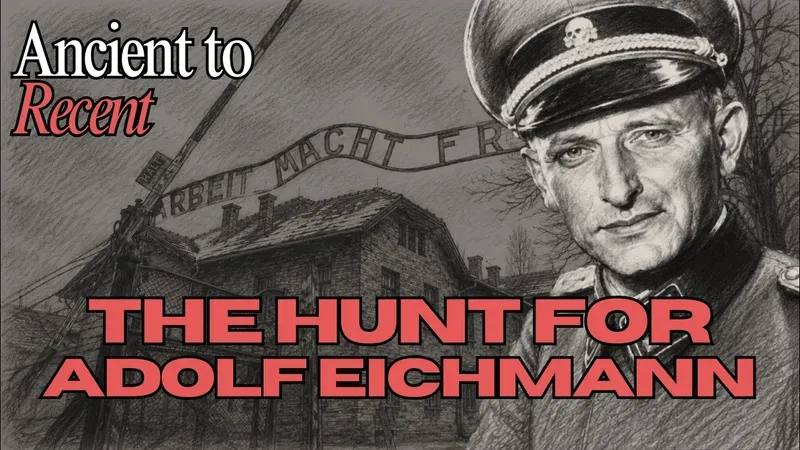
The Hunt for Adolf Eichmann — Part 1
30 May 2026 · 50 min · Season 1
 Watch on YouTube →
0:0050:32
Also on
Rate the show
Ratings are how new listeners find the show. It takes a minute and it makes a real difference.
In this episode of Ancient to Recent, we begin the story of one of the most infamous manhunts in modern history: the search for Adolf Eichmann, the Nazi official who played a central role in orchestrating the Holocaust and then vanished into the shadows after the Second World War.
The story opens on a cold evening in Buenos Aires in 1960, as a team of agents waits anxiously for a man who has spent fifteen years evading justice. As tensions rise and the operation hangs in the balance, we trace the life of Adolf Eichmann from his unremarkable childhood in Austria to his rise through the ranks of the Nazi Party and SS.
From the upheaval of post-First World War Europe to the radicalisation of a generation shaped by defeat and economic collapse, we explore how Eichmann found purpose in Nazism and became one of the key architects of the regime's anti-Jewish policies.
The episode follows Eichmann's transformation from bureaucrat to mass murderer, examining his role in the deportation of millions of Jews across occupied Europe and his central involvement in the implementation of the Final Solution. Particular attention is given to the destruction of Hungarian Jewry in 1944, one of the most devastating and rapid genocidal campaigns of the entire war.
As the Third Reich collapses around him, Eichmann flees across a ruined Europe, adopting false identities and narrowly avoiding capture while Allied investigators and Jewish organisations begin piecing together the truth about his crimes. By the war's end, the hunt is underway, but the man responsible for helping organise the Holocaust remains at large.
Join Joseph Parkinson as Ancient to Recent begins its series on the hunt for Adolf Eichmann, one of the most consequential pursuits of justice in the twentieth century.
#Ad
This episode includes paid promotion in partnership with Ground News.
Go to https://groundnews.com/ancient to get 40% off the unlimited access Vantage plan and compare how different outlets report the same story.
🎧 New episodes every Saturday
📲 Follow on YouTube, Spotify & Instagram @AncientToRecent
#AdolfEichmann #Holocaust #WorldWarII #paidpartnership #publicidad
Read transcript
This transcript is automatically generated, so it may contain typos and misheard names.
I will leap into my grave laughing, because the feeling that I have 5 million human beings in my conscience is for me a source of extraordinary satisfaction. Ubushtunf Banfurer Adolf Eichmann. He was late. This was unusual for him. He was never late, for he was a man of precision, of organization, of exact timing, a man of routine. Had he been brought up with his sense of organization? Did it come natural to him? Or was it something honed through years in a Nazi bureaucracy, years spent reducing human lives to files, schedules and railway timetables? Perhaps it was tiredness.
Perhaps the years of living in Latin America, in exile, had made his sense of timing more elastic. Or perhaps it was just age. He was, after all, no spring chicken, being now in his 50s, his days romping around Poland and Hungary at distant memory. They waited, they watched. For three weeks they had observed him as he stepped off bus 2O3 at 7:40 PM every night on Garibaldi St. to make his way to his small house. But tonight, 740 came and 7:40 went. Tension built, nerves jangled.
Had they been discovered? Had their cover been blown? Had someone let something slip that had tipped their target off? Maybe he had gotten wind that something was up and he had disappeared in the night, escaping justice yet again. As the seconds turned to minutes, each moment seemed to cut like a knife. But then at 744, turning the corner, the bus appeared. The team had familiarized themselves with his routine. Every night the man would cross the street and make his way to his home. Before entering his front door, he made one single round of the house.
Just checking, just making sure. A habit, a precaution. 1 can never be too cautious, not when you have enemies like this man. Even if 15 years had passed, he knew he was still being hunted and he was right to be cautious. He was right to be paranoid because on this cold, rainy night in Buenos Aires, Argentina, they had come for him. Welcome to Ancient to Recent. My name is Joseph Parkinson and today we saw a brand new series on the hunt for Adolf Eichmann.
Episodes of Ancient to Recent are out every Saturday and are available on YouTube, Spotify and Apple Podcasts. The agents sent to Couch Eichmann had taken up their positions on the street. The team was split into two groups waiting in separate cars. One car, a black Chevrolet sedan, would turn its lights on as soon as Eichmann started to cross the street to blind the ageing Nazi. The second team occupied a black limousine.
The driver, complete with chauffeur uniform, had popped the hood hoping to mimic engine trouble. To complete the ruse, 2 further men were to stand by the open hood, pointing and shaking their heads to add a layer of theatre to the fiction. Their job was to grab Eichman, bungle him in the back of the car with a minimum of fuss. But as 740 past, the team knew they could not wait long. This was a quiet neighborhood with few cars loitering.
Strangers were sure to draw attention, especially from the ever vigilant relatives of fugitive Nazis like the Eichman family. As the light faded on a Chile Buenos Aires night, the bus appeared. A figure stepped off. It was him. Otto Adolf Eichmann was born on March 1919 O 6IN Solingen, Germany, a small industrial city in the Rhineland known for its cutlery and steel production. He was the eldest of five children born to Adolf Carl Eichmann, A bookkeeper and accountant, and Maria Eichmann, a housewife.
The family was Protestant, specifically Calvinist. Evangelical and religious observance played a prominent role in the Eichmann household. In 1913, when Adolf was 7, his father received a job opportunity as the commercial manager for the Lintz Tramway and Electrical Company in Austria. The family moved the next year. This move to Austria would shape much of Eichmann's identity. He would later strongly identify with his Austrian upbringing rather than his German birthplace.
Young Adolf was a rather unremarkable and mediocre student. He attended school in Lintz, but showed little academic promise or ambition. He was described as a shy, nervous child with few friends. Tragically, his mother, Maria died in 1916 when Adolf was 10, and his father quickly remarried A devout Protestant woman also named Maria, who brought two sons of her own into the family. Eichmann briefly trained in mechanical engineering at the Lintzhire Institute for Electro Technical Studies, but dropped out after a couple of years without completing his course.
His father, who had started an oil extraction business, gave him a job, but again, Eichmann didn't stick with it. The years after World War One were turbulent for Austria. The Austro Hungarian Empire had collapsed, the economy was in ruins, hyperinflation and unemployment were rampant, and there was widespread political instability. Like many in his generation, Eichmann drifted aimlessly. In the mid 1920s he worked in sales for the Upper Austrian Electrical Construction Company, and then, from around 1927 to 1953, as a travelling salesman for the Vacuum Oil Company in Upper Austria. He lived the unremarkable life of an unremarkable man. This period coincided with the Great Depression, which hit Austria heart.
Eichman lost his job in 1933 amid the economic crisis, and these years of economic instability and national humiliation left many young Austrians, including Eichmann, receptive to radical political ideas, promising national revival and strong leadership. Many young men in Austria and Germany believed in what was called the stab in the back myth. Apparently, so the myth goes, the Central Powers had in 1918 been perched on the brink of victory, only to be cheated at the last moment.
This sense of humiliation was especially prevalent in the generation of young men who had come of age immediately after the war. Their older brothers and fathers had marched off, faced death and in many cases given their lives in defence of the Fatherland. For the youth of Austria and Germany, they had both missed out on the glory days of power of the pre war imperial age, whilst also being cheated of the sacrifice and camaraderie of war.
For them instead, the bitter bounty of defeat for men such as Eichmann, the November criminals, those who had wielded the knife that stabbed Germany and Austria in the back, supposedly they were to blame. And who were these men that had betrayed the Fatherland? For Eichmann, the answer was clear. Communists, socialists, liberals, and above all, the Jews. Eichmann's entry into the Nazi movement came in the early 1930s on the advice of a family friend and local s s leader, Ernst Kelton Bruner, who had later become a high-ranking Nazi.
Eichmann joined the Austrian branch of the Nazi Party on April 1st, 1932, membership number 889 895. It must be noted that the Nazis had a tendency to massively inflate their party membership numbers, usually by adding an extra digit. Seven months later, in November 1932, he joined the s s, the Shudstaffle, the Nazi Party's elite paramilitary organization. At this point, the Nazi Party was still heavily restricted in Austria, so members operated somewhat underground. Eichmann's early s s duties in Linz involved guarding party headquarters and protecting speakers at rallies, work that often turned violent with mass brawls with communists and socialists attempting to disrupt meetings. When the Austrian government cracked down on the Nazis in 1933, Eichmann fled to Germany.
He joined the Austrian Legion, a paramilitary training unit for exiled Austrian Nazis, and underwent military style training. In 1934 he was assigned to an s s unit at the Dachau concentration camp, then primarily used for political prisoners, before being transferred to the SD, the s s intelligence services in Berlin. There he was initially assigned to the department dealing with so-called Jewish affairs. Eichmann began studying Zionist organizations, Jewish culture, and even learning some Hebrew and Yiddish, not out of sympathy, but as a way to position himself as his so-called expert on the quote UN quote Jewish question. This marked the beginning of his specialization in supposed Jewish matters which would define his career. Having so long wandered aimlessly through life, the Nazi Party gave him purpose, meaning, structure and direction. By the mid 1930s, Eichmann had established himself within the SDS Jewish Affairs section.
His professional life was for the first time progressing nicely with new found career success. He also found success in his private life. He married Veronica Liebel in 1935, and they would eventually have four sons and more. Opportunities began presenting themselves to this self-proclaimed expert on Jewish affairs. When Nazi Germany annexed his native Austria in the Anschluss of March 1938, Eichmann was sent back to Vienna, where he set up the Central Office for Jewish Immigration. The office used a combination of bureaucratic efficiency, intimidation, and robbery to force Jews to emigrate while stripping them of their assets.
It became a model for later operations. A year later he performed a similar role in Prague after the German occupation of Czechoslovakia. By the time World War 2 broke out in September 1939, Eichmann was a rising figure in the Nazi apparatus, still relatively junior in rank, but recognized as someone who could solve logistical and administrative problems related to the regime's anti Jewish policies. When German tanks rolled into Poland on the 1st of September 1939 out of Eichmann was already positioned as a key administrator in the Nazi security apparatus. Just weeks earlier, the rank security main office RSHA have been created, merging the SD and Gestapo. Under Reinhard Hydrate.
Eichmann was placed in charge of RSHA 4B4, the department responsible for Jewish affairs and evacuations. What begun as forced emigration now rapidly evolved into something far more sinister. In the early months of the war, Eichmann organized the deportation of Jews from incorporated territories into the newly created general government in occupied Poland. He experimented with plans like the short lived NISCO Plan, attempting to create a Jewish reservation in eastern Poland. These efforts were chaotic and brutal, with thousands crammed into overcrowded ghettos in cities like Warsaw and Lotz. Eichmann personally inspected these sites and oversaw the logistical machinery of rounding up, transporting, and concentrating Jewish populations as the war expanded in 194041. Nazi policy shifted with the invasion of the Soviet Union in June 1941.
Operation Paparosa mobile killing squads called Einsatzgruppen began mass shootings behind the lines. Eichmann's role intensified. He was involved in discussions about moving from the expulsion and concentration of Jews to their systematic annihilation. The pivotal moment came on January 20, 1942 at the Vancey Conference. Eichmann, though not the most senior official present, played a crucial behind the scenes role. He prepared the statistical data on Jewish populations across Europe and took the minutes of the meeting.
There, Heidrich outlined the final solution to the Jewish question, the coordinated deportation of all Jews under German control to killing centres in the East, where they would be murdered. Eichmann became the chief operational coordinator. From his office in Berlin. He orchestrated the identification, rounding up and rail transport of Jews from across occupied Europe to the extermination camps, primarily Auschwitz, Birkenau, Treblinka, Belzek, Sobibor and Maiden Act. He negotiated with railway authorities for train schedules, worked with local collaborators and governments, and ensured the machinery of death ran with cold bureaucratic efficiency. He even visited camps like Auschwitz and inspected the gassing facilities.
Between 1942 and 1944, Eichmann's department managed the deportation of over 1.5 million Jewish men, women and children. He showed particular zeal when obstacles arose, often intervening personally to prevent exemptions or delays. As the Nazi war effort stumbled, Eichmann did not miss a step in his effortless rise. By late 1943, the war had turned decisively against Germany. Defeated Stalingrad and Kursk had shattered the myth of Nazi invincibility in North Africa. The Axis had collapsed and Allied troops had landed in Italy, bringing the war back onto European soil. Hungary, one of Germany's most dependable allies, had begun quietly exploring a way out.
It's leader, Admiral Horthy, understood what many in Berlin refused to admit. The war was lost. Hitler moved swiftly. On the 19th of March 1944, German troops occupied Hungary. Though Horsey remained in place as a figurehead, real power increasingly rested in German hands. For Eichmann, this was an extraordinary opportunity. Personally tasked with overseeing the deportation of Hungarian Jews, Eichmann arrived in Budapest with a small team and an enormous mission to destroy one of Europe's last major Jewish communities before the Reich itself collapsed, and he moved with terrifying speed.
Eichmann immediately set about categorising, systematising, pouring over railway timetables, drafting lists for deportation. Those fit for labour were to be sent to the factories and mines, their fate to be worked to death. Those not up to the arduous toil served no purpose. Their destination was the gas chambers. Eichmann was proud of his role. He felt a sense of achievement. The boy from humble beginnings now playing his part in fulfilling the furious dream. He was meticulous in his planning. Like a manager of a modern tech start up, he set about applying the highest principles of efficiency. Tasks were delegated, objectives set, data utilized, the best talent recruited, and he would need to master every resource if he was to achieve his historic mission. Like any good manager, Eichmann knew the importance of best practices.
He knew that delivering results required constant learning what worked and what didn't. The Nazi war and the Jews had not been all smooth sailing. There had been recent and embarrassing setbacks. In April 1943, the Jews of the Warsaw Ghetto had risen up. It took the Fairmac a month of fighting. Thousands of troops had to be diverted and the Germans suffered hundreds of casualties, including more than a dozen deaths, to put the rising down.
Both Himmler and Eichmann were keen to avoid such embarrassing scenes. Eichmann devised A2 pronged approach. First, he would deploy deception at every step. The Jews were to be assured that no harm would come to them should they comply with German demands. Eichmann personally met with Jewish community leaders to assure them that they were merely being relocated. Eichmann even encouraged German officers to accept Jewish offers of bribes for better treatment so as to further assure Hungarian Jews that their fate was in their own hands. With the Jewish community assured of the benign intention of German authorities, Eichmann's plans could be put into action.
The plan was to unfold in 4 stages. Firstly, the Jews were to be isolated from broader Hungarian society, forced to wear the Star of David, banned from holding government positions and even prevented from using the telephone. Secondly, Jews were to be stripped of their wealth. Everything from cash to cars, jewellery to art factories to corner shops was to be taken down to the last penny. Thirdly, concentration. Jews were to be forced into small ghettos to more easily control their movements. And lastly, deportation to the death camps. To further smooth the path, different stages were to be implemented in different parts of Hungary and different times. The time scale for isolated Jewish communities was to be accelerated.
But in Budapest, where the Jewish population was most concentrated and resistance most likely, the plan was to unfold slowly. If Eichmann was to achieve his goals and on time, then the cooperation of Hungarian civil authorities was essential. Thousands of Hungarian soldiers, policemen and civil servants would be required to draft the lists, arrange the trains, and herd Jewish men, women and children to their fate. Eichmann need not have worried.
Like in every country in Europe, with notable exceptions for Bulgaria and Denmark, Eichmann found endless numbers of local collaborators only too eager to murder their Jewish neighbors. Eichmann visited the Jewish Quarter in Budapest, a tiny area only nought .1 miles or nought .3 kilometers, which housed 70,000 men, women and children. Upon his visit, the Jews were gathered together for Eichmann to address the mass huddle.
In a clear voice, he announced, Jews, you have nothing to worry about. We want only the best for you. You will leave here shortly and be sent to very fine places indeed. You will work there, your wives will stay at home and your children will go to school. You will have wonderful lives. Only days later, the deportations to Auschwitz began. Teams of German and Hungarian police and soldiers wielding whips and truncheons herded Jewish men, women and children up the ramps onto the waiting cattle trades. Dozens crammed into small, poorly ventilated boxes with barbed wire over the windows.
The guards handed them two buckets, one for a toilet, one with drinking water. The doors were slammed shut, the heavy sound of padlocks followed by the slow rhythmic motion of the train pulling away from the station. As the train made its way through the Hungarian countryside, the hours seemed to drag by so many human bodies of all ages, sick and old, young and healthy. All forced together, breathing heavily, the stifling heat, sobbing parents, comforting children, gasping for air at the small cracks that allowed him just enough oxygen.
Soon the water ran out. Occasionally the train would stop from the small cracks. The inhabitants could catch a glimpse of the signs. Their place names have been changed from Hungarian to Polish. At the occasional stops, the guards would fling the doors open, select a child, point them to a nearby pump and tell them to quickly take the water bucket and refill it. The child, exhausted and weakened by thirst but desperate to help, dashed out, working the pump frantically before carefully returning. Just before stepping into the wagon, a soldier stepped forward and striking the child, breaking his nose with his rifle butt, setting the water crashing to the floor. The roar of laughter of the soldiers. The child gathered and thrown back into the wagon, The bucket left in the dirt as the train rolled on. Four days after leaving Budapest, the trains pulled into a camp.
Passing through the arch, the cast iron letters above spelled out a haunting message. Arbite Macked Fry. The train comes to a halt as wooden ramps are brought forward by inmates wearing striped uniforms. The doors flung open. Dogs bark and whips crack as a piercing shriek of half understood orders in German usher the emaciated inhabitants from their wooden casket. Searchlights blind the survivors. The air is heavy, the thick black smoke billowing from the chimneys, the unmistakable stench of burning flesh.
An S S officer, Black boots, the death's head symbols, staring down from his peat cap, makes a gesture with his hands. Left, right, left, left, right, left, right. With each word a choice is made, a fate decided. Those sent to the left are to be put to work, those to the right, children, the elderly, the sick, the gas chambers. Thus was the ruthless efficiency of the plan put in place by Adolf Eichmann. Every single day trains departed from Budapest. Every single day they arrived at Auschwitz. Every single day the harvest went on. On average, 4 trains with 3500 Jews were received at Auschwitz from Budapest daily.
A total of 437,402 Jews were deported from Hungary between the 15th of May and the 9th of July 1944. In total, some 330,000 Jewish men, women and children were selected on arrival for immediate murder. In only seven weeks, a Jewish community that had lived on the banks of the Danube since the 10th century was wiped off the face of the earth. What I've always found most incredible, most unfathomable about the story of the Hungarian Jews in the Second World War is realising that this is happening in mid 1944. This is having a time when the USA has entered the war, when the Soviet Union has turned the tide, when Allied landings in Italy have brought the fight back to continental Europe. This is happening at a time when the high command of the German army and of the Nazi Party and the German state, they know they have lost.
They know it is a matter of time. They know that it might be 6 months, it might be a year, but the outcome of this war has been decided and they are going to lose. And yet they are still committing unbelievable crimes that they know they will be punished for, but they're still doing it. They can't stop themselves. They can't help themselves. That's the thing that I have always thought was most incredible, most difficult to understand about this.
None of these people in the Nazi high command have any illusion that they are going to get away with any of this, and they're still doing it. But Eichmann was not able to finish his ghastly plan. The international community was starting to learn of what was happening in camps like Auschwitz. Hungarian Regent Admiral Horte had been kept on by Hitler as a figurehead, but the international outcry over the Holocaust was gathering pace and Horte, unlike a lot of Nazis, were starting to worry about life after the war. Pope Pius the 12th sent a message to Horte appealing to his Christian faith and begging him to stop the deportations. President Franklin Delano Roosevelt was more direct, warning that there would be dire consequences for Hungary if the deportations were not halted immediately. And King Gustav the 5th of Sweden sent a personal message urging Horte to stop the deportations. Horte intervened.
Eichmann was furious. He directly ordered the resumption of deportations, with thousands more dispatched to the death camps. But Horte wasn't the only one starting to worry about the day after the war. s s Reinke's Fuhrer, Heinrich Himmler, Adolf Eichmann Superior was clear sighted enough to understand the war was lost, whilst also being sufficiently deluded to believe that he could play a role in post war German politics. In November 1944 Himmler ordered the cessation of the use of gas in the camps and the destruction of the gas chambers and furnaces.
This was caused not by a sudden spasm of conscience on Himmler's part, more a desire to cover his tracks. Nevertheless, the order came down to stop the deportations directly from Eichmann's boss. Eichmann was outraged, Frustrated, Eichmann spent a few months kicking his heels in Budapest, enjoying the last days of the Reich by dining in fine restaurants, carrying out affairs and drinking himself into a stupor. But Eichmann was not done with the Jews yet. In late October, with the Soviets at the Hungarian border, Hitler finally concluded that Admiral Horte had outlived his usefulness, announcing backed coup by the name of Operation Panzerfaust on the 15th of October, removed Horte and replaced him with Ference Zealassie, a fanatical fascist and rabid anti semite who unleashed a tidal wave of violence against the remaining Jews. Eichmann was unleashed.
He began deportations to labour camps in Austria, but with the railway system smashed by allied bombing, Eichmann decided to send the 1st batch 25,000 men, women and children on 150 mile winter death March without provisions. Those who fell behind were shot or left to die. Even when given direct orders to stop the marches, Eichmann refused. Himmler had to summon Eichmann and give him a direct order to stop killing the Jews.
Even with the war lost, the right collapsing on all sides, the Red Army only miles away, it still took a direct order, given in person from Heinrich Himmler to stop Eichmann from murdering Jews. From the first advance of German troops into Poland in 1939, rumours of Nazi atrocities had begun circulating. As the war dragged on and the borders of the Reich expanded in every direction, these whispers became louder. In the summer of 1941, British code Breakers at Bletchley Park had intercepted transmissions describing in detail the mass executions of Jews in the Soviet Union carried out by special detachments called the Einsatzgruppen. One such massacre occurred on the 29th and 30th of September 1941, in a place called Babaya, Ukraine. 33,771 Jewish civilians were shot by German soldiers over the course of just 24 hours.
The first major Nazi death camps to be liberated was Maidineck near Lublin, Poland, with Red Army troops overrunning the camp on the 22nd of July 1944. In the final months of the war more camps were discovered, 1 by 1. Treblinka, Saxonhausen, Buchenwald, Bergen, Belsen and Auschwitz were liberated by the Allies. What the Allied leaders found was scenes from beyond the darkest nightmares of human imagination. Torture cells, medical experimentation on live human patients, mountains of emaciated corpses, hundreds of thousands of survivors starved, beaten, traumatized to the point of insanity. US General Dwight D Eisenhower forced himself to inspect every corner of the Ordorf camp and ordered that every available U.S. soldier, every journalist, and especially every German civilian be brought to the camp to bear witness to the crimes of the Nazi regime.
General Omar Bradley, on inspecting the camp, was incapable of speaking. George S Patton, the notoriously hard nosed American general, upon witnessing the mountains of decomposing human corpses, vomited in disgust. The Allies had long discussed how they would go about bringing the Nazis to justice. With the discovery of the campus, their minds became more focused. The whole world needed to bear witness. Every man, woman and child in every country on every continent needed to know exactly what the Nazis had done and the criminals men like Eichmann needed to be brought to justice.
In the fog of war propaganda and misinformation, it can be difficult to see the bigger picture, to cut through the spin and see the real story that often goes unreported. During the Second World War, rumours of atrocities spread for years before the full scale of Nazi crimes became impossible to deny. Governments pushed narratives, newspapers had political leanings and ordinary people were often left trying to work out what was true, exaggerated or deliberately hidden. And while today we live in a very different world, we still face a version of the same challenge. Information is everywhere, but seeing the full picture is harder than ever.
That's why Ancient or Recent have partnered with Ground News. Ground News is a media aggregating app that lets you compare how the same story is covered across hundreds of different outlets from around the world. You can quickly see political biases, ownership and which stories are being heavily covered by one side but ignored by the other. One feature I particularly like is the blind spot feature, which helps show stories that may be receiving attention from one side of the political spectrum whilst being overlooked by the other.
It's a genuinely useful way to step outside of your own information bubble and understand how narratives are being shaped. Subscribe today to get 40% Off the Ground News Vantage Plan, which is what I use and has made such a difference to my media diet. When you go to groundnews.com/ancient. As the Reich breathed its last breath, Adolf Eichmann was in Berlin. He'd escaped hungry, with the Red Army hot on his heels only months before, and now found himself hunkered down in the shattered heart of a once mighty empire. Berlin was a city in ruins.
Nightly raids by Allied heavy bombers had reduced the capitals a little more than a pile of ash as the Red Army closed in from the east and the British, American and Canadians from the West. For many German officers, it was thoughts of escape that occupied their minds. In courtyards outside government offices, bonfires were made with every scrap of paper, every file, document and archive cast into the flames. Soldiers changed into civilian clothes as officers stripped off their uniforms.
S s men with much to hide passed themselves off as priests, farmers, insurance salesman and postman. Unfortunately for members of the Waffen s s, the military wing of the State Security forces and most hardened of war criminals, a policy of tattooing each man's blood type on the underside of their left upper arm made them instantly identifiable with many Waffen s s men summarily executed not just by Soviets but by British, American, French and Canadian troops.
Eichmann felt revulsion as he saw hardened Nazis scramble to pass themselves off as used car salesman and Rd. sweepers to escape the Allied net. He was a proud Nazi. He viewed himself as a soldier in the eternal struggle against the Jew. Eichmann prepared himself for the final showdown with destiny, ready to go out in a blaze of glory. But alas, duty intervened. Himmler summoned Eichmann to a meeting at his private residence just outside Berlin. Himmler, still convinced that he could bargain with the Allies, that he might even be needed as a continuity figure to oversee the peaceful transition of power or perhaps emerge as a successor of Hitler in a post war Germany, had a mission for Eichmann. Eichmann was to assemble 1200 of the most prominent Jews then being held in the Trezean Schnat camp near Prague to be transported to the Austrian Alps to be held hostage as a bargaining chip in the negotiations with the Allies Himmler was certain was soon to begin. Eichmann, moments earlier eager to tell anyone who would hear about his willingness to fight to the last but now possessing official orders to leave Berlin, wished his staff the best of luck and escaped.
After Prague, he made his way to Innsbruck, Austria, to repair the arrival of the Jewish hostages. His path was increasingly constricted by the advance of Allied armies and the skies filled with American and British fighters. At one point, his lone car was spotted by an American plane, which swooped low and unleashed a volley of machine gunfire. But Eichman survived. With the telephone lines dead, Eichmann had to convey orders in person. Shuffling between Innsbruck and Prague, the Red Army had now encircled Berlin.
The final pages of the history of Hitler's Reich were being written as wave after wave of Red Army troops fought their way through the streets of Berlin. Hitler hid out in his bunker with his last few loyalists and Eva Brown, his long time girlfriend. By the 30th of April, the Thousand Year Reich that once stretched from the Pyrenees to the Volga was nothing more than isolated pockets of Nazi diehards, many of them foreign recruits drawn from the Netherlands, Norway, Russia and France.
At approximately 2:30 PM, Adolf Hitler and Eva Brown said their goodbyes to their last remaining staff. Retreating into their private apartment, they committed suicide. The Reich was over. Eichmann had made his way to the Austrian Alpine village of Altarsseh, from where supposedly the Nazis were to organise a partisan war against Allied occupation. Upon his arrival, he met up with old family friend and fellow Austrian Nazi Ernst Kaltenbrunner.
It was Kaltenbrunner who broke the news to Eichmann. Hitler was dead. Eichmann was stunned. Katherine Bruner gave Eichmann orders to recruit as many men as he possibly could and make for the mountains to begin their guerrilla resistance. Eichmann gathered a scratch unit of some 200 Baffin s s and Hitler Youth, many of them wounded, vetted them out with as many weapons as they could carry and made for the mountains. On the trip into the mountains, he quickly realised that many of the men were of no use and sent them home with a smaller group. He pressed further.
After a few days, a message arrived from Himmler. Still, Eichmann Superior Eichmann was not a fire on British or American soldiers. Possibly realizing the absurdity of the situation, hunkered down in an isolated village, supposedly fighting war on behalf of the dead Empire, and now under orders to not fight against the enemy, Eichmann realized the game was at last up. The next morning, May the 8th, 1945, he informed the last of his men that they had been released from their duties and they should return to their families.
Eichmann returned to Altese, where he learned to Admiral Dernitz, the nominal successor to Hitler, had accepted unconditional surrender. Eichmann, along with many prominent Nazis, had moved their families to Altese as the war drew to a close. Officially to continue the fight in the mountains, unofficially to facilitate escape. Eichmann now set upon one final visit to see his wife and children before fleeing into exile.
Eichmann and his wife Vera had a strained relationship. They never discussed politics and she had refused to join the Nazi Party. He was away for long periods of time and his frequent infidelities took a toll, but she still loved him. He told her the war was over, that he had to escape and he would contact her when things cooled down. He left the house and went to see his three sons who were playing outside by the lake.
He hugged each of them and said his goodbyes. Whilst they played, the youngest Dieter slipped into the water. Eichmann saved the boy only to administer a firm reprimand, complete with several slaps. After a few final words, he set off into the world. He had sought leadership from others his whole life. He had thrown himself body and soul into the Nazi corps with a Fuhrer, Adolf Hitler, as his Northern star. Now Eichmann was alone in the world with no one to guide him. Whatever decision Eichmann was to make, he knew one thing. Staying in Austria was not an auction. He had to make his escape.
He trapped through the night, sleeping in a small village. Eichmann was not alone. Austria was teeming with on the run Nazis, many like himself now making their way into the mountains, hoping to slip away. Though Eichmann may not have been the only Nazi, he was by far the most senior. Others in Eichmann's party began wondering if associating themselves with so high-ranking a figure in the old regime was a good idea. After all, while they were just one of the mill Nazis, Eichmann was a quite extraordinary Nazi.
Eichmann was informed by the others they were going to leave him and make their way without his guidance. With only one companion, no plan, money or network, Eichmann was on his own. With the war over, the Allies turn their attention to hunting down Nazi criminals. There had been a debate between the leaders of the Big Three, Britain, the United States and the USSR over who exactly should be targeted, with the British wanting to focus on just the most senior war criminals and the Soviets in US wanting to cast a brunette. But after the discovery of the camps, the focus changed. Every senior Nazi from government ministers down to platoon commanders, every person responsible for the crimes of the Nazi state was to be haunted down and brought to justice. 10s of thousands of names were compiled by Allied intelligence. Just days after Eichmann's meeting with Carlton Bruner, American troops arrived in Al Tassi. They began arresting local Nazis, interviewing resistance fighters and sending patrols deep into the mountains. They combed the countryside, knocking on every Hut, overturning every bushel of hay, inspecting every barn. But it was not only Allied soldiers Eichmann had to worry about.
Local resistance organisations that had groaned under the jackboot of Nazi occupation for years were eager to exact revenge. And so too were Jewish organisations. With the camps liberated, Holocaust survivors began to organise to hunt down those who had sent their families to the gas chambers. They were aided by Jewish organisations in the British Mandate of Palestine, who began gathering intelligence and plotting revenge. Some dressed as British soldiers arrested Nazis, took them into the forest and shot them.
Eichmann hiked towards Salzburg, hiding in fields and sleeping in barns. The journey took several days, but before he reached the city, he ran into an American patrol and surrendered. Eichmann, dressed in a Luftwaffe uniform, identified himself as Lieutenant Adolf Bart. He was brought to a camp crowded with hundreds of German PO WS. The camp was little more than a field with a single strand of barbed wire. There were few guards and no searchlights. For most German soldiers, exhausted by years of fighting, lice ridden, hungry and eager to go home, escape was the furthest thing from their minds.
As such, security was LAX. When night fell, Eichmann slipped through the wire and made his escape. For two days he hid out in Salzburg. He knew Austria, where he had spent much of his career and was more well known, was not somewhere he could stay hidden for long. He decided his chances for blending in would be better in Germany, but the streets were crawling with American soldiers and Rose crisscrossed with checkpoints. He recruited a nurse to help convince American guards that he was but a lowly Luftwaffe Lieutenant. She spoke for him at checkpoints, but the ruse only worked so long.
At one checkpoint, a more diligent than usual American soldier questioned Eichmann. By now, knowledge of the blood type tattoo under the left arm carried by Baffin S S was common knowledge amongst Allied soldiers. Eichmann was forced to take his shirt off, lift his arm and reveal the telltale sign. Eichmann had tried to burn the tattoo off with a cigarette whilst in the mountains, but it was still discernible. Taken into custody, Eichmann again tried to pass himself off as a Luftwaffe Lieutenant, but in captivity Eichmann noticed that German officers were treated better than enlisted men and decided to switch his identity. Yet again he produced a new identity, complete with back story.
Gone was Adolf Bart, now he was Otto Ekman, chosen because it was suitably close to his real name that if someone called out Adolf Eichmann and he responded he would have a ready made alibi. He passed himself off as an S S cavalry officer from the city of Breslau, then under Soviet occupation. The city had been nearly flattened, thus its archives and public documents incinerated, a ready made excuse for his inability to produce any documentation proving his identity.
After a brief interrogation, he was returned to captivity with the other German Pows. There were over 10 million German prisoners in Allied captivity in 1945. The Allied forces had neither the manpower nor the resources to thoroughly interrogate each man and verify their stories. But unbeknownst to Eichmann, at this very moment, his role in the Final Solution, till then known to very few, was beginning to draw attention. Unlike most S S officers, Eichmann had preferred to work from the shadows.
With the exception of Hungary, it was his underlings that were sent to meet with Jewish officials when the Nazis were trying to lure Jewish communities into a false sense of security. He avoided having his photograph taken, wouldn't allow any pictures of himself in either his home or that of his parents, and had the negatives from his s s identity card destroyed. Eichmann did not seek the same high profile that many senior s s men have been keen to cultivate that now made them sought after by Allied war crime investigators. But as Allied investigators pored over files, train timetables, transcripts of meetings and conducted extensive interviews with captured Nazis, a name kept coming up again and again.
Eichmann, Eichmann, Eichmann. A signature here, an order there, mentioned by underlings and adjutants over and over. Slowly an image began to form in the minds of Allied investigators. Then the breakthrough Taking the stand at the Nuremberg trials on January the 3rd, 1946, Dita Vilcenae, a close aide to Eichmann, outlined in detail Eichmann's role in The Final Solution. Vilcenae explained that in 1942, Eichmann showed him a secret document signed by Reich's furer s s Heinrich Himmler.
This written order explicitly commanded the systematic extermination of the Jewish population. Vilcenet noted that Eichmann personally managed the execution of this decree with absolute, uncompromising authority across occupied Europe, the Allies began seeking Eichmann in earnest. Little did they know, they already had him in captivity. Word of Vilcenet's testimony soon reached Eichmann in confinement. Realising that the net was now closing, Eichmann began concocting a plan to escape. Yet again, Eichmann changed his identity. Gone was Otto Ekman, now he was Otto Henninger. Eichmann shaped his beard and a sympathetic civilian smuggled him close through the wire.
He donned his disguise, slipped through the perimeter and made for the woods. Eichmann hid deep in the forest before finding work as a lumberjack. Months passed by where he spent a simple life felling trees and living with a work crew, but Eichmann could not escape. His past contact with the outside world was limited, but still, even here, newspapers bearing his name, describing him as a wanted war criminal, made their way into the mountains.
But the investigators were at a disadvantage. They did not possess a photo of him. Allied investigators had interviewed his father, wife and several mistresses, but none possessed even a single pitcher. But the Allies were not the only ones looking for Eichmann. Jewish organizations, most prominently the Hagenau, began their own search. A Hagenau agent by the name of Manus Damand, born in Katowice, Poland, in 1921, picked up a crucial lead. He discovered that Eichmann had a mistress by the name of Maria Mosenbacher, living in Lintz.
She was in her early 40s, frivolous and with a big mouth. Dament tracked her down, observed her routine and engineered an introduction. Daman was tall, with movie star good looks and was often employed by the Haggadah to play the romantic role in wooing the spouses of Nazi officers. Trailing wasn't back. He watched as one day she dropped some groceries. This was his inn. Acting as the tall, dark and handsome stranger, he assisted her and made his introduction. Over the following weeks, they chatted, went for walks in the countryside, and met for coffee.
Damand had introduced himself as Manus van Damand, a Dutch s s man, part of the brotherhood of Nazis, a shoulder to Cryon, who Mosenbach could reminisce with of the glory days of the Reich and the profidity of the Jews. Damand spoke of his love of amateur photography, hoping that Mosenbach might take the hint. Eager to impress her handsome admirer, she confessed to fondness for amateur photography herself. She reached for a Gold Rim photo album, complete with family pictures and snaps from holidays.
In happier times, as she perused the pages, she came across a picture of an old boyfriend, Adolf Dammand, who had lost family members in the Holocaust. His heart stopped The next day dam and approach the Allied authorities and arrange for the photograph to be confiscated. Hundreds of copies were made and sent to every department, police office and Nazi hunter in Europe. At last the hunt for Eichmann was on. Thank you for listening to Ancient Recent My Name is Joseph Parkinson episodes of Ancient Recent art every Saturday and are available on YouTube, Spotify, and Apple Podcasts.