
#51
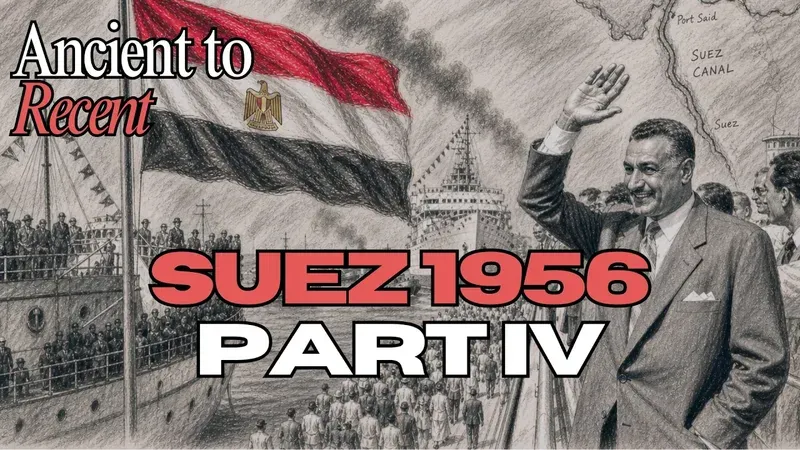
Suez Crisis 1956 — Part 4
23 May 2026 · 43 min · Season 1
 Watch on YouTube →
0:0043:28
Also on
Rate the show
Ratings are how new listeners find the show. It takes a minute and it makes a real difference.
In this episode of Ancient to Recent, Joseph Parkinson concludes the story of the 1956 Suez Crisis as Britain, France and Israel press forward with their invasion of Egypt, only to find military victory slipping into political disaster.
British and French paratroopers land in Port Said, Israeli forces complete their advance across the Sinai and Gamal Abdel Nasser faces the darkest moments of his leadership as Egypt braces for occupation.
Yet as fighting intensifies, a far greater crisis begins to emerge: economic panic in London, Soviet threats from Moscow and growing fury in Washington.
Joseph explores the final battles of the war, the secret pressures that forced Britain to back down, the dramatic showdown at the United Nations and the moment the Suez Crisis collided with the Soviet crushing of the Hungarian uprising, bringing the world dangerously close to Cold War escalation.
As ceasefires, financial collapse and superpower brinkmanship reshape the conflict, the Suez Crisis becomes something far larger than a battle for a canal, a turning point that marks the decline of empire, the rise of postcolonial nationalism and the arrival of a new global order.
Join Joseph Parkinson as Ancient to Recent concludes its series on one of the defining crises of the modern Middle East.
#Ad
This episode includes paid promotion in partnership with Ground News.
Go to https://groundnews.com/ancient to get 40% off the unlimited access Vantage plan and compare how different outlets report the same story.
#paidpartnership
🎧 New episodes every Saturday
📲 Follow on YouTube, Spotify & Instagram @AncientToRecent
#SuezCrisis #ColdWar #Nasser #HistoryPodcast
Read transcript
This transcript is automatically generated, so it may contain typos and misheard names.
In the rocket age, there can be no safe distance for aggressors. The fire of war can spread to any part of the world. Nikolai Bulganin, Premier of the Soviet Union, morning, Friday the 2nd of November 1956. Across Gaza, the fighting was beginning to die down. After days of bitter resistance, the Egyptian commanders agreed to surrender, reportedly persuaded by United Nations officials that continued fighting would only bring unnecessary bloodshed to a civilian population already trapped by war.
Thousands of exhausted Egyptian soldiers laid down their arms. Yet surrender was far from universal. Some Egyptian troops and Palestinian fedayeen fighters refused to give in, continuing isolated resistance even as the wider battlefield collapsed around them. Roughly 4000 Egyptian personnel eventually surrendered to Israeli forces. As Gaza fell, the war entered a new and increasingly dangerous phase, with Britain and France preparing to invade, Israel pushing deeper into the Sinai and Egyptian President Gamal Abdel Nasser defiant.
The crisis was playing out to a backdrop of rising Cold War tension. For the events in North Africa were not isolated. In the new world of ideological struggle, no conflict was simply regional. Distant struggles in lands far away now became central to the global game of chess. And as Gaza burned, so too did Budapest. Twin crises playing out, feeding off each other, ramping up the pressure on Nikita Khrushchev, leader of the Soviet Union, and Dwight D Eisenhower, President of the United States of America. Welcome to ancient, to recent.
My name is Joseph Parkinson and today we conclude the story of the 1956 Suez Crisis. The Cold War is heating up. The powers of Britain, France and Israel are determined to smash Nasser. The charismatic leader of Egypt, President Eisenhower, is faced with a choice. Support his allies or take the moral high ground. And crisis unfolds in Hungary as the clash between East and West threatens to turn nuclear. Episodes of Ancient Theresa are out every Saturday and are available on YouTube, Spotify and Apple Podcasts. In London, anxiety mounted.
Nasser had anticipated that if Britain and France intervene directly, their ultimate objective would be control of the canal itself. To prevent this, Egypt began scuttling ships at the northern entrance of the Suez Canal, deliberately sinking vessels to block one of the most important arteries of global trade, the canal, the very waterway Britain and France claimed to be saving, was being choked shot inside Downing St. Confusion deepened.
The British government hesitated over whether to proceed with the planned amphibious landings. Prime Minister Anthony Eden found himself pulled in opposite directions. The Americans demanded restraint. The French, led by Guy Mollet, demanded action. Paris have little time for hesitation. French leaders feared delay would only strengthen diplomatic pressure and leave Britain and France humiliated without achieving their objectives. The French increasingly suspected the British were losing their nerve.
Even now, many British military commanders still remained unaware of the full extent of British collusion with Israel. Among those growing alarmed was Admiral Lord Louis Mountbatten. Unable to stay silent any longer, Mountbatten sent an extraordinary private warning to Eden, urging him not to proceed with the invasion. The consequences, Mountbatten warned, could be catastrophic, destabilizing Britain's global position and dragging the country into an unpredictable conflict. Eden ignored him.
Out in the Mediterranean, an extraordinary spectacle unfolded. American warship shadowed British and French naval forces as reconnaissance aircraft repeatedly flew overhead. The message from Washington was unmistakable. the United States neither approved of the invasion nor trusted its closest allies. Some accounts would later even suggest American officials quietly considered just how far the United States might go to physically obstruct Anglo French operations should the crisis continue escalating.
Back in Britain, pressure intensified in the House of Commons. Opposition MPs demanded answers. Would the government obey the ceasefire demanded by the United Nations? Eden responded combatively, insisting Britain was acting not as an aggressor but as a peacekeeper attempting to separate the two warring sides. This argument convinced few student riots and demonstrations broke out across Britain, including protests in Edinburgh, Leeds and Oxford. To many young Britons, this looked less like peacekeeping and more like a return to imperial gunboat of politics and the United Nations.
Britain and France continued clinging to their increasingly fragile diplomatic fiction. British representatives insisted intervention was intended only to uphold international law and to preserve stability. Yet anger inside the General Assembly had become palpable. Delegates openly questioned how Britain and France could claim neutrality when every bomb had fallen on Egypt. The Canadian foreign minister, Lester Pearson, again pressed for an immediate ceasefire, followed by the deployment of a United Nations peacekeeping force. UN Secretary General Dag Hammers Ford worried that such a force risked appearing to merely rescue Britain and France from a political disaster of their own making and could undermine the legitimacy of the young United Nations. Meanwhile, in Cairo, Nasser prepared for a darker possibility.
Egypt could not defeat Britain, France and Israel in a conventional military struggle. If Egypt was occupied, then resistance would continue. Underground weapons caches were hidden, safe houses organized and plans laid for guerrilla warfare against occupying forces. At the same time, Nasser quietly withdrew regular Egyptian units from parts of the Sinai. The aim was simple, preserve the army for the long struggle ahead rather than see it annihilated in open battle. Across the Arab world, anger exploded. Jordan formally protested to Britain whilst outrage spread through newspapers, mosques and government ministries. One Saudi official reportedly posed a devastatingly simple question to a British journalist from the Times. If Britain and France were truly peacekeepers, why had they not launched a single meaningful strike against Israeli targets? Whilst attacking Egypt exclusively on the battlefield, Israeli forces continued their slow but relentless advance across Sinai.
Stubborn Egyptian resistance repeatedly slowed the Israelis, but poorly coordinated Egyptian formations steadily gave ground. Meanwhile, British air raids intensified against Cairo, targeting communication infrastructure and radio facilities in an attempt to cripple Egyptian command and control. Yet politically, the bombing seem to strengthen rather than weaken Nasser. Crowds gathered in the streets, chanting support for him.
At Cairo's Great Mosque, Nasser delivered a thunderous speech promising Egypt would fight to the end. The response was electric, for now at least. The leader and the people appeared united. One of the most fascinating parts of history, the reason that we endlessly argue about the facts decades and sometimes centuries later, is that history is all about perspectives. To Eden and Mollet, Nasser was a tyrant. To many people in the Arab world, Nasser, it was a saviour.
Who was right? Well, it depends on who you ask. It depends on your perspective. You see, how a story gets framed shapes our perspective. But that isn't just the case with history, it's also true with the news that we consume today. This is something I think about a lot and that's why Ancient Recent has partnered with Ground News. Ground News is an incredible media literacy tool that helps people look at headlines side by side, see how the same events are being reported by different sides of the political spectrum, and have a healthier, more balanced media diet. You can see each media outlets bias, who owns them, which stories are being pushed and which are being overlooked. At a time of such intense tribalism and media fragmentation, when it is so easy to disappear down a rabbit hole.
Ground News really helped me get more perspective and balance. It's something that has made my media diet much healthier, and I think it's something that certainly could have benefited Anthony Eden and Guy Mollet in the lead up to the Suez Crisis. You can support Ancient to Recent by subscribing to Ground News, and you can get 40% of the Vantage plan by either clicking the link on my bio or going to groundnews.com/ancient.
In Washington. Events grew more chaotic still. John Foster Dulles, already pushed to the limits of human insurance by the twin crises unfolding on the Danube and the Nile, awoke to intense pain and was rushed to hospital. He was diagnosed with cancer and rushed to emergency surgery. Though he attempted to retain influence over events, authority now became fragmented at precisely the moment the Western alliance was strained under the simultaneous crises in hunger and Suez, Dulles diminished. Role was felt immediately as Washington's messaging lost focus, messages became mixed, and confusion reigned. At times, American officials sharply condemned Britain and France and others.
They quietly encourage decisive action to end the paralysis. In one remarkable exchange, Robert Amery, deputy director of the CIA, reportedly instructed an American official in London to tell the British government to make up its mind. Either obey the UN ceasefire or proceed fully with the invasion, but stop hesitating. the US would back their action regardless. This was not Dulles position, nor was it that of President Eisenhower.
The confusion only deepened Eden's paralysis. He considered accelerating the landings, cancelling them and altering them. At one stage, British planners even discussed announcing the invasion of Port Said in advance, sacrificing surprise in order to better preserve the fiction of peacekeeping. Eden, a sick man, found himself pulled in every direction. Confused by Washington's messaging, he was beset by furious Israeli and French allies who demanded they push ahead an equally outraged domestic opposition that urged him to pull back.
In Gaza, the final pockets of Egyptian and Fedayeen resistance slowly collapsed as Egyptian withdraw isolated remaining defenders. But darker events unfolded in the aftermath. Akan, Yunus and Rafa. Serious allegations later emerged that Israeli troops killed Palestinian civilians and prisoners after the fighting had effectively ended in Khan Yunus. Hundreds were reportedly killed in Rafa. More deaths followed. The full details remain disputed and deeply contested.
But the events would cast a long shadow and would not become widely discussed inside Israel until decades later. Back in Westminster, Labour leader Hugh Gaitskill seized on the rapid Israeli advance. If Israel had already pushed far beyond the Canal Zone, then what possible justification remained for the Anglo French intervention? Eden held firm. Britain, he insisted, was still conducting a peace operation. Yet he hinted at an escape route. Should the United Nations force be deployed and a broader peace settlement emerge, Britain would consider withdrawing. The chambers erupted with cheers and heckling. At sea, the invasion force gathered in a moment of battlefield confusion.
A British frigate accidentally shot down an Israeli aircraft. Rather than quietly acknowledging the mistake, the British government attempted to spin the incident as evidence of British neutrality, proof they were acting impartially between both sides. Few believed it. And despite the cheering crowds and fiery speeches, Nasser himself was becoming increasingly desperate. His rhetoric remains defiant, his private calculations far lesser. Through quiet and diplomatic feelers, Egypt signaled to the United Nations that Nasser might accept a settlement. If Israeli forces withdrew, Egypt, too, would pull back. The Egyptian army was fighting bravely, but it was retreating, disorganized and under immense strain. The question now was no longer simply whether Egypt could survive militarily.
It was where the diplomatic, economic and international outrage could succeed, where armies had failed. Anthony Eden now took to the airwaves. In a national broadcast. The Prime Minister again defended intervention, insisting Britain and France had merely acted in response to fighting between Egypt and Israel. The peacekeeping fiction remained firmly intact. Eden reassured the British public that other nations, especially members of the Commonwealth, were increasingly coming round to Britain's position.
Nothing could have been further from the truth. Across the Commonwealth, anger simmered. Many governments viewed the intervention as reckless and deeply damaging to the international order. Britain itself claimed to defend. Relations with allies, not least the United States, had been badly shaken. Then came a dramatic turn at the United Nations. To widespread surprise, the Israeli representative, ABBA Iban, announced that Israel was prepared to accept an immediate ceasefire, provided Egypt agreed to do the same. Egypt had already accepted.
Suddenly, Britain and France stood alone. The entire public justification for intervention appeared to evaporate almost overnight. If both combatants had agreed to stop fighting, then on what grounds would British and French forces still continue advancing towards Egypt? Yet the invasion fleet continued steaming forward. London and Paris clung to one final hope. Perhaps events elsewhere would distract the world. For an Eastern Europe, another crisis was reaching it's terrible climax. Sunday the 4th of November 1956, Soviet tanks rolled into Budapest.
After days of uncertainty, Moscow abandoned compromise and launched a full scale military intervention to crush the Hungarian uprising. Armoured columns rumbled through the streets as lightly armed civilians attempted desperate resistance. Across the world, shocking images spread of Soviet troops firing upon demonstrators and revolutionaries. In the heart of Europe, global attention shifted abruptly towards Hungary. For Britain, this presented both opportunity and danger.
On the one hand, Eden hoped events in Budapest might divert attention from Suez. On the other, Britain desperately needed to avoid appearing morally indistinguishable from Soviet aggression. The British planners scramble to reshape the invasion. Bombardment of Port Said was reduced to avoid civilian casualties. Restrictions were placed on the use of heavy munitions. The stated objectives shifted further away from overthrowing Nasser and increasingly towards the narrow language of peacekeeping and canal security.
The invasion, at least publicly, would now be framed as limited, restrained and defensive. The French were furious. Paris wanted speed, overwhelming force and decisive victory. The British wanted damage limitation. Tensions between the Allies deepened inside Britain. Discontent also spread through the military establishment itself. Lord Louis Mountbatten once again conveyed his opposition to Eden, warning against the course that many senior figures increasingly believed disastrous. Then came another political crisis. After Edens national address, Labour leader Hugh Gaitskill demanded equal time to respond.
Initially the BBC refused. British forces were now committed to action, and many feared broadcasting a direct rebuttal during wartime would appear dangerously divisive. But accusations soon emerged that the BBC was colluding with government efforts to suppress dissent. Eventually, Gaitskill was allowed to speak and he did not hold back. The Labour leader accused Eden of recklessness. The intervention, he argued, was illegal, immoral and catastrophic for Britain's standing in the world. 1 by 1 Gaitskill dismantled the government's arguments. If intervention was about keeping the canal open, then why was the canal now blocked?
If Britain had sought peace, why had virtually no military action been directed against Israel? And if both Egypt and Israel had agreed to a ceasefire, why were British troops still sailing towards Egypt? Most devastatingly of all, Gateskill argued, Britain had stripped itself of moral authority at precisely the moment Soviet tanks were rolling into Hungary. How could Britain condemn Moscow whilst behaving similarly in Egypt?
Gateskill demanded Britain obey the United Nations ceasefire and the United Nations Pressure intensified. Talks now turn towards sanctions. Resolutions circulated proposing punitive measures against Britain and France, including threats aimed at oil supplies and growing diplomatic isolation. UN Secretary General Dag Hammersford made his position unmistakably clear. The fighting had to stop, and neither British nor French troops could credibly form part of any genuine international peacekeeping mission.
Until now, Eden had convinced himself there was still time. Time to topple Nasser, time to complete Britain's objectives, Time to hand responsibility over to the United Nations afterwards and present the entire affair as an unpleasant but necessary intervention. But reality was closing in. The central question now loomed over Downing St. What should Britain do? Accept humiliation and withdrawal? Or press ahead? Ignore international outrage and gamble that military success would justify everything? The problem was painfully obvious. None of the original objectives had been achieved. Nasser remained in power.
The canal was blocked. Britain stood diplomatically isolated. Yet after furious debate, the government reached its conclusion they would continue. Across London, demonstrations swelled in size and fury. Mounted police clashed with protesters as crowds denounced the war. Inside, Cabinet division widened. Some ministers hesitated. Others feared retreat would permanently destroy British prestige. In the end, most agreed the invasion would proceed. Confusion, meanwhile, reached almost absurd levels. The government received contradictory reports from Israel itself, some claiming negotiations were imminent. Others suggested fighting would continue. With no clear picture of events and time rapidly running out, reluctantly, Eden pressed ahead.
In Washington, attention increasingly drifted towards Budapest. The Eisenhower administration now faced simultaneous crises. More than ever, America needed unity amongst Western allies in confronting Soviet aggression. The tone toward Britain and France softened. Some officials quietly began reassessing events. Perhaps Suez mattered less than Hungary. Perhaps preserving alliance unity mattered more than humiliating Britain and France. Some increasingly argued that Nasser himself was secondary. What use would save in Egypt be if Western divisions handed the advantage to Moscow?
Still, no clear consensus emerged. Mixed signals continued flowing across the Atlantic. To the outside world, Gamal Abdel Nasser projected defiance. He stood as the champion of Arab nationalism, the man who promised to bear the dignity of the Arab world upon his shoulders. An iron willed figure, unbreakable. But privately, the reality looked very different in moments away from public view. Nasser wept. He believed Egypt stood on the brink of catastrophe. He travelled to Port Said to inspect the defenses personally. Along the road, his convoy passed blackened wrecks of Egyptian tanks and shattered vehicles destroyed by Anglo French airstrikes.
The destruction was immense. As he surveyed the damage, one terrible thought increasingly consumed him. What remained of Egypt's army? And how long can Egypt possibly resist the combined strength of Britain, France and Israel? For perhaps the first time since the crisis began, Nasser truly feared all might be lost. Then came the news he dreaded. British and French troops had landed. In the early hours of Monday the 5th of November, British and French planes swooped low over Port Said.
Incendiary bombs were dropped that set the port ablaze. Amid the pillars of smoke, hundreds of heavily armed British and French paratroopers touched down. They were met with immediate resistance as the night sky was lit up by trace of fire and the sounds of battle fill the air. The fighting was close quarter with British and French troops going house to house as Egyptians, though lightly armed, clung to every last position. As the fighting raised in Port Said, the Israelis pressed ever deeper into the Sinai.
Sharm El Sheikh, at the southern tip of the Sinai Peninsula, was a vital importance to the Israeli and Egyptians alike. Control of this one town would allow either side to command the waters flowing both into the Suez and the Gulf of Aqaba. The Israelis had to possess the town. Israeli troops hurled themselves against the town twice. They were beaten back by brave Egyptian defenders. But the superior training and firepower of the IDF meant the Egyptians could delay victory but not avoid defeat.
With the town now in Israeli hands, they had achieved all of their strategic goals. Victory for Israel was at hand. Or so it seemed, for the Israelis have not counted on the short sightedness of their allies. Whilst the British military was keeping its head in the field back in London, the British government was losing theirs. Britain in 1956 was no longer the financial Titan that had once ruled global commerce. Two world wars had left the country deeply indebted, reliant upon imports and increasingly dependent upon confidence in the pound sterling to maintain its position in the world. And now that confidence was beginning to crack. Harold Macmillan, the chancellor of the exchequer and one of the most senior figures in Eden's government, watch events with growing alarm.
The war was becoming expensive. Far more worrying still was the reaction of the outside world. Across the Middle East, government's furious British intervention began. Quietly withdrawing their money from London, states such as Iraq, Kuwait and other oil producers shifted financial reserves away from British institutions, many transferring funds into Swiss and American banks, fearful that Britain itself might soon face financial instability.
The consequences threatened to be catastrophic. Britain relied heavily upon sterling balances, foreign governments holding reserves in pounds rather than dollars, to sustain confidence in its currency. If too many nations rushed for the exit at once, the pound could collapse. And the danger extended beyond the Arab world. Countries across the Commonwealth and developing world had also begun to lose confidence. India, long resentful of Britain's colonial posture and deeply critical of the invasion, quietly reduced sterling holdings.
Suddenly, the specter haunting British officials was no longer simply military defeat in Egypt. It was economic humiliation. At precisely the same moment, another crisis looped oil. Much of Britain's fuel arrived through the Suez Canal or from Middle Eastern suppliers now outraged by British actions, with Egyptian forces having scuttled ships and blocked the canal. Oil supplies faced disruptions just as Arab governments began openly discussing restrictions on exports to Britain and France.
Petrol rationing, still within living memory from the Second World War, no longer seemed unthinkable. Macmillan began warning colleagues in increasingly urgent terms. Britain, he feared, was burning through political capital, diplomatic goodwill and financial credibility faster than it could be replaced. Yet the greatest pressure of all came from across the Atlantic. the United States had no intention of rescuing Britain from the consequences of Suez. For years, Britain had relied upon American financial backing during moments of instability.
If sterling came under attack, London could normally turn to Washington and the International Monetary Fund for emergency support. This time, President Eisenhower had little interest in helping. Furious that Britain and France had launched the invasion without consultation, the Americans began quietly applying pressure. Washington hinted that unless Britain accepted a ceasefire and complied with the United Nations, financial assistance might not be forthcoming. To many in London, the implication was unmistakable. Britain was fighting a war in Egypt, but America was holding a gun to the pound.
At 5:00 Cairo time came what briefly appeared to be the breakthrough London had been desperately waiting for. Reports reach British commanders suggesting that a local ceasefire had taken hold around Port Said. In the confusion of war, amidst broken communication, exhausted officers, and contradictory reports, many British commanders came to believe something extraordinary had happened. Amidst the confusion, British officials came to believe that the Egyptians had agreed not to a ceasefire, but rather to surrender. In London, Anthony Eden allowed himself a moment of relief. At last, it seemed victory.
After days of diplomatic humiliation, mounting protests at home and fierce criticism abroad, that gamble had worked. The operation was successful. British and French troops have landed. Port Said was under pressure, and Egypt appeared to be giving way. Yet once again, events on the ground proved far messier than imagined. Inside government offices, the Egyptian commander on the scene refused to formally confirm any surrender. He lacked authority.
Only one man could make such a decision, Gamal Abdel Nasser. And in Cairo, Nasser refused. No surrender, no capitulation, no acceptance of defeat. By 10:30 PM, the fighting resumed. Machine gunfire once again echoed through Port Paid as Egyptian soldiers, police irregulars and increasingly armed civilians returned to resistance. Far from collapsing, Egypt appeared determined to turn the struggle into something darker and more dangerous. Across the country, civilians began receiving weapons. The Egyptian government prepared for the possibility of prolonged resistance, stockpiling arms and encouraging volunteers to defend streets, bridges and neighborhoods if necessary. What Britain and France had hoped would resemble a short policing operation increasingly threatened to become urban warfare.
But events far beyond Egypt now threaten to make matters even more explosive. In Moscow, outrage was growing. The Soviet leadership had initially been consumed by the uprising in Hungary, where Soviet troops were crushing revolts in the streets of Budapest. Now the crisis in Egypt offered both danger and opportunity. Nikolai Bulganin, Soviet premier and understudy to Nikita Khrushchev, issued a series of furious warnings to Britain, France and Israel. The language was ominous.
Letters were sent to London, Paris and Tel Aviv, hinting darkly at Soviet retaliation if the aggression continued. Though carefully worded, many in the West interpreted the threat as carrying a chilling implication. Could the Soviet Union be hinting at nuclear force? Coming only a decade after Hiroshima and Nagasaki, and amidst rising Cold War tension, the possibility electrified governments across Europe and America.
Yet Khrushchev's motives were complex. The Soviet leader faced growing criticism at home and abroad over the bloodshed in Hungary. Suez provided a chance to turn world attention away from Budapest and place Britain and France in the dock instead. Suddenly, the Western powers look less like defenders of freedom and more like imperial aggressors. Then Moscow raised the stakes further. The Soviets proposed a joint American Soviet intervention force to halt what they called aggression against Egypt. On paper, the proposal sounded dramatic, even constructive. In reality, it was pure political theater. Khrushchev almost certainly knew the Americans would never agree to a joint military operation with the Soviet Union in the Middle East.
If Washington refused, the Kremlin could betray the United States as hypocritical, condemning aggression publicly while secretly shielding its allies. President Dwight Eisenhower rejected the idea outright. To the White House, the proposal looked less like diplomacy and more like an obvious attempt to distract international attention from Soviet tanks rolling through Budapest. Yet even as Eisenhower dismissed Moscow's offer, the pressure on Washington intensified. For Britain and France, the danger was becoming painfully clear.
This was no longer merely a war over the Suez Canal. The crisis was rapidly becoming entangled with the wider Cold War itself. In Paris during the early hours of the 6th of November, fear spread through the highest levels of government. At 3:00 in the morning, the American ambassador to France, Douglas Dillon, was urgently summoned to meet French Prime Minister Guy Mollet. Mollet was visibly shaken. He handed Dylan a communication from Moscow. The message, issued by Soviet Premier Nicolai Bulganin, carried language so menacing that many interpreted it as an outright threat of nuclear war.
Across Europe, officials read and reread the Soviet warning. Had the crisis suddenly crossed into something unimaginable? Could Egypt trigger a third World War? Mollet wanted answers. How, he asked, would the United States respond if the Soviets intervened? Would America stand behind France? Dylan sought to reassure him. the United States, he implied, would not abandon an ally. Yet even as Mollet search for reassurance, another devastating message arrived.
The telephone rang. It was Anthony Eden, and the news could hardly have been worse. Britain, even explained, could continue military operations only until the following morning. For the French, this landed like a bombshell. Paris had and no desire to halt the offensive. French leaders believe they stood on the edge of military success. British and French troops had reached the Suez Canal itself, securing the northern approaches around Port Said. But crucially, they did not control the entire waterway. Nasser remained in power.
The canal remained blocked. The political objectives of the war had not been achieved. And for the French, the stakes stretched far beyond Egypt. To many in Paris, Algeria hung in the balance. Nasser's support for the FLN insurgency convinced French officials that failure in Egypt would embolden revolution across North Africa. If Nasser survived, the struggle for French Algeria might be lost. Whilst Paris demanded resolve, panic deepened in Washington. Inside the CIA and the White House, Soviet threats triggered urgent reassessment.
The United States reacted to Bulgarians letter by quietly lifting restrictions on intelligence sharing with Britain, France and Israel. If the Soviets truly intended escalation, Western coordination suddenly mattered again. Publicly, many American officials dismissed Moscow's threats as bluff and bluster. Privately, confidence wavered. Few believed Khrushchev wanted nuclear war. But might the Soviets intervene below that threshold?
And naval confrontation in the Mediterranean. Air strikes against Anglo French forces, Military volunteers sent to Egypt. British and French commanders quietly began preparing for precisely these possibilities. Yet for London, another danger loomed even larger than Soviet threats. Financial collapse. For days, Chancellor of the Exchequer Harold Macmillan had watched Britains economic position deteriorate. Sterling was under immense pressure.
Gold and dollar reserves were draining away. Oil supplies faced disruption across financial markets. Confidence in Britain was evaporating. McMillan, once one of the strongest supporters of confronting Nasser, had undergone A dramatic conversion. Now he became one of the loudest voices urging withdrawal. Britain, he warned, stood on the brink of financial ruin. McMillan had spoken directly with the gravely ill American Secretary of State, John Foster Dulles.
The message from Washington was unmistakable. If Britain stopped the war, America would help stabilize Sterling. If Britain continued, there would be no rescue. The logic was brutal. Britain could no longer rely on Middle Eastern oil and would increasingly need American supplies. But America would not allow Britain to buy oil in pounds, only dollars. Britain lacked sufficient dollar reserves to keep the economy functioning.
London would require credit, and Washington held the key. No ceasefire, no assistance. At an emergency cabinet meeting, McMillan painted an apocalyptic picture. The Treasury, he warned, was hemorrhaging reserves. A run on the pound could devastate Britain's economy and destroy confidence in the country's global position. Some later suspected McMillan exaggerated the immediacy of the danger to force the cabinet's hand.
But the effect was immediate. Resistance inside government began to crack. Many ministers still hated the idea of stopping. After all, Britain and France had not achieved their injected yet. The political justification for war had also collapsed. Israel and Egypt had accepted ceasefire terms. The peacekeeping argument, always fragile, was now threadbare. Add to this the specter of Soviet escalation and looming economic catastrophe, and the conclusion became unavoidable. Reluctantly, bitterly, the Cabinet agreed. Britain would stop.
The matter would pass to the United Nations, Eden informed Mollet. A ceasefire would take place within hours. The French Prime Minister pleaded for time. Just a few more days, he argued. Enough to gain further ground. Enough perhaps to bring Nasser down all together. But Eden refused, as Mollet pressed desperately for delay. Britain had already made its choice. The war was over. At midnight on the 6th of November 1956, the guns fall silent. Across Port Said, the crack of rifle fire faded into uneasy quiet.
British and French soldiers stood in positions one only hours earlier, Israeli forces sat victorious across the Sinai. Egyptian troops regrouped in confusion. And somewhere beneath the smoke and rubble of war, a strange truth began to emerge. Militarily, Britain, France and Israel had won. Diplomatically, they had suffered catastrophe. In Cairo, crowds poured into the streets. The Egyptian forces have been driven back and the Sinai temporarily under Israeli occupation until UN peacekeepers arrived.
Gamal Abdel Nasser emerged not as a defeated man, but as a symbol of defiance. The young Colonel who had stood up to 3 military powers, Britain, France and Israel, had survived. Across the Arab world, Nasser's prestige surged to millions. He had stood firm against the old imperial powers and lived to tell the tale. Yet behind the closed doors, Nasser was far less triumphant than appearance suggested. The Egyptian army had performed poorly, though many soldiers had fought bravely.
Egypt military had been exposed as poorly coordinated, undertrained and unable to stand against Israeli battlefield superiority. Nasser had won in diplomacy, but he knew Egypt had narrowly escaped disaster. Meanwhile, in London, Anthony Eden remained Prime Minister in name only. Exhausted, medicated and increasingly isolated, the man who had once dreamed of restoring British prestige now appeared physically and politically broken. The empire had not been saved.
Instead, Britain's dependency upon the United States had been laid bare before the world. Yet perhaps nowhere were the consequences felt more painfully than across the Atlantic. As Britain lost her great power status, she had comforted herself with the idea of a special relationship with the United States, forged in war, blood and common purpose. British and American soldiers had fought side by side across two world wars. Anthony even had assumed that when the moment of truth came, Washington would ultimately stand beside London, even if reluctantly.
Instead, Suez shattered the illusion. To Eisenhower, the British and French had not merely acted recklessly, they had lied. The invasion had been launched despite repeated American warnings and amid growing suspicion that London had been deliberately concealing the extent of its collusion with Israel. In Washington, there was fury. Senior American officials spoke privately of betrayal. Trust between the allies, painstakingly built since the darkest days of the Second World War, had been deeply damaged. The humiliation cut especially deep for Britain because Suez exposed a painful reality. the United Kingdom was no longer capable of acting independently of American financial and diplomatic power.
When Washington squeezed, Britain folded. The old imperial center had become the junior partner. Repairing the partnership would take years. Indeed, so badly damaged had Anglo American relations become their British leaders increasingly looked to 1 figure capable of softening tensions where politicians had failed the monarch. Queen Elizabeth the Second. In 1957, just months after the Suez Crisis, the young Queen would undertake a highly symbolic tour of the United States. Charming political elites and the American public alike in an effort to restore warmth to a fractured alliance and remind Americans of the cultural and historical bonds that still linked the two nations.
The royal tour was a triumph, restoring old bonds of kinship that had been so weakened by the politicians. If Suez had revealed Britain's diminished powers, it also revealed something else. Britain's future influence would rely less upon imperial command and more upon diplomacy, symbolism and the careful management of relationships. In Paris, Angus Symid French leaders felt betrayed by Britain, furious that victory had been snatched away.
At the moment, they believed success was within reach. The bitterness of Suez would reshape French foreign policy for decades to come. And in Washington, President Dwight D Eisenhower emerged strengthened. He had stared down allies, avoided direct confrontation with Moscow and secured re election. Yet even as America celebrated, Soviet tanks still rolled through Budapest. In Budapest, the revenge began. The revolution crushed. Arrests spread through the city.
Some rebels fled into exile. Others disappeared into prisons. Executions would follow the dream of a free Hungary drowned beneath the tidal wave of Soviet steel. The Suez Crisis was a moment of profound change, a turning point where the assumptions of an old world collided with the realities of a new one. It was the moment where the old imperial powers of Britain and France were forced to confront an uncomfortable truth. They could no longer dictate terms to smaller nations like Egypt, as they once had.
But beneath the crisis lay a deeper tension. The world was being remade along ideological lines, and under the ever present shadow of nuclear annihilation, the rules of international politics had changed. There were no longer merely regional conflicts, only one single global stage upon which the superpowers of the Soviet Union and the United States played their dangerous game of chess. Yes, Suez also revealed something new. Smaller states, led by determined and charismatic figures like Gamal Abdel Nasser, were no longer simply pieces on the board.
Nasser had shown the world that weaker nations could resist, survive and in political terms at least, emerge victorious. The age of empire was fading. A new age of nationalism, superpower rivalry and post colonial struggle had arrived and the shock waves of Suez would echo through the Middle East, Europe and the Cold War for decades to come. Thank you for listening to Ancient to Recent, My name is Joseph Parkinson. Episodes of Ancient to Recent are out every Saturday and are available on YouTube, Spotify and Apple Podcasts.