
#50
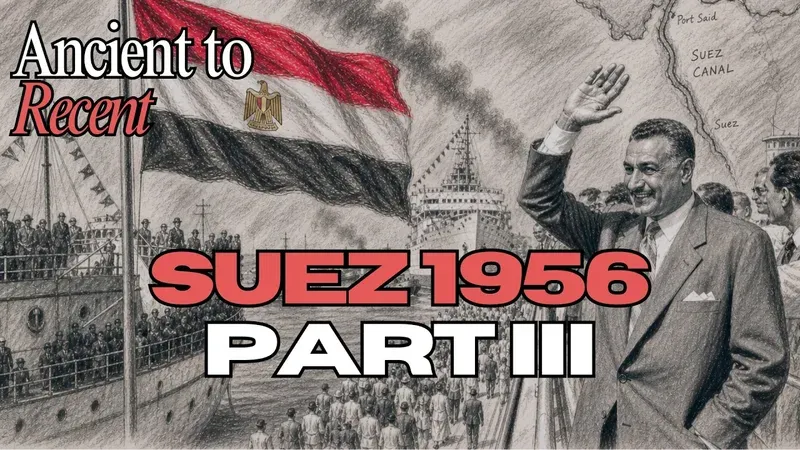
Suez Crisis 1956 — Part 3
16 May 2026 · 42 min · Season 1
 Watch on YouTube →
0:0042:01
Also on
Rate the show
Ratings are how new listeners find the show. It takes a minute and it makes a real difference.
In this episode of Ancient to Recent, Joseph Parkinson continues the story of the 1956 Suez Crisis as Britain, France and Israel launch their assault on Egypt.
Israeli paratroopers drop into the Sinai, British and French fleets move towards the Suez Canal and Gamal Abdel Nasser prepares Egypt for war. As Operation Musketeer begins, the secret conspiracy behind the invasion starts to unravel at the United Nations and in Washington, where President Eisenhower grows increasingly furious at America’s closest allies.
Joseph explores the opening battles of the war, the chaos inside Cairo, the mounting international backlash and the dangerous Cold War tensions unfolding alongside the Soviet crackdown in Hungary.
As the fighting intensifies and global pressure mounts, the Suez Crisis begins to transform from a regional conflict into a turning point in modern world history.
Join Joseph Parkinson as Ancient to Recent continues its series on one of the defining crises of the modern Middle East.
#Ad
This episode includes paid promotion in partnership with Ground News.
Go to https://groundnews.com/ancient to get 40% off the unlimited access Vantage plan and compare how different outlets report the same story.
🎧 New episodes every Saturday
📲 Follow on YouTube, Spotify & Instagram @AncientToRecent
#SuezCrisis #ColdWar #Nasser #HistoryPodcast
Read transcript
This transcript is automatically generated, so it may contain typos and misheard names.
We cannot subscribe to one law for the weak and another for the strong, one law for those that are our friends and another for those who are not President Dwight D Eisenhower As dawn broke over the Mediterranean on the 31st of October 1956, British and French warships slipped out of Malta Harbour and headed east towards Egypt. Operation Musketeer was underway. For weeks, the conspiracy between Britain, France and Israel had remained hidden behind diplomatic conferences, carefully worded communiques and frantic negotiations at the United Nations.
Now the time for secrecy was over. The invasion force was moving. Even at this late stage, many Israeli officials fear the British might still lose their nerve and pull out the final moment. London had wavered repeatedly throughout the crisis, and confidence in Anthony Eden's government was hardly universal in Tel Aviv. But as the fleet steamed towards the eastern Mediterranean, those doubts finally began to fade. War was upon us. Welcome to ancient, to recent.
My name is Joseph Parkinson, and today we continue the story of the 1956 Suez Crisis. Episodes of Ancient Theresa are out every Saturday and are available on YouTube, Spotify and Apple Podcasts. Some British officials had privately wondered whether the entire crisis might have been invoided through a simpler solution. Why invade Egypt? Why not simply assassinate Nasser? But such ideas quickly ran into reality. British intelligence inside Egypt was remarkably weak.
The old imperial networks that had once dominated Cairo had withered rapidly after the withdrawal of British troops from the Canal Zone. There had been some tentative contacts with the Muslim Brotherhood, the Islamist movement that fiercely opposed Nasser's government, an irony not lost to many observers given that the Brotherhood itself had originally emerged in part as a reaction against British influence in Egypt. Yet these contacts yielded little practical value. If Nasser was to be removed, it would not be through covert action, it would be through invasion. Whilst the Anglo French fleet advanced across the Mediterranean, the Israelis made their final preparation in the Sinai.
Egyptian intelligence had already begun hearing whispers that something unusual was taking place. Israeli units quietly moved into their assault positions whilst along the frontier. Tension mounted by the hour. Then came one of the most extraordinary episodes of the opening assault. 4 Israeli aircraft swept low across the Sinai desert, flying so close to the ground that in some places they were barely more than 12 feet above the sand.
From the aircraft, Hong Hawks designed to catch and sever Egyptian telephone and Telegraph wires. As the cable snapped, communications across parts of the Sinai began to breakdown. By around 2:00 in the afternoon, reports were already filtering into the Egyptian intelligence headquarters that Israeli troop movements had been detected inside the Sinai Peninsula. In Cairo, Gamal Abdel Nasser was attending his son's birthday party.
When the first warnings reached him. The Egyptian President quietly excused himself and left a deal of the mountain crisis. Meanwhile, 16 Israeli DC3 transport aircraft roared over the Negev desert, carrying 395 Israeli paratroopers towards one of the most strategically vital positions in the Sinai, the Midler Pass. The narrow mountain pass cut through the harsh wilderness of central Sinai controlled one of the main East West routes across the peninsula. Any army attempting to move rapidly through the Sinai towards the Suez Canal would almost certainly need to secure it.
Below the aircraft, long columns of Israeli armor and infantry were already advancing across the desert frontier. Inside Egyptian headquarters, confusion reigned. Telephone calls flooded in as fragments of intelligence reports arrived from across the front. Then the situation escalated dramatically. The Israeli paratroopers dropped directly onto the approaches to the Midler Pass. Panic spread through the Egyptian High command. The scale of the Israeli operation remained unclear, and many Egyptian commanders feared the assault in Sinai might merely be a diversion.
Perhaps the real Israeli objective was Jordan. Perhaps Syria would be next. Was this a faint, the opening moments of a general Israeli assault? Nobody knew. Shortly before midnight Cairo time, Egyptian commanders sent urgent requests to both Jordan and Syria calling for mobilization against Israel. In Amman, King Hussein of Jordan faced an agonizing decision. Some within his government urged immediate action, others warned caution. The Jordanian army remains small, poorly equipped, and heavily dependent upon British support. To enter a full scale war against Israel without knowing the true scale of the conflict risked disaster. For the moment, Hussein hesitated. But across the deserts of the Sinai, the first shots of the Suez War were already being fired. One of the strangest things about war is the sheer confusion in the fog of war.
Rumours spread faster than facts, governments make decisions based on fragments of intelligence and leaders are often forced to act without ever fully understanding what is actually happening. This was certainly true during the Suez Crisis. The conflict itself and the motivations of the participants that are completely contradictory have to be understood from the actors perspective. To the Israelis this was a pre emptive strike for survival, to Egypt it was naked aggression backed by imperial powers. To Britain and France, Nasser represented a growing threat to their influence and stability in the Middle East. And to Washington and Moscow, the crisis was viewed through the lens of the Cold War.
This confusion isn't something that's confined to the past. It is as true today about current events as it was then. That's actually one of the reasons I've been working with Ground News. Ground News gather reports from news organizations across the political spectrum and from around the world, allowing you to compare how the same event is being covered by different outlets. You can quickly see which organizations lean left, right or centre, who owns them, which stories are being pushed and which are being downplayed, and by who.
Especially when studying both history and current events, is genuinely useful to step outside a single narrative and understand how perspective directives shape the way stories are told. If you'd like to check it out and support the podcast at the same time, you can use the link in the description for 40% off the Unlimited Vantage plan or go to grandnews.com/ancient. As Israeli forces pushed deeper into the Sinai Peninsula, the crisis rapidly expanded beyond Egypt and Israel alone. Across the Arab world, governments watched events unfold with growing alarm.
In Syria, political instability was already reaching dangerous levels. Coups, counter coups and ideological struggles had become almost routine within Syrian politics. And now the Israeli invasion of Egypt intensified fears that the entire region was drifting towards a much wider war. The British US had planned a joint coup called Operations Straggle to overthrow the government of Syria which was set to go ahead on the 25th of October. But with the crisis in Egypt unfolding, the coup was postponed for fear of being interpreted in the Arab world as a US UK collusion with Israel.
Ironically, conspiring with Israel was exactly what the UK was already doing. Above Egypt, British reconnaissance aircraft began appearing in the sky, whilst in Cairo diplomats hurriedly burned sensitive documents inside the British and French embassies. The pretence of neutrality was rapidly evaporating. News reaching the US of Israeli actions caused fury from President Eisenhower, who'd urged caution at every turn and feared that a spark could set the Middle East on fire. In Washington, the Eisenhower administration prepared to refer Israel to the United Nations.
An awkward legal problem now loomed over London. Under the terms of the old Tripartite Declaration, Britain had theoretically committed itself to opposing aggression in the Middle East, regardless of which side initiated it. Technically, Britain might legally be required to go to war to check aggression that the British government itself was supporting. Privately, British officials were becoming increasingly nervous not only about military developments but also the reaction of the United States.
The British economy remained fragile and heavily dependent upon American financial support. A serious rupture with Washington could have catastrophic consequences. Above the Sinai Peninsula, the war intensified. Egyptian Migs clashed with Israeli missed air fighter aircraft in the skies, whilst below Israeli armoured columns continued driving westward towards the canal. Yet Egypt's air forces faced a severe problem. The Nasser to assess roughly 150 Soviet supplied Mig fighters.
Egypt lacked enough properly trained pilots to use them effectively, and the outbreak of the war Egypt reportedly had barely 30 fully trained Mig pilots available for combat. Meanwhile, messages of support began arriving in Cairo from across the Arab world. Saudi Arabia informed Nasser that the Kingdom would stand beside Egypt. The relationship between Saudi Arabia and Nasser's revolutionary Republic was in truth and an easy one.
Only weeks earlier, state visits between the countries have rejected an image of growing Arab unity. But beneath the surface, tension remained profound. Nasser despised the Muslim Brotherhood and viewed conservative monarchies with suspicion, while Saudi leadership deeply distrusted Nasser's revolutionary Arab nationalism. Yet faced with what appeared to be a coordinated Western assault on an Arab state, those divisions were temporarily pushed aside.
The crisis also exposed the strange shifting alliances of the Cold War in the Middle East. Saudi Arabia in the 1950s was already closely aligned with the United States. American oil interests, strategic cooperation and anti communism tied Washington and Riyadh together with increasing strength. Britain, meanwhile, had a colder relation with the Saudis, in large part because London traditionally backed the rival Hashemite monarchies in Iraq and Jordan. At moments, British officials became almost desperate in their attempts to weaken US Saudi relations. Anthony Eden, in particular, repeatedly tried convincing American officials that Arab nationalism and even Saudi Arabia itself risked falling under Soviet influence, and that the Saudis harboured secret communist sympathies. To many in Washington, these arguments appeared increasingly detached from reality.
Then came the ultimatum. At the Serfra conference, the British and French delegates had gone to great lengths to come up with a pretext for their participation in what would otherwise seem like a border dispute between 2 Middle Eastern neighbors. The UK and France wanted Nasser gone, but without a pretext, their involvement would look like nothing more than naked imperialism, certain to alienate both Arab and US opinion. What was needed was an excuse, a means, however flimsy, to save face and appear like an honest broker. What was needed was a pretext.
The British and French had worked up a tall tale that they would act as peacekeepers. Once the fighting had started. They would intervene to separate the two sides and protect the canal, thus humiliating Nasser, wrestling control of the canal from Egypt and hopefully bringing about a change of government. But for the charade to have any credibility, the UK and France could not be seen to be acting in open cooperation with the Israelis.
An ultimatum would have to be issued to the two sides. Britain and France formally demanded that both Egypt and Israel immediately cease hostilities and withdraw their forces to positions 10 miles from the Suez Canal. Officially, the ultimatum was presented as an impartial effort to separate the combatants and protect international shipping, but the dishonesty of the proposal was obvious at that stage. The fighting was taking place nearly 75 miles east of the canal.
Israel would effectively be rewarded for its advance, whilst Egypt would be asked to surrender vast stretches of its own territory to Anglo French occupation in Washington. President Eisenhower was unconvinced. The Americans The ultimatum appeared not as peacekeeping but as transparent collusion. British Prime Minister Anthony Eden insisted to Washington that Egypt had brought the crisis upon itself through Nasser's reckless behavior, his sponsorship of Federer in raids, his destabilitation of the region, and his refusal to compromise over the canal.
But Eisenhower was unmoved. The president now seemed determined to send Britain and France a clear message that the United States would not support what increasingly looked like in an Imperial War masquerading as international peacekeeping. In Moscow, events were viewed through an entirely different lens. For days, Soviet prestige had suffered severe damage as the world focused on the brutal suppression of the Hungarian uprising.
Now, suddenly, Britain and France were sharing international condemnation. For Nikita Khrushchev, the Suez crisis presented an unexpected opportunity. The Soviet leader had previously explored improving relations with Israel, but he also recognized the growing strategic importance of the Arab world across our capitals. Many already believe the United States must secretly be involved in the attack on Egypt alongside Britain, France and Israel.
The Soviets eagerly encouraged such suspicions. Suez became a propaganda gift for Moscow, allowing the USSR to present itself as the defender of anti colonial nationalism, whilst the tension drifted away from Soviet tanks rolling through Budapest and events in Hungary were indeed spiralling out of control. Initially Khrushchev had appeared open to compromise and even discussed the possibility of negotiating a peaceful settlement.
But violence in Budapest escalated dramatically. Communist officials and members of the hated Hungarian secret police were killed in the streets as revolutionary anger exploded across the capital. Just Soviet hardliners. The scenes revived their deepest fear of counter revolution and the collapse of communist control across Eastern Europe. The mood inside the Kremlin hardened rapidly. Negotiations gave way to preparations for overwhelming military force. Thus, as British, French and Israeli troops advance in the Middle East, Soviet tanks prepare to crush resistance in Hungary. 2 crises unfolding simultaneously on opposite sides of the world were becoming increasingly intertwined. Back in Cairo, the Anglo French ultimatum produced astonishment. Many Egyptian officials simply could not believe that Britain had risked growing its relationship with long standing regional allies such as Iraq and Jordan, both pillars of the British backed Baghdad Pact.
For all his hostility towards Anthony Eden, Nasser had still assumed Britain would never behave in such an openly dishonorable fashion. At first, many Egyptian leaders convinced themselves the ultimatum must surely be a bluff. Nasser rejected it immediately. In the streets of Cairo, huge crowds gathered in support of the Egyptian President. Blackouts descended over both Cairo and Tel Aviv as civilians prepared for the possibility of major air raids inside the Israeli government.
Fury erupted. Under the original plan, British and French air strikes against Egypt were supposed to begin before dawn on the day of the initial Israeli incursion. But now London insisted the attacks could not proceed until after the ultimatum formally expired. To Israeli leaders, this represented a serious breach of the agreement reached at several Once again, doubts resurfaced over whether Britain truly had the resolve to follow through.
Yet by now, events had moved beyond the control of anyone government Across the Middle East and Eastern Europe. The Cold War was entering one of its most dangerous moments. In the UK, the political storm was only beginning. Inside the House of Commons, Labour leader Hugh Gaitskill rose to denounce the government's actions. Britain, he warned, was acting recklessly and without the support of either the United Nations, the Commonwealth or the United States. The backlash spread far beyond the opposition benches. Across the Commonwealth, there was growing outrage at British and French actions.
Canada in particular, reacted with alarm. Canadian Prime Minister Louis St. Laurent and his foreign minister Lester Pearson feared the crisis could shatter the Western alliance at the height of the Cold War. Pearson, who'd fought alongside Britain in two world wars and remained deeply attached to the idea of Commonwealth unity, was horrified to see Britain now acting without international backing. Other Commonwealth nations reacted even more harshly.
India condemned the invasion outright as a return to imperial aggression. Pakistan and Ceylon voiced anger, whilst Australia and New Zealand, the most pathetic to Britain, were deeply uneasy at the scale of the crisis unfolding. For the first time since the Second World War, Britain appeared isolated not only from much of the world, but from parts of its own Commonwealth family. Anthony Eden attempted desperately to reassure Eisenhower.
This was not, Eden insisted, some crude return to the age of Empire. Britain and France were merely acting to separate the combatants, protect the Suez Canal and preserve international order. Eisenhower was unmoved. To the American president, the entire operation looked dishonest from the outset. The ultimatum issued by Britain and France had transparently favoured the Israelis whilst placing impossible demands upon Egypt. Far from preserving stability, Eisenhower feared the invasion risk driving the entire Arab world into the embrace of the Soviet Union.
At the United Nations, the crisis reached a dramatic turning point. To the astonishment of diplomats from London and Paris, the United States openly criticized it's allies. Washington introduced a resolution demanding an immediate Israeli withdrawal and strongly implied that Israel was the aggressor in the conflict. The Eisenhower administration even hinted that American support for Israel could be reconsidered unless Israeli forces withdrew. Then came a moment almost unthinkable only months earlier, Britain and France vetoed the resolution. It was the first time Britain had ever used its veto power at the United Nations.
Many British diplomats were appalled. The veto had long been associated in Western minds with Soviet obstructionism and the shielding of communist abuses. Now Britain itself was using the same mechanism to defend a deeply controversial military intervention. The atmosphere inside the British delegation grew depressed. 1 French representative reportedly suffered a nervous breakdown under the immense strain of the crisis. Then another blow arrived.
A formal letter from Egypt reached the United Nations accusing Britain and France of committing outright aggression against a sovereign state. It was not just the British and French who were under pressure in Washington. Eisenhower now faced mounting political pressure at home. The presidential election was only days away, and his Democratic opponent, Adelaide Stevenson, seized upon the chaos. Stevenson accused Eisenhower of drifting through international crises, reacting rather than leading. He reminded voters that Eisenhower had been on holiday when French forces collapsed at DNB and Foo in Vietnam. And now, once again, America appeared caught off guard as its closest allies plunged the Middle East into war to criticism.
Stung, Eisenhower had enormous affection for both Britain and France, having served alongside them in two world wars. Unlike his Secretary of State, John Foster Dulles, Eisenhower was also instinctively sympathetic towards Israel, having toured the Nazi death camps at the end of the war. But precisely because of that history, he became increasingly determined that the United States of America must not appear complicit. America, Eisenhower believed, had to stand apart from both old fashioned European imperialism and Soviet aggression. The United States would present itself as something different, an honest broker, a defender of international order rather than naked political power.
And increasingly, Eisenhower was prepared to confront even America's closest allies to prove it. As the diplomatic crisis intensified, the war itself was now rapidly escalating. Off the coast of Israel, an Egyptian warship moved against the poor city of Haifa, shelling targets along the waterfront. In one of the first direct naval engagements of the conflict, a French naval force responded quickly. A French warship intercepted the Egyptian vessel, and after a brief engagement, the ship was captured even before the Anglo French ultimatum had formally expired. French forces were already entering the war across the Mediterranean.
In Malta, British and French ships prepared to sail eastwards towards Egypt. Operation Musketeer was now fully underway. At 4:30 in the morning, London time, the order to begin military operations was finally issued. Yet on the ground in Sinai, the Israelis were fighting alone. At Midler Pass, Israeli paratroopers continue battling Egyptian forces. Without the British and French air support they had been promised, the fighting proved far harder than many Israeli commanders had anticipated. The Middler Pass itself was of enormous strategic importance. Cutting through the mountains of central Sinai, it formed one of the main routes connecting the eastern Sinai Peninsula to the Suez Canal Zone.
Control of the pass would allow Israeli forces to threaten Egyptian communications, isolate Egyptian units across the Sinai, and potentially open the road westward towards the canal itself. But the terrain heavily favored the defenders. The narrow, rocky defiles and steep ridges which is surrounding the past created ideal ambush positions for Egyptian troops. Israeli forces advancing through the area soon found themselves exposed to heavy fire as Egyptian defenders fought stubbornly to delay the advance. Meanwhile, in Cairo, Gamal Abdel Nasser desperately appealed to the United States for support against what he now openly described as Anglo French aggression. The request created an enormous dilemma for Washington. If the United States openly sided with Egypt, it risked A catastrophic rupture with Britain and France, America's two closest allies in NATO.
But if Washington refused to support Egypt, then much of the Arab world would inevitably conclude that the United States had quietly approved of the invasion all along. That perception threatened to destroy American influence across the Middle East and hand the Soviets a major propaganda victory. Eisenhower was not the only superpower leader who was feeling the sting of criticism over his handling of events in Hungary.
Soviet authority was beginning to collapse. Nikita Khrushchev had initially shown some willingness to compromise with the Hungarian rebels. At first he appeared prepared to tolerate a degree of independence similar to the position occupied by Tito's Yugoslavia, socialist but no longer tightly controlled by Moscow. But events in Hungary soon hardened Soviet attitudes dramatically. The violence on the streets of Budapest intensified.
Communist officials and members of the Hatred secret police were attacked and in some cases lynched by furious crowds. Even more alarmingly for Moscow was the growing talk of Hungary withdrawing entirely from the Warsaw Pact. To Soviet leaders, this now appeared less like reform and more like the possible collapse of Soviet power. In Eastern Europe itself, pressure mounted upon Khrushchev to act decisively. At the very same time, he was also facing criticism over his response to Suez.
Many inside the Soviet leadership believe Khrushchev was appearing weak both in Hungary and in Egypt. To the hardliners, the Western powers seem to be humiliating Soviet allies. Whilst Moscow hesitated, Khrushchev himself remained convinced that the United States was secretly backing Britain and France, despite Washington's public criticism. Increasingly, he began looking for ways to give the West what he called a bloody nose and prove Soviet strength to both allies and enemies alike.
Meanwhile, fighting in Sinai continue to expand. One of Israel's key strategic objectives was now becoming clear. Israeli forces sought to sever the Gaza Strip, then occupied by Egypt, from the rest of Egypt. Gaza had become a major base for Palestinian fedayim raised into Israel, and Israeli leaders viewed the territory as a security threat. By cutting Gaza off from Egyptian reinforcements and supplies, the Israelis hope not only to weaken Egyptian military coordination in Sinai, but also to cripple the infrastructure supporting cross-border attacks.
Israeli armoured columns push rapidly across the desert, seeking to isolate Egyptian positions and prevent organized resistance from forming. Yet despite their rapid advances, the Israelis were beginning to discover that conquering the Sinai would not be as easy as many had initially hoped. Back in London, Anthony even remained convinced that once Britain was fully at war, the country would rally behind him. The Prime Minister believed the British public, shaped by the memories of the Second World War, would ultimately support decisive action against a man.
He continued privately comparing to Hitler and Mussolini. But outside government circles, fewer and fewer people were accepting the official story. The claim that Britain and France were acting merely as neutral peacekeepers convinced almost nobody. Inside the House of Commons, opposition pressure intensified drastically. Labour MPs accused the government of misleading both Parliament and the public. Critics pointed out the glaring contradictions at the heart of the ultimatum.
British and French forces had ordered both Egypt and Israel to withdraw from the Canal Zone, despite the fighting taking place many miles to the east inside Sinai. To many observers, the entire operation look less like peacekeeping and more like a barely disguised invasion. Opposition also began growing outside Westminster. Demonstrations broke out in parts of Britain as students, trade unionists and anti war activists condemned the intervention. Newspapers that had initially shown sympathy towards Eden increasingly question both the legality and competence of the operation.
Yet even as the political pressure mounted, the military campaign itself was already beginning to encounter problems. David Ben Gurion was furious with the British and French. The Israelis had launched their initial invasion on the understanding that British and French air strikes would rapidly cripple Egyptian air power. But hours passed and the expected attacks failed to materialize. Israeli forces advanced through Sinai, remaining dangerously exposed to Egyptian aircraft. Ben Gurion sent angry messages to Paris, demanding to know why the promised intervention had not yet begun. Finally, British aircraft began operating against Egypt. Soon, explosions rocked Cairo.
But almost immediately, disaster struck British. British pilots have been directed away from the main military air base near Cairo as it was being used to evacuate U.S. citizens and the last thing the British government needed was American blood on their hands. The British pilots have been directed to a secondary air base, but in circular in Cairo became confused. Finally spotting what they thought was their intended targets, the pilots swooped down, strafing and dropping their bombs that exploded amongst planes, fuel tankers and crowds gathered on the tarmac. Returning to base, they assumed it was a job well done, only to find out that in the confusion and unfamiliar with the skies of a Cairo, it was not the secondary air base of pilots had bombed, but Cairo's main International Airport. British bombs attacked the wrong target. Instead of hitting a military airfield, they mistakenly bombed Cairo's civilian airport.
The incident handed Nasser an immediate propaganda victory. Egyptian officials now portrayed the bombing as proof that the British and French were recklessly attacking civilians rather than conducting limited military operations. Privately, many Egyptian leaders understood they cannot realistically defeat Britain, France and Israel in a conventional war. The Egyptian strategy increasingly became one of political resistance rather than outright military victory. If Egypt could survive long enough, perhaps international pressure wood forest the invaders to back down. In Washington, news that the British aircraft had bombed Egyptian targets whilst taking no action against Israel further inflamed tensions inside the Eisenhower administration. American officials worried not only about the wider political consequences but also about the economic risks. There was growing fear that the canal could become blocked entirely and that Arab oil supplies to Western Europe might be disrupted.
The timing could hardly have been worse. The United States was entering the final weeks of a bitter presidential election. Democratic candidate Adlai Stevenson attempted to turn the crisis into a political weapon against Eisenhower. Stevenson argued that American foreign policy had failed catastrophically and claimed the world now stood on the brink of a wider war because of Washington's inability to rein in its allies.
Meanwhile, the military campaign expanded further. French warships moved against targets along the Darza coast and began bombarding Rafa in support of Israeli operations. Yet many Israeli officers remained unimpressed by Anglo French intervention. Two Israeli commanders fighting brutal battles across Sinai. The British and French efforts often appeared hesitant, confused, and far less decisive than promised during the secret negotiations.
At several. Then, on October the 31st, Eisenhower addressed the American people directly. The president made one point absolutely clear. the United States, he declared, had not been consulted about the invasion and played no role whatsoever in planning the war. Eisenhower spoke repeatedly of American support for the United Nations international law, and the principle their disputes between nations must not be settled through force.
Domestically, the speech was received well. Many Americans were reassured by Eisenhower's calm tone and by his insistence that the United States stood apart from the invasion. At a moment when fear of global war was rising, the president appeared measured, steady and in control Across much of the Middle East, the reaction was even more significant. For many Arabs, Eisenhower's public condemnation of Britain and France came as a genuine surprise. Decades of Western imperial domination had convinced many across the region that the United States would inevitably side with the old European powers. Now, for the first time, Washington appeared willing to openly oppose Britain and France in defence of an Arab state. Those suspicions towards America's motivations remained widespread.
Eisenhower's stand temporarily improved the image of the United States across much of the Arab world. In Cairo especially, the speech was greeted with relief. Nasser now understood that Britain and France were becoming increasingly isolated internationally, and if American pressure continues to amount, the entire invasion might yet collapse before Anglo French troops could achieve their objectives. In Egypt, the government now moved onto a full war footing. General mobilization was declared across the country and martial law imposed as fear grew that the conflict could rapidly widen beyond the Sinai and Canal Zone. In Cairo, Gamal Abdel Nasser delivered a defiant address to the Egyptian people.
He denounced Britain and France as imperial aggressors attempting to drag Egypt back into the age of colonial domination, and vowed that Egypt would resist no matter the cost. Crowds gathered in the streets chanting Nasser's name as Patriotic further swept through much of the country. Yet behind the scenes, Nasser was behaving far more cautiously than many expected. The King Hussein of Jordan favored launching an attack against Israel.
Nasser abruptly called off plans for coordinated Jordanian and Syrian intervention. He understood something many others across the Arab world did not fully grasp. This was no longer simply a war between Israel and the Arab states. Britain and France were already deeply involved, and Nasser strongly suspected that the United States, despite its public position, might ultimately tilt towards the Western allies if the conflict spiralled further out of control.
The Jordanian army in particular, was poorly positioned for a major confrontation with Israel. If Jordan entered the war prematurely, it could suffer catastrophic defeat within days, leaving the Arab states militarily shattered and politically humiliated. Nasser increasingly feared that a wider regional war might trigger an uncontrollable chain reaction. If Jordan and Syria entered the fight, Iraq might soon follow. If Iraq moved, perhaps Turkey or even the Soviet Union could become drawn in. The crisis Nasser feared contained the seeds of something resembling the alliances and escalations that transformed a regional dispute into the First World War decades earlier. For that reason, Nasser even urged other Arab governments not to sabotage Western oil infrastructure. Despite the anger sweeping the Arab world. Oil pipelines, refineries and ports represented powerful leverage over Europe, but Nasser knew that destroying them could provide Britain and France with a justification for expanding the conflict still further.
More importantly, he increasingly understood that Egypt's greatest weapon was not military power, it was diplomacy. Every additional day the war continued seemed to isolate Britain and France further, or strengthening Egypt's position internationally. Meanwhile, in Britain, the crisis was beginning to create unease. Even at the very top of the state. Queen Elizabeth the Second reportedly harboured deep private concerns about the intervention. They're constitutionally bound to remain politically neutral. The Queen was said to be troubled both by the growing international isolation of Britain and by the possibility that the crisis could permanently damage relations within the Commonwealth.
The Queen requested daily briefings on the operation and in her confidential weekly meeting with Prime Minister Eder, quietly warned the PM of the danger the conflict posed. World Peace. The monarch was worried that the British state was behaving in a dishonest and dishonorable manner and the damage caused to British and US relations. International reaction to the bombing of Cairo grew increasingly hostile. Images and reports of British air strikes against Egyptian targets spread rapidly around the globe, fueling outrage across both the Arab world and much of Asia and Africa. In Jordan, public anger exploded. The Jordanian government responded by severing diplomatic relations with France altogether, accusing Paris of participating in naked aggression against an Arab nation.
Across the Middle East, anti British and anti French demonstrations intensified as the political consequences of the invasion continue to spread far beyond the battlefield. As the war intensified, the human cost became impossible to ignore. Across Gaza and the Sinai, thousands of civilians fled the advancing Israeli forces, long columns of refugees moving westward through the desert, carrying what possessions they could salvage.
Roads clogged with cars, trucks and exhausted families as rumors spread of fighting in nearby towns villages. For many Palestinians in Gaza, the memories of the upheaval of 1948 was still painfully fresh. Now, once again, war had arrived at their doorstep. On the ground, Israeli forces pressed hard into the Gaza Strip. The IDF sought to sever Gaza from Egypt entirely, isolating Egyptian units and crushing Fedahen bases.
Heavy fighting erupted around Rafa and Gaza City as Israeli armor and infantry pushed through Egyptian defensive positions. Resistance was often fierce, but disorganized. Egyptian commanders struggle to maintain communication of the constant air attack, whilst Israeli forces, battle hardened and highly mobile, steadily advanced ever deeper. Yet even as Israel gained ground militarily, the political situation surrounding the war was rapidly turning against Britain, France and Israel.
In Washington, the Eisenhower administration was now searching desperately for a way to force its allies to back down without permanently fracturing the Western alliance. President Eisenhower understood the immense states involved. the United States needed Britain and France in the Cold War against the Soviet Union. But at the same time, America could not afford to appear complicit in what much of the world increasingly viewed as a colonial style invasion of Egypt. Secretary of State John Foster Dulles delivered a stark warning to the administration.
Unless the United States acted decisively against the invasion, America risked losing credibility across the developing world forever. Newly independent nations in Africa, Asia and the Middle East would conclude that Washington was no different from the old European colonial powers. The Soviets, Dulles warned, would seize the moral high ground and the entire Cold War balance in the developing world could shift against the United States.
Pressure on Israel also increased the American signal that arms shipments to Israel could be suspended unless the fighting stopped. Meanwhile, the risk of direct confrontation between allies was quietly growing. At sea, American reconnaissance aircraft flew over British and American naval formations operating in the eastern Mediterranean, whilst vessels of the United States Navy shadowed the Anglo French fleet. Officially, the Americans were monitoring the situation. Unofficially, the message was unmistakable. Washington was watching closely and tensions between the allies were becoming increasingly dangerous. Back in Britain, the political atmosphere was turning poisonous.
Inside the House of Commons, scenes of chaos erupted as opposition MPs jeered and booed Anthony Eden. Debates became so heated that at one stage the Speaker was forced to adjourn proceedings to allow tempers to cool. Criticism of Eden was no longer confined to questions of policy. Opponents increasingly attacked the Prime Minister, personally, questioning his judgement, his health and even whether he was fit to lead the country. Rumours surrounding Eden's deteriorating physical conditions circulated widely throughout Westminster. Outside Parliament, shooting demonstrations broke out in London, Manchester and other British cities. What Eden had expected to become a triumphant assertion of British strength was instead becoming a political nightmare. At the United Nations, the crisis escalated still further. UN Secretary General Dag Hammers Ford, furious of what he viewed as a blatant violation of the UN Charter, reportedly threatened to resign.
Notably, he had not taken such steps even during the Soviet crackdown in Hungary. To many observers, this highlighted just how serious the international backlash against Britain, France and Israel had become. the United States now took the lead. At the UN, Washington pushed for a resolution demanding the immediate withdrawal of all foreign troops from Egyptian territory. It was during this crisis that Canadian Foreign Minister Lester Pearson proposed something entirely new.
Rather than simply condemning the fighting, Pearson suggested the creation of an international peacekeeping force that could deploy between the combatants and supervise A ceasefire. For the first time in history, the idea of United Nation peacekeepers began to take shape. Pearson also called for a wider international conference aimed at resolving tensions in the Middle East before the conflict spiraled even further out of control.
Britain and France publicly insisted that they themselves were already acting as peacekeepers, maintaining the increasingly unbelievable fiction that their intervention had been intended only to separate the warring sides and protect the canal. John Foster Dulles, meanwhile, addressed the United Nations in somber tones. He spoke of his regret that the United States had been forced to oppose its closest allies, but he insisted that actions were wrong. Dulles outlined the diplomatic efforts Washington had undertaken to avoid war and warned that the Suez crisis represented A defining test for the young United Nations itself. If the UN failed now, he argued, then the world risks sliding back into the dangerous era of great power, aggression and imperial real conquest that had twice plunged humanity into World War. the United States proposed an immediate ceasefire, the withdrawal of all foreign troops, A halt to arms shipments into the conflict zone and a guarantee of free navigation for the Suez Canal.
The resolution passed overwhelmingly. By 64 votes to five, the world had delivered its verdict. Yet despite the diplomatic defeat and the mounting international outrage, the war itself was far from over. British and French forces were now preparing for the next stage of Operation Musketeer paratroopers stood ready, invasion fleets moved into position off the Egyptian coast, and plans were being finalized for the assault on Port Said itself. In Cairo, Nasser remained defiant.
Though Egypt was losing militarily, politically the tide increasingly seemed to be turning its favour. Across the Arab world, crowds rallied behind him, whilst Britain and France found themselves isolated, condemned not only by the Soviet Union but now by the United States and many of their own allies. In Washington, Eisenhower prepared to escalate pressure on London and Paris even further, determined to force a ceasefire before the crisis spiralled into a direct superpower confrontation.
And in Moscow, Khrushchev, fresh from crushing the uprising in Hungary, began considering how far the Soviet Union was willing to go into defense of Egypt. The Middle East now stood on the edge of something far larger than a regional war. The question was now no longer simply whether Britain, France and Israel could defeat Egypt militarily. The question was whether the old imperial powers had catastrophically misjudged the New Balance of power in the post war world. In our next episode, British and French troops will storm port side, the United Nations will scramble to contain the crisis, and the United States will unleash financial pressure that threatens to bring Britain to its knees. The Suez Crisis is about to become not just a war in Egypt, but a turning point in the history of the modern world. Thank you for listening to Ancient to Recent. My name is Joseph Parkinson.
Episodes of Ancient to Recent are out every Saturday and are available on YouTube, Spotify and Apple Podcasts.