
#49
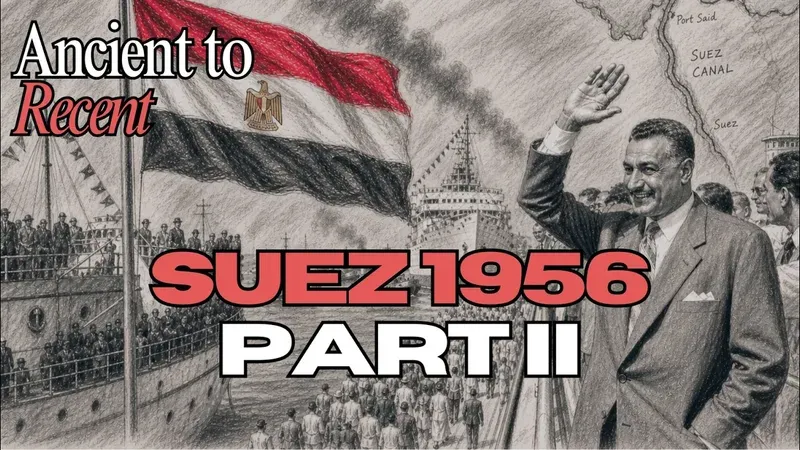
Suez Crisis 1956 — Part 2
9 May 2026 · 39 min · Season 1
 Watch on YouTube →
0:0039:11
Also on
Rate the show
Ratings are how new listeners find the show. It takes a minute and it makes a real difference.
In this episode of Ancient to Recent, Joseph Parkinson continues the story of the 1956 Suez Crisis as Britain, France and Israel move ever closer towards war.
In secret meetings outside Paris, David Ben-Gurion, Moshe Dayan and Shimon Peres meet with British and French officials to lay out plans for a joint attack on Egypt. As tensions rise across the Middle East, Gamal Abdel Nasser’s growing influence, Soviet arms shipments and the escalating Fedayeen conflict convince many Western leaders that confrontation is unavoidable.
We explore the fears driving each side of the crisis: Britain’s anxiety over imperial decline, France’s brutal war in Algeria and Israel’s growing belief that Egypt posed an existential threat. Meanwhile in Washington, President Eisenhower struggles to prevent the crisis from spiralling into catastrophe as the Cold War deepens and revolution erupts in Hungary.
As diplomacy collapses behind closed doors, Operation Musketeer begins to take shape and the world edges towards one of the most explosive confrontations of the Cold War.
Join Joseph Parkinson as Ancient to Recent continues its series on one of the defining crises of the modern Middle East.
#Ad
This episode includes paid promotion in partnership with Ground News.
Go to https://groundnews.com/ancient to get 40% off the unlimited access Vantage plan and compare how different outlets report the same story.
🎧 New episodes every Saturday
📲 Follow on YouTube, Spotify & Instagram @AncientToRecent
#SuezCrisis #Nasser #ColdWar #HistoryPodcast
Read transcript
This transcript is automatically generated, so it may contain typos and misheard names.
There is no doubt in our minds that Nasser, whether he likes it or not, is now effectively in Russian hands, just as Mussolini was in Hitler's. It would be as ineffective to show weakness to Nasser now in order to placate him as it was to show weakness to Mussolini. Anthony Eden, Prime Minister of the United Kingdom of Great Britain and Northern Ireland. The DC-4 plane touched down on the wet asphalt in Paris on the 22nd of October 1956. The weather was as bad as the mood of the small group of delegates that shuttled off the plane into the waiting cars. Such an illustrious group would, in the happiest circumstances, be met with a military band, flashing light bulbs, cheering crowds, bouquets and all the pomp and circumstance normally associated with a visit from such distinguished gentlemen. But this group had no time for diplomatic niceties. The men in question, David Ben Gurion, the diminutive founder and Prime Minister of the State of Israel, Shimon Perez, the 33 year old Director General of the Ministry of Defence, and Moshe Dayan, the head of the IDF, The Israeli Defence Force, complete with his distinctive black eye patch, had not come to Paris to take in the sights.
They were whisked through the streets of the French capital to a villa on the outskirts of the city in this Severa neighborhood for secret talks. Waiting for them were representatives of the government of France, plus officers from all three branches of the French armed forces and intelligence services. The party would be complete by officials from the United Kingdom. Once together, the representatives of the three nations, 2 great all powers and one new upstart state would layout plans for one of the most daring, some might say foolhardy, episodes in all of history.
They would plan for war. Welcome to Ancient to Recent My name is Joseph Parkinson and today we continue our story of the 1956 Suez Crisis. Episodes of Ancient to Recent are out every Saturday and are available on YouTube, Spotify and Apple Podcasts. After the Arab Israeli War of 1948, the border between the new Jewish state and the former land of the Pharaohs had been quiet. So quiet that the Israelis had even disbanded the southern command of the IDF with a 1952 coup that overthrew the Egyptian monarchy and brought the three officers led by Gamal Abdullah to power.
This had changed. All of a sudden Egypt was transformed from stable neighbor to hotbed of revolutionary fervour and Nasser, keen to present himself as a symbol of liberation, had taken up the cause of anti imperialism and anti colonialism. Nasser had lent support to revolutionary movements such as the Algerian FLN battling the French and to the Palestinian Fedayim whose bloody raid struck fear into the hearts of Israelis.
Nasser railed against the pro Western client states of Syria, Iraq and Jordan, and soon enough radical elements in those countries found not just a sympathetic E in the halls of power of Cairo, but an eager accomplice to stir up coups and rebellions. Nasser turned his attention to the Suez Canal, the mighty waterway that linked the Red Sea and the Mediterranean, the artery of global trade. The Suez Canal was opened in 1869, and though constructed with massive Egyptian labour, it was London and Parisian shareholders, not the working poor of Alexandria and Cairo, that benefited from the flow of trade.
Nasser was determined to free Egypt, long a British vassal state, not just a foreign domination but also of the scourge of poverty. To do this he required a great leap forward, the industrialization of the country, complete with new infrastructure projects such as the Aswan high down. But there was one problem. Infrastructure projects required money, and lots of it, and Nasser didn't have that sort of cash. Nasser had initially turned to the US and UK for support with the World Bank, and the deal seemed to be in the offing. But in the heightened tension of the Cold War, the US got cold feet.
After Nasser recognized Mao's China and began purchasing arms from the Soviet bloc, the deal collapsed. The Soviets were willing to help, but could not plug the gap, so Nasser was on his own. Nasser decided to kill two birds with one stone. He would throw off the last vestiges of imperial domination and seize the greatest prize of all in Egypt, the Suez Canal. The revenue would then flow not into the open seas of Western financiers, but into the deep pool of Egyptian state coffers and would be used to transform Egypt from backward nation to modern power.
Nasser's message of anti imperialism won him admirers throughout the Arab world and drew concerned glances from Tel Aviv, Paris and London. For Britain, this was about far more than a canal. The empire that had once painted vast stretches of the globe red was already beginning to slip away. India was gone, nationalist movements were erupting across the colonies and Britain, exhausted by two world wars, were struggling to hold on to its place in the world. To Anthony Eden, Nasser was not simply an Egyptian nationalist. He was a dangerous agitator, a man Eden believed was testing the resolves of the Western powers in much the same way Mussolini and Hitler had in the 1930s. Eden feared that if Britain backed down in Egypt, the consequences would ripple far beyond the Suez Canal. British influence across the Middle East could collapse, and with it Britain's claim to still be a great power. Increasingly, Israel found a sympathetic ear in Paris. The French had come to see Nasser not just as an Egyptian nationalist, but as the driving force behind anti French Revolution across North Africa and the Middle East. As relations between Egypt and Israel deteriorated, France began supplying Israel with weapons, aircraft and military cooperation.
By 1956, the two countries, though vastly different in age and circumstance, were being drawn together by a common enemy. In Algeria, events were spiralling out of control. Long French colony that called the Great Autonomy and eventual independence, Algeria had met with indifference and hostility from the French. Frustrated, many Algerians had turned to violence, founding the FLN which launched a campaign of assassination and bombing against French authorities. Nasser was eager to support the FLN in any way he could. For French Prime Minister Guy Mollet, the FLN was only a symptom of a much larger problem.
Mollet believed that Nasser was the true architect of the anti French Revolution across North Africa, the man stirring rebellion from Cairo whilst presenting himself to the world as a champion of liberation. If France was to crush the FLN then in the minds of many French officials they would first have to deal with Nasser's Egypt. Israeli intelligence had started picking up signs that Nasser was ready to backup his rhetoric with more than just words. Nasser was not only allowing the Palestinian Federine to use the Sinai as a base of operation, the Israelis now notice the movement of Egyptian troops.
Mosheedan reported to Ben Gurion in February 1956 of Egyptian troop buildup in the Sinai. In late 1955, only one of Egypt's 16 brigades were in the Sinai. By February, the number had risen to 9. Nervous conversations began in Israeli government circles. Some, such as Diane, urged a pre emptive strike, but others, such as Foreign Minister Moshe Sharad, urged caution. Ben Gurion, mindful of international opinion and Israel's delicate strategic position, decided to hold back play for time. If Israel was going to act, she would need allies, and it was far from clear that Israel could rely on support from others in the event of war.
Necessity made for interesting bedfellows as the imperial powers of Britain and France and the new state of Israel found themselves with a common foe. In the leafy suburbs of Paris, officials from three great powers laid out their plans. David Ben Gurion started by outlining the threat posed to the still young Jewish state. Israel was threatened by infiltration from Sinai and potential blockade by Nasser. Soviet weapons were flowing into Egypt, and the Egyptian army, now being trained by Soviet advisors, would soon not be the ramshackle outfit that had performed so poorly in the 1948 war. Ben Gurion argued for a simultaneous attack by Israeli, British and French forces to deal Nasser a knockout blow. But the British and French had different ideas. They were conscious of international opinion, not just in the Arab world but also in Washington. They knew that both France and the UK were still rebuilding after the exertions of the Second World War and dependent on economic assistance from the US. the United States would not look kindly on what would look to all intents and purposes to be returned to the days of 19th century empire building. Selwyn Lloyd, the British Foreign Minister, a man who had never left Britain other than service during World War 2, urged that it would be better for the British and French to attack two days after the initial Israeli strike so they could be perceived to be reacting to events rather than coordinating them.
In the end, the plan was as simple as it was implausible. Israel would launch a pre emptive strike on Egypt. The British and French would publicly condemn the attack whilst privately supporting it. The British and French would then intervene in the name of protecting the canal by landing troops that would seize the canal, placing themselves between the Egyptian and Israeli armies and returning the canal to international control. The Israelis would be allowed to keep any land they had taken, and a propaganda campaign would be launched to paint Nasser as a weak leader who had LED Egypt to a point of humiliation. On paper, the conspiracy appeared elegant. In reality, it depended on a chain of assumptions that the Egyptians would react predictably, that world opinion could be managed, that the United Nations could be sidelined, and, most dangerously of all, that the United States would ultimately fall into line.
Those assumptions would soon collide with reality. In 1956, the United States of America was at the height of its imperial power. the US had bounced back from the Great Depression, becoming the workshop of freedom, providing the material muscle of the Allied cause. In the Second World War, the USA had defeated the twin evils of German Nazism and Japanese imperialism and emerged as the most powerful nation in the world, the first true superpower. At home, Americans enjoyed a level of prosperity unimaginable even a generation before.
But all was not well for the descendants of Washington and Lincoln. Beneath the appearance of supreme confidence, there was a deep anxiety, for America had not emerged alone from the ashes of World War. the US presented one vision of the future, capitalist, democratic, free. But this vision was challenged by the Union of Soviet Socialist Republics, or the USSR, and it's ideology of communism. Communism promised not democracy but revolution, not prosperity but equality, not freedom but brotherhood.
Soon the white heat of the struggle against Hitler gave way to the Cold War, and ideological battle contested just as ferociously for the nations of Africa and Asia emerging from colonialism plus the aspiring states of Latin America. A choice lay before them. Would they be tantalized for the bright lights of the American dream, with its promise of freedom and opportunity for all, or with the siren song of Soviet socialism, with its promise of land, peace, bread, and universal brotherhood? Win the loyalty of those struggling for a better tomorrow.
Many in the US, like then President Dwight D Eisenhower, had welcomed the withdrawal of the European powers from their colonies. Eisenhower and many Americans looked down on imperialism, or at least as it was practiced by Britain and France, and saw the emergence of so many nations into freedom as a step into the modern world. But soon questions began to be asked just what exactly would be filling the vacuum left by the imperial powers?
What path would these new states be taking? It was not at all clear that countries from Uganda to Vietnam would side with the US. Though the US under Eisenhower wanted to draw the countries of the developing world closer to them, that did not mean tolerance would be extended to nations. This seemed to be on the brink of choosing the wrong side. The US had pulled out a supporting Nasser's bid for financing the Aswan High Dam after Nasser's recognition of the People's Republic of China in 1953. British and U.S. intelligence services collaborated in the removal of the Iranian Prime Minister Mohammed Mozdek for fear he harbored communist sympathies. In 1954, Eisenhower directed the CIA to instigate a coup in Guatemala to overthrow the democratically elected left-leaning government of Jacob R Benz. For many in the US State Department, the world was seen increasingly in black and white.
Thus the non aligned movement was viewed with suspicion, nothing more than a Trojan horse for the forces of international communism. the United States closest allies were undoubtedly Britain and France. All three had fought side by side in two world wars, had founded NATO, and now faced a shared enemy in Soviet communism. But though bound together by history and alliance, the Americans and the European partners no longer viewed the world in quite the same way. the United States had emerged from the Second World War revitalized, richer and more powerful than ever. Britain and France, by contrast, had emerged exhausted, indebted and increasingly anxious about the future of their empires. As much as America exuded confidence, Britain and France radiated insecurity.
Thus, Washington, London and Paris viewed both the Middle East and Nasser through very different lenses. For the British and French, Nasser was a dangerous agitator bent on dismantling their hard fought for influence in the region. But Eisenhower, a military adventure in the Middle East, threatened to inflamed the entire Arab world and pushed newly independent nations towards the Soviet Union. When Nasser nationalized the Suez Canal, Anthony Eden spoke openly to American officials of military action.
Eisenhower responded with a stern warning. Britain, he cautioned, could expect no support from the United States if it embarked upon what the president viewed as a reckless adventure. The situation was hardly helped by poor relations between senior British and American officials. Eden and US Secretary of State John Foster Dulles, in particular, deeply disliked one another. Yet despite the growing tensions, the British government remained convinced that when push came to shock, the Americans would ultimately stand beside their closest ally.
After all, there was the so-called special relationship. As the crisis deepened, British and French officials intensified their lobbying in Washington, constantly drawing comparisons between Nasser and the dictators of the 1930s. For the men who occupied the highest offices in Britain, France and the United States, the Second World War was not distant history. It was the defining experience of their lives. And one of the fascinating things about studying history is seeing how exactly the same events can look completely different depending on where you're standing. To many in Britain, Nasser look like another dangerous strongman threatening global stability.
To Egyptians, he was the man finally standing up to imperial domination. To Americans, the real danger was that the crisis might push the Arabs towards the Soviet Union. There's actually one of the reasons I've been enjoying Ground News, who are sponsoring today's episode. Ground News gathers reports from news organizations across the political spectrum and from around the world, letting you compare how different outlets are covering the same story. You can see which publications lean left, right or centre. Who owns them, and even which stories are being unreported entirely and by who?
When covering history or current events, it's genuinely useful to step outside a single narrative and understand how perspectives shape the way stories are told. To check out Ground News and support the podcast, you can click the link in my bio for 40% off the Vantage plan or go to groundnews.com/ancient. For Mollet, Eden and Ben Gurion, memories of the 1930s would make compromise impossible. Nasser became another Hitler in the minds of many Western leaders.
Soviet arms sales to Egypt echoed the diplomatic manoeuvres that had preceded the Second World War. Any hesitation, any reluctance to confront aggression was increasingly dismissed as appeasement. Publicly, however, the crisis still appeared to be moving along diplomatic lines rather than towards war. The US Secretary of State, John Foster Dulles, spoke in favour of international control of the canal during meetings with British and French officials, remarks that many in London interpreted as quiet support for stronger action.
Dulles persuaded Britain and France to attend a conference in London between the 16th and 23rd of August, bringing together the world's major maritime powers to discuss the future of the canal. Officially, the conference was intended to exhaust every possible diplomatic Ave. before military action could be considered. Nasser was invited, though it remained unclear whether he would attend. Eisenhower, still desperate to avoid a catastrophic split between the West and the Arab world, even floated the extraordinary idea of meeting Nasser in Rome and accompanying him to the conference alongside Indian Prime Minister Nehru.
The symbolism would have been unmistakable. Nasser, flanked by the leaders of two nations that had themselves emerged from colonial domination, entering the conference not as a defeated suclicant but is the representative of a proud independent state. But Dulles persuaded Eisenhower to abandon the idea. Then Eden made matters considerably worse. In a public broadcast, the British Prime Minister denounced Nasser as a dictator and drew direct comparison with Hitler.
The speech outraged Cairo and made it politically impossible for Nasser to attend the conference. After weeks of negotiation, the assembled powers agreed upon a proposal for an international body that would oversee the operation of the canal. The plan was delivered to Cairo by Australian Prime Minister Sir Robert Menzies. Yet even as diplomacy continued, tensions beneath the surface were intensifying. Britain's economy was weakening, and officials in London feared that prolonged uncertainty over the canal could trigger another collapse in the value of the pound. To many within the British establishment, economic decline and imperial decline had become inseparable. If Britain could no longer defend its interest in Egypt, then perhaps Britain was no longer truly a global power. Eisenhower, meanwhile, publicly insisted that every possible Ave. for peace must be exhausted before military action could even be contemplated.
To Nasser, this appeared to remove the immediate threat of war and made it easier for Egypt to reject proposals that infringed upon Egyptian sovereignty. Frustration with Washington steadily grew in London and Paris. British and French officials increasingly convinced themselves that American hesitation was temporary, little more than an attempt by Eisenhower to avoid controversy during the upcoming presidential elections.
Surely, they reasoned, the United States would never truly abandoned its closest allies. Dulles continued searching for a diplomatic solution, proposing the creation of the Suez Canal Users Association, or Skewer, a body intended to unite the major users of the canal and negotiate collectively with Egypt. But the initiative satisfied nobody. The Egyptians viewed Skewer as a thinly disguised attempt to undermine Egyptian sovereignty, whilst many British and French officials saw it as yet another American delaying tactic.
Throughout September, further conferences were held in London whilst negotiations continued at the United Nations. By October, a framework based on freedom of transit, Egyptian sovereignty and international guarantees for the operation of the canal was beginning to emerge. In theory the crisis appeared close to resolution, but by this stage the canal itself was no longer the true issue. For Britain, the crisis had become bound up with imperial decline and national prestige. For France it was inseparable from the war in Algeria and the belief that Nasser was orchestrating anti French revolutions across North Africa.
For Israel, the issue was survival itself, the fear that Egypt's growing military strength might one day threaten the existence of the Jewish state. The canal dispute had become the pretext for something much larger. Increasingly, the governments in London, Paris and Tel Aviv were reaching the same conclusion. Nasser had to go in. Several talks continued. The discussions went long into the night as slowly a plan began to take shape. But there was 1 nagging problem.
On what pretext would the war be launched? Ideas were bounced around with one French general suggesting the Israeli should bomb the Arab Israeli town of Beersheba and claim Egypt was responsible, a suggestion Ben Gurion angrily dismissed. In the end it was Mosha Diane who came up with the pretext. The Sinai was being used as a base of operations for Fedean raids into Israel. Israel had a policy of reprisal to punish those responsible.
Israel would use the raids as an excuse for a four scale invasion of the peninsula. In return, the Israelis outlined their demands for their involvement. They expected half of the Sinai Peninsula and next to the Jewish state, an area large enough to almost double the size of Israel and provide strategic depth for the fragile nation. In the Sinai, the situation was becoming increasingly volatile. Fedean raids launched from Egyptian territory were met with ever more deadly Israeli reprisals.
Israeli civilians were killed in cross-border attacks, whilst Israeli retaliations often inflicted devastating losses upon Arab villages, military positions and police posts. The cycle of raid and reprisals steadily drew Egypt deeper into confrontation with Israel. Yet these clashes exposed a troubling reality for Cairo. Egyptian troops frequently performed poorly in skirmishes with the Israelis, highlighting the weakness of an army still equipped largely with ageing Western weapons. For years, Egypt had depended upon Britain and the United States for military supplies, but relations with the West were rapidly deteriorating.
Nasser increasingly looked elsewhere for arms. Then, in September 1955, came a development. Then sent shock waves through the Middle East. Egypt signed a massive arms deal with Czechoslovakia, acting on behalf of the Soviet Union. Suddenly, the balance of power in the region appeared to be shifting. Under the terms of the tripartite agreement, Britain, France and the United States had attempted to maintain an arms balance between Israel and the Arab states.
Now that balance seemed to be in danger of collapse. To Israeli leaders, the implications were terrifying. Nasser, armed with Soviet tanks, aircraft and artillery, would represent an entirely different kind of enemy from the poorly equipped Egyptian forces Israel had faced in 1948. Israel urgently appealed to the United States for increasing military assistance, but Washington remained cautious, fearful of accelerating an arms race in the Middle East.
Meanwhile, the violence continued to escalate. Israeli reprisal raids grew increasingly aggressive, many led by young commanders such as Ariel Sharon, who believed only overwhelming force could deter future attacks. Even within Israel, there was growing concern over the scale of the retaliation. Foreign Minister Moshe Sharat frequently clashed with David Ben Gurion and the military leadership, warning that such operations risked isolating Israel diplomatically. The Americans, too, were alarmed. Secretary of State John Foster Dulles, already deeply suspicious of growing instability in the region, reacted angrily to several Israeli operations and temporarily halted discussions over arms sales. At the same time, tensions across the wider Middle East continue to rise.
Britain's support of the Baghdad Pact, an anti Soviet alliance linking Iraq, Turkey and other regional powers, convinced Nasser that the West was attempting to encircle Egypt and undermine Arab nationalism. Nasser responded by seeking to draw the Arab world closer together under Egyptian leadership. By 1956, the Middle East was rapidly becoming one of the most dangerous flashpoints in the world and arms race was under way.
Diplomacy was faltering and all sides increasingly suspected that war was approaching. As negotiations continued in several, the outlines of the conspiracy slowly took shape. The British made one point unmistakably clear. Britain would not intervene unless Israel struck first. At one stage, David Ben Gurion summoned Moshe Dayan and Shimon Peres into the garden where, using a cigarette package, he sketched out the broad outline of the coming operation.
Yet even within Israel, there remained deep disagreement over how the young Jewish state should confront the Arab world. Ben Gurion and former Prime Minister Moshe Sharat represented 2 very different schools of thought. Ben Gurion believed Israel existed in a brutal and unforgiving environment where survival depended upon strength, deterrence and when necessary, pre emptive action. Shirat viewed the situation differently.
Having spent much of his life in Palestine before the creation of Israel, Shirat believed that however bitter relations with the Arab states had become, some form of negotiation and coexistence would ultimately be necessary. When Ben Gurion temporarily stepped down as Prime Minister in 1953, Shirat inherited the leadership of Israel and attempted to pursue a more cautious foreign policy. Quiet contacts were opened with several Arab governments, including Egypt, in the hope that tensions might gradually ease. But events soon undermine Sharat's approach. Fed aeen attacks continued, Israeli reprisals escalated, and distrust between Cairo and Tel Aviv deepened further. Then came the disastrous Lavon Affair in 1954, An Israeli covert operation in Egypt intended to sabotage Western targets and blame the attack on Egyptian nationalists collapsed after Egyptian authorities uncovered the network. The scandal humiliated Israel internationally, poisoned relations with Egypt even further, and intensified divisions within the Israeli leadership itself. Sharat's cautious approach increasingly appeared weak and ineffective in the eyes of many within the Israeli military and political establishment then.
Gurion, meanwhile, returned to power convinced that time was running out, Egypt was rearming, Soviet weapons were flowing into the region, and Nasser's influence across the Arab world continued to grow. By 1956, the advocates of negotiation were steadily losing ground to those who believed that another war with Egypt was not only inevitable but perhaps necessary before Israel's strategic position deteriorated further. As the diplomatic deadlock continued into early 1956, the Eisenhower administration made one final effort to prevent the Middle East sliding towards war.
President Eisenhower dispatched the American diplomat Robert Anderson to the region, carrying proposals that became known as the Alpha Plan. The plan saw a broad settlement between Israel and the Arab states, combining security guarantees, territorial adjustments, and economic assistance in the hope of stabilizing the region before the Cold War and the Arab Israeli conflict became hopelessly intertwined. But the initiative quickly ran into the realities of Middle Eastern politics.
Neither side trusted the other enough to make the concessions necessary for peace, and violence along the Israeli borders continued unabated. Within Israel, the balance of power was shifting decisively. Moshe Sharat, then foreign minister, found himself increasingly isolated. He resigned and was replaced by Golda Meir, a far more loyal supporter of Ben Gurion's hardline approach towards Egypt. With Sharat gone, the Israeli leadership was now far more united in its outlook. Diplomacy had failed, Egypt was growing stronger, and many within the Israeli government had come to believe that confrontation with Nasser was becoming unavoidable. The French further encouraged this thinking. Officials in Paris quietly informed the Israelis that Britain too was increasingly prepared to take military action and would likely accept many of Israel's strategic demands in the event of war.
At the same time, the diplomatic initiative sponsored by Washington was steadily beginning to unravel. The Suez Canal Users Association, or Skewer, struggled to gain real authority, whilst British and French officials became ever less cooperative with John Foster Dulles and the Americans. Publicly, London and Paris still spoke the language and negotiation. Privately, they were drifting steadily towards military solutions. Across the region, tensions continue to mount. Relations between Israel and Jordan deteriorated sharply as border violence intensified, whilst in Algeria the French army remained locked in an increasingly bitter and brutal struggle with the FLN insurgency. To many French officials, the conflict in Algeria, Egypt and Israel no longer appeared separate crises, but part of a single wider struggle for the future of the Middle East and North Africa.
By the autumn of 1956, diplomacy was slowly collapsing under the weight of fear, mistrust and political desperation. Increasingly, the real negotiations were no longer taking place in public conferences or at the United Nations, but rather in secret in several representatives of Britain, France and Israel were preparing to formalize the conspiracy that would soon plunge the Middle East into war. Events elsewhere in the Middle East only deepen the sense of crisis in London, Paris and Tel Aviv.
Jordan, fearful of growing instability and increasing isolation, moved closer towards Egypt and agreed to join a joint military command under Nasser's leadership. King Hussein of Jordan believed Israel might soon launch an attack, and Jordanian officials warned Cairo that Israeli mobilization appeared imminent. To Britain, France and Israel, the tightening alignment between the Arab states seemed to confirm the darkest suspicions about Nasser's intentions.
What had once appeared to be Egyptian nationalism now increasingly looked, in their eyes at least, like the emergence of a unified anti Western and anti Israeli bloc stretching across the Arab world. The negotiations at several now took on a new urgency. Once the secret talks concluded, the delegates quietly departed Paris and returned home to begin putting the plan into action. Across Britain, France and Israel, military preparation accelerated. Troops were mobilized, ships assembled and aircraft moved into position.
The conspiracy was becoming reality. Anthony Eden presented the plan to the British cabinet. Some ministers voiced serious concerns. They feared the operation could shatter relations with the United States, violate Britain's international commitment and leave the country isolated diplomatically. Yet the momentum towards military action had become increasingly difficult to resist. Eden remained convinced the failure to confront Nasser would signal the final collapse of British power and prestige in the Middle East. In the end, the cabinet approved the operation. The date was set October the 29th, 1956. The ultimate in Britain and France would later issue to both Egypt and Israel demanded they withdraw from the Canal Zone was carefully drafted, providing the appearance of neutrality whilst masking the collusion that lay beneath the entire operation. Yet even as the final preparations for war were underway, there were growing concerns about even himself. The British prime minister's health was deteriorating badly. Exhausted, under immense pressure and increasingly dependent upon medication, Eden's judgement appeared at times erratic and emotionally driven. Meanwhile, across the Atlantic, American officials were beginning to suspect that something was deeply wrong. Reports reaching Washington hinted an unusual coordination between Britain, France and Israel. Though Eisenhower and Dulles did not yet know the full details of the conspiracy, Suspicions of collusion was steadily growing. At precisely the same moment, another crisis was erupting hundreds of miles away in Eastern Europe. In Hungary, mass protests against Soviet domination had spiralled into open revolt.
Demonstrators tore down Communist symbols, demanded political freedom and clashed with Soviet troops in the streets of Budapest. The timing could hardly have been more dangerous. Suddenly, the Cold War appeared to be entering a period of simultaneous crisis in both Europe and the Middle East. For the Soviet Union, the uprising in Hungary threaten the stability of its Eastern European empire. For the Western powers, Suez risked igniting the Arab world and drawing the superpowers into direct confrontation. Within days, two seemingly separate crises would become fatally intertwined, each shaping the course of the other in ways few at the time fully understood. As military preparations accelerated, doubts were beginning to spread throughout the highest levels of the British state.
A report delivered to Anthony Eden by Britain's chiefs of staff painted a grim picture of what intervention in Egypt might actually entail. Simply occupying the canal, the military warned, would like to achieve very little. To truly secure the situation. Britain and France might find themselves drawn into a much wider occupation of Egypt, acquiring enormous military resources at a time when Britain's armed forces was already stretched thin across the globe. The risk extended far beyond the battlefield. The report warned that military action could provoke Arab oil producing states into restricting supplies to the West, whilst pro Western governments across the Middle East might collapse under the pressure of popular anger. The assessment was unanimous.
Every member of the Chiefs of Staff had signed it. Only now, as the invasion drew closer, were many within the British government beginning to fully confront the possible consequences of war. Yet despite these warnings, preparations for the operation continued to intensify. The objectives themselves remain surprisingly unclear. Was the aim to merely seize the canal, to destroy the Egyptian army or to overthrow Nasser? At different moments, British officials seem to favour all three goals, often without fully recognizing the contradictions between them.
The planning for what became known as Operation Musketeer was increasingly marked by confusion and improvisation. Military planners repeatedly revised the invasion plans amid fears of heavy civilian casualties in cities along the canal and concerns over how the Arab world might react to images of British and French bombs falling on Egyptian civilians. Delay followed delay. Senior officials warned the government that the operation could not be postponed indefinitely without seriously disrupting mobilisation and damaging military readiness. Yet London continued publicly pursuing negotiations, desperate to maintain the appearance that every diplomatic Ave. had been exhausted before resorting to force. Opposition to the operation was also growing at home. The opposition Labour Party strongly criticised the drift towards war, whilst public opinion polls suggested that many Britons remained deeply uneasy about military intervention.
Even within the Foreign Office, significant numbers of officials opposed the plan, fearing it would permanently alienate Arab opinion and destroy Britain's standing. Across the Middle East. American intelligence agencies reached similarly bleak conclusions. ACIA assessment warned that any Anglo French occupation of Egypt could quickly descend into prolonged guerrilla warfare, dragging Britain and France into a costly and deeply unpopular colonial style conflict. Meanwhile, another problem complicated the planning still further.
Many senior British military commanders had not been informed of the full extent of the secret collusion with the Israelis. London remained deeply uncomfortable with openly appearing alongside the Israelis. British officials feared that any visible alliance with Israel would inflamed Arab opinions still further and expose the entire justification for intervention as a sham. The Israelis had their own reservations. Many within Israel were equally reluctant to appear too closely associated with Britain, the old imperial power that had once ruled Palestine and had often been viewed with deep suspicion by Zionist leaders. It was the French who increasingly acted as the bridge between the two Uneasy partners, smoothing over tensions and holding the fragile alliance together. By late October 1956, the machinery of war was now moving almost under its own momentum.
Diplomacy continued publicly. Privately, the invasion force assembled across airfields, naval bases and military camps. British, French and Israeli troops prepared for the operation that many believed would reshape the Middle East. Would the British and French top on Nasser and restore their places global imperial powers? Would the Israeli smash the threat of Egypt and secure the borders of their state? How would the USA and Soviet Union react?
Would a spark in the Middle East set the Cold War ablaze? We will find out in our next episode. Thank you for listening to Ancient to Recent. My name is Joseph Parkinson. Episodes of Ancient to Recent are out every Saturday and are available on YouTube, Spotify and our whole podcasts.