
#48
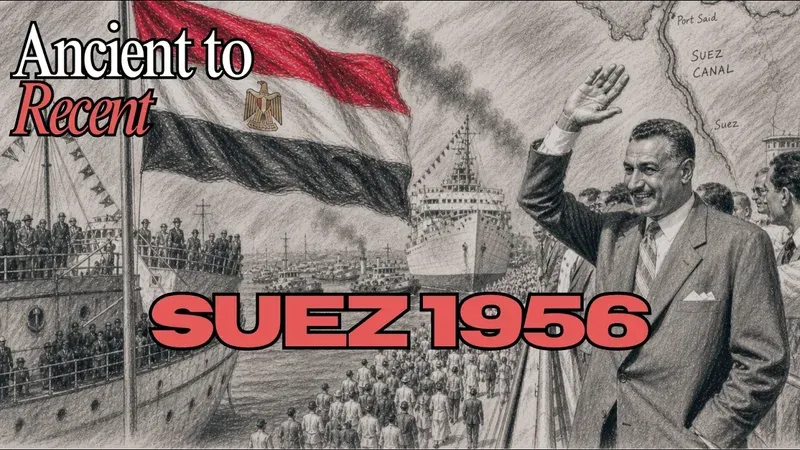
Suez Crisis 1956 — Part 1
2 May 2026 · 48 min · Season 1
 Watch on YouTube →
0:0048:08
Also on
Rate the show
Ratings are how new listeners find the show. It takes a minute and it makes a real difference.
In this episode of Ancient to Recent, Joseph Parkinson begins a new series on the Suez Crisis, exploring the collapse of European imperial power and the rise of a new global order.
From the battlefields of the Second World War to the streets of colonial Algeria, the cracks in the old empires begin to show. As France struggles to maintain control and nationalist movements gain momentum, a new force emerges in the Arab world.
At the centre of it all is Gamal Abdel Nasser.
Rising from modest beginnings to become Egypt’s dominant political figure, Nasser reshapes his country through revolution, repression, and ambition. As he consolidates power at home, he begins to challenge Western influence abroad, supporting anti-colonial movements, confronting old imperial powers, and positioning himself as a leader of the non-aligned world.
But as tensions rise and alliances shift, one bold decision looms on the horizon one that will bring Egypt into direct conflict with Britain, France, and Israel.
Join Joseph Parkinson as Ancient to Recent explores the forces that led to one of the most consequential crises of the Cold War era.
#Ad
This episode includes paid promotion in partnership with Ground News.
Go to https://groundnews.com/ancient to get 40% off the unlimited access Vantage plan and compare how different outlets report the same story.
🎧 New episodes every Saturday
📲 Follow on YouTube, Spotify & Instagram @AncientToRecent
Read transcript
This transcript is automatically generated, so it may contain typos and misheard names.
The whole world is with us, and I wish to make it quite clear to the free peoples of the world that the ordeal through which the world is passing at present is the responsibility of the aggressors who invaded Egypt. Gamal Abdul Nasser as the cheering crowds drifted away and the celebration of victory, the greatest triumph of freedom in the greatest battle against evil ever fought, blurred with memories of stolen kisses, lost comrades and nameless villages, For many it was time to go home.
They had come from around the world to answer the call of the mother country. To the men who had fought, struggled, sacrificed for France, theirs had been a war of liberation, but not of their own. For France, unlike Britain, unlike America, had fallen. She had tasted defeat long before savouring victory. She had experienced the pain of collaboration as well as the glory of valiant resistance. But many of those who fought into the tricolor did not come from Leon Leal, Toulon or Bordeaux. For them, their home was not the winding streets of Paris, nor the flowing fields of Gascony, but the red dust of the African savannahs, the humid jungles of Indochina and the sun scorched hills of the Maghreb.
Some 300,000 colonial soldiers served in the ranks of the French army, fighting to free France from Nazi occupation, even as their own country was held in bondage by France itself. When these men came home for them, a difficult question awaited a much needed answer. Just what exactly had they been fighting for? By the end of the Second World War, Algeria had been under French control since 1830. King Charles the 10th had used a diplomatic dispute as an excuse to send in the troops, hoping their quick victory in a not so far off land might boost his flagging popularity and perhaps restore French pride after the defeats of the Napoleonic Wars. In the subsequent 115 years Algeria had been ruled known as a colony, but as a part of France proper. Algeria was not some far off place but rather the other side of the Gallic lake.
Many French people had settled in North Africa, they would come to be known as the Piet Noir, literally Black Feet, and by 1960 they and their descendants would number someone million people, roughly 10% of the population of Algeria. With the war over, it did not take long for tensions to begin to surface in North Africa. On VE Day 8th of May 1945, a victory parade in the town of Satif, some 266 kilometers east of Algiers, turned into a riot, with Algerians attacking local French people, leaving over 100 dead.
It took five days of brutal fighting to restore order, with the application of mass violence, first by French soldiers, then by local Piednoir vigilante groups. Estimates, as ever, vary, with some putting the number of Algerians killed in the retaliation at over 1000, whilst others claim even this figure is far too low. Algeria was a divided society. Some, including Algerians themselves, valued their ties to France, believing that their bonds with Paris brought them the chance to ascend to European levels of education, prosperity and democracy.
But for others, including many of the 250,000 Algerians who'd fought in the ranks of the French army, they began to see France known as a benevolent protector but an unwelcome occupier. In 1946, the MTLD Movement for the Triumph of Democratic Liberties was formed with the aim of bringing about independence from France. But efforts at a political solution were frustrated by the system of government constructed by their colonial masters.
The Algerian National Assembly had a dual Electoral College system that allocated 60 seats to each ethnic Algerians and French voters, even though Algerians outnumbered their French counterparts 9 to 1. Peaceful efforts were further frustrated by French interference in the 1948 elections, where widespread fraud was used to tilt the scales in the electoral system already stacked against Algerians. With Paris uninterested in any democratic road to independence, the path of peace seemed to many to lead to a dead end. In 1954, a new organization was formed, the Fron de Liberacion Nacional, or FLN.
The FLN would launch a violent uprising against French rule, determined to drive the French into the sea and forge Algeria as an independent state in blood and steel. There was one man who watched these developments in Algeria with growing excitement. This man was not French, nor Algerian, nor did he belong to either of the fading European colonial powers. Nor was he the product of the emerging superpowers of the Soviet Union or the United States of America. He was Gamal Abdel Nasser, the president of Egypt, and he was about to set the Middle East on fire. Welcome to Ancient Recent.
My name is Joseph Parkinson and today we start a new series on the 1956 Suez Crisis, the twilight of European imperial power and the birth of a new world order. Episodes of Ancient Recent are out every Saturday and are available on YouTube, Spotify and Apple Podcasts. Soon enough, the FLN grew from minor irritant to major challenge to French rule in Algeria, with a wave of bombing and assassinations targeting French forces and local collaborators. The new French Prime Minister Guimola visited Algeria only to be pelted in the streets with Rotten Tomatoes, an act of humiliation that would be dubbed Legernais de Tomatz by the French press.
Outraged, Mollet vowed never to give up French rule in Algeria and responded with an ever heavier hand. Molly became convinced that behind the FLN stood the President of Egypt, Kamal Abdel Nasser. Molly was not alone in looking at Nasser, the fire breathing rabble rouser who spoke directly to the passions of the streets and hearing the echoes of the not too distant past. Both in the halls of power in Paris and London and the offices of Tel Aviv, concerned diplomats and officials listened to Nasser's speeches and heard not a Messiah, but a Fuhrer.
I find it endlessly fascinating how the same events can be told in completely different ways. One person's freedom fighter is another person's dangerous dictator. In the Suez crisis, the same man, Gamal Abdel Nasser, was seen as a Liberator by many Arabs and the new Hitler by the British and French. Different lenses, different narratives. The same stories were reported as the president stands up for the nation and also tyrant sees as power. Same events, different interpretations. That's why I use ground news.
It lets you compare how different outlets cover the same story, see bias ratings, and discover what each side is ignoring. Get 40% off the Vantage plan at groundnews.com/ancient or by clicking the link on my Biome. In 1956, Israel was not yet 10 years old. The newly established Jewish state was led by David Ben Gurion, born David Grunn on the 16th of October 1881 in Planche, Poland, then a basal state of the Russian Empire.
In the late 19th century, a tidal wave of hatred washed over the already heavily discriminated against Jews of Eastern Europe. The 19th century was a time of rapid and disorientating change. Millions of rural peasants poured into the factories and slums of cities. Old beliefs in inherited power and privilege found themselves challenged by new concepts such as nationalism, socialism, communism and democracy. Long oppressed groups, ethnic and linguistic minorities, women and the poor began agitating for more rights, even dangerously. In the eyes of many reactionaries, equality to some of these changes made no sense.
They challenged their very concept of reality, their very idea of themselves. To these reactionaries who felt discomfort with the growing chorus of objections and demands, there was one group that above all else was to blame, the Jews. In the late 19th century a new concept emerged, anti-Semitism, different from age or Judaeophobia, which was religious in nature and looked down on by upstanding people as being a peasant superstition.
anti-Semitism was considered a respectable intellectual belief, very much in line with the scientific racism that pervaded many learned circles after the discoveries of Darwin. Many a captain of industry and distinguished gentlemen would become devotees of the anti-Semitic faith which could count in its ranks such figures as Henry Ford, Charles Limburm, Coco Chanel and TS Eliot. What made anti-Semitism different and altogether more violent than Judeophobia is that anti-Semitism purported to be a science.
Old school hatred of the Jews. Blame the Jews for murdering Jesus, but this could be atoned for with conversion and assimilation in the race crazed atmosphere of the late 19th century. Anti Semites argued that Jews were inherently wicked and that Jewish blood would poison more ethnically pure people. Anti Semites argued that Jews engaged in a global conspiracy to control every aspect of society, from banking to art, from finance to diplomacy, for their own cynical self-interest. Because of the Jews inherent evil, as Anti Semites saw it, there could be no compromise.
There must be at least separation and at best eradication. anti-Semitism therefore blended the science of Darwin with a theory of economics and society to form an all-encompassing worldview where behind every inconvenience was the nefarious Jew. Anti-Semitism was, as the German Social Democrat August Babel noted, the socialism of fools. In this atmosphere of growing intolerance, hatred soon turned to violence as anti-Semitic riots known as pogrom swept across the Tsarist empire. Between 1881 and 1914, between 2 and 2.5 million Jews fled violence in Eastern Europe.
Their destinations were varied. Some made their way to Canada or Australia. Some went to Argentina. More still would find home in the growing Jewish communities in New York or Boston. But some began dreaming of something more permanent. Some began dreaming of their own state. One of these was David Ben Gurion. Ben Gurion became enchanted by the idea of Zionism, the return of the Jewish people to the land they had been expelled from by the Romans in the 2nd century.
Under the influence of Zionist thinkers like the Hungarian intellectual Theodore Herzl, Ben Gurion threw himself into the Zionist cause. In 1909 he migrated to Palestine, then part of the Turkish Ottoman Empire, before studying law in Istanbul. But the Zionist project seemed to run into a roadblock. Ultimately, the land was part of the Ottoman Empire, and the Sultan was not for giving it up. Plus, if you were a Jewish person migrating, fleeing from violence in Eastern Europe, and you had a choice of London, Boston, Paris, Buenos Aires or New York, or alternately an obscure part of the Ottoman Empire, why would you go there?
Why would you choose to go to Natania over Brooklyn? But then fate intervened. With the outbreak of the Great War, the shifting tectonic plates of early 20th century Europe created a complex web of alliances. When one of those plates suddenly seemed to give with the assassination of the heir to the throne of the Habsburg Austria Hungarian Empire, Franz Ferdinand, on the 28th of June 1914 by the Serbian nationalist Gabriella Princip, a whole continent was plunged into war. For four bloody years the world was convulsed with a war the likes of which had never before been seen. The war hung on a knife edge and 10s of thousands of men were mowed down by machine gunfire daily and new ghastly inventions, tanks, submarines and chemical weapons were unleashed for the first time.
As the war swung back and forth, the British government sought to unsettle the Ottoman Empire by issuing what would become one of the most consequential and controversial promises of the 20th century, the Balfour Declaration. In November 1917, the British Foreign Secretary, Arthur Balfour wrote to Lord Rothschild expressing support for the establishment in Palestine of a national home for the Jewish people, whilst adding the caveat that nothing should prejudice the rights of the existing non Jewish communities.
It was a short letter, just 67 words, but it's consequences would echo across the decades. For the British, it was a tool of war. By appealing to Jewish communities, particularly in the United States and Russia, London hoped to strengthen support for their Allied cause and weaken the Ottoman position in the Middle East. But the declaration did not exist in isolation. Even as Britain made promises to Zionist leaders, it was making very different promises elsewhere.
Through the Hussein McMahon correspondence, British officials had engaged Arab leaders to rise against the Ottomans with the implicit understanding that independence would follow. At the same time, in the secret Sykes Picot Agreement of 1916, Britain and France had already carved the region into spheres of influence, dividing land they did not yet control. 3 overlapping promises, 3 incompatible visions of the future and at the centre of all three, Palestine. When the war ended in 1918, the Ottoman Empire collapsed under the strain of defeat.
It's Arab provinces did not emerge into independence, but instead passed into the hands of the victorious European powers under the League of Nations mandate system. In 1922, Britain was formally granted the Mandate for Palestine. On paper, the British now carried a dual obligation to prepare the territory for eventual self government, while also facilitating the creation of a Jewish national home. In practice, these goals would prove increasingly irreconcilable.
Throughout the 1920s and 30s, waves of Jewish migrants began arriving in Palestine. Some came driven by ideology, inspired by a Zionist dream of building a new society. But many more came out of necessity. Eastern Europe was being torn apart by the aftermath of the imperial collapse. Old empires had vanished, replaced by fragile nation states gripped by economic crisis, political instability and rising ethnic nationalism.
In this volatile environment, Jews were often singled out as scapegoats. Violence was never far away. The pogroms that had started in the late 19th centuries did not disappear with a new century. If anything, they intensified in places where order had broken down. Between 1881 and 1914, as many as two and a half million Jews had already fled Eastern Europe, most crossing the Atlantic, seeking refuge in the United States.
But that door began to close. In 1924, the United States passed the Johnson Reid Act, drastically reducing immigration through a strict quota system designed to limit arrivals from eastern and southern Europe. And America was not alone. Across the world, countries began tightening their borders. In 1919, Britain introduced the Aliens Restrictions Act. In 1933, Chile instructed its consulate officials to deny visas to Jews. Brazil imposed quotas in 1934 and later banned immigrants of Semitic origin.
Mexico followed with its own restrictions. Argentina stopped issuing visas to Jews in 1938, while Paraguay and Uruguay closed their borders entirely the following year. Even countries that did not openly declare such policies often found quiet ways to achieve the same end. For Europe's Jews, options were narrowing as persecution intensified, especially after the rise of Nazi Germany in 1933, Palestine became not just an ideological destination, but one of the few remaining places of refuge.
The result was a surge of Jewish immigration, but this influx did not occur in an empty land. In the 1930's the Arab population of Palestine watched with growing alarm as demographic and economic changes accelerated. Land purchases, new settlements and expanding institutions of a proto state began to reshape the landscape. Tensions hardened into confrontation. Riots broke out in 19/20/21 and 29. Then, in 1936, Palestine erupted into a full scale revolt.
For three years, Arab insurgents targeted British forces and Jewish communities, demanding an end to mass immigration and the creation of an independent Arab state. The British response was forceful. Troops were deployed, villages searched, leaders were arrested or exiled. By 1939, the revolt had been crushed, but at a cost. Thousands were dead, and whatever fragile trust had existed between communities had all but disappeared. In an attempt to restore order, Britain issued the White Paper of 1939 sharply limiting Jewish immigration and land purchases. But by then events in Europe were overtaking policy, because as the door of the world closed to Jewish refugees, something far darker was unfolding on the continent they were trying to escape.
And the consequences of that failure, of promises made, broken and contradicted, would soon be felt not just in Europe but across the Middle East. The Second World War did not just reshape borders, it shattered illusions. In Europe 6,000,000 Jews had been systematically murdered in the Holocaust. Entire communities, centuries old, had vanished. For those who survived, there could be no return to what had been. The question was no longer theoretical.
It was immediate, urgent, unavoidable. Where could the Jewish people be safe? The newly established United Nations attempted to provide an answer. On the 29th of November 1947, it passed a resolution calling for the partitioning of Palestine into two states, one Jewish, one Arab. On paper, it was a compromise. In reality, it satisfied no one. Jewish leaders accepted the plan reluctantly but pragmatically. It offered international legitimacy, A foothold for statehood Arab leaders rejected outright.
They argued, with some justification, that it was fundamentally unjust. A land with an Arab majority was being divided to create a Jewish state, much of it allocated to recent arrivals. Tensions, already high, snapped. Civil war broke out almost immediately between Jewish and Arab communities in Palestine. Then on the 14th of May 1948, as the British Mandate came to an end, David Ben Gurion stood in Tel Aviv and declared the independence of the State of Israel. The next day, the war expanded.
Armies from Egypt, Jordan, Iraq and Syria invaded. Saudi Arabia and Lebanon would soon follow. The odds of Israeli survival were long, but weapons provided by Czechoslovakia at the behest of the Soviet Union allowed the Israelis to stand their ground. For the Arab armies. Their objective was clear, to destroy the newly declared state before it took root. What followed was 10 months of brutal, chaotic warfare. Against the odds, Israel survived. More than that, it expanded.
By the end of the war, the map looked very different from the one the United Nations had proposed. Israel controlled significantly more territory than it had been allocated. But the Israelis were not the only ones who ended up with slices of Palestine. Jordan took control of the West Bank, including E Jerusalem. Egypt occupied the Gaza Strip. And for the Palestinians, this moment would be remembered not as a war of independence, but as a catastrophe. The Nakba.
Around 700,000 Palestinians were displaced. Some fled the fighting, fearing for their lives as the front lines shifted and violence spread. Others were expelled, driven from their homes in a conflict where survival often left little room for nuance or mercy. Villages were emptied, communities dissolved and people scattered. For Israel, it was a triumph. For Palestinians, it was the loss of their homeland. And for the wider region, it was only the beginning.
In the years that followed, Israel remained a small, vulnerable state, surrounded by neighbors who refused to recognize its existence. The borders were tense, but largely static. There were raids and reprisals. Palestinian fighters called Fedayeen crossing into Israel, Israeli forces responding with force but no full scale war. But along the southern border with Egypt, things were quiet. Quiet enough, in fact, that Israel made a remarkable decision. It disbanded its southern command. That was how little threat Egypt was perceived to pose. History had a habit of turning on individuals because in Cairo, a new kind of leader was emerging. Young, charismatic, defiant.
A man who spoke not just to Egypt but to the entire Arab world. A man who rejected the old order, colonialism, monarchy, division and promised something radically different. And he was about to change everything. If the story of Suez has one central figure, it is Gamal Abdel Nasser. He was born on January the 15th, 1918, in Alexandria, in a modest lower middle class family. His father was a postman, his mother the daughter of a coal merchant.
It was not the background of a king, or even a traditional political leader, but it was one that shaped him. Nasser's childhood was unstable. His father's work meant the family moved often, never quite settling. Then, when he was just eight years old, his mother died. The loss left a mark those who knew him would later speak of a man driven, disciplined but emotionally guarded, a man shaped early by pain. He was a strong student with a deep interest in history and literature and a love of reading that never left him. But it was in his teenage years that politics began to take hold, because Egypt at the time was not truly independent. Though nominally sovereign, it remained under the heavy influence, indeed the control, of the British Empire. The Revolution of 1919 had shaken British rule, but it had not ended it.
The generation that followed had largely committed itself to reform, negotiation, compromise and gradual change, and they had achieved very little. To young Egyptians like Nasser, they looked like relics, men of yesterday clinging to faded victories. In the 1930s, Nasser threw himself into student politics. He joined protests, demonstrations, moments of defiance that were often met with force. The police did not hesitate to use live ammunition. The message was clear.
Reform has limits. The main political force in Egypt was the WAFTA party, which still spoke the language of negotiation. But after years of rejection by the British, it's credibility was fading. And into that vacuum stepped something new, something more radical. The Muslim Brotherhood, founded in 1928, called the sweeping fundamental change. It built a mass following and at times embraced violence. Alongside it was Young Egypt, found in 1933, inspired openly by European fascists, complete with paramilitary green shirts.
Nasser briefly joined Young Egypt in 1936, but he left just two years later. For Nasser, there was too much rhetoric, not enough action. And he was a man of deeds. He didn't want slogans, he wanted change. There was one other movement, Communism, which appealed to intellectual circles, but they remained marginal, disconnected from the wider population. So Nasser made a decision. If Egypt was to change, it would not come through speeches or slogans, it would come from power.
So he decided to join the army. But even this path was not straightforward. The British still dominated Egyptian institutions. Advancement often depended not on merit but on connections and political reliability. Nasser applies to the Military Academy. He was rejected. His background was too modest, his politics too suspect. He briefly turned to studying law, but this he found unsatisfactory and abandoned. Then he tried the military again.
This time he succeeded. In March 1937, Nasser entered the Royal Military Academy. It was the turning point of his life. There he found something he had not yet encountered in politics men like himself. Ambitious, nationalistic, frustrated. Amongst them were figures who would shape the future of Egypt, including Anwar Sadat and Abdel Hakim Amir. Together they formed the nucleus of what would later become a revolutionary movement. Then came war.
In 1939, the Second World War broke out and Egypt became a critical battleground. British forces flooded back into the country, taking direct control. The western deserts became the stage for a brutal campaign between Allied forces and the advancing armies of Owen Rommel, who sought to capture the Suez Canal and threaten British oil supplies. To many Egyptians, it was a bitter irony. Their land, their cities, their infrastructure, all used in a war that was not truly theirs.
Worse still, British actions made clear just how limited British sovereignty really was. In 1942, when it appeared that King Farouk might appoint a government not to British liking, British tanks rolled into Cairo. The King was given a simple choice. Comply or be removed, the King went along. The message was unmistakable. Egypt was independent in name only. Though the British would go on to defeat role at LLMN and Dr. Axis forces from North Africa in 1943, the damage had been done. For many Egyptians the humiliation lingered. Nasser was amongst them.
As he rose through the ranks of the army, he gathered around him a circle of like minded officers, men united not by ideology but a shared sense of national indignation. For a time he even gravitated towards the Muslim Brotherhood. Exactly how deeply he was involved remains unclear. Some argued the appeal was ideological. Others suggest it was purely practical, the Brotherhood being one of the few organizations capable of seriously challenging British influence. By the late 1940s he had distanced himself, but his anger had only deepened.
Then came 1948 war with Israel. Nasser went to fight, and what he saw would shape everything that followed. The Egyptian army was unprepared, poorly equipped, poorly LED. But worse than that, there was no unity. The war was supposed to be a great united effort by the Arab states, but instead each country had its own interests, and the only thing they could all agree on was that they wanted the other Arab armies to lose more than they wanted to defeat Israel.
Coordination was weak, strategy almost nonexistent. At one point, Egyptian forces attempting to link U with Jordan found themselves isolated and surrounded. Nasser was amongst those trapped. For months he sat with his men abandoned under constant artillery fire as his friends died around him whilst nothing was done. Though he survived, he came away with a profound sense of betrayal. He was deeply angry, not just with an enemy that against all odds had inflicted A humiliating defeat, but against an indifferent government that had betrayed the nation and sent its youth to die.
And yet, in A twist that would define his thinking, he also felt something else a reluctant respect for the Israelis. They had done what he believed Egypt had failed to do. They had overthrown foreign domination, driving the British out, and built a state. When Nasser returned to Cairo, he found a country on the edge. Violence simmer beneath the surface. Assassinations, riots, bombings. Some directed at the Egyptian Jewish community, others as symbols of the state itself. The system was breaking down South. In 1949, Nasser made his move.
He founded a secret organization within the army. The three officers, a small, tightly knit group, ideologically diverse but united in one goal. End British influence, end corruption, end the old order. Nasser was chosen as its leader. Event soon accelerated. In October 1951, the Egyptian Prime Minister formally renounced the Anglo Egyptian treaty. Fighting broke out in the Suez Canal zone between British forces and Egyptian guerrillas. Anti British riots spread and in Cairo the monarchy began to panic.
King Farouk, increasingly isolated, ordered the officer board to be dissolved, fearing disloyalty within the army. It was a fatal mistake. The Free officers knew what was coming, a crackdown, arrests, purges, perhaps even executions. They decided to act first. On the night of July the 23rd 1952, they launched their coup. Army units move quickly through Cairo, seizing key positions, government buildings, communication centers and the road to Suez in case the British troops attempted to intervene. And what followed was not chaos.
It was almost surreal. The coup was virtually bloodless. There was even moments of almost comedy. At one point, Nasser himself was mistakenly arrested by his own troops, taken for a loyalist officer. Meanwhile, Anwar Sadat, Nasser's friend and future president of Egypt and successor to Nasser, missed the beginning of the coup entirely. He had been at the cinema in Cairo. Many people didn't even realize what was happening. It seemed at first like just another internal military reshuffle. But the illusion did not last.
On July the 25th, the new regime ordered King Farouk to leave the royal palace. The following day he abdicated. Some officers demanded the King's execution, but Nasser refused, not out of mercy, but instead practicality. An execution would require a trial. A trial would take time, and time was something that now Nasser did not have. Instead, the King was allowed to leave. He boarded his Royal Yacht and sailed into exile in Naples, given, in a final touch of irony, a 21 gun salute. The monarchy was over.
Egypt would never be the same again. And though Nasser did not yet formally take power, the revolution now belonged to him. The revolution had succeeded, but what came next was not freedom. Instead, it was control. Egypt was now ruled by a fourteen man hunter, the Free Officers, men who had seized power in the name of the people and who now moved quickly to ensure the power would never slip from their hands. They did not just dismantle the monarchy, they dismantled everything that could oppose them.
The old political order, fragile, flawed but real, was swept aside. Liberal institutions built over decades were not reformed but erased. In their places, something new began to take shape. A one party state supported by a ruthless security apparatus and at its center, increasingly one man, Gamal Abdel Nasser. At first he stayed in the shadows. Formerly, Egypt was led by Muhammad Nageb, A respected general and war hero whose easy charm made him the perfect public face of the revolution. But real power lay elsewhere, and step by step opposition was eliminated.
On September the 5th, the leading figures from the WAFT party, still the most popular political force in the country, were arrested. Soon after, all political parties were dissolved, ordered to reform, and then they were banned. In the period post 1919, Egypt, though far from a full liberal democracy, had evolved many of the institutions and the culture of a democratic society. There was an independent civil service and judiciary, A largely Free Press, regular, somewhat free elections where an engaged electorate would choose from a range of political parties from religious to communist. There was open debate and Egypt even boasted one of the most artistically free and commercially successful film industries in the world, all under the protection of a constitutional monarchy.
With Nasser in the driving seat. These institutions would be bulldozed. The constitution was annulled. A new court system was created, not to uphold the law, but to enforce the will of the regime. Hundreds were arrested, liberals, communist students, anyone seen as a threat. The army was purged. Officers suspected of disloyalty were removed. A pro government militia was set up to beat up anyone who did not get the message.
The press was brought under control. Independent newspapers were shut down, replaced by propaganda. In September 1953 a revolutionary tribunal was established. With the power of life and death. The three officers declared their movement was now a revolution, and by doing so they placed themselves above the law. They broke from the liberal past and emancipated themselves from the genteel norms of the previous era. From now on, there were two camps. The people defined as anyone who supported Nasser and traitors. Those were different.
Opinions were no longer political rivals, but rather hated enemies of the people. But revolutions have a way of turning on themselves, and soon tensions began to emerge within the regime. Muhammad Najib, the figurehead president, began to chafe at his role. He wanted real power and maybe even a return to democracy. Worse, from Nasser's perspective, he began to enjoy his popularity. When Najib discovered the key decisions were being made without him, he tended his resignation. The Hunter, thinking that Nageb was nothing but a paper tiger, gladly accepted.
And then something unexpected happened. The streets erupted across Egypt. Demonstrations broke out in support of Nageb. For the first time, a broad opposition coalition began to form, an unlikely alliance of liberals and Islamists, monarchists and communists, workers and intellectuals, all united by 1 objective opposition to the Hunter. Crowds demanded that Gebbs return, but that was not all. Nasser had made vague promises of a transition period supposedly to last three years, but had given no firm date for elections. Now the protesters thronging the streets demanded elections be held.
No more stalling. Some even called for the arrest of Nasser himself. The free officers was stunned. To calm the situation, they made concessions. Elections would be held, martial law lifted, censorship ease, political prisoners released. For a brief moment is seemed as though the revolution might give way to real democracy. But the hunter had no plans to give up power. They had not come this far to share the spoils with the coffee shop intellectuals or effete liberals.
With their love of the rule of law and meaningless legal proceedings, the concessions were merely a way to buy time. Soon chaos returned to the streets. Bombs exploded across Cairo, with some suggesting the devices were planted by the regime itself. Violence spread. Pro government militias attacked protesters, journalists, judges, anyone associated with the opposition. It was not spontaneous, it was orchestrated. And as fear spread, the opposition began to fracture. Nasser understood something fundamental. Divide and conquer deals were struck. The Muslim Brotherhood, one of the most powerful opposition groups, was offered legal recognition in exchange for breaking ranks.
They agreed. Trade union leaders were bribed. Alliances crumbled. the United front dissolved. Students continue to protest. But now they stood increasingly alone. And the army, the one institution that could truly threaten the regime, which had begun to show signs of division. That was something Nasser could not tolerate. He acted personally, travelling to the barracks suspected of disloyalty. He ordered arrest, removed commanders and reasserted control. It worked.
The army fell back into line. And with that, the real challenge to the Hunter collapsed. The promise of democracy was quietly buried. Military rule would continue indefinitely. Gamal Abdel Nasser emerged from the crisis stronger than ever, more powerful, more ruthless. Mohammed Najib lingered briefly as president before being removed entirely, placed under house arrest, erased from power. The purges intensified, not just in the army, but across society. Judges, journalists, professors, artists, anyone who might question the regime.
It was no longer enough to dismantle democratic institutions. The very idea of democracy had to be extinguished. Egypt's prisons began to fill with the intellectual and cultural elite of the previous age. A new order was taking hold. Disciplined, centralized, unquestioned. And yet, even as Nasser consolidated power at home, tensions abroad continued to simmer. A new Anglo Egyptian treaty was signed. British troops would withdraw from the Suez Canal Zone.
But there was a catch. They retained the right to return in the event of a war to ensure the canal stayed open and with it, the vital supply of oil. For Nasser, it was unfinished business. At home, everyone was willing to accept his rule. The Muslim Brotherhood, now outside the fragile arrangement they had once accepted, became increasingly vocal. The relationship deteriorated rapidly. In 1954, it reached breaking point.
During a public speech, an attempt was made on Nasser's life. Shots rang out. The crowd panicked, but Nasser did not run. He stood his ground and in that moment he saw not just danger but opportunity. The assassin fired eight shots at Nasser, but as others fled he made an impassioned speech calling for unity and brotherhood. Was this bravery, or rather a pre planned moment to present Nasser as the unbreakable father of the nation? The assassination attempt failed or did it achieve exactly the objective it was intended to?
Politically, it was a masterstroke. Gamal Abdel Nasser not only survived, he was transformed. In the aftermath, he addressed the nation with defiance, calm, almost theatrical composure. The message was unmistakable. He had faced death and he had not flinched. It was a moment that elevated him beyond politics into mythology. And with that myth came power. Nasser, who was till then just one face amongst many of the hunter, now began to emerge as it's unmistakable leader.
His face began appearing on posters, smiling down from billboards and on banners. A fresh wave of crackdowns followed. The Muslim Brotherhood was crushed, thousands were arrested. It's leaders were imprisoned, it's networks dismantled. By 1955, Nasser stood unchallenged. At home he was no longer first amongst equals, he was the state and abroad he was becoming something else entirely. He was becoming a symbol in emerging Cold War nations were being forced, often brutally, into one of two camps, American LED West or Soviet LED East. But not everyone was willing to choose. Across Asia, Africa and the Middle East, newly independent states began to chart in different course the non aligned movement and Nasser intended to lead it. He positioned himself as a champion of anti colonialism, a voice for the developing world, a man who would not bow to either superpowers.
But neutrality did not mean isolation. Relations with the Soviet Union deepened. Arms deals with signs Soviet finance began to flow into Egypt, supporting ambitious infrastructure plans and on the global stage, Nasser. Arrived, he moved amongst revolutionary icons and rising leaders, figures like Che Guevara and show and lie, projecting confidence, charisma and purpose. He was no longer just an Egyptian leader, he was an international figure.
Nasser took to the radio and railed against the influence of the West in the Arab world, especially the Baghdad Pact, the British sponsored proposed alliance of Iraq and Jordan, both having pro British monarchies installed after World war. With the pact supposed to check Soviet influence in the Middle East. Nasser said the pact had tied Arab nations to Western interests. He spoke of the unfair treaties, the constant meddling, the insults to Arab dignity done by the British, all to protect their oil interests. He pointed his finger directly at the governments of other Arab nations.
Syria and Lebanon, though both independent democracies, had governments that still look to Paris leadership. He lent his authority and opened his pocketbook to movements from Yemen to Palestine to Algeria. The Palestinian Federer and the Algerian FLN were invited to use Egypt as a base of operation and to establish training camps to take the fight to their enemies. Soon Egyptian money, guns and expertise were flowing to these organizations and all the Wilds propaganda, both from Egyptian newspapers and Nasas regular radio stations, was flooding out of Egypt, inciting the Arab world's arms against the evils of Western interference. The back in Cairo the transformation was even more profound.
Power had become personal. The old junta still existed, but only in form. In reality, Nasser now dominated completely. When once he had been one man amongst many, now others stood. When he entered the room a new constitution was introduced. On paper it promised freedom of parliament representation. In practice it changed very little. Egypt was a one man state. And yet despite his dominance, there remained 1 issue that Nasser could not ignore. One symbol of foreign control that still cuts the heart of Egyptian sovereignty, the Suez Canal. At the same time, Nasser was thinking bigger. He envisaged transforming Egypt.
At the centre of this vision was a colossal project, a vast hydroelectric dam on the Nile, the Aswan High Dam. It would generate electricity, expanding arable land, controlling flooding, laying the foundation for industrial growth. A kind of Egyptian great Leap forward. But there was a problem. Money. The project was estimated to cost around $1 million, an enormous sum for a developing country. Nasser needed help. He turned to the World Bank and the West.
The proposal was straightforward. The World Bank would provide part of the funds. the United States and United Kingdom would contribute the rest. Egypt would cover what remained. For Washington and London, it was an opportunity support Egypt and perhaps pull Nasser away from Moscow's orbit. For a moment, it seemed like a deal could be struck. Nasser agreed, but doubts began to creep in. In London, there was growing suspicion that Egypt with actively undermining British influence across the Middle East, which in fact it was.
In Washington, alarm bells rang when Nasser recognized the People's Republic of China, a bold move in the context of the Cold War. Trust began to erode. Then on July 19th, 1956, the United States pulled out. The deal collapsed. Britain followed. Nasser was furious. The Soviets, despite their support, were not yet willing to fully fund the project. Nasser was out of options, or so it seemed, because Gamal Abdel Nasser had another idea, a bold 1A dangerous 1.
The Suez Canal company generated around $100 million a year. Egypt received just a fraction, around 3,000,000. The canal ran through Egyptian territory, but it was controlled and profited from by European interests. To Nasser, it was more than an economic issue. It was a symbol of humiliation, of exploitation, of a past he was determined to destroy. So he made his decision. He would nationalize the Suez Canal, seize it, use its revenue to fund the dam, and in doing so strike a blow against the old imperial order. But this was never going to be a purely economic move. This was about more than economics. It was about sovereignty.
It was about pride. It was about independence. It was about prestige. It was about announcing to the world that Egypt as a nation had stood up. And it was a decision that Nasser knew was a direct challenge to the old imperial powers. And that is exactly how those powers interpreted this for the British. Nasser challenged the friendly monarchies in Iraq and Jordan they have cultivated so long and threatened British oil supplies through Suez. For the French, Nasser supported the FLN, who were killing French soldiers every day, and also threatened French interests in Syria and Lebanon.
For the Israelis, Nasser pose an existential threat and his backing of the Fedaean had turned Israel's southern front from its most secure to its most volatile. All the while, Nasser was also growing increasingly close to Moscow, inviting Serbia. Advisors and engineers, accepting Soviet loans and buying Soviet weapons were still in the eyes of the West. Nasser was clearly a dictator. He had destroyed the liberal and democratic institutions of Egypt and replaced them with one man rule.
To men like David Ben Gurion Kimolay and Anthony Eden, Nasser looked every inch of an Arab Fuhrer. And to the Western powers in Israel, such figures had to be stopped. Had not the Allies waited too long to confront Hitler, thus plunging the world into a war only 20 years before? For such men, the lessons of history were clear. Ambitious dictatorships had to be confronted, not negotiated, with. A secret plan began to form that would bring together European imperial powers and the rising state of Israel and place them on a collision course with the emerging tide of Arab nationalism. This would play out on the chess board of the Cold War as the Soviet Union and the United States plotted their next move. Would Nasser be brought to heel?
Would the imperial powers bring down what they viewed as a Mad Dog tyrant bent on domination? Or in the eyes of Nasser, with the force of the people so long in bondage, led by a new Messiah, rise up to see of the threat from their old masters? We will find out in our next episode, the Ancient to Recent podcast. Thank you for listening to Ancient to Recent. My name is Joseph Parkinson. Episodes of Ancient to Recent are out every Saturday and are available on YouTube, Spotify and Apple Podcasts.