
#47
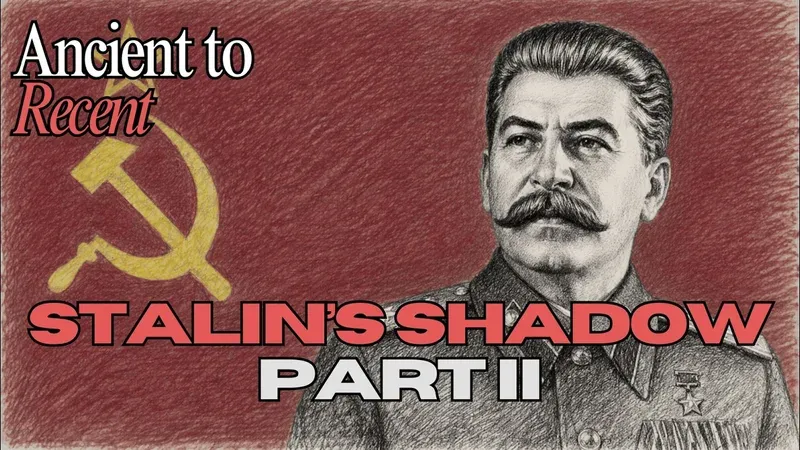
Stalin’s Shadow — Part 2
26 April 2026 · 59 min · Season 1
 Watch on YouTube →
0:0059:03
Also on
Rate the show
Ratings are how new listeners find the show. It takes a minute and it makes a real difference.
In this episode of Ancient to Recent, Joseph Parkinson continues the story of the Soviet Union after the death of Stalin, as the struggle for power begins.
As the regime stages a grand funeral to preserve the illusion of stability, figures like Georgy Malenkov, Lavrentiy Beria, and Nikita Khrushchev maneuver behind the scenes to claim control of the Soviet state.
But beneath the surface, the empire Stalin built begins to crack. From mass amnesties and sudden reforms to unrest across Eastern Europe, culminating in violent uprisings in East Germany, the system is tested in ways it has never faced before.
As fear, propaganda, and power struggles collide, one question dominates: who will control the future of the Soviet Union?
Join Joseph Parkinson as Ancient to Recent continues its series on the struggle that would reshape the Cold War world.
#Ad
This episode is brought to you in partnership with Ground News.
Go to https://ground.news/ancient to get 40% off the unlimited access Vantage plan and unlock world-wide perspectives on the stories shaping our modern world.
🎧 New episodes every Saturday
📲 Follow on YouTube, Spotify & Instagram @AncientToRecent
#Sponsored #Stalin #SovietUnion #ColdWar #Khrushchev #Beria #HistoryPodcast
Read transcript
This transcript is automatically generated, so it may contain typos and misheard names.
Show me the man and I'll show you the crime. Lavrenti Barrier. With Joseph Stalin the Great dictator now firmly pass into the next World, attention turned to what would follow. Would the Soviet state that Stalin had done so much to build simply crumble? Would the people rise up? Those who wished for a revolution against Soviet power were soon disappointed. The Soviet people have known nothing but turmoil for decades.
Even the years before the 1917 Russian Revolution had been ones of constant and painful change. War in 1914 was followed by revolution. Soon came civil war, Then the long bloody period between 1922 and the early 30s of constant peasant rebellions and man made famines that broke the resistance of the Soviet people. The Bolsheviks had shown that they did not care how high they had to pile the bodies. There was no level of slaughter they would not inflict to stay in power. With the people cowed, the Bolsheviks had then, under Stalin, turned on each other.
The 1930s had seen a series of show trials that purged the party elite, with old comrades denouncing friends, allies, and even family members to save themselves and those they loved. All too often, after the abasement was over, the only thing to do was so many who had shown themselves willing to betray even those closest to themselves to survive was to offer them up for sacrifice as well. The late 1930s had been the military's turn, with thousands of officers from Captain all the way to Field Marshall arrested, tortured, put against the wall and shot.
Next came the mass sacrifice of the Second World War, with 27,000,000 dead, though the exact figure was not known until the collapse of the USSR in 1991. The figure given at the time was 7 million, a number seen as suitably heroic without being criminally incompetent. By the time of Stalin's death, the population had experienced decades of relentless propaganda and paralysing fear. Every person in the Soviet Union knew someone who had disappeared in the night or watched as their loved ones withered away in hunger. With the regime secure, the question now became who would replace Stalin?
Welcome to ancient, to recent. My name is Joseph Parkinson and today we conclude our story of the scramble for power to succeed Joseph Stalin. Episodes of Ancient Recent are out every Saturday and are available on YouTube, Spotify and Apple Podcasts. Whoever came after Stalin would have to be seen as the legitimate heir to his legacy. The death of the dictator had to be viewed as a natural event, with a great man having simply given his all for the revolutionary 'cause now passing the torch to the next generation. But this would require Stalin to have died of natural causes in the days after Stalin's death.
Propped to the main source of Soviet state propaganda carried details of Stalin's autopsy listing Stalin's ailments, plus the report, which was signed by many of the nation's top positions. All clearly stated that Stalin, unlike so many of his enemies and friends, had suffered a natural death brought about by a stroke. Exactly the outcome the regime wanted. But one doctor, Alexander Misnikov, confided to his diary, which would be seized on his death in 1965, troubling details about Stalin that, if known by the public, would lead to uncomfortable questions. Miss Niqab had attended Stalin as he lay dying, and he had concluded that Stalin had suffered from a chronic hardening of the cerebral artery. This is significant because such a condition affects the cognitive ability of the victim, clouding their judgement and rendering them incapable of telling right from wrong, good from bad, and friend from foe.
It also worsens an individual's most negative personality traits. An angry person becomes vicious. A suspicious person becomes paranoid. Had Stalin's murderous paranoia been a result of worsening medical condition? If so, how could such a man have been allowed to stay in office when they were clearly unfit? What did such questions say about the legitimacy of the system itself and those that had enabled Stalin? Tempting as it might be to put Stalin's cruelties down to a medical condition, it must be remembered that the hardening of his cerebral arteries was something that affected him later in life. It cannot explain his long capacity with paranoid violence he had displayed so freely from 1917 onwards. With the autopsy predictably showing the results Stalin's hench men craved, it was now time to bury the Red Tsar and claim his legacy.
What was required was a suitably grand funeral, a great display of pomp and majesty to show the might of the Red Empire, the system's enduring strength and it's capacity to outlive any leader. Pravda. It's pages rimmed in black, carried pictures of the great leader lying in state with his grim faced henchman standing guard over their fallen comrade. Even now the subtle hints could be picked up as behind the scenes candidates began manoeuvring to take the Red Throne.
I say subtle, but for some subtlety seems to be a talent they did not possess. Gyorgy Malenkov, who was at the time viewed as Stalin's chosen successor, was being pushed heavily in the papers. While the others appeared as a group, Malenkov would be shown alone. Articles about Malenkov's great achievements were given pride of place. Malenkov was displayed alongside Stalin with other luminaries of the communist world such as Mao, or in pictures that had been obviously doctored to remove other Politburo members. The editing of history and removal of friends turned foe was an old trick of Stalin's, but Stalin possessed a level of cunning Malenkov sadly lacked.
Stalin always waited till the victim was weakened before going in for the kill. Malenkov was openly maneuvering against rivals who are at the height of their strengths. Under Stalin, many of the most powerful positions have been vested in his iron grip. At the time of his death, Stalin was simultaneously chair of the Council of Ministers, effectively premier Secretary of the Central Committee of the Communist Party, leader of the Communist Party, the only political party allowed, head of the Presidium, the supreme decision making body of the Soviet Union, and Supreme Commander of the Red Army. Now these positions were divided between the ruling elite, with Malenkov being appointed Chairman of the Council of Ministers, the plum position.
But Malenkov was not the only one launching a power grab. Berry had been the head of the NKVD, but this all powerful security apparatus had been broken up in 1946 into the MVD, Internal Security, MGB Foreign Intelligence and Espionage, and SMUSH military counterintelligence. Berry now retook his position as head of the intelligence services and reabsorbed these branches back into one single entity. This gave Barrier unprecedented command over an intelligence apparatus that could call upon maybe as many as 750,000 agents, police officers, officials and soldiers. For Khrushchev, Malenkov, Molotov and others who already feared and hated Berrier, this was a clear indicator of Berrier's intentions.
There were further appointments. Vlasya Slav Molotov, Stalin's long serving foreign minister who had helped negotiate the Molotov Ribbentrov pact to carve up Poland and start the Second World War, was returned to the Foreign Ministry. Molotov had been a long term ally of Stalin, but had been stripped of his power and was undergoing regular public criticism and humiliation in the Soviet press. That was a normal prelude to arrest and execution.
Stalin's death saved Molotov and his wife Paulina, who Stalin hated partly because of her closeness to Stalin's former wife, Nadiazza Alleluia, who had committed suicide in 1932, but also because Paulina was a Jew. But there was one person who seemed to lose out in the power ground. Nikita Khrushchev, the Communist Party boss for Ukraine, was relieved of his position as head of the party in Moscow. He was given a new position, something of a poisoned chalice.
He would be appointed to organize Stalin's funeral. Khrushchev had been a trusted Lieutenant of Stalin, carrying out his boss's wishes without scruples, enforcing collectivization in Ukraine even as it condemned many Ukrainians to death, and signing off on lists for deportation and execution. But Khrushchev had one thing the other presidium members lacked the common touch. He was not cold like Molotov, nervous like Malenkov, or overtly sinister like Berrier. He was down to earth and jovial.
He had frank conversations with his subordinates, demanded honesty from them, not comforting myths. He insisted on straight talking, not party jargon, whilst others cloistered themselves in the secluded world of luxury Bolshevism, shuffling from their Duchess to the Kremlin in their government limousines. Khrushchev had told the country after the war he had witnessed the devastation. He had met ordinary people, not just ranks of pre vetted workers arranged by the NKBD. Instead of talking, he had listened to them. They had told him a tale of hardship shortages, of pointless meddling by incompetent commissars and party officials more interested in pleasing their bosses and earning promotion than improving the lives of ordinary people. It was Khrushchev who would take charge of playing Stalin to rest.
Stalin's body would lie in the Hall of Columns in the House of the Union, one of the most impressive stately buildings in Moscow, in the same room that decades before Lenin, the founder of the Soviet state, had lain. The room was decorated with red flags and in front of the building was a 40 foot poster of Stalin, just in case anyone forgot who the star of the show was. The body would lie in state for three days to allow for respectful visits from both foreign dignitaries and terrified Soviet subjects. On March the 9th the funeral would take place and Stalin would then be laid to rest alongside Lenin. The Soviet people were to participate in the morning whether they liked it or not.
Across the Red Empire, all theatres were closed, alongside cinemas and the cancellation of sporting events. Participation in grieving for Stalin, much like everything else in the Soviet Union, was mandatory. Life itself was to grind to a halt till Stalin was in the ground. When the viewing for Stalin's body was open, crowds gathered in their 10s of thousands. The line stretched, some estimates say 10 miles. But such a huge crowd was hard to control, and with every shift in momentum, people were carried along.
A massive police and army presence had been deployed to Moscow to maintain order, but they were told to contain the crowd, not to provide for its safety. As the crowd grew, people were swept along. The soldiers hemmed them in, not letting them escape. As the pressure grew and grew and grew, people were pressed against walls, lampposts, trucks. Children and the elderly were sucked under the mass tide of humanity. But the soldiers would not let them escape. They had no orders to.
The cries of those who fell were muffled by the mass heaving of the body of mourners. At night, after the crowd dispersed, the trucks moved in to remove the corpses and wash away the even in death, Stalin dragged more people down with him. Now, how Stalin was seen inside the Soviet Union was one thing, but how he was portrayed depended entirely on who was telling the story. And I find that endlessly fascinating, because history isn't just about what happened, it's about how it's interpreted.
We like to think that we see events clearly, but most of the time we just see one version of the story. And it makes me wonder how much of what we see today works in exactly the same way. That's why I've been using Ground News. It's not a news publisher, it's a tool that lets you compare how different outlets are covering the same story. For example, one outlet might frame the death of Stalin as brutal tyrant dead. Millions rejoice, whilst another, say great statesman, passes away. People mourn.
Same events, completely different framing. Ground News also shows you bias ratings for each publication, so you can see where that perspective is coming from. It's a simple way to step outside your bubble and get a clearer picture of what's really going on. To give it a go, you can get 40% off the Vantage plan at grandnews.com/ancient or through the link in my bio. For the international press, Stalin's passing elicited mixed reactions, with most publications failing the test of remembering A tyrant honestly. Some remembered the Stalin of World War 2, portrayed as good old Uncle Joe, the kindly leader of the brave Red Army bearing the burden of the fight against Nazi tyranny. Stalin was lauded as the master military tactician, the brains behind the Soviet fight back against Hitler and one of the great statesman of the age.
This could not be further from the truth. It was Stalin that had instructed the German Communist Party to resist an alliance with the German Social Democrats against the Nazis in 1932 that had cleared the way for Hitler to come to power in the 1st place. Stalin had been an eager ally with Hitler before 1941 had conspired with the Fuhrer to divide Poland in return for annexing the Baltic States and being free to attack Finland.
Stalin had purged the Red Army, massacring its officer corps and replacing a professional military class with party hacks good for nothing but mouthing slogans and denouncing doubters. Stalin had dismissed mountains of evidence provided by everyone from the Czech resistance, British intelligence all the way to Soviet spies within the German High Command that Hitler was planning to attack the Soviet Union. Even his own Air Force had shown Stalin photos of the massive 3.8 million German and Allied soldiers that had amassed on the Soviet border in 1941. Stalin had been so unwilling to accept the idea that Hitler would betray him that Soviet anti aircraft crews were ordered not to fire at German bombers even whilst they were attacking the Soviet Union.
When Stalin finally accepted that Hitler had betrayed him, Stalin suffered a near breakdown and his military instructions to launch prepared counter attacks a whole positions of no value even whilst Red Army units were being outflanked, had cost the Red Army millions of men. It was only when Stalin started listening to his generals instead of shooting them and allowing professional military men like Zhukov and Tymoshenko to direct military matters that the tide began to turn.
If the international press was willing, for the most part, to paint an overly rosy picture of Stalin's contribution to the war, it was actively silent when it came to Stalin's crimes against his own people. There were few mentions of the Holodomor, the man made famines that killed maybe as many as 5 million people in Ukraine, nor the gulag system of slave labour or the show trials of the 1930s. What was most shocking is that all of this was public knowledge.
The crimes of Stalin had been documented in memoirs and reported in Western newspapers. If the mainstream press was bad, the Communist papers in the West some to new levels of abasement and self humiliation. The Daily Worker, the mouthpiece of the British Communist Party, carried an obituary of Stalin so laden with syrup that those were the misfortune to read. It was sure to show signs of diabetes. Stalin was lauded as the greatest man of the age, maybe the greatest man whoever lived, the friend of the workers, the man of peace, the hero of the working class, the hope of a hopeless world. Harry Pollit, the General Secretary of the British Communist Party, a man who had never met a Soviet atrocity he could not justify and who had supported every outrage from the Soviet invasion of Poland in 1919 to the Hitler Stalin Pact of 1939, wrote in the pages of the Daily Worker that with tear blinded eyes and a grief we have not the language at our command to describe.
Pollett wrote that Stalin had written golden pages in world history. The front cover of the Daily Worker carried the headline Stalin Died last night, accompanied by a large portrait of Stalin and a sub headline that read The loss to mankind is immeasurable. In Eastern Europe, communist rulers poked and prodded their reluctant people into public displays of grief. The entire population of Tirana, capital of Albania, was forced to gather in the public square, kneel and make an oath of allegiance to the now deceased Stalin.
Crowds gathered outside Soviet embassies in the Eastern Bloc to sign the book of condolences. But behind closed doors, many could not hide their Glee as bottles of vodka and champagne, secluded for years in preparation for this very moment, were open to toasts and shared moments of rejoicing to Communist Party bosses. Such displays of delight were to be prevented and the perpetrators punished. Across occupying Eastern Europe, curfews were enforced and police stopped people they suspected of celebrating.
In Poland and Romania, communist officials became so concerned by the widespread celebration, the sales of alcohol was actually suspended to dampen the mood of illicit celebration. Jokes began to circulate mocking the dictator, with one noting that Stalin had finally responded to the cry of the people and died. Most foreign governments made official displays of mourning. France and Britain sent allegations to express their sorrow and extend their condolences to the Soviet people.
Mohammed Musaddek, Prime Minister of Iran, ordered flags on public buildings to be flown at half mast. Juan Peron, president of Argentina, sent condolences to the Soviet government. The parliament of newly independent India stood in silence for two minutes and the Vatican issued a plea for Catholics the world over to pray for Stalin's soul. Stalin's funeral was held on the 9th of March. A crowd of 50,000 gathered in Moscow, complete with red flags, slogan bearing banners and pictures of Stalin. The funeral began at 10 AM with the coffin carried by Politburo members and also show in lie the premier of the newly established People's Republic of China, who'd been sent in Mao's place. Mao's wife happened to be in Moscow at the time, and Mao didn't want to be forced to see her, so he sent Joe instead. The coffin was carried in a procession that solemnly marched with flags and flowers to Stalins final resting place beside Lenin in the mausoleum.
Malenkov delivered the main eulogy, stressing the need to live in peace with other countries, perhaps a hint of a shift in policy after Stalin's body was finally laid to rest. The red flag flown at half mast since the official announcement of Stalin's death was at last raised again. For the true believers in the communist faith in the West, their heartbreak at the death of Stalin was real. For many in Eastern Europe, then crushed under the Soviet Jack boots, they could not hide their joy.
But there was a third group. Many in the USSR who were not committed to the red faith still felt a profound sense of loss and deep anxiety for the future. For three decades, the Soviet people have been told that Stalin was their guide and protector. They're from his office in the Kremlin. He told away relentlessly to safeguard them from harm and to build the socialist fatherland for which they would be the beneficiaries.
And yet still their lives were terrible. Their existence was one of constant fear, repression, hunger and war. This was all they had ever known. And now they had to face their faith without their supposed protector. Many in the Soviet Union believed that Stalin must not have known about. At the NKBD death squads, the gulags and the mass terrors for this third group, the tears were real. The 1st place where change was seen was in the pages of Prafda Malenkov, who had secured the three most important positions, the Premiership Secretariat of the party and head of the Presidium.
But after his clumsy attempt at asserting himself, he was soon forced to relinquish some of his power, giving up his position as Secretary of the Central Committee. The glowing press coverage stopped, and in his place Khrushchev became the main focus of praise. A telltale sign of who is up and who was down in the Kremlin pecking order was how the Kremlin elite were listed, with the most powerful always coming first, regardless of alphabetic order. Suddenly, the Soviet alphabet began with AK. It was not only Malenkov who was disappearing from the pages of Pravda.
Soon enough, Stalin himself would begin to recede from the headlines. For some newspaper editors, this proved to be a hard habit to kill. Weeks after Stalin's death, articles still appeared praising Stalin in glowing terms. One editor, Constantine Simeonov, published the usual prose about the glories of Comrade Stalin, only to receive a stern rebuke from Khrushchev with Stalin's funeral. After the way reforms began immediately. Many thousands have been swept up in a wave of arrests for making remarks or passing on jokes after the death of Stalin, with sentences stretching to 10 years, not uncommon. These people were for the most part released. The most vocal proponent of liberalisation was, of all people, Berrier himself.
Berrier, Stalin's most vicious executioner, now sought to win popular approval by presenting himself as the reform candidate. Berrier ordered a review of post war trials. Pointedly, only cases after 1946, when he was no longer head of the secret police, were to be investigated. Infrastructure projects where hundreds of thousands of Gulag inmates toiled, but which had little economic value, were suddenly stopped. BARRIER addressed the Central Presidium, the key decision making body of the Soviet Union.
There were, in 1950, three 2,526,401 people currently incarcerated in the Gulag system. The Gulag had served a dual role. It was partly a system of mass terror to pass by the Soviet population and partly a source of slave labour, vital for the Soviet economy, with many of the Soviet Union's greatest infrastructure projects, from dams and bridges to canals and ports, built entirely by slave labour. But the system was deeply inefficient.
It had outlived its economic use. So what to do with so many people? Barrier. The born again liberal reformer proposed a simple solution of mass amnesty. On March the 27th a sweeping review of the Soviet Penal Code was announced alongside with the release of 1,000,000 of the 2.5 million gulag inmates, all pregnant women, children under 18, those serving sentences of five years or less, women over 50, men over 55, those terminally ill and those held for so-called economic crimes were to be released immediately.
The sentences of those serving terms of more than five years were to be halved. This would apply to all apart from those being held for counter revolutionary offences. This may seem like a good idea, but such a sudden shift in the system that from it's very inception was conceived of by Lenin and carried to it's logical conclusion by Stalin as a totalitarian system of slavery had unintended consequences. The reforms released a million people, but many of them were hardened criminals. Brutality was the way of the gulag and those that survived, even the innocent, were hardened by the experience as hundreds of thousands of people came home.
Some who had been in prison for many years, returning to spouses who had remarried, children who did not remember them and neighbors who had sold them to the NKBD, either to protect themselves or for more petty reasons to get rid of a romantic rival or clear the path for a promotion. For many, this proved to be a difficult transition. A wave of violent crime washed over cities like Leningrad and Moscow. There was a spike in theft, rape, domestic violence and even murder.
Some of the released inmates were back in the same camps within weeks. Police were flooded with complaints and Pravda was inundated with letters from concerned citizens. One person released from detention was Polina Molotov. She had been arrested in 1949 and had been in Moscow undergoing interrogation for her part in the so-called doctor's plot. Suddenly the interrogation stopped. She was given better food and treated better.
And then she was told Stalin had died. She was so overcome by the news she fainted. On March the 10th she was reunited with her husband. The reforms kept coming. On April the 1st, a major reduction in the price of food and retail goods was announced. Announcements were made about improvements in housing, agriculture and religious freedom. But for some of the inner circle, so many reforms and so quickly raised alarms. So much change and so rapidly could create an unstoppable momentum that could set up a chain reaction of events with the opening Pandora's box should they not wait, gather their strength and then announce reforms. Slowly, but urged on by barrier, they pressed ahead. Next up was the doctor's plot.
The Kremlin quickly released the accused doctors. In the pages of Prapter, a series of stunning articles appeared that denounced the supposed conspiracy that only weeks earlier Prapter itself had been promoting, with hysterical headlines calling for the immediate execution of the imprisoned doctors. Now Crafter was announcing that the Dox's plot itself was a wicked plot to stir up hatred of the Jews, which, in fairness, is exactly what it was.
In the communist press, in the West, confusion reigned For these true believers, every word from Moscow, every act of intellectual gymnastics, was treated as a solemn commandment. The true believers fell in line. Communist papers from New York to New Zealand dutifully followed Moscow's whim, turning on the same conspiracies they have promoted only days before. There was only one thing missing from all of this. There was never an apology. There was no admission of guilt or soul searching or recognition of damage done.
The doctor's plot had not just sent dozens of Jewish physicians to the torture chambers of the Lubyanka, it had promoted hatred of the Jews worldwide and whipped crowds into frenzies of anti-Semitic rage. People had been fired from their jobs, beaten up at school, insulted and threatened, all for nothing more than being Jewish. What's most perverse about this is that this happened only a few years after the Holocaust, and many of the victims were themselves Holocaust survivors of the country slash territories that became part of the Soviet sphere of influence, Poland, Hungary, Romania, Bulgaria, Albania, East Germany and Czechoslovakia.
Their Jewish communities had been almost entirely exterminated only a few years before. There were 5.4 million Jews living in these countries in 1939. By 1945 only one million were left. For many Jewish people in the Soviet Union and it's communist satellite states, the doctor's plot displayed just how fragile their existence really was and that anti-Semitism had not been confined to the past. Those that could pack their bags for Israel.
In Washington, policy makers struggle to make sense of the rapidly changing events. Some believed that without Stalin in charge, the USSR would surely collapse, but others were not so sure. the US as approach to the communist threat have been outlined in the Truman Doctrine by then President Harry Truman. the United States would contain communist aggression and give assistance to those who wish to halt Soviet advances, as the US had done in Korea. But with the Republicans back in office for the first time in two decades, the US was undergoing a policy shift. The new president, Dwight D Eisenhower, wanted to signify that the Republicans were the party that could be trusted to confront communism and that containment was not enough. The objective had to be rolling back Soviet power and liberating the enslaved peoples groaning under the communist boot. The CIA had already set about seeking to aid anti communist groups behind the Iron Curtain with parachute drops of weapons, radio kits and advisors linking up with local resistance groups in Ukraine, the Baltic States and Poland. Some argued that this was a time to push ahead with greater support, but it was feared that such an effort would be irresponsible.
The anti communist forces were too weak and causing too much trouble would simply lead to bloodshed as the Red Army rolled in. For the most part the Eisenhower administration took a wait and see approach to Soviet reforms, both wary of being hoodwinked whilst not wanting to close up a path to genuine dialogue and relaxation of tensions. Signs that the Kremlin was willing to engage began to trickle through. Under Stalin, a number of US and British aeroplanes have been shot down for straying into the airspace of Eastern European countries.
The Soviets had rigidly enforced checkpoints and blocked canals for trade in Germany. Now there was greater dialogue and more cooperation. Negotiations over an end to the Korean War had dragged on for some time, but now a breakthrough was reached. The communist powers North Korea and China, both militarily engaged with Soviet backing, had insisted on the return of all prisoners, regardless of whether they wanted to be repatriated or not.
The US and UN had insisted that prisoners be free to choose. The Chinese and N Koreans, with Soviet approval, dropped their demand and cleared the way for negotiations. With the deal signed on July the 27th, 1953 that holds to this day. Things became easier for Western journalists in the USSR too. More Western journalists were granted visas, allowed to travel more freely and file their dispatches from their hotel rooms, rather than cram into the tiny room with just three telephones as before.
Under Stalin, the restrictions on Soviet women marrying foreigners, in place since 1947 was lifted in November 1953 and those already married to Western journalists and embassy staff were now allowed to apply for exit visas to leave the country with their husbands. Soviet authorities sought to lessen tensions with a number of neighbors. Relations broken with Israel were restored tensions with Turkey, which had risen after Stalin demanded control of both the Dardanelles and handing over of several provinces in North East Turkey. These threats had pushed Turkey to abandoning its policy of neutrality.
It had followed in the Second World War and joined NATO in 1952. Now the Soviet Union dropped its claims and sought to mend fences with Ankara. Soviet officials even sent feelers out to Tito's Yugoslavia. The two states had broken relations in 1948, but within months of Stalin's death relations were re established, with a Yugoslav ambassador taking up residence in Moscow in July and the Soviet embassy in Belgrade opening in September 1953.
Nevertheless, Washington was wary. There was a sense that during the Big Three conferences at the end of and after World War 2, Yalta, Tehran and Potsdam, the Soviets had gotten the better of their American counterparts. This was an accusation the Republicans had hung around the Democrats neck, accusing them of being patsies easily taken in by sweet words from Moscow. The reforms coming out of the Kremlin were not based on a new found commitment to human decency, rather realpolitique. Stalin's belligerence had alienated many countries. Eight years after the war, the USSR still did not have formal relations with either Germany or Japan, was committed economically if not militarily to a bloody stalemate in Korea, and had needlessly alienated Yugoslavia, Turkey and Israel, 1A formerly neutral state, and the other two former allies. But worse than affairs in the far abroad were the unfolding events in the Soviet's own backyard. Eastern Europe had been conquered by the Red Army at the end of World War 2, with the Soviets in command. Stalin was in no mood to allow this empire to slip from his grasp.
The Soviets had, even before the end of the war, actively collaborated with the Nazis to crush any movement that could resist Kremlin domination. In 1944, with the Red Army approaching Warsaw, the Polish Home Army rose against German occupation, hoping the Soviets, then at the gates of the city, would come to their assistance. The last thing Stalin wanted was independent minded governments in the capitals of his sphere of influence. Stalin ordered the tanks of the Red Army to stop within only miles of Warsaw to allow the Germans to fight a bloody battle with the Poles.
Stalin even refused the pleading requests from Churchland Roosevelt to allow for airdrops to be delivered to the beleaguered Polish fighters. The Germans ruthlessly crushed the rise in killing as many as 200,000 people and expelling the surviving population of Warsaw, some 700,000 people, into the snow. After the Soviets assumed control of the ashes, they began hunting down the surviving members of the Polish Home Army, executing them or deporting them to Siberia. The pattern was repeated across Eastern Europe with the Soviets in command.
They ordered the formation of coalition governments where the Communist parties were given the most important positions. Complete control of the army and police purges were launched. Opposition parties were formally absorbed into the Communist Party. Non communist government ministers were arrested, disappeared or simply murdered in broad daylight. Communist rule was imposed at the point of a bayonet, along with mass collectivization, abolition of free trade unions, closing down of opposition newspapers, and the imposition of a planned economy with an emphasis on heavy industry. Despite complete control and the atmosphere of fear that now pervaded Eastern Europe, the communist authorities were still aware of the constant grumbling and deep resentment of the population, even if their Marxist ideology would not allow them to understand what the root cause of the resentment was. Resentment soon turned to action. The first series unrest was in May 1953 in both Czechoslovakia and Bulgaria.
In Bulgaria, tobacco workers were laid off by the communist bosses, with the communist trade unions announcing the layoffs instead of standing up for their members. At the same time, Bulgarian party bosses began demanding greater output from workers without an increase in wages. This led to strikes and work stoppages that were only ended when Communist Party bosses visited the workers and agreed to rescind the demands for additional work.
In Czechoslovakia, events were even more dramatic. Rumours had swirled of a planned monetary reform that would reduce the value of the Czech currency. This would directly hit the savings of many people. Communist bosses went to great lengths to dismiss these rumours. And then went ahead with implementing the devaluation anyway. Overnight, people's life savings evaporated. A wave of anger swept the country and in Pilsen, West of Prague, workers at the Skoda plant went on strike.
They marched in the City Hall to demand they will listen to and were joined by others soon. Quickly these calls for address of economic grievances became demands for political change. Posters in banners bearing communist slogans were torn down. Statues and busts of Stalin and Lenin smashed members of the Communist Party. In the STB, the Communist secret police who had ordered so many purges, deportations and executions were beaten up.
Communist authorities reacted by declaring martial law and arresting 2000 people. In Germany. Things were bleaker still for the Kremlin. Germany had been divided into 4 zones after the war, British, French, US and Soviet and the pattern was repeated inside Berlin. Soon enough the three western areas began coming together separately from the East. Stalin had actually not been too keen on the idea of keeping East Germany. He reasoned that a Germany's division was permanent. Then West Germany would soon enough become an economic and military powerhouse and a valued member of the anti Soviet NATO alliance.
Stalin sought to unify Germany on the condition Germany would be disarmed and neutral, a plan he put to the West in 1952. But the West had dismissed the Stalin note, as it came to be known, after fear both that a unified but weakened Germany would soon fall under Soviet power and a refusal by Stalin to allow free elections supervised by the United Nations. As Germany began its recovery from the war, soon enough disparities between living conditions in the West and E became apparent. West Germany had free elections, free trade unions, Free Press and rising standards of living.
East Germany had the Communist Party, bread lines and the Stasi. Hundreds of thousands of people, including many of East Germany's most talented professionals, soon began relocating to the West, though the Communist Party in East Germany was led by the door Walter Ubricht, A fanatical Stalinist who had a long history of denouncing his comrades to the NKVD, including during the Spanish Civil War, where he had been charged with liquidating members of the International Brigade who were not sufficiently loyal to the Dear Leader, Comrade Stalin. Ubricht pushed through ever greater work quotas in an effort to build socialism at breakneck speed. Ubricht wasn't concerned by the anger of the people he ruled over, and his suggested solution to the Kremlin for the growing flood of people out of the country was to close the borders.
The Kremlin rejected his suggestion and tried to press Ubreak to lessen his demands on the people. The Kremlin wanted to push their acolytes in Eastern Europe in a more moderate direction, summoning the leaders of East Germany, Hungary and Albania to a meeting in Moscow. The new line was laid out. No more forced industrialization, collectivization or mass terror. The communist governments are to try and win the support of the people, not simply terrify them into compliance of the Soviet leaders. Barrier was the most vocal in his criticism. He mocked and ridiculed the Eastern European party bosses. He pointed out that in Hungary, a country of 9.5 million, a full 1.5 million had come in for some level of steep persecution. Was this not a little excessive?
But in East Germany, Walter Ubricht did not get the memo. An article appeared in the communist press praising a group of workers who had supposedly, quote UN quote, volunteered to increase their work quota without additional pay. Such an article, innocuous though unlikely in a free society, had quite a different meaning in a communist dictatorship in East Germany. This was a not so subtle hint that increased work quotas was soon to be mandatory for many in East Germany. The mixed messages were leading to frustration, and frustration was turning to anger.
After the devastation of the war, East Germany was in ruins, with many cities such as Berlin and Dresden having been flattened by bombing. By 1950 East Germany's population of 18,000,000 was lacking around 6,000,000 homes to adequately house it's population. In the early 1950s, under order from Stalin, desperately needed investment was diverted from housing and food production to heavy industry to fulfil the Soviet mandated 5 year plan.
This led to food shortages and for the worsen, the housing crisis. But despite the shortages and widespread deprivation, the Communist Party still found time to divert desperately needed resources away from the urgent needs of the population to vanity projects. In 1952, construction began on the Stalin Alley, a new luxury district of East Berlin lined with upscale shops and housing exclusively for the communist elite.
Needless to say, those not holding a Communist Party membership card would not be allowed to dine in its exclusive restaurants or browse the shelves groaning with expensive goods. It was those workers who were urged to toil forever longer hours on these projects that led the first protests. On June the 15th, 1953, workers approached the Communist Party bosses to discuss their concerns. Lubricht, not wanting to set a precedent where the workers would feel that their concerns would be taken seriously, dismiss the workers without engaging with them lest they get ideas above their station.
The next day, hundreds marched down the Stalin LA. Soon the marchers were engaged in running battles with the police as a demonstration became a riot. Ubrick, shocked, agreed to rescind the new increased work quotas and issued a statement that the Communist Party had listened to the workers concerns, which of course is the opposite of the truth. But the anger of the workers was too deep. They demanded real change. They demanded the one thing the East German Communist Party feared the most, free elections. As the communist officials prevaricated, anger burned amongst the workers.
The call went up for a general strike on June the 17th. 10s of thousands crowded into the streets of East Berlin. Banners demanding elections in the release of political prisoners were displayed. The demonstrations turned angry as symbols of the communist state were torn down, offices raided, busts of Lenin and Stalin hurled from windows, Red flags ripped down and hurled into the of the flames as the crowd cheered. The flag of the old German Republic, black, red and gold was unfurled to the delight of the crowd. 25,000 converged on the seas of government as Soviet soldiers in East German police battled to hold them back.
Martial law was declared. East Berlin was sealed off from the West as fighting breeze in the streets. The pictures of crowds of workers burning red flags and demanding an enter communist rule were carried by newspapers around the world. For the communist press in the West, such scenes made no sense. Unable to grapple with the discontent of the working class in East Germany, the Daily Worker in the US and its sister publication in the UK echoed the line out of Moscow, dismissing the grievances of the German working class and blaming CIA spies and former Nazi elements as instigating a coup. In their warped world view, the real heroes were the Stasi officers firing live ammunition into the unarmed crowds, not the workers demanding to be listened to. Six people were summarily executed by security forces, 120 shot dead in the streets, and hundreds more injured. In the end, the ruthlessness of the institutions of terror overcame the unarmed workers.
Soviet bullets swept the streets clean. With the protests broken, the crackdown began. Nationwide, police and starting teams launch raids, smashing doors down, dragging people from their beds, hauling them into police stations for interrogations and off to prison. The Communist Party would settle it's score with those workers who had dared challenge it's right to rule. In the end, some 500,000 people are believed to have joined the protests and 3000 arrested.
With the protest crushed, the difficult question began for the Communist Party. The idea that the working class should rise up against them was simply unthinkable. The people who ran the East German state in the 1950s were people who had given their lives to the one true faith of Marxist Leninism. These were people like Eric Milker, who would assume command of the Stasi from 1953 onwards. He'd been a member of the Communist Party since 1925 and experienced the turmoil of the Weimar Republic, the long night of Nazi rule, and now he was eager to build socialism.
These were not careerists taking the easy path. These were people who had suffered exile, imprisonment, and war, all for their deeply, sincerely held ideals. This is something I cannot emphasize enough. The people who ran the Communist parties of Eastern Europe really, really believed in their ideology. Fanatically, absolutely committed. They genuinely thought they were building a better and different world. They believed their ideas were not ideas. Their beliefs were not beliefs.
They believed that Marxism was scientifically true. It was a scientific fact, act like the idea that the earth rotates around the sun. That is the level of belief that these people had. So for them, when the workers, the industrial working class, the very proletariat of Marxist mythology rose up against them, they could not make any sense of this. So how did they try and explain these events to themselves? The Communist Party commissioned A thorough investigation to understand the root cause of this uprising. The Commission came back and talked about incompetence, economic mismanagement, corruption, misrule and a lack of the most basic fundamental essentials in life. It talks about how bad the system of government that they had created actually was a delivering for the people. But these findings that were psychologically too challenging for the Communist Party to accept. So instead they fell back on comforting myths. It's a fascist coup, it's the CIA, it's all made-up. There's no deprivation.
This is not true. It's all foreign agitators. Anything, anything at all. Rather than deal with the difficult truth in the Kremlin, the leaders faced with anger at Ubrecht. But they did nothing. Privately they rebuked him, but they could not remove him as it was called for reform from the Kremlin. That had raised expectations and contributed to the riots. The ultimate victim of the uprising in East Germany would not be the hapless Walter Ubricht, but rather Barrier himself. Barrier had been reappointed head of the Soviet secret police after the death of Stalin.
It was his task to maintain order and snuff out any challenge to Soviet rule. And yet mass protests had rocked Soviet satellites in Bulgaria, Czechoslovakia, and almost toppled the communist government in East Germany. And all apparently at the hands of a vast, secretive, shadowy, highly organized fascist underground in the pay of foreign powers. Wasn't it Barry's job to prevent exactly such an occurrence? Surely this represents possibly the biggest failure of Soviet intelligence ever.
Unless it was not a failure in the paranoid world of the Kremlin, maybe Barrier was in on it all along. Khrushchev was eager to move against Barrier. Barrier was both the most capable of the Soviet leaders and by far the most ruthless. Khrushchev knew that with Barrier back in charge of his beloved security services, it would only be a matter of time before he assumed complete control. And then, with the leadership in his pocket, all of those who could challenge him would be eliminated. Barrier had to go.
Barrier had not just been reappointed as the head of the security services, he'd amassed more power than he ever had on the stall. Barrier was now in charge of security for the Kremlin. The border guards supervised the party security and government communication networks. Barrier had ascended to new heights and had made his intentions clear. Khrushchev had to move quickly, but also quietly. In June, Khrushchev gained a majority on the Presidium to remove Barrier, but that was not enough. Barrier controlled so much of the security services. He could have Khrushchev arrested or staged A coup if he felt threatened.
Khrushchev would need powerful allies to take on Barrier, and he would need the support of the one institution that could challenge the might of the security forces. He would need the support of the Red Army. But Khrushchev was in luck. If there was 1 institution that hated Barrier more than he did, it was the Soviet military. Barrier had overseen the purges of the Red Army in the 1930s, with many Soviet commanders finding themselves confined to the Gulags or tortured in NKBD prisons, Some by Barrier himself, and many of their comrades had been dragged off and shot on Barry's orders. There was no lack of Red Army officers with long memories who were eager for revenge.
Khrushchev approached the nation's most famous war hero, Marshall Giorgi Zhukov, the man who had taken Berlin. Zhukov heard the plan out and without hesitation agreed to join. On the morning of June 26th, the plan was put into action. The plan called for a group of lightly armed officers to slip into the Kremlin, which was guarded by personnel loyal to Barrier. At a meeting of the Presidium, a motion would be tabled calling for Barriers removal. With the officers waiting in an adjoining room. Malenkov would press a button under the table that would set a light off in the office to tell the men to enter the room and arrest Barrier.
When the members of the Presidium gathered, Balonco shocked Barrier by opening the meeting with a motion to discuss the actions of Comrade Barrier. Barrier, the master conspirator, found himself beset on all sides by accusations. Barrier had sought to place the security forces above the Communist Party. Barrier was accused of violating the principles of collective leadership by trying to turn 1 leader against the other. Barrier was accused of rudeness.
One of the questions that comes to mind is why are the accusations against Barriers so ridiculous? Why not accuse Barrier of torture, famine, deportation, rape, genocide or ethnic cleansing? Why accuse him of rudeness? The simple answer is if Khrushchev, Malenkov, Molotov and Bulgarian were going to arrest someone for murder, then they would have to be arrested as well. They had to accuse him of a crime they were not guilty of. As the meeting went on, tempers fled. More accusations 1 by 1 various comrades unleashed years of hatred against him.
With Khrushchev leading the charge, Malenkov pressed the button and in stormed Zhukov, his men simultaneously entering from all three doors into the room to prevent escape. Barrier was under arrest, but the job was not done yet. Barrier still commanded the loyalty of hundreds of thousands of men, including those guarding the Kremlin itself. Zhukov's men searched Barrier and found a note with the word ALARM scribbled on it that Barrier had hoped to slip to the guards. Barry was led away to a secluded room, his belt and trouser buttons removed so he'd have to hold his pants up, thus hindering an escape.
The conspirators had to wait till the guards were changed in order to bring in reinforcements. At that exact moment, 30 soldiers, all heavily armed, arrived in a limousine to take Barrier away. Barrier was transported to a secret underground facility, a bunker so secret that even Barrier himself did not know of its existence. The guards were given strict instructions if Barrier tried to escape. If anyone tried to rescue Barrier, they were to shoot him immediately. At a meeting of the Central Committee, Khrushchev explained the move against Barrier.
The charges were read out. Foreign spy, careerist, part of an anti Soviet body under Khrushchev's direction. Now clearly the rising power on the land. The meeting continued with the Central Committee members urged to come forward with denunciations against Barrier. One by one, they aired decades of grievances against the man who had sent so many of their friends and family members to the grave. But again, they could denounce him. But they could never denounce him for what he was guilty of, because they were guilty of the same crimes. When the Central Committee came to vote, the result was unanimous.
Barrier was to be put on trial. In the months that followed Barrier's arrest, he rotted away in prison, soaking in despair and self pity. He spent his time writing grovelling letters to his former comrades, begging for forgiveness, pleading for the mercy he never showed his victims. In response to the flow of correspondence, Khrushchev had his paper and pencil taken away. The trial of Barrier began on the 18th of December 1953.
Unlike the show trial of the 1930s it was a closed event presided over by a military judge. The trial lasted for six days. On the 23rd of December the verdict was read out. Guilty of high treason, terrorism and anti state actions. The sentence death barrier was taken from the court, LED into a dark room. His hands were tied in an iron ring as he faced his execution. As his knees grew weak, he turned pale, his cheek twitched. He fell to his knees, trembling, begging for forgiveness, pleading for mercy.
General Pavel Butitsky stepped forward, raised his pistol to the back of Berry's head and shot him. A further 6 Red Army officers riddled Barrier's body with bullets just for good measure. With Burier dead, the path was clear for the rise of Nikita Khrushchev. Khrushchev would preside over the liberalisation of the Soviet system. There were further moves to shift focus on to agriculture and consumer goods, lessening political repression and more amnesties for prisoners.
The main party jobs, long centralised in the hands of Stalin, were handed out over. Powerful government ministries were broken up, and the security forces were reconstituted into a new body, the KGB and the Khrushchev. The Soviet system would be repressive but not murderous. Gone were the days of mass deportations, gulags with millions of inhabitants and people being executed on a whim. Khrushchev wanted to present a kinder, more humanitarian communism. But Khrushchev was a humanitarian second and a devotee of Marxist Leninism first. The Communist Party maintained its iron grip on power and the KGB still crushed all hints of dissent in 1956 when Imran Naj, the Communist Party boss of Hungary, announced real reforms, complete with multi party elections and a withdrawal from the Warsaw Pact.
Khrushchev sent the tanks in mowing down protesters. 3000 were killed, 200,000 fled the country and Naj was arrested and executed. The Soviet system was from its very beginning under Lenin, a system of state terror. It was Lenin who closed down the last democratically elected assemblies in Russia after they didn't return a Bolshevik majority. It was Lenin that created the Chequer and vested in them the power to kill.
It was Lenin who created the Gulag system of slave labour. It was Lenin who banned opposition political parties and closed down opposition newspapers. It was Lenin who crushed the trade unions and peasant movements using every trick in the trade from chemical weapons to man made famines. Stalin. It was simply a natural conclusion to the journey Lenin had started. Those that followed after Stalin believed they could to some extent extract the terror from the system whilst leaving the system in place.
But every time people got some freedom, be it the Hungarians in 1956, checks in 1967, the system rapidly unravelled after Stalin, Khrushchev inherited a people so cowed by political repression, propaganda and war that Stability and Brad was all they craved. But without the white heat of constant state terror, the system began to atrophy. Khrushchev was himself removed in 1964 and replaced by Lenin Brezhnev, who governed the Soviet Union until 1982, presiding over a slow but steady decline as economic growth first slowed down and then went into reverse.
A quick succession of Soviet leaders, each more geriatric than the last, came and went with little impact before a brash young man, Mikhail Gorbachev, was appointed general secretary of the Communist Party in 1985. Gorbachev set upon an ambitious programme of reform to both modernise the Soviet economy and open Soviet society to liberalisation. But by the 1980's, the bright future of the socialist fatherland seemed like a bad joke. Gorbachev and the reformers in the Kremlin may have dreamed of rejuvenating the Soviet Union, but many of its subject nationalities, especially bolts, Georgians and Ukrainians, were looking for the exit with the promised land of abundance the Bolsheviks insisted was always and forever just over the hill, never materializing.
The only thing that held the system together was repression. Gorbachev decided that unlike Khrushchev, he was a humanitarian first and a Marxist land is second. He refused to engage in mass repression and so with nothing left to hold the system together, the Soviet Union on the 26th of December 1991 collapsed. Thank you for listening to Ancient to Recent. My name is Joseph Parkinson. Episodes of Ancient to Recent are out every Saturday and are available on YouTube, Spotify and Apple Podcasts.