
#46
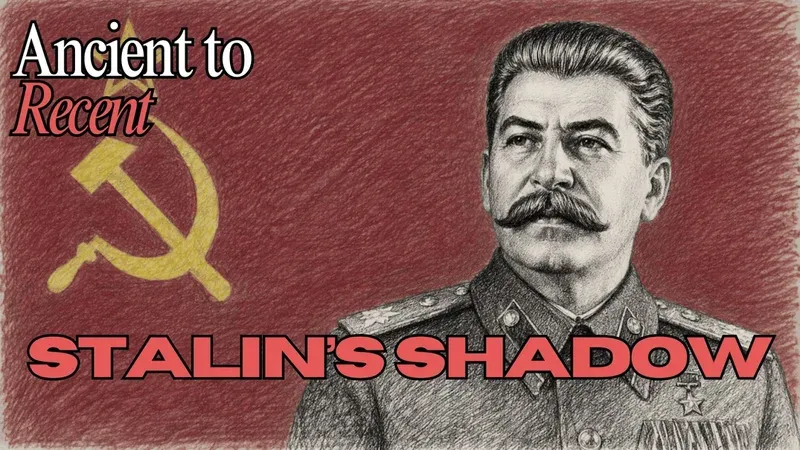
Stalin’s Shadow — Part 1
19 April 2026 · 37 min · Season 1
 Watch on YouTube →
0:0037:11
Also on
Rate the show
Ratings are how new listeners find the show. It takes a minute and it makes a real difference.
In this episode of Ancient to Recent, Joseph Parkinson begins a new series on the final days of Joseph Stalin.
At the height of his power, the Soviet dictator who had ruled through fear, purges, and war suddenly lies stricken after a stroke in his dacha. As his inner circle, men like Lavrentyi Beria and Nikita Khrushchev, hesitate, delay, and quietly calculate their next moves, the fate of the Soviet Union hangs in the balance.
Across the USSR and the wider world, confusion spreads. Allies and enemies alike wait for news, while millions, from Kremlin insiders to Gulag prisoners, react in vastly different ways to the impending death of one of history’s most feared rulers.
As Stalin fades, the system he built begins to tremble, and the race for power is already underway.
Join Joseph Parkinson as Ancient to Recent begins its series on the death of a dictator and the struggle that follows.
🎧 New episodes every Saturday
📲 Follow on YouTube, Spotify & Instagram @AncientToRecent
#Stalin #SovietUnion #ColdWar
Read transcript
This transcript is automatically generated, so it may contain typos and misheard names.
Death is the solution to all problems. No man, no problem. Joseph Stalin rising late in the morning of the 27th of February 1953. Joseph Virianovic to Sugarshvili. Whereas history would remember him, Stalin was at the height of his power. He'd slept badly. He always slept badly, often passing out on the couch in the early hours of the morning with a book in hand. Stalin was a ferocious reader with a personal library of 10s of thousands of books that stretch from Marxist theories to histories of ancient Greece, novels by Dickens, Dostoevsky and even figures such as Balzac whose monarchist and right wing views graced his shells. We'll retired any Soviet citizen other than the General Isimo who would enjoy such a right as work for them. They would be sure of a one way trip to the Dulac or a bullet in the back of the head merely for possessing counter revolutionary propaganda.
Like a great actor, Stalin strode the boardwalks of the global stage with supreme confidence and command all he surveyed. Little did he know his final act was about to begin. Welcome to ancient to recent. My name is Joseph Parkinson, and today we start a brand new series on the final days of Joseph Stalin. Episodes of Ancient Recent are out every Saturday are available on YouTube, Spotify and Apple Podcasts. Joseph Stalin had risen from poverty.
The son of a drunken cobbler and a washerwoman, he had given up a promising career as a priest. Realistically, the best a Georgian could hope for in Czarist empire to commit himself to a new faith, that of Marxist revolution. Years of struggle had followed, 2 decades spent on the run, in exile or in prison, carrying out hits, robbing banks, writing articles and attending meetings of tiny revolutionary organizations the length of Europe.
As representative of the Russian Social Democratic Labour Party, or Bolsheviks as they were known, he had been constantly tracked, observed and arrested by the Czarist police, the Okrana, for which there is some suggestion he may have been an agent. There's every chance that all we would ever have known of Stalin would have been confined to a file in the archives of the Zara State. Just another misguided youth with dreams of revolution.
But Stalin's life was transformed from the turmoil of the First World War. Zara's Russia was already a powder keg, having experienced revolution in 1905. But the incompetent handling the war effort, massive casualties of the army, and hardship on the home front led to revolution in February 1917. Suddenly, Petrograd, St. Petersburg haven't changed his name during the war, believing it sounded too German was the center of the revolutionary world. In October or November 1917, depending on which Calendar 1 uses, a further revolution brought the Bolsheviks and their ruthless leader Vladimir Ilich Lenin to power and Stalin. It's one of his key disciples.
In the ensuing years, the Bolsheviks constructed a system of repression unprecedented in its cruelty and paranoia. In the annals of history, Serbia power was based on slavery, arbitrary violence and mass terror to crush any who opposed the dream of a Marxist utopia. After the death of Lenin in 1924, a power struggle emerged between Stalin and Leon Trotsky, a brilliant journalist, powerful speaker and dynamic intellectual. But for all of Trotsky's brilliance, he lacked Stalin's peasant cunning or his single minded determination. Stalin was able to isolate Trotsky, drive him from power, then the country, and have him assassinated. An exile in Mexico City in 1940.
Stalin was able to out manoeuvre one enemy after another, purging those who blocked his rise to supreme leadership. By the late 1930s he was the unquestionable master of the Soviet Union. In 1941 he faced his greatest crisis, Operation Barbarossa, the German invasion of the USSR. Stalin had shocked the world by masterminding an unlikely alliance with Hitler in 1939 to pave the way for the partitioning of Poland and annexation of the Baltic States.
He dismissed mountains of evidence of Hitler's preparation for war as British propaganda. But in June 1941, Hitler had unleashed over 4 million Axis troops against the Soviet Union, shocking Stalin and leading him to possibly suffer a nervous breakdown. But Stalin had rallied the Red Army through brute strength, iron will, complete indifference to casualties and massive British and American assistance had turned back. The VEM Act broken Hitler's legions at the Battle of Stalingrad and chased the Germans all the way back to Berlin.
In May 1945, the Red Army captured the capital of the Reich, Hitler killed himself, and Stalin now found himself master of half the continent. But the alliance of the war years soon broke down, and the Soviets and Western allies of Britain, France and the USA glowered at each other across the Iron Curtain. The Cold War, a battle for ideological supremacy between capitalist West and Communist E raged from the beaches of Korea to the favelas of Latin America.
On the 26th of February, Stalin had attended a performance of Swan Lake at the Bolshoi, passing a message to the cast thanking them for their performance. He then went to his dacha to work till 3:00 AM before heading to bed. The next morning Stalin was late. He perused the latest forced confessions from the Jewish doctors at that moment being tortured for their supposed role in a plot against the Soviet state and the reports from the Korean War.
He walked in the snow covered garden and had a steamed bath which he found ease the pain from his arthritis in his arm. In the evening he was driven to the Kremlin, where he met up with his hench men. There was Levente Barrier, the most recognizable figure of the Soviet security forces. A fellow Georgian like Stalin himself, he had led the bloody purges of the 1930s with great relish. But now, in early 1953, he found his star was waning.
He had been eased out of the day-to-day control of the secret police and keen Kremlin watches had noticed the subtle hints of his sudden fall from grace in the carefully choreographed lineups for parades alongside Stalin. Barrier, who once stood close to the boss, now was pushed further down the road. All of a sudden, Barrier, once indispensable, could feel the trapdoor creaking beneath him. There was Nikita Khrushchev, a blunt Ukrainian who had risen from the coal mines through Stalin's brutal purges.
He was the ambitious Central Committee secretary who had just taken charge of the party's apparatus after Mellencock stepped aside. There was Georgie Mellenkopf, Stalin's long time aide and presumed heir apparent. He was the new chair of the Council of Ministers, effectively the premier of the Soviet Union. And the man who now held the top government post. There was Nikolai Bulganin, the smooth talking veteran Bolshevik and former Moscow boss who had served as Stalin's wartime deputy. He was the newly appointed deputy premier and minister of defence, the political Marshall overseeing the armed forces. Then there was Clement Voroshilov, the old civil War Marshall and one of Stalin's closest comrades from the revolutionary days.
He was the chairman of the Presidium of the Supreme Soviet, the Soviet Union's ceremonial head of state. They gathered, somewhat reluctantly, for the interminable rounds of movies, drinking and dinner. Stalin subjected his close entourage too. Stalin loved westerns, Chaplin films and Tarzan movies, sometime watching the same movies repeatedly in the same night. It was predictable, fair for those with a misfortune to be summoned to accompany Stalin in such mammoth cinematic efforts. We're not watching the same movies over and over. Stalin liked to be surprised getting the director of his private cinema to introduce new titles from time to time. This was a risky business, as Stalin's distaste could have lethal consequences.
Stalin was particularly sensitive to nudity in movies, 1 storming out of a cinema when he believed the film was too raunchy. After the movie, the party was driven from the Kremlin to Stalin's dacha, Kunzaba in the suburbs of Moscow for a late dinner. A Georgian buffet prepared by Stalin's housekeeper and suspected mistress, Valentina Estamina, had been prepared. The conversation was as predictable as the entertainment plots. Cold War Jews, Korea.
At 4:00 AM Stalin's hench men were released from their bosses octopus like grasp and finally allowed to go home. Stalin was a little drunk, poking Khrushchev in his stomach and calling him Nikita in a high voice that he liked to do when he was in a good mood. With his guest at last liberated, Stalin retired to bed, dismissing his guards for the night. At midday the next day, the guards waited for Stalin to wake. Stalin, A lifelong insomniac who took heavy doses of sleeping pills, kept irregular hours, so the morning passing without his appearance was far from unusual. But this time something was different. Gradually, as the hours crept by, the guards became anxious. At 6:00 PM, Stalin turned on a light in the small dining room. Much to the guards relief.
There was nothing to worry about. The boss was just sleeping off last night's success. All was well. He would surely summon them for tea, breakfast and papers. Soon regular service would resume. And yet the hours continue to pass and no word from Stalin. The guards and attendants began nervously discussing what to do. Should we knock? Should we leave Comrade Stalin to his own devices or to be sick? Should we contact the Politburo?
Finally, around 10:00 PM, Piotr Laskochev, 1 of Stalin's security guards, plucked up the courage to enter the journalists must room on the pretence of delivering mail. What he saw shocked him. Inside the office, decorated with pictures of Lenin and Marx, was Stalin leaning on one hand, laying on the carpet in his PJ bottoms. Stalin tried to call to him but could hardly muster more than a faint groan. Laskochev. Seeing the stricken dictator rush to his side, Stalin had wet himself. Laskochev asked Stalin if he should call the doctor, but Stalin could manage no more than a faint buzzing noise. Laskochev, scanning the room, found on the floor a copy of Pravda, the organ of Soviet propaganda, and Stalin's pocket watch, which had stopped at 6:30 AM, when Stalin must have suffered his stroke and collapse to the floor. Laskichev rushed to the phone to call for help. The other guards rushed in and lifted Stalin onto the sofa. The guards called the senior Politburo members Malenkov, Khrushchev and others, though they had trouble reaching Barrier, who was at the time occupied with one of his mistresses.
Word reached Barrier, who called the dancer. Getting the latest news, he gave the guards clear instructions. Do not tell anyone. At 3:00 AM on the morning of the 2nd of March, over 4 hours after the guards had raised the alarm, Stalin's close group of hench men arrived at the Duchet. Looking at Stalin, who was by this time snoozing, Barrier angrily exclaimed that Stalin was fine and was just sleeping. He ordered the guards not to cause a panic and left.
The guards reluctantly returned to their positions. By this point, many hours had passed and Stalin was still in his soiled pyjamas. And yet no doctor had been called. The guards continue to be deeply anxious, not just for the fate of Stalin, but for their own, if he was not cared for, an urge for a doctor to be called, believing that this was all Much Ado about nothing. Stalin's close accomplices had returned home, but the guards insisted on calling Malenkov, who in turn called Barrier.
Something really was afoot. Something really was wrong with Comrade Stalin. A doctor should be called, but witch doctor? All of the best doctors in the Soviet Union were busy being tortured as spies. Well, if all the best doctors are unavailable, what if we get a not best doctor? If Stalin recovers, then the doctor is by definition good. And if Stalin doesn't recover, then no Stalin. Stalin was in a desperate state, unable to do more than burn his eyes into each of his hench men who had gathered around his bed. At 7:00 AM, the doctors arrived, but they were far from familiar with his medical history.
What's more, they were petrified. At that very moment, their colleagues were being beaten and tortured by the NKBD. Would they share the same fate? The doctors, visibly terrified, their hands trembling, began their inspection. A dentist was brought in to remove Stalin's ball's teeth, but he was so scared that he dropped the dentures which shattered on the wooden floor. The hands of the doctors were shaking so much that they found it hard to remove Stalin's shirt or take his pulse.
The sight of Barrier glaring at the doctors, intermittently barking orders at them can't have done much for their nerves either. Eventually the doctors cut Stalin's shirt off and conducted their inspections. Comrade Stalin is very ill and seems to have suffered a stroke. Comrade Stalin has be treated with complete rest and silence and with the application of leeches behind his ears. Stalin must be kept hydrated with spoons full of soup or tea.
Stalin's children, Svetlana, his daughter, and Vasily, Stalin's alcoholic son, soon arrived. They rushed to their father's side, but soon enough Vasily would be drunk and have to be restrained. Stalin lapsed in and out of consciousness. Each time Stalin seemed to be slipping away. Barrier, who had done much of Stalin's dirty work but was marked for execution, would pour out his bile, his hatred, his rage at the man he had served so diligently. When Stalin roused, he would throw himself at Stalin's feet, kissing his hands and praising the generalissimo in tones that made even the other Politburo members cringe. But Barrier was alone in his vitriol. The others, Malenkov, Khrushchev, were genuinely moved by the plight of the old man.
They had no illusions as to who Stalin was. He was a killer of the worst sort, and a killer of many of their friends and family. But there was something else Stalin was he was incredibly capable. Stalin had taken over a fragile state, one that was not really secure until well into the 1920s, and had, through sheer force of will, turned the Soviet Union into a major industrialized nuclear power. Stalin had solidified the Communist Party in power, crushed Hitler, and spread the one true faith of Marxist Leninism from Berlin to Beijing for believing communists. And they were believing communists. Whatever his failings, however many his victims, he was a Titan in the struggle of the international proletariat. Stalin seemed to rally before slipping back, in, one moment pointing at a photograph on the wall of a girl feeding a lamb, and then mysteriously pointing back at himself. It's likely that nothing could have been done to save Stalin. He would have required immediate attention to have had any chance, and by this point several days had passed since his stroke.
His breathing became ragged, heart rate weakened, and he seemed to be slipping away peacefully. Suddenly he opened his eyes, a look of fear and hatred burning into those who stared at the stricken dictator. He raised his left hand and then collapsed. A huge man came forward and began aggressively administering a chest massage in one desperate attempt to keep Stalin alive. The man pounded away at Stalin's chest as all those around watched awkwardly until Khrushchev called out.
For God's sake, the man's dead. Stop this spectacle. Joseph Stalin, the man who would crush the culacks, forced industrialization of our country at the point of a gun, won the Second World War, and brought the red flag to the heart of Europe, was no more. Early Wednesday morning on March the 4th, Soviet government announced on Radio Moscow news that shocked the citizens of the Basque Red Empire. Comrade Stalin was ill. The radio announced that Stalin had suffered a stroke, but assured Soviet citizens that the best medical treatment was being given to the nation's leader.
A statement was issued in the name of 11 doctors, all of them with non Jewish names, as only weeks previously newspapers across the nation had carried headlines written in blood curdling tones as supposed Jewish doctor plots instigated in the name of International Zionism to murder the nation's leaders. And now, like a bolt of lightning, the Deer leader himself had been struck down. By the time the first news bulletins were issued, Stalin was already well beyond the reach of medical assistance.
Word had been delayed by Stalin's hench men whilst they busied themselves jostling for power and making arrangements for their smooth transition from expendable lackeys to essential statesman. These men had lived in fear of Stalin for years. A single word, a joke taken in the wrong way, a glance or hint or simply outliving their use and they would disappear in the night, never to be seen again. Suddenly they had done the unthinkable.
They had survived. There was a solemn atmosphere in the room as the gravity of the moment sunk in. But there was one person in no mood to grieve. Cristeliev. My car shouted. Barrier to his driver. The others, understanding what was at stake, snapped out of their moment of awestruck reverence and called for their chauffeur. The race for power was on. Stalin's health had long been a topic of quiet conversation in elite circles.
He was 74, a bad sleeper, A smoker and had a long list of ailments, from his face that bore the scars of a battle with smallpox to a withered arm to webbed toes in his left foot. He had dull pains in his extremities, which he treated with regular steam baths. He suffered constant headaches and sore throats, and from 1936 on, at bad gait. With all these ailments and a truly mammoth workload, no man could last forever but Stalin, the Man of Steel.
He was Stalin the Generalissimo. He was immortal in the Western press. In diplomatic circles, rumors abound of Stalin's supposed ill health. Stalin was believed in both 1947 and 1949 to have suffered heart attacks. Some rumored that Stalin, who appeared at public events, was a body double. Diplomats commented on how much he had aged since the war, how he now resembled a tired old man. Stalin is said to have experienced bouts of fainting, including in front of his Politburo comrades.
Stalin was a hypochondriac. He obsessed about rest and relaxation, not just for himself but for others too, sending colleagues letters, making sure they took their full complements of holidays, even going so far as to book vacations for those that did not do so for themselves. He took frequent trips down to the Crimea or the Caucasus, where the fresh air and warm climate seemed to agree with him more than the gloom of Moscow. He drank boiling water laced with iodine before dinner in the hope of treating his many ailments with predictably no effect.
But of all of Stalin's physical elements, there was one thing he suffered from more than any other loneliness. Stalin hated being lone and craved friendship deeply. His friendship could be vice, like in intensity. On one occasion, Stalin recalled an old childhood friend from the Caucasus who'd become a priest and invited him and his family to the Kremlin. The visit became a prolonged state, it's Stalin's insistence, and his friend was only allowed to leave after he began singing a longing song for a return home. Depressed, Stalin took the hint and released his old comrade. In Moscow, the small band of foreign journalists now rushed to report the news of the world's greatest dictator was dying.
They operated under strict control, with the ever watchful eyes of the Soviet censors always attended to their activities. They were further Hanford by the lack of facilities. The reports had to be filed in a single small room with only three assigned telephones for making long distance calls. The New York Times was the first Western news source to break the story. Stalin, gravely ill after stroke, flashed the headline in Moscow. Normal people were stunned by the news, with many turning to their faith for guidance.
The churches were packed in prayers offered for the speedy recovery of the man who'd done more to crush Christianity in Russia than any before. News reached Washington in the middle of the night, with the newly elected President, Dwight D Eisenhower, not informed till the early hours of the morning. He had not been woken by his aides because it was believed that Eisenhower would not have a decision to make. So best let the president sleep in the White House.
No one knew how to react. Stalin was an adversary and a former ally, a brutal dictator and a man who had crushed Hitler. He was a blood soaked tyrant and respected head of state. Should they gloat or commiserate? Was this an opportunity or a threat? It was widely believed in the State Department that Stalin's death presented more of a challenge than an opportunity as Stalin was amazingly believed to be a moderating force within the Kremlin as opposed to his supposedly hot headed underlings.
The debate dragged on. Would the Soviet people rise up? Would there be a coup? Would the people of Eastern Europe try and throw off the shackles of the Soviet empire? Should they make a statement or say nothing? In the end, Eisenhower insisted there's some sort of statement should be issued. The statement read in full and uniquely folksy American style. At this moment in history, when multitudes of Russians are anxiously concerned because of the illness of the Soviet ruler, the thoughts of America go out to all the peoples of the USSR, the men and women, the boys and the girls, in the villages, cities, farms and factories of their homeland. They are the children of God, who is the father of all peoples everywhere.
And like all peoples, Russia's millions share our longing for a friendly and peaceful world. Regardless of the identity of government personalities, the prayers of us Americans continue to be that the Almighty will watch over the people of that vast country and bring them, in his wisdom, the opportunity to live their lives in a world where all men and women and children dwell in peace and comradeship. The Ambassador of the newly independent India, GL Mehta, confined it to his diary that history does not record a more sanctimonious attempt to drive a wedge between people and its leaders at the moment of death. The British and French government played it safe and sent official delegations to express their concerns. Tito's Yugoslavia, on the other hand, could do little to restrain its Glee with Yugoslav radio noting that Radio Moscow would never have mentioned the sickness of Stalin unless the dictator was a death door.
Deep in the heart of Siberia. Millions of slaves, the inmates of the vast Gulag system of forced labour the Soviet state relied on, toiled, suffered and died as they struggled with heavy burdens and empty stomachs over the announced system. The din was broken by a sudden burst of classical music. Taken aback, the inmates and camps from Solovetsky Island on the Baltic to Magadan near the Korean border, listened in stunned silence. Comrade Stalin is greatly I'll.
The best medical attention is being made available, followed by a list of Stalin's symptoms. Camp doctors and medical staff, all who were themselves inmates, conferred in secret. The verdict was unanimous. He was done for. In hushed tones that could barely contain their Glee, they spread word to their fellow inmates. One doctor, blurting out the bastards done for. Inmates began hugging and kissing openly, celebrating a moment of joy in the lives of millions of people.
The great Soviet dissident Alexander Solzhenitsyn have been arrested in 1945 and sent to a camp in Kazakhstan. He was given a life sentence. His crime? He referred to Stalin as the boss in a private letter. It just so happened that the day he was released was March the 5th, 1953, the very day Stalin died. Sojinitskin, like many others, reacted with unbridled joy at the news of Stalin's death, writing a poem called The 5th of March. In the final months of Stalin's life, the old dictator seemed to be planning a major shake up of the Soviet system of government. It was announced that the latest Congress of the Soviet Communist Party, the 19th, was to be held, an event that was supposed to take place at regular intervals but had not in fact been staged since 1939.
At the Congress, Giorgi Melankov was to deliver the key address where he would set the direction of travel for Soviet policy. To Kremlin watchers, this was seen as a key indicator as to the order of favour and potentially a sign that Melankov was being lined up as Stalin's successor. Stalin envisaged a number of reforms. The nine man Politburo was to be replaced by a new expanded 25 man presidium which would be filled with untried, untested and largely unknown figures, along with the same old faces.
Some seem to believe there was a sinister reason for this move. With an expanded body, the disappearance of two or three faces into the depths of the gulag would be less noticeable than from a nine man Politburo. Stalin saw the Congress as a chance to further turn the screw on the peasantry. New restrictions were to be introduced on the collective farms, with even the peasants private plots to be taken over by state control. These miniscule scraps of land have been the difference between life and death for millions in the 1930s, but no challenge to Soviet power was ever to be allowed. Stalin indicated that with the Cold War heating up and the threat from imperialism ever present, further investment in heavy industry was required and the much hoped for switch to prioritizing investment in agriculture and consumer goods would have to wait.
These announcements were sandwiched between notices on the doubling of wages and the intention to reduce the working day first to 8 and then six hours as the state progressed towards communism, all of which went nowhere and were mutually incompatible with the ever expansion of heavy industry and demands of the Five Year Plan. But nobody who wanted to live would point out such contradictions. At the Congress, Malenkov took to the stage and gave by Starling his standards, A relatively short speech, only five hours long, with Malenkov regularly glancing over to Stalin. Sat on the stage with the other Politburo members, it was essential to keep an eye on the Dear Leader to watch for his telltale signs of boredom, which was to check his gold pocket watch.
On seeing such a sign, the speaker would cut their speech short, sometimes in mid sentence. Better to look ridiculous than draw Stalin's wrath by going too long. In the end, Stalin listened to the entire five hours in silence. Malenkov hit all the Stalinist high notes, the glory of the Soviet Union, marching towards a better tomorrow, brilliant leadership of Comrade Stalin, etcetera, etcetera. But he also dropped a number of worrying hints for the amassed delegates. Malenkov mentioned the presence of traitors and spies, the penetration of the Soviet elite by foreign intelligence services, the fear of 1/5 column, and the need forever greater vigilance.
Was this an indicator of a return to the dark old days of the 1930s, with their mass arrests and relentless purges? Some in the audience must have wondered if they would make it out of the building alive. On the final day of the Congress, Stalin gave his own speech, a four 7 minutes of platitudes. His entry into the room was greeted with evangelical applause from the Congregation of True Believers. Stalin thanked the delegations from the Italian and French Communist parties for attending, pointedly leaving out any mention of Mao Zedong, leader of the Chinese Communist Party, as a public insult.
The meeting seemed to set the direction for the Soviet Union and Stalin in the coming years, and it would be more of the same. More paranoia, more confrontation abroad, more repression at home with little or no compromise offered to ordinary people, and only relentless repression to keep the population in line. There was one group that was already experiencing the ever greater turning of the screw Soviet Jews. Jews had always been held in suspicion by Russian society going back to the days of the Tsar, but they had actually received less attention for oppression from the Bolsheviks in the early days of the USSR. As Bolshevik violence was predominantly class based and most Jews in the former Tsarist empire were so discriminated against and impoverished that they were purposely held in crushing poverty, this had little chance to join the ranks of the property owning classes that would draw communist ire. The Soviet Union had welcomed the establishment of the State of Israel in 1948 as a means of weakening British presence in the Middle East.
With Israel fighting its war of independence against the UK, Stalin had allowed communist Czechoslovakia to provide the Israelis with weapons at a time when the US placed an arms embargo on Israel. But Stalin soon soured on the Jewish state. The arrival of Golden Mayerson, soon to change her name to the more Jewish sounding Mayer as Israeli ambassador to Moscow, caused Stalin great anger. Mayer had been born in the Czarist Empire in 1898, but anti Jewish pogroms swept the Czarist domain as Jews were singled out for violence, leading to over 2 million Jews fleeing between 1880 and 1920, largely to the USA before the Johnson Reid Act cut off Jewish immigration in 1920.
Four Maya had then emigrated from the US to the British Mandate of Palestine to work in a kibbutz and build a Jewish society in 1921 and been a key player in the establishment of Israel. When Maya arrived in Moscow in September 1948, she was mobbed by Soviet Jews eager to greet the representative of the first Jewish state in nearly 2000 years. The scene of Stalin's Jewish subjects thronging the streets to greet a foreign dignitary raised Stalin's suspicion. In the Soviet Union, there was no identity other than Soviet identity.
There was no culture other than Soviet culture. There was no world view other than Marxist Leninism. All other identities, from religious to cultural to national, were to be absorbed into communism to see this expression of Jewish identity and after so many years of not just relentless propaganda but also physical violence, ask difficult questions about the validity of Marxist orthodoxy. The first signs of this new direction came with the trial of Rudolf Slansky, a prominent Czech communist.
Slansky, a notably servile Stalinist taken to endless professions of adoration towards the Dear Leader, Comrade Stalin and the socialist fatherland that was the Soviet Union, was also Jewish. He, along with thirteen others, were singled up for arrest, torture, and then convictioned on charges of Titoism and Zionism in the service of American capital and international imperialism. In 1952, Slansky, along with ten other defendants, were executed.
All of them Jews. A wave of anti-Semitic arrests washed over the newly established workers democracies in Eastern Europe. In Hungary, prominent Jews were arrested. Jewish officials were fired from the government. The same happened in East Germany. In Romania, the Jewish foreign minister Anna Poker was fired from her position and arrested. Communist states expelled Israeli diplomats. The Soviet press shrieked by the evils of Zionism and questioned the loyalty of Soviet Jews within the Soviet Union.
Jewish newspapers were closed. Jewish cultural clubs and societies for the promotion of the Yiddish language, along with Jewish theatre organizations were banned. Hundreds of Jews were arrested, and some Jews were expelled from the Communist Party. Universities began dismissing Jewish staff members and limiting the admission of Jewish students. Even attending events remembering the victims of the Holocaust became politically dangerous. The Jewish Anti Fascist committee was closed, it's members arrested and tortured, and in 195213 members were executed.
But Stalin was not done. His paranoid appetite only grew with the eating. He turned his attention to Jewish doctors. His own personal physician, Professor Vladimir Nikichik Vinogradov, had advised Stalin to consider stepping down from power in 1952 due to high blood pressure. Stalin had him arrested. Viciously tortured, Stalin declared in a meeting of the Presidium that every Jew was in league with the Americans. Israel tried to walk a tightrope, not wanting to be drawn into the Cold War and hoping to maintain some sort of relationship with the Soviet Union.
David Ben Gurion, the Israeli Prime Minister, avoided making public comment on the Slansky trial. But the Israeli press clamored for condemnation and publicly denounced the Israeli Communist Party, which supported Moscow's wildest fantasies. The Israeli Communist Party was not alone in their servile abasement. Publications associated with the French Communist Party also repeated the most hysterical accusations. The Soviet press announced the uncovering of a pot by Jewish doctors to murder Soviet officials under the guise of offering medical attention, complete with grotesque cartoons of doctors as figures that would not have looked out of place in the Nazi newspapers. Der Sturmer and the Racial Observer The Soviet press claims that the Jews were in the service of the Nazis and that Jewish doctors were trying to start a Third World War. But the papers did not just blame the nefarious work of supposed sinister Jewish cabals.
They also commented on how Soviet intelligence services had lost their vigilance. How could such wicked creatures get so close to our dear Soviet leaders? If the NKBD was doing its job properly. Thus the doctor's plot became a vehicle not just for Stalins race hatred of Jews, but also an excuse for the planned bloody purges that he had in mind. The atmosphere of anti-Semitism became so poisonous that parents refused to allow their children to take medicine prescribed by Jewish doctors.
Meetings were organized by Communist officials in offices and factories to denounce Zionism, where workers expressed openly anti-Semitic views about the supposed cowardice and selfishness of Jews. At such meetings, Communist officials reported hearing a common assertion that Jews had no place in the Soviet Union and should go back to Palestine. At school, Jewish children were beaten up and teachers wrote riddles about the wickedness of Jews in the blackboard and encouraged their students to join in the denunciations.
Rumours began to swirl that the arrest and denunciation of the Jewish doctors was but the first step in a larger plan. In the end of January 1953, a letter began to be circulated by the regime in elite circles that was to be published in Pravda. The letter was addressed to Stalin, which prominent Jews were expected to sign. In the letter, the signatories were to call for Jews to be deported from Moscow, St. Petersburg and other major cities to the Far East to be resettled for their own good. Some leading Jewish cultural and intellectual figures were summoned to the Pravd office and ordered to sign immediately. This was to provide the pretext for the removal of the Jews. No copy of this letter has been found and neither has any official documents stating that it was official policy to deport the Jews to Siberia.
But the letter's existence is attested to by dozens of people who signed it. The lack of documentary evidence for the policy of deporting the Jews is not surprising. It was often left up to Soviet officials to interpret the wishes of their superiors or as it was called, work towards Stalin. Was Stalin really planning the mass deportation of Soviet Jews? Only Stalin knew. In the years after Stalin's death, the accusations of imminent deportation of the Jews were actively encouraged by Stalin's successors, alongside the self-serving suggestion that they had opposed it. They're supposed opposition is highly unlikely, as Politburo members such as Molotov had gone along with the arrest of his own wife and Khrushchev had been the accomplice of the mass murdering of his fellow Ukrainians.
The chances they stood up to Stalin was slim to none, and the mystery as to Stalin's final intention towards the Jews will be forever unsolved. This was the atmosphere of Soviet society at the demise of the dictator. With Stalin now lying dead, the iron grip that held everything together for nearly 30 years was gone. The paranoid purges, doctors plots, the looming deportations, all of it hung in the air like thick smoke.
For the first time since Lenin, the Soviet Union faced the terrifying question it has never been allowed to ask. Who would rule next? In the days and weeks that followed, the men who had trembled at Stalin's table barrier, Khrushchev, Malenkov, Bulganin and the rest would smile for the cameras at the funeral, speak of collective leadership and promised ability. But behind the black curtains and solemn speeches, a ruthless race for power had already begun. Alliances would form and shatter overnight. Old scores would be settled and more than one of Stalin's loyal henchman would discover that surviving the tyrant is only the beginning.
That will be the topic of our next episode. Thank you for listening to Ancient Recent, My name is Joseph Parkinson. Episodes of Ancient Recent are out every Saturday that are available on YouTube, Spotify and Apple Podcasts.