
#45
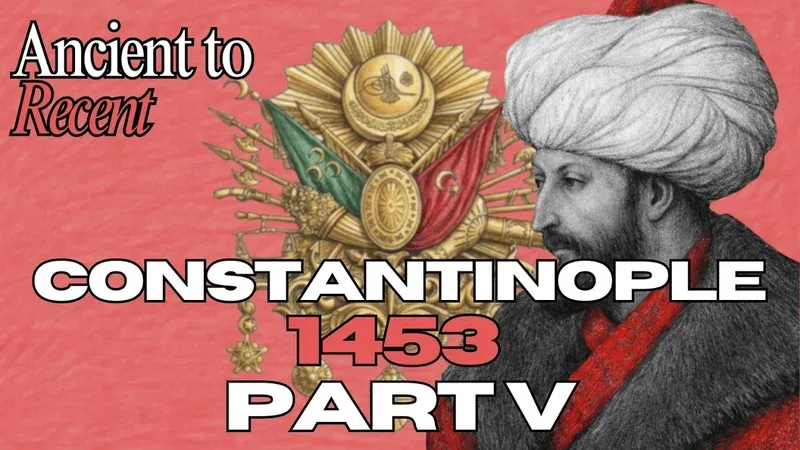
The Siege of Constantinople — Part 5
11 April 2026 · 38 min · Season 1
 Watch on YouTube →
0:0038:27
Also on
Rate the show
Ratings are how new listeners find the show. It takes a minute and it makes a real difference.
In this episode of Ancient to Recent, Joseph Parkinson concludes the dramatic siege of Constantinople.
After weeks of relentless bombardment and failed assaults, Mehmed II launches his final, all-out attack. Wave after wave crashes against the shattered walls, as the exhausted defenders under Constantine XI Palaiologos fight to hold the line.
But a series of crucial moments, a forgotten gate, the wounding of key commanders, and the unstoppable advance of the Janissaries, bring the city to the brink. As the defenses collapse, the last emperor of Rome makes his final stand.
What follows is the fall of a city that had stood for over a thousand years, and the birth of a new era under the Ottoman Empire.
Join Joseph Parkinson as Ancient to Recent concludes its series on one of the most decisive sieges in history.
🎧 New episodes every Saturday
📲 Follow on YouTube, Spotify & Instagram @AncientToRecent
#Constantinople #ByzantineEmpire #OttomanEmpire #MehmedII #FallOfConstantinople #MedievalHistory #HistoryPodcast
Read transcript
This transcript is automatically generated, so it may contain typos and misheard names.
The Emperor then, seeking to avoid capture, cried. Which of my brave young soldiers will run me through now with my own sword in God's name, so that his sovereign may not be handed over to a crafty foe? For a while he survived battling against the Press of the Turks, and was cleft in two by an axe. Leonardo of Chias, Archbishop of Mittelene, Latin eyewitness, who was present in the city from his letters to Pope Nicholas, the 5th August, 1453. For 53 days the army of Sultan Mement of the Ottoman Empire had laid siege to the holy city of Constantinople. The great guns of the Ottoman artillery had batted away at the ancient Theodosian Walls.
In a feat of ingenuity, the Ottoman Navy had been carried across land, placed down in the waters of the Golden Horn, behind the chain that protected the harbour. Ottoman miners had tunnelled under the walls in hope of either finding a way beyond the defenses or undermining them from beneath. But each act of Ottoman cunning was matched by Byzantine ingenuity, determination and will to survive. The vast Ottoman army that stretched as far as the eye could see had become discontent and desperate. They had suffered terrible casualties. 3 times the Ottoman soldiers had been urged forward against the walls, three times they had raised the banner and banged the drum of war. Three times the ground had trembled as they came on, and three times they had been held back. The plains before the great walls were littered with their fallen comrades.
The artillery of the Ottomans had blasted away night and day, a greater concentration of firepower never before seen in all of history. The Ottomans had stretched their cannons to the very limits of their endurance till the hulls grew weak, cracked, and exploded. Huge stones had been hurled that shattered towers, crushed defenders and sent sections of the wall tumbling down. But the defenders had each time rushed forward under a hail of arrows, piled up timber barrels full of earth and masonry, and patched the holes up, turning the gaps in the walls to ready made ramparts for the defenders. They had held out hope that surely the Christians of Europe would rally.
The Pope would command kings and Princess to come to their aid. Any day now. An army would March across the Danube and appear on the horizon. Or a fleet from Genoa or Venice sail up the Dark Nails to their rescue. They waited. But when a single Venetian ship slipped the autumn blockade and scoured the Mediterranean, they found only terrible news. No army was marching. No Armada was sailing. The city was on its own, slowly that they turned back every Ottoman assault and withstood every Ottoman bombardment.
A toll was taken. The pressure chipped away at their morale and thinned their ranks for the Ottomans. With spring turning to some of the rising heat, mounting death toll and logistical challenges of providing food and water to such a vast army would meet eventually disease and lack of provisions wood forest them to withdraw. Mehmed, whose ascent of the throne had been fiercely contested and claimed to power, constantly challenged.
Such a failure would surely doom his reign and potentially his empire. For both Christian defenders and Muslim attackers, time was running out. Welcome to Ancient Recent, My name is Joseph Parkinson and today we complete the final dramatic story of the siege of Constantinople. Episodes of Ancient or Recent are out every Saturday and are available on YouTube, Spotify and Apple Podcasts. As the siege dragged on into May, desperate residents of Constantinople turned to the supernatural for some portend of the future.
People shared rumours, dreams and visions. Children reported seeing the Angel that stood atop the city walls In defines of all would be attackers suddenly abandoning his post. The people saw in every event an indication of their fate. The city lay not far from the North Anatolian fault line, where great shifting tectonic plates grind against each other, producing frequent tremors. These rumblings now took on supernatural meanings as if the end of the world was nigh. Morale was already low after the news spread by the returning Venetian ship that no reinforcements were on the way. Bizarre weather patterns and appearances in the night seemed to hammer home the message.
On May the 23rd, the shocked, desperate residents of the beleaguered city stared in horror as a partial eclipse appeared, with the sun taking on the shape of a Crescent moon, the symbol of the Turk. What clearer sign was needed that God's favour had passed from the city and that all was lost? The city was beset by heavy fog, severe rain and battered with hail storms. Strange lights appeared in the sky, the scene to tell of a desperate fate. Constantine summoned his priests, demanding to know what these signs meant.
Mehmed too called his mullahs. What could such apparitions mean? Was victory at hand? Had God blessed our holy cause? Or rather, is this a sign of the Lord's displeasure? Have we offended the Almighty? Both sides desperately prayed, consulted their holy texts and conferred with religious leaders. What neither knew, what they of course could not have known, was that on the other side of the world, the island of Kuwait, not far from Australia, had exploded in a massive volcanic eruption, sending dust into the atmosphere, causing strange and bizarre weather patterns around the world for years to come.
The Bison Times, in desperation turned to their greatest protector, the Virgin Mary. The priests of the city ordered a holy procession of the icon of the Virgin Mother along the walls to try and Curry favour with the Almighty. As the procession made its way, in a sudden moment, the icon, seemingly out of nowhere, slipped from the grasp of the bearers, fell into the mud and remained stock as desperate believers tried to prize it from the thick mud.
To many Byzantines, they had sought an understanding from the Almighty as to what these signs meant. Now they had their answer. The city was doomed to remember things were going little better. His army had been camped outside the city for weeks. They had taken terrible casualties, and yet victory seemed no closer. The great cannon that had battered the walls to dust have not brought him the swift victory he so yearned for.
Though Mehmed had gone to vast lengths to provision his army and take precautions against disease, it would only be a matter of time before food began to run out and dysentery reared its ugly head. Hundreds of thousands of men required massive quantities of food and water every day and produce oceans of urine and fields of human waste. Constant fighting also meant the ever presence of corpses rotting in the rising heat. Even with the most meticulous planning, such mammoth logistical efforts could not be maintained forever. Eventually, hunger and sickness would take their toll. More pressing for Mehmed was the morale of his army. Many within the Ottoman ranks fought out of religious zeal, others for booty, and others Still Mehmed's Christian soldiers were pressed into action against their will. How long before his men could take such hardships no more? Mehmed also had to contend with the crisis of legitimacy. Mehmed was but a boy, only 21 years old. He'd ruled briefly before as a child, only for his reign to be a disastrous failure and lead to his much respected father, Murat, who had abdicated to smooth Mehmed's rise to power, to return from retirement and place Mehmed firmly on the substitutes bench.
Mehmed had been returned to the throne after the passing of his father, but many questioned his ability to rule. The halls of power of the Ottoman Empire were a dangerous place and there was little time for sentimentality. Sultans that did not prove their worth were not long for this life. Manette had few achievements. He had led his army into a war in the hope of the swift and glorious victory that would seal his throne and solidify the Ottoman Empire, so often riven by factional rivalry.
So far, for all his efforts, the city still stood, but massive numbers of Ottoman soldiers had died. The campaign must end soon, and if it did not end in a swift victory with the Crescent moon atop the Church's Saint Sophia, then Mehmed was surely doomed. Resolving the Ottoman camp was further undermined by constant rumours. The Christians were coming. The Hungarians had crossed the Danube. The vanguard of the Pope's army would be here any day. The Ottomans would be caught in the field and massacred. The Ottomans of the arrival of the Venetian ship is the advance party of a calming relief Armada that would arrive any moment soon to deliver untold reinforcements that would sweep the troops of MENA into the Marmara. Constantine was aware of these rumors and was all too eager to encourage them, hoping that desperation would sweep through the camp and cause a breakdown of Ottoman resolve. But for mement, retreat meant death. Ironically, the growing pressure from the rumours made Mehmed redouble his efforts.
He knew he had to act swiftly. Time was not on his side. He had to take the city. But before doing this, he had to unify his army. And Mehmed had a plan. On the 25th of May, he sent emissaries to the city to parley. These emissaries carried a simple message. The city could pay a massive tribune well beyond it's already impoverished means. Surrender or face the consequences. And the consequences would be dire for the defenders.
They knew what would await them if the city was taken. The city would be sacked, their families sold at the slave markets of Adrenal, their daughters and sons sacrificed to the sexual lust of the Turks and their old and infirmed slaughtered For the defenders. The fate that awaited them was death at the end of a Turkish sword or hoisted on the point of a Turkish stake. Constantine pondered the offer. In return, he sent one man to Mehmed.
The emperor would give you all he had, but not the city. The city would never be surrendered. In the end, the negotiations broke down. It's almost certain that no negotiations could have succeeded. The two sides had faced each other across the plains for nearly seven weeks. The Turks had impaled Byzantine sailors. The Byzantines had butchered Ottoman captives. Both sides had fought this battle with ever increasing bitterness. Their desperation had at every turn increased their vindictiveness.
Too much had been done, too many cruelties dealt out, for anything other than this battle to be fought to the death, with quarter neither asked nor given. But for Mehmed, the negotiations had served their purpose. To his army, he could say he had tried to end their suffering with bloodless negotiations, that his kindness to the heathen Christians have been met only with insults. To his enemies he could say he had tried to offer them a way out, that it was Constantine who had doomed their wives to the slave markets and daughters to the harem. For Mehmed, the negotiations had brought unity to his camp and turned the tables on Constantine, sowing division amongst his supporters.
With the die now cast, Mehmed turned his mind to preparation for the final assault. The Ottoman camp was a scene of frantic activity. Ladders gathered along with ropes attached with hooks to pull the barrels filled with earth down from the makeshift ramparts. Swords sharpened, guns greased. Extra stalks of crossbow bolts and arrowheads brought up. Battering Rams move into place. Gunpowder readied all that could be needed to storm the city.
Such reparations could not be kept secret. The defenders peering down from the wall could see the camp was high of activity. Christian Ottoman soldiers attached messages to arrows and fired them over the wall to let their Co relationists know the final assault is coming. Prepare yourself. The bombardment was kept up. The Ottoman cannons roared, hurling giant stone balls into the already fractured walls. More and more sections of the wall crumbled and fell into the constant pounding with each breach. The defenders hurried into action with planks and barrels filled with earth to block up the gaps that the caps were growing too wide, too many.
Exhausted, the defenders pushed themselves to superhuman feats of Labor. On Sunday the 27th of Bombardment was its heaviest yet. Focused on selected weak spots, the artillery blasted away. So intense was the fire that the breaches could not be plugged. Meme called his commanders. Together. The final battle was at hand. Mehmed used every rhetorical trick. He appealed to their sense of history, their faith, their patriotism, and their pocketbook. Take the city and the empire will be whole. The Ottomans will ascend to new heights of power and might. Take the city and God's mission will be complete. Your place in heaven assured.
Take the city and the glory shall be yours. Generation shall tell stories of your great deeds and you shall be remembered throughout the ages alongside Alexander, Caesar and Saladin. Take the city and you shall have all the gold and jewels you can carry. She will be yours. The greatest city in the world. It's wealth untold, unimagined. And every penny of it shall fall into your hands. Men assure them that the defenders were spent, their ranks thinned, the fortifications little more than dust.
Now, Now is the time. She is yours. Your destiny awaits. You have only to reach out and claim it. The entire army is to be committed. Nothing is to be held back. There is to be no reserve. Every man, every beast, every cannon is to be hurled into the fray. The army shall mass and rank after rank, wave after way, sent forward, until the city is ours. A fine sentiment, but reality was different. No attack could be maintained indefinitely. In a final assault, neither relentless pressure nor overwhelming numbers would tell, but rather decisive action. Even with all his army committed, the Ottoman numbers would actually work against Memet. The field before the walls would soon be littered with dead and drenched in blood.
Under so many trampling feet, the ground would quickly turn to a quagmire littered with obstacles. Pressing forward into the narrow breaches, tight banks clambering over unsteady ground, the vast numbers of men would deprive the Ottomans of maneuverability. Trapped, their very numbers would condemn the Ottomans to a killing field Without a quick breakthrough and caught beneath the walls, the Ottoman army would surely panic it's morale collapse and a Stampede ensue.
The Janissaries would be cut down by Byzantine swords and drown in mud beneath the battlements, within sight of the Spires San Sophia. For Mehmed, he knew this was his final opportunity. Nothing was to be left to chance. Each regiment was allocated a position in the line, each commander given a specific objective and a clear time frame by which he'd had to be achieved. The night before the assault, as the men completed their preparations and said their prayers, Mehmed rose with the camp, stopping to talk to his men. Encouraging, threatening, promising great booty, glory in the hereafter and punishment for failure. Mehmed showed himself to his men that he was there amongst them, prepared to share their fate.
To some this inspired, others is intimidated. Either way, it's stiffened Ottoman resolve and raised Ottoman morale for the final assault. All the while, the bombardment continued to chip away at the walls within the city. The Byzantines received a shattering blow. Giustiniani, the Genoese general who had commanded the defence of the city with such skill, was wounded. He withdrew from the line to recover. In his absence, the Byzantine defence lost organization focus within the city walls.
Every man, woman and child was pressed into the defence. The men picked up Lance and sword and man the battlements. The children carried stones and food. Women tended the sick and injured. The defence was in a desperate state. At the beginning of the siege, Constantinople could call upon 8000 men to defend 12 miles of war. Now it was hardly 4000 left to defend, little more than a pile of rubble so diminished with the defenders ranks that some towers were held by only two or three men, others but only a single lonely Archer. The attack would take place in the early hours of May the 29th. The night before, as Ottoman units took up their positions in the line, the defenders stood to, watching with stern resolve as the full Ottoman army deployed for battle in the Church of Saint Sophia, the believers gathered. They begged the Holy Mother for protection, that God not forsake them, that their sons and brothers be safe, their city be spared.
There was now no Orthodox in Latin, no East and West. The old arguments and divisions seem to melt away in those final moments. The pious may have spent those last moments in prayer to the more wildly they busied themselves burying their treasure or finding secure hiding holes to wait up the storm for the final assault. Mehmed would direct the main thrust at the middle section of the wall. This section had been relentlessly pounded, but all along the line, huge gaping holes it appeared, some as long as 30 yards wide.
Mehmed commanded that the assault take place all along the line and by both land and sea simultaneously. The Ottoman army was to be committed in waves. The first wave, made-up of mostly lightly armored and inexperienced troops, was to be cannon fodder, meant to soak up the projectiles and exhaust the Byzantine defenders. Each subsequent wave was with more heavily armored and experienced troops. Until the last. The mighty Janissaries held back as an elite core the crack troops to deliver the killing blow.
Just after midnight, each unit had been taken up its position. The Ottoman troops waited for the order to advance. At 1:30 AM, the signal for the first wave was given. The artillery erupted, blasting fresh holes in the walls, sending masonry and defenders hurtling into the air. The first wave advanced, not at a rush, not an exciting bounds, but rather steady, determined steps, Not with a yell or scream, but in eerie silence. Forward they came, in a huge mass, their lines stretching as far as the eye could see.
The defenders waited, eyes fixed, breath calm, until the Ottomans were well within range. Until the Ottomans were nearly upon them. At last the bison tines let loose every bolt and bow, firing into the pack ranks. The shrieks of anguish, the gargle cries of men, their bodies pierced their comrades pushing forward into the breach, onto the ramparts, forward, forward. The Ottoman troops now rushed upon the defenders. Their excitement and fear could no longer be contained.
They charged the defenders, ladders raised to scale the ramparts. Ropes with attached hooks hurled to try and drag the barrels of earth down as they we tried to dismantle the ramparts to gain entry to the city. From the towers above, stones and rocks came hurtling down skulls, shattered bolts piercing sides and plunging into ice sockets. Boiling, pitched, scolding, human fresh as men fell in agony, the packed ranks of the Ottomans impossible to miss. The first wave, caught at the rampart, unable to dismantle the defences or get at their tormentors, began to waver. As casualties mounted, some began to turn and run. Those not picked off by the Byzantine Archers were caught by the Ottomans themselves.
They met, determined to press the advance no matter the cost, had placed his military police behind the first wave, armed with whips and clubs to lash those too cowardly to die for their Sultan. Behind them, heavily armed janissaries who dispatched those who made it through. For two hours, the first wave crashed against the walls. At 3:30 AM, Mehmed relented, allowing what was left of the first wave to withdraw. As they pull back, the survivors, exhausted and bloodied, dragging their wounded comrades, made a pitiful spectacle.
To Mehmed. They had served their purpose, exhausting the Byzantine defenders and absorbing much of their ammunition. For a moment the battle paused. The Byzantines peered out across the field, now ghastly abattoir. Was the battle over? Was that it? Was that all you have, Mehmed? The defenders held their breath, but Mehmed was far from done. Mehmed was just getting started. The signal went up. On came the next wave, these troops, not lightly armored, inexperienced cannon fodder, but hardened veterans. As they closed the Bison times, their tight ranks made inviting targets.
Again the bolts and arrows flew through the air. Again the Ottomans littered the ground. Again the Ottomans pressed the assault. For a moment these veterans faulted under the hail of projectiles, only to rally Shields held up to give themselves some cover. They pushed on, the dead now piled in mounds. The wounded collapsed, soon covered by the corpses, their comrades trapped under the bodies of their fallen brethren and trampled by the feet of the next wave. They were crushed or suffocated in the press. Ottoman troops climbed over the bodies of their own men to try and reach the ramparts.
Onward they pushed, Up went the ladders. Clambering forward, the Ottoman troops ascended the battlements to meet the waiting bison tines. Hand to hand fighting broke out. The bison times pushed the ladders back, crashing below onto the packed Ottoman ranks. The few who made it up on the ramparts were soon cut down. Still on the Ottomans came minutes unable to contain himself, cried out shouts, curses and threats, ordering them forward in sheer desperation. Turning to his artillery, he ordered them to fire, knowing that shells would land indiscriminately, killing friend and foe alike in the early hours. In the dim light, the struggle continued at one point and Ottoman Cannonball scored a direct hit on the ramparts. There was a moment of confusion, but it was the Ottomans who gained their composure first.
Seizing the chance, they surged into the breach. For the first time the Ottomans were inside the fortifications. The defenders did not panic, they rallied and in the narrow space between the walls hacked the intruding Ottomans to pieces. It was now 5:30 in the morning. The cannons had blasted, 2 waves of men had been sent forward. The Ottomans had suffered massive casualties, but no progress had been made along the line.
The story was the same, massive casualties for little game. Mehmed was now down to his final reserve, his best chance, and his last hope. The Janissaries forward, onward to victory or death. Mehmed, in a frenzy, committed the Janissaries to the fray. If they could not make the breakthrough, all was lost. But the Bison times they had withstood everything Mehmed could throw at them and dawn was almost upon them. If they could withstand this final assault, the city would be saved.
They would be victorious and against all the odds, without the help of the Christian W Victory was finally within grasp. Ottoman Archers showered the ramparts. With a great cry. The Janissaries rushed forward. Again. The Byzantine projectiles took a terrible toll. Again the Ottomans thrashed at the ramparts. For an hour the battle was at a standstill. But hope was fading fast for the Ottomans. At this moment, the unthinkable happened.
The Janissaries seem to falter, Unable to get at the defenders and taking massive casualties. They wavered. The spirits of the Byzantines rose. They had been in action for five hours without rest, without food, without water. But the Ottoman attack was losing momentum up the line from the main focal point of the battle. The Byzantine defence was commanded by three Italian brothers, the Buchiatis. These brothers are taking advantage of a hidden gate to launch sorties on the startled Ottomans, who found themselves set upon by Byzantines, who appeared from the dark like phantoms to slash and hack at them, only to disappear into the night. But returning from one raid, an Italian soldier forgot to lock the gate.
As dawn broke, the hidden gate, now open, appeared before the Ottomans. Seeing their chance, a group of Ottoman troops burst through the gate. Climbing a flight of stairs, they suddenly appeared on the walls behind Byzantine defenders. Quickly killing the defenders, they tore down the Byzantine standard and raised in its place the Crescent moon of the Ottomans. The Ottomans, so desperate, with all hope seemingly lost, saw the sight of their banner upon the walls. Gaining heart, they renewed their assault just in the Ani. The Genoese commander, wounded the day before, had returned to the walls to direct the defence.
With great vigor he commanded the defenders, giving determination and purpose to the weary as they desperately struggled, his very presence filling them with hope that the city could be held at this crucial point in the battle. The already bloody commander was struck down by a bolt or bullet, by an Ottoman bow or by friendly fire. We do not know. What we do know is that he was injured and his Genoese comrades urged that he be withdrawn from the line. Giustiniani's retainers approached Constantine, who is himself at the front, and begged the Emperor for the key to open the gate to allow Giustiniani to be withdrawn. Reluctantly, the Emperor allowed the gate to be opened. The defenders on the wall, exhausted from 5 hours of fighting, worried the Ottomans were inside the fortifications, pressed ever harder by renewed assault by the Janissaries, and now with their inspirational commander wounded. Seeing the gate opened and withdrawal now an opportunity, decided to make a break for it.
Constantine desperately tried to prevent the defenders from pulling back. He begged and pleaded anything to rally his men. The Ottomans, sensing the decisive moment of the battle had arrived, pressed ever harder. One group of Janis series now managed to ascend the stockade and taking an Osman flag for the first time, planted it on the ramparts. The defenders soon cut these Janissaries to pieces, but the Janissaries were pushing forward, their momentum relentless. Memet's men fought their way into the inner wall and began firing down onto the Byzantine defenders, where the Janissaries now gaining entrance to the rampart and the gate behind them opened.
The defenders lost faith and began surging for the open gate. In a desperate attempt to save themselves, the crush jammed the open gate, allowing ever more Janissaries to pour through the breach into the rampart and hacking the defenders down. In this crush, as the defenses seem to crumble, the Emperor, brave to the end, was seen for the last time, sword in hand. He had been at the front, commanding his troops. As those around him lost heart. He never gave up hope.
Emperor Constantine Pallioglis, the 9th of his name, descendant of the Great Caesars, the last emperor of the Romans, defending the city of Constantine, fell to the Turks, forcing the gate open. The Janissaries flooded in. A great cry went up amongst their ranks. Just before the dawn, the city had fallen. As the Janissary surged into the street, all organized defence collapsed. Panic spread as civilians and soldiers alike fled for their lives.
Small bands of Byzantine troops fought on before being overcome by sheer numbers. Even in the streets, residents threw bricks and tiles down on the Janissary's heads, inflicting yet more casualties. The Ottomans, exhausted by battle, infuriated by their losses and incensed by the continuing resistance, went berserk, killing all they could get their hands on. Months of suffering and pent up rage was repaid back to the people of Constantinople, who had resisted them so ferociously and been so merciless to Ottoman prisons. An orgy of destruction, rape, plunder and murder erupted as Ottoman fury could not be contained. Still, fighting continued in the streets. Still, the dead from both sides piled up on the sea wall, where fighting had also been raging.
The Ottomans now gain ground. Word of the collapse of the Theodosian War soon reached the defenders on the sea wall, who panicked and tried to save themselves in the anarchy. The city became a slaughterhouse with every man for himself. Some fought on, others try to find a place to hide, yet others made their way home to protect their families or knowing what awaited their loved ones in Ottoman hands. To spare their wives and children the horrors of life under the Ottomans, to dispatch their loved ones themselves.
After the initial hours of frenzy killing, Ottoman commanders try to restore some sort of order. Distinctions had to be made for the able bodied, the slave markets for the pretty boys and girls, the harem for the elderly and infirmed the sword after so many weeks of sacrifice and words of memo ringing in their ears that the city was theirs to sack for three days. The task of restoring order was a tall when indeed. Ottoman troops even began fighting each other, not just over gold, but resorting to knives as to who would take possession of the most beautiful girls and young boys. Ottoman soldiers plundered the city, not just private homes but churches too.
Anything of value was up for grabs. Chalices and gold plates, candlesticks and crosses, precious stones prized from walls. All that could not be taken was smashed or desecrated. Statues were hurled to the ground, tombs of Saints ransacked, with the remains thrown in the gutter to be trampled under foot, altars splattered with blood. Refugees converged on Saint Sophia. Inside the church, the faithful prayed for salvation, the doors barred in a hopeless attempt to deny the Janissary's entry.
Constantinople, more a series of villages than a single city. As it had been at its height, some of its villagers were able to send delegations to Mehmed to negotiate surrender. They would be spared the worst of the sacking. For others, surrender was not an option or hand. The Pretender, Mehmed's uncle who had contested Mehmed's claim to the throne, stripped off his noble robes and dressed as a peasant, tried to escape the city.
He was recognized by a janissary. His head was brought to Mehmed. But this was not the head Mehmed wanted the most. What a Constantine. His body was never recovered. Rumours would swirl for years that he had escaped and planned a comeback. Our best bet is he died in the breach, cut down by a janissary whose name is lost to history. Seeing the collapse of the city's defenses, the Ottoman Navy beached its ships, hoping to take part in the plunder. This offered the defenders a rare moment of good luck. Many Ottoman troops were too busy plundering to notice the Italians and Byzantine sailors scrambling into their ships. Many nobles bribed their way on board a life's fortune traded for the last ticket out of town.
Desperate survivors gathered in the harbour of the Golden Horn, hoping to gain passage on a ship. The ships of the Byzantine Navy harboured out to Bay were faced with an agonizing choice. Make for the shore and try and save as many as they could, but run the risk of their ships being swamped or attacked by the Ottomans. Or take the opportunity presented by the Ottoman Navy seeking plunder to escape. Many captains took the safe option, closing their ears to the screams of those stranded on the harbour and headed for the open seas.
Some on the beaches, caught between the waves and the Ottoman swords, decided to take their chances and swam out to the Italian ships. Some made it pull the board before the ship set off. Many perished in the waters from the ships. The lucky few watched in horror as the Janissaries arrived in the harbour, slashing and stabbing those that had not made it to the ships. The harbour was soon littered with the dead, the waters turned red with Byzantine blood. On the Asian shore of the Bosphorus, the people of the Genoese colony of Galata watched on, wondering if it was their turn next, the sounds of a city being sacked unforgettable for those with the misfortune to hear. Screaming, fighting, dying, the roaring of fires and a desperate ringing of bells suddenly silenced, filled the air. Some didn't wait around to find out, making their way for their own ships.
With what few possessions they had, they made for safer ports. With the Ottoman Navy gorging itself on plunder, the window was opened. Backed by a strong wind. What ships could Byzantine, Venetian and Genoese headed for the open seas in the city. The Janus series made their way to the central Plaza, reaching the Forum of Constantine and the Church of Saint Sophia. Hacking at the door with axes, the Janissaries burst in, tearing women and boys from the arms of parents and husbands, killing those foolish enough to resist. The plunder continued, even the great church itself was not spared.
When greed was satisfied, religious fury took over with destructive attention turned to the symbols of Christianity. Menat waited outside the city. After receiving the surrender of some communities and the head of the pretender, Orhan, he decided time had come for his triumphant entry. This is a moment immortalized in Turkish art, with representations of Memo entering the city on a White Horse, common to this day in shops and homes throughout Turkey.
This was his moment. The young man, only 21 years old, his ability, competence and legitimacy questioned every step of the way, had now done something no Ottoman insulted, no Muslim ruler had ever done in seven centuries. He had taken the city of Constantine. His power was now solidified, his right to rule unquestionable, his place in history secure. From this moment, he was a man transformed. No longer Mehmed, son of Murad, he was Sultan Fatih Mehmed, Mehmed the Conqueror. Mehmed continued into the city he had dreamed of taking since he was a boy.
He had imagined Constantinople as a place of unimaginable grandeur and beauty. He had envisioned the city as the Pearl in the Ottoman crown. What he found was quite different. Constantinople had suffered a long, lingering and painful decline, never having recovered from his sacking by The Crusaders. In 12O four he found an impoverished, dilapidated collection of ruins, little more than a shantytown, interspersed with a few grand buildings and monuments.
As testimony to a history long forgotten, Memmer had promised his men 3 days of plunder. He now broke his promise, calling off the sacking. It made no difference, it had taken only hours to pick the bones clean. Mehmed now made his way to the church as Saint Sophia entering the church and Mullah accompanied him. Rising in the pulpit, the Mullah sang the call to prayer for the first time. As the fighting died down, the survivors would gathered together, whimpering and bound.
They made a pitiful sight. The 30,000 who survived were destined for the slave markets of Adrina. Some would be ransomed by families, many would never be seen again. Gallata would discover its fate soon enough, having seen what awaited those who defied Mehmed. The city offered no resistance when Mehmed sent his instructions. The city walls and towers were to be dismantled, Cannon handed over, ditch filled in. The residence of Gallata quickly complied.
Word of the fall of the city would soon spread, carried by traumatized survivors. On Friday the 29th of June, word reached Venice, a runner rushing from the harbour to tell the Venetian Senate, which was then in session. The senators heard the news in stunned silence. On the 8th of July, word arrived in Rome. There had been rumours and whispers of the fall of the city, but Pope Nicholas had no official confirmation. When word finally arrived, he was devastated and began immediately organizing for a renewed effort to take the city.
But the Christians had missed their chance to save Constantinople and would require all of their mind to try and slow down Ottoman advances into Europe. Mehmed's hunger for conquest was not satisfied. In the coming years Mehmed would add Wallachia in 1462, Bosnia in 1463 and Albania in 1479. In 1481 word reach Rome. The unthinkable was about to happen. The Ottomans were planning to invade Italy itself. But the conquest of Rome did not come to pass, as that very year, 1481, at the age of just 49, Mehmed died.
It would be several 100 years before Ottoman advances into Europe finally peted out, broken at another siege, the Siege of Vienna in 1683. The conquest of Constantinople had a number of long lasting transformative effects. It solidified Memet's rule, brought an end to the last remnants of the Roman Empire, and catapulted the Ottomans to being the true superpower of their age. But it also had unexpected consequences. Constantinople had long been in decline.
By the time of its fall, it was little more than a ruin. As the capital of the Ottoman Empire, Constantinople was transformed. Memo set about rebuilding and resettling the city. Within only a few years, Constantinople had risen from shantytown on the edge of Europe to being once more one of the truly great, wealthy and powerful cities the world. It's bazaars and harbours filled with merchants and traders haggling over goods from around the globe. It's palaces with generals and viziers commanded great armies. It's coffee shops and places of learning, training some of the finest minds of the age.
Constantinople was not destroyed from the ashes. She would rise to be more powerful than ever before. Thank you for listening to Ancient Recent. My name is Joseph Parkinson and this series has been the 1453 Siege of Constantinople. Next week we will begin a brand new series. Episodes of Ancient Theresa are out every Saturday and are available on YouTube, Spotify and Apple Podcasts.