
#44
The Siege of Constantinople — Part 4
4 April 2026 · 31 min · Season 1
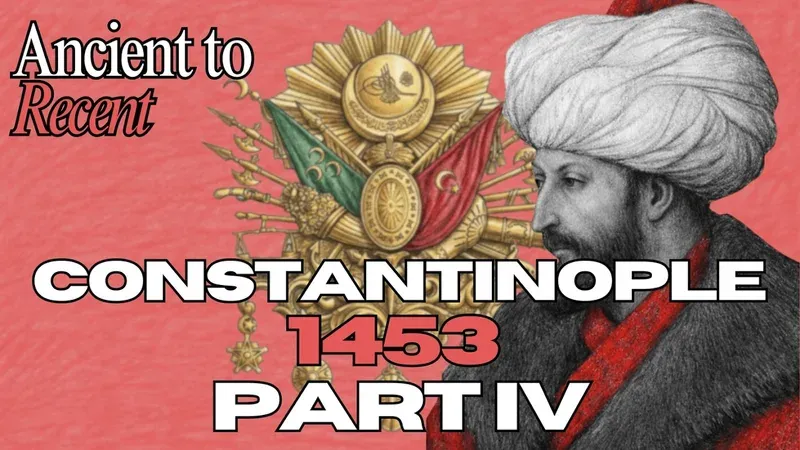 Watch on YouTube →
0:0031:30
Also on
Rate the show
Ratings are how new listeners find the show. It takes a minute and it makes a real difference.
In this episode of Ancient to Recent, Joseph Parkinson continues the dramatic siege of Constantinople as the struggle enters a final and brutal new phase.
With his navy strengthened, Mehmed II seeks to break the city from both land and sea. After a failed assault on the Golden Horn, he executes one of the most audacious maneuvers in military history, hauling ships over land to bypass the chain and threaten the city from within.
Inside the walls, Constantine XI Palaiologos and his exhausted defenders face dwindling supplies, growing division, and the devastating realization that no relief is coming from the West.
As bombardment, betrayal, and relentless assaults grind on, the siege tightens, and the fate of the Byzantine Empire hangs by a thread.
Join Joseph Parkinson as Ancient to Recent builds toward the final, decisive chapter in the fall of one of history’s greatest cities.
🎧 New episodes every Saturday
📲 Follow on YouTube, Spotify & Instagram @AncientToRecent
#Constantinople #ByzantineEmpire #OttomanEmpire
Read transcript
This transcript is automatically generated, so it may contain typos and misheard names.
Every day we expected help from the Christians, but none came and we began to despair of our lives. Nicolo Bardoro Diary of the Siege of Constantinople By the middle of April 1453, Constantinople was besieged by the great army of Sultan Mehmed of the Ottoman Empire. Huge cannon, the latest in Renaissance military technology, have been brought up to batter the fortifications down. The first cracks had appeared in the ancient structure of the Theodosian War that had stood for 1000 years.
Mehmed had hurl his army banners waving drums, banging cries of Allah Akbar against the walls for one decisive battle, hoping to pluck the ripe pair of Constantinople. But the defenders, though desperately out manned what they lacked in numbers, they made-up in belief in will to resist. They had exacted a terrible toll on the Ottomans. As the Ottoman troops staggered back to camp, Mehmed turned to another advantage he had that no previous besieging force could call upon command of the waves. The city was surrounded by water on three sides, and so many attacking armies had floundered as Constantinople could be easily resupplied and reinforced by sea, the stripping the attacking force of its advantage of time. But time was never going to be on them it's side. Mehmed knew the city had to be stormed before reinforcements could arrive from Europe.
Even without reinforcements, besieging forces would require hundreds of thousands of tons of food and be susceptible to disease soon enough. A lack of supplies and the spread of dysentery would do to the Ottoman army what the defenders could not. As such, every day was precious, every moment decisive. The city would have to be strangled into submission, battered into compliance. It is for this reason Mehmed had constructed the Straight Cutter fortress downstream from the city, at the Bosphorus's most narrow point. From this fortification, Ottoman guns, many cast by the Hungarian engineer Urban, could hurl massive stone balls across the water, shattering the hulls of any ship that dared test the accuracy of the Ottoman artillery. But the fortress alone would never be enough. Mehmed would need to take the fight to the city by land and by sea.
But to do this, he would need to call upon all his skills as a military organizer. He would need something ingenious. Welcome to Ancient to Recent. My name is Joseph Parkinson, and on today's episode we continue the story of the 1453 siege of Constantinople. Episodes of Ancient Recent are every Saturday and are available on YouTube, Spotify, and Apple Podcasts. In the winter of 1452, Mehmed set about expanding and strengthening the Ottoman Navy. The Ottomans, descendants of nomadic step warriors, had long fought from the saddle.
For them, the ocean was not their natural habitat. But as the Ottomans expanded outwards, soon enough Turkish horses were wetting their hooves in the waters of the Mediterranean. The Ottomans came into contact with and subsequently conquered Greek Christian sailing communities. This natural source of naval talent was augmented by the Ottomans willingness to pay handsomely for any, regardless of faith, who would lend their skills to Ottoman expansion. Soon sailors, scientists, soldiers and engineers from across Christendom, from as far as Genoa, Catalonia and island were plying their vocation in the Ottoman Navy. The backbone of this new Ottoman fleet was the classic odd war galley, sleek vessels around 100 feet long and narrow in the beam, powered by banks of enslaved rowers. The upper decks were packed with soldiers armed with bows, lances and swords.
In battle, these galleys were hurled by javelins ramming into enemy ships so boarding parties could swarm across with grappling hooks and bridges. Mehmed had assemble a large, if somewhat patchwork, fleet by April 1453. It numbered roughly 140 ships, between 12 and 18 war galleys, dozens of smaller vessels, and numerous transports. Many of the crews were Christian levies and mercenaries serving the Sultan, but the Ottoman ships had a number of crucial weaknesses. The galleys were built for speed and manoeuvrability. As such they sat low in the water and their thin holes meant they were often flimsy in comparison with the sturdy, high sided ships of their Christian adversaries. These galleys were susceptible to bad weather, had to stay close to the shore and avoid the rough waters of the open sea. Being powered by oarsmen also meant that, though capable of bursts of high speed, the oarsmen would soon tire and thus over a long enough distance, sailing ships would always have the chance to get away.
Constantinople, meanwhile, prepared its own response. On April the 2nd the city raised the massive iron chain across the entrance to the Golden Horn, sealing the harbour. The Byzantine Navy, reinforced by Italian ships, could muster about 37 vessels in total, 10 Byzantine galleys and the rest mostly sturdy high sided merchant ships from Venice, Genoa and Catalonia. Though few were purpose built warships, they were manned by some of the finest sailors in the Mediterranean and towered over the lower Ottoman galleys.
On April the 12th, the Ottoman fleet was sighted approaching for the first time, but the Ottomans did not attack immediately. First, they scouted out the waters and observed the defences, getting a firm understanding of the forces arranged against them before picking their moment to strike. Mehmed had three clear objectives for his naval forces to blockade the city, prevent any reinforcements from arriving by sea, and ultimately storm the Golden Horn itself. To complete these objectives, the Byzantine fleet would have to be swept from the seas and the chain across the waters smashed to clear the way for the Ottoman ships. On April the 18th, Mehmed ordered the first major naval assault.
Ottoman galleys, packed with soldiers and with small cannons mounted on their decks, surged forward towards the Great Chain and the Christian ships defending it. The fighting was ferocious. The Ottomans rammed and tried to board the taller merchant vessels with their defenders, raining down javelin stones and boiling liquid from above. Ottoman cannonballs proved too small and light to seriously damage the thick holes of the Italian and Byzantine ships.
Soon the waters of the Bosphorus were Crimson with the blood of the Sultan sailors. After hours of savage close quarter combat, the Ottoman fleet was forced to pull back, bloodied and unsuccessful. For now, the chain held. The Golden Horn remain closed to Memet's Navy. While the land war shook under the constant war of Ottoman cannons. Emperor Constantine the 11th desperately needed help from the West. He had fulfilled his part of the bargain.
The Union of the Churches had been formally proclaimed in Hagia Sofia the previous December. Now he waited for Rome and the Italian Maritime Republics to honour theirs. Their response was painfully slow and half hearted. Rome wanted clear proof that the Bison Times were genuinely committed to the Union. Venice and Genoa, on the other hand, cared far more about trade routes and profits than about religion or the survival of an ancient Christian empire. In August 1452, some in the Venetian Senate had actually voted to abandon Constantinople to the Ottomans. Cash, it seemed, mattered more than the cross. Comfort in this life was preferable to paradise in the next, but events soon changed their calculations. When Ottoman forces began sinking Venetian merchant ships and strangling trade routes in the Aegean, self-interest finally kicked in.
Venice prepared a small relief fleet. The Pope, for his part, wrote to Venice requesting 5 galleys and hired 3 large Genoese merchant ships, loaded them with much needed supplies, weapons and a few 100 fighting men. On April the 20th, 1453, those 3 Genoese ships finally approached Constantinople from the city wars. The defenders could see the ships in the distance. Shortly after 10 AM, chairs erupted across Constantinople, The first real hope in weeks. But the Ottomans had also spotted the ships. Mehmed the Second wasted no time. He ordered his fleet to intercept them at all costs. Take those ships he commanded or do not return. The Ottoman galleys surged out to meet the three tall Genoese merchant vessels.
The winds were behind the Christians and the rough waters of the Marmara favoured the deeper hold European ships. Thousands of people, byes and tines on the wall and Ottomans on the Asian shore watch the drama unfold like spectators at a deadly theatre. A running battle erupted. Ottoman Archers and crossbowmen poured bolts and arrows into the Genoese ships whilst the defenders fired back. The Ottomans tried desperately to close the distance, but the rough seas made boarding almost impossible.
But just as the Genoese ships were about to slip into the safety of the Golden Horn, the wind suddenly died. The vessel sails went slack. The three vessels sat motionless in the water. The Ottomans saw their chance and closed in fast. Grappling hooks flew, ladders were raised and men tried to smash the thick holes of the Genoese ships with their axes. But the high sided merchant ships towered over the low Ottoman galleys.
Heavily armoured Genoese troops armed with crossbows, Spears and swords stood ready on the decks. Any Ottoman who managed to grab the rails had his hand Hacked Off or his head split open. Screams filled the air as men tumbled into the sea. The battle rage for nearly three hours. At one point minute became so agitated that he rode his horse straight into the water, shouting orders and urging his men forward. It looked for a moment as though the Ottomans might finally overwhelm the ships.
Then, just as suddenly as it had vanished, the wind returned. The Genoese sails snapped full and the heavy merchant ships surged forward, their massive holes smashing through the lighter Ottoman galleys like battering Rams. With the final burst of speed, the three relief ships glided safely into the Golden Horn. Mehmed the Second could only watch in despair from the shores as the precious supplies and reinforcements slipped through his fingers.
For the defenders inside the city, it was a rare moment, a celebration. For the Sultan, it was a bitter reminder that despite all his preparations, the sea still belonged to his enemies. At least now. The arrival of the three Genoese ships on April the 20th dramatically swung the psychological advantage back to the defenders. For the first time in weeks, hope flooded the city. The ships brought not only vital supplies and a few 100 fresh fighters, but something even more valuable. Belief.
When more ships on the way, people asked. Many saw it as a sign from God that the city would not fall. Emperor Constantine the 11th, sensing growing crisis and discontent in the Ottoman camp, decided it was time to make a peace offer. The great guns had failed to bring down the fortifications, the planes outside the Theodosian War were littered with Ottoman dead, and the bloated bodies of sailors were washing up along the shores of the Bosphorus. Mehmed's gamble appeared to be failing. A long, grinding siege now loomed with all its disease, desertions and constant threat of a Christian relief force arriving from the West.
Constantine offered generous terms that would allow the young Sultan to save face, but Mehmed was in no mood for compromise. He was a new ruler whose position was still fragile. He had already faced opposition from the old guard, and another failure could spark rebellion within his own ranks. On April the 21st, Mehmed summoned his Admiral Bolteloglu, who had been badly wounded in the face by a stone during the naval battle. In a fit of rage, the Sultan ordered the Admiral impaled. Only after his advisers begged for mercy was the Admiral spared, instead receiving 100 lashes and being stripped of his rank and command.
Mehmed then called the War Council to discuss Constantine's peace offer. The old grand vizier, Halil Pasha, urged caution. He warned that defeat could shatter the Ottoman Empire. The city will fall one day, he argued, but time is on our side. We can wait them out. He feared that another bloody failure or the arrival of a Western relief army would doom both the campaign and Mehmed's rule. Opposing him was the young, ambitious Zaganos Pasha, a Greek convert to Islam who spoke with fire. We have come too far, he demanded. Now is the time to press on.
Mehmed sided with the Hawks. He sent back account offer he knew would be refused, surrender the city and Constantine would be allowed to leave and rule the Peloponnese as an Ottoman vassal. When the offer was rejected, as it was always intended to be, the bombardment resumed night and day, concentrating on the weakest sections of the war, yet the city still held. Frustrated and needing to break the deadlock, Mehmed turned his attention to the Golden Horn.
As long as the Great Chain guarded the harbour, Constantine could concentrate his limited forces on the land walls. The failed naval assault had proven that storming the chain directly was almost impossible, so Mehmed came up with one of the most audacious ideas in military history. If they could not go through the chain, they would go around it. On the night of April the 21st, 22nd, using thousands of labourers, engineers and soldiers, the Ottomans began dragging their ships over land. They cleared a path, laid greased wooden tracks and used massive rollers slick with animal fat. In a stunning feat of logistics and secrecy, ship after ship was hauled across the hills behind Galata and lowered into the Golden Horn behind the chain.
On the afternoon of April the 22nd, the first Ottoman ships appeared inside the harbour. Suddenly behind the Defenders defensive line, panic swept through Constantinople. The city now faced attack from both the land walls and the sea walls simultaneously. Constantine was forced to stretch his already thin force ever thinner. Desperate to regain the initiative, the defenders planned a night wade, using Greek fire to burn the newly arrived Ottoman fleet. The task was given to the Venetians, but at the last moment the Genoese demanded to join the operation, forcing a last minute delay.
The Byzantines waited a haul four days for the Genoese to be ready. All the while Mehmed strengthened his defensive positions overlooking the fleet inside the Golden Horn, hauling cannons into place to defend his ships. Finally, on the night of April the 28th, 2 hours before dawn, the small attack flotilla set out. The plan was for two small galleys laden with Greek fire to be escorted by the more robust merchant ships as close to the Ottoman Armada as possible.
As soon as the Venetian galleys were within striking distance, they could surge from cover to unleash Greek fire and set the Ottoman fleet ablaze. The water that night was calm and the winds low. As Venetian ships advanced, the fleet was forced to travel at the pace of the lumbering merchant ships, deprived of wind to carry them along. Slowly the Armada crawled towards the Ottoman ships. Tensions rose and tempers flared in the Bison Time fleet until 1 impatient Venetian galley broke formation and surged ahead alone, determined to strike a blow and destroy the hated fleet of the profidious Turks. As this lone Venetian ship closed, suddenly Ottoman cannons opened fire, tearing the ship apart and sending it to the bottom of the Golden Horn.
The remaining ships were met with a brutal hail of cannon fire and arrows. The raid collapsed in disaster. The losses to the Christian force had been terrible, but the horror was not yet over. Of those who tried to swim to shore, around 40 had the misfortune of swimming to the Ottoman bank, not the Byzantine. These sailors were swiftly captured. Mehmed, determined to send a clear message of the fate that awaited those who sought to defy his divine will, would make an example of these men.
One by one, in full view of the city, the men were taken, forced to lay down in their stomachs. A large sharpened stake was placed between the cheeks of their buttocks. Stepping forward, a Turk with a great mallet, swinging with all his might, would hammer the stake until it entered the victim's body. The victim would be hoisted on the stake and planted, some dead, some still alive to rise in pain as their helpless comrades watched on in horror.
The psychological blow was devastating. In Constantinople, grief turned to rage. Before the siege, a small Turkish community of some 260 people lived within the city's walls. The people of Constantinople, while with desire for revenge, took these Turks, LED them to the walls and, as a ghastly repost to Mehmed's cruelty, butchered them. The bodies of the Turks were hung from the walls for their countrymen to see. A hideous reply in an increasingly bitter war. The siege had entered a new and far darker phase within the city.
Questions began to be asked. How are the Turks known of the coming attack? Had the Genoese betrayed the Venetians and the city itself? Rumours even circled the Genoese traders were really mingling with the Ottomans outside of Gallata and trading with them, only to then take their place in the walls. Was there a fifth column within the city? Fear read paranoia as people struggle to tell friend from foe. The Venetians claimed the Genoese were playing both sides, the Genoese that the Venetians were training the city for improved trade terms with the Sultan.
But the Genoese drew the greatest suspicion. Was it not true that the Genoese still traded with the Turks? Had the Genoese not requested a delay to the plan at the last minute? Was it really to be believed that no one in Gallata was aware of the construction of an overland highway that carried an entire Ottoman fleet constructed by an army of levees? Fighting continued, now along an even broader front, with Ottoman and Byzantine artillery exchanging fire across the Bosphorus as the Byzantines now tried to sink the Ottoman fleet from afar.
Mehmed had a mortar constructed that fired huge stone balls into the harbour to sink the Venetian ships. The mortar pointedly fired directly over Gallata, a not so subtle warning to the Genoese that their colony persisted at the sufferance of Memet. With a golden horn open to Ottoman shipping, Venetian fleet pinned down and Byzantine troops stretched to the limit, Memet could now tighten the screw. The artillery bombardment continued relentlessly.
Night and day raids launched to keep the Byzantines on their toes, and at the end of their tethers holes started appearing in the walls. And yet the Byzantines held on. Grimly. On came major Ottoman assaults. Wave after wave of troops with Hawks battering grounds in ladders once more. Through smoke and flame they try to press their way through breeches blasted by cannons. And again the Byzantines met them, sword in hand, sending yet another Ottoman assault scurrying back, bloodied, climbing over the writhing bodies of their comrades, contorted in agony, each marked with ghastly wounds, intestines torn out, skulls split asunder by sword, stomachs pierced by lance's limbs, cleaved by the thundering blows of axe.
The ghastly theatre of death continued on evermore desperately for the defenders, the endless cycle of bombardment, repair, raid and assault of desperate struggle, the slow chipping away of their numbers, the constant scanning of the horizon for much hope for reinforcement. And yet, as far as the eye could see, Turks, Turks and more Turks. No matter how many they killed, there were always more Turks, and by early May, food was running low. The presence of the Ottoman Navy made resupply from Galata more difficult, and even fishing in the Golden Horn was fraught with danger.
The lack of food was becoming critical, with Constantine ordering the churches to be stripped of what gold was left, to be melted down, to make coin to pay the soldiers and buy what food could be had. Constantine's commanders argued, but none were able to come up with a clear path to lift the siege. Some suggested that the only hope was for the emperor himself to depart the city, head W for Rome and the Italian city states, show himself to the Christians of the West and rouse them to save the city.
Upon hearing the suggestion, Constantine fell silent before weeping. His place was in the city. If he should fall, he will fall with it. He would never abandoned his people. He would share their fate, whatever it would be. A further plan was suggested. Send a ship, just one, disguised as Ottomans, to slip through the blockade and search the Eastern Mediterranean for the rumoured reinforcement, and carry word that Constantinople had not been taken.
The city still resisted. On May the 3rd. A single ship, it's crew dressed as Turks, under the cover of darkness, set out on the lonely mission to find the reinforcements the city so desperately needed. Still, the bombardment continued. Still the grain stone balls crashed into the walls. Still the Turkish crews sprang, loaded, aimed, fired, reloaded, aimed and fired again. By early May 1453, Mehmed believed the siege had reached its crucial moment.
On May the 6th, buoyed by reports of collapsing morale inside the city and spurred on by intelligence that a Christian relief force might be gathering, Mehmed decided the time had come. The final push, a ferocious artillery bombardment, began. Sections of the Outer War collapsed under the relentless pounding. At 7:00 PM, the Sultan unleashed a massive infantry assault. Wave after wave of Ottoman troops surged forward into the breaches. For three brutal hours, the fighting raged in the cramped killing zones between the walls.
Men were crushed together in desperate, chaotic struggle. Both sides fought with terrifying intensity. When bullets and arrows, those ran out. They used swords and Spears. When these broke, they used knives, stones, fists and teeth. The fighting was intimate, primal, personal, but once again, the defenders held. The days that followed blurred into an endless repestive cycle of bombardment, attack and repair as both sides seem to give in to hopelessness. Time slowed to a crawl.
Days became interchangeable, a constant struggle for survival that tested the sanity of both attackers and defenders. Tension gripped both camps, disunity amongst the defenders only made things worse. The Venetians continue to operate as an almost independent force, reluctant to commit too many men's to the war for fear of being trapped if they had to abandon their ships in the Ottoman camp. Tensions flared as casualties mounted and a breakthrough for all the sacrifices seemed nowhere.
Insight. Mehmed pushed on, his single minded determination allowing him to close out all other considerations. There was only one objecting, the city. Nothing else mattered. Memet concentrated most of his artillery on the vulnerable section by the Lycus River, but he also hammered other weak points, including the awkward junction where the Theodosian Wall met the single wall near the Blackening Palace. On May the 12th, a large section of this wall had crumbled.
That night, the Ottomans launched a surprise attack. For a terrifying moment, they breached the defenses. Panic spread through the streets. The city seemed to be in the verge of collapse. The emperor himself rushed to the breach, rallying fleeing soldiers. With his presence and his voice, he led a fierce counter attack. The trapped Ottoman troops were hacked to pieces in the narrow, winding streets the next morning, their bodies hurled from the wall, splattering into the ditch below in full view of their comrades.
On May 14th, learning that many Christian ships had withdrawn behind the chain to a safer anchorage, Mehmed stripped artillery from the Galata and focused at a greater firepower. On the gate of Saint Romanas in the Lycus Valley. The bombardment reached new levels of ferocity. On May 19th, Ottoman engineers completed a daring pontoon bridge across the Golden Horn. 1000 large wine barrels lashed together wide enough for five soldiers to March abreast.
Pressure was mounting on every front. By the middle of May, Constantinople was stretched to the absolute limit. Yet somehow it's still held the Ottomans. Only one strategy remained untried mining. The ground beneath the Theodosian War was mostly solid rock, and many believed tunnels would be impossible. But on May 16th, the defenders heard the faint sound of pickaxes and muffled voices beneath their feet. A Scottish miner named Grant, in the service of Constantine, located the tunnel, bursting inside with his men and collapsing it, leaving the Ottoman diggers to suffocate in the dark.
The defenders took to leaving buckets of water at regular intervals along the walls, the ripples of the water a sure sign of tunnelling below. More mines were discovered and destroyed. Some flooded, some burned, some collapsed, burying those inside alive. Again, Mehmed pressed ahead. Again he disregarded the casualties. A new contraption was brought to bear. Awakening 1 morning, the Byzantine defenders were stunned to see a gigantic siege tower, its surface covered with hide to prevent burning, its sides packed over with earth to absorb the shock of Byzantine cannons looming over the Byzantine walls.
How had such a monstrous contraption been constructed? Seemingly overnight? The tower was connected to the Ottoman camp by a covered Causeway, allowing Ottoman troops to advance close to the Byzantine wall without being picked off by Archers. Within the tower, Ottoman troops worked ferociously to pile up dirt they flung into the ditch in front of the walls, whilst Ottoman Archers, now with the ability to look down on their Byzantine tormentors, picked off the defenders manning the walls. The tower inched closer and closer as cannonballs and arrows bounced off it's outer shell, but the defenders did not give in to despair.
Loading wine barrels with gunpowder and lighting a fuse, they rolled the barrels off the wall onto the base of the tower and with the great explosion, blasted it to pieces, hurling the great wooden structure and the Ottoman troops inside into the air and showering down on the Ottoman camp. Yet again. Ottoman brilliance had been checked by Byzantine ingenuity, but the greatest blow came not from the Ottoman enemy but from Constantinople's Christian allies. A Venetian ship had slipped out through the Ottoman blockade to search for news of the promised Christian relief force. The sailors questioned passing vessels across the Mediterranean.
They hoped to hear that a Hungarian army was marching, that the Pope had rallied all of Europe from England to Portugal, that the city states of Italy had put aside their petty squabbles and a mighty fleet dispatched to relieve the city. Instead, they learned the devastating truth. The ships the Pope had ordered were still under construction. No relief force was coming anytime soon. Confronted with this grim news, the Venetian crew faced a terrible dilemma. Some argue the city was already lost. Better to sail for safety than join their comrades impaled on the ends of an Ottoman stake.
Others insisted that honour demanded they return and tell the Emperor Constantine the truth. In the end, Duty 1. The ship slipped back through the blockade and delivered the heartbreaking message to the Emperor. Constantine listened calmly. Thank the men and dismissed them. There would be no rescue. Alone. With his dwindling force and his ancient walls, Constantinople would face its final battle. As May drew close to an end, both sides prepared for the final showdown.
The greatest city in Christendom, once the heart of the Roman Empire, now stood on the edge of the abyss, facing the overwhelming might of the Ottoman Empire and with nothing left but courage, faith, and the will to die fighting the final battle was at hand. Thank you for listening to Ancient Theresa. My name is Joseph Parkinson, and next week we will tell the final chapter of the desperate struggle for the city of Constantinople.
Episodes of Ancient Theresa are out every Saturday and are available on YouTube, Spotify and Apple Podcasts.