
#41
The Siege of Constantinople — Part 1
14 March 2026 · 38 min · Season 1
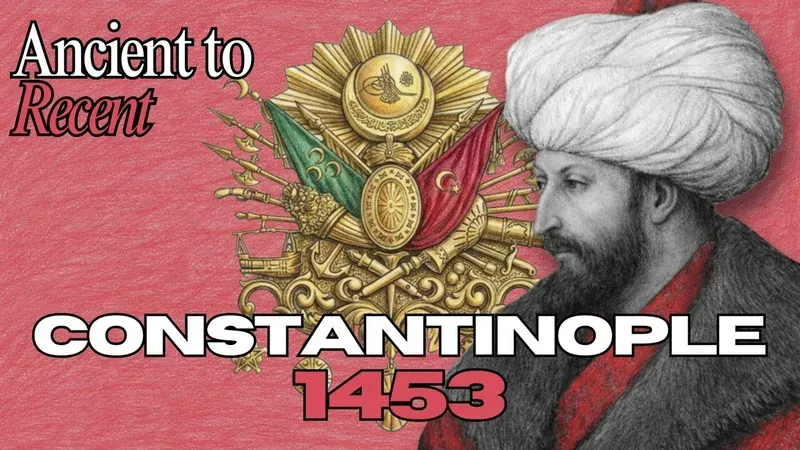 Watch on YouTube →
0:0038:21
Also on
Rate the show
Ratings are how new listeners find the show. It takes a minute and it makes a real difference.
In this episode of Ancient to Recent, Joseph Parkinson begins a new series on the long road to the fall of Constantinople.
For centuries the great city stood as the heart of the Byzantine Empire, a wealthy, powerful capital that guarded the frontier between Christianity and the rising forces of Islam.
From the early expansion of Islam under Muhammad and the Arab sieges of the city, to the catastrophic Fourth Crusade and the rise of the Ottoman Empire, Constantinople faced wave after wave of enemies determined to claim the Queen of Cities.
By the 15th century the once mighty empire had been reduced to little more than the city itself.
The stage was set for the final siege that would change history forever.
Join Joseph Parkinson as Ancient to Recent begins its series on the dramatic struggle for one of the most legendary cities in history.
🎧 New episodes every Saturday
📲 Follow on YouTube, Spotify & Instagram @AncientToRecent
#Constantinople #ByzantineEmpire #Ottomans #SiegeOfConstantinople #HistoryPodcast
Read transcript
This transcript is automatically generated, so it may contain typos and misheard names.
Verily, you shall conquer Constantinople. What a wonderful leader will that leader be. And what a wonderful army will that army be, The Prophet Muhammad on the banks of the Bosphorus. It's a city the likes of which few who have not seen will be able to conceive of. A city that to this day is called home by some 20 million people and has been the capital of three of history's greatest empires, Roman, Byzantine and Ottoman. A city that has captured the imagination of sculptors, poets, musicians, merchants, philosophers and soldiers for thousands of years.
It's bustling streets and crowded bazaars have been home to many peoples, from Greeks and Turks to Armenians, Genoese, Jews and Arabs. But of all the emotions that this city has, a boat, one of the deepest, one of the most keenly felt has been jealousy. For none can gaze upon her wealth, grandeur and beauty without wanting her for themselves. This is the city of modern day Istanbul, but she was once known as Constantinople.
Welcome to ancient to recent. My name is Joseph Parkinson and today we start a new series on the 1453 Siege of Constantinople. Episodes of Ancient Theresa are out every Saturday and are available on YouTube, Spotify and Apple Podcasts. First mention of settlement on what would be Constantinople is made by Plenty the Elder in his Naturales Historia, when he states upon which is the town of Byzantium, a Free State formerly called Lagos.
This was written sometime around AD 70, several 100 years after the original founding of the encampment. Byzantium was rechristened Constantinople on the 11th of May 330 AD, and became the new capital of the ancient world's original superpower, the Roman Empire. The site was selected for its combination of four distinct factors. The city was easy to defend on key trade routes, close enough to imperiled frontiers to offer support, whilst being far enough not to be under immediate threat. But it was not simple practicality that led the Romans to seek a new capital.
There was also powerful symbolic reasons. The Roman Empire's main focus was shifting east, and so a capital more central to the empire made sense. But this was not all. In the 4th century, Rome had embraced Christianity and a new capital seemed like a break with a Pagan past and to symbolize a bright new future dedicated to Christ. It is from the banks of the Bosporus Best Ride 2 continents that the Caesars would send forth armies to conquer and missionaries to convert.
Barbarians were to be made civilized and heathens to be saved. But only a few 100 years after the foundation of the Queen of Cities, a new challenge, the likes of which never before seen, would begin to stir deep in the Arabian desert. The challenge would assail the city not just militarily, but also spiritually. The Challenge of Islam. The Middle East is dotted with ancient civilizations and religious traditions that trace their roots deep into the mists of time.
By the 7th century, there had already been the Egyptians, Assyrians, Babylonians, ancient Hebrews, the mighty Persians and the vast domain of Alexander. But the Arabs, the rich in poetry, trade and tribal culture, had yet to produce their own contender for the crown of great power. This all changed with Muhammad IBM Abdullah, born around 570 in the bustling Caravan City of Mecca. Orphaned early, his father died before his birth and his mother when he was six. He was raised first by his grandfather and then by his uncle Abu Talib, in the respected Banu Hashim clan of the powerful Kurashi tribe.
Mecca was no backwater. It thrived as a commercial crossroads and pilgrimage hub, centred on the ancient Kaaba shrine, which housed hundreds of idols and drew worshippers from across Arabia. As a young man, Muhammad gained A reputation for integrity and fairness, earning the nickname Al Amin the Trustworthy. He worked as a merchant on the trade routes, encountering Jewish, Christian and Zoetarian communities along the way. At the age of 25, he married Hadija, A prosperous widow 15 years his senior, who became his devoted partner and 1st supporter.
Then around 6:10, at the age of 40, came the turning point. While retreating for meditation in a cave on Mount Hira overlooking Mecca, Muhammad received what Muslims regard as the first divine revelation from God or Allah. Through the Archangel Gabriel, the words began Recite in the name of your Lord, who created the opening words of what would become the Quran, the Islamic sacred scripture. Over the next 23 years, these revelations arrived in stages, forming a message of strict monotheism, social justice, moral accountability and a preparation for the Day of Judgement. Muhammad first shared this message privately with family and close friends, but when he preached publicly calling for the rejection of idols, protection for the vulnerable, and worship of one God alone, it threatened Mecca's elite, who profited from the polytheistic pilgrimage trade. Persecution followed mockery, boycott, torture, and violence against early converts.
In 622, the situation became untenable. Muhammad and his followers emigrated N to the Oasis settlement of Yathrib, soon renamed Medina. This event, known as the Hishra or emigration, marks year one of the Islamic calendar and the birth of the Muslim community, or Uma, as a unified political and religious force. I Medina. Muhammad forged alliances and defended the fledgling community in battles against meccan aggression. Through a mixture of diplomacy, alliance and military success, Islam spread across Arabia.
By 630, Muhammad returned to Mecca in triumph, cleansing the Kaaba of idols and rededicating it to the worship of Allah. When he died in Medina on June the 8th, 632, at age 62, nearly all of Arabia had embraced Islam. A faith born in the desert. It would soon surge outward across continents. At first, the Pies and Times did not fully appreciate the scale of the threat posed by the emerging Muslim armed forces, exhausted and preoccupied with the aftermath of their devastating 26 year war against the Sassanid Empire, 6O2 to 628, which had left both empires severely weakened militarily, economically and demographically. The Byzantines initially viewed the Arab raids as manageable border disputes or annoyances rather than an existential threat.
But gradually the Byzantines were pushed back. In 636, at the Battle of Yarmuk, on the modern border between Syria and Jordan, the Arab armies that had harassed and harried their Christian counterparts delivered a decisive blow, crushing the Byzantines and breaking Byzantine military might in the Levant. From this point on, one by one, the major centres of Eastern Christianity fell to the advancing armies of Islam. Damascus was already in Muslim hands, soon to be followed by Jerusalem, Antioch and Aleppo in 637, Alexandria in 641, Cyprus in 648. So rapid was the advance of the Muslim armies that it seemed all of what was once the Eastern Roman Empire, built over thousands of years, was going to be swept away like so much dust. In 674 Caliph Mawya dispatched a huge army, over 100,000 men and hundreds of ships to finally seize the beating heart of Christendom.
The Muslim armies a plan They would establish a toehold in Europe an inch by inch. Tighten the rope around Constantinople's neck, blockading the port, raiding the countryside, they forced the Byzantines back. They would not try and storm the city with its thick walls studded with towers. Instead, they would take their time. Through raids and attrition. They would strangle the great city into submission. But just as all seemed lost, the tide suddenly turned.
In 678, the Byzantine fleet launched A daring attack on the Muslim Navy. As the Byzantine ships closed for battle, great jets of liquid fire shot forth, consuming the Muslim ships in a sudden and devastating inferno. The very sea itself was set ablaze. The whole Muslim fleet that had terrorized the great city and commanded the seas was turned to floating ash in near minutes. The siege lasted for five years. 10s of thousands perished, but the city held by Emperor Constantine the 4th stood firm.
The Arab armies limped home, only to be further routed as it withdrew with massive casualties. These were the first major military setbacks for Muslim armies who until recently had seemed all but invincible. These victories also allowed the Byzantines much needed breathing room to gather their strength and stabilize the front. But peace did not last long. In 717 a huge Muslim army, some 80,000 men, advanced from the city, determined to avenge the defeat of decades prior. Convinced that the city could not be stormed, the Muslim commander decided that only slow strangulation would work, but this would require time and the ability to provision a massive army outside the city gates.
A colossal logistical effort was undertaken to provide the Muslim army with everything it required, including bringing seeds to sow the surrounding fields. The Muslim army would take as long as it took. The Bison times were led by Emperor Leo the Third. What he lacked in manpower, he made-up for in conic. Deploying A ruse so bold it's hard to believe true, he convinced the commander of the Muslim army that the city would surrender if the Muslims gave supplies to the city and then destroyed their own stocks. Defying all reason and logic, the commander of the Arab army fell for it.
What ensued was a predictable disaster. After receiving the supplies from the Muslims, the Christians sealed the gates, refused to surrender and let the Muslims to starve in the barren space outside the city walls. The Arab army, weakened by hunger and disease, faced A bleak winter, shivering outside the gates of the city as it consumed its horses and camels to survive. Leo, the master tactician, convinced the Pagan Bulgar Kingdom to attack the Arabs and inflict great slaughter upon them. In 718, the Arabs, realising all hope was lost, lifted the siege and staggered home.
But fate was not done with this most unlucky of armies. Not just yet. As the Arab ships sailed home, an underwater volcanic eruption caused the sea to rise and bubble, wrecking the ships, casting the surviving sailors into the boiling water to meet a terrible end to the Muslims. Repeated defeat at the gates of the great city posed a serious theological challenge. Was not all the world destined to accept Muslim rule? If this was so, how could defeat beneath the walls of Constantinople be understood for the Christians? They repeated triumph for proof that their religion was the one true faith, and that God looked with favour upon them. Defeat for the Muslims signalled the turning of the tide and end of a period of rapid expansion.
Muslim armies had advanced as far north as the Caucasus, as Far East as India and as far West as France soon found themselves fought to a standstill. Constantinople would now become a central fortress in the front line that marked the end of the Christian world and the beginning of the Islamic She would be a source of longing, of despair and hope, regeneration of Muslim caliphs, sultans and generals who would think back to those fateful sieges, those moments where history seemed to be on the verge of fulfilling its promises, and wonder what if?
For Christians, Constantinople was a symbol of defiance, the rock upon which the Muslim horde had dashed itself, a sturdy rampart of resistance that gave promise to a restoration of glory and ultimate triumph. As the centuries went by, army after army, emperor after emperor would cast itself against the walls of Constantinople. Huns and Tatars, Russians and Bulgars, all would try and all would fail. The city itself was designed as a vision of heaven on earth. It's why promenades and grand churches were constructed to inspire both awe and envy.
The smell of incense, sights of holy processions and the toll of church bells all meant to give the visitor the idea that Constantinople was God's city. At the heart of the divine city was the haggiest fear. Constructed between 532 and 537 by Emperor Justinian the First, it was the largest and most beautiful church in the world. Visitors from as far as Scandinavia and North Africa gazed in amazement at its grandeur. It was the site of the Church and the beauty of the Eastern Orthodox tradition that had converted Russia to Christianity.
The city was a place of unique religious fervour. Theological issues were debated as passionately then as football is today, with ordinary people from stable boys to wet nurses arguing the oneness of Christ or the place of icons within the Christian tradition. As the centuries went by, the Byzantine Empire expanded and contracted, provinces were lost and regions gained. One army after another marched through the gates of Constantinople or setting sail round the Golden Horn, determined to reassert Byzantine's place as the pre eminent power in the world.
The Empire would go through periods of rebirth, capturing lost territory, but would never quite become what it was before the Battle of Yarmouk. Byzantine found in Islam a foe qualitatively different from the hordes of Tartans or the tribes of Bulgars that periodically battered the city walls. In Islam, Byzantine found an ideological foe that did not simply challenge the Empire on the field of battle, but waged A relentless spiritual conflict for the heart of every convert.
But for a few centuries after the defeat of the second siege of Constantinople, the scimitar of Islam returned to it's sheath. From deep in the heart of Asia, the Thunder of hoofs could be heard. A new danger over the horizon stirred for the Byzantines. The Turkic people originated in the vast steppes in mountain regions of Central East Asia, with their proto Turkic homeland most commonly placed in the Altai Saian region around the Altai Mountains where modern day Russia, Mongolia, Kazakhstan and China converge. The area served as the cradle of early Turkic speaking groups who were initially semi nomadic, skilled horsemen and warriors living in a world of shifting alliances, harsh climates and endless grasslands.
The name Turk or Tuduk in Old Turkic first appeared historically in the mid 6th century with the Gok Turks. From their eastern heartland, Turkic groups began gradual western migrations across the EU Asian steppes, driven by climate shifts, overpopulation, conflict with neighbors, and the search for new passages and conquests. In the 5th century, Attila led his Huns, a distant cousin of the Turks, into Europe to strike fear into the hearts of the Christians.
By the 8th to 10th century, branches of the Turkic family had moved into the steppes north of the Caspian and Aral Sea, modern Kazakhstan, and Turkmenistan. These migrations accelerated in the 9th to 11th century, with Turkic people pushing southward and westward through Transnanesia, Central Asia and into Persia and Mesopotamia. A key branch, the Seljuks, converted to Sunni Islam around the mid 10th century, providing ideological drive for expansion.
They built the Great Seljuk Empire from 10:37 onwards. Thus, what began as distant steppe nomads from the Altai and Mongolian Highlands evolved into a major force reshaping the Middle East and Anatolia, blending with local populations, adopting Islam, and laying the foundation for later powers. Though the Turks were able to conquer much of the Muslim societies of the Middle East, the coming of the Turks, rather than heralding the collapse of the Muslim world, brought a renewed vitality and purpose. The Turks, skilled warriors, married their love of raiding in booty to the ideological message of Islam to spread the faith in all directions.
Islam that had been set back by defeats at the hands of the Christians and seen as expansion stall, now discovered a new zeal. The banner of the Crescent was on the March W once more. Soon Turkic raids were pressing deep into Byzantine land, and the Emperor in Constantinople could not sit behind his high walls and ignore the challenge. The Turkic threat was met at the Battle of Manzikerk in 1071, where the Turks shattered the Byzantine army, opening Anatolia to Turkic settlement and the road to Constantinople.
The Turks now found themselves governing over large Christian communities, many of whom were perfectly happy to exchange the emperor for the Sultan. Christians were protected as peoples of the book, and some chose to convert the new faith. Christian minorities positively welcomed the coming of the Turks, who persecuted them less than their fellow Christians. Efforts were made to reconquer the Byzantine hinterland, but all failed. Manzi Kirk could not be undone.
The Turks, finding a land, temperate and climate and rich in soul for grazing and sowing, were here to stay. The spread of Islam had not gone unnoticed in Western Europe. The Pope in Rome watched as the cradle of the faith, with it's once great cities as a Christian tradition fell to Muslim armies. Pope obeyed the Second in 1095, called the believers to seize from the Saracens, as Muslims were called by Christians the former Christian heartland. By this time, the Christian Church had split into Western or Catholic and Eastern or Orthodox faith. In 1054, rather than welcoming the support of their Christian kin, Orthodox Christians often found themselves beset by marauding bands of Catholic Knights who knew little of their faith and were also eager to express their contempt for those they had come supposedly to aid.
Byzantine saw Catholics as ignorant Barbarians and Catholics viewed the Byzantines as little better than semi oriental heathens. Byzantine had gone through repeated periods of set back and revival. She had been greatly weakened by the defeat at Manzukirk which stripped her of her Anatolian hinterland. But Byzantine was not finished yet. Though diminished, Byzantine could still command the western crust of Anatolia, much of modern Greece, Crete, and even colonies in the Crimea. It was from the West that the shattering blow from which Byzantine would never recover would be delivered. Mutual hatred between Catholics and Orthodox had been steadily growing.
This would find its greatest expression in 12 O 4. The 4th Crusade had been called to wrest Christian lands from Muslim occupation. The pious who signed up gathered in the Italian city state of Venice, believing their destination to be Egypt. One can only imagine their surprising 12 O 3 when it was Constantinople that appeared before them, not Alexandria. Venice, under the supposedly blind Doge Enrique Dandolo, had been charted to transport the Crusades to the Holy Land, but without payment forthcoming, he decided to put the Crusade to his own use.
Playing on divisions in Constantinople, the Doge picked up a pretender to the throne, Alexios the 4th, and used him as a pretend to attack the city, with Alexios promising massive rewards if he was assisted. With Alexios on the throne, The Crusaders expected their just rewards, but promises, it turned out, were easier to make than to keep. With no payment forthcoming, The Crusaders lost their temper. Rampage through the city, massacring it's people, plundering and desecrating it's places of worship and carrying away what they could. Men who had set out from France in the lowlands to restore the cross to Jerusalem had dealt a blow to Eastern Christianity that the Christian faith has never recovered from. The city was a shell, it's population reduced, grandeur a faded memory, wealth plundered.
Byzantine continued as little more than a memorial to its former glory. For the next 60 years, the Lassen Empire would call Constantinople its capital before being recaptured by the Byzantines in 1261. By then, the city was little more than a pile of rubble. Geopolitical earthquakes were not limited to the Christian world. Deep in the Asian steppes, a new power was emerging. Temüjin, a young man from the unfancied nomadic Mongol people, managed to unify the warriors of the steppe and unleash them upon their neighbors. 1 by 1.
The city dwelling empires of Central and western Asia were overridden by Mongol warriors, sending waves of refugees into Anatolia. In 1243, the Mongol squared off against the most powerful of the Turkic empires, the Seljuks, delivering a crushing defeat. The Seljuk Empire that dominated much of Anatolia collapsed, leaving behind a patchwork of squabbling statelets and warring bands. From this vacuum emerged a new power founded by Osman, soon to be known as Osman the First. He too would dream of conquering Constantinople. Osman's dynasty, known to history as the Ottomans, were blessed by fortune.
Born between a shattered Byzantine Empire too weakened by the 4th Crusade to reassert itself, and the ruined Seljuks, all of a sudden, Anatolia was there for the taking. The Ottomans didn't wait around to count their blessings. They quickly acquired as much land as they could. In 1326, the Ottomans had their first major success against the Byzantines, capturing Bursa just South of Constantinople and making it their capital and power base from which they would plan and direct their expansion. Perched on the coast of western Anatolia, the Ottomans were in prime position to expand both eastwardly into the Levant and West into Europe.
The constant civil war the Byzantine state hosts, the 4th Crusade provided plenty of opportunity for the Ottomans, with Byzantine emperors keen on making use of the skilled Ottoman warriors to settle disputes with their Christian rivals. In 1350, a Muslim army and the invitation of the Byzantine emperor set foot in Europe for the first time in nearly 7 centuries. In 1354, the Ottomans occupied Gallipoli, on the West Bank of the Dardanelle Straits. Steadily, piece by piece, the Ottomans expanded their presence in Europe.
The Ottomans were practical rulers, the Muslims themselves. They ruled A diverse number of peoples and made no attempt to convert their largely Christian subjects to Islam. Many Christians preferred the light touch of the Sultan to the heavy hand of emperor or Pope. Actually proselytizing was positively discouraged as Christians and Jews, though protected from discrimination, paid the jizra the tax on non believers and the Ottomans wanted the coin more than the converts. The Ottomans took a unique view of statecraft that must have seemed bewildering to the Christians of Europe. Rather than favouring the first point son as the next successor, or excluding those born out of wedlock in the Ottoman tradition, any son could be the next Sultan. This had its advantages and disadvantages. There was less pressure for the production of an heir as the next Sultan could just as easily be the son of a milk maid as a Princess.
The Ottoman Empire would never have produced a figure like England's Henry the Eighth obsessed with the production of a legitimate heir, as all heirs were by default legitimate. The Ottomans therefore had a surprisingly diverse gene pool to draw upon for their rulers, avoiding the horrors of cousin marrying cousin and uncles wedding niece that produced so many physically and mentally handicapped rulers in the House of Habsburg. But there was also a lethal downside to this practice. With no clear successor, the death of the Sultan resulted in a scramble, a mad dash for the throne that inevitably lead to bloodshed that uniquely primed the Ottoman Empire for civil strife as brother squared off against brother. In an effort to end such contests, Sultan Rudd the Second officially legalized the practice of fratricide, with the chosen son bumping off his brothers sometimes in mass killings.
Ottoman innovation did not stop with the government. The Ottomans, descendants of the nomadic tradition of horseback riding Archers riding circles around heavily armoured Christian Knights, were also innovators in the art of war. The nomadic tradition, with it's emphasis on lightly armoured horseback Archers, had merged with the Muslim concept of jihad to form a potent new force that drove the Ottomans to conquer ever more land. But if the Ottomans were to retain their advantage over their Christian and Arab competitors, further innovation would be required.
The Ottomans, Christian rivals, relied on troops drawn from peasant levies, hardly trained, badly disciplined, with Pike thrust into their hand and sent to the front, or a tiny elite of consecrated Knights, powerful in combat but too few to be more than a chosen brotherhood. The Ottomans need something unheard for the time they needed a standing army, patient, disciplined, technically skilled in the science of war, from skirmishing to the construction of siege engines.
This new force would take the Ottomans from regional player to global power. In 1363, Sultan Murad the First decided he required new soldiers. Or literally in Ottoman Turkish, Yeni, Surrey. It is from this that we get the word Janissary. The Janissaries were recruited from conquered Christian peoples of the Balkans. The first born son of each Christian family would be given, or more accurately taken for service to the Sultan. The child would be circumcised, converted to Islam and taught Turkish.
The Ottoman state was able to draw on a professional army, better trained, more highly motivated and stripped of family loyalty, committed not to the service of any great house or dynasty, not loyal to a Lord or aristocrat, but instead to the Sultan and the Ottoman state alone. There was a further psychological aspect to the Janissaries. For the Christians of Europe, the thought that it was their own converted children enslaved, radicalized and sent against them was further terrifying.
Whilst the Ottomans were building an army and a state, the Byzantine Empire was tearing itself apart. Constant struggle with its neighbors, civil strife in the streets of Constantinople as occupants of the throne change at a frightening rate. An endless procession of civil wars, dynastic conflict and military coups hollowed out the Byzantine state. But even worse than internal bickering or external invasion was succumb an invisible threat.
The great empire of Genghis Khan and his descendants swept states away, tore down trade barriers, and mercilessly crushed banditry. For the first time it was relatively quick and easy to travel the vast distances of Asia. Though of great benefit to merchants and traders, there were other, more deadly consequences. Deep in the heart of the Gogi Desert in the West of China, looked to terror the likes of which had never been seen before.
A disease carried by fleas that travelled on the backs rats. Once bitten, the disease would incubate for anywhere between two and eight days. On the 8th day, the victim would suddenly develop a high fever, severe chills, intense headaches, fatigue and body aches. On the 9th day, lymph nodes, typically in the groin, armpit or neck would swell to the size of an apple. This was accompanied by extreme pain where even the slightest touch could leave the victim convulsed in agony, skin turned red, sores developed, vomiting and diarrhoea were common.
By the 11th day the swelling grew larger still, oozing foul smelling puss and blood. The body racked with pain as the organs broke down. Fever, racing, vomiting blood, and slurred speech followed. Black or purple rashes appeared in the body. Extremities such as fingers and toes turned black soon after. The victim was quite dead. The Black Death was one of the most deadly diseases in all of history. Before the Mongols, the distance between encampments was too great, the journey too treacherous, and the speed of movement too slow for the disease to spread far. But once the Mongols had unified much of Asia into one smoothly administered body, the disease spread like wild fire. In 1346, the Genoese colony of Kafir, on the shores of the Crimea, was besieged by the Mongols. The Mongols, ever the innovators of violence, catapulted corpses infected with the disease over the walls. Within days, the Genoese started dying like flies. Desperate refugees boarded their ships and sailed away for Constantinople.
The sight of Genoese ghost ships drifting in the Black Sea, their crews long perished, haunted those who encountered them. The Black Death arrived in Constantinople in the summer of 1347. With the epidemic exploding in early July, the city, already a vital crossroad between Asia and Europe, became the first major European hub struck, turning the once mighty capital into a city of the dead. The great city, home to hundreds of thousands, perhaps half a million souls at its peak, emptied with terrifying speed.
Contemporary reports speak of daily deaths in the thousands. At the height of the pandemic, the emperor himself lamented how fathers abandoned dying children, priests fled their flocks and doctors hid away scribbling wheels instead of cures. The once thriving forums and basilicas echoed with the cries of the afflicted and the silence of the dead. Estimates vary, but the first wave lightly claimed between 40 and 50% of Constantinople's population in that brutal year of 1347 to 48.
The plague lingered for months, recurred in ways for decades after, but that initial strike shattered an already broken empire. Trade stalled, the army weakened, and the Empire, already battered by civil war, teetered close to collapse. Yet amid the despair, some clung to faith. Processions wound through the streets. Icons carry high prayers, rising against the unseen enemy. But no relic, no prayer, no quarantine could halt what had come on those dune ships from the east, from Constantinople. The horror didn't stop.
It leapt onward, carried by fleeing merchants to Sicily. By autumn, then, Genoa, Venice, and the rest of Europe, the Black Death had found its way into the West. The city was all but ruined, the palaces bare, the basilicas stripped of their finery by crusading Knights. So impoverished had the Emperor become that the jewels of the imperial crown were made of glass, and the plates used at banquets were indistinguishable from that of those found in the hovels of any pauper. The Ottoman advance into Europe continued. In 1362, the Ottomans took the city of Adrianople, or modern day Adrina, 140 miles to the West of Constantinople. Virtually encircling Constantinople and cutting it off from the Christian world.
The Ottomans came to show that they had come to stay, moved the capital from Bursa on the Asian shores of Turkey to Adrina, firmly on the soil of Europe. After defeating the Serbs in 1371, the Ottomans were even able to reduce Constantinople, the once capital of the mighty Roman Empire, to being a vassal state and the emperor the servant of the Sultan. By the 14th century, the Ottoman Sultan ruled a domain that stretched from Sofia in modern Bulgaria to the banks of the Euphrates. The Byzantine emperor controlled little further than the suburbs of Constantinople itself.
In the late 14th century, the Pope sent 3 crusades to rollback the advance of the Ottomans, each a lumbering mass of ill disciplined peasants, each led by squabbling bands of entitled European aristocrats. Each met the same fate at the end of the Janissary Sword, but still the Ottomans cast envious glances to the Queen of Cities, and still she defied them. In 1394, Emperor Emmanuel renounced his pledge of vassalage to the Ottoman Sultan and reasserted Constantinople's independence once more. In punishment, Sultan Baezid the First besieged the city in 14 O two, only to be forced to lift the siege due to a clash with the Mongols that culminated in the Battle of Ankara, where the Ottomans received a shattering blow that almost brought the collapse of the Empire.
Manuel frantically sought help from the Christian W, even taking the extraordinary step of leaving the city and touring Europe in 1399 to 14 O3 to make the case in person. He visited Italian states, France, even making his way to England to meet King Henry the 4th. Manuel pursued a policy of trying to stir up trouble in the Ottoman Empire by encouraging 1 pretender to the throne after the other. The new Ottoman Emperor, Murad the Second, sought to punish the city and yet again lay siege, this time introducing a new deadly weapon, the cannon.
Dilapidated as Constantinople was, it's walls were still mighty and the spirit of its people to resist remained unbroken. The siege was lifted by the mid 15th century. Constantinople was the last missing piece of the puzzle that the Sultan needed to complete his great empire. But still she held out for the Ottomans. They can no longer wait for the buys and times. Time was running out. The stage was set for a final showdown.
Thank you for listening to Ancient to Recent. My name is Joseph Parkinson and next week we will continue our story of the siege of Constantinople. Episodes of Ancient to Recent are every Saturday and are available on YouTube, Spotify and Apple Podcasts.