
#40
The Haitian Revolution — Part 5
7 March 2026 · 39 min · Season 1
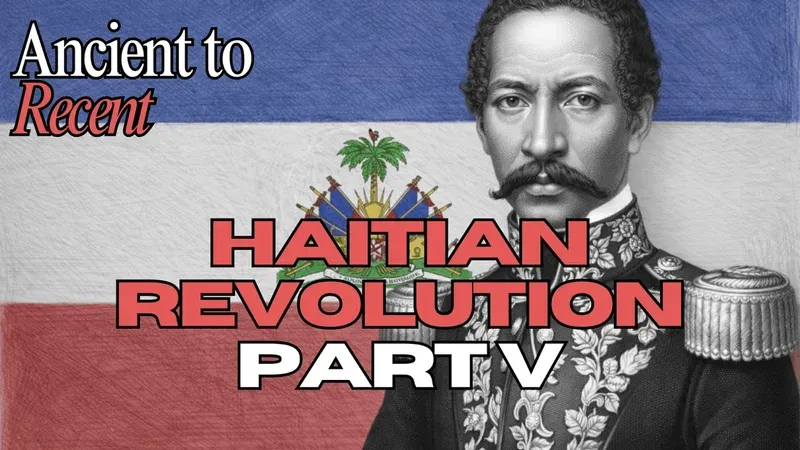 Watch on YouTube →
0:0039:45
Also on
Rate the show
Ratings are how new listeners find the show. It takes a minute and it makes a real difference.
In this episode of Ancient to Recent, Napoleon Bonaparte launches one of the largest overseas expeditions of the age to crush Toussaint Louverture and restore French control over Saint-Domingue.
In 1802, a vast armada carrying tens of thousands of soldiers sails across the Atlantic under General Charles Leclerc. Publicly, France promises to defend emancipation. Privately, Napoleon prepares to dismantle Louverture’s regime, purge the island’s leadership, and ultimately restore slavery.
What follows is a brutal and chaotic war.
Louverture’s forces adopt scorched-earth tactics, drawing the French into the mountains while disease, hunger, and guerrilla attacks slowly destroy the invading army. Betrayals, shifting alliances, and racial violence fracture the island as commanders like Dessalines and Christophe rise to prominence.
Louverture himself is eventually captured and deported to France, where he dies in a cold prison cell. But his warning proves prophetic: the roots of liberty in Saint-Domingue run too deep to be destroyed.
As yellow fever devastates French ranks and Napoleon’s true intentions become clear, former allies unite against the occupation. The struggle transforms into a war for independence that will end French rule forever and give birth to the nation of Haiti.
Join Joseph Parkinson as Ancient to Recent concludes its series on the only successful slave revolution in history.
🎧 New episodes every Saturday
📲 Follow on YouTube, Spotify & Instagram @AncientToRecent
#HaitianRevolution #Haiti #ToussaintLouverture #Napoleon #Dessalines #FrenchRevolution #Abolition #ColonialHistory #HistoryPodcast
Read transcript
This transcript is automatically generated, so it may contain typos and misheard names.
I am for the whites because I am white. I have no other reason, and that one is good. Napoleon Bonaparte. The great wooden beams that made-up the decks of the ships creaked the rigging, swayed, the mass thrust into the sky, bristling like timber bayonets of the vast army of the ocean or battered by the relentless Atlantic wind. Every detail of the expedition had been planned, measured, weighed. The full arsenal of the Science war deployed calculated, quantified sacks of vegetables, barrels of water, so many 1000 tons of feed for so many thousand horses, powder cannonballs, Sabres, flour for hard tack, biscuits so sturdy men jokes they could stop a musket ball, water, wine, and importantly, citrus fruit essential for any expedition to combat the sailor's worst nightmare, scurvy.
All was ready. All was prepared for an expedition like nonsense. Columbus himself departed for the New World in 1492. Seven thousand of the finest soldiers of the Grand Army, the victorious legions of First Consul of the French Republic, Napoleon Bonaparte gathered together in the port of Breast awaiting for their orders to depart. But unlike Columbus, these men were not sailing into the unknown. They had a clear objective, the restoration of authority and control over the recalcitrant colony of Santa Man and claiming for France it's rightful place in the Americas.
Welcome to ancient to recent, My name is Joseph Parkinson and today we continue our story of Toussaint or mature and the Haitian Revolution. Episodes of Ancient to Recent are out every Saturday and are available on YouTube, Spotify, in Apple Podcasts. Despite weeks of preparation, no amount of logistical brilliance could command the obedience of the weather. For 37 days, the French commander Charles Victor Emmanuel Leclair waited.
Leclair's career in the army had been fast tracked by the revolution. Not of noble birth himself, his father being a flower merchant, his career prospects would have been limited in the army of the onsen regime. But with the revolution in full swing, he now found the path cleared for his seamless and rapid rise through the ranks. It was during his ascent that he met and befriended a young artillery officer by the name of Napoleon Bonaparte, even marrying Napoleon's younger sister.
Pauline Leclerc had fought by Napoleon's side in Toulon in 1793 and then in Italy before playing a crucial role in the 1799 coup that put Napoleon to power. The expedition was departing in response to Toussaint Longmechur, now Master of All Saint de Man, issuing on the 12th of July 1801, a constitution that declared or seized, as Napoleon saw it, the right to self rule in the French Empire for Saint de Man and the declaration of Toussaint as Saint de Man's governor on life. Napoleon had initially been inclined to accept Toussaint as governor, but with events turning in France's favour on the battlefields of Europe in 1801, Austria having been defeated at Marengo, the kingdoms of Nepal and Russia both made peace.
With France and Britain entering into negotiations, Napoleon suddenly found his hands free. The convoy departing breast into the fast Atlantic was just part of a huge fleet, some 50 ships, roughly half of France's entire Navy, with some 22,000 soldiers supported by a further 20,000 sailors. Neither Napoleon nor Leclerc were taking the task. Likely on the other side of the world, Lumbershire, new events were stirring, but he did not know for what reason.
Was Leclerc coming to overthrow him or to protect him? Surely, as a loyal son of France and a soldier in the service of the government of Paris, he would have no problem with the arrival of French troops in a French colony. Among the fleet's passengers were two particularly important guests for Toussaint, Isaac and Placid Le Vitur, Toussaint's sons, who had been sent to France to complete their education. Buonaparte had met the boys and told them the army was to strengthen the French position on Saint de Man, not to remove their father.
Napoleon, technically Toussaint's commanding officer and sovereign, had given the boys a letter for Toussaint asking him to submit to the authority of Le Clair. But Toussaint was not the only person who is watching the fast Amalek make its way through the waves with trepidation. Britain may have been finalized in terms of peace, but few expected hostilities to be permanently suspended. Rather, both nations were simply catching their breath, ready for round two. Bonaparte was at first well disposed towards Long Mature, promoting him to the rank of Captain General of Saint Daman, which would have made him the supreme commander of all French army personnel, white and black, on the island. But Bonaparte's opinion changed as Long Vitur amassed more power, particularly after Long Vitur occupied the eastern part of the island, formerly San Domingo, even though the occupation was carried out in the name of France and officially sanctioned by the 1795 treaty signed between France and Spain.
Bonaparte rescinded Long Vitur's promotion, but still did not move formally against him. Things change with the arrival of news of the Constitution of Santa Man, constructed by l'ambertur with no input from Paris. Napoleon, suddenly freed from the threats on France's border, took the Constitution as an affront to France's dignity and a challenge to his authority. Saint-Domingue was officially speaking French and therefore subject to French law.
With Napoleon as the supreme authority, how could a French officer design laws to rule over French citizens on French territory, and all without consulting France herself? Napoleon argued that such a move was contrary to the dignity of the French nation and could not be accepted. Toussaint was still keen to maintain ties to France and eager to win time to restore his war-torn country. Tried to negotiate but Napoleon was in no mood.
Napoleon set out a three stage plan for the removal of Long voucher and the overturning of his regime. Firstly Le Clair Woodland posing as a friend coming to office support from the mother country only to set about testing the waters and soliciting support from free blacks, especially in formerly Spanish Santo Domingo. Le Clair was then to appeal to lower rank officials and use them to come up with a pretext for the removal and then deportation of Longichore.
With Longichore out of the way, the government and armed forces of the island were to be thoroughly purged. White officials, seen as two prolonged mature, were to be removed from the island. But with the black population, the purge was to be less subtle. Any black officer over the rank of captain was simply to be deported, regardless of their opinions. Before moving against Lumberjack, Napoleon needed to sheep the narrative in the French press. Old planter prejudices were given full bent, with lurid reports of black depravity filling the pages. That's allowing Napoleon to frame the expedition as a crusade pitting white civilization against black sabotry.
Support from the international community would also have to be won, especially from Britain. Hostilities between Britain and France may have been winding down in 1801, but Britannia still ruled the waves, and the transit of so many ships over so vast a distance could never be accomplished without the consent of the Royal Navy. But Napoleon was pushing on an open door with the Spanish, British and American. None wanted San Damang to succeed or view the example of slaves rising up and establishing their own society as a potential existential threat to their own slave holdings either in the Caribbean or mainland.
Americans. Once Leclerc had removed longer chore, decapitated both the government and army in established control of the island, the plan was simple to reimpose slavery, but to assure the success of the expedition. Napoleon publicly declared his commitment to emancipation, aware that nothing would solidify the island's black population behind long mature like tipping his true intentions to restore the lash and the chain.
Such plans, even by a legitimate genius as Napoleon Bonaparte certainly was, may seem fine and good on paper, but ignore a stark reality, a reality that Napoleon would have been aware of had he ever visited the island, or for that matter, if he simply looked out the window. A decade of revolutionary warfare had a transformative effect in France, and the chances of returning the French people, once the subjects of an absolute monarch with few rights, ruled over by a clerical class and their opportunities for advancement hemmed in by an aristocratic system that barred commoners from many professions, were slim indeed. There had been a fundamental shift in the mindset in the intellectual universe of the average French person in how they saw themselves and their place in society. If this was so in France that imagine the difference such a process would have In Saint Domingue. People want literal slaves with neither rights nor property, had overthrown their masters, fought and killed white soldiers and now ran society.
Such people would choke the rivers of Sandeman with their own dead rather than ever submit to being returned to bondage. What is more surprising is that Napoleon did not seem to realise that such a campaign fought half a world away from resupply and reinforcement, in a climate lethal to white soldiers, against a highly motivated foe, and by troops in total ignorance of their surroundings, was surely doomed to failure.
And yet rational thought was clouded by racial prejudice. Napoleon's position on lumberjores seemed to evolve with time, crushing Sandoman. The end, he was urged to by close aides, many of them planters, was one option, but so was the idea of recognizing Toussaint and using Sandoman as a weapon. Other powerful voices in the French government, such as Charles Maurice de Tallerat, one of the 19th century's most Machiavellian figures, a character as indispensable in his talents as he was promiscuous in his ideology, seem to see what Napoleon could not. Restoring direct power of a Saint-Domingue would be a byword for burning the colony to the ground and killing much of its population whilst wasting the lives of countless French soldiers.
The conquest would not end the violence, but rather the maintenance of control would require an ongoing and costly occupation. The colony would not be a bonanza, it would be a weeping ulcer. But should France recognize the liberties of the colonies as slaves, then sand a man would be not just a gold mine from which France would draw incalculable wealth, but also a barracks for the recruiting of soldiers and a dagger aimed directly at the heart of some of Britain's most valuable colonies?
What effect, Tally Ran pondered, would black skinned soldiers in the service of France, speaking the language of liberty and freedom, have upon the toiling masses of British Jamaica and Barbados? Napoleon was not necessarily an ideological racist, nor was he an idealistic radical. What mattered to Napoleon was power. The idea of using Santa Man against the British had its appeal, but it would require Napoleon to eat a slice of humble pie and this was a dish that, for the future emperor, was never on the menu. Rumours of the coming of Le Clair Le Lombardo to issue a statement declaring his loyalty to France and dismissing reports of his imminent removal.
But whilst publicly declaring all was well, l'ambertur became quietly preparing for the worst. Thousands of troops were recruited, bringing his forces up to 23,000. A local militia was established to serve as an auxiliary force. Word was sent to all ports. No warships, regardless of nationality, were to be allowed to land without L'ambertur's expressed permission. In late January 1802, the Claire's Armada arrived up the coast of the island.
Leclair's plan was to occupy the island's major towns and then advance down the coast, taking all strategically important positions. Leclair sent a message ashore informing local officials that he had come to defeat rebels, who these rebels exactly were, and what they were supposedly rebelling against, Leclair's message didn't say. Leclair assured local people that he had come to protect them and not to restore slavery, whilst also making clear that no opposition to his authority would be tolerated.
Despite the high mining rhetoric, the sights of a heavily armed fleet taking up positions around the island ready to disembark troops left little to the imagination, and when French troops landed near Lakau, they came under immediate attack from black defenders. Dozens of French troops were killed before the defendants were overwhelmed, with many of the surrendering blacks summarily executed. Le Clair, denied entrance to the town, decided to seize the town by force. Troops were ferried to shore before marching on Le Cow. Friendships began shelling the town. The town was set to the flame by the local commanders before pulling out.
All hopes in negotiation or compromise had failed. The die was cast, the course set. It would be war. Lanvature said about organizing the defence of the island. The recruitment of fresh troops was stepped up with every able bodied man pressed into service. Policy of slash and boom was decided upon. Nothing was to be left that could aid the enemy. Not a spring to drink from, a tree to eat from, nor a house to shelter in. Deprived of supplies and forced to live or what they could carry, Longfiture was certain that disease, the coming of the rainy season and hunger would do for the French much more quickly than musket balls.
Leclerc met fierce resistance as he advanced along the coast. Lomachur's troops sought to delay the advance of the French whilst they have the time to carry out their policy of slash and burn. The coming of the French did not necessarily rally support Lomachur. They had long been resistance to Lomachur's reign, and Lomachur has spent many years putting down constant rebellions, not to mention his recent and violent defeat of his principal rival, Andre Regard, which had been followed by mass reprisals against Regard supporters. Some people, including officers in L'onberchur's army, welcomed the coming of the French and readily went over to Le Clair. And not just white officers, but black too. Le Clair was aided by L'onberchur's own missteps. The eastern part of the island was commanded by Toussaint's own brother Paul.
Toussaint sent messengers to Paul carrying two letters, one ordering Poor to resist, the other a false letter, only to be presented if the messengers were captured. Ordered Poor to submit to the French, the messengers were indeed captured, and the French, guessing the ruse, executed the messengers and presented the false letters to Paul, who, believing he was following Toussaint's orders, subsequently surrendered his force without a fight, a major blow to Toussaint's hope for victory. Despite these early victories, Le Clair was already facing predictable difficulties.
Without the ability to live off the land and with resupply several thousands of miles away, the French army soon began running short of everything from food to footwear. Leclerc, maybe not quite the man of the Enlightenment that he liked to think of himself, blamed such setbacks on the Jews. Disease began taking a predictable toll, with the hospitals soon filling with the sick and the graves with the dead. Leclerc began sending a stream of letters back to Paris, begging for both reinforcement and resupply.
The French army faced great frustration. The forces along the chore fled in the face of the oncoming French legions, only to reappear behind boulders and from hilltops to fire a few well placed volleys and then disappear yet again. But the French pressed onwards, taking one smouldering town after another. Long the chore sought to draw the French further inland, into the dense forests and steep mountains where the French technological advantage would be mitigated by the Haitian familiarity with the terrain. Within the Haitian ranks, there had long been a debate, one that picked away at those in command, what to do with the island's white population.
Lombechour had been keen to extend the offer of citizenship in a multiracial state to the white colonists. Others, viewing all whites as their oppressors, wanted a more permanent solution. Many of Lombechour's commanders viewed whites as a fifth column, inherently suspicious and untrustworthy. Officers in L'ambertur's army started taking whites as hostages. Some began killing whites as they were drew in the face of the French army, even killing white soldiers and officers who were fighting in the ranks of L'ambertur's own army.
Of all those that took the most aggressive attitude towards whites, 1 of L'ambertur's commanders stood out. Jean Jacques Desaline, born in 1758, was a former slave who had worked the sugar cane fields. He had taken the last name Desaline's after the man who had purchased him, who was himself a free black man, and Desaline had eventually acquired his own freedom. He'd been fighting in the revolutionary ranks since the early stage of the uprising, and had risen to be 1 of Lumberjoer's senior commanders.
Desaline now took a ruthless attitude to the white community, freely ordering the execution of whites. French troops as they advanced began finding piles of white civilians buried in shallow graves in the wake of the retreat of Desaline's men. The mass racist killing of whites it must be said was not universal with some black soldiers and officers going out of their way to protect white civilians. Long Bichore trying to draw Laquette into the mountains, hoping to use a fortress built when the British as a strong point garrisoned by Desaline to tie up the French troops whilst Long Bichore rally troops for a surprise attack Long which were hoped would smash the French force. The French had been hoping to force a decisive battle, wanting to end the guerrilla warfare and deal with Longvature once and for all.
The Fort was called Crete a Piro. The French arrived at night, taking a group of Desoline's men that had been encamped in the open by surprise and routing them. Seeing a chance of a quick and decisive victory, the French carried away surged forward, only to find themselves in the dim light and confusion of battle in the open in front of the Fort with no cover, the defenders raked the French ranks with musket fires, siding down whole groups of men and sending the French scrambling back in panic. French casualties soon mounted.
The French found themselves constantly harassed by raiding parties. The black soldiers under Desane's command used to have vast experience. Many of them have been fighting longer than the French troops, and they used their unique knowledge of the dream to constantly harass the French, appearing from seemingly nowhere, inflicting casualties, only to melt away as the French came after them, then to spring forward yet once more as the French withdrew. The French troops amassed for an assault on the Fort, but knowing his chances of success limited in a pitch battle, Desaiin withdrew.
A small skeleton force was left behind and the Fort was surrounded. The French bombarded the Fort before launching A frontal attack, only to be thrown back. The French settled in for a siege, hoping to starve the Haitian troops into submission. The small Garrison decides to launch a breakout attempt that fought its way through the French lines, and the French in turn were able to occupy the Fort. In the end, after all the loss of life, the French found themselves in possession of an abandoned Fort in the middle of nowhere, with no strategic value. Such an encounter was typical of the war in Saint-Domingue, but Long Bichal was still experiencing setbacks, and the kleck spirit was boosted by a major defection, Henri Cristo, born to a slave mother and a free father in 1767, who had been a slave at an early age and fought in the French army during the American Revolution.
Before siding with the revolution in Saint de Mang decided to switch sides. His decision was in part motivated by news from across the Atlantic. By now, word of France's peace with the British had reached the island. More of Long Beach's commanders began to trickle over to the French as Haitian morale began to slide. Longichur realised that France had a nearly limitless number of troops to deploy to the island and now further weakened by high-ranking defections, contacted Leclerc to open negotiations.
Longichur and Leclerc met in the CAP and an agreement was reached. Longichur would retire as a private citizen, leaving politics for good, and live out his days on his plantation, allowed to keep his rank in the French army. But his public life in Santa Man is to be over. But Leclerc was delighted, always going to plan. Lanvature had been humbled. The colony was once more in French hands. Though Leclerc was eager to boast of his conquest in letters to Napoleon, his forces had taken a considerable beating.
The French may have bested their enemies, but so great was the toll, he doubted that they would be able to hold the island without considerable reinforcements, especially as Lanvature may have surrendered. But resistance had not ceased. Triumphalist reports sent back by Leclerc were being published in French newspapers, and such papers were still making their way back to Sandy Man. Inflamed by French arrogance, resistance continued. Rebel set traps such as open pits concealed by branch and shrub, studded with stakes where any French soldier not watching their step would four and be impaled. Rebels disguised cannons as empty tree trunks and fashioned poisoned arrows even send me word of willingness to negotiate only to ambush French troops that had come to take their surrender.
All of this took a deadly toll on the French army. So desperate did the French manpower shortage become that Leclerc even had to press surrendering rebels into the French ranks to fight those still resisting. The rebels were masters of ambush, of hit and run. They would roll rocks down steep hills to crush French soldiers or poison wells, anything to drag the campaign out, hoping the climate would take its toll on the French ranks.
The clerk decided that Toussaint's continued presence on the island was giving the rebels hope, and the only way to end the resistance was to remove Toussaint from the island physically. Toussaint was summoned to a meeting, ambushed and arrested. Along with his wife, Toussaint was summoned to a meeting ambush and arrested. Toussaint, along with his wife and son, were forced into a ship and departed for France. Upon boarding the ship, Toussaint declared, In overthrowing me you have cut down in sand. Demand only the trunk of the tree of Liberty. It will spring up again from the roots, for they are numerous and they are deep.
The clerk sent instruction to the minister for colonies to watch longer chore like a hawk, keep him under lock and key at all times, observe him night and day, and under no circumstances let him escape, instructing that Toussaint be kept as far as possible away from any ports or any possibility of return to the colony. Disease was rapidly tearing through the French army, and the summer months would be the most deadly. Napoleon had hoped that the campaign would be over by then, but the war dragged on.
More fringe troops were sent to bolster Le Clair's army, but they died in their droves, with as many as 50% perishing from the climate. Within mere weeks. The French army was losing 100 soldiers to the disease a day by late 1802, and month by month the rate of loss was climbing. French soldiers died in agony, shivering with fever, their urine and feces red with blood, yellow bile foaming from their mouths, many of them no more than teenagers, they slipped into delirium before passing on to the next life.
Wrapped in a white blanket, you were tossed into open graves by their comrades who were soon to join them. Le Clair had to rely more and more on black officers recruited for non virtual loyalists such as Christo and the newly defected Desaiim. Le Clair, so heavily indebted to black soldiers now grew paranoid, certain that the blacks were simply waiting for the moment to strike. Ironically, Desane and Christo with a few officers who actually held the French army together. They were motivated by mutual loathing of their former allies in the rebel army, who they viewed as potential rivals for the future leadership of the island. They would use the French to destroy their rivals, and then use the rebels and disease to destroy the French. Once the French was sufficiently reduced, they could then make their move.
Desayen's reputation for brutality earned over many years, first in the initial uprising, then in war against Andre Regard, then against the Whites after the French return, and now against his own political enemies, grew. Leclerc even dubbed Desayen the Butcher of the Blacks that the Claire could not fulfil Napoleon's three-part strategy as he found himself totally reliant on black soldiers and especially the black officers to maintain orders.
He sought to enact the parts of the orders he could whilst ignoring what he could not. Part of the plan required the disarming of the general population. This was a task that Claire passed Desain who was only too eager to fulfil his new masters wishes, knowing it would put him in the strongest position for his dash to power when the moment came. Fearing disarmament would be a first step to the restoration of slavery, many ex slaves rose in opposition with some black officers who had sided with the French now passing back to the rebels.
French policy was not just failing to pass by the island but was reigniting the flames of rebellion. In frustration, Leclerc set upon a new path. Mass terror, hangings, shootings, burning of villages. The French cut a sway through the island. The island now had a rebel army to destroy anything, abuse to the French, and a French army bent upon mass violence to assert control. Many French officers, driven by racial hatred and now brutalized by a war to the knife, took a simple reductive view. The rebels are black, and therefore All Blacks are rebels. The war was taking on the dynamics of a racial conflict, indiscriminate violence by French forces encouraged to factions.
The klec's foolish policy was tearing at the sinew of the one institution, the black troops that could actually bring order to the island. Napoleon had no firm opinion on slavery. He tended to say whatever was most advantageous to him and often whatever those in the room wanted to hear. When he needed the ex slaves he would declare himself in favour of emancipation. When the planters were the most important, he would commit himself to the preservation of slavery.
This policy could only work for so long as the 19th century was the beginning of the world of mass international communication. What happened in France and other colonies would soon enough make its way to sand a man. Martinique have been a French colony since 1635, and like sand, a man was a major export of sugar cane and coffee. After the French Revolution, slavery had been abolished throughout the French Empire, but before the abolition could be enacted on Martinique, Martinique was already under British occupation. From 1794 onward.
The Treaty of Amiance that brought peace between France and Britain led to the island being restored temporarily to French rule, but the abolition of slavery had not been enacted by the British. Thus, when the French officials returned to Martinique, the slaves had not been emancipated. Napoleon, not caring particularly if the slaves were free or not, decided on what seemed to be the most expedient course of action. Those already enslaved he would not go to the trouble of freeing.
This caused delight amongst the pro planter advisors around Bonaparte in Paris. But words soon reached Sandaman. Napoleon had made many grand declarations on the rights of man and his supposed support for emancipation, but his words did not match his deeds and further under pressure from planters in Paris, a raft of anti black legislation was enacted in France. Blacks were forbidden from visiting Paris or French ports without permission.
Black sailors upon arriving in France were required to remain on ship whilst their white comrades could go unsure at will. Under Napoleon, the enlightened laws of the Revolution were rolled back and replaced by naked racial prejudice. Leclaire's expedition was not the only dispatch to reinstate French white domination in the Caribbean of Guadalupe, also a French colony since 1639, a French force had arrived and crushed resistance with a commander given orders to reinstate slavery.
News could not be kept from Sand A man for long understanding what was at stake. The ex slaves of Sand, a man fought ever harder, having to be uprooted from every position with fire and bayonet. Ex slaves fought to the death, choosing the grave over the return of slavery. Such butchery had an effect on the already exhausted French troops. Le Caire had sent pleading letters to Napoleon to let him finish pacifying the island before reinstating slavery. But the First Consul, under pressure from former plaintiffs who smelled the sweet revenge in the air, pushed onwards. The war was at a stalemate.
The killing went on, but victory was no closer. Eventually something had to break. The relentless brutality of the French. Rumours of the reimposition of slavery and their harsh treatment finally began to take its toll of the black soldiers French power relied on. On October the 13th, 18022 senior black commanders in the service of the French, Petion and Clavaru, switched sides. In a coordinated effort with rebels, they attacked French positions.
Christo, who had earlier defected from Lomachur's army to the French and whose move had been one of the final straws that had brought down Lomachur, switched sides again and rejoined the rebels. Desaiim followed Christo. Soon the French had a full blown rebellion of their colonial troops on their hands. The French faced with defeat. The spiral of atrocities grew ever worse. Christo slaughtered captured Polish soldiers.
Lacaire ordered 1000 black troops loaded onto a ship weighed down with sacks of flour and thrown overboard. White prisoners were executed, black captives hanged. Le Carre began writing about fighting a war of extermination. He advocated the outright killing of All Blacks over the age of 12 in the mountains and half of the general black population, arguing the slaves have been too polluted by the ideas of liberty and freedom for France to ever restore authority over the island. Soon the great harvest of terror would come, even for Le Carre himself.
But he was not the bullet or the bayonet that would do for him. It would be the same fate that filled the graves of Saint de Man with so many sons of France. On November the 2nd, 1802, Le Caire succumbed to your fever. Le Caire was replaced by Donetier de Russian Bow. He was determined to bring the island to heel no matter the cost. Russian Bow introduced a new punishment meant to inflict terror into the hearts of the rebels.
He began having rebels eaten alive by dogs in public. Displays of sadism and brutality designed to seek the desire of some whites for revenge are serving as a powerful reminder on what those who oppose France could expect. Rochembeau would make the people of Sanderman pine for the good old days of lacquer by unleashing the most depraved tendencies on a helpless people. Torture, burning victims live, forcing captives to dig their own graves before shooting them.
Even crucifixion was deployed against the people to break their spirits. But the more Russian beau dealt up punishment, the more ferociously the former slaves resisted. All along, the message from the earliest days of the uprising in 1791 had been remarkably similar. The people wished to end slavery, but not necessarily to become independent from France. Lanvature had himself repeatedly protested that autonomy was his goal, not political independence.
The relentless violence of the French army, bad under Leclerc and worse under Russian bow, finally managed to indict society in opposition to French rule and a drive for full independence. The rebel or indigenous army as it now called itself, decided to make the decision final by taking the French flag that they still carried into battle, tearing the white from the tricolour and sewing the red and blue back together. This was not just a message to the French army, but also to the French white population on the colony. You have now not stayed.
You're welcome. Mixed race, free black and ex slaves so often divided on purpose. We're now united into a force the French could never hope to defeat. Events turned further against the French. Peace between Britain and France, always uneasy, had made the French expedition to Sanderman possible. But in May 1803, only 14 months after the treaty was signed, war between the two great foes, the whale and the elephant, resumed once more.
Napoleon had consolidated his power and was now itching for more, casting hungry glances towards Switzerland, continuing to interfere in the north of Italy, and had failed to withdraw the French army from the Netherlands. Britain decided to act, the Royal Navy began seizing French shipping, and Napoleon retaliated by arresting all British adult males under the age of 60, then in France. With war in Europe and on the high seas having resumed, the French position in Saint der Man went from desperate to hopeless.
As the island came under British blockade, the French herring by black rebels and devastated by disease, withdrew within the walls of the town of Le Cap. Ruschenbaugh may have been a vindictive sadist, but he was not a martyr. Seeing always lost, he negotiated with Desane and agreed to board the last of his ships and sailed directly into the British blockade to be taken as prisoner of war. The French effort to recapture St. der Man, an island that had no intention of declaring independence from France and whose leaders, already bloodied by years of war, repeatedly professed their loyalty as a sad and pointless affair.
When French troops withdrew, they left behind an island already scarred by war, rebellion and revolution, now devastated by a pitiless race war. The fields of Sandomang had been sown fresh, planted with the seeds of 50,000 French troops who'd perished in a meaningless colonial war thousands of miles from home. With the French gone, Dessai in marched triumphantly into the camp and on the 1st of January 1804 declared the new nation of Haiti to be an independent state and no longer subject to any empire. Dessai in like Longichaw before him, declared himself governor for life and he decided he was going to settle the issue of the white population once and for all. Many whites had fled with the French army, but some still stayed, hoping to build a new life in a land they had long called home.
Long mature had tried to build bridges with the white population and assured them that they too could be part of the post racial nation he dreamed of creating. Desaiin was not so keen to forgive his enemies. Desaiin decided to settle the question of interracial relations permanently. Desaiin ordered his officers to begin the systematic slaughter of the white community, with the death toll running to somewhere between 3 and 7000 white persons in excess of 90% of the island's white community.
With this final act of brutality in a long list of atrocities, Desaiin was able to seal his control of the colony. But one of Toussaint, the architect of independence, who had done so much to build sand. A man, he was the revolutionary spirit of Sundaman and represented the best hope of his people for a better life. After his transportation to France, Lomachur was imprisoned. On arrival between the cold climate and exhausted by years of warfare, Lomachur grew sick.
Imprisoned, he was repeatedly denied medical treatment despite his deteriorating condition. He was even refused firewood and had to ensure the cold temperatures he was so unused to with nothing but a blanket to keep him warm. On the 7th of April 1803, before Haiti had achieved it's independence, Toussaint Number Chore, the father of the Haitian people, passed away in a French cell at the age of 59. The departure of the French and the subsequent massacre of the white community brought the Haitian Revolution to a brutal end. Haiti would play a role in encouraging independence and anti slavery movements throughout the Americas, including winning assurances from Simon Bolivar, the Liberator of much of Latin America from Spanish rule, of the abolition of slavery.
Desaiin, who had already declared himself governor for life, was not satisfied with such a lowly title and on the 22nd of September 18 and 4 declared himself emperor. The French may have gone, but that did not mean the island was unified and his rule extended only over much of the West of the island. The newly crowned emperor sought to unify the island under his command and invaded the former Spanish colony of Santo Domingo in 1805, only to turn back with the coming for French naval squadron.
Des Saen soon alienated many of his allies and in 18 O 6A rebellion broke out led by Christo, which culminated in Des Saen's assassination on the 17th of October 18 O 6. The future continued to be bleak for the new nation, torn apart by constant rebellions, wars and coups, whilst being shunned by many nations due to the massacre of whites by Des Saen. Gradually Haiti would gain international recognition. It was the restored French monarchy under Charles the 10th who recognized Haiti in 1825, followed by the UK in 1826 where the United States not recognizing Haiti as a nation until 1862. The deep wounds of slavery, the brutal wars between 1791 and 1804, and the constant instability of the post revolution era left a bitter legacy that Haiti has struggled to overcome to this very day.
Haiti is by far the poorest nation in the Americas with over 40% of its population living in absolute poverty in 2026. We can only hope that one day the ghosts of the past can be put to rest and the dream of Toussaint, long chore but prosperous, happy and stable country taking its place in the family of nations will finally come true. Thank you for listening to Ancient Recent, My name is Joseph Parkinson. Episodes of Ancient Recent are out every Saturday and are available on YouTube, Spotify and Echo podcasts.