
#42
The Siege of Constantinople — Part 2
21 March 2026 · 35 min · Season 1
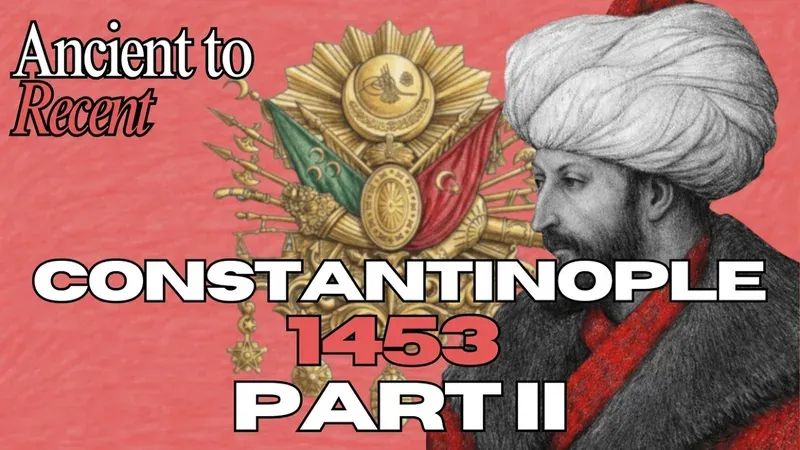 Watch on YouTube →
0:0035:58
Also on
Rate the show
Ratings are how new listeners find the show. It takes a minute and it makes a real difference.
In this episode of Ancient to Recent, the stage is set for one of history’s most brutal sieges as the Ottoman Empire and Byzantium move toward their final confrontation.
Born into uncertainty and raised in a court shaped by ambition and intrigue, Mehmed II rises to power with a singular vision: the conquest of Constantinople. While his father Murad II had preserved and stabilized the Ottoman state, Mehmed prepares to finish what generations before him could not.
As he secures his rule through ruthless consolidation, Mehmed begins laying the foundations for war, purging rivals, strengthening his army, and embarking on an unprecedented military buildup.
Across the Bosporus, the Byzantine Empire stands on the brink. Emperor Constantine XI rules over a fractured, impoverished state, plagued by internal divisions and reliant on uncertain Western aid. Old wounds between Eastern and Western Christianity resurface, as desperation forces uneasy concessions that divide the city even further.
Meanwhile, Mehmed constructs the formidable Rumeli Hisarı fortress, tightening his grip on the straits and cutting Constantinople off from vital supplies. Diplomacy collapses, threats turn to action, and the noose begins to tighten.
With Europe hesitant and the Ottomans preparing for total war, the fate of Constantinople hangs in the balance.
Join Joseph Parkinson as Ancient to Recent continues its series on one of history’s greatest cities.
🎧 New episodes every Saturday
📲 Follow on YouTube, Spotify & Instagram @AncientToRecent
#Constantinople #OttomanEmpire #MehmedII #ByzantineEmpire #FallOfConstantinople #MedievalHistory #HistoryPodcast #AncientToRecent
Read transcript
This transcript is automatically generated, so it may contain typos and misheard names.
Better a Turkish turban than the Pope's tiara. Lucas Bartaras, Byzantine Statesman The comet burned brightly in the night sky, it's long tail illuminating the heavens. The Lord himself was communing with his people, but what did it mean? Were the heavens rejoicing or mourning? It could only be a sign. But a sign of what? Of coming victory or of impending defeat? Comets were often ascribed supernatural meanings by the peoples of the Middle Ages. Before the Battle of Hastings in 1066, the appearance in the night sky of Halley's Comet gave William, Duke of Normandy, confidence that God had blessed his invasion of England and victory was at hand.
In 1432, as the comet burned its way across the heavens, Christians and Muslims gazed and asked themselves these very questions. In Adrina, in that most fortuitous of year 1432 in the Christian calendar, 835 in the Islamic, a child was born, his mother a slave girl taken for the pleasure of the Sultan. His father, Murad the Second, had rebuilt the Ottoman domain, which had seemed at the point of total disintegration after defeat at the hands of the Timurid Empire in 14 O2. Murad's reign had not been one of lightning conquest, but rather of cautious fortification. The Ottomans could so easily have slipped beneath the waves of history, but Murad had steadied the ship, consolidated power in Anatolia, and, once the empire had gathered its strength, expanded Ottoman rule in the Balkans. Murad had brought Albania, Macedonia and Serbia under Ottoman command and seen off repeated Crusader efforts to turn back the Muslim tide.
But now Murad had delivered to the Ottomans his greatest gift, the child that history would remember, a Sultan, Fatih Mehmed Mehmed the Conqueror. Welcome to Ancient Recent, My name is Joseph Parkinson and today we continue the story of the 1453 siege of Constantinople. Episodes of Ancient Recent are out every Saturday and are available on YouTube, Spotify and Apple Podcasts. The boy was given the name Mehmed, the Turkish version of Muhammad. Mehmed was the third son.
Both his brothers were considerably older and he was not his father's favorite. Unlike European monarchies, where the eldest born legitimate male would automatically become the next king, the Ottomans allowed all male children to contend for the throne. This was designed to assure the empire was always led by a ruthless and cunning Sultan who would be vetted by the brutal struggle for power rather than rely on the accident of birth to the next leader.
But this primed the Ottoman state for dynastic turmoil with the passing of each Sultan and provided the much diminished Byzantines with ample opportunity to sow discord or back pretenders to the throne, playing faction against faction. As such, Mehmed's chances of ascending to the throne was slim indeed, especially as his fate as an unfancied and considerably younger brother would almost certainly be the ritualistic embrace of the silk cord used to strangle rival contenders for the throne. From the early 15th century on, the Ottomans, once nomadic step warriors who Sultan's rule from the saddle, were undergoing A cultural shift.
As the Ottomans ascended to power, it became increasingly important to justify and understand their rise. They required the one thing that any aspiring power needs, some good old fashioned mythology. No state ever justifies itself on the grounds of luck and proficiency with killing. There has to be some sort of myth behind it, some sort of reason why it was all preordained, why it was all inevitable. Think the Romans claiming descent from the Trojans, with Romulus and Remus being suckled by the wolf. The Ottomans needed to do the same. And with mythology comes ritual.
The Sultan can't just be another step warrior, They have to be set apart gradually. Access to the Sultan who once strode confidently and mingle freely with his warriors was limited. The Sultan 8 alone took on more and ever grander titles and styled himself the Sultan of Rum. Rum being the Islamic name for Rome. The Ottomans were now claiming legitimacy as the true descendants of the Romans. This much more formal, ritualized atmosphere is the environment that Mimet was raised in.
Sultan's, aware of the weaknesses of the Ottoman system of succession, often tried to fix the game in advance for their preferred candidate. It might seem like a free for all for the throne, but in reality geography was power in the Ottoman state. The closer one's proximity to the centre of power, and with it the treasury and machinery of state, the better a claimant's chance of winning the Game of Thrones. As such, unfancied claimants would be dispatched to distant provinces, while the Sultan's favourites would stay close to the capital.
Mehmed as a child was dispatched to Amassea, officially to gain experience of government, but in reality to be out of the way, as Amassea was then on the eastern extremity of the Ottoman domain. This may have been the last we would ever have heard of Mehmed had fate not intervened. In 1437, Mehmed's older brother Ahmed died shortly after his other older Brother Ali, the favorite for the throne, was assassinated. All of a sudden, the unfancied Mehmed was the last man standing and all by the age of 11. Mehmed's father Murat now had to clear the way for his son's ascension to the throne.
He recalled the young Mehmed to Adrina to oversee his formal education only to discover that Mehmed had grown into a stubborn young man. Mehmed was not keen on his studies and would defy his tutors at every turn. Murat, in no mood for disobedience, brought in the wisest mullahs in the empire to educate young Mehmed and gave the mullahs a simple instruction. Mehmed was to be educated and no defiance was to be tolerated.
If the young Mehmed resisted, then the future Sultan could expect the belt soon. Mehmed buckled down and discovered a love for learning that would stay with him his whole life. Mehmed had a ravenous mind that consumed books and ideas. He had a great talent for languages, gaining fluency in Turkish, Persian, Arabic and even command of Greek and some Latin. The boy craved knowledge, seeking out texts on everything from history to science, geography to literature.
Hoping to avoid the turmoil that accompanied the passing of the crown, Murad the Second came up with an ingenious idea. Instead of waiting for his own death, he would abdicate so he could oversee the ascent of his son. This may have appeared a brilliant idea, but it soon unravelled disastrously. The Ottoman domain was still fragile and beset by challenges both internally and externally. The ascent to the throne of a boy, Mehmed, at the time was only 12, was seen as an opportunity too good to be true for those who sought to do the Ottoman's harm.
In Anatolia, an uprising by rival Turkey groups erupted in Europe. The Pope called a crusade and the mighty Kingdom of Hungary answered the call, sending Christian troops rushing over the border into the Balkans. The Venetians further added to the Ottoman troubles by blockading the Dardnails, hoping to cut off the Ottoman capital Adrina from support in Asia Minor. At this exact moment of crisis, a further schism emerged in the empire. In the late 14th century, a new sect called Hodafia, named after the holy man Fazullah Hodaf, emerged. Hodafiism claims to unify Islam and Christianity, and missionaries proclaim the faith spread throughout the Ottoman Empire.
Devotees made their way to Adrina and were welcomed by the young Mamet, who seemed intrigued by their message, to the horror of Mamet's more orthodox Sunni advisers. This could have caused a major division in the Ottoman Empire at exactly a moment of crisis, but action was swiftly taken and the young Sultan set on the straight path. Murad the Second came out of retirement, reclaimed the throne, killed the followers of the Hodafia sect, crushed the rebellion, and marched to meet the Crusader threat at the Battle of Bonner in 1444. Morad routed the Crusader army and once and for all put an end to Crusader efforts to roll back the Muslim conquests. The Byzantines had not been passive observers of the Ottoman's misfortunes.
The Byzantines had sponsored their own pretender to the Ottoman throne, Orhan, a distant cousin of Mehmed, who they gave sanctuary within the Wars of Confidentanople. At a crucial moment where the whole structure of the Ottoman Empire seemed to be on the point of collapse. The Byzantines had done everything they could to bring the Ottoman domain crashing down. But the Byzantines had failed. The Crusaders were turned back, heretics massacred, rebels burned at the stake.
With the crisis having passed, those around Nemet now understood that Constantinople could no longer be ignored. Constantinople would always be a challenge to Ottoman legitimacy, a boil waiting to burst, seeping the infection of discontent deep into the pores of the Ottoman realm. Unless, that is, the boil was lanced and Constantinople taken for the Ottomans. Murad would rule till 1451 when he passed away. He was both popular and respected with not just his own people but also his adversaries.
He may have inflated numerous defeats on the Christians, but in dealing with him, they had found him to be both merciful and honest. He was a victorious general, but he never enjoyed war nor sought military glory. A man who prized peace over conflict and favored mercy over brutality. But Murad had a responsibility to the Ottoman Empire, and as much as he wished to avoid war, he also left a grave warning for his advisers.
He had been scarred by the near disintegration of the Ottoman state and the role the Byzantines had played. If the state was to survive, then Constantinople would have to be taken. At Murad's death, it was not clear who would succeed him. The Byzantines still give shelter to Orhan the pretender, and there were those who still yearn to throw off Ottoman domination. Mennett was the legitimate successor, but memories of Mehmed's time on the throne were fresh.
Morad knew that many would not be keen on Mehmed's return, but Mehmed was the chosen successor and had come a long way since he was a bold 12 year old boy. When Murad died. In order to smooth Mehmed's ascension to the throne, word of the Sultan's death was kept quiet. Mehmed was contacted and told to make his way to the capital as soon as possible. Mehmed, upon being informed of his father's past and gathered his supporters and set out to the capital. That very night.
He arrived and was greeted in triumph. Now still a teenager, Mehmed gathered around his father's advisors, some who had helped Morad reassert his claim to the throne and push Mehmed out. A slight the young man would not forget. Soon, Mehmed presented himself as a steady hand, a young man who had grown into maturity, a man keen to continue his father's wise rule. Mehmed did not allow any hint of his deeper burning ambition, one that some of his father's advisors would stand in the way of. But if his words did not give clue to his true nature, then his deeds soon would.
Just days after ascending the throne, Mehmed dispatched an assassin to visit his one remaining brother, Ahmed, then an infant. The assassin, taking Ahmed in his hands, drowned the boy in his bath. There was one Sultan, and nothing would be allowed that could divide the Ottoman realm. If the Ottomans were battling to survive the set by external foes and internal intrigue, they were a bastion of peace and prosperity compared to their Byzantine rivals. Sat upon the Byzantine throne was a new emperor, Constantine, the 11th of the Paleoglist dynasty. The Paleoclu dynasty were relatively recent usurpers, and their ascent of power had offset yet another round of dynastic squabbles, infighting, civil war and assassinations that accompanied the sad decline of the once mighty Byzantine Empire.
Though claiming descent from the Caesars of old, the Palaeoglu dynasty were anything but Roman. Constantine's father was part Italian, his mother of Serbian descent. Constantine, born in 14 O 5, was already in his 40s when he ascended to the throne in 1449, having spent many years campaigning to reassert Byzantine's faded power by fighting desperate pitch battles over small towns and forgotten hills in Greece, each of dubious value.
By the time he came to power, Byzantine was bankrupt, all but broken. The city had never recovered from its sacking by the Catholics during the 4th Crusade some 200 years previously. Those who still inhabited Constantinople lived in a constant state of fear, with the city already surrounded by the Ottomans. Even within the wars of their own city, the Byzantines had little say. The powerful rising Italian states Venice, Florence and Genoa dominated trade, with the Genoese having a bustling colony on the other side of the Bosphorus Galata, a stark contrast to the decrepit state of Constantinople. The emperor himself was more of a figurehead, with power resting in the hands of courtiers and aristocrats, each jostling for positions of influence within the regime, their rivalries growing ever more bitter even as the power of the Byzantine state faded.
Murad may have been respected in the West, but he was not mourned. Many a king and Pope were delighted with the death of their old foe who proved himself such a stubborn opponent time after time. With Murad gone and Mehmed still a child, and one whose previous reign had seen the near collapse of Ottoman power, surely time was at last on the side of the Christians. But the Christian world was still licking it's wounds.
They had been repeatedly humbled by Ottoman armies and were not in any rush to test Ottoman steel. Yet again, ambassadors from across Europe made their way to Adrina to offer their congratulations to the new Sultan, to renew old contracts and propose new alliances. Mehmed was eager to welcome them and give assurances that he was a man of peace, a man who could be trusted, never letting slip his imperial intentions. Emissaries from Constantinople made the short journey only 140 miles West to the Ottoman capital to offer their congratulations.
But unlike others, their sweet words came with a threat. Was it arrogance, stupidity or maybe desperation that stood behind the Byzantine message? The emissaries, after the formalities of congratulating new Sultan, informed Memmet that the sum paid to Constantinople to keep or hand the pretender within the city walls was now no longer enough and the sum would have to be doubled or else. The Ottoman lands have been torn apart again and again by 1 rebellion or pretender, and Mehmed knew that those who challenged his legitimacy would be all too eager to rally to the banner of a new pretender.
This is no small threat. Even in the early days of Mehmed's rule, he'd already put down a rebellion and been forced to pay a bonus to Janissary units that made clear their support to him was not unconditional. At this very moment, the fate of Constantinople was being hotly debated within Mehmed's inner circles, those that oppose taking the city fearing it about too weak to commit to such a mammoth military adventure and worried that such an effort could unify the Christians for yet another crusade.
Such doves gathered around 1 of Mehmed's advisors. Halil Pasha. Desperate to avoid war, Halil Pasha tried to direct the young Sultan into more peaceful adventures. Urgent caution on the impatient youth, as Helio Pasha exerted all his might to avoid conflict. In stepped the Byzantine emissaries with their veiled threats to set a flame to the kindling of civil war. Halil Pasha heard out the emissaries, and unable to control his rage, he exploded in fury.
You stupid Greeks, I have known your cunning ways for long enough. The late Sultan was a lenient and conscientious friend to you. The present Sultan Mehmed is not of the same mind. If Constantinople eludes his bald and impetuous grip, it will only be because God continues to overlook your devious and wicked schemes. You are fools to think you can frighten us with your fantasies when the ink on our recent Treaty of peace is barely dry.
We are not children without strength or sense. If you think you can start something, do so. If you want to proclaim or Hannah's a Sultan, embrace, go ahead. If you want to bring the Hungarians across the Danube, let them come. If you want to recover places you have lost long sins, try it. But know this, you will make no headway in any of these things. All that you will do is lose what little you have. When Mehmed was told of the Byzantines threats, he did not shout, he did not rage or insult.
He simply thanked the ambassadors for their message and promised to look into the matter. Constantine had now given him the exact thing he wanted the most, a pretext for war. Manette's reply to Constantine was swift. Instead of increasing the amount paid to Byzantine Mehmed stock payment altogether, Menette now set about in earnest the task he had yearned for for so many years. Menette began full preparations for war, but before he could rally his troops, he needed to consolidate his power. The civil service was purged, governors replaced, officers believed insufficiently loyal dismissed, and the pay of the Janissaries doubled.
With his rear secure, he now turned to planning the conquest of the city. Many attempts have been made, and many have failed. The only attempt in those long centuries to succeed have been the 4th Crusade. What was it that the seafaring Venetians had that all others lacked? Dominance. The waves. If Mehmed was to take the city, he would have to command the Dardanelles. Without commanding the waters, the city could be endlessly resupplied with men and food from Europe, and the Ottoman army would bleed to death beneath the city walls.
But in order to command the waves, Mehmed would need two things. Firstly, he would need a massive Navy, one big enough to see off any rival. For a second, he would need an imposing structure that could command views over the water and a crucial point surveying the banks of the Bosphorus. Mehmed chose a hill at the narrowest point of the straits, where the two banks are only 660 meters apart. On this hill he would construct a Fort called the Bourgas Kessen Fortress, translated into English as the Straight Cutter. Mehmed's intentions could not have been clearer. He would dominate the waters, sever connections to the outside world, cut off resupply, and throttle the city into submission.
From all corners of the empire. Resources and manpower was summoned. Masons from Anatolia, miners from Serbia, carpenters from the Black Sea regions, Smiths from the Balkan vassal lands, lime burners and laborers from across Romella and Anatolia, along with boatmen, coachman, and transporters. All were requisitioned and rushed to the site of a massive logistical effort, but the construction of a Fort so close to Constantinople could not go unnoticed. From Constantinople, ambassadors were rushed to Venice and Rome to beg for help with the Venetian sending armaments that few soldiers.
Constantine also set ambassadors to Mehmed. This time their tone was more conciliatory to remind the Sultan that such a fortification could be construed as an act of aggression. This time Mehmed did away with the pleasantries. Do not insult my intelligence, man, I warned. Your pleasantries will do you no good this time, man. I warned them not to waste their breath with further blandishments, and that the next ambassadors that darkened his door would not live to see Constantinople again. The construction of the fortress was to be completed as quickly as possible.
Huge barges ferry the materials across the Bosphorus, Stone, timber, lime and iron. Nothing is left to chance. Work began on April the 15th, 1452 and then it drove the effort forward with a mixture of threats and bribes to keep the pace reliveless. Under blazing sun in Howlingale, through lashing rain night and day, the work continued. Over 6000 workers were mobilized in total. A huge military detachment guarded the site against any raids or interference. Even Ottoman nobles and high officials were pressed into service, carrying stones and wielding pickaxe alongside the common workers.
They labored night and day without end under the constant watchful eye of the distant walls of Constantinople, only 6 miles away. To speed things up, the Ottomans pillaged local villages and nearby ruins for building materials, hauling away stones from ancient Byzantine churches and structures, sometimes right under the Byzantines noses. Ottoman raiding parties swept through the surrounding fields, seizing supplies and provoking the locals.
Those that tried to stop the Ottomans were executed villages that resisted or put to the torch that peoples killed or scattered. These brutal tactics ensured a steady flow of resources while sowing fear and chaos in the Byzantine hinterland. Emperor Constantine, watching the fortress rise like a noose around his city, sent further M series to Mement. Pleading for peace, was vowing that Byzantines would fight to the end.
Mehmed's response was merciless. He had the envoys killed and sent back a stark message. Surrender unconditionally or prepare for Total War. With all hope of diplomatic settlement ended, the gates of Constantinople were shot. The city braced itself. By August the 31st, less than five months after construction began, the fortress was complete. It's walls stood in imposing 22 feet thick and up to 50 feet tall in places, studded with three massive towers and 13 smaller watchtowers.
Once armed with cannons, it turned the Bosphorus into an unbreakable Ottoman chokehold. With the job done, Mehmed made one final Sally. 4th. He wrote out to personally observe the walls of Constantinople in great detail, making thorough notes of every vulnerability. Then he returned to Adrina to prepare for the campaign, the siege that would design the fate of an empire. The fortress commanded the straits with huge cannons placed to command a field of fire that assured that no ship would be safe. The cannons hurled huge balls, some as heavy as £600, that could tear through the hull of any ship so bold or so foolish to try and test the aim of the Ottoman artillery crews. Panic grew in Constantinople with increasingly desperate messages sent to the powers of Europe. Dispatches were sent to Hungary, Naples, Genoa and the Vatican begging for assistance.
The Christian powers were slow to stir, partly still smarting from their repeated thrashings at Ottoman hands, partly disdainful of the Orthodox, who many Catholics consider little more than heretics, and partly concerned about their own financial interests. The cities of Genoa and Venice traded in spice and silks from the Levant and did so the sufferings of the Ottomans. Access to the markets, imports that Egypt, Syria and Palestine were vital for their interests and they knew the Ottomans could cut them out at any moment.
An uneasy silence settled over the merchants and traders of the Italian city states. What should they do? Help their fellow Christians or help themselves to the profits came from Ottoman trade. In spite of the selfishness of the merchant classes, some were still aware of the danger. Pope Nicholas urged the Holy Roman Emperor to send warning to the Sultan. Alfonso of Naples dispatched a small naval force to the Aegean, only to withdraw it soon after.
But for far too many, the ultimate motivation was cash, not the cross. The Genoese went as far as to contact the Sultan and seek assurances that their colony at Galata opposite Constantinople would not be threatened in the event of war. With the four constructed, the city was now cut off not just from its supply of grain, but also from the tolls that Constantinople relied on for what little revenue it had. Ships who sought to pass the Darbnells now had to submit to paying the Turks or face the consequences. One Venetian ship tried to test the resolve of the new Turkish fortress.
Ignoring calls to lower their sails and submit to boarding, the Venetian ship pressed ahead, hoping it's vital cargo of food bound for the city would reach the desperate people of Constantinople. As cannonballs skimmed across the surface of water on the Venetia ship pressed, determined to make it through. Closer and closer the huge stone balls came as the ship surged deeper into the straits every second it's chances of running, the blockade growing.
As the ship was almost out of range, one huge stone ball crashed into the ships, all splintering the decks, sending the crews diving into the waters. The crew scrambled aboard a lifeboat and made it to the shore, only to be quickly captured by the Turks. Brought in chains before the Sultan, Mehmed would send a clear message to all those who sought to test his resolve. As Venetian emissaries begged for the men's life, Mehmed would not be swayed. A few men were spared.
They would carry word to Constantinople of what they were about to witness. For the unfortunate they would take it, and 1 by 1 headed the captain who had dared to defy the Sultan's warning. He was impaled with a stake rammed into his anus. Only one boy was spared, a young lad who was added to the Sultan's harem for Mad's nocturnal entertainment. The psychological effect of the traumatized sailors arriving in the city achieved the intended goal. Fear and to panic.
Desperation grew as the end seemed to be nigh. There was only one hope. Could the Christians of Europe rally to the defence of their fellow believers? Would they finally set aside their pursuit of profit to save one of Christendom's great cities? But for many, the divisions between Eastern and Western Christianity were not merely theological issues, they were existential. To understand this tension we have to travel back some 400 years.
The split between Eastern and Western Christianity wasn't a sudden break, more a gradual disintegration. The dispute centered on 2 main issues, the first being papal supremacy. Eastern Christians were willing to grant the Pope in Rome a special place in the Christian community, but bridled at the claim from the 9th century on that the Pope was supreme and has such held dominion over all Christian churches. The second was a debate over the Nicean Creed. The original creed, finalized at the Council of Constantinople AT381AD and accepted by the entire undivided Church, described the Holy Spirit as the Lord, the giver of life who proceeds from the Father.
This wording emphasized the Father as the sole source of the Trinity's eternal life and procession in the West. Starting in the late 6th century, notably at the Third Council of Toledo, in 589 churches began inserting the word Philoquet and the Son to read who proceeds from the Father and the Son. This was added to combat those that denied the full divinity of Jesus. The East saw it differently. Eastern theologians viewed the unilateral edition as a grave error.
It disrupted the monarchy or supremacy of the Father. More critically, it violated the authority of ecumenical councils. No single part of the Church, especially not the West, acting alone could alter a creed ratified by the whole Church without another Ecumenical council. Patriarch Thotius of Constantinople condemned the phyloquy as heretical in the 9th century, and the insertion was seen as symptomatic of Western overreach, papal supremacy, and theological innovation.
Tensions boiled over in 1054 when Papal Leggetts placed a bull of excommunication against Patriarch Michael Cerulliaris on the altar of Hagia Sofia, with the patriarch responding in kind by excommunicating the Leggings and Pope Leo. The 9th riots broke out in Constantinople and the papal bull was publicly burned. The mutual anathema symbolized a fracture that grew wider over time. By the 15th century, this bitterness had become miserable hatred. The 4th Crusade OF12O Four, when Catholic crusaders sacked Constantinople, looted his treasures and installed a Latin emperor, remained a war unforgivable wound for the Byzantines.
To the Byzantines, the Latins were not their brothers in Christ, but ignorant, treacherous Barbarians who had already betrayed and desecrated their city once, whilst in the West the Greeks were often seen as schismatic, arrogant and superstitious. But by the 15th century the relentless advance of the Ottoman armies forced one emperor after another to seek help from the Catholic W Emperor John. The 8 Palliagulis pursued union negotiations. The Council of Florence 1438 to 39 was a bitter affair but did produce a temporary reunion.
The Eastern delegation, under pressure, accepted papal primacy and other Western points in exchange for military assistance. Emperor John the 8th and Patriarch Joseph the Second signed the decree of union. But back in Constantinople, the agreement sparked fury. Most clergy, monks and ordinary people rejected it as a betrayal of orthodoxy for Latin gold. The hatred of the Catholic Church ran so deep that the phrase the Roman Pope became slang to stray dogs. Anti unionists called the signers Latin minded traitors. Riots erupted.
Priests refused to commemorate the Pope in a liturgy. The bitterness was so intense that when the union was proclaimed in Hakia Sofia in December 1452, just months before the siege, many in the congregation walked out in protest. But as the Ottoman threat crystallized, more were willing to bite their tongue, swallow their pride, and accept union with Rome. The desperate pleas were sent once more to the Vatican for assistance and compromise. But pelt Nicholas would not budget. He had already negotiated compromise with the Byzantines at the Council of Florence.
They had gone back on the terms of the treaty. He was in no mood to accommodate the Greeks. Further in the city, the emperor was jeered by Orthodox crowds. Constantine worried about civil strife, with civil war breakout between those willing to accept union and those not. Nonetheless, the Emperor had run out of options. He would press ahead with union and accept the supremacy of Rome. But even then, even as the sound of cannon fire from the straight cutter could be heard from within Constantinople, some still opposed any compromise with Rome. In the Ottoman capital of Adrina, Mehmed received regular reports from Byzantine.
He was well aware of the deep divisions within the city. He called to gather his counsellors and stated the case for war. Yes, the city had been besieged before. Yes, all but one attempt had failed. But unlike before, the Ottomans had supremacy at land and sea. They commanded the straits and the city was crucially weakened from within whilst being denied support from without. He also outlined the city was an existential threat to the Ottoman domain.
One emperor after another had backed factions and supported pretenders like Orhan to weaken the Ottoman Empire. The chances of success have never been greater, the threat posed by Constantinople never more grave. The time had come for war. Thank you for listening to Ancient Theresa. My name is Joseph Parkinson and next week we will continue the story The Siege of Constantinople. Episodes of ancient Recent art every Saturday and can be listened to on YouTube, Spotify and Apple Podcasts.