
#32
Genghis Khan and the Mongol Empire — Part 2
11 January 2026 · 39 min · Season 1
 Watch on YouTube →
0:0039:53
Also on
Rate the show
Ratings are how new listeners find the show. It takes a minute and it makes a real difference.
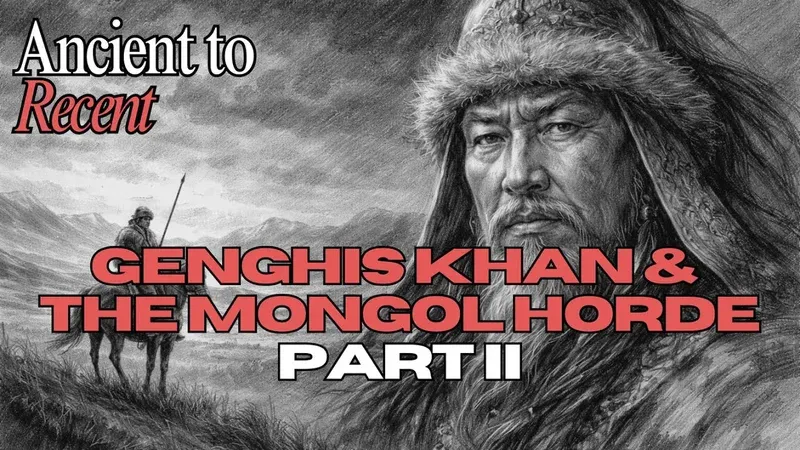
In this history podcast episode of Ancient to Recent, we follow Genghis Khan as his newly united Mongol nation collides with the great settled empires to the south, beginning a cycle of conquest that would change world history forever.
Having unified the steppe through blood, loyalty, and merit, Temüjin now faced a new challenge: how to sustain his people without endless civil war. The answer lay beyond the grasslands. When the Jin Dynasty demanded Mongol submission, Genghis Khan chose defiance and war.
This episode explores the Mongols’ first full-scale invasion of northern China, revealing how a nomadic society of barely one million people took on a civilization of fifty million. Through speed, intelligence, psychological warfare, and ruthless pragmatism, the Mongols shattered armies, bypassed fortifications, and turned the enemy’s strength into weakness.
We examine the radical nature of Mongol warfare: total mobility, flexible command, deception, terror as strategy, and the deliberate use of refugees, propaganda, and fear to collapse resistance before battle was even joined. Cities fell, dynasties bent the knee, and unimaginable wealth flowed north to the steppe.
As victory brought luxury, new enemies, and internal tensions, the foundations of a world empire were laid but so too were the seeds of future conflict. This episode marks the moment the Mongols stopped being a steppe power and became a global force.
Join Joseph Parkinson for Episode 32 of Ancient to Recent, as Genghis Khan leads the Mongols out of obscurity and onto the world stage.
🎧 New episodes every Saturday📲 Follow on YouTube, Spotify & Instagram @AncientToRecent
#GenghisKhan #MongolEmpire #JinDynasty #MongolWarfare #HistoryPodcast #WorldHistory #MedievalHistory #AncientToRecent
Read transcript
This transcript is automatically generated, so it may contain typos and misheard names.
I am the punishment of God. If you had not committed great sins, God would not have sent a punishment like me upon you. Genghis Khan In 12/10, a delegation arrived at the encampment of Genghis Khan. Genghis Khan, since his unification of the steppe people after long and bloody war, was used to visitors coming to him to pay tribute and to cleft Beatty, or to offer their goods and services to his ever expanding realm. But these visitors were different. They had not come to give, but to take. They had come with a haughty air of superiority. They were from the Churchid, A sedatory agrarian society much different from the nomadic Mongols. Theirs was a Society of great cities and walled palaces, not the simplicity of the step warrior with his herd and bow. The Churchid looked down on the nomads, warring, squabbling, barely human, almost entirely illiterate, with no roots, and the Churchid officials conveyed every inch of the contempt they felt for the Mongols and their way of life. It was an honour to have a visit from the mighty Churchid. They had come to confer on the lowly Mongols a great privilege. The Judged Kingdom had been founded in 1125, only a few decades before Genghis Khan's birth, and was a relatively new power in Central Asia.
The judged domainion stretched from Manchuria down to inner China and out West to the banks of the flowing current of the Silk Road. The Great Khan of the Church had had died, and a new Khan sent his officials to demand a declaration of vassilage from all of the steppe tribes the Church had claimed sovereignty over. In the presence of Genghis. They presented themselves as the bearers of a great gift, the opportunity for a lowly barbarian like Genghis to be someone to make something of himself, the privilege of being a vassal of the mighty Gurchard Khan. If only he would bow.
If only he would grovel. If only he would kiss the ring. If only he would humble himself before his superiors. Genghis had climbed inch by inch, tooth and nail, fighting and scratching from poverty to immense power, and he bridled at every attempt by others to claim superiority over him. He would not submit to this latest demand. He listened to the ambassadors saying nothing. He turned and spat. There was more than bravado to Genghis's insult. Genghis had succeeded in uniting the warring tribes of the steppe, but his position of power came from his ability to deliver.
The steppe people grew no crops and fashioned few goods. They depended on raiding. Historically, this had come in the form of sibling warfare between the steppe tribes, but this constant conflict had been ended by Genghis. The people, however, still expected a flow of goods. These goods came from beyond the steppe, and without any ability to make them themselves, the Mongols would need another means of acquiring the goods they craved so much.
The churchy Kingdom was ripe, overflowing with silk, tools, craft goods, animals beyond the wildest dreams of the Mongols. If Genghis Khan could wage war against the churched, he could St. his people's endless lust for booty. The insulting behaviour of the ambassador had been exactly the pretext Genghis had needed. This display of open defiance of the church had might by an upstart step tribe was a Declaration of Independence and this could only mean one thing, war. Welcome to Ancient to Recent.
My name is Joseph Parkinson and today we continue the story of Genghis Khan and the Mongol Empire. Episodes of Ancient to Recent are out every Saturday and are available on YouTube, Spotify and our podcast. In spring of 12/11, Genghis summoned a great council or hurl tie. Genghis was not like a European king who claimed legitimacy as a result of royal birth conferred by God. He expressly needed the consent of his people. Mongols were expected to participate in decision making, to know and understand what for and why they were fighting, and to show their approval or disapproval by their attendance of the Hurl Thai.
Thus, every Mongol had an active interest in the decisions of Genghis Khan and would fight harder knowing their voice was heard. There was much public discussion at the Hurl Thai, with Genghis's officials going to great lengths to explain why war with the Church it was necessary. After the discussion, Genghis retired for three days. The process of getting consent for a war was complex and could not be made by one man, or even just by men.
Genghis had set out his case to his people and sought their consent, but now he needed to say not from mere mortals, but from the great blue sky. Genghis was a devout animalist. Genghis prayed, fasted and meditated to seek the approval of Tenga, the God of the sky. After much soul searching in prayer, he had a revelation. Tenga had spoken to him and promised Genghis that if he raised his hand against the churches then the Mongols would be victorious.
On the 4th day, Genghis conferred with his people. The great blue sky had promised victory. Prepare yourselves for war. The Mongol realm was convulsed with action. Fresh horses, stocks of food, weapons, forge, prayers to purify the soul said before the army headed South into the unknown. This was truly a radical course of action. There had been raids and wars before between the peoples of the steppe and the city based kingdoms of the South, but this was different. This wasn't a steppe tribe, this was the steppe tribes. All of them united.
And they weren't launching a raid, a smash and grab to steal horses, women and booty. They were coming to change history. How did the church react to this insult? A combination of disbelief and mockery. They must have laughed at the very idea of some backward step rabble was going to stand up to them. What were these horsemen to do? Right up to the churches mighty walls manned by the professional soldiers with their play armor. And do what exactly?
In the 13th century, China was born from a single entity, but rather a patchwork of kingdoms, and the churches were just one of many. But they were amongst the most powerful, with some 50 million inhabitants, second only to the mighty Song dynasty with a population of 60 million. The step, on the other hand, had barely 1,000,000 people. The judge had had been involved in step politics for a long time, stirring up one tribe against the other to clip the wings of anyone who might become too powerful.
Genghis had participated in this interstep warfare on behalf of the churched and he resented their power and wealth which they lauded over the steppe people, not to mention the churched's arrogant ways. Steppe people had come South before to raid the churched, but the churched with a large well armed professional army and thick city walls had never seen this as a serious challenge but rather a minor and passing inconvenience. But they had never faced the steppe warrior like Genghis Khan.
Genghis took his warriors S crossing the Gobi desert. Scouts were sent ahead to mark out paths and check for grassland and water to feed the Mongol cavalry. With no infantry on foot or lumbering siege engines, the Mongols travelled quickly. The Mongols had no supply chain, no long columns of wagons that had to be protected. Mongol warriors carried only the essentials, clothing, utensils for cookings, and a blanket. Speed was their weapon, surprise their greatest advantage. Genghis brought 65,000 horsemen with him, but he was vastly outnumbered by the churched.
The population of all of Genghis Khans realm was 1,000,000 people, vastly smaller than the 50 million of the churched Kingdom. But most of the churchy troops were slow moving infantry drawn from an impoverished and poorly fed peasantry. They were more slight in build than the burly Mongols. The churchy soldiers lived in a diet of carbohydrates, grain and rice which made for poor teeth, weak bones, and stunted growth. They labored day and night in the baking sun to eke out a living through back breaking toil in the fields. The Mongols lived their lives in a saddle, ate yoghurt, Kurds milk, meat, had a high protein diet. Mongol warriors were trained to hunt and ride from a young age. They were expert with bow and Lance. The Mongols spread out across a wide area so their horses could graze.
They also carried out extensive reconnaissance, always staying a step ahead of their enemies. Mongols were almost entirely illiterate, so officers composed their orders in a series of rhymes and verses to be memorized by each man. Thus, each order was like learning a verse of a new poem. Genghis had close bonds with his officers and men. He had known them all his life. He knew their strengths and their weaknesses and which man would be best for each step of the campaign, when it was time for aggression and when for caution, when trickery was called upon or when brute force was required. But the Mongols had a problem.
The judges had a simple strategy. Withdraw within their city, behind the high walls and thick ramparts. They could wait out the Mongols like they had done with step people so many times before. But the Mongols were not just another step people coming South for easy booty. The Mongols thought about war at great length. Genghis thought about how to accentuate the positives and downplay the negatives. He thought about how to turn his enemy's strengths against them.
If the church hid would stay behind their walls, then Genghis would use this against them. He would make their fortifications into their tombs. First, he deployed psychological warfare. Mongols raided, burned, slaughtered, and raped the towns and villages throughout the churched countryside. The horizon was dotted with burning farms as far as the eye could see. This set off a flood of terrorized refugees surging into the cities, each of them bringing horrifying stories of Mongol cruelty and malice. The cities would then be choked with refugees who would eat their way through stocks of food needed to survive a Mongol siege.
The Mongol sought to sow a division between the peoples of the Church of Kingdom. Unlike the Mongols, who went to great lengths to bring together all the conquered peoples in their empire and make them willing and eager participants in the new Order, the Church had kept the people they conquered under heel. The Church had had conquered the Heatan, devastating Heatan society and driving the Heatan royal family into poverty and exile.
Mongol troops fanned out, spread the word amongst the Heatan that Genghis had come to liberate them, to break the chains of their oppression and to side with the Mongols. To avenge their defeat, Genghis sent emissaries to comb the countryside and find descendants of the Hitan royal family to act as rival claimants to the throne, ones that would owe their power and thus their loyalty to Genghis. Thus Genghis could draw away many of the churches supporters.
It didn't hurt that the Hitans and the Mongols were distant relatives, unlike the churches who were considered foreign invaders. And many people welcomed the Mongols. Yes, the church had had the numbers over the Mongols, but many of these people were unreliable and had no stake in maintaining churched power. Genghis was the ultimate pragmatist. He had no time for convention or tradition. He always sought to use the skills others had to Mongol advantage. He recruited from amongst the subject people of the churches, scribes, scholars and engineers put to use for his empire in his war against their former masters. Genghis was also very conscious of Mongol casualties. The Mongols sold their lives dearly, never giving them away. For the Mongols, there was no honour in dying, only in winning and winning by any means.
For the Mongols, there was no such thing as underhand tactics, only good tactics or bad tactics, only winning or losing. Not only were Mongol warriors not encouraged to give their lives away, as so many rulers had to their followers before, Mongol warriors were not even allowed to discuss death or even to reminisce about those who died. Any mention of death was seen as completely taboo. The Mongols employed trickery and deception to their advantage. They played upon the arrogance of the church, had Mongol horsemen would ride up to the church, had fire arrows, and then as soon as the church had came out from their fortifications, would race off.
The exhilaration of seeing a fleeing foe would lead. The church had to lose organization. Once the church had had been drawn too far from reinforcements, the Mongols would change horse, turn round and ride down their pursuers. The Mongols never wasted anything. The people they forged may have been incomprehensible to the Mongols. Why live in a hovel scratching out a living in the vastness of the steppe and all its wonders were just before you?
So the Mongols thought. But still they put the peasant population to use. They divided the population into different categories, those with special skills like doctors and engineers. They could tend to the soldiers and be pressed into building siege engines. Those that could work as labourers to do the heavy lifting, or who could be marched in front of the Mongol army towards the city, pushed into the Moat to fill it in so Mongol warriors could scramble over their corpses.
Those that would be set to flight to spread terror and hamper reinforcements by clogging the roads. Those who were useless would be killed. The immense slaughter of the Mongols and the inability of the Church to protect their own people had a further effect. It led to a collapse of churchy legitimacy and to rebellions against churchy rule. Some sought to join the Mongols, others to strike out for themselves. Either way, it made no difference to the Mongols.
Anything that weakened their enemies was good for them. Mongol forces would appear before cities, skirmish, and then retreat, disappearing over the horizon. The defenders would wait one day, 2 days, three days more and then when the coast seemed cleared, they would emerge from the city to collect the booty from the battlefields and to let in fresh supplies, thus clogging the entrance only for the sudden appearance when the gates were jammed for for the Mongols to re emerge. Churchill engineers would be pressed into service to build catapults, trebuchets and devious devices that held fire grenades and huge arrows to pound cities into submission and batter down huge walls.
In 12/14, Genghis Khan besieged the Churchill capital of Zhongdu, modern day Beijing. The Churchid had seen city after city fall to the advancing Mongols, and in their desperation, the Golden Khan of the Churchid decided to play his last card. If he could not defeat the Mongols, he would pay them off. Massive amounts of gold and silver were offered to the Mongols, as well as animals, tools and slaves, anything to stop the relentless advance of the Mongol hordes. The Golden Khan even gave his daughter to Genghis to be his wife and agreed to submit to be a Mongol vassal state. The irony no doubt, was not lost to the Mongols. Those who had sought to make them their vassals were now agreeing to vassilage in turn.
To Genghis. This was enough. He had made his point and had no desire to rule the churched lands. He had answered the slight to Mongol pride and had more booty than he knew what to do with. The time had come to return to the steppe, but the season was wrong. It was high summer and too hot to cross the Gobi Desert, so the great Mongol army camped just South of the desert, waiting for the coming of autumn. Some people, it turns out, are slow learners, and the Golden Khan of the church head was just such a person.
With Genghis still in his realm, the golden Khan went back on his word. Throwing off fastlage, Genghis turned his army around. The return of the Mongols caused a great panic. Churchy troops threw their weapons down side of the Mongols or fled as they advanced. The Mongols laid waste. But this was not the mindless destruction of so many other armies. Nothing the Mongols did was by accident, by destroying the villages and towns, burning the farms and driving the peasants away. The land would revert to pasture, perfect for their horses, perfect to sustain a Mongol army in the field. The church at Kingdom was crushed. Genghis again set out to his northern homeland. The windfall of booty was incredible. Silks, silver, gold, diamonds, cattle, kitchen utensils, jewellery, makeup, perfume, fine cloth were all highly prized. But it was not just possessions the Mongols talk, but also people.
Accountants, miners, priests, scribes, all were transported on mass back to the Mongol homeland. The sheer scale of the lute was beyond anything previously acquired by a broad raid, and the Mongols got used to a new life of luxury Mongol men who only years before hardly owned a blanket for their horse. Would now eat from fine Chinese porcelain and Mongol children played with fine crafted dolls, Mongol women wore silks and Pearl earrings, and new appetite woken the Mongols for luxury and the appetite only grew with the eating. Genghis had been away for several years when he had summoned his Great Council to make the decision to go to war. Many had come with him, but not all. A Siberian tribe to the north of the Mongol lands, led by a queen called Bhutuhai Tahan, had been summoned as a Mongol vassal to send her troops to support the invasion of the Church of Lad, but had reneged on her promises of vassalage. Not tolerating broken promises, Genghis sent representatives to Bhutai to demand an answer for her betrayal. The emissaries were captured, some killed, others taken prisoner by the Siberian warriors. Genghis reputation had travelled far and wide, but one can only imagine word had not reached Siberia. A Mongol force set out to avenge the slight done to Genghis's messengers.
But maybe there was a little bit of the church in arrogance creeping into the Mongols. Mongol warriors, so lethal in the open step, where surprise and maneuverability with deadly weapons in their hands, were sitting docks, wading through the snow in thick Siberian forests. Robbed of their advantages, the Mongols crawled through the dense pine trees directly into a trap. Botu Hide Tahan ambushed the Mongol forces and cut them to pieces, killing the Mongol general.
This minor irritation had now turned into a major insult to Mongol honour and an act of blatant defiance that could not stand talked out of. Setting out personally to punish Botu Hai Tahan, Genghis sent another army, but this time there would be no underestimating of the enemy. Yet again, trickery would be the arrow in the Mongol bow to Pierce the heart of an intransigent enemy. The Mongol expedition avoided the existing winding paths used for hundreds of years by travellers.
Instead, evading detection, they cut their own way through the forest. The forest had been the Siberian tribes cloak. Now it became their funeral shroud, but too high. Tahan discovered the coming of the Mongols only when it was too late. The Mongols descended upon her encampment, extracting revenge and freeing the hostages, bringing her and her tribe back as prisoners. Genghis set about settling the affairs estate, distributing booted followers and arbitrating disputes. But affairs beyond his borders also drew his attention. The Black Heatan, a nation in Central Asia, were persecuting the Turkic Muslim people of the Uyghurs. The Uyghurs sent out a call to their distant cousins to Mongols, begging for help, which Genghis answered, dispatching a force that easily dealt with the Black Heat Hand. As with the churches, skirmishers went ahead to map out waterways and grasslands.
Raiding parties sow destruction and terror, driving peasants into the cities to spread horror stories. Division was sowed amongst the subject people of the Horizon Empire. The Horizon Empire was like many other empires like Genghis's own empire, a patchwork of conquered people. But unlike Genghis who went to great lengths to win over his newly conquered people as equal citizens with a vested interest in the well-being of the state, much like the churchyard, the Horizon Empire was a state founded by and run for the benefit of only the central clan. The subject peoples, Persians, Arabs, Jews, Kurds gained no benefits and felt no royalty to the empire, thus making them an easily exploitable 5th column.
The Horizon Empire also had powerful external enemies. The Caliph of Baghdad was a long standing enemy of Muhammad the 2nd, and rumours swirled that he had encouraged Genghis to attack the empire, even sending secret messages to the Mongols tattooed onto the head of an emissary. The Caliph, who had even gone to the Lens, if legends to be believed, of sending a detachment of captured German crusaders to Genghis, but Genghis, having no use for infantry, set them free.
They would make their way home and bring with them to Europe the first words of the fast Mongol Empire of the steppe. 1 by 1 the cities of the Horizon Empire were sacked. 1 by 1 the armies of the Empire that were destroyed, the Mongol juggernaut could not be stopped. Muhammad the Second must have fancied his chances against Genghis. He could call upon 400,000 men to Genghis's barely 150. But the clever tactics and psychological warfare turned the countless armies of Muhammad the Second to so much dust as it blew away with the coming of the Mongol Tempest.
Again the Mongols advanced, cutting like a sigh through everything placed before them. Again they harvested the talents and riches of the nations they conquered. The human capital was the greatest wealth. The Mongols claimed the civilization. Their horses, whose now trampled on, were the wealthiest and best educated in the world. Literacy was common, if not ubiquitous amongst normal people in the 13th century Middle East.
New skill sets could be added to the Mongol awesome. Papermakers, glassblowers, doctors, scientists were now put to work for the Mongol cause. The Mongols left no army of occupation. The cities would Garrison themselves by creating opportunities for up and comers who had a vested interest in the preservation of Pax Mongolia. First room had to be made at the top. The Mongols always had a way of creating vacancies for the up and coming and ambitious. In each city conquered, the ruling class was simply slaughtered by the Mongols.
Fleeing refugees brought with them horror stories of Mongol brutality, stories that Genghis was keen, if anything, to play up to. The Mongols never went to any effort to put down even the wildest rumors if their enemies said completely outrageous things. The Mongols were cannibals. They fired children out of catapults. They were the sons of Satan sent from hell itself. The Mongols were more than happy to encourage even the most outrageous and baseless accusations. But the accusations were not always baseless. We can never know for fact the exact numbers of those to die in the Mongol conquest of Central Asia. What we do know is that it was amongst the most bloody conquests in all history.
The death toll was conservatively in the millions. Contemporary sources such as the Persian chronicler Atta Malik Giovani gave the death toll for one battle, the Siege of Mirv, at 1.3 million people. This would put the toll as roughly the same as the Battle of Stalingrad. Fair to say that was unlikely. In the 13th century, the ruler of the city of Istfan captured a party of 400 Mongols, dragged them through the streets behind horses, killed them, and then fed their remains to the city docks.
The Mongols added to their reputation for revenge, slaughtering the entire population, some 200,000 people. The message was very clear. Those who surrendered would be welcomed into the nation, those who resisted would be killed. Some cities try to play it both ways. The city of Nishapur surrendered the Mongols immediately, but as soon as the Mongols departed they threw off Mongol rule. In the ensuing siege the son-in-law of Genghis Khan was killed by an arrow. Genghis Khan allowed his daughter to choose any punishment for the people she felt fit death kill them all. Another 200,000 were added to the ever growing tally of Mongol victims.
So great was the slaughter. The three mountains were created each for the heads of men, women and children. The slaughter did not stop that. Even the cats and dogs were killed. Not a living thing was to be left. Even if we take into consideration that many of the figures provided at the time were exaggerated, conservative estimates put the number of people killed in the conquest of Central Asia at something around 15,000,000. That's roughly the equivalent of the First World War. This estimate is on the low side and still would require every Mongol to have killed roughly 300 people each. What is the truth?
We will never know, but we do know that the casualties were astronomical. With a former empire of Horizon now a smoldering wasteland, and Muhammad the Second fleeing to the Caspian Sea where he would die of sickness, Genghis Khan was now free to return home. He was in his 60s, he'd achieved everything he had set out to and much more than could be imagined. His conquest surpassed out of any warrior known in history, then or now.
Still to this day, none have passed his achievements, not Caesar, Alexander or Napoleon. He had left the Mongol homeland to be ruled by his younger brother Temu Ojiken, whilst Genghis brought his four sons with him on campaign. Genghis had not been an attentive father, but ever the pragmatist, he now turned his attention to the succession. He was an old man by the standards of 13th century step and nature was the one foe he could not Vanquish.
Having neglected his children's training, he now tried to make up for it in one go. Genghis wanted to avoid the fate of so many empires created by 1 charismatic ruler, only to fall apart as the children and generals squabble. He set a structure in place. The empire would be divided, three sons would each get a region to rule, whilst one would rule centrally as the Great card. Sort of a federal state with autonomy within a governing body like the European Union or the USA.
Genghis summoned his sons together to take the highly controversial step of discussing death. This is completely taboo in Mongol culture and it would have been hard to even sit through. It would be like being summoned by your parents to discuss their sex lives. Oh no, thank you. Genghis's four sons, Judge Chagatay, Ergaday and Tolu, gathered round to settle the matter. Genghis urged them to find a way of working together, but with a price so great on offer, bickering soon broke out. Questions were especially raised about the right of Judge to even attend.
He was the oldest son of Genghis, but Bort, Genghis's wife, was only found to be with child after Bort was kidnapped by the Murkids, raising questions as to whether Genghis was the father at all. Questions and disagreements became confrontation. The exchange of insults, that's the exchange of fists. Genghis strained to keep his sons in line and ordered them to recognize George as legitimate and never speak of the issue again whilst he was alive.
But that would not be forever. George was the oldest, but the eldest did not automatically become the heir. Chagate and George were rivals and as such would block each other's ascent to the throne. So it was agreed that Ogaday, the alcoholic younger son, would be the great card as a compromise candidate. With the succession settled, the lands and herds were distributed between the other three sons. In some senses this was actually quite out of character for Genghis Khan. He had always favoured merit above blood for promotions to positions within state and army, but now he was allowing his entirely unqualified sons to divide the empire up and his alcoholic offspring to be Great Khan. This could only mean trouble.
Worried for the future of the empire if his sons could not get along, Genghis tried to heal the rifts between Judge and Chagate by sending them on campaign together. But rather than shared endeavour and common purpose, creating harmony, familiarity bred contempt. The two boys were sent to capture the city of Ogens in present day Uzbekistan, but they could not agree on tactics and the city proved a particularly tough nut to crack.
They pounded the city with projectiles, surrounded it, cut off the food and water supply. The city did not surrender, they broke through the walls, but the inhabitants fought St. to St. and house to house. They set fire to the city, and still the people did not give up. Eventually, so desperate were the Mongols that they destroyed the local dam, diverted the river to drown the city's inhabitants. Finally, the Mongols pacified the city, but only by wiping off the face of the earth.
Bitterness was only deepened by the fact that the city was supposed to fall within George's domain. He had set out with a promise of adding a jewel to his crown and ended up with a pile of rubble. Genghis was furious and called his sons together to scold them. His sons continue to disappoint him. Genghis had been a step warrior through and through. His life was the saddle, the herd, the hunt, the hardship of campaigning shared with his men.
But his sons had not been forged by suffering, but raised as the privileged offspring of one of the most powerful men in the world. They had grown used to wealth and privilege. Genghis warned them to be humble and seek their pleasures and simple things, but they ignored him. Genghis continued to push forward the boundaries of his realm. He advanced S into what is today central Pakistan with a view to the vast wealth of India. But Mongol expansion depended on the steppe. As the Mongols marched S, the climate became too hot and humid for their horses.
Their arrows lost effectiveness as they flew through the air. With such a vast realm already conquered, Genghis decided in his old age to head home, leaving behind a contingent of 20,000 to continue the conquest. Maybe war was a young man's game. Finally heading home, Genghis arranged a BAS party to celebrate his conquests. And what better way to celebrate than a grand hunt? He called his army and sons together for a vast display of the step warriors favorite pastime.
There would be feasting, drinking and hunting, plus many other forms of entertainment for his troops. But the tension between sons had spilled over to bad blood between generations. Judge sent word that he was sick but then he arranged his own hunt with his own followers. Church and Genghis would never meet again and Church died shortly thereafter. Death came quickly and could strike someone at any age in the 13th century, but it still cannot be ruled out that this could have been arranged by Genghis. You will never know.
Whilst out on yet another campaign against the Tanggood, Genghis was thrown from his horse in the winter of 12/26/27. He was urged to return to Mongolia, but he refused. How Genghis Khan died is a mystery. Rumours have swirled suggesting everything from malaria to bubolic plague, from an arrow to a bolt of lightning. We do not know. We do know that sometime in August 1227, Genghis Khan, the boy from nowhere, born to a kidnapped mother, into a world with not a penny to his name, born with a clot of blood clenched in his right hand, died. He had overcome incredible hardship and unleashed incredible suffering.
He had taken a little known tribal warriors, united the steppe people, and created a vast empire that stretched from Manchuria to the heart of the Middle East. In doing so, he had fought countless battles, visited untold cruelty, reformed and reorganized, crushed and punished. He was a visionary, A ruler, A revolutionary and a pragmatist. He had laid the foundation for an empire that would outlive him and last over 160 years.
His descendants would sit on Thrones into the 20th century, with the last ruler being said Mayor Muhammad Ali Khan, who would rule Bukhara in present day Uzbekistan till 1920, only being removed from power by Lenin and the Bolsheviks. But for all the undeniable talents of Genghis Khan and his incredible accomplishments, there was also an incredible cost. The death toll from his constant campaigning, however justified one may argue they may have been, is estimated conservatively to be around 40 million people. That is roughly 11% of the entire population of the world, including fully 75% of the population of Persia. So many people were killed by Genghis Khan that he actually managed to reduce the carbon footprint of the human race. Maybe it would have been better if he'd learnt to turn the other cheek.
Thank you for listening to Ancient to Recent. My name is Joseph Parkinson. Episodes of Ancient to Recent are every Saturday and are available on YouTube, Spotify and Apple Podcasts.