
#31
Genghis Khan and the Mongol Empire
3 January 2026 · 49 min · Season 1
 Watch on YouTube →
0:0049:01
Also on
Rate the show
Ratings are how new listeners find the show. It takes a minute and it makes a real difference.
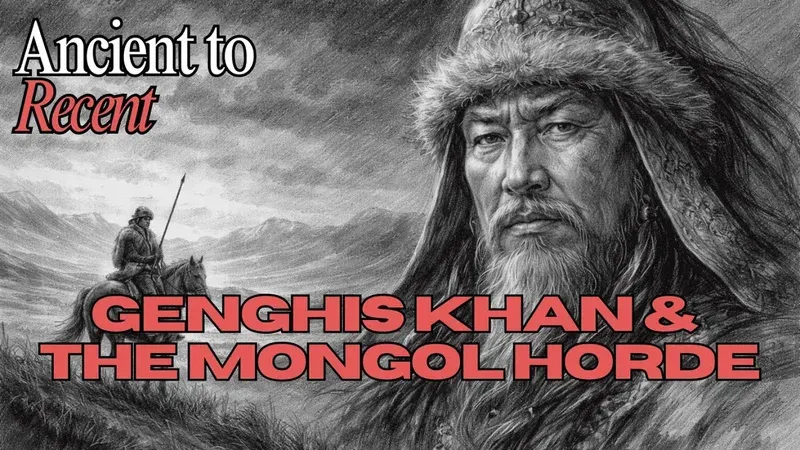
In this history podcast episode of Ancient to Recent, we explore the early life of Genghis Khan, the rise of Temüjin, and the origins of the Mongol Empire on the Eurasian Steppe.
Born into violence, betrayal, and extreme poverty, Temüjin’s childhood was defined by abandonment, hunger, and survival. After his family was cast out by their own clan, he endured slavery, exile, and constant danger in a world where loyalty meant more than blood and strength mattered more than birth.
This episode follows Temüjin’s transformation from an outcast commoner into a rising leader with a radical vision for steppe society. Rejecting aristocratic privilege, he began promoting men by merit rather than lineage, forging loyalty through shared reward and protection. Former enemies were absorbed, old hierarchies dismantled, and the foundations laid for what would become the Mongol Empire.
As rival tribes clashed, alliances shifted, and ancient traditions were overturned, Temüjin’s rise signaled the beginning of one of the most consequential empires in world history. This opening episode sets the stage for the Mongol conquests that would reshape Asia, the Middle East, and Europe.
Join Joseph Parkinson for the first chapter in the story of Genghis Khan and the Mongol Empire, a history podcast series exploring how one man rose from nothing to change the course of the medieval world.
🎧 New episodes every Saturday
📲 Follow on YouTube, Spotify & Instagram @AncientToRecent
#GenghisKhan #MongolEmpire #Temujin #HistoryPodcast #WorldHistory #MedievalHistory #AncientHistory #AncientToRecent
Read transcript
This transcript is automatically generated, so it may contain typos and misheard names.
The Tartars came from the east, devastating the lands of Islam, killing men, women and children, ripping open the wombs of pregnant women. Ibn al Atahir, the vast EUR Asian steppe, stretches from Manchuria in northeast China to the heart of Europe, Hungary, Romania and Bulgaria. Thousands of endless miles of rolling hills, open fields, gentle streams and cloudless skies were home to nomadic tribes that carried many names. Uzbeks, Kazakhs, Uyghurs took men's Tuvans, Tartars and many others.
All made the step their home or following a form of similar lifestyle based around the great herds, the saddle and the bow. Their herds pushed across the fast step in constant search for fodder and water. The steppe was both giver of life and provocateur. It was upon the steppe and the herds that relied on its vast grassland that the Turkic people were sustained. But the weather was both harsh and changeable. Icy Arctic winds swept from the north. The steppe was too dry, the soil too thin and lacking in nutrients.
The scarcity of resources spread constant tension between warring tribes who augmented their herds by constant cattle rustling and raiding of more sedentary people to the South and each other. But it was not just cattle they stole, but women. From these people's many great empires arose, and many great warriors stepped forth to carve their names in the tablet of history. None more so than a boy born in the spring of 1162 to a young woman by the name of Hoi Loon.
This young boy would go on to be the greatest, most feared and most accomplished military commander in all of history. The dominion he would create was stretched from present day Korea to Poland, greater than the exploits of Napoleon, Caesar or Alexander and not to be surpassed till the British Empire reached its fullest territorial extent in 1922. Welcome to ancient to recent, my name is Joseph Parkinson and today we start a new series on Genghis Khan and the Mongol Empire. Episodes of Ancient to recent are every Friday and are available on YouTube, Spotify and Apple Podcasts. The boy was given at birth the name Tamajin, and Tamajin, it is fair to say, had an inauspicious start to life of all the Turkey people that carried great names, conquering traditions and possessed vast wealth.
Temejin was born in one of the poorer relations of the Turkic family, the Mongols, a little known tribe of few accomplishments whose homeland was in the wooded North East of present day Mongolia and an area known for its natural beauty and abundance of wildlife, from deers to cranes to wolves. In fact, it's hard to imagine how Temejin could have started life a greater disadvantage as he was ushered into the world by his mother. It was not into the welcoming arms of a loving family to be raised by daunting aunts and protected by a strong father. Such a life may have awaited other step boys, but rather it was into the cold grasp of his mother's captor. You see, Temejin's mother had recently been kidnapped. If Hoi Loon, Temejin's mother, had cursed the cards that fate had dealt her and wondered what could have been, you could hardly have blamed her.
Hoi Loon was born into the powerful Ongerat tribe. She was a great beauty and much sought after. Probably in her mid teens at the time, she had married a young warrior by the name of Chilette, the brother of the chief of the powerful Murkett tribe. They were a power couple, the Brangelina of the 12th century. Step After the ceremony, Hoi Loon and her husband were travelling back to the Murkett lands, where she would hold an exalted position as the wife of a senior member of one of the wealthiest and most powerful tribes in step. But as their cart made it slow progress through the whining passages, what they did not know, what they could not have known, was that they were being watched from the above cliffs. A young warrior by the name of yes again had been watching as he had been out falconing.
He'd spotted the slow moving cart and the young bride, a beauty surely well out of his league. He could never hope to have such a wife, lacking both the prestige of his tribe or the money to be a suitable match. But there were other means a man of his lowly station could secure such a bride force. Yes, again. Not letting his presence be known, slipped away and rode as fast as he could to his nearby camp to inform his brothers.
They made it back to the hills overlooking the car and suddenly descending down, revealing themselves. If successful, they would capture Hoi Loon. And As for Chilette, they would kill him. Panic suddenly seized the newly married couple. Chillette rode off, hoping to draw the three brothers away, giving Hoy Lun time to hide, hoping to circle back to rescue his bride. But the chances were stacked against him. Hoy Lun, tears in her eyes, knew that the only way to save her love was to allow herself to be captured. She removed her blouse which held her smell and gave it to him.
Smell holding a very important place in steppe culture, and with it he would always have part of her with him. She thrust it into his hands and begged him to save his own life. He rode off promising to return for her, but what she knew and what he would come to learn is that this would be the last time they would ever see each other. Yes again. His brothers brought Hoi Loon back to their camp. They were from an obscure, impoverished tribe pretty much at the bottom of the step ladder, the Mongols.
Hoi Loon thought she had married into wealth, comfort and power. Instead, she ended up in grinding poverty. Worse yet, she would not even be Yes Again's first wife. She would have to take the role of a subordinate in the House of one of her own social inferiors. The humiliation must have been unbearable when Hoilun's son arrived. The ancient accounts tell us his birth was most notable, for the child was born into the world, grasping a blood clot between the fingers of his right hand. A child who would unleash oceans of suffering was born into the world, quite literally, with blood on his hands. Yes, again gave the boy the name Temüjin, supposedly after a Tatar warrior he had killed.
The Mongols have a distinct identity in that they, unlike other Turkic tribes, claim a direct descent from the Huns, the mythical people led by the feared Attila, who terrorized much of Europe between the 4th and the 6th century. The Mongols, though inhabiting a distant part of the already isolated steppe, were not totally cut off from the world around them. They were aware of the swirling currents of Chinese, Arab, Persian and even European civilization, though they struggled to scratch out a living from the open step. With little to trade to make use of the Silk Road, the vast flow of goods, money and cultural intercourse that surged tantalisingly close to them.
A trickle of goods did make its way N some through barter, but others through the well established practice of steppe tribes launching raids on their southern neighbors. It was not just goods, but also ideas that made their way north. The steppe tribes had their own shamanistic faith called Tengri, the worship of the great blue sky. But many steppe peoples practiced Islam, Buddhism, Confucianism and Christianity instead of, or often alongside Tengri ISM. From a young age, Mongol boys were trained with bow, Lance and sword.
The Mongols had no formal army. Being a Mongol was their profession. Their training was their very existence on the harsh steppe. The young Timagin and his father were, it seems, not close. Yes Again was keen to palm Timagin off on another family, particularly because he already had an eldest son, begged her by his first wife, who Yes Again was positioning to be his successor. Yes Again encountered a family with a daughter called Bort and Bort and Tamagin seemed to become close.
Yes Again was happy to offload the son he cared so little for. On the way back from depositing Tamagin with his new family, Yes Again came across a group of Tartars in celebratory mood, and Yes Again wanted to join in the festivities. But as Yes Again had once claimed the life of a Tartar, it was important he kept his identity a secret. It was no use. His identity was revealed and Yes Again was poisoned. Stricken, he escaped back to his family, where he called for his son to visit him, but too late, before Temejin arrived, Yes Again had died.
Yes Again's family had been dominated by the Tai Chut clan, and the protection of the clan was predicated on the ability of its members to contribute. Now, with the able bodied male of the family gone, leaving behind only two women and their seven hungry children, each with open mouths but none with the ability to hunt or fish, the clan decided to abandon them to a certain long and lingering death on the open step. With a less resourceful matriarch than Hoyloon, the family's fate would have been sealed.
But instead of giving into despair, she yet again showed the clarity of thought and swiftness of action that had saved her first husband's life. Instead of giving up to hopelessness, she threw herself into the tireless effort to save her family. Hunting, scavenging, begging, and borrowing anything to get enough food to make it through the day. Rats, small birds, roots, wild fruits, anything would do to fill their stomachs.
One can only imagine how much she must have cursed. Yes, again, a man who stole her from a life of wealth and privilege and thrust her into one despair. Hoi Loon kept the family together and alive until Tamajin could come of age. Tamajin was profoundly shaped by the hardship of his early life. He drew a number of lessons that would help him rise to being one of the most powerful figures in all of history. Temüjin formed a close bond with another boy of a similar age who was part of related clan.
The boy was called Jamukha. Their past would be bound together and their relationship would play an important role in Temüjin's rise. They became more than friends, they became Andas or Blood Brothers, exchanging gifts and swearing oaths of allegiance to each other. They were inseparable, hunting, fishing, learning, survive with each other as skilled stepchildren mastered by the age of 4. The close relationship Temejin enjoyed with Jamaica was not repeated with Temejin's half brother Begta. Begta, as the oldest son of Yes Again and his first wife, was the head of the family after his father's death. The Mongol tradition gave Bector not only power over the younger siblings controlled their property, but also the right to sexual access to Hoelun, Temüjin's mother. The situation was only worsened from Temüjin's perspective, as Hoelun often sided with Bector in the struggle for power within the family.
The man who would become Genghis Khan was not going to be restrained by arbitrary cultural norms that forced him into submission to another man. He decided upon a bold course of action. He would enlist Kassar, a young brother and one of the most skilled in the tribe, with bow and arrow to murder Begta. Temujin and Kassar crept up to Begta, confronting him, and shot him dead, leaving his body to rot on the steps. Temujin had committed a grievous sin, the stain of which would fall not just on him, but on his family too. He had placed himself outside of steppe society. The other members of steppe society could not grant him protection, but instead by law were compelled to capture and kill him.
Temujin decided to flee to the mountains, but the powerful Thai Shute clan set out to punish him. The Thai sheds captured him and sold Temujin into slavery. The family who acquired him, instead of treating him harshly, treated him with compassion and acceptance, caring for his wounds and loosening his shackles yet again. Temüjin could contrast the kindness of strangers with the cruelty of kin. Temüjin was able to escape captivity, partly with the assistance of the family, and make his way back to his mother. The hemogine by this time was probably somewhere in his mid to late teens and was soon to be too old to marry. He remembered bought the daughter of the family his father had tried to give him to.
Though years had passed, he set out to find her, tracking her clan down and convincing her parents to let her be with him. Steppe tribes exchange gifts, but in a steppe culture based on movement, large, cumbersome gifts are of no practical use. Instead, the tradition is to give clothes as a symbol of respect and loyalty. Bought had a fur coat that was highly prized that under normal circumstances would have gone to Temüjin's father, but with Yessuke dead, the coat would go to a different use. With slavery behind him and Bought by his side, time had come for Temüjin to make something of himself. To do so, he would need allies, and these would not be easy to come by for a former slave from the lowest Turkic tribe who was also now an outlaw.
But Temejin was an extraordinary man. The longer the odds, the greater the glory. The challenge never dimmed his ambition. Temejin set out to make an alliance with Anne Khan of the Carrier. The Kyriad were one of the three tribal confederations that dominated life on the step. Temuchin's family was not related to the Kyriad, but Yes Again, Temuchin's father had been the blood brother or Ander of En Khan. The leader of the Kyriad.
Yes Again had fought by En Khan's side many times and helped En Khan's ascent to power on the step. Loyalty was based on a complex web of male to male fidelity. Even if people were not directly related, they could enter into blood brother relationships that had closer bonds than mere biological family ties. As Yes Again had been a blood brother of On Khan. Then in the eyes of steppe culture, Temüjin, as the son of Yessige, was a sort of distant relative of Arm Khan. Temüjin would present the valuable gift of the black fur coat to Arm Khan in place of his father as a sign of fealty and loyalty to the leader of the Ceriat. A relationship with the carrier also had a special appeal to Temujin.
The carrier were not just one of the great powers on the steppe. They also had a further connection to a wider web of cultural and economic significance. They were Christians. The version of Christianity they practiced was called the Church of the East. The Church of the East claimed sent from the Apostle Thomas and was preached by wandering monks. This particular form of Christianity placed less emphasis on rigid doctrine and more on customs and medicine, and therefore had a practical appeal to the no man's of the steppe.
There was further symbolic appeal to the steppe tribes. The cross had four points, like the four directions in which the great blue sky extended. Jesus had healed the sick and risen from the dead. Surely he must have been an incredibly powerful shaman. There were other factors that made Christianity particularly appealing. There were no lack of missionaries hungry for converts. But Buddhism required vegetarianism, hardly appealing to nomadic tribes dependent on cattle for sustenance. And Islam forbade alcohol, not something that was going to go down well with the hard party in Mongols. Christianity allowed for, if not actually encouraged, both on Khan accepted the gift of the cloak and extended his protection to Temüjin.
He offered to make Temüjin a minor official in the carriered realm. But Temüjin, perhaps out of immaturity, perhaps out of an unwillingness to submit to the authority of another man, refused. All he wanted was legal protection and the ability to make his own way. With this in his pocket, he yearned for freedom. Had history played out differently and Temüjin accepted ANG Khan's offer, this could have been the last that we ever heard of Temüjin.
But this is not how the story played out. History had plans for Temüjin. Hoi Loon had originally been married into the Murky tribe, but her future was stolen from her when she was kidnapped at yes, a gay's hands. And now the Murkid were back. But it was not Hoi Loon, now in her mid to late 20s by the standards of steppe society, an old woman that the murkid were after, but rather it was bought. Temüjin's young wife, that is, who the murkid sought.
As Temüjin and his party slept in the early hours of the morning, blissfully unaware of what was coming, the thundering hooves of murkid great horses that made the very grounded self vibrate announced. They're coming before anyone could be raised to confront the coming of the band, the Murkid, whereupon Timojin and his small party of followers, Timojin and his brother, just had enough time to gather themselves, mount their horses, and ride as hard as they could to flee from the Murkid for fear of being killed. Just like when Hoi Loon was kidnapped all those years before.
They left the womenfolk behind, believing that the Murkid would not bother to chase after them if they could secure the prize they had come for abandoning. The women bought Temmagin and his party time to make their escape. They rode hard to the north, putting distance between themselves and the murkid. The ruse worked. The murkid made off with boards and another two women. Temmagin was in a state of shock, unable to decide what to do next. He had lost his right, and being a Mongol, and a commoner at that, he was unlikely to be able to attract another spouse. After all, with so few prospects, who'd want to be married to a man like Temmagin?
Temejin, A devout animalist, prayed to the God of the Great Sky to lead his decision. Should he accept his fate? Try and start again? Scrabble together enough to get by? Or was a different path open to him? There was another option other than sinking into powerlessness. Temejin could go to on Khan and ask for his help. He had been a slave. His mother had been kidnapped. He had no wealth, lineage, or seniority. His own father had sought to give him away. One thing was certain, if he was going to have anything, if he was going to be anything, if he was going to break the cycle of powerlessness, then he had to take his own fate into his own hands.
Riding into the camp of On Khan, Temüjin explained the situation and begged for help. On Khan had a long feud with the Murkid and he was eager to put them in their place. This could be just a pretext that On Khan needed. On Khan agreed to assist Temüjin but there was one of the person that would be needed if On Khan and Temüjin were to get bought back, Jamukha, Temüjin's old friend and blood brother. Jamukha agreed straight away to join the others and to help return bought to Temüjin. With the help of On Khan and Jamukar, Temüjin launched a lightning raid on the Mercad.
The raiding party broke into the Mercad camp, and amidst the Mele Temüjin call to Bought, she heard her husband and the two were reunited. Their reunion, however, would be no fairy tale, for Bort was pregnant. Was Temujin the father? Or rather, was the child in her belly that of her murkid captors? There was no way of knowing. Bought gave birth in 1179 to a son called Judge, which in the Mongol language means visitor or guest. Was such a name meant to be an admission of a dark suspicion? Temujin and Jamaka were so close as children, and with Bought safely back, they were now free to renew their bonds of friendship.
But now they were adults. Things were different. Jamaica came from a noble family and a prestigious tribe. Tamagin was a commoner from an undistinguished lineage. Jamaica had come to expect subordination and deference. And now he expected this from his old friend. This new power dynamic grated on Tamagin. Tamagin had proven himself in battle. He had a growing reputation for bravery, organizational skills, and inspiring the loyalty of his men.
He also had a considerable chip on his shoulder. He had suffered enough at the hands of others, and he would never allow himself to be talked down to. Both were rising stars in steppe culture. The former friends were now on a collision course. Temijan decided it was time to form his own power base. The Mongols may not be the most prestigious people, but in the right hands maybe they could do great things. All they needed was unity. Temejin thought he was just the right man to bring the Mongols together.
Temejin made a point of sending a message to On Khan that he was his loyal vassal and he sought to unify the Mongols to better serve On Khan, and that such an effort should not be seen as a challenge to on Khan's authority or the supremacy of the carrier tribe. Temejin arranged a council or hurl tie, a sort of vote by attendance. Everyone who attended was a vote for him, and everyone who didn't was a vote against his leadership.
Enough of the Mongols attended for Temejin to claim victory on Khan. Rather than being threatened by Temejin, establishing his own power base was rather happy on Khan had come to power by overthrowing his uncle, and the last thing he wanted was too much unity amongst his subordinates. With Jamakar seemingly the rising star, a counterbalance could be useful, especially one from someone like Temüjin. After all, Temüjin was nothing and nobody, an upstart with no lineage from a minor clan.
If he wanted to bring the Mongol rabble together, then sure, whatever, fill your boots. Maybe it would be good enough to cause Jamukar a few headaches, but nothing for the great on card of the carriers to worry about. Right? But Tamajin was not an average nobody. He was an exceptional nobody. Tamajin had some radical ideas for how to organise the Mongols, to turn them into an effective fighting force. His experience of abuse at the hands of those who, by the standards of steppe society, was supposed to be his closest kin gave him a contempt for convention.
And he would turn the world upside down. Instead of promoting people by name, blood or heritage, he would appoint people by merit. He gave opportunities to the sons of blacksmiths, shepherds and milkmaids. If they were good enough to command a raiding party or an army, then who cared who their parents were? Jamukha was not happy to see Temüjin rise to a position of prominence. He saw himself as the Chosen 1, and he was not keen to welcome a rival, even a lonely one.
In 1190, Jamukha decided time had come to clip Temüjin's wheels. OK, Temüjin, enough is enough. It's been fun, but time to get real, time to know your place. The followers of Jamukha and Temüjin met with Jamukha, the aristocrat emerging victoriously, showing this lowly upstart a lesson in respect. But Jamukha maybe to make a point, to teach Temüjin a lesson when a step too far, he broke a major taboo of steppe society. He cut off the head of 1 of Temujin's followers and tied it to his horse, thus defiling his soul.
He also arranged for 70 of Temujin's followers to be boiled alive and thereby destroying their soul. Such cruelty, such contempt, such vengeance shocked steppe society. This was a major taboo. And in making his point, Jamukha also made a faux pas. He had won the battle, but so appalled steppe sensibilities, the Tamajin won considerable sympathy and attracted many to rally to his banner. Tamajin licked his wounds and he needed a bit of luck. He needed a win.
He needed to restore face and in 1196 such an event would occur. The Jutchid people to the South of the Gobi Desert were growing concerned by the rising power of the Tatars. ANG Khan, an ally of the Jutchid, was instructed to organise a raid on the Tatars to unsettle them. The Tatars were a rich and powerful people and they possessed many trade goods that they had acquired from the Silk Road, goods beyond the wildest dreams of the impoverished Mongols. With judges support on Khan attack the Tatars and Temüjin was part of the raiding party.
The raid allowed Temüjin to acquire a large booty of treasures much sought after by his Mongol followers. Such goods also allowed Temuchin to attract many new supporters. But Temuchin did not just gain riches from raiding the Tartars. He gained something more vital. He gained an insight into how the steppe people were divided, used, and weakened by each other and by their rivals. He saw how the Dutchie had allied themselves with Ankan just to destabilize the Tartars.
On the steppe there was a constant shift of alliances as one tribe allied and then betrayed with another in an attempt to gain an upper hand. But in the grand scheme of things, it was a lose lose game for the people of the steppe. The steppe people remained forever divided, while kingdoms such as the Jiuchid would always maintain their dominance. Temüjin was on the rise again. He set about an aggressive policy of carrot and stick to unify the Mongols, distributing goods to those who joined and raiding those who resisted.
Temüjin continued to display inability to think beyond the parameters placed upon him by tradition and convention. He already implemented radical ideas such as promotion by merit. Now he had another idea. The step was trapped in a constant cycle of raid and counter raid, alliance and betrayal. No victory was final, Today's ally being tomorrow's enemy. Temichin wanted his victories to last. He would change how things worked on the Step.
The tribes he defeated he set out to absorb. The ruling class were to be killed, and after decapitating society, those that joined would be taken not as slaves, but rather we be welcomed as equals with all the rights, privileges, and protections of any other member of the tribe. Temujin wasn't just another warrior seeking power. The Step had no lack of ambitious young men determined to make a name for themselves. Temujin was setting off a revolution. He had no time for the old conventions and niceties, and he would not know his place.
He was not going to stay in his lane, and anything that hindered his rise would be crushed. But for some, especially Mongol aristocrats, these changes threaten their position of power and privilege. They were not happy at all for these more conservative Mongols. They saw Jamukha as a figure who could block the rise of this ambitious young man with his radical ideas. In 1201, Jamaica, with the backing of the Tiedge hood and the aristocratic Mongols, decided to issue a direct challenge to Chemojin.
He would summon his own corals, high or council, where he would be proclaimed Khan of the Mongols. The two sides squared off. Much of internal tribal warfare was psychological and ritualistic, rather than out and out violence. It was a show of force combined with an appeal to lineage and religion. When the two sides met, shamans preyed, animals were sacrificed, drums beaten, each side trying to impress on the other their might, their will, their claim to dominance.
As the two sides squared off, storm broke out and taking this as a sign, some of Jamukha's followers fled. Fighting broke out as the field turned into a running battle. Step warfare derived from step life. Knights with plated armour, as was happening at this time in Europe, would neither be practical nor possible on the open. Step warfare centred on fast moving horses, skilled riders and the dominance of the mounted Archer. Thus fighting was often at a distance. This tied in with step culture as step people hated the sight of blood and wished to avoid the smell of their enemies. As smell had huge significance in step society, it was a persons smell that contained their essence. To be exposed by hand to hand combat to your enemy's smell or blood was to risk being defiled.
The two sides battled all day, but neither could land the decisive blow. But just before nightfall, Temüjin was struck in the neck with an arrow. The wound was not deep, but to see their leader struck down and bleeding could have a huge psychological effect on Temüjin's followers. The wound itself may not prove fatal to Temüjin, but it could prove fatal to his cause. As night came Jelme, 1 of Temüjin's followers cared for Temüjin. Jelme tended to Temüjin's injuries by sucking the blood from Temüjin's wound and not wanting to spit it out, because to spit blood on the floor would be an insult in Mongol culture. He instead swallowed it, only spitting when he could consume no more.
All night Jelme nursed Temüjin. Such commitment showed Temüjin's deep bond with his men. Temüjin never punished any of his commanders and in turn he was never betrayed. The next morning, followers of Jamaica had slipped away and Temüjin was left in command of the field. He had avenged his earlier defeat. Temüjin followed his now tried and tested approach. The tribe was absorbed into the Mongols. While it's leaders were killed, Temüjin's power continued to grow.
Temüjin continued to show an uncanny ability to analyse and solve problems. In 12O2 on, Khan sent Temüjin to again raid the Tartars. It was during this raid that Temüjin witnessed a major problem that constantly hindered steppe people. A steppe tribe would begin a raid, surprise their enemies, setting them to flight, but their advantage would be wasted as soon as the enemy was in full retreat. Instead of chasing after them and turning a retreat into a route, potentially crushing an enemy in a single swoop, A Mongol attack would immediately lose all momentum as soon as it happened to break into the enemy's camp. The booty Mongol warriors gained from raids was up to themselves to seize, so as soon as they came into the camp they would set themselves to plunder, thus allowing the enemy to escape. Temujin instigated a new system.
Under his leadership, no warrior could claim booty for himself or commander distribute it without Temujin's approval. Tamajin drew on the example of the hunt. During a hunt, the hunters would share the game amongst themselves to make sure that everybody got what they needed. This is exactly the system that Tamajin implemented in Mongol warfare. All booty was to be collected after the battle and would be distributed by Tamajin himself, and a share of the booty would be given to the family of any Mongol warrior who died in combat.
This had a huge effect. Now the Mongols would pursue their enemy with their full force, hunting them down and destroying them, inflicting maximum casualties. It also increased the sum total of booty to be distributed and gave each warrior the confidence that no matter what happened, their families would be cared for. This further strength and bonds of loyalty of ordinary soldiers to Temüjin. Temejin defeated the Tartars and added them to his tribe, even taking a Tartar wife.
To further strengthen this idea of bringing people together, of being one, Temejin continued to implement reforms. In 12 O3 he reorganised his army. Each ten soldiers became a squad or arban. In these Arban's each soldier was a brother to the others. They would live and fight together and were forbidden from allowing one of their number from being left behind alive in battle. The eldest in the Arban would be in charge, but the soldiers would be allowed to vote, thus removing leaders and giving the soldiers confidence in those that commanded them. 10 arbans or squads would be a Zagon or company, 10 companies would be a battalion or Mingan and 10 battalions would be an Army or Tumin.
Each Tumins leave leader was personally appointed by Tamagin. Tamagin was addressing yet another key source of Mongol weakness, turning it into a strength. This was more than military reform. What Tamagin was doing was creating bonds of loyalty and identity that run across tribe, clan and family identities that were based on loyalty to him and a shared sense of togetherness. And where the Mongols had always been exploited for their weakness, now they would be feared for their unity.
This sense of shared loyalty and duty did not end with the army. All Mongols had to share in common effort for the good of society. Those who did not fight would give one day a week to labour for Temüjin. Be it through cooking, caring for the sick and injured, or even singing and entertaining, everyone would contribute. Temüjin was effectively flattening society, wiping out the old distinctions, and creating a single solid identity with himself at the very heart. To solidify this new sense of identity, Temüjin even came up with a new name for his embryonic nation. From now on, his people.
Once Mongols, Taichuds, Tartars, would now be known simply as the people of the Felt Walls. Temüjin's rise to power was not going unnoticed as the boy from nowhere ascended to rising star in the land, seeing off challenges and turning society upside down, concerns about his rise started to spread beyond Mongol society. The question started to be asked, just what were the limits of this young man's ambition? An Khan, who Temejin was still officially a Vaslov, was getting old. The question arose, who could be an Khan's successor? An Khan had a son.
His son had no following of his own. The two options would be Jamukar, stunned but not defeated just yet, and the man on the make, Temüjin. Temüjin was the most powerful of the two, but he was still a commoner, and he is also still a Mongol, hardly fit to be Khan on. Khan had been happy to see the two fighting, presuming they would weaken each other. He certainly did not imagine it would only further empower Temüjin. Now it was Anne Khan who was worrying about his own vassal. Temijan proposed the marriage of his son George to Anne Khan's daughter, thus settling the issue of Anne Khan's succession in Temijan's favour.
The daughter of the Khan, married to the son of the most powerful man in the land, would make Temijan unstoppable. But in the deeply conservative and rigid hierarchical world of the steppe, the marriage of a commoner into the royal family would be unthinkable. En Khan refused, dismissing the suggestion. But then En Khan had an idea. Maybe this was an opportunity. Maybe he could neutralize Tamajin. Confronting Tamajin and his growing band of followers was something even the leader of the carrier would think twice about. But if Tamajin were to have some tragic accident, then that would solve all of An Khan's problems.
And hadn't Tamajin's father yes again had such an accident being poisoned? While he was at a party, An Khan announced that he had changed his mind and sent word to Tamajin that he would be delighted for his daughter to marry Tamajin's son. He even sent details of the time and place of the wedding several days ride away from Temejin's army. Temejin departed from his army with a small band of followers, seemingly none the wiser of the trap that lay ahead. But somewhere on the journey, he seems to either had second thoughts or perhaps been warned.
Temüjin ordered his followers to split up, heading in every directions to make them harder to capture. He took a party of his most loyal followers and rode hard for the east, too far from his base and not knowing if an Khan had sent his warriors to intercept him. He knew he had to take a detour rather than going directly home for fear of capture. But this would mean much hardship, and his party brought little supplies.
His party, starving and exposed to the elements, exhausted and overcome with fear, made their way to Lake Baljuna. They were nearing the end of their strength, but just as it seemed lost, a stray horse appeared. They brought the horse down with their bows and feasted upon it. The horse is central to step life. The horse is essential to herding, hunting and fighting, and it is seen by many as the living embodiment of the steppe warrior and way of life. For a horse to suddenly appear and save Tamajin at his very lowest ebb, to a devout animalist, this seemed like divine intervention.
This was the great blue sky showing that Tamajin was special. He was protected, for he had a destiny. This moment of deliverance by divine intervention would take on a mythical significance for the Mongols. Temüjin and his followers that day took the water of Lake Baljuna and swore an oath of allegiance. Temüjin to his men, and his men to Temüjin to always be faithful. This would be known as the Baljuna Covenant. The bond between Temüjin and his followers had now become a sworn, sacred holy covenant, protected and blessed by the great blue sky itself. But Temüjin situation was still desperate, and there was no way of knowing what would come next.
Tamogen was temporarily out of action. His tribe was leaderless. For all they knew he was dead. Would they relapse, falling back into old habits of squabbling in division or with the new unity Tamogen had done so much to instill in them? Hold them together? Tamogen spread word of what had happened to him and called for his army to assemble. Anda by Anda in their 10's and hundreds, and then in their thousands. The army of Temüjin came together, rallying around him.
They had not forgotten him nor betrayed their oath of allegiance. He had shown them a different way. His leadership had made them more powerful than they had ever been before, and they believed in him. Temüjin's reputation even LED some of on Khan's followers to come over to Temüjin's side. They would unite and take the fight to En Khan. For En Khan, he was celebrating his victory. Tengjin had been set to flight. His pathetic band of commoners would soon disintegrate and all would be right with the world yet again. He had in one wave his hand on simple trick done away with this troublesome upstart and his ridiculous impertinent reforms. But as En Khan was celebrating, Tengjin and his army were closing in.
Temejin took his army on a detour around on Khan's camp rather than across the plains so as to disguise their coming. Temejin ordered fresh horses to be placed along the journey so his men could keep their momentum up and move like lightning. By the time on, Khan and the carrier knew that Temejin was coming. It was already too late. Tamajin's men came upon the carrier like a storm, a sudden Mongol blitzkrieg appearing from nowhere, sowing confusion and dismay. 3 days of fighting broke out as the Mongols pushed the carrier back in a panicked retreat. Some slipped away, others changed side to join Tamajin. Those who did not fell to the Mongol bow. As the fighting turned against ARN Khan, his support crumble, a trickle of defectors turned to a flood. All were accepted into the Mongol tribe, not as defeated foes, but as honored members of the tribe, thus encouraging further defection.
Jamma Khan made his way to the West on the vast open step. 2 of the three great powers have now been crushed. The Tatars had been absorbed, the carrier had also been swallowed whole. There was only one tribe left, the Naman, and this is where Jamukar set out for On Khan also avoided capture. Temujin spread stories that On Khan was dead, but he knew that this was not true. He knew that the Naman could come under the influence of On Khan and Jamukar and they too would pose a threat.
Temujin was now tantalisingly close to doing the impossible, uniting the step people into one single nation, the Naman. With a final piece of the puzzle, Temujin started spreading rumours about the Naman, their decrepit leader Tian Khan, and their contempt for the Mongols who they feared and looked down on. The Mongols began hit and run attacks on the Naman, avoiding facing the more numerous warriors Tan Khan could call upon, whilst also sowing fear and discord. The final bat came in twelve O 4, when the superior organization and discipline of the Mongols allowed Tamagen to deal a decisive defeat to Tan Khan, crushing the Neymar once and for all and swallowing them whole into Tamagen's ever expanding realm.
Tamagen had Tan Khan killed, but Jamukar yet again got away. Jamukar, however, had played his last card. He had battled Tamajin for supremacy on the steps and been defeated again and again. Now there were no allies left for him to call upon. Jammu Khan lived as an outcast, scraping in existence with a small group of supporters until in 12 O 5, his followers betrayed him and handed him over to Tamajin. Tamajin valued loyalty, even in his enemies. Instead of rewarding Jamukar's followers, he had them all killed one by one for breaking their oaths and betraying their Lord.
Temujin was victorious. There could be no doubt who had won in the struggle between the two former Blood Brothers, But Temujin was forever a pragmatist. Anything that could help him accumulate more power, he was in favor of. And with his superiority established, he offered Jamukar and reprieve. Become one of his commanders, take his place at Temujin sight and all would be forgiven. But Jamukar was proud. He could not accept the offer. He asked Temujin to do him instead. One final deed to kill him in the old aristocratic way, without spilling his blood.
And it done, this last favour. Then, from the next World, Jamukar would be forever his friend and protector, watching over Temüjin and his offspring. With great sadness, Temüjin agreed. Temüjin had started life as a son of a commoner, had endured poverty and slavery, had been left to starve, had seen his own wife kidnap from him, but by sheer force of personality had risen to unify all of the people of the steps into one mighty nation.
He had faced many foes, the mercured, titered, carriered and naman. He had been opposed by the great men of the Steppe, Arm, Khan and Jamukha, and yet he had always prevailed. Temuchin was now the undisputed ruler of a state the size of Western Europe, with a population of over 1,000,000 people. Temujin said about constructing a state based along his own ideals and principles. He understood the challenges that beset the steppe people and how their division had allowed them to be manipulated by their neighbors.
Like the judges, he said about eliminating any source of division or weakness and forming his people into one single solid, mighty mass. Temüjin abolished inherited titles from now on. Offices were given by him on merit, which further centralized power in his own hands. He created a Mongol legal framework that took precedent over local laws and customs by which all would be judged no matter their tribe, clan, or rank.
He outlawed bride kidnapping and enslaving other Mongols. All children were declared legal no matter the marital status of their parents. The selling of women into marriage was declared illegal. The step had been riven by constant cattle raids. Stealing cattle was now declared a capital punishment. Temuchin also implemented a vast system for the return of all lost cattle. Anyone who found cattle and did not return it to its rightful owner would be put to death. He instituted laws for the hunting of animals, which was only to take place in winter after the breeding season had ended, thus preventing the food supply from becoming exhausted. Laws were introduced regarding the butchering of animals to prevent anything from being wasted. Temuchin also attempted something truly visionary. The steps were home to believers of every faith, Animalists, Christians, Muslims, Buddhists, and many others, all claiming to believe in the one true God.
At a time when Europe was being torn apart by religious wars and the Crusades was still raging in the Middle East, Temuchin declared that every person had total freedom to worship whatever God or gods they saw fit. Temujin further decreed the adoption of a writing system that was alien to step culture to allow his decrees to be taken down and implemented throughout his Kingdom. But this would require a postal system, so he set one up.
A series of posts were established every 20 miles, maintained by local people and stocked with fresh horses to allow for communication to travel quickly across his vast realm, so efficient was the system that was still in place in the 18th century. Temujin was victorious, but military victory alone did not confer legitimacy in steppe culture. He would have to win the approval of those he sought to govern. He summoned a coral tie or great council in 12 O 6.
This was a great religious festival complete with prayer of shamans, the feasting and rituals. All who came would be his supporters. Those who did not were declaring that they rejected his right to rule. From every tribe, clan and family, they came in their thousands to pledge their allegiance to him, thus declaring him their leader. Tamajin, the common boy who'd been abandoned and had himself been condemned to slavery, had now been declared the legitimate leader of the vast state that he had, through his own force of personality, forged. With this, Tamajin took a new name, the Universal Ruler, or in Mongol, Chengis Khan.
Genghis Khan had melded the world's most fierce warriors into a single state with a meritocratic officer corps, rational government and single minded determination to expand and subjugate. Those who stood in its way would be absorbed or be crushed. He was about to unleash this new power on a wholly unsuspecting world with devastating consequences. Thank you for listening to Ancient to Recent. My name is Joseph Parkinson and next week's episode we will continue the story of Genghis Khan and the Mongol Empire. Episodes of Ancient to Recent are out every Saturday and are available on YouTube, Spotify and Apple Podcasts.