
#28
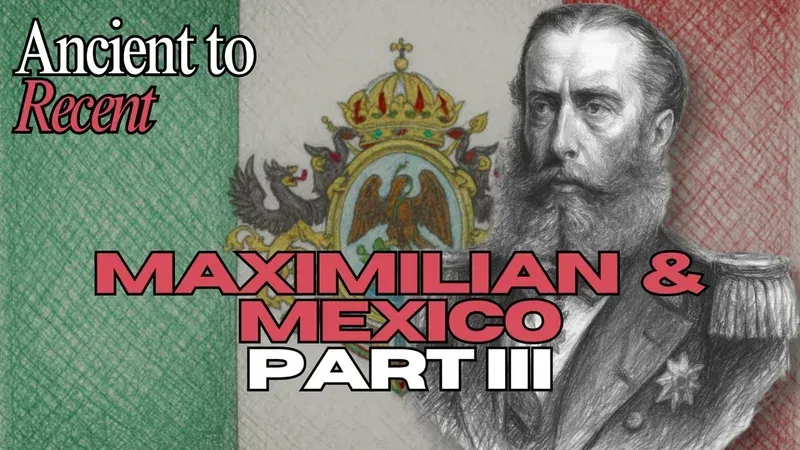
Maximilian of Mexico: The Rise and Fall of the Second Mexican Empire — Part 3
13 December 2025 · 43 min · Season 1
 Watch on YouTube →
0:0043:08
Also on
Rate the show
Ratings are how new listeners find the show. It takes a minute and it makes a real difference.
At the height of his power, Emperor Maximilian believed he could reconcile monarchy with liberal reform and heal a nation torn apart by decades of war. By the end of 1864, the Second Mexican Empire stretched to the U.S. border, Republican forces were on the run, and French troops appeared to have secured the throne. Yet the empire’s greatest victories concealed its deepest weaknesses.
This episode explores Maximilian’s fatal balancing act. Determined to rule as an enlightened monarch, he alienated Mexican conservatives who demanded a return to privilege, confronted a Catholic Church unwilling to compromise, and frustrated French officials desperate for financial reform. Progressive laws were proclaimed with fanfare, but the machinery of government ground to a halt, leaving reform trapped on paper while the war grew ever more brutal.
As guerrilla violence escalated and unity within the imperial camp collapsed, events beyond Mexico’s borders began to dictate the empire’s fate. The American Civil War was nearing its end, the Monroe Doctrine was reasserted, and the United States emerged stronger than ever, ready to challenge any European monarchy in the Americas.
Join Joseph Parkinson as the Second Mexican Empire reaches its high-water mark, tracing the moment when Maximilian seemed closest to victory and when the forces that would destroy his throne were already closing in.
🎧 New episodes every Friday
📲 Follow on YouTube, Spotify & Instagram @AncientToRecent
.
.
.
#SecondMexicanEmpire #MaximilianOfMexico #MexicanHistory #CatholicChurch #NapoleonIII #BenitoJuarez #USCivilWar #HistoryPodcast
Read transcript
This transcript is automatically generated, so it may contain typos and misheard names.
Among individuals, as amongst nations, respect for the rights of others is peace. Benito Juarez, the Queen is said about their business. The bunting taking down confetti piled up and casted away. The band stands in banquet tables dismantled, the half drank champagne and half eaten tortillas disposed of. It was the morning after, the night before. Monarchist Mexico was waking up with sore feet and even sore heads. The Emperor had come in glory. Religion had been victorious.
The rights of men of property would finally be respected. Mexico was, as it had always meant to be, back to its old self, and the nightmare of republicanism could be consigned to the past. It never happened. Little more than a bedtime story to scare the children of the wealthy and landed, it would be plain sailing from here. That's how the story was meant to go, right? Well, as far as the Archbishop of Mexico City Antonio de la Bastida and arch monarchist Gutierrez de Estrada.
That's how it was supposed to work out. The emperor would come as a good Catholic monarchy would roll back the reforms of Juarez. The monarchists wouldn't have to listen to the droning of Byzan and the other French officials with their childish talk of reforms winning over liberals and suspiciously secular ways, and all would be right with the world. But there was one person the conservatives hadn't cleared this plan with, the Emperor himself. The monarchists wanted a Catholic conservative to turn the clock back to the colonial days and restore the rights conferred by property and privilege. A source of reactionary Santa Claus, but one that crossed only nice children off the list.
Now the Habsburg family had plenty of them. But the monarchists had made a mistake. They'd got the wrong Habsburg. Welcome to ancient, to recent. My name is Joseph Parkinson. And today we will continue our story of Maximilian of Mexico and the Second Mexican Empire. Episodes of Ancient Recent are out every Friday and are available on YouTube, Spotify and Apple Podcasts. Maximilian had spent his life on the sidelines.
He briefly had the occasion to apply his ideas of modernity, rationality and popular consent in his time as governor of Lombardi Venicia in northern Italy, but he always had the handbrake of his brother, Emperor Franz Joseph, firmly on. Now he would be free. He was an emperor in his own right, and he fully intended to rule as one, to reform Mexico along liberal, enlightened ideas. This was to be the melding of modernity and monarchy, empire with a progressive twist, Maximilian said about adopting a programme of reform. And to the horror of Mexican conservatives, it was not they but a French journalist that Maximilian turned for a program for government.
Very soon, Mexican conservatives realized that the pounding in their heads was not the result of too much champagne, but rather the ideas Maximilian had for Mexico. It was a bingo, a jackpot, a full house, a royal flush of everything. They despised reconciliation, democracy, progress, religious tolerance. What kind of monarchy is this? Of all the institutions that had been crucial to Maximilian's ascent to power, that lent his throne legitimacy, and it helped Maximilian place the crown on his head, the Catholic Church was foremost, and the Catholic Church didn't do favours for free.
Tension between church and foreign officials had emerged immediately, with the church expecting the return of property confiscated by Juarez and his reforming regime. As much as church officials grumbled and not getting their way, they expected Maximilian to say things right. Why make a king if he didn't do your bidding? But Maximilian had other ideas. He feared being seen as a foreign interloper imposed at the point of a French musket.
He knew it was one thing to make an empire, quite another to rule it. If Maximilian was to stay in power, it could not be papal authority of French military might. He had to rely on. He had to win over his opponents. There was another issue that had to be addressed. Napoleon, the third emperor of France, the man who had provided the muscle to make Maximilian's dream of empire a reality. He too did not work pro bono. For Louis Napoleon, it was not a romantic dream of monarchy or memories of a long lost past that motivated him to empty French coffers and send the sons of France to die in a far off land.
It was cold, hard self-interest. Louis Napoleon dreamed of a fast French sphere of influence stretching from the Rio Grande to Patagonia, dotted with French Klein states, each with a monarch that turned to Paris for guidance. Mexico was just to be a first step and this was all so Napoleon thought, meant to be an empire on the cheap. France wouldn't officially run these countries, but rather be the leading light in this informal empire.
These states would provide vast natural resources to fire French industry and markets for French exports, all whilst governing and garrisoning themselves. Mexico was to be bought the first piece of the puzzle, but this all had to be paid for. Before departing from Mexico, Maximilian had agreed a deal with Louis Napoleon, a large loan that was to be paid back in full and the price 1000 francs per French soldier per year.
But Mexico was a war-torn and impoverished nation. Defeat in the US Mexican War of 1846 to 48, followed by years of turmoil, civil war between 1857 and 61 and now French invasion had hardly left Mexico flush with cash. Whilst little time had been committed to the urgent financial reforms so desperately needed if Mexico was to pay for French occupation, Maximilian seemed to be swept up by his new position. He had finally stepped out of the shadow of his brother Franz Joseph, and he fully intended to bring Habsburg pizzaz to Mexico. Instead of urgently setting about the difficult and laborious task of much needed reform, Maximilian wanted to get his feet under the table.
But as a Habsburg, he expected a certain standard of comfort. Maximilian didn't care for the palace that had been set aside to be his official residence. It was infested with rats and insects, the furniture was not to his liking, and the less said about the cutlery the better. Such a hovel as the presidential palace may have been good enough for a lowly provincial like Benito Juarez, but a president was but a bureaucrat.
An emperor was something entirely different. Maximilian was not a government employee. He was the government, he was a descendant of Charles the 5th Philip the Great, he was the scion of a royal family, and he expected to live in style. After only a few days, some of which Maximilian spent sleeping on a billiard table to escape the rats that tormented him, Maximilian moved out to Chapel Tepec Castle, the former residence of the Spanish Viceroy, a more suitable home till extensive renovations had been completed. And the renovations would be extensive. Indeed, despite sending ahead a team of cooks, ballets and advisors, there was much to be done. Candles, chandeliers, the best furniture from Paris and London cut crystal champagne glass from Berlin, Venetian curtains, Austrian lace.
All of it had to be ordered and shipped from Europe at the very moment when Maximilian should have been directing his military to finish off the liberals, reforming the state finances and presiding of a crucial land redistribution to win over enemies. He was blinded but the trivial. The royal couple was settling into their new life and Carlota was in her element. She had always loved balls in banquets and now she could have as many as she liked and she could be the centre of attention.
Maximilian always found such formal affairs trying and he avoided as many as possible, but Carlota indulged her love of pomp and pageantry. Life, however, could not be all fun and games. As much as Maximilian had allowed himself to be distracted, he did begin to turn to affairs of the state. Maximilian was a creature of habit, and this was reflected in his daily routine. Waking early meetings, even if all too many of them were about cushions and not enough about worries to gorillas, regular exercise, dinner and then bed. By 8, Maximilian suddenly went from a man with far too much time in his hands to being pulled in every direction with every pressure group and politician calling for his attention.
Just at the moment when Maximilian and Kelota needed each other the most, they now began to drift apart. Kelota had always been Maximilian's greatest advocate, his pillar of strength, but as the work piled up, duty placed a strain on their relationship. They were not seeing each other apart from at dinner time, and Kelota found herself having to make an appointment just to spend time with her husband. There was a further stress placed upon married life.
Maximilian's wandering eye, Carlota was a great beauty and only in her early 20s. But Maximilian had never seen women like he now found all around him in Mexico, and so many of them desperate for his attention. Maximilian and Kolota, like many royal couples, didn't sleep in the same bed and this allowed Maximilian to indulge his sexual fantasies. But Maximilian took his philandering to extremes, setting up a second residence 50 miles from Mexico City, where his lust could be satisfied.
Rumours of Maximilian's behaviour soon began to swirl in the Mexican court. Was Kolota hurt by this, or did she take this as part and parcel of the life of so many royal spouses? French officials had always had a clear idea for how to win the war and secure Maximilian's throne. The carrot and the stick. Aggressive military action against Juarez and progressive reforms to win the support of less committed Republicans.
This was an approach to Maximilian. Fully supported. He understood that you have to make peace with your enemies, not your friends. If Maximilian was going to win over Republican Mexico, then he had to show them that he could be their emperor too. For this reason, Maximilian appointed Jose Fernando Ramirez, an outspoken Republican, as one of his ministers. However, from the very beginning, Maximilian showed an unfortunate tendency to place 1 foot forward and the next back.
He had appointed a Republican minister, but he had also brought with him many advisers and officials from Europe, Austrians, Hungarians, Croats and French. Many spoke no Spanish and completely lacked any understanding of Mexico, it's history, culture or customs. This created an information loop. Who was in charge, Maximilian, the Mexican ministers, the French officials or the Austrian advisors? Decision making was further complicated by the language barriers, with all documents having to be translated into multiple languages. Maximilian was riding high.
His enthusiasm and reformist zeal allowed him, despite hiccups, to win. Doubt is over. He consistently displayed a liberal outlook, pushed forward progressive policies and showed lenience, often in the teeth of conservative outrage towards his opponents, including pardoning those condemned to execution. In the summer of 1864, Maximilian approach had its first success. Santiago Viduri, a senior Republican commander, turned himself in and swore allegiance to Maximilian and the Empire.
Jose Lopez Uruga, the Republican commander who had led the attack on Mature Khan, quickly followed, declaring for the Emperor and abandoning Juarez and what seemed like the doomed Republican cause. Things seem to go from bad to worse for Juarez and the Republicans. French forces continue to pursue them, and no sooner had they set up a new camp that they were driven north. Always N the Republican cause, weakened by defeat, starved of support and now losing increasing numbers to defection, suffered a further blow. On the 26th of September 1864, Matamoros, the last Republican held port on the Atlantic just South of the US border, fell to Imperialista forces.
Juarez looked defeated. Maximilian sent a steady stream of correspondence both to his brother and now fellow Emperor Franz Joseph, and also to his patron, Louis Napoleon, always painting the most positive picture. But Napoleon continued to grow anxious. For all of Maximilian's success, and he was having success, there was no sign of the vital economic reforms Napoleon was desperate for. Where was the money? This was a financial investment for Napoleon, and he knew he would not be able to secure his expected dividend without reforms. Napoleon warned Maximilian in the sternest terms to focus his attention on balancing the books and putting the Mexican Empire on a firm financial footing.
Maximilian oscillated. Sometimes he should vision, sometime he struggled to discern what was truly a priority. Maximilian decided that to secure his empire, he would have to show himself to his people. He would travel the country, sit with normal Mexicans, eat from their tables, listen to their concerns, and by showing himself the magic of monarchy, would win them to his banner. But the financial reforms were neglected. Maybe the reason he didn't focus on the Empire's books was because it was something that a simple declaration or display of majesty could not solve.
A division was beginning to emerge. Maximilian was greater making proclamations, but all too often there was no follow through and financial reform would be all follow through and little pomp. It wasn't a sexy task, and maybe that's why he found it easy to allow himself to be distracted by tours and pronouncements. Maximilian embarked on his tour, an event that would further separate him from Kelota and present ample opportunity for nocturnal entertainment with the opposite sex. Maximilian wanted to mark Mexican Independence Day, but this was a cultural minefield that Maximilian didn't understand.
History was a live issue in Mexican society and there were few topics that divided a room as to which date should be celebrated as Mexico's Independence Day. For Mexicans of the left, the 16th of September was as close to a secular holy day as you could get. The 16th was the date a priest by the name of Miguel Hidalgo urged his parishioners to rebel against Spanish rule. For Republicans, this was the moment that the chain of slavery was broken. The long March to freedom began.
Hidalgo was a secular St. a Mexican Joan of Art who tolled the bell of freedom and called the Mexican people to liberty. Mexican conservatives saw Hidalgo very differently. To conservatives, Hidalgo was no Joan of Arc. He was no hero or Liberator. He was Genghis Khan, a blood soaked tyrant who whipped peasants into frenzies of race hatred and LED the poor to slaughter Spanish Mexicans, including women and children. Hidalgo was the devil himself.
Monarchists celebrated the 27th of September as their Independence Day. The 27th was the anniversary of Augustine, the first entry into Mexico City. Augustine brought not just liberty but Order 2, and he did so in a way that Sir Monacus argued was in line with the culture of Mexico. Augustine was Mexico's Alexander the Great, but to Republicans, Augustine was not Alexander. Instead, he was Caesar, a cynical despot who turned tyrant the moment he could, a traitor who betrayed the promise of the Mexican people for personal glory.
Given a choice, Maximilian chose the 16th. Again, conservatives viewed, Maximilian had to be careful. If he kept poking conservatives in the eye, he could lose his strongest supporters. That's exactly what started to happen. Groans became grumbles. What was the point of a Mexican monarch who was, in his heart, a liberal? They had not brought a Habsburg to the Rio Grande so he could break bread with their enemies and put the final seal on their defeat in Mexico's 19th century culture wars. If conservatives had wanted a radical, they could have stuck with Juarez.
They at least had the luxury of hating him. All the while, far from Mexico City, the war rumbled on. Juarez was down, but not out. And Juarez was not for quitting. As the war dragged on, the cycle of violence grew ever more brutal. The French were in a rush to stamp out the burning embers of republicanism. Juarez was determined to keep the flame flickering in the dark. For both sides, the quickest and most effective route was always violence.
The more desperate they became, the less they were interested in distinguishing between the guilty and the innocent. The French burned villages, Republicans hanged collaborators, French shot peasants, Republicans tortured stragglers, and on and on The killing continued. Juarez issued new orders to his commanders. From now on, no mercy was to be shown. Those who collaborated with the Imperial Easter government were enemies of the Mexican people and traitors, and the only punishment that a traitor could expect was death.
The commander of French forces at Chile, Bazaine, was also growing concerned. The French army marched ever forward, always advancing. When they engaged the Republican forces, they were always victorious. But no sooner had French troops taken a village, appointed local officials and marched on, those officials would be killed in the village, revert back to Republican control. It was as if the French were trying to hold on the sand.
The tighter their grip, the more slipped through their fingers. One French soldier commented that the French army glided through the Mexican countryside like a ship through the ocean. As soon as they had moved on, they left no trace. This is not quite true. Few ships mark their progress with burning villages. Maximilian returned to Mexico City on the 30th of October 1864. He found ever more letters from Napoleon, always with the same message. When, with the financial reforms to begin, what result could be expected?
How soon could payments commence? Maximilian was further frustrated to learn that in his absence, paralysis had set in, in the heart of the Mexican government, with no clarity as to who was in command in the Emperor's absence, the French officers, Austrian advisers or Mexican ministers, nothing had been done. This was frustrating for Maximilian, but hardly terminal teething problems that would no doubt be solved in the fullness of time. There was much work to be done, but also many successes. Juarez was running out of room.
Soon the Liberals would be forced over the border and Juarez would lose the last of his support. An ever increasing number of Republican generals were switching side. Yes, conservatives grumbled. They weren't happy, but hardly mutinous. Things seem to be, however delicately, going well for Maximilian. But there were two concerns this still had to be addressed, and even a Habsburg emperor would struggle dealing with them. Beyond the border, the American Civil War was entering its final throes.
The tide had turned decisively against the South, and Union forces under Ulysses S Grant were turning the screws on their Confederate adversaries. U.S. President Abraham Lincoln, the same man who had introduced the spot amendment that insisted on knowing the exact place Mexican troops had shed blood that led to the US Mexican War, was turning his attention to the day after Southern defeat. On April the 4th, 1864, Congress passed a resolution stating that the United States considered the Monroe Doctrine to still be in full effect and would not allow for the establishment of any European monarchies in the Americas. the United States of America was emerging from the American Civil War more powerful than it ever been. The issue of slavery was now being settled by force of arms and the US now had at its disposal a large, well trained, well funded and battle hardened army. The window of opportunity for the monarchy to win the war and establish the regime was beginning to close. Time was now on Juarez's side but Maximilian still retain French support.
Maybe if the Imperial Easters could rally for one final push, they could crush Juarez once and for all. If the Empire was secure before the American Civil War was over, then the US might think twice before trying to change the facts on the ground. It was one thing for the US to take advantage of an ongoing insurgency in Mexico, quite another to overthrow an established government with the support of a major European power.
What was needed now was unity. All hands to the grindstone for one last heave. Into the mix stepped a long expected visitor, Francesco Malaya, Archbishop of Damascus, papal nuncio, the official representative of the Roman Catholic Church, personally sent by Pope Pius the 9th. Malaya arrived in Mexico City in December 1864 to the customary elaborate greeting. But Malaya's visit was not a courtesy call. Malaya had come to discuss business. Maximilian had refused to overturn the property reforms that Juarez had introduced in the 1850s. The Catholic Church had been written out of the Mexican constitution, Mexican law had enshrined freedom of religion, and church property had been distributed to the poor. Maximilian, partly knowing that he needed to win over moderate republican support and partly because he believed in enlightened government, had refused to undo these reforms. Maximilian was convinced that he could negotiate with the Papal nunzio.
The time was not right. Let's win the war first. The Church would have a special place in Mexican society, but first a good faith gesture was needed to be shown to the defeated side to allow them to reconcile with the new order. On the 8th of December 1864, the day after the Papal Nuncio arrived, Pius the 9th issued the Syllabus of Errors. The Syllabus of Errors was the Catholic Church's answer to a rapidly changing time where many of the old certainties were suddenly being challenged by social and economic forces hard to understand and even harder to control.
The Syllabus of Errors denounced, amongst other things, secularism, rationalism, moderate rationalism, civil marriage, freedom of conscience, freedom of worship, separation of Church and state, and any civil authority over the Church. It was almost as if the Church was issuing a personal warning to Maximilian. Maximilian had hoped to negotiate, but the Church was in no mood to compromise. There would be no negotiation, no meeting of the minds, no seeing the other side. Meglia had come armed with an ultimatum. He had come to dictate terms.
All church property was to be returned, all of it. Every cup, every saucer, every acre of land, every teaspoon, every Candlestick, down to the last penny. Maximilian and Carlota were shocked. Ever since arriving in Mexico, the royal couple had been scandalised by the behaviour of Catholic clergy. Carlota had even sent a letter to her mother, the Queen of Belgium, stating that she now knew that Catholicism was the one true faith, as only divine intervention could sustain it.
In the face of the Catholic priests of Mexico, Carlota was eager for confrontation. Maximilian, as ever, as with his brother Franz Joseph over the Austrian succession, showed signs of buckling under the pressure. But one person who was not bending was Malaya. He refused to give an inch. No compromise, no negotiation. Maximilian informed the Papal Nuncio that if the Church did not water down its demands, then Maximilian would have no choice but to approve of all of Juarez's reforms and to confirm the transfer of Church property to the port.
Still, the Papal Nuncio refused to compromise. Not one handful of dirt, not one penny. Nothing. No compromise. On the 27th of December 1864, Maximilian signed a law confirming all property transfers that had been introduced by Juarez. This was the nuclear option, and the clergy in Mexico were furious. La Bastida, the Archbishop of Mexico, threatened to withdraw his support, and many conservatives refused to serve. Just at the moment when the Imperial Easter cause most needed unity, the first major cracks appeared.
Maximilian grew increasingly suspicious of his own supporters. He was now faced with a large number of disillusioned and embittered Mexican conservatives who saw no reason to support him. One of his largest areas of concern was his own Mexican army. Many of its rank and file were hardcore reactionaries who now hated him. As a tracer to the conservative Catholic cause, Maximilian feared the army decided to disband it.
Some of these officers started trickling into the ranks of the Hoaristas. Better a Mexican radical than a foreign phony, they thought. This disbanding of the Imperial Lisa Army made Maximilian even more reliant on the French and susceptible to their demands. Doubts have been growing amongst conservatives. These doubts now burst into outright opposition. Gutierrez Destrada wrote to Maximilian in pleading terms, denouncing reform and demanding a return to the principles of reaction.
For once, Maximilian stood up to the pressure. It was now his turn to refuse to buckle. He furiously pointed out the abuses of the clergy, the needs of the poor, and the callousness of the rich. Maximilian must have in some ways felt liberated. With his most reactionary supporters now gone, he was free from having to appease them. He'd always found the job of juggling the concerns of people who yearned for the days of the previous century. I'll at ease with his own liberal worldview. Now he could govern as he saw fit. It was at this moment that Maximilian was at his best. He passed a raft of enlightened reforms. Corporal punishment was banned.
So was child labour. Limits were introduced to working hours, mandatory lunch breaks for workers, days off, free schooling, legislation to grant access to water and shelter. All introduced in a burst of activity as he sought to remake Mexico in his own image. This won him praise from unlikely quarters, with even some hardline Juarez supporters publicly praising Maximilian. Maximilian was not done. An Imperial Academy of Science and Literature was founded, as were institutes to protect and promote indigenous art and culture that had been mocked and derided by Mexican conservatives as backwards and barbaric.
Maximilian met with indigenous leaders and ordered laws to be printed in Noatal for the first time. Maximilian may be getting a little ahead of himself, even considered sending an emissary to Juarez to ask him to become his Prime Minister. This is all fine and good and of course highly commendable, but this is the part that Maximilian was great at. He was fantastic at coming up with a raft of enlightened reforms to make people's lives better. It was actually getting these laws implemented that he was not so good at.
Maximilian had not actually sorted out how to get the wheels of government to turn. There was much deadlock and many bottlenecks. Laws were announced to great fanfare and then nothing. They were never implemented. The system all too often relied on him to personally Dr. reforms through because of the lack of clarity as to who is in charge and where the power sat. Maximilian and Carlota tried to put a brave face on as the division in their supporters grew. They hoped more displays of pomp and ceremony would chase the doubts away.
More fireworks, more parades, more flags, more speeches, more champagne. But as they partied, Louis Napoleon grew concerned. French soldiers were still dying and much needed reforms were still not being carried out. Frustrated, Louis Napoleon sent Jacques Langlez to insist on the changes needed. Langlez found anarchy at the heart of the Mexican state and the public finances in disarray. The war continued. Whereas clung on, Maximilian pressed his generals to deliver the coup de grace.
Republican general and future Mexican President Pfira Diaz, a veteran of many battles, had amassed a force near the city of Ochaca. In January 1865, the French army under Bizan besieged the town. French artillery pounded the city for five days. Republican troops ran low on ammunition and even melted the church bells down to make bullets as the French mass to make a frontal assault. Diaz, seeing the situation was hopeless, surrenders another step. Tantalisingly close to victory.
Just as it seemed to be slipping from his grasp was Maximilian winning the battle but losing the war. No matter how many victories there were where Easter guerrillas French troops killed, nothing seemed to change. Guerrilla war still raged with it's terrible toll of reprisal and counter reprisal on the monarchist side. Disillusion seemed to set in. Conservatives now knowing both that the war would still drag on and now doubting the point of winning it at all. Many refused to serve.
Lethargy, apathy and blame became the normal. French officers blame Maximilian for not reforming enough to win over Republicans. Conservatives and Catholics blamed him for reforming. Too much Focus drifted even amongst the French. At Chile Baizan, the French commander suffered a personal tragedy. His wife died, but soon he was embroiled in a new romantic affair with a 17 year old girl. After disbanding his disgruntled Mexican forces, Maximilian fell back on a hotchpotch of regular French troops, augmented by 1.3000 Belgians, 6000 Austrians and 450 Egyptian volunteers. Maximilian, feeling dejected, found pleasure in the company of Austrian officers who shared melancholy songs of their homeland that made him pine for his old life. A new operation was launched hoping to bring the war to a swift conclusion.
French, Belgium and Austrian troops marched into the region of Maturekan hoping to hunt down and destroy the rebel forces. As the main force pushed ahead, 300 Belgians under the command of Major Constantiagot were left to Garrison the town of Morelia. Seeing their chance to isolate and destroy European force, the Republicans besieged the town. On April the 11th, the Republicans launched a frontal assault. The Belgians fought bravely, making a desperate last stand in the church, but Republican forces set fire to the church and the Belgians were forced to surrender. 187 Belgians were taken prisoner. This was a significant psychological blow to the Imperial Easter cause and especially affected Carlota, who had to bear the indignity of her countrymen being taken prisoner. The French pressed ahead.
They were determined to capture Chihuahua, the latest some suspected final republican capital. Baizan believed that this would be the decisive battle of the war and Wood Forest Suarez to flee into the USA, effectively ending the conflict. On August the 15th, Chihuahua fell to French forces. Rumours swirled that Juarez had fled to the US. Maximilian, delighted, issued a statement declaring victory. Mexicans, the core, sustained with so much courage and consistency by Benito Juarez, has degenerated into factions and remains abandoned by the fact of the exit of it's chief from the nation.
But Juarez had not fled, rather he had made his way to a small town even further to the north called El Paso della Norte, from which he issued his own statement. The Mexican people will never cease their struggle against the invaders and will end infallibly in triumph in the defence of it's independence and republican institutions. El Paso del Norte was not far from the French forces who were only 55 miles to the South, but it was too close to the border.
With victory at hand, the French and Imperial Easter forces stalled at Appomattox Courthouse in Virginia. On the 9th of April 1865, Robert E Lee, the commander of the Confederate Army of Virginia, after four bloody years that had claimed the lives of over 600,000 Americans, surrendered to Ulysses S Grant. The American Civil War was over. The US was now victorious and with a large, experienced army more powerful than ever, the US would never accept papal and royal power that would threaten Washington's domination in the Americas. News of Northern victory and Lincoln's subsequent assassination shocked imperial easterns. Lincoln had actually been a restraining force. Many US generals wanted immediate war with Mexico. The new president was Andrew Johnson, one of the worst in American history.
A tempestuous and obstinate man, he would win fame for being the first, but not last U.S. President to be impeached. Imperialisters did not know what was to come next. Maximilian understood clearly that the US could be a lethal threat to his reign and sought recognition from the United States. Diplomats were dispatched to Washington seeking meetings, but U.S. officials refused to meet with them. With the Civil War out of the way and Washington showing Maximilian the cold shoulder, the US began turning it's attention to South of the border. By April 1865, Juarez, who seemed to be on his last leg for so much of the conflict, really was running out of steam. He was down to his last few poorly armed men, but close to the US border he now found powerful patron US arsenals bulging with weapons from the Civil War, soon found their way across the border.
Cannons, muskets, bayonets, ammunitions, Sabres, all of the latest make and model. But Juarez did not just receive weapons, money, food, horses, blankets, canisters, tents, utensils, everything that a modern army needed to fight and win a war, but he also received something else. Volunteers, Experienced American soldiers, many with a taste not just for adventure but for blood and not keen to return to the humdrum of civilian life, crossed the border to swell the Republican ranks. All of a sudden, border towns were crowded with merchants, troops, spies and diplomats eager to contribute to Juarez's cause.
Proximity to the border had further advantages for Juarez. Republican guerrillas could attack French troops and then slip back across the border, knowing they would be safe in the USA. Conventional forces built up on the US side of the border. Was the United States bound to enter the war officially? On the side of Juarez, the French and Imperial Easter commanders and soldiers looked on in dismay. They were powerless to stop, as Juarez's ragtag force was transformed from last holdouts of a doomed cause to an army of destiny.
The French began to pull back S away from the border, eager to avoid clashes and a pretext for invasion, possibly remembering that the US needed no such encouragement as in 1864. As they withdrew, they visited their vengeance on the local people, burning villages and shooting peasants. The countryside continued to burn and Maximilian came under increasing pressure to take a firm stand. Only blood and steel wins wars. On the 3rd of October 1865, Maximilian signed an order under pressure from the French, called the Black Decree, declaring that the war was to be prosecuted with all means. No quarter was to be asked, none was to be given. Maximilian, ever the optimist, believed that he could still win the hearts and the minds of his people. He toured to ever more distant corners of Mexico, hoping to personally win over doubters.
But there were further matters that needed to be addressed. The succession, maybe some held back from supporting the regime because Maximilian and Kelota had not produced an heir. Without a successor, the regime would always be inherently unstable. Maximilian and Kelota were both young, he in his early 30s, she in her early 20s, but they had not produced a child, even though they had been married by 1865. For eight years rumours swirled of his infertility. Maximilian and Kelota came up with what must be described as a frankly bizarre plan.
They would find the descendants of the previous emperor, Augustine the 1st, and adopt them as his children. The eldest child of Augustine was Salvador, who was then living in Paris, but there was another child, also called Augustine, who was resident in Mexico. To add scandal to absurdity, Maximilian had the mother of Augustine, AUS citizen called Alice Green kidnapped and deported. She travelled to Washington to plead her case in what became something of an international scandal, further blackening Maximilian's name.
By 1865, Maximilian was at a crossroads. He had established himself on the throne, and his regime had an impressive track record of progressive reforms. The Empire was at its greatest territorial extent, stretching all the way to the US border. Many liberals had changed sides and become supporters of the government. Imperial troops had won victory after victory, driving Juarez ever back. The Juarez was far from beaten, and with the American Civil War at an end, money, volunteers and supplies now flowed to Juarez's army, replenishing the liberal ranks, filling Juarez's coffers and equipping Juarez with an increasingly well armed, trained and experienced fighting force.
All the while, the intransigent of the Mexican conservatives and Catholic Church, unwilling to even consider any compromise, had weakened the conservative coalition that had brought Maximilian to power. And there was Maximilian's relationship with the French. Maximilian's hopes to keep his crown, and Louis Napoleon's hopes for the vast last American sphere of influence he was so certain he would gain for so little cost was now starting to seem less and less likely.
France was sinking ever greater quantities of cash into the Mexican adventure, and everyday more French coffins were being a loaded in French ports. How much longer would French taxpayers be expected to keep an Austrian archduke on a throne half a world away? How many more French families would be expected to sacrifice a son, brother or father for Maximilian's dream? And how many more Mexican villages we have to burn to decide an increasingly brutal civil war that was turning brother against brother, son against father, neighbor against neighbor.
Thank you for listening to Ancient to Recent. My name is Joseph Parkinson, And next week we will conclude the story of Maximilian of Mexico and the Second Mexican Empire. Episodes of Ancient to Recent are out every Friday and are available on YouTube, Spotify and Apple Podcasts.