
#27
Maximilian of Mexico: The Rise and Fall of the Second Mexican Empire — Part 2
6 December 2025 · 41 min · Season 1
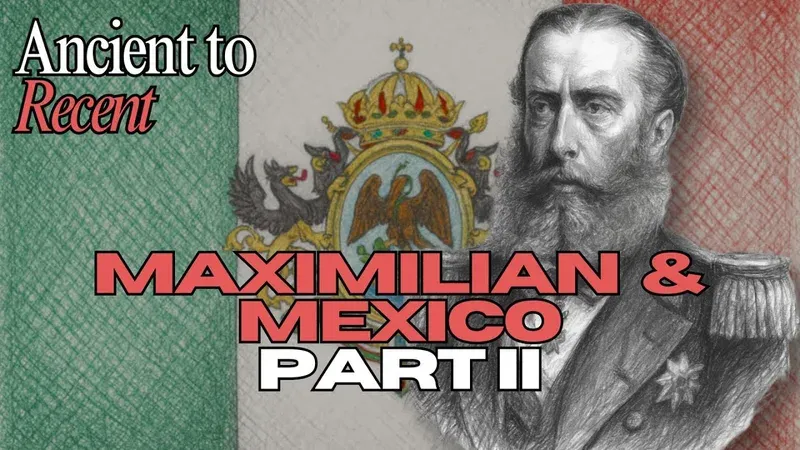 Watch on YouTube →
0:0041:09
Also on
Rate the show
Ratings are how new listeners find the show. It takes a minute and it makes a real difference.
In 1864, Archduke Ferdinand Maximilian of Austria crossed the Atlantic to claim a crown forged in diplomacy, ambition, and illusion. What awaited him in Mexico was not the enlightened monarchy he imagined but a nation exhausted by war, divided by ideology, and pushed to the breaking point by foreign intervention.
This episode follows Maximilian and Carlota as they enter Mexico City in triumph, unaware that beneath the flags and cheering crowds lay political traps, conservative factions demanding vengeance, and relentless Republican resistance. Guided by French bayonets and pressured by Napoleon III, Maximilian attempted to rule as a liberal monarch. Instead, he found himself squeezed between a reactionary clergy, a skeptical people, and a war that refused to end.
From the fragile plebiscite engineered to legitimize his rule, to the bitter disputes between French generals and Mexican monarchists, the Second Mexican Empire rose quickly but its foundations were already crumbling. Meanwhile, far to the north, the outcome of the American Civil War would determine the fate of the entire enterprise.
Join Joseph Parkinson as he continues the gripping saga of the Habsburg experiment in the Americas, exploring the peak of Maximilian’s empire, its grandeur, its contradictions, and the storm gathering just beyond the horizon.
🎧 New episodes every Friday
📲 Follow on YouTube, Spotify & Instagram @AncientToRecent
#UScivil war #SecondMexicanEmpire #Habsburg #MexicoHistory #BenitoJuarez #NapoleonIII #HistoryPodcast
Read transcript
This transcript is automatically generated, so it may contain typos and misheard names.
You go to a nation in turmoil, rule with justice and God will sustain you. Pope Pius the 9th to Maximilian before his departure for Mexico. On the 3rd of October 1863, a delegation of 11 Mexicans arrived at the royal residence of Archduke Maximilian of Austria. They had a sacred mission to save their nation by righting a terrible wrong to secure the one thing that Mexico, so they told themselves, most desperately needed a king.
The delegation was greeted with great pomp, a fine display of royal Habsburg power meant to impress upon them the might of one of Europe's oldest and most distinguished royal houses. In a carefully choreographed display, row upon row of hand picked servants and soldiers lined the way for the Mexican delegation, each soldier dressed in glinting uniforms, each selected for their height, build and striking appearance. At midday the Mexican dignitaries entered the royal residence. Maximilian was waiting for them.
The leader of the Mexican delegation was Jose Maria Gutierrez D Estrada, a man who had moved heaven and earth to make this moment possible. And this was a moment that Maximilian, the second in line to the Habsburg throne, a liberal man in a conservative empire, a man so often out of step, at odds, in disagreement with the rule of his brother Franz Joseph, the emperor of Austria, but powerless to bring about the change he so yearned for, had dreamed of all his life. Gutierrez Destrada, in a carefully staged managed moment meant not just for the assembled delegation but for history itself, read a prepared statement. He implored Maximilian, your people, your subjects, call out to you and to you alone.
They have toiled in darkness and cry out to you. They who have lived in slavery, cry out for freedom in the name of Holy Mexico, in the name of the one true Catholic Church, in the name of our Lord and Savior Jesus Christ, Strike their bonds from their weary limbs and become Emperor Maximilian, the First of Mexico. Welcome to Ancient Theresa, My name is Joseph Parkinson, and today we continue the story of Maximilian of Mexico and the Second Mexican Empire.
Episodes of Ancient Theresa are out every Friday and are available on YouTube, Spotify, and Apple Podcasts. Maximilian thanked the Mexican dignitaries and stated his conditions for taking the crown. The Mexican people would have to affirm their support through a popular plebiscite, and Maximilian would need firm guarantees from the great powers of the day, France and Great Britain. At that very moment, Maximilian knew he possessed neither.
A French force had gone ahead to displace the Mexican government of Benito Juarez in a bloody campaign, but the UK had declined to take part in what the British Prime Minister, Lord Palmerston viewed as French empire building in the Americas. Though the French held the capital, their power was based on force and Juarez and the Liberals still possessed much of the country and many of its major towns and cities. Maximilian gave no firm answer at the time, but after stating his terms, welcomed the Mexican delegation to enjoy the festivities. To mark the occasion, there was a formal reception with fine food and drink of every sort, followed by an elaborate fireworks display.
The night sky lit up with streamers in the green, white and red colours of the Mexican flag. The Mexican dignitaries mixed with Austrian aristocrats and chatted with Carlota, the would be Empress of Mexico, who charmed them with her elegant ways. The delegates retired without a firm commitment from Maximilian, but Carlota and Maximilian had noticed something that had left them very concerned. Maximilian was at his heart a liberal, enlightened man. He looked to science and reason to solve the problems of society.
He believed in the consent of the people as the bedrock of legitimate power. This could not be more at odds with men such as Gutierrez de Estrada. Maximilian and Carlota both noticed in chatting with the Mexican monarchists that the society that they seem to dream of was not one of liberty and justice, but order and hierarchy. The Mexican monarchists saw themselves as the natural masters of their society. If they had wanted Habsburg to be their monarch, then a man like Franz Joseph was probably more what they had in mind.
After departing Austria, the Mexican monarchists made their way to Paris to visit Louis Napoleon, Emperor of France and the grandson of Napoleon the Great, upon whose shoulders and pocketbook their dream of empire rested. At a formal dinner in Paris, further differences emerged. Louis Napoleon, like Maximilian, viewed himself as a child of the Enlightenment, but the Emperor soon discovered that it was not to the world of Voltaire and Russo that Gutierrez de Stradupined. Eugenia, the Empress of France, urged the Mexican conservatives to reach out to their liberal countrymen, to put their past behind them, to heal the wounds caused by such bitter division. These men, however, were not ones to live and let live. It was not reconciliation that they had in mind, but revenge. Horrified by even the suggestion of letting bygones be bygones with a bunch of filthy upstart atheistic radicals, they insisted that Mexico was not a European country and only possessed a thin veneer of true civilization. What was needed was a firm hand.
D Estrada then committed something of a faux pas. He stated that what Mexico required was a dictatorship like, say, France. Silence descended almost as quickly as eyebrows rose. France, under the benign and enlightened rule of Louis Napoleon, a dictatorship? Was then Louis Napoleon a dictator? A tyrant? The argument became heated as French and Mexican dignitaries exchanged insults. Back in Austria, Franz Joseph urged his brother to insist on the guarantees he had set out. There must be both French and British support for Maximilian's new empire.
But despite the awkward scenes Gutierrez Destrada had caused in Paris, both the French and Mexicans had come too far to turn back now. Coffins and unpaid bills were already arriving back in France, and the French government expected a return on its investment. The Mexican monarchists and Napoleon piled on the pressure both for Maximilian to accept and the British to lend their support. But the British government would not commit. Palmerston gave a less than helpful answer. Though a monarchical government would be no doubt in Her Majesty Queen Victoria's government interests, Palmerston would not firmly throw his weight behind such an adventure. As events moved at a glacial pace in the palaces of Europe, on the other side of the Atlantic, things were spiralling out of control.
The United States of America was being ripped apart by a bloody civil war. 11 Southern states had seceded from the Union in 1861 to form the Confederate States of America in a determined effort to protect the institution of slavery. The North under Abraham Lincoln was committed to end both secession and slavery by any means. This conflict had distracted the US and presented an opportunity both to Mexican monarchists and European powers to subvert the Monroe Doctrine, the right the USA reserved for itself, to dictate the affairs of Latin American States and to prevent any European interference in the Americas.
Maximilian was wary of US involvement in Mexico. Between 1846 and 1848, the US had invaded Mexico, annexing vast swathes of Mexican territory, and had also interfered in the Mexican Civil War in the 1850s on the side of the liberals. Even with French support, it would be unlikely that Maximilian's regime would survive if the USA remained hostile. But as the American Civil War ground on and Northern armies suffered a string of defeats at Southern hands, Maximilian became convinced the Confederate victory was assured.
Maximilian, who had always sought purpose and dreamed of taking his rightful place as Emperor of Mexico, began to silence his own doubts. The South would surely win. France would support him. The people cried out with his royal name. And the British, well, they would come around with time. He even talked himself out of his previous stated need for popular support from the Mexican people. The Mexicans, so the Mexican conservatives said, and so he with time came to believe, were not ready for democracy. They did not know their own minds. But under his enlightened rule would come to see the benefits of a monarchical system of government in Mexico. The French army had pushed Juarez out of the capital. But instead of mounting an aggressive campaign to hunt down and destroy what was left of the Mexican government exactly at the moment when he was at his most vulnerable, the French LED up the pressure.
They had completed a hard campaign, cutting a brutal swathe from Veracruz on the coast all the way to Mexico City. Once in the capital, they had been welcomed as liberating heroes. The French, who had suffered for so many months from bad food, scorching heat, dysentery, disease and barista guerrilla attacks, now found themselves with roofs over their head, food on their table, wine in their glasses and Mexican women in their beds. They were in no rush to give up such delights to chase gorillas into the mountains.
In Mexico City, the affairs of state had been turned over to the Regency Council, a governing body composed of arch conservatives, and they had one thing on their mind revenge. The Regency Council was determined to turn the clock back before the liberal reforms that had stripped them of so many of the privileges that they believed they were entitled by birth. The property confiscated from the Catholic Church was to be returned.
Fines were imposed for not attending Mass on Sunday. Land taken from aristocrats, descendant of the Spanish elite, were to be stripped from the presence and given back to their rightful owners. Elie Federic for a The French commander busied himself arranging balls and parties, making merry and accepting the congratulations of Mexico's conservative elite. But Louis Napoleon grew frustrated with his commander. Juarez was not defeated, the war was not won, and yet his commander sat on his backside doing nothing. Louis Napoleon decided to act.
He sacked for a upwards. Napoleon thanked for a for his contribution and rewarded him with the promotion to Marshall of France, a promotion that would naturally require for A to return to France and surrender command of the army in the field. A new commander was appointed a Chile Byzen, an experienced officer who had seen action in Algeria, Crimea and Italy. Byzen was full of energy. He spoke fluent Spanish and had a reputation for personal bravery, A trait that had seen him repeatedly wounded in combat. But despite Byzen's promotion, his hands were still tied for a dallied in Mexico City for weeks, delaying Byzen taking command and fighting the aggressive campaign he so yearned to unleash.
Baizan was further frustrated by the Regency Council. The French officers were sons of the French Revolution. They drank in the mythology of the Revolution with its promises of liberte, egalite and fraternity. The arch conservatism of their Mexican counterparts and deference to church and aristocracy grated on them. Napoleon was keen for French presence not to be seen as an army of occupation, so he insisted that French forces differ in the drafting of domestic policy to the Regency Council. Bazen wanted to pursue a policy of carrot and stick, liberal reforms to weaken Juarez's base and win support for the Empire, and decisive action to smash the republican military forces. Though the Regency Council was keen on the stick, they were not so fond of the carrot.
The most vocal opponent of any reconciliation was Pelagio Antonio de la Bastida, Archbishop of Mexico City. Anything less than a full turning back of the clock was unacceptable to La Bastida. After all, what was the point of overthrowing the Republic if the monarchy was going to keep the same hated policies? Napoleon, however, insisted church property confiscated by the Juarez government was not to be returned. This caused outrage amongst conservatives. In October 1863, La Bastida demanded to meet with Byzen. La Bastida pressed his case again, but again the French authorities refused.
So furious was the Archbishop that he threatened to withdraw support for French presence and the restoration of the monarchy. Byzen declared that the French would no longer attend meetings at the Regency council while La Bastida was a member. La Bastida, with no choice, withdrew from the council to brood in resentment of the backstabbing French. Louis Napoleon now turned his attention to the next problem, how to win popular legitimacy for the monarchy.
Louis Napoleon had started his career as a lowly politician, winning the French presidency before a coup in 1851 placed himself on the throne. But always wary of how the wind blew, Louis Napoleon held a series of plebiscites to ratify his position of power. Never exactly free or fair, the votes had lent a veneer of legitimacy, just enough to bat away awkward questions, not too much to truly concern himself with the opinions of the great unwashed.
Louis Napoleon sought to repeat the trick in Mexico. But how exactly? And how to make sure of the desired result, especially as it was not clear even a heavily weighted vote would turn out in Maximilian's favour. The French and Regency Council hit upon an idea, a simple head count. Anyone who lived in areas controlled by the French forces was counted by definition as a vote for Empire and against Republic. Even then it would be close as the French only controlled a thin strip of land between Veracruz on the coast and Mexico City. With Foray now safely back in France, Byzan was free to take the fight to Juarez.
He marched 2 columns of troops N to take Querétaro, a city 130 miles north of the capital, which was now the home to the republican government. The force was led by one of the most talented commanders of the war, Thomas Mejia, A dashing and brave royalist officer of indigenous heritage. He was from the Otomi people, based in the Central Valley of the country. As Mejia's forces made progress north town after town fell to them with hardly a shot fired.
What was meant to be a forced March became victory procession. In November 1863, troops under Mojillo took Querétaro. The royalist troops were yet again welcomed as liberating heroes, as yet again Juarez and his forces pulled back in panic. But progress was deceptive. Juarez could still command the loyalty of 20,000 soldiers, and while the cities fell to the monarchists, the forest and Bush with a habitat of Republican guerrillas, Juarez played for time.
He knew that direct confrontation against the better armed French held no advantage for him. He pulled back N closer to the US border, hoping that the American Civil War would soon end and US attention would again turn to events South of the border. The French were keen not to be seen as foreign invaders imposing a puppet government, so they turned their attention to recruiting allies to Maximilian's cause. At first, allies were hard to come by.
There was no lack of cheering crowds, but it was one thing to hurl flowers and kisses, quite another to shoulder pack and rifle. The French ended up taking what allies were available. Often these allies would turn out to do more harm than good, as they were hardcore conservatives who shared the reactionary worldview of men like Gutierrez. De Estrada. 1 was a notorious conservative guerrilla called Juan Chavez. After one skirmish, a French officer asked Chavez how the Republican prisoners were being cared for.
Chavez responded that they'd been cared for all right, they had all been beheaded. Such brutality shocked the French. Despite teething problems for the Imperial Easters, pro Maximilian Mexicans and their French allies, their problems seemed to pale in comparison to the shock and dismay that was engulfing the Republican cause. At every turn a new disaster seemed to befall the Republicans and such turns were in abundant supply.
The Imperialistas held a town called Moralia, the capital of Michoacan. It was imperative to the Imperialista cause to hold this region as its population could be counted towards the vote for Maximilian and the monarchy. This was well known to Republican forces who appointed Jose Lopez Uruga, a local resident and decorated veteran of the US Mexican War, to storm the town, leading a force of 12,000 men. The town was held by a small Imperial Easter Garrison commanded by another veteran of the US Mexican War by the name of Leonardo Marquez.
On December the 17th, Republican forces gathered outside the town before pressing forward, determined to overwhelm the defense. And deal an early blow to the monarchist cause, something that could rally and inspire Republican Mexico and show that hope was not lost. Facing Urrago's 12,000 troops, Marquez had but 3500 men. But they had set about fortifying their position, and they were fired by a fanatical commitment to their cause.
They were not fighting for abstract ideas. They were fighting for God and for Emperor. Republican troops pressed forward, only to be met with ferocious musket fire. They fell back, regrouping, and came again the next morning. Weight of numbers allowed the Republicans to breach the defences, fighting their way into the winding alleys and passages of the town. Street fighting broke out, every house contested, every room fought over. Republican forces faced fire from in front and behind. Republican troops pushed through the narrow passageways only for monarchists fired by their determination to turn back the godless hordes.
The enemies of Christ fire down upon them from the rooftops. The Republicans pushed ahead until the monarchists held just the main square. Marquez, badly wounded, a bullet striking him in the face, refused to be relieved of command. Again the Republicans came. Again, the monarchists cut them down. When the Imperial Easters ran out of bullets, they used rocks. When they ran out of rocks, they used blades and fists and teeth.
The attack lost its momentum. The main square held 45 monarchists had died. 600 Republicans had fallen beneath their guns. What should have been what the Republicans felt was certain to be a momentum shifting victory instead became a humiliation. Not only were they defeated, but they were defeated by their fellow Mexicans. The Imperial E has kept up the pressure, Mejia marching on chasing Juarez. No sooner had he set up a new capital, he was forced to abandon it.
San Luis Potosi falling to monarchist forces. Juarez now pulled further north, 280 miles to Coahuila, not far from the US border. The Republican cause seemed doomed. Despair set in. The midnight of the soul had arrived for Juarez and the belief in Republican government. For some it was too much. Some began drifting away, turning themselves over to the imperialistas, but not Juarez. He would not be beaten so easily. But just as all seemed to be lost, Juarez found a new ally. Of all the people who would have come riding to the rescue of the Republican cause, this was the most unlikely of candidates. Pelagio de la Bastida, the Archbishop of Mexico City. Back in the capital.
It's fair to say that La Bastida was not taking the French refusal to return church property well. La Bastida sulked and brooded. And he was not alone. The entire senior clergy of the Catholic Church joined him in resentment. Anonymous clergy took to writing a proclamation and posting it on walls and sliding it under doors, denouncing in fiery terms the heresy and treachery of the Regency council. And godless French Lavastida raged from the pulpit. If we wanted godless atheists, we would have kept Juarez in power.
At least they were honest about who they were. La Bastida threatened to excommunicate anyone who did not return church property. Needless to say, this did not go down well with the French. La Bastida ordered that the doors of the cathedral be closed to French soldiers and officers who were prevented from attending Mass by Zen. In no mood to be lectured by a reactionary priest arrayed artillery outside the cathedral and ordered that if the doors were not opened then he would command the cannon to fire.
La Bastida blinked. He had overplayed his hand for a second time, but crucially, just at the moment of near total defeat for the Republican forces, he had distracted the French just enough to allow Juarez to catch some breathing space. Back in Austria, Maximilian heard nothing of such events. He was instead informed of cheering crowds, grateful towns liberated, and glorious victories won by his brave soldiers. As the conflict seemed to be nearing an end, the time had finally come for Maximilian to make his way to his new empire.
Preparations to depart began in January 1864. Everything was to be arranged to recreate European Court life in the Americas. Cutlery, crockery, tablecloths, candles, cushions, every ornament and trinket that would allow Maximilian to immediately set about living like a Habsburg was to be shipped across the oceans. Teams of cooks, grooms, and valets were sent ahead to make the preparations. Maximilian busied himself not with learning as much as he could about his new Kingdom and subjects, but rather with trivial questions of etiquette.
Which plates to use? How and in what way is the Emperor to hand his hat to a servant who shall be tasked with the taking of the Empress's handkerchief, and how shall they receive it? These were the questions the Maximilian brooded on. Before his voyage. Maximilian made a trip to Paris to visit Louis Napoleon, arriving on the 5th of March 1864. There he was greeted with receptions and balls by the great and the good, making somewhat of a better impression than Gutierrez de Estrada did. While in Paris there was a thorny matter, an elephant in the room that had to be discussed. Money.
This adventure was turning out to be expensive and someone was going to have to foot the bill as Maximilian was the ultimate beneficiary. So the French argued, then he should be the one to pick up the cheque. Maximilian agreed. Not that he was in much of A position to argue. Mexico would pay for the privilege of being occupied to the tune of 1000 francs per French soldier per year. All seemed set. Maximilian had merely to board his ship and sail to Mexico to take his place in the history books.
But just at that moment, Franz Joseph threatened to blow the whole scheme sky high. Franz Joseph only had one son, Rudolph. So if something should befall the young Prince, then Maximilian, that would become Emperor of Austria in the event of the death of Franz Joseph. This raised a highly unpalatable possibility. In Franz Joseph's mind. If Maximilian became Emperor of Mexico and something should then befall Rudolph and Franz Joseph, Maximilian would also then inherit the Austrian throne, thus making the Emperor of Mexico also the Emperor of Austria, therefore making Austria a colony of Mexico.
To Franz Joseph, this was unthinkable. There was only one solution. Before leaving for Mexico, Maximilian would have to renounce his claim to the Austrian throne. This news devastated Maximilian. How could Franz Joseph spring this on him as he was about to leave? This had not been raised before, but now. Now everything had been agreed and his arrival was expected. Now was the moment to bring this up. Maximilian angrily refused.
The whole affair seemed to be on the verge of collapse. To Louis Napoleon, this latest dynastic Habsburg bus stop must have left him in a state of despair. So much time, so much effort into something he was promised would be so easy, only for yet another hurdle to be thrown up. Franz Joseph asked Louie Napoleon to step in and pressure Maximilian to accept. If he did not, then Franz Joseph would withhold his approval. The Empire of Mexico would collapse, and all on a dynastic technicality.
By this point, France was deeply committed to the Mexican adventure. Unpaid bills were piling up and young French soldiers were being buried. Things became so heated that there was even rumours of war between France and Austria, but neither party would give ground. Maximilian considered this an intolerable insult to his honour and an attempt to strong arm him into renouncing his title. Franz Joseph would not risk making his empire into a colony of a nation that he considered to be barely civilized.
French dignitaries made their way to the door of Maximilian, begging, pleading, piling on the pressure, anything to get him onto that ship. It got so bad between the brothers that they would not even speak to each other. But it was not just Maximilian and France who were involved. Carlota was desperate to be Empress. She took up Maximilian's cause, travelling to Vienna to thrash her out, with Franz Joseph having a stand up argument with the Emperor that went on for three hours.
Maximilian sank into a fatalistic depression, but on April the 8th, 1864, Maximilian decided to accept the throne. The next day, Franz Joseph visited Maximilian yet again. The halls reverberated with arguing Hapsburgs, servants scurrying through corridors, desperate to try not to be noticed while straining to hear as two emperors argued ferociously. Eventually, Maximilian gave in, a Hapsburg to his core, the heart of an Austrian patriot beating in his chest. He signed away his rights to the throne. As Franz Joseph left, he turned to his brother. Two men once so close, bound together in purpose but somehow cut from different cloth.
The austere, reserved Franz, the charismatic, progressive Max. Franz hugged his brother, tears in his eyes, and thanked him. The Mexican delegation was still waiting for the final word. They had held on in anxious anticipation. They were summoned by Maximilian. Maximilian informed them that he would accept. He would become their emperor. A sense of delight and relief swept through the Mexican monarchists. Long live the Emperor, they cried.
But Maximilian, in his heart, felt a deep sadness. He began to sink into depression after accepting the crown. The festivities got on the way. Fireworks, banquets, toast to the emperor, the Empress, the empire, to Mexico. But there was one person who wasn't celebrating Maximilian. He locked himself away, hardly speaking, hardly seeing anyone. Did he suffer some sort of mental collapse? The weight of the whole affair from burning desire to grinding negotiations to painful compromise to now dynastic expectation, Was it all too much for him?
On the 14th of April, Maximilian was able to summon the strength to board his ship in Trieste to begin the journey for Mexico. Before crossing the Atlantic, the royal couple would make a stop in Rome to receive the blessing of Pope Pius the 9th. Maximilian and Carlota met the Pope, who greeted them warmly, the sticky topic of church property quietly sidelined. On the voyage to Mexico, Maximilian chatted with the Mexican politicians. They talked about the challenges facing Mexico, never missing an opportunity to shock Maximilian with their reactionary worldview.
After 40-4 days at sea, on the 28th of May 1864, the towering peaks of Mexico appeared in the distance. Maximilian's ship was escorted by a French flotilla. But Maximilian was keen to draw a line between himself, the rightful Emperor of Mexico and the French forces. He made a point of anchoring his ship away from his French escort. At 2:00 PM his ship dropped anchor, but instead of the docks being lined with dignitaries, soldiers and women in their finest dresses, all he could see was a near deserted town. Maximilian had arrived at an unfortunate moment. Veracruz was riding out an epidemic of yellow fever and most of the inhabitants were not keen to risk contamination even for the arrival of a Habsburg.
Things went from underwhelming to downright humiliating for Maximilian. The first person to board the ship was a French Admiral who publicly dressed down the would be Emperor for dropping anchor in the most pestilent part of the harbour and demanded the ship move off at once. The Admiral further told Maximilian that coming to shore as quickly as possible was the best idea as the countryside was teeming with Republican guerrillas who was certain to soon find out of his arrival. This was more likely in Veracruz than perhaps anywhere in Mexico, as the city was in sentiment, if not in arms. A liberal bastion.
The royal couple made their way to shore and quickly began the incredibly uncomfortable 400 kilometre journey through winding streets, narrow canyons and across dirt roads populated with Republican gorillas all too keen to cut their throats if they got half a chance. At first the journey was more than uncomfortable. It was positively terrifying for Maximilian and Kolota, often passing through ghost like deserted towns. But as they made their way, one jolting uncomfortable mile after another into the heart of imperial territory, the atmosphere changed.
Sullen silence gave way to rapturous applause. They had passed from Republican stronghold to monarchist heartland. These really were their people, and they were happy to see them. Maximilian and Carlota began to realize just how alien a land Mexico really was. Alpine Austria, with its court etiquette and Old World ways, was vanishing into the distance to be replaced by local peoples speaking alien dialects, strange sights and sounds, entirely new tastes and sensations. For the first time, Maximilian and Carlota met indigenous Mexicans and tried Mexican food such as tortillas and Chile washed down with pulque, a Milky coloured alcoholic drink made from the agave plant.
They could not finish this food. It was too spicy for their bland European palate. On the 12th of June 1864, two months after leaving Austria, Maximilian and Kelota entered Mexico City, the seat of their new empire. Crowds cheered. Long live the emperor. They were greeted by streets bedecked in French, Austrian and Mexican flags showered with flowers. Children hung from lampposts, ladies waved and blue kisses. They were welcomed to the city by Archbishop La Bastia with the customary today. And it was everything that they had expected. It was everything that they had dreamed. The celebrations began another round of balls, banquets, toast and dancing.
Fireworks lit the sky and people hailed the coming of a new era, the era of Maximilian and Habsburg Mexico. The celebration was, as ever, a carefully choreographed affair. Enlightened rule would meet Catholic piety, monarchical power and progressive reform. The bright new future dawned in a land at ease with it's indigenous heritage. There were however some slight moments of misunderstanding, as could only be expected from the contact between such radically different societies, Habsburg etiquette and Mexican informality. At one moment one Mexican lady tried to hug Carlota, only for the former Belgian Princess to pull away in barely concealed horror. 1 did not hug the Empress. The moment shocked the Mexican woman and deeply upset Carlota. To break the tension, the Mexican woman offered Carlota a cigarette, only for the Empress to decline further, rubbing salt into the wounds as tears sting the eyes of both ladies. A slight hiccup or a clash of civilization. In the capital, Monarchist danced and drank toast to the Emperor.
But not all Mexicans were celebrating. Away from the festivities, the war rumbled on. Juarez pulled further north to the city of Monterey. Juarez had just 15,000 men, poorly armed and scattered throughout the country. The Imperial Easters could call on 30,000 battle hardened, well equipped and well trained French troops, plus a further 20,000 Mexican monarchists at arms. As Juarez and his dwindling band pulled ever north, the Republican light seemed to flicker in the dark.
Everything progressive Mexicans had dreamed of. A secular, forward thinking nation, a nation that stood on its own feet, free from the dead way to its colonial and Catholic past seemed to be slipping away. Was this it? Was this how the dream died? Was history really on the side of the men of yesterday like Gutierrez de Estrada and La Bastia, with the hopes of free men and women for a life of dignity away from the squalor of the slums, back breaking toil of the Encomidas and chants of the priests really to disappear like so many rebellions that had torn through the Americas ever since Cortés set foot on the soil of Mexico?
Or was there yet still? Hope thank you for listening to Ancient to Recent. My name is Joseph Parkinson and in our next episode we will look at the Mexican Empire at its height. Episodes of the Ancient to Recent podcast are out every Friday and are available on YouTube, Spotify and Apple Podcasts.