
#26
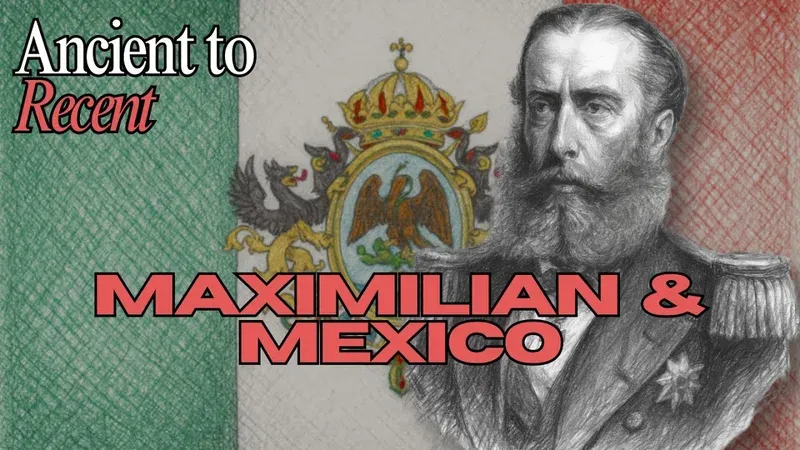
Maximilian of Mexico: The Rise and Fall of the Second Mexican Empire
29 November 2025 · 56 min · Season 1
 Watch on YouTube →
0:0056:31
Also on
Rate the show
Ratings are how new listeners find the show. It takes a minute and it makes a real difference.
In 1864, Archduke Ferdinand Maximilian of Austria took the throne as Emperor Maximilian of Mexico, believing he could unite a fractured nation and build a modern empire. Instead, he stepped into one of the most violent political storms of the 19th century.
Backed by Napoleon III’s French army, opposed by Benito Juárez and the Mexican Republican forces, Maximilian struggled to rule a country divided by civil war, foreign intervention, and economic devastation. His liberal reforms alienated the conservatives who invited him, while the Republicans saw him as a foreign usurper.
As the American Civil War ended, the United States enforced the Monroe Doctrine, pressuring France to withdraw. Abandoned by Europe and betrayed by his allies, Maximilian faced the rising Republican tide alone. His wife Charlotte (Carlota) descended into madness as she fought to save the collapsing empire, pleading with the courts of Europe.
The final act came at Querétaro in 1867, where Maximilian made a last stand before facing a firing squad—an ending that transformed him from emperor to tragic legend.
This series tells the story of the Second Mexican Empire, a gripping account of ambition, idealism, and the fatal collision between European monarchy and Mexican nationalism.
Join Joseph Parkinson as he explores how the Second Mexican Empire rose, unraveled, and crashed into the reality of Mexican resistance.
🎧 New episodes every Friday
📲 Follow on YouTube, Spotify & Instagram @AncientToRecent
#Maximilian #MaximilianOfMexico #SecondMexicanEmpire #BenitoJuarez #NapoleonIII #Mexico #MexicoHistory #HistoryPodcast #AncientToRecent
Read transcript
This transcript is automatically generated, so it may contain typos and misheard names.
Poor Mexico, so far from God, so close to the United States. Pavira Diaz On the 14th of September 1847, the battered, ragged but victorious columns of United States General Winfield Scott, exhausted but triumphant, tramped into Mexico City. They made their way to the Presidential Palace, where they raised the Stars and stripes over the symbol of Mexican sovereignty and power. They had accomplished something that no U.S. Army had ever done.
They had captured the capital of a foreign nation. Scott had led his army from Veracruz, a small seaside town founded in 1519 by Hernán Cortés, the original foreign conqueror of Mexico, all the way to Mexico City, fighting 1 running bloody battle after another. This was his moment of triumph, and though exhausted, Scott, a student of history, an admirer of so many conquering victors of old Napoleon, Alexander, Caesar Wellington, wanted to bask in the glory. As the Stars and Stripes rose, the military band struck up Yankee Doodle, a patriotic song with its roots in the American Revolution.
But the city was not deserted. Far from it. To see the spectacle of foreign jingoistic triumphalism, thousands of residents of Mexico City gathered around. It seemed not to occur to Scott or any of his officers that celebrating so arrogantly the US victory in its war of aggression against the Mexican people, a war entirely of the US is making, manufactured on completely trumped up charges and for nakedly imperialistic reasons.
And doing so in the face of those they had just so bloodily vanquished, might not be the most tactful decision. As the band played in, the crowd grew. The atmosphere turned tense. A shot rang out, followed by stones and bottles. Panic set in as U.S. soldiers retaliated, firing wildly into the crowd. Scuffles broke out as American troops responded with bayonet thrust and Sabre slash. 3 days of bloody fighting consumed the city, biting that was only brought to conclusion by US artillery officers bringing cannon to bear on their assailants. By the time the smoke had cleared and the last rite had been administered to the dead and the dying, large parts of Mexico City, the former seat of power of the Spanish Empire in the Americas, lay in ruins.
This was the conclusion of a long but inevitable historical process. Some in Mexico had argued. You see, they claimed the root of Mexico's ills was that it had an alien form of government, a government it was never supposed to have. Mexico was a Republic, and if Mexico was ever to heal its wounds and take its place amongst the family of great powers, Mexico would need to be transformed. Mexico would need to become a monarchy. Welcome to ancient, to recent.
My name is Joseph Parkinson and today we're starting a new story, The story of one of the most unlikely events of the 19th century, the rise and fall of the Second Mexican Empire and it's monarch, an Austrian Arts Duke Maximilian the 1st and Maximilian the Last of Mexico. Episodes of Ancient Theresa are out every Friday and are available on YouTube, Spotify and Apple Podcast. The land we today call Mexico is a rich and fertile land, home to human civilization.
Since the 12th century BC, one civilization after another has settled, conquered, risen and fallen in the Mexican valley till a group that would be remembered by history as the Mexico or Aztecs arrived from the southwest of present day USA. Sometime around the 13th century AD, at a time when Genghis Khan was carving out a vast empire, the Magna Carta was being drafted in England and Constantinople was being sacked by the 4th Crusade, the Aztecs conquered, colonized, subjugated and enslaved a vast swathe of modern Mexico, establishing a society rich in culture, sophisticated in political institutions, and resented by the people the Aztecs ruled over.
Truly, the Aztecs were one of the superpowers of the Americas, but all would change with the voyage of Christopher Columbus, who in 1492 spotted land in the Caribbean. This would open the door for European explorers, missionaries and soldiers, most notably from Spain. In February 1519, Hernán Cortés, a minor member of the Spanish aristocracy, arrived with a small band of soldiers aided by local allies. Eager to throw off the yoke of Aztec domination, Cortés fought a bloody war that brought the Aztec state crashing down. Cortés had a number of advantages, such as horses and firearms, but he had a trio of invisible weapons much more deadly than the primitive muskets wielded by his gold hungry soldiers.
Smallpox, typhus and measles, diseases common to Europe but that the people of the Americas had no immunity to these diseases, went off like an atomic bomb, wiping out whole communities, depopulating entire regions. The population of Mexico in 1519 was estimated to be around 30 million. By 18/21 it had declined to just six. For three centuries after the coming of Cortés, Mexico would be the jewel in the crown of the Spanish Empire. The Spanish would construct a society based on exploitation with vast estates called Encamidas inhabited by white skinned European elite and their descendants. A Millennium old civilization, complete with culture, language, religion and tradition had superimposed onto it a European, Spanish speaking and Catholic elite. Mexico City, formerly the capital of the Aztec Empire, Tenochtitlan was redesigned with much European style architecture and the Catholic faith was spread by eager missionaries, often accompanied by extreme violence for those who clung too keenly to their old religion. Change is, however, the only constant in Mexican history. After long centuries of Spanish domination, The Peninsula War, the invasion of Spain by Napoleon in 18 O 8 weakened the Spanish grip on the Americas, leading so many Spanish colonies to throw off European power, and Mexico had emerged as an independent country by 1821.
But from the start, Mexico had a troubled history. Mexico was at first an empire led by Augustine D Etruder. Originally a pro Spanish royalist, he had switched sides to support independence and had declared himself Emperor Augustine the first. Things did not go well for Augustine. He quickly went from being viewed as a liberating hero to despotic tyrant before abdicating in March 1823, returning in 1824 believing he would receive a hero's welcome, only to be arrested, imprisoned, and shot. The Mexican Empire collapsed and was transformed into a Federal Republic.
Mexico was a hard country to rule. Mexico had a population of roughly 6 million people in 1821, divided between 3 broad groups. 1,000,000 descendants of the Spanish called Creos. 1.5 million people of mixed heritage called Mestigos and 3.5 million indigenous peoples. Even these three groups are massive over the simplifications. The Mexican people were really more like the Mexican peoples, speaking many different languages, practicing many different cultures and lifestyles, spread over a vast area from present day Panama to modern Utah. Over the next two decades, the Republican government in Mexico City would struggle to exert control over the sprawling state, many of whose citizens viewed it with suspicion or contempt.
There were constant rebellions on the local and national level, with government changing at an alarming rate. From 1821 to 1846, Mexico had 22 heads of state, some for no more than a few days, and only one president completed their term. Some looked at the patient and diagnosed the problem. The issue, they argued, was that Mexico was a Republic. Republicanism was an alien, suspiciously Protestant form of government with no tradition in Mexican culture.
What was needed was a monarchy. What was needed was an emperor. One of these monarchists was Jose Maria Gutierrez de Estrada. He argued that only the creation of a strong monarchy would arrest the constant turmoil, defeats and humiliation Mexico seemed doomed to. He set out his arguments in a series of pamphlets and sent correspondents to Royal House of Europe. For a Prince, a Duke, count. Anyone with blue blood would do the job.
To the north, Mexico's neighbor, the USA. Anglo-Saxon in culture, English in language, Protestant in faith and Republican in government, had a vision of itself, a grand continental empire to spread from sea to shining sea, from pole to glinting pole, all under the ever spreading wings of the American eagle. It was so they argued, their manifest destiny. But why after all, had the good Lord placed His chosen people, built His New Jerusalem on the shores of such a empty land? If the Lord himself did not will the Americans to go forth and multiply?
1 of the northern provinces of Mexico was called Tejas, and it had a particular problem. It had a population problem that just weren't enough Mexicans to settle the land. The government in Mexico City invited land hungry American citizens to settle the land on the promise they would become good loyal Mexicans and convert to Catholicism. This plan backfired from the start. The Mexican settlers cultural and economic links ran N not South, and in 1836 Tejas rechristened Texas, declared independence and defeated Mexico with many Americans fighting in the ranks of the Texan army. In 1848, the USA would further up salt in Mexican wounds by annexing Texas.
But the US wasn't done yet. President James Polk cast a covetous eye on the vast, sparsely populated and loosely controlled land of northern Mexico that now comprises California, Arizona, New Mexico, Utah, Wyoming and Nevada, claiming a border skirmish had taken place within the US where American blood had been shed. The fighting was actually a result of American troops marching into Mexico and provoking the Mexicans. Polk used this as a pretext to launch a full scale invasion. In April 1846, the US declared war and defeated Mexico, occupying Mexico City.
US aggression was widely condemned even within the USA, with young Illinois Congressman Abraham Lincoln decrying the war and introducing the spot resolution, demanding to know the exact spot on the map where Mexican troops had shed American blood, causing Polk great embarrassment when he was unable to do so. Future President USCS Grant, who served in the invasion force and fought in nearly every battle, said of the war it was one of the most unjust ever fought and claimed in later life that I am ashamed of my country when I think of that invasion. The Treaty of Guadalupe, signed in 1848, was a disgrace even by the standards of the 19th century. Vast tracts of Mexican land were annexed by the USA for little more than a handshake.
Defeat for Mexico fed into a bitter argument. Why was Mexico so weak? Why was Mexico trapped in a constant cycle of turmoil? This argument split society down the middle. On the one side, you have the right land owners, monarchists, devout Catholics who yearn for the good old days of Spanish rule and who insisted Mexico had been infected with a disease called radicalism. On the left, you had liberals and Republicans committed to reform who detested the Church and wanted to uproot the last vestiges of the Spanish past. In 1855, a left wing revolt broke out. This revolt targeted the Church as the largest landowner in Mexican society.
After the left came to power, the new government passed a law that legalized the seizing of church property and the creation of a new constitution that for the first time omitted any mention of the Catholic Church within Mexican society. The Church was to be stripped of its privileges. This new constitution was enacted in 1857 and caused outrage amongst conservatives. The Archbishop of Mexico City denounced the Constitution and promised to excommunicate anyone who swore allegiance to it. In December 1857, a counter revolution was launched by conservatives determined to arrest the leftward drift of Mexico.
The counter revolution was led by Miguel Miramón, a hero of the US Mexican War. He had taken part in one of the most romantic moments of self sacrifice in the history of Mexico, where he and the collection of young, almost child soldiers had fought to the last round in defence of the Fortress Chapel Tech, a key ridout on the way to Mexico City. The left was led in the civil war by Benito Juarez, a judge from a humble background who had briefly been a seminarian before leaving the church, which he detested to start a legal career.
The United States had backed Juarez, seeing him as someone who would open the country up to U.S. investment and therefore control. The USA played a crucial role in the war, tipping the balance so the conservatives said with AUS naval intervention to prevent a conservative victory. When it seemed that Juarez was on the canvas, Juarez and the left rebounded, and in 1861 they took Mexico City, driving the Conservatives into exile in Europe or forcing them to go underground. Juarez inherited a smashed country and a bankrupt state that was especially heavily indebted to the European powers of Britain and France.
Relations between Mexico and the European states deteriorated to such an extent that Mexico suspended debt payments, causing outrage in Paris and London. The United States treated its southern neighbors as its own personal fiefdom. The USA had as a corner of its foreign policy the Monroe Doctrine, introduced in 1823 by then President James Monroe, that stated the US would consider any interference by a European power in the affairs of Latin America as a direct threat. Interference by the USA in the affairs of Latin America, however, well, that was just fine. This, perversely, could have acted as a shield for Mexico against European interference if it were not for the US being concerned by domestic affairs in 1861. In November 1860, Abraham Lincoln was elected President of the United States for a new radical political party, the Republican Party, a party committed to the abolition of slavery.
This was seen as such an outrageous proposal in many southern states, whose economies were based on the export of cotton harvested by slaves, that Lincoln didn't even appear on the ballot paper in many southern states. Lincoln's elections sparked the secession of 11 states in the South to form the Confederate States of America, led by Jefferson Davis, with its capital in Richmond. The American Civil War had begun. The USA was thus paralysed by it's own internal affairs, freeing European powers to interfere in Mexico.
After Juarez came to power, many conservatives, Miramont included, had begun to search for a patron. They turned to the unlikely figure of Emperor Louis Napoleon the Third, the nephew of Napoleon Bonaparte. Napoleon the Third had been president of France but had LED a coup in 1851 to make himself emperor, styling himself as the natural successor to his uncle and the man to restore French pride after defeat in the Napoleonic War.
Louis Napoleon inherited A deeply divided country. Half secular republican yearning for the radicalism of the French Revolution, half Catholic and monarchist pining for the glory of the Napoleonic Empire, Napoleon the Third hit upon a recipe to try and win favour with both sides and legitimacy for himself. He would involve France in a series of conflicts, winning glory on the battlefield and redeeming the defeat at Waterloo, but always on the progressive side. He championed French involvement against Austria on the side of the romantic cause of Italian nationalism, one of the core celebrities of the 19th century, and also in the Crimea against Czarist Russia, the state viewed as the living embodiment of reaction and repression by European radicals. Napoleon oversaw the rapid expansion of the French economy and empire, participating in the Opium Wars with Britain against China, pacifying Algeria and landing troops in Vietnam. Mexican monarchists and European monarchs saw each other as allies with a common foe, the USA. The US, they argued, was determined not just to consume the entire American landmass, but to export republicanism globally, eventually to Europe.
The USA, if left unchecked, was an existential threat to the monarchical powers of old Europe and the very existence of Mexico. Something had to be done to shackle the American juggernaut. This fear of America became known as the Western question. Napoleon, like many of his generation, viewed South America as having a special bond with France based on its shared Latin heritage, a heritage that needed to be preserved. So strong was the sense of a shared civilization that it even led to the coining of a phrase in the 1850s that has stayed with us to this day, Latin America. If France, which championed every progressive cause with muscular military power, had stepped in on the side of the Italians against the bullying Austrians and for the Turks against the expansionist Russia, surely France could not sit by and watch imperialist America, so full of confidence and arrogance, so assured of its destiny, so little concerned by the rights of others, swallow Mexico like some red, white and blue Python.
The idea for French intervention came through the wife of Napoleon the Third, Empress Eugenia. Eugenia happened to become the acquaintance of a number of exiled Mexican monarchists who introduced them to Napoleon the Third. But Napoleon stressed that he would not intervene due to US objections. The American Civil War changed that calculation. French intervention was now possible. Mexican monarchists assured Louis Napoleon that the masses would rise up to support a restored monarchy.
Napoleon, fired by dreams of saving Latin civilization, saw an opportunity for an empire on the cheap. He would establish a pro French state with a monarchy beholden to him, be hailed as the saviour of Latin civilization from American arrogance, and all for little more than a handful of soldiers and a few ships. Grateful Mexican monarchist would be the foot soldiers of this new empire, the saving France, the bloody grind that had accompanied conquest in Algeria or the pitch battles of the Crimea.
Grateful Mexico would open its door to French investment and exploitation of its vast natural resources. Other Latin American states would see Mexico, under the protection of France as a shining city on a hill that they too could seek to imitate such a staggering success by appointing their own French backed monarchs. At a stroke France would gain a mast American spear of influence already populated by happy and content people who would police themselves. The benefits would be limitless, the costs trifling. It would all be too good to be true. But there was 1 immediate problem. Just who would be the first of a no doubt long line of Mexican emperors?
It was during a conversation in the South of France between Napoleon and the Mexican monarchist Jose Manuel Hidalgo that names were bandied around. A Spanish Prince? No. German Duke? No. How about a Polish count? No. What about an Italian Baron? No. Wait a minute. What about an Austrian Archduke? What about Maximilian Ferdinand? Maximilian was an archduke of the Austrian Habsburg royal family. The Habsburgs, though still a formidable force and continental power, were not what they once were. The Habsburg Princess and princesses were brought up on tales of daring do of the greatest expanses of the Habsburg rules, where Once Upon a time Austria really did rule the waves.
The Hapsburg Dominion stretch from the depths of Transylvanian forests to the peaks of the Andes, from the rolling hills of California to the coffee houses of Budapest and Vienna. Truly, the Hapsburgs were the world's first global superpower. Young Maximilian was captivated by these stories of Hapsburg heroes bringing the sword and the cross to all corners of the world and returning way down with the laurels of the conquering hero to take their place in the pantheon of the righteous, not one daring to die before they had added one ounce to the glory of the Habsburg name.
Under Charles the 5th, the Habsburg Reach had extended to all ends of the globe. Mexico, the Philippines, parts of India, even Africa fell under Habsburg sway. The Habsburgs were now a people in retreat. The Spanish half of the empire had been lost to the Bourbon family in 1700, leaving the Hapsburgs with just the unwieldy Austrian Empire, comprised of its patchwork of languages and cultures in Central and Eastern Europe.
Austria was further weakened as the 19th century progressed. In 1848, revolution across Europe spread to the Austrian Empire and Emperor Ferdinand, who is mentally handicapped, was forced to abdicate in favour of his nephew Franz Joseph. Austria was a bastion of monarchism, conservatism and reaction in the years after the Napoleonic Wars, Austria had played a leading role in defeating the French emperor and under its chief minister, Clems von Messnic, sought to set the clock back to before the French Revolution, with its detestable ideas of liberty, egality and fraternity.
Maximilian was deeply affected by the revolutions of 1848. He saw how his parents were humiliated, how they feared the collapse of the regime that they had served their whole lives, and the weight they bore as they slipped out of Vienna, fearing that all was lost. As revolution ripped through the Empire. It seemed that the world of the Hapsburgs was about to be consigned to the history books. But the army, the army stayed loyal.
Maximilian may have been inspired by the stories of the old Habsburgs, but his brother Franz Joseph would become emperor. And Maximilian fell into the no man's land that so many royal siblings have fallen into then and now. What to do with the spare? Maximilian grew up obsessed with literature and poetry, unlike his brother who revelled in all things military. But despite their differences of character, the two boys were close. Franz Joseph's ascent the throne placed a strain on their relationship.
Maximilian and Joseph drifted apart as Joseph said about crushing the rebellion. Maximilian had a pronounced liberal and enlightened streak. He believed in constitutional government and ruling not just with the fear but with the respect of Habsburg's subjects. Franz Joseph grew bitter as Maximilian did not keep his disapproval to himself. Out walking in Vienna, Franz Joseph was approached by a Hungarian nationalist, Yanosh Libenae, who lunged at the Emperor with a knife, coming only centimeters from plunging the dagger into Joseph's back and thus bringing Maximilian to the throne. Joseph was shaken by this attempt, but also haunted by the idea that someone with Maximilian's liberal leanings, ones that would surely bring disaster to the Empire, would come to the throne.
Something must be done to prevent that from ever happening. Maximilian was pushed into a naval career. The Navy, unlike the army, was held in low regard, and it was felt that long voyages away from home might remove Maximilian from the public art set up to fail. Maximilian took lemons and he made lemonade. He said about transforming the Navy and turning it into a modest but modern force that finally had a valued place in Austrian society.
Maximilian took the opportunity to sail the Mediterranean, exploring places no Hapsburg had ever been before, such as Jerusalem and Cyprus, thus making him one of the best travelled Hapsburgs ever. In May 1856, Maximilian met Louis Napoleon for the first time, thinking little of the self-proclaimed Emperor first, but eventually Napoleon the Third grew on him. Maximilian then visited Belgium. Belgium was a new country, only gaining its independence from the Netherlands in 1830. Belgium, in need of a king, followed the normal 19th century path, which was to appoint a minor German Prince, in this case Leopold of Sax Cobald Tharfeld. It was while in Belgium that Maximilian met Charlotte, one of the great beauties of the day.
She was devoutly Catholic, highly driven, but somewhat obsessive. She was swept off her feet by Maximilian and they quickly fell in love. They were married on July the 27th, 1857. She was 17, he was 25. Upon returning to Vienna, Maximilian was appointed to a new position, the Governor of the Hapsburg Province of Northern Italy, Lombardy and Venezia. Lombardy and Venezia was at the time, one of the most unruly parts of the Hapsburg Empire.
Italian nationalism was stirring. The pull of joining a new Italian nation state was strong for the Italian people of the Austrian Empire, who never displayed any deep loyalty to the Habsburgs. A cynical mind at this point might see a pattern emerging. First sent to the Navy, a position considered a joke by an almost entirely landlocked empire, then packed off to the most unruly of all the unruly parts of the Habsburg Empire.
Was Franz Joseph maybe trying to set up his brother to fail? We shall never know. What we do know is that the same energy Maximilian had brought to bringing respect and prestige to the Navy, he now dedicated to bringing an enlightened government to the Italian provinces of the Austrian Empire. Maximilian, though lacking extensive powers, was determined to win over the people and toured the province giving balls and meeting local dignitaries, accompanied by his wife Charlotte, who enjoyed such formal occasions while he found them trying.
He set about introducing reforms to alleviate poverty, suggesting an ambitious program for change to allow for greater autonomy within the empire, including a Senate and a governor for Lombardi Venezia. But Franz Joseph only knew one way to govern the firm hand. More police, more prisons, more oppression. There was only one approach that Joseph would allow, to the great frustration of Maximilian, who is certain that trouble was ahead.
In 1858, France was rocked by an audacious assassination attempt on Louis Napoleon. The emperor and his wife were riding in their carriage on the way to the theatre when a series of explosions ripped through the air before an assassin approached the emperor, dagger in one hand, gun in the other, determined to finish off the stricken monarch. But the assailant was stopped by Louis Napoleon's bodyguards. The attempt was mastermind by Felici Orsini, a radical Italian nationalist who was put on trial and sent to the guillotine.
Italian nationalist sentiment exploded in Austrian Lombardy and Venezia with protests and demonstrations in support of Ossini. Maximilian pleaded with Franz Joseph to meet the demonstrators with restraint and compromise, but Franz Joseph resorted to the tried and tested. More arrests, more censorship, more hard lines. Maximilian protested. Franz Joseph lost his temper and his ungrateful brother sacking him on April the 18th 1859.
War soon broke out between Piedmont and northern Italian state that was leading the charge for Italian unification and Austria. But Piedmont was not alone. France was joining the fight against the Hapsburgs. Louis Napoleon took up his old formula, Foreign wars for glory for the right, progressive causes for the left, and maybe also wanting to convince Italian nationalists not to have another go. Deciding war with Austria would cover all of the bases and the French army marched into Northern Italy and inflicted heavy defeats on the Austrians at the Battles of Magento and Sulpharino.
Austria signed a humiliating treaty that saw Austria hand Lombardy to the new Kingdom of Sardinia, the renamed Piedmont. Maximilian increasingly saw Franz Joseph and how the Hapsburgs ruled their dominion as decrepit while looking longingly at countries like Britain and Belgium, constitutional monarchies that retained the ancient mystery of king and crown but had the modern institutions of a constitutional government, parliament and Free Press.
These nations industrialized and liberalized whilst Austria withered. Maximilian grew frustrated. Every path to the life of meaning he's so yearned for was blocked and checked. The handbrake of his brother always firmly on was this it? Was this his lot, doomed to be nothing but a bejeweled extra. Condemned to a life of kicking around royal banquets and making small talk with aristocrats stuck in the last century, Maximilian sunk into depression.
A long road of unfulfilled dreams and wasted potential stretched out before him as he howled into the void. That is, until a calling came from the blue, from across the ocean, from a land far away. A calling too good to be true beyond his wildest dreams. The calling to be Emperor of Mexico. You see, Maximilian, to the minds of Mexican monarchists, was the perfect candidate. He ticked every box. Their ideal candidate had to be a bonafide royal stock. Nobody's blood was bluer than the Hapsburgs. He has to be Catholic.
Few houses were as close to the Vatican as the Hapsburgs were, and he had to be available. Maximilian was many things gainfully employed. However, who is not one of them? On July the 4th, 1861, Jose Gutierrez Destrada, a man who had argued so forcefully for a Mexican monarchy that he had been driven into exile, wrote a letter to Richard Messnik, the Austrian ambassador to France and son of the famous Clemson Messnik, to inquire about the availability of Maximilian to become Emperor of Mexico. The plan has an appeal to the Austrian government, but could not be practically achieved without the support of other major powers, specifically France and Britain. Mexico was, after all, several 1000 miles away from Austria, and getting Maximilian to Mexico was one thing, keeping him alive while there was another entirely. Louis Napoleon, fresh from driving Austria from much of Italy, was willing to make such guarantees. The American Civil War was now beginning it's terrible harvest, but there was no way of knowing how long this war could go on. A day, a month, a year would the window of distraction close and thus the opportunity to create a French sphere of influence snatched from Napoleon.
No sooner than it had appeared. Louis Napoleon knew he needed to act. Napoleon the Third let the Austrian government know that he would back the scheme and make sure Britain and Spain also lent their support. This changed the calculation for the Austrian foreign ministry, seeing an opportunity to restore dynastic pride after defeat in Italy. Now, aided by their so recent enemy, the Austrian foreign minister, Count Johann Bernard von Rechhtberg, would first need the approval of Franz Joseph.
Franz Joseph, seeing an opportunity to finally solve the problem of his charismatic, capable but shockingly liberal brother, finally out of the way of the succession, gave his approval. Maximilian was delighted at last purpose, at last sweet meaning. But first he had to do the one thing that any husband has to do. He had the approval of Franz Joseph, but Franz Joseph was but a lowly emperor. Now Maximilian needs to get the approval of the one person who is really in charge.
He needed the approval of his wife. Fortunately, Charlotte was desperate to take this opportunity. She too was eager to make something of herself and escape the confines of the stifling course of Vienna. Maximilian, so recently redundant, was now being invited to take over a vast empire with limitless potential and had the support of France, Austria, Britain and Belgium. All of a sudden, the impossible dream had become a very serious reality.
But Maximilian had doubts the US would be determined to prevent the monarchy from taking root. He also feared that he would be seen as a foreign interloper imposed from outside. Maybe this was shaped by his experience of Austrian power in Lombardy and Venetia. Maximilian sort guarantees firstly that Britain and France would give their assurance in a formal alliance to defend Mexico in the event of aggression from the USA. Secondly, A plebiscite would have to be held to demonstrate the sincere desire of the Mexican people for a monarchical government with Maximilian as it's head. Gutierrez put together a petition to try and convince Maximilian to take the throne.
There was a problem though. The petition only had six names, and one of them was Gutierrez's own son. As negotiations went on between Maximilian and the Mexican monarchists, Napoleon was eager to push the plan forward. The stars seem to have aligned for one shot to place a monarch on the throne of Mexico, and neither the Mexican monarchists nor Napoleon, we're going to let this chance pass them by. Every favour was called in, every iron was cast into the fire. Petitions were drafted, support was rallied, letter writing campaign was organized, officials and dignitaries, anyone who could be pressed to put pen to paper was recruited. Even the Catholic Church threw in its weight behind the push to get Maximilian to accept.
Eventually, Maximilian, yearning for purpose, desperate to play a role, to no longer be a substitute, the stand in the second choice, allowed his romantic notions to get the better of cold, rational thought and invited a delegation of Mexican monarchists to visit him. The delegation arrived in Austria with Estrada as its head. Estrada poured on the charm, leaving nothing to chance. He begged, pleaded an appeal to Maximilian to save his people who were crying out his royal name. History had placed this moment before you, Maximilian. It has laid its mantle at your feet and begged you to pick it up.
Will you fulfill your destiny? Will you the answer? The call of the people of Mexico, who cry out from bondage for you and for only you. In Great Britain, the Prime Minister, Lord Palmerston, was deeply concerned. He saw in the United States of America the emergence of a potentially lethal foe, one that should it dominate the full landmass of North America. As its politicians were so eager to announce, their intention may be unstoppable, but Palmerston was a practical man. It was one thing to be worried about the advance of the US, it was another to know what to do about it. Maybe a monarchical system of government planted in Mexico would rally the enormous potential of the Mexican state to become just the block on American ambition Palmerston yearned for.
Perhaps. But as ever, the pragmatist Palmerston had little time for fanciful dreams and grand schemes. His concerns when it came to Mexico were more immediate. Mexico owed the UK money, money Palmerston was determined to see paid. John Russell, the British Foreign Secretary, was another who had little time for Louis and Maximilian's harebrained schemes. He saw Mexico as a far off land of which we know nothing. Meddling Mexican affairs could only create an intractable quagmire, one of which Britain was unlikely to drive any benefits.
Russell agreed with Palmerston The debt of the Mexican government was to be repaid. Beyond that, the affairs of the Mexicans were none of Britain's concern. So determined would Palmerston and Russell to avoid intractable involvement in Mexican affairs that they had inserted into the 1861 Convention of London the agreement to send British, French and Spanish troops to Mexico. That there was to be no interference in Mexico's domestic politics beyond that which was strictly necessary for the full and prompt repayment of debt.
This presented a problem to Louis Napoleon. Maximilian had made his conditions for going to Mexico clear support from the Mexican people and material assistance from Britain. Maximilian had neither. So the Emperor hit upon a simple scheme. He would lie. He was not going to let an inconvenient truth get between himself and the vast pro French sphere of influence he was sure he would turn Latin America into. In 1861 his fighting ground on the American Civil War and northern hopes of a quick victory evaporated. The combined Spanish, British and French task force sailed for Mexico.
On January the 9th, the task force reached Veracruz, the same port Winfield Scott had landed his US troops in 1847 to begin the US invasion of Mexico. 14 years later, the Allied forces had arrived. The French troops had been assured that they were in for a swift victory, complete with an easy March on Mexico City. But it soon became clear that things were going to be tougher than expected. The Mexican President, Benito Juarez, governing a country still recovering from civil war and hardly prepared to face a full invasion from three major European powers, tries to play for time. He negotiated with the Allied forces, who immediately showed deep division while the French looked for any reason for confrontation.
The British were reluctant. The British troops did not even disembark from their ships, they were so keen to avoid provocation. The French made land but soon found themselves bottled up at the end of a transatlantic supply line in a hostile country with a tropical climate. They were I'll suited to divided in purpose and confused as to their objectives. Their allies seemed unclear as what to do next. Were they to press ahead or to turn back? The expedition was degenerating into a shambles. Juarez played his diplomatic cards well. He would allow the French to move inland if, and this is a big if, they recognize the legitimacy of the Juarez government.
With disease mounting and desperation growing, the French commander Edmond Horian de la Graviere signed a document called the Preliminaries of Soledad that officially recognised Juarez as the legitimate government of Mexico. An expedition deployed at great cost halfway around the world for the very purpose of dislodging Quarry's government had succeeded in one thing and one thing alone, recognizing the very government they were meant to be overthrowing.
This was the opposite of what you were supposed to do. The expedition was turning from farce to tragedy. Napoleon exploded with rage, sacked Lagraviere and replaced him with his subordinate. Lauren says Juarez used the time he bought to prepare his battered country for invasion. Fortifications were constructed, weapons were purchased, troops recruited and a propaganda effort mounted to rally the people to see off the foreign invasion.
The French commanders, Louis Napoleon's condemnation ringing in their ears, began to move. On the 9th of April, the French force of around 7300 men began their March inland, hoping to raise conservative support to his side. Much as Cortés had rallied the enemies of the Aztecs hundreds of years before, the intentions of the French now became clear to the wary Spanish and British. Not wanting to play a part in French ambitions, they boarded their ships and set sail for home, leaving the French to their own devices.
The French army dragged itself through the Mexican countryside teeming with pro Juarez guerrillas under a harsh sun. Their destination? The city of Puebla, some 130 kilometres SE of the capital, the last stop on the road to Mexico City. The French commander, Lauren says, knew his men were outnumbered 2 to one by the Mexicans, but he was supremely confident of the fighting men's quality and ability. They had triumphed so recently against the might of old Europe, sending the Russians and Austrians home to think again. What would a bunch of ragtag Mexicans, little more to his mind than shoeless peasants, to against the might of the French Imperial Army?
On the 5th of May, the French forces took the field outside Pueblo, displaying themselves in full battle formation. For the French troops, this was their moment. Their fathers had seen victory at Marengo, Yerna, Auschstadt and Austerlitz in the grand old days of Napoleon the Great. They had tasted triumphs so recently, and Magento and Salvarino. And now they were being asked to win glory for France once more. After an opening barrage, forward came the French infantry.
Viva France, Viva Vompre, they shouted. Bands played flags waving, the Imperial eagle bearing her claws once again. But instead of glory, all these French soldiers encountered was volley after volley of disciplined, must get fire from the Mexican defenders. Rank upon rank cut down on they came in the same old way, and the Mexican stopped them in the same old way. A few French soldiers scrambled their way to the Mexican battlements, scaling the ramparts to hoist the French flag, only to be shot down. Forward came the next brave man, thrusting the trickler into the ground, only to be dispatched.
The desperate struggle continued until the heavens opened. A heavy rain poured down, turning the slopes of the battlefield, already littered with the French dead, into a quagmire. The French commander had no choice but to call off the attack. French arrogance have been paid back with Mexican bullets. It was the most humiliating defeat the French army had experienced since Napoleon's dreams of empire had been swept away on the fields of Waterloo some 40-5 years before.
The date was the 5th of May, Cinco de Mayo, and would be a day still celebrated in Mexico until this very time. In the capital. Juarez breathed a sigh of relief. Rejoicing broke out amongst the Republican faithful. Mexico had been saved. The French would surely take their scheme with them, limp back to their ships and depart in disgrace. But Louis Napoleon was not to be deterred. News reached the Emperor of the defeat yet again.
Outraged, he redoubled his efforts. 7000 troops limp back to Veracruz where they would be joined by 25,000 reinforcements. Napoleon, as best as he could, kept word of the set back from Maximilian. Louis Napoleon also sent a new commander, Lawrence says was stripped of his position and replaced with Elie Federic for a A veteran of both the Crimea and the wars with Austria, he was also a devout loyalist committed to Louis Napoleon and had participated in the 1851 coup that had made Louis the emperor. Word of the set back could only be kept from Maximilian. For so long.
Maximilian had been clear that he would only take the throne if there was both popular support from the Mexican people and practical backing from Britain. He now knew that he had neither. Events seem to be turning against Maximilian. The US government, though embroiled in the American Civil War, sent word to Maximilian that it intended to uphold the Monroe Doctrine and would consider any monarchical form of government imposed on Mexico unacceptable.
With set back on the battlefield, the loss of British support, and US hostility, the Austrian government began to lose faith in the project, encouraging Maximilian not to go. But Maximilian was a dreamer. He yearned his whole life for meaning, for purpose, to play his part, and now he had his chance. Napoleon was also a dreamer, and he dreamed of a French sphere of influence there would only be possible if Maximilian took the Mexican throne. Sensing his scheme was in peril, Louis Napoleon threw his weight behind his project, even more assuring Maximilian that no matter what, French support would always be there. The firm assurances of Louis Napoleon and his own dreams of a throne clouded Maximilian's judgement, silenced his doubts and pushed him ever forward.
Palmerston tried one last time to dissuade Maximilian. The King of Greece had recently been chased from his throne, and the British Prime Minister tried to arrange for the crown to be offered to Maximilian. But Maximilian, already seeing himself as the Emperor of Mexico, seeing Mexico is his destiny, seeing the Mexican people as his own, angrily dismissed the idea of taking on any different royal title in Mexico. The French forces regrouped.
Foray and the reinforcements arrived, and they conceived of a plan. Puebla would have to be taken, but this time the French would set about their tasks, shown of any ideas of their inevitable superiority. Joined by a small band of Mexican monarchist gorillas, the French besieged the city of Puebla. This time there was to be no underestimating of the Mexicans. No marching with bands playing and flags waving into the sheets of musket fire. Instead, the careful construction of fortifications, the relentless tunnelling and chiseling of siege engineers, the meticulous calculation of precision bombardments to reduce one strong point after another.
Little by little, the French chipped away at the Mexican defences. Reinforcements were sent from Mexico City, only to be routed. On the 17th of May 1863, a little over a year after the French army was humbled at the gates of Puebla, the city surrendered. The road to Mexico City was opened in the capital. Republicans, panicked monarchists, could hardly contain their Glee. The government setting out from Pueblo, the French army following the exact route the Hernán Cortés had taken 340 years before, March towards Mexico City and Destiny. On the morning of the 10th of June 1863, the peel of church bells pierced the air.
A wave of excitement surged through the city and what few Republicans were left consoled themselves indoors. The French had arrived, their bayonets gleaming in the sun, the long columns of French troops marching through the streets. Men cheered, women hung from balconies and windows to shout their welcomes and welcome the soldiers who had come to liberate Catholic conservative Mexico from the hated tyranny of the godless Republican rabble.
They hurled flowers and kisses at their emancipators. Long live religion, Long live the Catholic faith, Long live Christ the King. As the French troops reached the cathedral, the doors were opened, and the clergy of the city and all their finery had come out to meet them today, and was sung to honour the soldiers of Christ who had delivered the believers from the ignominy of despair. For several days the celebrations continued.
Dancing and drinking went on long into the night, and French soldiers mixed with Mexican ladies. A hunter was established to rule as a Regency council. An assembly of 215 notables was to decide the form of government best suited to Mexico. On the 11th of July, 1863, the assembly reported its findings. Mexico was to become an empire. An official request was to be sent to Ferdinand Maximilian Joseph Maria von Hapsburg Lutheringen to answer the sincere pleading of the people of Mexico to take up the crown as Maximilian, the first Emperor of the Mexicans.
This was a glorious moment for the Mexican monarchists. Decades of arguing, campaigning and bloodshed have finally led to their dream. But Benito Juarez was still at large, and as Maximilian and Louis Napoleon were soon to learn, you can make a throne of bayonets, but you cannot sit on it. Thank you for listening to Ancient to Reason. My name is Joseph Parkinson and next week we shall look at the next chapter of the story of Maximilian of Mexico and the Mexican Empire.
Episodes of Ancient Recent are out every Friday and are available on Spotify, YouTube and Apple Podcast.