
#22
The Ukrainian Revolution — Part 3
31 October 2025 · 45 min · Season 2
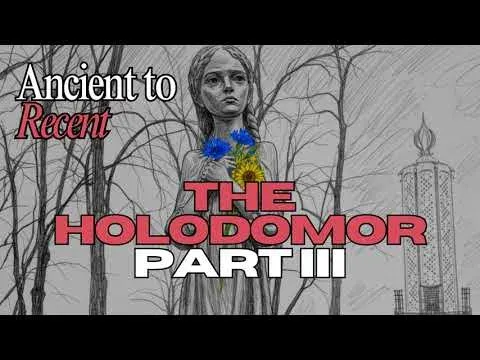 Watch on YouTube →
0:0045:06
Also on
Rate the show
Ratings are how new listeners find the show. It takes a minute and it makes a real difference.
By the end of the 1920s, Stalin had a vision, to forge a new Soviet man and break the old peasant world forever.
Across Ukraine, a war was declared on the countryside. Villages were torn apart, churches destroyed, families deported, and the proud independence of Ukraine’s farmers was crushed beneath the machinery of collectivisation.
Through forced labor, quotas, and terror, millions were driven from their homes as the Soviet dream turned into a nightmare. Stalin’s campaign to “liquidate the kulaks as a class” would not only shatter rural life, it would lay the foundations for the famine to come.
Join Joseph Parkinson as he tells the story of Stalin’s collectivisation, the destruction of Ukraine’s villages, and the ideological madness that reshaped an entire nation.
🎧 New episodes every Friday
📲 Follow on Spotify, YouTube & Instagram @AncientToRecent
Read transcript
This transcript is automatically generated, so it may contain typos and misheard names.
A single death is a tragedy. 1,000,000 deaths is a statistic. Joseph Stalin In the late 1920's, the presence of the Soviet state in the lives of peasants in rural Ukraine could be quite light. The civil war had ended. Forced grain requisition was a thing of the past and many peasants lives were beginning to return to normal after nearly a decade of constant turmoil. The state was hostile to the peasant way of life, but with so many towns, villages and thousands of small farms spread out over such a vast area, it was hard for the Soviet state to make itself felt in every aspect of the lives of its citizens. Peasants could still travel freely, celebrate religious festivals and go about their way of life. That most Ukrainians had not seen change in centuries, a life centred around the plough, the church and the family. But this would all change with the advent of collectivisation. Independent farmers were to be transformed into state employees.
Peasants were to become members of the working class and in doing so, part of the international proletariat. Conservative agrarian farmers, clinging to their beliefs, traditions and way of life, were to be transformed into devout communists who saw themselves as part of the vast struggle against international capitalism. The peasants were to be sovietized in thought, deed and outlook. The peasants were to give up their independence and turn everything, their land, homes and tools over to the state for the greater good.
This was supposed to create greater efficiency, allow for mechanization, the greater use of fertilizer, and thus yield ever greater, ever more bountiful harvests that would feed the next generation of happy, smiling children, the first generation to be born under the Communist revolution. Children free of the scourge of capitalism would carry the crusading cause of communism and the good news of Marx and Engels to every corner of the world to liberate their brothers and sisters and build the workers paradise.
Or at least that was a theory. You see, this was the dream of the Soviet government, not of the peasants. Stalin and those around him were true believers in the revolutionary creed of Marx. They were utterly determined to forge a new world in their own image and to pay any price to build the Kingdom of heaven on earth. And they were not going to let the peasants of Ukraine stand in their way. Those that opposed the Soviet state were not citizens with rights to be heard.
They did not have opinions that had to be respected. They were best dupes and fools, too simple to understand the revealed word of Marx. At worst they were class traitors. The myth called culacks too selfish to help others. Either way, no resistance was to be tolerated. Those who opposed the building of the shining city on the hill were to be crushed. Welcome to ancient Theresa. My name is Joseph Parkinson and on today's episode we will be talking about collectivization, the enforced agricultural reorganization inflicted on the Ukrainian people by Stalin and the devastating effect it had, the brutal methods of the Soviet government, and the determined resistance of Ukrainian people fighting desperately to preserve their land, culture and identity.
Episodes of Ancient Recent are out every Friday and are available on YouTube, Spotify, and Apple Podcast. In the 1920's, the Soviet Union had a serious problem with the countryside. The Soviets had been able to make their revolution in part by their ability to control grain supplies shipped to the cities of Moscow and Leningrad, formerly St. Petersburg. Renamed after the death of Lenin in 1924. The Soviets had tried to implement their Marxist ideology on the countryside through war, communism, the complete militarisation of the economy. But this not only sparked mass peasant resistance, it also led to the complete collapse of the rural economy. This forced the Soviets to backtrack and introduce the New Economic Policy, or NEP, where peasants would pay a tax in kind to the Soviet state of grain, but everything after they could keep to sell in the markets.
The NEP had lead to an improvement of the grain supply, but was in effect a form of heavily regulated capitalism. Soon some peasants began to accumulate greater wealth than others. But the Soviets, trapped in their Marxist ideology, began to denounce and harass this new class of wealthy peasants as NEP or Nepmen. This has created a vicious circle. The state needed more grains, so it pressured the peasants to work harder. But this would result in inequality, which would lead to Soviet repression.
So peasants that didn't work hard starved, and those that did were arrested. The Soviet government needed a way of increasing food production without allowing for the emergence of a new capitalist class. This was especially pressing as the Soviet state had set a course for breakneck industrialization, which required technology and machinery. The USSR did not possess products that would have to be purchased from abroad and that would have to be paid for with hard cash. And the only way the Soviet government could raise the money it needed was by selling grain abroad. So the government in Moscow hitting a new idea, collectivization.
Supposedly, collectivization was meant to be a voluntary scheme, and Soviet newspapers such as Pravda ran front page stories on the enthusiasm for collectivization sweeping the countryside, complete with pictures of smiling peasants eager to do their bit for the revolution. The reality was that there was nothing voluntary about collectivization. Starting in 1929, Soviet officials began turning up in villages and farms.
They were recruited from the cities and filled with Marxist seal to build the revolution. Their clothes and jargon filled speech was alien to the peasants that they had come to save. These foot soldiers of the revolution treated the peasants not as comrades that they've come to help, but instead with contempt and open hostility. The Soviet papers had talked endlessly about the backward lazy peasants, the greedy culacks, and how peasants had hoarded grain, keeping it from being transported to the starving cities.
Despite the best and most brutal efforts of the Soviets, shortages had still been common in the cities after the Civil War, Pravda had done all it could to sow resentment among city folks towards the peasants. Attitudes amongst the peasants towards these youthful urban enthusiasts, nicknamed the 25 Thousanders, were equally hostile. The Soviet officials sent from the cities were people who knew little and cared less for rural life, and often gave instructions derived from Marxist dogma, not agrarian reality. They were considered hostile and in even many cases incompetent meddlers by the peasants.
But there was a further dimension to this tension. The Soviet officials were almost always ethnically Russian, and they were now being sent to confiscate the land and interfere in the lives of overwhelmingly Ukrainian peasants. The Soviet officials did not seek the opinion or permission of the peasants. They simply came into villages and began issuing orders. The peasants did not take kindly to this, and relations between Soviet officials and peasants went from bad to worse.
To the fanatical Soviet officials feared a steady diet of hatred and resentment by the Soviet press. The resistance they encountered turned resentment into rage and justified to them the cruelty that they would deal out. But before the Soviets could crush the peasants, they would need to divide them. Soviet officials began looking for collaborators amongst the peasants, offering promotions and advancement for those that would inform on their neighbors and enforce Soviet policy. Some joined out cynicism attracted by potential advancement, some out of genuine ideological commitment, but others, quite possibly most, joined out of fear. The best way to avoid coming under suspicion of being branded as a class enemy, or worse still, a kulak, was to side with Soviet power.
After all, Ukraine had experienced a decade of rebellion against Soviet power on and off, and every rebellion had ended the same way. The lesson had been well learned. By 1929, those that oppose Soviet power could expect either deportation to the gulags or death at the hands of the OGPU, the feared Soviet secret police. But before collectivization could go ahead, rural society had to be decapitated to prevent any organized resistance from emerging. The OGPU had already began rounding up, deporting and shooting those parts of the urban population that could rally support in opposition to Soviet policy priests, writers, intellectuals, and even some party members. This policy would now be extended to the countryside. To justify this, the Soviets, partly for cynical reasons and partly for ideological ones, denounced those they felt could oppose them as being culacks.
But what was a kulak? It was meant to be used as a name to describe a rich peasant. But who was a rich peasant within the context of 1920s and 30s rural Ukraine? Was someone in a village with two horses when others had one, a rich peasant? Nobody knew. The term conveniently could be applied to anyone the Soviets didn't like. In an effort to move away from simply randomly labeling anyone a kulak, in August 1929, the Ukrainian Communist Party issued a definition of who could legitimately be suspected of being a kulak.
Hiring labour, owning a mill, a tannery, or a brick factory or any small industrial plant. A farmer who rented tools to others. Any farmer engaged in trade or lending money with interest all would be considered culax and fit for arrest, expropriation, deportation, or simply taken into the forest and shot. As time went on and reality continued its stubborn resistance to Marxist dogma, the authorities needed to explain why even some peasants who didn't fit the above description resisted collectivization.
Soviet authorities needed to invent more mythical classes of people such as the under Culax, poor peasants who were still, in some amorphous way, kulaks. Eventually, the Soviets would give up on trying to define what a kulak was, trapped in their rigid ideological prison and incapable of thinking beyond its bounds, challenging its tenants, or understanding the actions of others that refuse to bend to how they, as Marxists, believe reality should adhere. The Soviets simply deemed all those who expressed any opposition to be kulaks.
But most Soviet officials were not interested in trying to develop some intellectual understanding of what a kulak was. Many simply attributed particular ethnic groups with characteristics that allow them to channel their ethnic hatreds into class struggle. Poles, Germans, Greeks, Chechens, and Ukrainians, amongst others, were considered inherently suspicious. The Soviets even had a saying Gras polyak znachit kulak, which translates If you are a Pole, then you are a kulak.
In a rare moment in human history, Jews were actually not singled out for persecution. Ironically, Jewish people had been so brutally persecuted throughout the history of Czarist Russia that most Jewish people were too poor to own any property at all, and therefore the Bolshevik actually didn't persecute the Jews. This is possibly the first time in human history where being Jewish actually spared someone from persecution, though many Jews would still be arrested as speculators. And the Soviet Union was a deeply anti-Semitic society that did indeed persecute Jews in many other ways, such as quotas at university, not minimum numbers, but rather Soviet universities had maximum numbers of of Jews that were allowed to attend and the Stalin estate would later single the Jews out for punishment.
Each region of the Soviet Union was given not just a definition of what a Coulac was, but was also given a quota. How many were to be arrested and how many were to be deported. If not enough people in the region fit even the loosest definition of a culac, then innocent people would simply have to do. If the Central Committee of the Communist Party said there was 1002 thousand or 10,000 culacs in the region, then as far as local communist officials were concerned, there were also an inability to fill a quota would reflect badly on local officials who would be accused of going soft on the culacs. In fact, regions competed to overfill their quotas of culacks arrested.
The more arrests, the better. A revolutionary you were. The Moscow OGPU directed the Ukrainian OGPU to arrest 15,000 kulaks and 30 to 35,000 kulak families were to be exiled and all to be deported to the White Sea region near Finland. When someone was denounced as a kulak, the victim would lose all rights and their property would be confiscated and either stolen or sold at auction. Culacks would be driven from their homes. But not all were deported.
Some were simply reduced to destitution. Some fled from their homes and swelled the regions of the Donbass with its heavy industry and coal mines. Others made their ways to the cities and found factory work. Soviet officials, under pressure to fulfil the Five Year Plans, would sometime overlook the designation of these itinerant workers, previously deemed politically untrustworthy because the factories and mines needed labour desperately and after all, many people who were sent down the mines would simply die anyway. Between 1930 and 33, at least 100,000 culacks were deported to the Gulag, many of them dying in the massive industrial projects that would become bywords for incompetence and cruelty. The coal mines of Vacuta, the White Sea canal projects where the bodies of slave labourers will be mixed in with the ballast to save on concrete.
In fact, the Soviet 5 year plans would not have been possible without forced labour and the culacs were the first to be fed into this pitiless system. The programme of deculacization was part of a broader programme to smash the social structures of the villages and break bonds of family, community and anything that could pose as an alternative source of identity to the Soviet state. The most noticeable of these institutions was the village church.
The programme to suppress the culacs was accompanied by a vast campaign of church closure, confiscation of church property and arrests of priests. Church bells were melted down, icons smashed, holy places were desecrated. This campaign was also accompanied by a wave of atheistic propaganda, especially in schools directed at children. Religious holidays such as Christmas and Easter were banned, replaced with revolutionary holidays such as the October Revolution and Mayday.
Churches could no longer service centres of communities or a sources of charity to be dispersed in times of need. These functions were to be taken by the Soviet state. This would have catastrophic consequences. During the great famines of the 1930's, the entire culture of the countryside was changed. Folk music, seen as representing the peasantry and therefore viewed as inherently reactionary, was banned. Parents no longer had property to pass down to children and were often separated by fathers and mothers having to move to the city to earn meager wages.
The Soviet state actively worked to undermine the family, encouraging children to inform on parents, teachers, even quizzing children on the conversations they overheard their parents having. They're so distrust between generations and weakened bonds of identity and loyalty. The state was to be the only parent a child would have, and Stalin was the only father a child would love. The campaign for collectivization began with meetings in the villages where Soviet officials would try to convince the peasants to volunteer to join the collective farms. Peasants would be promised improved housing, steady wages, and communal kitchens that would cook for them. But if this did not convince the peasants, and in most cases it did not, then threats would be issued. Red Army troops would March through villages just to make sure that people were aware that no resistance will be tolerated. Peasants will be brought 1 by 1 to see local Soviet officials who would intimidate them, placing a gun on the table so the peasants would know the lens the Soviets would go to to get their way.
When threats were not enough, then collectivization brigades would use force, beating people up, arresting them, torturing them, whatever was required to terrorize the peasants. Men were forced to dance and then beaten. Girls were raped. Nothing was off limits to pressurize the peasants to comply with the Soviet government's will. From the start of collectivization, there had been massive resistance. Initially, this took the former's widespread refusal to join the collective farms. But with every act of defiance, Soviet officials reacted with violence.
The starting of vicious cycle of rebellion and bloody repression. Faced with having their livestock confiscated, peasants slaughtered their cattle. Between 1928 and 1933, the number of cattle in the Soviet Union dropped by nearly 50%. Where villagers didn't slaughter their cattle, they did everything they could to keep them out of the hands of the communists, beating up communist officials who came to confiscate pigs, sheep, cows and horses. To the minds of Soviet officials, they were baffled by these actions.
They could not understand why peasants were not only unwilling to join collective farms, they were downright hostile. The communist officials believe that any opposition to their rule could only be born of nothing short of counter revolutionary agitation and be a political act rather than being poor people not wanting to surrender their livelihood to a state that only in 1929 had inflicted a famine on them and had forced them to be part of the Soviet Union against their wishes. With massive violence in the 1st place, peasant farmers living near borders try to flee into neighboring countries and some took to the forest to form partisan bands. As opposition to collectivization grew, Stalin was given pause for thought.
He experienced massive Ukrainian resistance to the Soviet state in the civil war and how he had almost toppled the Soviet regime. Stalin decided to take a step back, or at least to appear to. On the 2nd of March 1930, Pravda published an article written by Stalin called Dizzy with Success. In which he claimed that collectivization had been a success beyond all imagination, but that there had been some excesses. Stalin did not mention that these excesses had involved mass deportation, expropriation, slave labor, arrest, torture and execution, nor that these were deliberate policy that he and the Politburo had ordered. Stalin blamed local party members and condemned the language and methods of collectivization, both of which, of course, had come directly from him. If this was meant to turn down the temperature on Ukraine, then it failed miserably.
Already by March 1930, a massive peasant rebellion was under way. To loyal Communist Party members, this article came as a shock. Many of them had to read it aloud to the very villagers that they had been terrorizing, only to be greeted with stunned silence. At one such meeting, a party official, after reading the article to locals, went on to explain that the real culprits for the excesses had been, of course, the Jews.
By this point, however, the countryside across the USSR was ablaze. Mobs attacked and beat up Communist Party activists. Crowds broke into storehouses and took grain. People raided collective farms and took back their property and farm animals in Marion, Paul, Ukraine. Local people beat up and spat on communist officials who had to be saved by the OGPU. By March 1930, the OGPU reported 2000 mass protests in Ukraine alone. Violence against Communist Party officials was widespread. The OGPU reported 13,794 incidents of terror within only a few weeks of the publication of Dizzy with Success. Rioting and spontaneous rebellions were turning into a nationwide uprising.
The OGPU responded with mass arrests. Between January the 20th and February the 9th, 1931, the OGPU in Ukraine arrested 11,865 people. Those with links abroad were considered especially suspect as they might be contacts between foreign governments and counter revolutionary cells. One issue is worth considering. It is hard to tell just how widespread these rebellions were. Now there certainly were rebellions, and they certainly did happen on a large scale, but were the OGPU exaggerating? The OGPU was paranoid by nature and they had a history of inventing fictional counter revolutionary organizations to justify mass arrests, as had happened in the 1920s and again would happen in the Great Terror of the 1930s. Many OGPU reports were rambling screeds full of Marxist jargon about how opposition they encountered was never simply peasants who were desperate, but was always White Guards, Czarist officers, Ukrainian counter revolutionary nationalist fascist cells backed by Japan and Poland, etcetera. There are two reasons for this, one being that it would make their brutal repression seem more impressive to their bosses in Moscow.
The second was ideological. It would be impossible for the Communist Party to accept that their policies were being opposed by the poor. They would have to convince themselves that it was a grand strategy mastermind by a shadowy international conspiracy. That would raise fewer troubling ideological questions. Were, or rather to what extent, were the OGPU deliberately exaggerating the scale of opposition? We will never know.
But whatever the exaggerations of excitable secret policemen, we do know that there was indeed opposition. There were rebellions, and they were widespread, armed and organized. In mid March in the Tulchin district of Ukraine, peasants shouted. We don't want the leaders who robbed the peasants and down with the communists who are leading the country to disaster. In 343 villages, Ukrainian peasants drove out, murdered or simply ignored communist officials and elected their own leaders. The OGPU reacted swiftly with the usual mixture of deportations, arrests and executions. The region was divided up and each area was assigned an OGPU armed cavalry unit to guard over it. In some areas, the rebellion did have a clear political outlook. In Pavlovad, in eastern Ukraine, near Denisprotesk province, a revolt broke out in March 1930.
Representatives from the region came together and began to plan the removal of Soviet authorities. The group plan to March to the local town, gather weapons, storm the city of Denisprotesk and from there lead a national uprising to drive the Soviets out of Ukraine and create an independent Republic. The contact was even made with local Red Army troops to try and win them over. On the 5th of April the uprising began in Odsadshi where rebels murdered the local Communist Party activists and was soon joined by the local villagers. But they failed in cutting the village telegram lines till the end of the day, by which time the communist officials had already sent messages asking for assistance. And the next day, on April the 6th, an OGPU unit arrived and put down the rebellion. 300 were arrested, 210 were put on trial. But strangely, the Soviets, who love the show trial, decided that these proceedings would take place behind closed doors. The Communist Party didn't want the world to know why real rebellions happened within the Soviet Union. And on the 20th of May, less than six weeks later, 27 peasants were taken out and shot. There was an information loop within the Soviet system. The OGPU could not tell their bosses in Moscow that their policy was a failure and deeply unpopular, so they fed them the information they felt the Politburo wanted to hear, either based on exaggerations or outright fabrications. The OGPU and other Communist Party organs would then receive orders sent down from the Politburo based on the fictitious information they had provided. So the OGPU would be expected to enact policies that bore no relation to reality, and they were expected to get results. When those results were not forthcoming, the OGPU would need scapegoats.
This was a system where lies went in and lies came out. This all comes down to 1 central ideological flaw. The Communists could not entertain any idea that they might be wrong. And if you start from a position of infallibility, you construct a system that has no mechanism for course correction. OGPU reports explained peasant opposition to Soviet policy as the result of anti Soviet elements inspired by culacks, foreigners and class enemies.
The Communist Party responded to opposition the same way it always did, the same way it always had. Mass arrests, mass deportations, mass repression. Stalin's article Dizzy was success did not indicate a let up of pressure. The same policies were pushed forward, but with ever more force. In July 1930, the Politburo set a new target. 70% of households in the main agricultural regions of the Soviet Union, mostly Ukraine, were to join collective farms by September 1931.
By December 1930, that number had been increased to 80%. The Central Committee of the Communist Party's resolution stated that to achieve such a lofty goal would require the liquidation of the culacks. As a class, peasants was subject to constant rounds of threats, propaganda, and ever increasing taxes. And if that failed Force 30 starvation was reported for the first time. Peasants began abandoning their farms looking for work in the cities. Some people in Crimea became sick from eating horse feed out of sheer desperation, and many gave up their land under intense pressure.
Collectivization tightened the state's control over the lives of the peasants. The peasants could now no longer grow their own food and have no surplus to sell. To raise cash, the collective farm would in theory pay the peasants, but in reality payment was often in kind rations of wheat bread and potatoes. This had the effect of depriving the peasants of hard cash, thus tying them to the collective farm and depriving them of the ability to move away.
The peasants were stripped of their agency. Many peasants worked as little as possible. Instead of convincing the peasants that the means of production belonged to everyone, Soviet policy convinced the peasants that the means of production belonged to nobody. Instead of making a new class of people, Soviet man free of ego, driven to ever greater levels of exertion by pure ideology, Soviet policy made peasants lazy, petty, and selfish.
Stealing became common maintenance work. When neglected, everyone took from the hated collective farm as much as they could and gave back as little as possible. The collective farms produced drastically less grain than they could. Instead of Soviet policy empowering the peasants, it turned them into serfs. Instead of increasing efficiency, it robbed peasants of their dignity. A class of proud, independent farmers, known for their rugged individualism had been replaced by sedate, apathetic agricultural bureaucrats.
Violent acts of rebellion continues. Shops were ransacked and warehouses broken into. But the Soviet Union continue to press ahead. Stalin, not yet the supreme leader he would become in the mid 1930s, but certainly the most recognizable Soviet leader, had tied his reputation to collectivization. Also, for the Communists, what was the alternative to claiming that collectivization was a success? Let's look at their record in government war.
Communism had failed. The NEP had been some success, but that was a form of capitalism. If collectivization opposed by a bunch of backward peasants who had no place in Marxist ideology failed, that would be a huge blow to the ideological legitimacy of the whole Soviet experiment. So collectivization had to succeed no matter what. Official figures claimed that 83.5 million tons were collected in 1930, a significant increase on the 71.7 million tons of 1929.
Whether these official figures are true or not is another question entirely. True or not, Stalin believed these figures. And so Stalin took what would turn out to be the catastrophic decision to increase the amount of grain released for sale on the international markets. Soviet grain exports to Western countries increased, with exports to Germany alone tripling between 1929 and 1931. The Soviets didn't just get hard cash from these exports.
The Bolsheviks had a long history of seeking to exercise diplomatic influence through food shipments. The USSR demanded, in return for artificially low prices, that Latvia would recognise Ukraine as part of the Soviet Union in 1920. In 1922, the USSR demanded that the British government sign a peace treaty that recognised the Soviet Union or face an end of all grain shipments. All of this happened as Soviet citizens starved.
Poor weather in 1931 had a negative effect on the harvest, but this alone would not have caused a famine. Bad weather combined with Soviet agricultural policies, however, would. Reports began to flood in that grain production was well below what was expected and that famine was a serious possibility. The Politburo and Stalin were deeply troubled by these reports. But not that peasants would starve, rather that the Soviet Union would miss its grain export quotas. Official figures for the harvest state that the Soviet government collected 69.5 million tons of grain in 1931, well down from the figure of 83.5 million in 1930. At this rate, the Soviet government would not be able to pay for the machinery it needed for the Five Year Plans. And worse still, food shortages in the cities could lead to riots that could undermine Soviet rule. Bread, vegetables, fish and meat disappeared from shops across the Soviet Union.
Workers began to grumble, and lines formed outside shops. Everyone in the Politburo, including Stalin, knew their collectivization was a failure. We're not being inundated with fantastically exaggerated information from the OGPU. Stalin would get reports from collective farm managers and party bosses explaining in detail how and why the policy just didn't work. It didn't matter. Stalin had attached his reputation to this policy.
It was needed for controlling the peasants and for shipping grain to pay for the Five Year Plan. The peasants would just have to suffer. But the consequences of collectivisation could not be ignored. So in true Soviet style, if the guilty could not be blamed, then the innocent would be. Even communist activists started sending in reports about hungry peasant and the failure of collectivisation. These reports were dismissed and many Communist Party members were purged as reactionaries or going soft on the culacks.
The OGPU began its predictable search for scapegoats, arresting and deporting agricultural experts who, of course had to be members of some shadowy international conspiracy. But problems persisted. No amount of propaganda, arrests or executions would increase grain production or hide the reality that collectivization was a disaster. Rather than reassessing these policies, the Soviets ratcheted up the repression. Collective farm bosses were threatened they would face consequences if not enough grain was collected. Molotov, one of the most senior Politburo members, dismissed the idea that there was a lack of grain, instead insisting that there was a lack of efficiency and, of course, revolutionary zeal.
That was the real problem. To make matters worse, the harvest had been poor across the entire Soviet Union. So Ukraine, as the principal agricultural region, was instructed not just to collect it's ever increasing quota of grain to be sold abroad and shipped to feed Russian workers, but also to provide seed grain to the other Soviet republics. With threats coming down from Moscow in the spring of 1932, desperate party officials in Ukraine, aware their failure to fulfil Stalin's orders would have lethal consequences for them and their families, enacted a program of mass grain confiscation. Teams of desperate party officials took to nighttime raids on peasant dwellings, tearing them apart in search for any grain, ripping up floorboards, smashing stoves, tearing open mattresses and pillows, anything to find the last sack of onions or loaf of bread. Party activists even searched through the soil with long metal poles to find buried vegetables.
Those found in possession of any grain at all would be expelled from their homes and deprived of their belongings. But this was actually rare because most peasants in Ukraine at this point had no food at all. Reports of starvation from Volga, the Caucasus and Kazakhstan started to come into communist officials. Starvation started to appear around Odessa in the South of Ukraine. In one village, Korbritska, by 1932 over half the villagers had starved to death.
Soviet health inspectors found villages of people living on nothing but crow's meat, drinking soup made of boiled bones, children too weak to stand, the corpses of their parents littering the streets. Desperation drove peasants to eat what few animals they had left. Even peasants who filled the grain requisition targets still had what food they had left confiscated. Panic ensued amongst Ukrainian communist officials.
They were overwhelmed at both ends, both by desperate reports of mass starvation from below and from above, threats as to what would happen to them if they didn't push harder forever. More food collections. Reports of hunger started to appear outside the Soviet Union. German and Polish diplomatic officials started to send home the first indications of mass starvation, all too often dismissed by sympathetic pro Soviet journalists. In Britain, France and the United States of America. The peasants were driven to eating their last seed grain, many of them too weak to work.
Others saw no point, as all the food would be taken by the communists anyway. Agriculture throughout the Soviet Union simply collapsed. In the spring of 1932, some senior Ukrainian communist officials finally decided that enough was enough. They could see what was happening with their own eyes. They could see that the people were being driven to starvation. And this was because of the insane demands of Moscow. In February, Hiroy Petrovsky, a member of the Bolsheviks since before the revolution and chairman of the Ukrainian Supreme Soviet, the puppet Soviet parliament in Ukraine, wrote a letter to senior Ukrainian party members. He made a list of suggestions, including asking for a change of policy and also asking for international aid. He even recommended that the Soviet state should stop exporting food.
His suggestions were taken on by some party officials, with some Soviet officials refusing to collect rain or to share food with other Soviet republics. The Soviet Ukrainian leaders sent a tepid letter to Stalin, downplaying the severity of the famine, but asking that maybe some just a little, certainly not too much, but perhaps a wee bit of food aid could be shared with the Ukrainian peasants. Temporarily, of course.
Please. Stalin does seem to have taken some measures, buying foodstuffs from Iran for distribution. But then, just when he seemed to be softening a little bit, he had a change of heart. Rebellion in Ukraine and panic from Communist Party bosses begging for a change of course sent Stalin into a rage. On April the 26th, he sent a furious letter demanding to know why the OGPU wasn't suppressing opposition and demanding punishment for those who did not fulfill their grain quotas. But amazingly, the Ukrainian leaders, who only weeks before had been enforcing the policies that had inflicted mass starvation on their own people, didn't back down. They once again tried to reason with Stalin. Petrovsky sent a letter again to Stalin, painting an image of desperation gone with the coded tones of deference and instead laid out before Stalin was the stark reality of collectivization.
Petrovsky told Stalin directly of villages starving of desperate peasants swollen with hunger, begging for food. He begged Stalin for aid for Ukraine. The leader of Soviet Ukraine, Blast Chubar, also wrote a similar direct letter to Stalin, describing in detail the situation and pleading for a change of course. Even Molotov, the heartless Politburo member who was such a shameless lackey of Stalin, asks Stalin to stop the export of food. But Stalin refused, claiming that these letters were simply an attempt to get out of fulfilling their grain quotas. Stalin responded by increasing the quotas and reminding Ukrainian bosses that if these targets were not filled, they would be held personally responsible. Resistance continued.
Workers at the Odessa ports refused to export pigs and the Red Army had to be brought in to do the job for them. Molotov and Lazar Kaganovich, the second secretary of the Soviet Communist Party, were sent to Ukraine to oversee grain fulfilment. The third party conference of the Ukrainian Communist Party was a desperate affair. Desperate Communist Party officials begged Kaganovich and Molotov for relief. Speaking bluntly, they said that they could not fill their quotas without mass famine.
Others told Kaganovich and Molotov that grain requisition squads doomed peasants to slow and lingering deaths. These Communist Party officials, they were not bleeding hearts. They had themselves engaged in mass repression against the peasants and eagerly participated in the deportations that went with the liquidation of the culacks. And yet, even for these bloody hard men, they could see how desperate the situation was becoming.
But Molotov and Kaganovich refused to blink. In the end, it was the Ukrainian Communist Party that back down and passed a resolution committing Ukraine to meeting their grain quota in full. The Ukrainian Communists, when given a choice between their ideology and their humanity, chose the former. On the 7th of August 1932, Stalin reacted with force. A new law was passed stating that even stealing the most tiny amount of food would be punishable with 10 years imprisonment or execution.
Within six months of this law passing, 4500 people were executed for stealing food and 100,000 people were deported to the Gulag for sentences of over 10 years. Stalin had been shaped by his experience of Ukraine during the civil war. He'd inherited Bolshevik's suspicion of Ukrainian identity and viewed Ukraine as a direct threat to Soviet power. Stalin now saw everything he held dear Marxism, the Soviet state, the global proletarian revolution that he had given his life to set against, everything that he had always despised backward peasants, bourgeois morality and suspect Ukrainian identity.
For Stalin this was a fight to the death, a struggle for the very survival of the Soviet state and for the revolution that it was founded on. The stage was set for the final showdown, the battle of wills between the peasants and the Soviet state that would result in the Great Famine of Ukraine, known today as the Holodomor. Thank you for listening to Ancient Theresa, My name is Joseph Parkinson. Next week we will finish the story of the Holodomor.
Episodes of Ancient Theresa are out every Friday and are available on YouTube, Spotify and Apple Podcasts.