
#21
The Ukrainian Revolution — Part 2
24 October 2025 · 50 min · Season 1
 Watch on YouTube →
0:0050:18
Also on
Rate the show
Ratings are how new listeners find the show. It takes a minute and it makes a real difference.
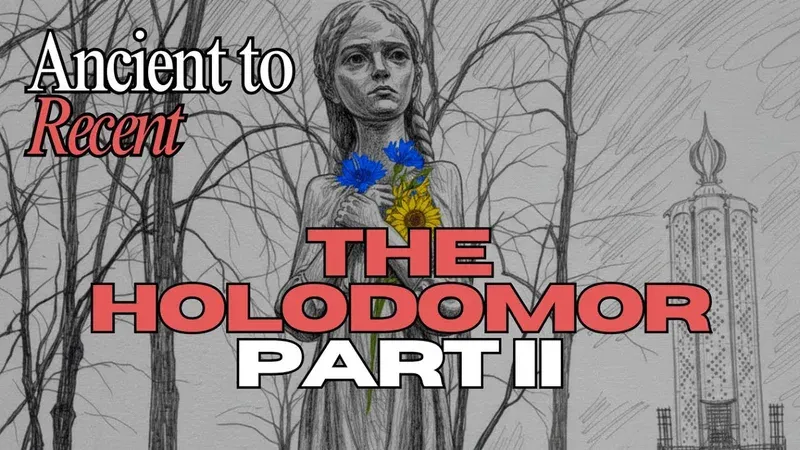
In the aftermath of revolution, Ukraine lies in ruins. The Bolsheviks have won the Civil War but for Lenin, victory is not enough. From the brutal terror of the Cheka to forced grain seizures and man-made famine, Ukraine becomes the testing ground for a new kind of tyranny.
As millions starve and resistance is crushed, a new figure rises from the shadows: Joseph Stalin. His plan for collectivization will turn Lenin’s famine into something far darker, the Holodomor.
Join Joseph Parkinson as he continues the story of Ukraine’s struggle for survival under Lenin and Stalin, the birth of Soviet power, and the seeds of one of history’s greatest tragedies.
🎧 New episodes every Friday
📲 Follow on Spotify, YouTube & Instagram @AncientToRecent
Sponsored by World of Whisky – Some things only get better with age. With World of Whisky, you can own a share of Scotland’s most iconic export. You must be over 18. Investing carries risks. Drink responsibly. Invest responsibly. This is not financial advice.
👉 Learn more: https://tr.ee/ZaBoYD
#sponsored #publication
Read transcript
This transcript is automatically generated, so it may contain typos and misheard names.
They make a desert and call it peace. Tacitus. We shall teach these people a lesson right now so that they will not ever dare to think of resisting us in the coming decades. Lenin in a letter to Viatrislav Molotov, 1922. Welcome to ancient, to recent. My name is Joseph Parkinson and on today's episode we will continue our story of the Holodomor, the man made famines inflicted on Ukraine by Stalin and the Soviet Union. In our last episode, we talked about Ukraine during the Russian Revolution and civil war.
Ukrainians struggle for independence and how it was thwarted by the Bolsheviks and Lenin. That and all episodes of Ancient Teresin are available to listen to right now on YouTube, Spotify or Apple Podcasts. But in today's episode we will be focusing on the period after the end of the Russian Civil War through to the late 1920s. Episodes of Ancient Recent are out every Friday and are brought to you by World whiskey.co.uk, the premier place for whiskey cask investment. With the withdrawal of the Poles and the defeat of the White armies, the Bolsheviks were the power in the land and Ukraine settled into a sullen peace.
There was still resistance from some scattered groups of partisans, but the brutal methods of the Chequer and the Red Army slowly strangled those that opposed rule from Moscow. Felix Traczynski, the bloody founder of the Chequer, the feared Soviet secret police, personally took command of the repression, ordering round after round of deportations, shooting and torture, burning of crops in villages to terrorize Ukrainian people into submission. The new rulers of Ukraine moved the capital from Kiev to Kharkiv, closer to the Russian border, in the belief that the local population, overwhelmingly ethnically, culturally and linguistically Russian, would be more supportive of Bolshevik rule.
A combination of years of war and revolution had left agriculture and society in tatters. Ukraine was a land of twisted rail lines, burnt out buildings, devastated farms, a land of orphans and widows held in the iron grip of the Chequer. But it was not war alone that had impoverished Ukraine. The Bolsheviks had been in a hurry to implement their theories, and they did so if necessary, at the point of a gun Trade had collapsed, commerce had ceased, investment evaporated, industry ground to a halt. The countryside was littered with abandoned and often torch collective farms.
What little food there was was either confiscated by the Bolsheviks for transportation back to Moscow and Petrograd or rotted in the countryside. Within the USSR, Ukraine was technically an equal member of a federal union. There was a devolved Ukrainian government with its own politburo. There was a Ukrainian Communist Party separate from the Soviet Communist Party. But in reality, policy was dictated from the Kremlin.
Now the Bolsheviks were secure in power, they could more easily implement their ideals. Some would think that with a civil war over that maybe it was time to relax, to take the boot off the throat of the people. But not the Bolsheviks. You see, the Bolsheviks, they were men in a hurry. They wanted tomorrow to start yesterday, and they believed that it was their job to create heaven on earth. And as the old saying goes, you can't make an omelette without cracking a few eggs. The Bolsheviks had won the civil war through terror, and they intended to rule through terror.
But the Bolsheviks terror was not a last resort. It was their preferred means of operation. Leon Trotsky, the People's Commissar for Military Affairs, called for the militarisation of the economy. Workers would to be conscripted into labour armies and property was to be confiscated. All economic means of control were to be vested in the hands of the state and by the state. The Bolsheviks men themselves. Joseph Stalin, the People's Commissar for Nationalities, insisted that the same tactics that had won the civil war would now be applied to running the economy in agrarian Ukraine. The Bolsheviks exerted power mostly through village Soviets called Kamen Nazi.
These bodies were staffed by party loyalists and they were all powerful. They could confiscate grain, issue arrest warrants, even order executions against those they deemed to be anti Soviet or displaying kulak counter revolutionary tendencies. But the Bolsheviks were still desperate for grain. They may have won the revolution, they may have won the civil war, but that didn't mean they were secure in power. They had to keep the grain rolling, and that meant they had to keep it rolling to Petrograd, formerly St. Petersburg, and Moscow.
They had to keep the workers and the army fed. They knew that they hadn't won a lot of goodwill at the first opportunity. Their enemies would sweep them from power. The bread basket of the Soviet Union was Ukraine. And so if that meant that Lenin had to strip Ukraine and leave the Ukrainians to starve, then as far as Lenin was concerned, so be it. Lenin's instructions in 1920 explicitly dictated the collection of all grain, even seed grain required for the planting of the next year's harvest was to be taken from the peasants, who were to be left with nothing.
Now there was a debate within the Soviet Procurement Commissariat, the body that was responsible for collecting the grain. However, after talking over, they decided that ultimately the needs of the state and the revolution was simply more important than the needs of some Ukrainian peasants. And so they went to work ruthlessly hunting down every last crust of bread and sack of potatoes to be shipped to feed the industrial Russian working class. The Bolsheviks policies were an immediate disaster for the countryside.
Ukraine was still reeling from years of war. Hundreds of thousands of Ukrainian men who had collected the harvest in the years before 1914 were dead, meaning Ukraine suffered from a severe manpower shortage, making Lenin's demands for grain impossible to fulfil. But not only did the Bolsheviks inhibit the practical abilities of those who wish to grow grain, they also stripped the incentive from those who could. The Bolsheviks set artificially low prices for the grain, and what they didn't buy for a pittance, they simply took through forced grain requisition.
This further de incentivize the peasants. Why labour and toil day after day in the baking Ukrainian sun when the grain was simply going to be taken by the Bolsheviks and you were going to be left with nothing? Before 1917, the 20 most agriculturally productive regions of the Tsarist empire produced 20 million tons of grain. By 1920, that was down to 8.45 million tons. By 1921, a combination of bad policy, lack of available manpower, and bad weather sent the total plummeting to just 2.9 million tons.
Some regions of Ukraine, amongst the most fertile agricultural land in the world, produced no grain at all. Ukrainian and Russian peasants had historically survived periods of grain shortage by storing surplus grain as insurance, but the Bolsheviks had confiscated the grain, and as a result, famine ensued. Desperate peasants ate dogs, rats and insects, boiled grass and even resorted to cannibalism. Peasants began fleeing the countrysides in a desperate search of food, flooding the city's clogging the streets. Malnutrition lead to outbreaks of epidemics, including bubonic plague.
These scenes would be repeated A decade later, but there were, however, some differences between Lenin's man made famine and Stalin's. Firstly, Lenin didn't seek to hide the famine. Proud, the main outlet for Soviet propaganda, talked openly of millions of people starving. The government in Moscow did take some steps to address the famine caused by their own policies. The Soviet government called for international aid and allowed self help committees to be set up, even those not run directly by the Communist Party itself. The Ukrainian Communist Party even contemplated asking the Ukrainian diaspora, usually a source of tremendous suspicion amongst Bolsheviks, for charitable contributions to alleviate the suffering back in Ukraine. International bodies such as the Red Cross were allowed into Ukraine to begin delivering aid.
But the biggest source of relief was from the American Relief Administration, the ARA, founded by future President Herbert Hoover. Hoover requested publicly that American citizens being held in Russian jails by the Bolsheviks be released, and this caused Lenin to fly into a rage. How dare a capitalist and a millionaire like Herbert Hoover make requests of the Bolshevik government? But the sheer scale of the famine caused by Lenin's disastrous policies and still being further worsened by those policies that he continued to enact, was so terrible.
The disaster was so all-encompassing that even Lenin, a man not known for his compassion, even he, had to relent and accept international aid. In September 1921, the first ARA workers arrived in Ukraine, and they described emaciated, skeletal children, their ribs showing, their cheekbones sunken, their stomachs bloated from hunger, their eyes bulging, hardly able to lift their own arms, dying in Soviet orphanages by the hundreds every single day. By the summer of 1922, the ARA was feeding 11,000,000 Ukrainians every day.
But before the famine was over, Lenin ordered the dissolution of the independent Russian and Ukrainian aid organizations. Lenin didn't want any institution not directly controlled by the Communist Party to receive any recognition of its efforts to alleviate the suffering caused by his famine. Lenin's determination to cling to power was all-encompassing, and no amount of human suffering ever gave him pause or doubt for a single moment. In 1922, with the famine still raging and it's very high, the Soviet government began exporting food from Ukraine to purchase weapons, ammunition and industrial machinery. The Soviet officials also directly interfered in the efforts of the ARA, preventing them from going to certain places, telling them that they weren't allowed to speak, tearing their posters down, informing them not to interfere in the domestic affairs, not to criticize the Soviet government no matter what, or they be expelled. The famine didn't just affect Ukraine, there was also mass hunger throughout the Soviet Union. But there was a marked difference between how the Bolsheviks treated Russian and Ukrainian peasants. The few regions of Ukraine that did have surplus grain were not allowed to share it with other parts of Ukraine. Instead, this had to be shipped for famine relief in Russia. Also, grain requisition stopped much earlier in Russia, but in Ukraine it kept going and going and going. The Bolsheviks began to ratchet up terror against Ukrainian peasants to ensure grain shipments. In echoes of violence in inflicted on the people of the Congo by the Belgians.
Grain requisition squads began taking hostages and demanding quotas of grain to be delivered. Lenin stated in every village take between 50 and 20 hostages and in cases of unmet quotas put them all against the wall. If that didn't work, then those hostages were to be shot as enemies of the state. The Bolsheviks even initially denied the ARA the right to distribute aid in Ukraine, only allowing the ARA to operate in Russia. It was not until the famine in Ukraine was so widespread that the Bolsheviks finally relented.
In January 1922, the Ukrainian Communist Party finally allowed the ARA to distribute aid in Ukraine. While the ARA was distributing aid and saving lives, the checker, always suspicious, began to take the names of Ukrainians who assisted the American aid workers. Those Ukrainians would be marked as politically unreliable, and many of them would end their days in the gulag or in the receiving end of a Bolshevik bullet.
ARA soup kitchens opened in the winter of 1922. Even as the ARA and other charities such as the Red Cross struggled to save the lives of Ukrainian peasants, the Bolsheviks strictly controlled their activities, insisting on directing the flow of aid and channelling aid through communist associations, occasionally arbitrarily banning the delivering of aid to certain areas. It was noted by international observers that the areas that had most resisted Bolshevik rule seemed to be the ones that had to wait the longest for the delivery of aid, even when aid was available. Eventually the flow of aid began to make a difference, and by the end of 1923 the crisis seemed to be coming under control. Other than the mass death from hunger, there was another effect the famine had the Ukrainian people had kept fighting to defy the Bolsheviks even after the withdrawal of the Poles and the defeat of the White armies.
But hunger broke the Ukrainian peasants and allowed the Bolsheviks to pacify Ukraine. Lenin also saw the famine as a mean to bring Ukrainian churches under communist control. Church property and artifacts were taken by the Soviets on the pretense of being sold to buy famine relief, knowing that the peasants who would normally have protected their churches would not do so if the Soviets would argue that the property was needed to buy food. In 1922, Lenin sent a letter to Molotov. Now and only now, when the people are being eaten in famine stricken areas and hundreds if not thousands of corpses lie on the road, we can and must pursue the removal of church property with the most frenzied and ruthless energy and not hesitate to put down the least opposition. Now and only now, the vast majority of peasants will either be on our side or at least not be in a position to support to a decisive degree the handful of reactionary clergy and react sectionary urban petty bourgeoisie who are willing and able to attempt to oppose this Soviet decree with a policy of force.
Lenin wanted to use the famine to break the Ukrainian people, to control Ukrainian society and to bring Ukraine under the control of the government in Moscow. It's estimated that in Ukraine alone, between 250 and half a million people lost their lives in Lenin's famine. The Bolsheviks knew that they were deeply unpopular in Ukraine, and that force alone could never pacify the country forever. They needed to win some popular support. They needed part of society to be vested in continuing Soviet control.
So the Bolsheviks hit on 2 new policies, one programme of economic liberalisation called the New Economic Policy or the NEP and the second a policy of Indigenisation or Ukrainianisation. Non Russian languages were officially granted legal status for the first time and some effort was made to promote the culture of non Russian minorities. There was also a programme of affirmative action launched to promote ethnic minorities into positions of power and responsibility within the regime. But the Bolsheviks had not had a change of heart. They had not had some sort of road to Damascus conversion to now value tolerance.
They were still the same people who held all the old same attitudes. So the program was effectively A ruse. And the Bolsheviks in private said as much. Zenovia, the senior member of the Politburo, describe the policy as, and I quote, a strategic retreat. The policy was to allow the opposition to dissipate, to allow some of the heat, some of the steam to come out of the nations of the Soviet Union, and therefore allow the Bolsheviks to solidify their control on power. In private, Soviet officials even argued against teaching Ukrainian in Ukrainian schools.
They took a Marxist attitude towards this, or what they interpreted as a Marxist attitude. Russian was the language of the industrial working class. It was the language of the factory and the mine. It was the language of Saint Petersburg and Moscow. Ukrainian was the language of the peasants. It was the language of the farmyard and the field. Teaching Ukrainian would therefore promote Ukrainian national identity, which would then inhibit the Ukrainian peasants from gaining class consciousness and understanding that their true identity was as members of the international proletariat. With the new economic policy in place, Ukraine began to rebound very slowly, very gradually.
But trade was now allowed. Grain requisition came to an end and was replaced with a tax. Peasants were now allowed to produce grain, and what wasn't taxed by the government could then be sold at markets. Unsettlingly for the Bolsheviks, but this now began to produce a new class of peasants. Peasants who worked harder, dedicated themselves, were more efficient or maybe even just were luckier, began to accumulate additional wealth and this new class we'll call the NEP or the NEP man. The policy of Ukrainianisation also picked up steam. Laws were passed that requires state employees to become bilingual and Ukrainian was recognized as the official language of the Ukrainian Soviet Republic. The Ukrainian Communist Party even tried to appeal to Ukrainian intellectuals in exiles to return to the Ukraine and build the Socialist fatherland, one of the appeals of this policy.
Was that the distribution of ethnic populations doesn't always cohere to national boundaries and so such a multi ethnic state as the Soviet Union was always rubbing up against country that had large populations on the other side of a border that shared an ethnic kinship with parts of the Soviet population. And so when it came to Ukrainianisation, the fact that there were very large numbers of Ukrainians living in places like Poland was actually quite useful to the Soviet authorities. Ukrainian Poles weren't treated particularly well and they were subject to force assimilation.
In the 1920s and 30s. They were pressured to learn Polish and become Poles. So by promoting these national identities, the Soviet Union felt that it could try and use these ethnic minorities just across the border to become fifth columns for Soviet influence, and that maybe one day they could use this policy to draw other countries such as Poland to become Soviet battle states. However, cynically this policy was implemented, there was in the 1920s a period of a certain flowering of Ukrainian culture within the Soviet Union. Independent institutions that promoted Ukrainian culture were set up, Ukrainian journals were allowed, and institutions were allowed to do research exploring the history of the Ukrainian people.
For a brief period it did seem that the Soviet government was getting behind the ideas of promoting Ukrainian culture in schools, literature and theatre, and it has to be said that this was probably the most cultural freedom Ukrainians had had as part of any empire run from Moscow. Certainly there was a greater level of cultural expression for Ukrainians in this brief period of the early 1920s that had ever been allowed under the Czars, although it does have to be said that that is an incredibly low bar to hurdle.
By the 1920s, some people within the Communist Party were starting to become decidedly nervous. The Bolsheviks were utterly convinced of the righteousness of their cause. The theories of Marx. They were not theories. They were not opinions. They were, as far as the Bolsheviks were concerned, simply the facts of life. To deny or even question Marxism was to the Bolsheviks the same as denying that the world was round. Trotsky went to great lengths to write about scientific socialism where he asserted that Marxism was a simple scientific reality like E Equals MC squared.
But there was a problem. Despite their absolute faith, reality seemed to hold a shocking bourgeois anti Marxist bias war communism. The complete militarization of the economy had not delivered the abundance the Bolsheviks believed it would. The new economic policy had been more successful but also more capitalist, but by the late 1920s it too was falling short. In 1927 the state was able to collect 5.4 million tons of grain, well short of the pre war levels, and even after 10 years of the Bolsheviks being in power, shortages were still common in the cities with long queues for bread at the shops. The Soviet secret police now renamed the GPU. The Soviet Union was constantly renaming the secret police the Chequer, the GPU, the OGPU, the NKVD, the KGB. The name of the institution constantly changed. The methods of the institution stayed the same, but they started to record increasing grumbling from the population. Theoretically, the NEP had allowed the peasants to trade their grain on the market, paying a tax in kind, giving away a certain amount to the state at a set price. But this didn't sit well with austere Marxist. This seemed a bit too light capitalism, and it's also facilitated the emergence of a new class of wealthy peasants that were called NEP Man, named after the NEP. The NEP had indeed lead to an increase in grain production, but it had also introduced market mechanisms into the Soviet economy, again, such as price fluctuations. As demand for grain increase, so did price. As supply increase, the price plummeted, but the peasants were required to sell grain to the state at a set lower price. The peasants began to hold back their grain supplies when prices declined in hope of pushing the prices up, and they sometimes refused to sell to the state at all. This infuriated the Soviet government, which began to return to state repression, issuing orders that anyone who refused to sell grain to the state would be subject to arrest.
The Bolsheviks were caught in a self-imposed ideological prison. They needed food production to feed the cities and stay in power, but they also opposed market forces. They had attempted policies that aligned with their ideologies, such as war communism, but they had been an utter disaster, sparking rebellions and almost leading the Bolsheviks to lose power. However, allowing market forces to reboot the economy would bring with it unsettling ideological questions. Thus, the Bolsheviks were in a bind, incapable of getting out of their own way.
Peasants who worked hard, ran their farms efficiently, and produced the grain the state needed, with some leftover to sell at the market would provide the state with the resources that they so desperately required. Those same peasants, however, would then accumulate wealth and become culacks, the mythical hated class of wealthy peasants of Bolshevik nightmare, who then in Bolshevik ideology, as they had become wealthy, they must surely be exploiters in blood suckers, leading the Bolsheviks to repress them.
But peasants who didn't work well or were simply unlucky would go hungry and would also be incapable of providing the state with the grain is so desperately needed. The Bolsheviks created an environment where peasants had to choose between hunger and repression. By 1927, there was a growing power struggle within the Communist Party. Lenin had died in 1924, leading to a period of collective leadership. There were two emerging figures within the Communist Party, the George and Coppola's son Joseph Stalin, and the fire breathing journalist and intellectual Leon Trotsky.
Leon Trotsky was on the left of the Communist Party. He had opposed the NEP for the very reason that one would imagine a Marxist would It is a form of capitalism and it would allow the creation of a new landowning class to emerge. To many Trotsky seemed to be the natural successor, but he was out manoeuvred by Joseph Stalin. Stalin was very good at forming alliances within the party to isolate and then destroy his opponents. He first allied himself with the supporters of the NEP against Trotsky and then after outmanoeuvring him and driving Trotsky into exile, he was then able to turn on the proponents of the NEP and destroy them.
Stalin thought about the contradictions in Soviet agricultural policy. Stalin understood that larger, more efficient farms were required rather than the thousands of subsistence farms of no more than a few acres. But Stalin was himself a devout Marxist, and allowing the creation of a landowning class to emerge would be a back door for the reintroduction of capitalism. So Stalin decided on a new policy, and this new policy would lead inexorably to chaos and anarchy in the Ukrainian countryside and to the mass famines that would claim the lives of millions of people. That policy was called collectivization. Before we dive back into the story of the events that led up to the whole lot more, a quick word from our sponsor, World of Whiskey.
Some things only get better with age. A fine single malt is one of them. That's why Whiskey Cask Investment has such serious allure. With World of Whiskey, you can own a share of Scotland's most iconic export. You'll get full certification of ownership, delivery orders and access to rare expressions few ever taste. And in the UK, there's no capital gain tax when you sell now. This is not financial advice. Investment carries risks and you must be over 18.
Remember to drink responsibly and invest responsibly and a great place to start is with World of Whiskey. Under collectivization, small farms would be joined together to form large state owned collectives, thus making them more efficient and facilitating investment in fertilizer and machinery. Collectivization was to be a voluntary scheme, but voluntary in the context of the 1920s and 30s Soviet Union under Joseph Stalin basically translated into do it or we'll kill you. Collectivization also served a further ideological purpose. By making the peasants into state employees, it could be argued that they were becoming members of the working class. They would therefore in theory lose their peasant way of seeing the world and the scales would fall from their eyes and they would become good communists like the industrial working class supposedly were.
Collectivization would also allow the Soviet state to take full control of agriculture and thus be integrated into the new Soviet plan for the economy. In 1928, the Soviet government had issued its first ever five year plan, an audacious program for rapid industrial development, complete with sky high, some might say fantastical targets for production across the economy in terms of coal, iron, steel, chemicals. The plan was designed to transform in one great leap, Soviet Russia from a basically 19th, some could even say 18th century agrarian economy straight away into a modern industrial economy that could compete with Germany, Britain and the United States of America.
The Five Year Plan was incredibly ambitious, with 20% increases in production set across the board in order to bring about the breakneck industrialization that Stalin and the Soviet leaders envisioned. They would need tractors, steel mills, forgeries, chemical plants, coal mines, factories, vast production plans, and all of them had to be built from scratch. And this all required skills, expertise and technology the Soviet Union did not possess. All of this needed to be purchased abroad and imported into the Soviet Union from industrialized capitalist countries in the West, such as France, Germany, the UK, and Canada.
And these countries, unlike the peasants, we're not going to accept payment in ideological zeal. They expected hard cash collectivization would allow the Soviet government to take full control of the grain supply and thus allow the Kremlin to sell grain in much larger quantities on the international market. To raise funds, they needed to buy the machinery required to power the Five Year Plan. Stalin further tied his name and his reputation to the policy of collectivization. Stalin was far from being the supreme leader of the Soviet Union he would become in the mid to late 1930s. He was the most powerful of the leadership, but it was still a collective effort, and he could, if policy failed or was seen to fail, lose face and with it fall from power. So collectivization had to succeed, no matter what the cost and no matter who had to pay it.
As the NEP was breaking down, so too was the policy of Ukrainianization. The Soviets had believed that by allowing for even promoting Ukrainian language and culture, they would convince the Ukrainians that they were equal citizens in a voluntary union with Russia and that their interests were linked with the Russian proletariat. Instead what actually happened is that Ukrainian people increasingly saw themselves as Ukrainians and some those brave enough in the literary class even began to question just how valuable this quote UN quote voluntary union with Moscow really could be considered if it was brought to them with the bayonets of the Red Army. Stalin and senior communists began to believe that the policy of Ukrainianisation was simply a cover for anti Soviet forces to infiltrate the Communist Party and the Soviet system and to bring it down from within.
The old Bolshevik attitude that viewed Ukrainians as inherently untrustworthy were reasserting themselves yet again. A crackdown on Ukrainian identity was launched. Suddenly became harder to publish books and pamphlets in Ukrainian. Ukrainian nationals found their promotions blocked. And the OGPU again. The Soviets have renamed the Secret Service, started carrying out surveillance on Ukrainian intellectuals. In 1927, events took a new and sinister turn in the Soviet Union. The OGPU quote UN quote uncovered A conspiracy by engineers to destroy Soviet coal industry, allegedly at the behest of a shadowy foreign power. The Soviet secret police arrested dozens of engineers and put them on trials covered by international journalists, many of them often naive idealists taken in by Soviet propaganda that the USSR was a workers paradise. Five engineers were sentenced to death and dozens more were sent to the Gulag.
The trials were not illegal proceedings by any standard recognized today. Those that were arrested and in the case of the five shot were not individuals accused of crimes per SE. It was a purely ideological exercise. The defendants were accused of being wreckers and saboteurs, agents of international capital and foreign powers. Their trial fed into a growing myth that explains the failure of Soviet policy if, as Stalin and the communist leaders saw it, Marxism was a scientific reality and could not be wrong. But the results that they expected were not forthcoming. Then there was only one way to explain this. It was not that that ideology was at fault. That was utterly unthinkable.
It must be instead that there was a sinister international conspiracy preventing the creation of the socialist Fatherland. Such conspirators deserved swift revolutionary justice and could expect no mercy. At the same time, another show trial was taking place, that of members of a mysterious organization called the Union for the Liberation of Ukraine. This body allegedly had thousands of members across Ukraine and was part of, Yep, you guessed it, yet another British American capitalist fascist French Polish conspiracy to destroy the Soviet Union by wrenching Ukraine from its bosom.
Arrests began in 1929 with 30,000 people were swept up in mass repression and 45 would be subject to show trials starting in the spring of 1930. These arrests tended to be from the cultural and political elite of Ukrainian society, academics, musicians, writers, party officials, doctors, priests, professors, poets and teachers. But what all the defendants had in common was the role they played within Ukrainian culture of asserting a separate Ukrainian identity.
A particular example would be that of the Ukrainian Orthodox Church, or one of the Orthodox churches anyway. You see, there are two Orthodox churches in Ukraine. There's the Ukrainian Orthosphalius Church. This tends to be a Ukrainian entity. Most of the Ukrainians of the Orthodox faith tends to belong to this institution. But there's another Orthodox Church in Ukraine, and that is the Ukrainian Orthodox Church. This body tends to be predominant amongst ethnic Russians and in ethnic Russian areas.
And what's different about the latter is that, importantly, it owes it's allegiance to the Patriarch of Moscow, and the Patriarch of Moscow can only take his position with the approvement of the Soviet government. This institution therefore became a mechanism for asserting the Soviet power. A clergy that were targeted overwhelmingly belonged to the Ukrainian Auto Fusalius Church, which was seen as nurturing a separate Ukrainian identity.
Of all the thousands of people who were arrested, 45 people were put on trial. All were found guilty and sent to the gulags, many of them dying in the camps from hunger, overwork and exposure. And some of them in the 1930s were Simply put against the wall and shot. But the trials were not the ends of the purges. From 1929 through to 1934, the Ukrainian branch of the OGPU would discover three more national conspiracies, each of them, of course, always at the behest of some foreign government. France, Britain, Canada, the US, whoever it was, wave after wave of arrests swept through society, targeting one group of alleged counter revolutionaries, including, in one instance A sinister and secretive ring of counter revolutionary veterinarians.
There was another reason for ratcheting up the repression in Ukraine. Few groups of people had resisted the Bolsheviks so determinedly as the Ukrainian peasants. The Ukrainian countryside had been ablaze with revolution from 1918 until really the mid 1920s. This had started as opposition to the war and revolt against economic pressure had turned into Ukrainian nationalism, and then almost succeeding in casting off Bolshevik rule.
The Ukrainian peasants have been allowed to keep their farmland and the grain requisition squads had been withdrawn. But this set back could not be tolerated. The OGPU knew that the new policy of collectivisation was about to be implemented and this would require massive repression. Grain confiscation would be back, farmers would be forced at the point of a gun to join collective farms, and peasants would likely resist.
It was vital for the OGPU to neutralize anyone who could provide leadership in these coming revolts before the trouble broke out, thus crippling opposition before it even started. The OGPU kept a close watch on the Ukrainian population informants, constantly filing reports with the secret police to keep them abreast of the public mood. The OGPU knew that their open resistance may have died down. Ukrainian people harboured a deep resentment against the communists.
There were muttered conversations about the evils of Russian colonialism, widespread hopes of an invasion, maybe by Poland or possibly by Germany, that would help drive the Bolshevik invaders out and end Russian imperial rule. There is also a further reason for the oppression. Totalitarian systems of government require human suffering. They require it like the body requires oxygen. Paranoia begets paranoia. The conspiratorial mindset of the Bolshevik leaders convince them that because they were always conspiring against everyone else, everyone else must in turn always be conspiring against them. This wed to their faith in Marxism, which had no room for doubt and no room for failure, meant the system needed to constantly be fed with scapegoats for guys and mythical enemies to be vanquished.
A system sustained by fear, a system that gorged itself on suspicion, where no actual conspiracies were available. Ambitious Soviet officers would take up the cause, inventing and fabricating new secret agents, new plots, new spy rings to justify a round of arrests, torturing people, beating confessions out of new suspects and forcing them to give up names of accomplices of these new fictional organisations imagined out of thin air. That then, in turn justifies the next round of arrests, constantly feeding the cycle of oppression. These officers would then pass this information up to their superiors, who, possessing A fanatical conspiratorial mindset themselves, would believe them and promote their underlings. The system itself rewarded cruelty and prized paranoia. As Soviet policy failed and failed again in agriculture and industry, in foreign policy and domestic, more scapegoats were always needed.
And to the Soviet system, Ukraine was a never ending well of suspicion. Information gathered from the Ukrainian population brought to light to Soviet officials just how distrusted and hated they were. The Soviets then reacted with ruthless, brutal oppression, which then created further resentment, which then justified ever greater levels of oppression. The cycle went on and on because it had to, because it was all consuming, because it was out of control.
In the minds of the OGPU, there were only two types of people, those who were with the party and those who were against it. As collectivisation was rolled out across Ukraine, peasants began being forced into voluntarily joining collective farms. The OGPU was overwhelmed with reports of peasant resistance to Soviet policy. Rebellions began to brew, and the Soviet secret police's most fanatical fantasies seem to be confirmed to them.
There was a further factor to add into this witch's brew of disaster. Collectivisation was being rolled out just after the poorest harvest in years. O stocks were already running low to the peasants to be forced to hand over their surpluses when they were already struggling. This turned grumbling at new impositions into a fight for survival itself. Communist Party officials sent to enforce grain requisition were beaten up and harassed by peasants.
They then brought back to the OGPU horror stories of Ukrainian nationalist fascist plots and conspiracies by Poland, Germany, France had turned the Ukrainian peasants against the Soviet government as they saw it, not seeming to understand why peasants might object to having their last grain taken and being forced to give up their land in the of a terrible harvest. This did not compute for them. So bad were the shortages brought about in 1928 and 1923 by Soviet policy that 23,000 people died of hunger and a further 80,000 people died of famine related diseases. But unlike in 1921, when the Soviets finally relented and allowed international aid, this time there was to be no international aid.
There were to be no foreigners prying into the Soviet Union's internal affairs. The government of Moscow simply directed the Ukrainian Communist Party to deal with the famine. The Ukrainian Communist Party tried to enact some policies on a small and inadequate scale. But the government in Moscow didn't pause for a second. It pushed ahead even as the very policies it was enacting was causing rebellion and famine. As suffering increased, so too did opposition, and as opposition increased, the OGPU reacted with ever greater paranoia and terror. Tension began to boil over, with rumours of discontent even amongst the ranks of the Red Army. But the Communists pushed forward. They simply could not understand that there was any connection between the policies that they were enacting, the famine that was resulting, and the opposition that this was bringing about.
They did not understand this. It was not an idea they were able to entertain because that would bring with it certain existential questions about the ideology that they had built their entire lives around. Paranoia within the OGPU grew to such levels that they even began to cast suspicion on the Ukrainian Communist Party itself. Reports started to circulate that some regions were not hitting their grain production targets because local communists were going soft on the culacks and had sympathy with the peasants over the international communist cause and the cause of the international proletariat. In November 1928, a purge was lodged to remove insufficiently fanatical members of the village councils who were no longer trusted by the Soviet Communist Party. The Soviet government also ordered a purge of Ukrainian Communist Party members itself.
The purpose was to eliminate any potential for mercy, dissent, or independent thoughts. Those that remained were the most devoted of the devoted, the most fanatical, the most committed, the most ruthless, those who would enact the wishes of Moscow regardless of the consequences. By 1929, Ukraine was a land on the brink. Hunger was fueling resentment and paranoia was leading to reprisals. A course was set for a head on collision between the Ukrainian peasants and the demands of the Soviet government only a few short years after the ruthless war that had claimed so many lives and so, so much bitterness. The insatiable, implacable, fanatical beliefs of the Bolsheviks, their conspiratorial world view, their inability to understand or even entertain the views of others had driven Ukraine to the point of civil war. Something was going to give.
Thank you for listening to this episode of Ancient to Recent. My name is Joseph Parkinson. In our next episode, we'll be talking about the full impact of collectivization and the onset of the famines of the 1930s brought about by the megalomaniac desires of Joseph Stalin that history would remember as the Holodomor. Episodes of Ancient to Recent are out every Friday. They're available on YouTube, Apple Podcasts, and Spotify.