
#23
The Ukrainian Revolution — Part 4
7 November 2025 · 49 min · Season 1
 Watch on YouTube →
0:0049:38
Also on
Rate the show
Ratings are how new listeners find the show. It takes a minute and it makes a real difference.
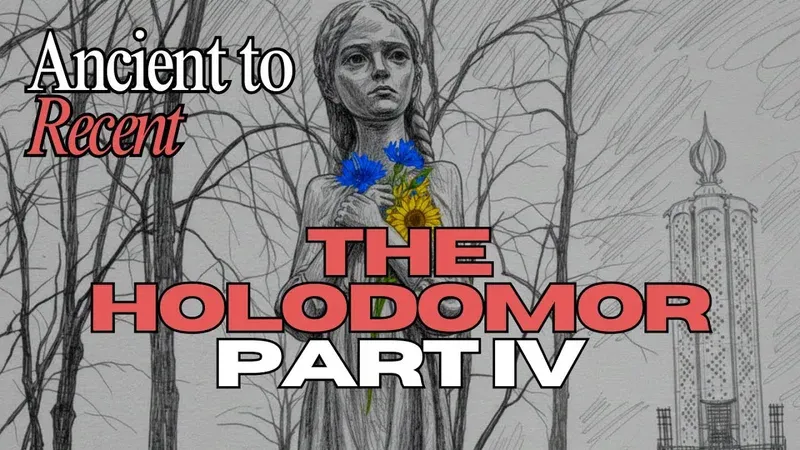
In 1932–33, Ukraine faced one of the deadliest tragedies of the 20th century, the Holodomor. Stalin’s regime seized food, blacklisted entire villages, sealed Ukraine’s borders, and used starvation as a weapon to crush resistance. Millions died as the Soviet state destroyed Ukrainian culture, language, and identity.
In Episode 23, Joseph Parkinson uncovers how the famine was engineered, how the OGPU enforced it, and why the Holodomor stands as a defining crime of the Soviet Union. From grain requisitions to the cultural purges, this episode reveals how Stalin turned Ukraine into a laboratory of terror.
🎧 New episodes every Friday
📲 Follow on Spotify, YouTube & Instagram @AncientToRecent
#Holodomor #UkraineHistory #Stalin #SovietUnion #HistoryPodcast #UkrainianRevolution
Read transcript
This transcript is automatically generated, so it may contain typos and misheard names.
What I saw that morning was inexpressibly horrible. On a battlefield, men die quickly. They fight back. Here I saw people dying in solitude by slow degrees, dying hideously without the excuse of sacrifice for a cause. They've been trapped and left to starve, each in his own home by a political decision made in a far off capital around conference and banquet tables. There was not even the consolation of inevitability to relieve the horror. Viktor Kravanchenko, I choose Freedom, 1946. Not one of them was guilty of anything, but they all belong to a class that was guilty of everything. Ilya Ehenburg 1934 Welcome to Ancient to Recent My name is Joseph Parkinson and today we will be telling the story of the famines of 19321933 inflicted on Ukraine by Stalin and the Soviet Union.
Episodes of Ancient to recent are out every Friday and are available on YouTube, Spotify and Apple Podcasts. In August 1932, famine was reaping a terrible harvest throughout the Soviet Union. As the communist leadership speed through the countryside, encased in their luxury trains on the way to Crimea, Sochi or any of the many places members of the communist elite kept opulent mansions where they would take frequent and long rests, complete with tennis, hiking, swimming, barbecue and long banquets, where the vodka and Georgian wine flowed, where caviar and kebabs were served, the communist apparatchiks would peek through the lace and satin windows. They could see children with swollen stomachs, old women in rags, men collapsed by the side of the road. They could see the fields unsewn, littered with the corpses of peasants who had expired from exhaustion and malnutrition.
Stalin received a constant flow of reports from the OGPU, the Soviet secret police, but also from Communist officials and senior members of the Politburo, the governing body of the Soviet Union, attesting to the failure of collectivization and the severity of the famine. Clement Voroshilov, the People's Commissar for the Defence of the Soviet Union, sent Stalin a letter in August 1932. Across the Strabalpol region, I saw all the fields uncultivated. We were expecting a good harvest, but we didn't get it across Ukraine from my train window. The truth is that it looks less cultivated than the North Caucasus.
Simon Bedouin, the inspector of cavalry for the Red Army, reported to Stalin. Looking at the people from the windows of our train, I see very tired people in old worn clothes, our horses, our skin and bone. Kira Alliluyeva, the niece of Stalin's wife Nadia, also saw starving people. She told her mother, who told Nadia, who told Stalin. She's a child, she makes things up. Stalin snapped. You see, Stalin was fighting his own battle.
Opposition to collectivisation was growing within the ranks of the communist ruling class. Stalin's wife herself had spoken openly of the need for a change of direction, and others were also gathering their strength to oppose Stalin's policies, maybe even to block Stalin's rise to the position of supreme ruler of the Soviet Union. Martian Riotin was a former senior Communist Party boss who'd been expelled from the party in 1934. Right opportunist views.
But he had refused to change his position and kept in contact with those within the Communist Party who shared his opposition to Stalin's policies. In the spring of 1932, he invited fellow opponents of Stalin to come together to write a manifesto appealing for a change to the emerging totalitarian system. The Soviet Union at this point in the early 1930s was a brutal authoritarian state, but that tended to apply to the people, not so much the communist elite themselves. The Soviet Union wasn't quite yet the totalitarian system of control it would become in the mid to late 1930s. And Stalin in the early 30s wasn't all powerful. He was the leading member of the Politburo, the ruling body that governed the Soviet Union.
But he could still be, by a show of hands, removed from his position. So Stalin was desperate to crush any opposition and solidify his grasp on power. Ryukin's manifesto attacked Stalin specifically for the horror of collectivisation, which Ryukin denounced as both violent and competent. Ryukin called for party members to remove Stalin, to rise up, to rally round, to prevent the system that was emerging right in front of them that would soon swallow even them up. And Stalin took this challenge to his authority very seriously. Stalin unleashed the OGPU on Ryukin. Ryukin, his wife, and both of his sons were arrested and shot. Not only was Ryukin suppressed, his manifesto was suppressed as well.
In years to come, having read it or even being aware that it existed would become dangerous. Stalin took this opportunity to clean house. Those even suspected of dissent were haunted down and arrested by the OGPU. Stalin instructed the OGPU to suppress panic mongers and those that he claimed was spreading fake reports of famine in Ukraine. Stalin insisted that the rumours of famine were just the latest tactics that the mythical culacks were using to undermine the Soviet state.
In the summer of 1932 it may have been possible to avert disaster. The Soviet state had considerable food reserves, marked a course for export. But the state could have released food to the peasants and the worst of the disaster could have been avoided. But Stalin did no such thing. Instead, he turned up the pressure. By November 1932, the Soviet planners knew of the extent of the failure of collectivisation. The harvest of the USSR was 40% lower than the year before, and the harvest in Ukraine alone, the most fertile agricultural part of the Soviet Union, was a staggering 60% lower.
In 1932, the USSR exported 3.5000 tonnes of butter and 586 tonnes of bacon from Ukraine alone. In 1933, the number increased to 5433 tonnes of butter and 1037 tonnes of bacon. The USSR continued to export fruit, nuts, eggs, cheese, jam, honey, tinned fish, and tinned meat even as the famine began to set in. Frustrated by their inability to collect enough grain, in 1932 the Soviet government introduced a system of blacklists.
Blacklists were applied across the Soviet Union, but they were applied earlier, more widely and more rigorously in Ukraine than in any other part of the USSR. And unlike in Russia, where blacklists only applied to grain production, in Ukraine it was applied to any industry, including teachers, nurses, and civil servants. These blacklists were not applied to individuals, but instead to collectives, to villages, to collective farms and to sometimes entire districts. Those put on the list would be subject to a range of punishments.
Newspapers published the names of villages and collective farms and the percentage of their grain quota that they had failed to fulfil. Blacklisted villages were banned from purchasing any manufactured or industrial goods. This included things like kerosene and matches, so peasants who did have food would not have the fuel to cook it and would further be punished by being forced to give clothes and tools to the collective farm to make up for being behind on their quotas. Purges followed.
The OGPU focused their attentions on blacklisted areas, singling out the inhabitants for arrest and deportation to the gulag. Hundreds of thousands of Ukrainian peasants will be arrested and deported to Siberia, the Arctic Circle, the Korean border and to Outer Mongolia. There they would face a bleak existence as slave labourers. The blacklists were supposed to encourage the villagers to grow more grain, but they had the opposite effect. Villagers now had no fuel for tractors or feed for their cattle, and many of the most talented farmers were deported or simply executed.
As famine continued to intensify, the OGPU began to worry about a refugee crisis as thousands of starving peasants fled the collective farms. Many peasants try to make their way to the border to escape the country, bringing with them stories of desperate hunger and repression from within the workers paradise. This would be a propaganda disaster for the Soviet Union and bring embarrassment upon the communist cause. The OGPU estimated that in January 1930 / 30,000 people had fled Ukraine between the 15th of December 1932 and the 2nd of February 1933, nearly 95,000 people had fled their homes. Some Ukrainians fled either into ethnically Russian parts of Ukraine or into Russia proper, where they found that there was no famine.
The famine was contained to the ethnically Ukrainian parts of Ukraine. Soviet officials were faced with a mass exodus from Ukraine by starving and terrorised peasants. Train stations became desperate places, overcrowded with people determined to flee the platforms, having to be cleared of those who had fainted and died whilst queuing for the few places to escape from the horror of the famine. But these people were for the most part trapped. Ukrainian collective farms did not issue salaries. Instead of cash, collective farmers were paid in kind, so Ukrainian peasants had no spare money and therefore couldn't purchase train tickets.
Those that could fled into Poland, with many drowning, crossing the fast flowing river Bug. Others were shot by Soviet border guards. So great was the flow of Ukrainians into Poland that the Polish government and the League of Nations set up a permanent Ukrainian refugee Commission to help process, feed and clothe these people. But there was also a mass movement of refugees from the countryside to the cities. The cities were flooded with desperate people.
Long queues formed outside of bread shops. Peasants with no money, often clothed just in rags. Many exhausted by their long journey and now, with winter closing in, banged on the doors of people begging for food. Others simply sat against the side of the street and died. Mothers with skeletal babies, the children staring vacantly into the distance, too hungry to cry, beseeched passersby for any crust of bread or crumb that could help them survive just another day. Some gathered in markets, others by railway stations. Many found their final moments rest in ditches, under trees, by window ledges, and some simply collapsed in the middle of the streets.
Desperate parents abandoned their children and orphanages. That was soon filled and overflowed to capacity. Thinking that the Soviet state would surely care for abandoned children, city authorities had to remove 400 corpses from the streets of Kiev in January 1933 alone. In February it was 518, and just in the 1st 8 days of March, 248 trucks roamed the streets, collecting corpses piled high with their ghastly cargo. Bakeries were broken into.
Militia distributing bread rations were attacked by hungry mobs. The Soviet government became alarmed at this refugee crisis. Not that hundreds of thousands were dying and millions were being driven from their homes. No, that wasn't what concerned them. Rather what they were worried by was that the mass movement of desperate people would carry stories of what they had experienced both internationally and within the Soviet Union.
And this would, in the minds of the Soviet elite, constitute the spreading of anti Soviet propaganda. In January 1933, Stalin, Molotov came up with a solution to this refugee crisis. They wouldn't stop the grain requisition. They wouldn't lower the quota that Ukraine needed to fill. They wouldn't stop the export of food. No, what they would do instead would doom millions of Ukrainians. They sealed the borders. The borders of Ukraine, not just with Poland but with Russia too, were closed off by the OGPU.
Millions of Ukrainians were to simply be left to die. To enforce this system, the Soviet state introduced a new system of internal passports that would be issued by the Soviet government to all Soviet citizens. Any Ukrainian peasant found outside of Ukraine would be arrested and deported back to their place of origin. The right to leave your town, your collective farm, your village was subject to approval by Soviet government officials, and in the case of Ukrainians, they need not apply.
The Soviet state even stopped allowing for the sale of train tickets to ethnic Ukrainians. Roadblocks were set up to trap anyone trying to defy the system, and in February 1933 the OGPU banned the issuing of travel documents to any Ukrainian peasant. The passport system had another effect. It allowed the Soviet state to more clearly, more easily identify people in the cities who weren't city dwellers. OGPU officers could now stop Ukrainians in the streets of Kiev, Odessa, Marion, Paul or Kharkiv, demand that they show their paperwork.
And if their paperwork showed that they weren't from the city, those people could be immediately deported back to their villages or even sent to the gulag. Sometimes Soviet officials didn't even do that. What meagre bread rations were being distributed required the showing of identity papers. Those with documents that identified them as peasants were taken from the lines, put on trucks and driven into the countryside.
The OGPU would sometimes simply drive so far out of the city, drop people off in the middle of nowhere, knowing that the starving people they had just abandoned would be far too weak to be able to return to the cities, and in their March back would simply die. Some peasants, too weak to resist were taken from the major cities to local ravines, where they were simply dumped into mass open graves, even those who were still alive. With Ukraine brought to its knees through mass starvation, now was the perfect time for Stalin to unleash an assault on Ukrainian culture.
Ukrainian newspapers were encouraged to print only in Russian. Books stopped being published in the Ukrainian language. Anyone who had played any role in the process of Ukrainisation in the early 1920's, the brief period where the Soviet state had encouraged Ukrainian identity, was to be purged. Communist Party officials, writers, artists, teachers, professors. Ukrainian culture, viewed by the Bolsheviks as being the culture of peasants, was discouraged and it's place was taken by a Russian culture, the culture of Saint Petersburg and Moscow.
Stalin received reports handed to him by the OGPU of discontent amongst Ukrainian Communist Party members complaining about even outright refusing to implement Soviet policy on the grounds that it was causing a famine. Stalin responded by removing Vlas Chuvar, the leader of the Ukrainian Communist Party, who had complained to him and asked for a change of direction. Communist Party members who had spoken frankly about the realities of famine were accused of being wreckers and were arrested and sent to the Gulag.
Even the Communist Youth League was not spared. Over 18,000 members were expelled for anti Soviet attitudes. The Soviet Communist Party in the early 1920s briefly got over it's deeply chauvinistic attitude towards Ukrainian identity and tried on for size a form of cultural tolerance. One of the ways they manifested that was they tried to appeal to a lot of intellectuals who had fled after the independent Ukrainian state had been crushed by the immense violence of the Bolsheviks in 19/19/2021.
They attracted some of these intellectuals back to Ukraine and encouraged them to engage in cultural and historical research into the Ukrainian language, Ukrainian poetry, Ukrainian literature, Ukrainian history. And the most notable of these was Mihailo Hurefsky. And he had set up a historical institution to research Ukrainian national identity. But in the early 1930's, the window of cultural tolerance was slammed. Shot with an almighty bang by Joseph Stalin and the OGPU, Hurefsky began being harassed by the Soviet secret police. His work was banned and he was sent into exile. Debates were organised where Marxist intellectuals were brought in to criticise and scrutinise his work on Ukrainian national identity and Ukrainian history. And this was attacked as being insufficiently focused on class struggle within Ukrainian society. These debates, of course, were entirely 1 sided. He wasn't even allowed to attend them. They were simply a series of Marxist intellectuals standing in front of a crowd, outlying why they were wrong. When that had been finished, no questions were invited from the floor.
Hareski was expelled from Ukraine and he would die in 1934 under suspicious circumstances. In January 1933, Ukrainian language courses were banned at Ukrainian universities and Ukrainian textbooks were replaced with Russian ones. The education system was thoroughly purged in 1933. Every single regional head of education in Ukraine was dismissed from their position and 4000 Ukrainian teachers were named as class hostile enemies and arrested in 1932 and 33.
The OGPU carried out 200,000 arrests just in Ukraine, and this was aimed overwhelmingly at the professional class and the cultural elite. No institution was spared. 40 members of staff of the Ukrainian National Library were arrested. The Ukrainian Academy of Agricultural Science lost nearly all of its executive committee. The editorial board of the Ukrainian Soviet Encyclopedia, the cinema studio, the Chamber of Weights and Measures, all were purged. 200 Ukrainian plays were banned.
Ukrainian translations of books ceased. The pressure grew so much for some Ukrainian writers and educators that those that weren't arrested were driven to committing suicide. Newspapers that previously had published in Ukrainian switched to Russian. City councils that had conducted their business in Ukrainian were encouraged to change to Russian. Universities ceased teaching in Ukrainian, instead taught in Russian. The campaign against Ukrainian culture extended to the Ukrainian autosuppalacious church.
Between 1931 and 1936, three quarters of churches in Ukraine were closed. Between 1934 and 3769, churches in Kiev alone were demolished. By 1936, there were whole swathes of the Ukrainian countryside where there was not a single Ukrainian church still saying services, even architecture in Ukraine was not safe. Dozens of monuments, including churches, were bulldozed, blown up, razed to the ground or converted, often to being warehouses or stables for horses.
The cultural harvest of the Ukrainian elite, overseen by the OGPU, went on. Mikhailo Pavlenko, director of the Kiev Gallery, was arrested in 1934, and after three years imprisonment, in 1937 he was shot. Federer Kuzobodski, director of the Institute of History and Culture in Kiev, was arrested and in 1938 shot. Pablo Petovsky, an art collector who donated his collection to the Historical Museum in Kiev, was arrested.
His advance age was no protection. He was 81 at the time of his arrest and he would die in the Lubyanka of a heart attack. On December the 15th, 1934, Soviet authorities issued a list of books to be banned. This list would be repeatedly updated to thoroughly purge Ukrainian culture. The Ukrainian dictionary was not safe. A separate Ukrainian dictionary had only recently been published for the first time in hundreds of years. This was now banned.
Those who had published the Ukrainian dictionary were denounced, arrested and executed. Even the Ukrainian alphabet had to be Russified, Sovietised. The Ukrainians have a particular letter equivalent to the letter G in the Roman alphabet that doesn't exist in the Russian alphabet. This letter was now banned. In the winter of 1933, Stalin ordered the grain requisition campaign to be ramped up. Activists were equipped with special long metal rods to allow them to poke and prod into every part of a peasant's property, under floorboards, into chimneys and the flower beds behind walls.
Nowhere was to be safe. Grain requisition squads took everything. Eggs, chicken, potatoes, old vegetables, stale bread. They even took pots of soup that were cooking on the stoves, desperate children crying as their last food was taken away or pushed aside by Communist Party officials. The green requisition squads would vary the time they carried out their raids, sometimes at night, sometimes in the morning. If they interrupted a family of dinner, they would empty the contents of the pot onto the floor just to deprive them of food.
By the logic of the Communist Party, anyone who had food was by definition a kulak. Green squads would sit in the forests on the edges of villages, and they would watch through their binoculars until smoke started to come from chimneys so that they could carry out their raid. Exactly at the moment when families were cooking, peasants were encouraged to inform on each other. Anyone who gave word of others having food would be rewarded with a third of the catch. This had the double impact of increasing the take and also sowing distrust, thus making it harder to organise resistance. Those receiving packages from outside of the district were singled out for raids.
One family survived on shipments of stale bread crumbs from relatives in Leningrad. They were subject to a raid and half of their stale bread was confiscated. Fines were also a common form of punishment. Those who did not fill their grain quota were fined five times the value of the grain they failed to provide. Those with relatives abroad were assumed to be receiving money. The houses would be raided. They'd be beaten, even tortured in their own home, often parents humiliated in front of their children. Sometimes, if communist activists couldn't carry all the food away, what was left They would destroy, pouring acid on fish and grain to make it inedible. Desperate peasants who hadn't eaten in days still filled their stomachs with this desiccated food, with disastrous effects. To ensure complete control of food supplies, communist officials broke all the mill stones except for the one at the collective farm.
So anyone who had even a tiny bit of grain couldn't mill it to make flour to bake bread. Being alive itself became grounds for suspicion. If you're alive, then you have food. If you had food, then you weren't contributing that to the state quota. If you weren't contributing to the state quota, you were a kulak. Mihaili Balanovski, a peasant in the Checkasi province, after having his house ransacked by communist officials, was interrogated.
The officials demanded to know how is it possible that none of your family have yet died? The Ukrainian Communist Party began a drive to draft more people into grain requisition squads. More manpower was needed, so the Communist Party thought to meet the quota. If they were falling short, then surely a redoubling of efforts was required. Nothing was impossible with Bolshevik determination. Nothing could not be achieved if they simply closed their ears to the wails and the screams of the starving women and children. To be a Bolshevik was to be hard, was to be tough, was to get things done, was to do what had to be done to build the workers paradise.
On the 11th of November 1932, the Ukrainian Communist Party announced that it was seeking to set up a further 1100 new activist brigades by the 1st of December. They would sweep the countryside clean of food. How did those carrying out these grim tasks justify to themselves what they were doing? Many had come from the cities and they knew or cared little for the peasants. The Soviet press had been full of stories about lazy, selfish peasants wilfully starving the cities.
The communist activist was subject to relentless propaganda. They were told to think of the peasants as second class citizens, class enemies, or even as subhumans. Vasili Grossman, who took part in the grain confiscations, recalls in Everything Flows 1961 being told by fellow communists, they're not people, they're kulak. You see, Bolshevik ideology had no place for the peasants and their backward ways, nor was there room for pity for the class enemies that were the culacks. But most who took part in the grain confiscation were not ideological Bolsheviks fired by zeal. They were normal people.
They were local people. They were very often taking grain from their own neighbors, people that they had known all their lives and that they were now condemning to death. The Ukrainian Communist Party began to worry that people would be reluctant to effectively murder their own neighbors, family and friends. So what the Ukrainian Communist Party did was it sent local collaborators to raid different villages, one or two villages away, not so close to their own, so that those bonds of friendship and memory wouldn't be quite so tight. Some local activists refused to collaborate. Those that did all too often were deported themselves. But the vast majority went along, driven by desperation, by starvation.
Collaboration was the only way to survive. And even then, many people who did collaborate only prolonged the inevitable. They couldn't prevent it. Many people who went along still ended up starving to death. Communist Party members, however, were protected. They and their families had special ration cards that allowed them more and better quality food. There were also special shops just for Communist Party members that were off limits to the starving masses.
Hunger does strange things to the human body. First the body consumes it's stores of glucose. Feelings of extreme hunger set in and a person becomes obsessed with thoughts of food. Then the body consumes it's fat stores. Then the body eats it's protein, it's tissues and muscle. Skin becomes thin, bellies and legs swollen. As the body retains water, the victim becomes susceptible to diseases such as scurvy and diphtheria, and a range of rashes and skin lesions.
Survivors remember their family members fading away, becoming translucent. Communist Party activists speaking years later recount seeing children with yellow, paper thin skin stretched over Bony frames, their bellies swollen, barely able to hold their heads up, with faces that looks like those of old men. Skin broke under the slightest pressure. Foul smelling liquids oozed out of open wounds. Some children became so skeletal that it was possible to see their heart beating through their rib cage. In the final stages, the victim descends into a drowsy, dreamlike state that may last for up to a week until eventually their heart gives out. Some died after prolonged struggle. Some died suddenly, dropping to the floor, passing away in the middle of the street.
Teachers in Ukrainian schools would, after dismissing a class for the day, go through the desks collecting the bodies of children who'd passed away during the lessons. Some died whilst eating. During the long period of starvation, the body will lose the ability to actually digest food, so suddenly consuming food will become a life threatening situation in itself. Starvation doesn't just ravage the body, it attacks the mind. Starving people struggle to concentrate. They hallucinate.
Their personalities morph and change. Feelings of kindness and compassion turn to anger, jealousy, and selfishness. People stole from their friends, from their spouses, even from their own children. 1 Mother stole the food her children was given at a kindergarten, leaving them to die. People had to choose between feeding themselves and their family. Driven insane by hunger, many chose to try and save themselves. Others, summoning the last reserves of human feelings, sacrificed themselves to save their loved ones. Trust evaporated.
Empathy disappeared. Cruelty became common. Morality itself disintegrated. One young boy teased other starving children with a loaf of bread and some jam that his family had finally been able to get for him. His former classmates beat him to death with stones a grain lifts. Children would gather to collect kernels of grain that had spilled from burst sacks. They would throw themselves at any morsel that fell on the floor, only to be kicked, cudgeled and punched by OGPU troops. These children, weakened by hunger, would die in the desperate press for food.
Some parents killed their own children, smothering them, strangling them, anything to end the suffering. People feared their neighbors, their friends. People feared theft, and they took to violence to protect their last morsels of food. Apathy and hopelessness spread through our society. People became dull to the pain, incapable of thinking of anything other than their next meal. The normal rhythms of life simply ended. Laughter, love, births, weddings, holy days disappeared. People stopped attending funerals, even of their closest kin.
What was the point anymore? The dead no longer suffered. The living envied the dead. Between February and June 1933, the OGPU removed from the streets of Kharkiv alone 2785 corpses and buried them in local fields. They kept the location of these secret mass graves hidden. The corpses would be collected at night to be dumped where no one could find them. To even know where these graves were would in years to come run the risk of reprisals.
The Soviet government denied any suggestion that there was any famine in the Ukraine and they went to great lengths to cover their tracks. So determined was the Soviet state to keep secret the scale of the disaster that anyone who had first hand experience of what had happened became a potential threat to state security. In 1938, all of the staff of the Lukianskiev ceremony in Kiev, people who'd been responsible for burying the dead and therefore knew just how great the catastrophe was, were arrested by the NKVD for counter revolutionary activities.
They knew too much. The entire staff, every one of them, was put on trial and shot. By the spring of 1933, cannibalism was becoming widespread in Ukraine. There were reports of people being arrested for eating their own children. Children in villages started disappearing. This further sowed suspicion, as even in this moment of terror, cannibalism was still considered beyond the pale. The disappearance of children was not confined just to the countryside.
In the city, parents took to taking their children to school and to accompanying them everywhere they went to prevent them from being kidnapped and eaten. By March 1933, the OGPU were receiving 10 reports of cannibalism per day. The OGPU in Vignetza received 6 reports of parents eating their children in one month. In one report, the OGPU in Kiev stated that there had been 69 cases of cannibalism between January and March.
But the report also knows that the OGPU didn't actually believe this, because they estimated that the figures were vastly higher. Kaganovich, the OGPU, the bosses of the Ukrainian Communist Party, and the officials in Moscow were all aware that cannibalism was sweeping Ukraine. They all knew just how desperate the situation was. And what did they do? They did nothing. People ate anything to survive. Moss, leaves, acorn, the bark of trees, insects, rats, squirrels, anything that could fill their stomach.
People made soup from nettles. People ate weeds, grass, rotten potatoes. People boiled belts and shoes to eat the leather. Some survived by chance, Some survived by cruelty. Some survived by acts of kindness from strangers. Some were able to get work at collective farms where they would be served a thin gruel in return for their labour. Some were saved by the charity of their Jewish neighbors. Jews were spared from being labeled as culacks because Jews in the Czarist empire had been forbidden from accumulating property.
And so, by a bizarre twist of fate, Jewish people were, for once in history, spared persecution. The famine reached its peak in the spring of 1933. There's a range of estimates as to how many people lost their lives. Some say, too. Some estimates are as high as 10 million people. The opening of the Kremlin archives allowed researchers in the 1990s access to secret Soviet documentation that would give us a better idea of the true figures, A-Team of Ukrainian demographers have concluded in extensive research.
That points to a figure of 3.9 million excess deaths. That's deaths of those that were directly tied to the famines and also a decline in population due to a decline in the birth rate. Modern research also sheds light onto how much the famine was inflicted directly on Ukraine. Though there was famine throughout the Soviet Union, the death rate increased in Russia by only 3% between 1932 and 33, but the figure for Ukraine is a staggering 14.9% increase in deaths.
In may of 1933, Stalin finally agreed to allow food aid into Ukraine. The harvest arrived. The Soviet government began switching it's tactics. Instead of all food being confiscated, the Soviet state set a percentage of food that would be confiscated, and what was left after that could be kept by the peasants. Manpower was rushed to the countryside to bring in the harvest, and the Ukrainian Communist Party decided to let up the pressure being exerted on the peasants.
The mass arrests and deportations slowed down. Stanislav Koisa, the general secretary of the Ukrainian Communist Party, brought a letter to Stalin praising the harvest and saying that though there had been a significant improvement in the harvest, there had been no such thing. Maybe some food aid could be allowed into Ukraine, Stalin relented. Ukraine's grain quota for 1933 was reduced by 415,000 tonnes. A few weeks later a further reduction of 500,000 tonnes was agreed.
There was a change in tone from the Ukrainian Communist Party. Instead of constantly lashing out against Ukrainian nationalism, there was instead a tepid admission that some mistakes may have occurred. None of them of course attributed to Comrade Stalin, and of course none of this done on purpose, but rather the blame fell entirely on the Ukrainian Communist Party and it's local leaders. Moscow and Stalin were absolved. There was some further loosening by Moscow in the spring of 1934. No vegetables were requisitioned at all. But all the while collectivization continued at pace.
Hundreds of thousands of people joined the collective farms and the last privately owned peasant land passed into the hands of the state. This time there was no need for force. This time the Ukrainian peasants didn't have to be bullied or beaten as they had been in the late 1920's. The Ukrainian peasants starved, terrorized, traumatized, accepted their fate, surrendered their land, and submitted to Soviet power. They offered no resistance. The long years of fierce Ukrainian resistance to Moscow's rule, the determination to stand their ground, to hold onto their identity, to assert their culture, had been starved out of the Ukrainian people.
And that was the point. That was the objective all along. The Soviet Union officially denied the hoarder more, and they were not alone. Throughout the West, at universities and newspapers, in country clubs and cocktail parties, from Paris to London and New York, the comfortable, well heeled Communist sympathizers, some of them devoted agents of the Soviet states, such as Kim Philby and Guy Burgess of the Cambridge spy ring, others simply useful idiots, ferociously peddled Soviet propaganda. Reports that escape the USSR of the sheer scale of the loss of life was systematically downplayed, dismissed, and those attempting to tell the truth was smeared. Within the Soviet Union itself, more blunt means of suppression were used.
In 1937, the Soviet Statistic Office produced its Census of the Soviet Population and it found that the Soviet population stood 162 million people, 8 million short of the expected figure of 170. Stalin responded in typical Bolshevik fashion. The head of the Soviet Census Bureau, Ivan Cravall, was arrested and shot as a counter revolutionary. His team that had helped him compile the figures and therefore knew the truth, were arrested and shot. Mikhailo Abedenko, the Kiev editor of the magazine Soviet Statistics, who'd also seen the figures, met a similar fate. He was arrested and he was shot.
The hallotomor was not a natural disaster. The hallotomor was not an accident. It wasn't a mistake. It wasn't an unfortunate occurrence. It was a classic example of what we would today describe as a genocide. It was a policy conceived of by Joseph Stalin and inflicted on the Ukrainian people to break them, to render them passive, to make the people of Ukraine malleable, to facilitate the Soviet government's desire to reshape Ukraine, to Sovietize it, to Russify it, to extinguish the flame of Ukrainian identity.
The Ukrainian national anthem is called. Ukraine's glory and freedom has not yet perished. And Ukraine did not perish. Ukraine survived. The Hallotomour, for all it's cruelty and pointless horror, failed. The Ukrainian people were not crushed. They were not defeated, they did not disappear and become perfect little Russians. They clung to their culture, their language, their identity, and one day the Ukrainian people, they would get their revenge. In 1991, as the Soviet empire, the prison of nations, came apart at the seams, the then Soviet premier, Mikhail Gorbachev gathered together the leaders of Russia, Belarus and Ukraine to try and agree a new treaty to save the decrepit Soviet state.
He put the proposal for a new federal union to these three States and it was Ukraine that said no. The empire of blood and cruelty and misery built by Lenin, fortified by Stalin, and maintained by the Checker, the OGPU, the NKVD and the KGB was ended and it was ended by the people of Ukraine. Thank you for listening to Ancient Recent, My name is Joseph Parkinson. Episodes of Ancient Recent are out every Friday and are available on YouTube, Spotify and Apple Podcast.