
#10
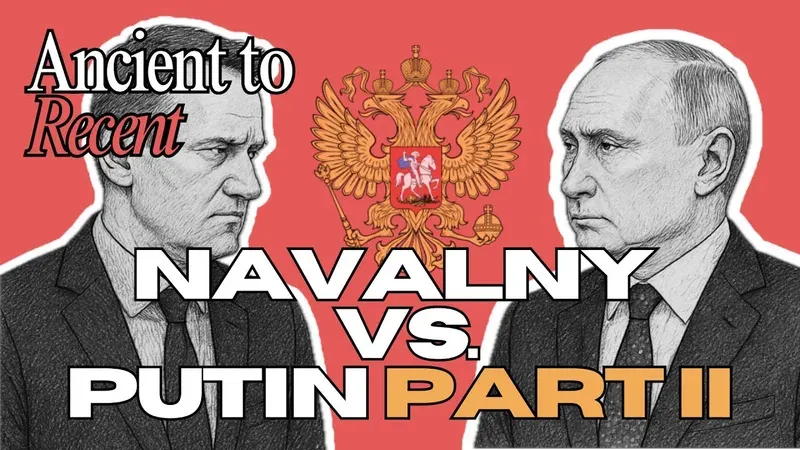
Navalny vs. Putin — Part 2
8 August 2025 · 1 hr 1 min · Season 1
 Watch on YouTube →
0:001:01:36
Also on
Rate the show
Ratings are how new listeners find the show. It takes a minute and it makes a real difference.
In Part II of Ancient to Recent’s deep dive, Alexei Navalny takes his fight against Vladimir Putin to the streets, the courts, and the ballot box. From rigged Moscow elections to uncovering multi-million dollar corruption at the Kremlin’s core, discover how Navalny became Putin’s most dangerous opponent and the ruthless tactics used to bring him down.
🎧 New episodes every Friday, 8PM CET
📲 Follow on Spotify, YouTube & Instagram @AncientToRecent
Sponsored by World of Whisky – Some things only get better with age. With World of Whisky, you can own a share of Scotland’s most iconic export. You must be over 18. Investing carries risks. Drink responsibly. Invest responsibly. This is not financial advice.
Want to check out World of Whiskey? Click here, https://tr.ee/ZaBoYD
#sponsored #publication
Read transcript
This transcript is automatically generated, so it may contain typos and misheard names.
Under Vladimir Putin, the Russian state is all knowing, all seeing, maybe even all powerful. Or at least that's what you're supposed to believe. That is the image that Putin and his fellow checkists project, both internally to dissidents and externally to opponents. As a former KGB Colonel, Putin knows all the dark arts of his chosen vocation. The FSB, the successor organization to the KGB, employs legions of agents to monitor, observe documents, to harass, tap phones, bribe, intimidate any opponent not of the Russian nation, not of the Russian people. For they are the greatest enemies. They are the most deadly foe of the Russian people. But instead of the Russian state of Putin and Shoigin and Lavrov, of the people who have been running Russia for 25 years. The majority of the time the measures used against dissidents and opponents of the kleptocracy of which Vladimir Putin is the Don Corleone, are fairly modest.
Harassment, intimidation, corruption. But the FSB is like a coiled snake stalking it's prey. And at any moment it can spring striking lethally, destroying the lives of its chosen victims. At any moment it can engage in active measures, as the gentleman of the SFB describe it, where intimidation and psychological pressure becomes something more sinister, something more permanent, something more lethal. Welcome to ancient recent My name is Joseph Parkinson. Before we dive into today's episode on Alexei Navalny, a quick word from our sponsor, World of Whiskey. Some things only get better with age. A fine single malt is one of them. That's part of the reason Whiskey cask Investing holds such timeless appeal.
With World of Whiskey, you can own a share of Scotland's most iconic export. You'll receive full certification of ownership, delivery orders and access to rare expressions few ever get to taste. And in the UK, there's no capital gains tax when you sell. This isn't financial advice. Investing carries risks and you must be over 18. Drink responsibly. Invest responsibly. To learn more, you can click the link on my bio and go to worldofwhiskey.co.uk.
Ivan Rubikin was the former leader of the Duma, the Russian state parliament. In 2004, he was selected to be the candidate for the Russian Liberal Party. This was at a time when the idea of some sort of free election in Russia wasn't entirely absurd. Of course, by 2004 we were some way removed from the last even vaguely free election, which had happened in really the end of the Soviet Union. From 1986 onwards, elections in Russia were increasingly rigged after the Russian oligarchs had a scare at the thought of the Communist Party returning to power.
But in 2004, Rubicon, who's a popular, well spoken figure, it seemed that he might actually be able to do something, maybe 'cause an upset, maybe make things a little bit uncomfortable for Putin. And he started talking about things that no one was meant to speak about. He highlighted the September 1999 apartment bombings and he started asking some awkward questions. Were these attacks really the fault of the Chechens?
Wasn't this all just a little bit convenient? As you'll remember, in the first episode, we talked about the series of apartment bombings that ripped through Moscow in various other cities in September 1999, which Putin, who was then the head of the FSB before his appointment, or should I say coronation as the President of Russia, the successor of Boris Yeltsin, blamed on Chechen terrorists and unleashed massive violence and repression against the Chechen people. One Russian parliamentarian who was connected to Putin and the ultra nationalist right made a bit of a faux pas. He stood up in the State Duma, the Russian state parliament, and he spoke of the recent bombing in a city where 12 people had been killed in a terrible Chechen attack. The only problem was it was 3 days before the bombing he had let the cat out of the back.
He had let the secret slip. And so ever since that point, there had been these continuous questions as to whether this was something that had been carried out by Chechens or by the FSB themselves to help garner support for Putin, to help rally everyone round the flag and make Putin seem like a strong, tough leader who is taking the fight to fundamentalist Islamic terrorists. After Rubicon raised these issues in 2004, he made a trip to Kiev to meet with a representative of the Chechens. At the time, Ukraine was very much under the influence of Russia.
It was before Ukraine had been able to throw off the controlling sway of Russian power. He takes a drink. All of a sudden he starts feeling woozy, passes out, and he wakes up four days later. After waking up, he is shown a video of himself performing what he describes as revolting acts, and he is told that if he persists in his campaign against Putin, then this video will be shared publicly for everyone to see. He promptly decides to withdraw from the race and no longer speak publicly about the September 1999 apartment bombings or criticize Vladimir Putin.
He had been silenced. One of the most. Persistent rumours that has swirled around Vladimir Putin is that he is a paedophile. This is something that many Kremlin insiders have seemed to give a nod and a wink towards, and it's an accusation that never quite seems to go away. Alexander Litvinenko was a K GB agent turned Western defector who became a very public critic of Putin. And he began writing A blog in which he would air publicly The Dirty laundry and embarrassing claims and accusations against Vladimir Putin. And one of the claims that he persistently made was that Putin was sexually attracted to children, that he was a paedophile.
That Putin had been kept in Leningrad by the KGB after they found out that he was a paedophile and had avoided giving him a more prestigious foreign posting and prevented him from being promoted higher up than the fairly middling rank of Colonel precisely because of his sexual fondness for children. It was seen that by sending him to somewhere abroad that he could engage in activities that the KGB might end up finding incredibly embarrassing.
And so even when Putin is sent abroad, he isn't sent to one of the really. And so even and so even when Putin isn't abroad, he isn't sent to Washington or New York or London or Paris or somewhere. That's a real heart of the action for the KGB. He's sent to Dresden, which is a relative backwater in the Grand Theatre of the Cold War. Now it must be noted that Litvinenko was never able to produce any hard evidence to back up this claim.
He cited other KGB defectors as sources, but was never able to produce anything truly concrete. But it is also worth noting that shortly after making these accusations, he was poisoned in London and killed. And there's two other people, Antonio Russo and Artyom Borovich, who were both Russian journalists who were said to be working on the Putin is a paedophile story when both of them were also killed mysteriously in the year 2000. Now, there's no way of knowing whether Putin truly is a sexual threat to children.
We know he's a threat to children in general because he has killed so many of them in air strikes in Syria and Ukraine and various other places, but we don't know whether he actually is a sexual threat to them. There's another rumour about Putin's private life that never seems to quite go away, and that is that he is bisexual. Now, I'm not for a second saying there's any moral equivalence between being bisexual and being a paedophile. There is absolutely nothing wrong with being bisexual. However.
Putin, who projects this image of himself as the alpha male, as this Uber macho bastion of Christian values and heterosexuality, is surprisingly concerned and sensitive to the accusation that he is bisexual. Paul Joyle is an American security contractor who has worked extensively in Russia, and he gave an interview to NBC in which he repeated the claim that Putin is bisexual. Now, why would anyone care about this? Why would this elicit any reaction from a global leader? Nonetheless, however, this is Vladimir Putin we're talking about, and he seems to be unbelievably sensitive to the merest suggestion that he might not be the most heterosexual person who has ever existed in all time. Paul Joyle was walking home in 2007. Near his home in Washington.
He was accosted by two men, assaulted, beaten up, shot in the leg. Then they placed a gun to his head to execute him and the gun jammed. The two men fled the scene and were never arrested. Now, there's all sorts of reasons why someone could be attacked on the streets of Washington. However, they didn't try and steal anything from him. But there seems to be a running theme here that as soon as people criticize Vladimir Putin. They just all of a sudden become incredibly unlucky and subject to all sorts of unforeseen, entirely unrelated coincidences that befall them.
Tragically. This hypersensitivity to criticism would make the challenge of Alexei Navalny unbearable for Putin and for the people around him. In February 2012, Alexei Navalny found. His anti corruption foundation. He tries to get people to sign up to sponsor his organization, and his organization is not a political organization. It's not trying to overthrow the government. It's not campaigning for the election of 1 figure or party, or the removal from government of anyone. The purpose of the organization is to simply campaign against corruption, and officially speaking, corruption is illegal in Russia.
So what's the problem then? Why would anyone in power have any objection to the existence of an organization that is simply campaigning to make sure that the laws enacted by Vladimir Putin, passed by Vladimir Putin, enforced by Vladimir Putin, officially speaking anyway, that officially speaking, Putin and his Confederates in the United Russia party and also in the Russian State Duma all say that they are in favour of that. They all say publicly that they are against corruption. There exists a very, very active institution within Russia, the public prosecutions officer, that is constantly prosecuting people for corruption.
It's just very interesting that those people always happen to be opponents of Vladimir Putin, that as soon as they voice any criticism of him, then all of a sudden their corruption becomes a problem. Navalny sets up this independent body that surely should face no obstacles at all. Why would the state want to prevent its own laws from being enforced? But very few people are willing to be sponsors. He is able to get 16 people, public officials, intellectuals, businessmen who are willing to sign on the dotted line to say yes, we are sponsors of this independent organization that is campaigning against corruption.
Maybe some of those people were naive, maybe they were brave, maybe they were both. As soon as this institution is created, these people become international celebrities. They're on the front cover of every newspaper in Russia. They're immediately recognisable. Walking down the street. They have been willing to put their head above the parapet and say we put our name to a campaign against corruption. As soon as this organization is founded, the state media in Russia goes after these people again, people who are simply saying that the laws of the Russian Federation that exist against corruption must be enforced. And yet, for simply stating this, for saying that they want to support the law, they are smeared and slandered across every newspaper in the country.
They are agents of the CIA, of MI 5, of Mossad, of conspiracies with dark sinister forces to bring down the Russian state and destroy the Russian people and pollute Russian culture. Why should this be? What is the problem here? They're simply saying the laws of the Russian Federation should be applied, but this causes a hysterical reaction from the state-run media. Immediately these 16 people, their lives become much harder. They are fired from their jobs.
Loans that they owe to the banks are immediately called in. Some of these people are international businessmen and they travel abroad. All of a sudden. Going in and out of Russia is an arduous process. When they pass through passport control, it takes hours. Every page of their passport is checked and stamped. Extensive questions. What is the purpose of your visit to France, to the United States, America? Who will you be meeting with when you get there?
They find that they are all of a sudden being followed. The same car start appearing in their rear view mirrors. The same people start following them down the streets, sitting opposite them, watching and observing them. In the coffee shop, in the library, in the cafe. There, their flats are bugged and for many of them the pressure becomes so intense that they have to flee the country. By this point, Navalny now finds that he is being constantly followed. He can't go to the local.
Coffee shop without the same policeman being SAT 2 tables away. Anyone that Navalny meets is immediately photographed and their information is sent to the FSB. And again, the point I want to hammer home is that the institution that Navalny has founded is an apolitical institution that is campaigning not for the overthrow of Vladimir Putin, but simply so that the laws that exist that have been passed by the Russian government on corruption are applied.
That is all he is campaigning for. One of the things that's fascinating about Vladimir Putin is his craving for legitimacy. He both wants to be a tyrant, A dictator, an autocrat, but also to be part of the club. He wants to be part of the Davos crowd. He wants to be accepted in the world of high power and high finance as an illegitimate ruler. And that gives him this yearning, this need for legal formalities. You see, before Putin destroys someone, he has to bring them low.
It's not enough to simply kill someone like Navalny. He could do that anytime he wanted. He could have Navalny shot dead in the street. But that would make Navalny into a symbol, into a hero, into a martyr. It would canonize Navalny. What Putin needs to do first is to bring his enemies low. He needs to use courts and judges and the appearance the institutions of a law abiding formal legal system to blackened the name, tarnish the reputation of his enemies so he can then destroy them. It's only when they have no hope of being seen as symbols he can then have them killed.
One of the things that Putin desperately wanted to do was to show that Navalny was not popular. That he was a fringe crazy figure that no one in Russia really cared about. That Putin was the real symbol of Russia. He was the real symbol of the Russian soul, of the Russian everyday man. That Putin cared about the day-to-day issues that affect normal Russians. And Navalny is just as lawyer with his Western liberal friends prattling on this rubbish about human rights that no one possibly cares about that is so alien to the Russian soul. So to prove how out of touch and irrelevant Navalny was, Putin allowed Navalny to run to be mayor of Moscow in 2013. The idea here is that Navalny will run, he will be defeated. And then Putin can say, look, Navalny has no real power, has no real support within Russia.
He's a nobody. But as with all things Putin. Never leaves anything to chance, so he allows Navalny to run to be mayor of Moscow. At the same time, Navalny and his Anti corruption foundation had started working with a liberal politician called Nikita Belich. Nikita Belich was the governor of the Kirov Obelast, which is 500 miles away from Moscow thereabouts, and Bellich had asked Navalny to start investigating corruption that was occurring within local government contracts.
Specifically investigating one company called the Kirovlev Timber Company, because it was believed that there was a lot of illegal logging that was taking place within the area and the timber was then being stolen and sold and kept off the books. So Navalny begins investigating the embezzlement and this is seen as an opportunity by Putin to have Navalny himself arrested and accused of the very crime that Navalny is actually investigating himself. He's arrested and accused of embezzlement. Now, if he is convicted, Navalny will face A10 year prison sentence and according to the laws of the Russian Federation, he will be banned from running for public office. It's around this time that Dmitry Medvedev, who was briefly serving as the puppet president of Russia whilst the real power was held by Putin, who is the Prime Minister at the time, decided to sack the mayor of Moscow. Medvedev appoints a new mayor who's called Sergei Sobnaya and he's appointed on A5 year term.
Now this causes outrage in Moscow. One of the most high-ranking officials within the Russian state, who holds a position which is officially supposed to be selected by elections, has just been removed and replaced by someone else from the ruling party without even the pretence of any legal formality. There is widespread protests in Moscow, and this Spooks Putin and Medvedev. What Putin and Medvedev decide to do is they decide to announce that there will indeed be elections for the position of the mayor of Moscow. And this is seen as a great opportunity for Navalny. He can run, he can challenge the United Russian Party, he can challenge Putin and he can take up a position from which he can bring his anti corruption campaign to the entire nation. In order to become a candidate, you are acquired 70,000 signatures from the general public or you have to be selected by two political parties and get the signature of 110 councillors throughout Moscow. Now the reason the bar is so high is to simply prevent anyone who doesn't have the official approval of the powers that be of Putin and Medvedev to actually run. To make sure that the system is a closed shop where only people who are tame candidates can run against Putin and his chosen supporters.
But Putin decides to allow Navalny to run at the very same time as Navalny is on trial for embezzlement. Throughout the entire campaign, Navalny is constantly having to take time out to attend court proceedings, being prosecuted for an absolutely ridiculous charge. The court proceedings are covered as if it's the Russian version of the OJ trial, day in, day out about the crimes and the sleaze and the lies that Navalny has engaged in.
All of this is designed to blacken Navalny's image. Navalny is denied the opportunity to bring witnesses, denied opportunity to ask the prosecution any questions. It is a total sham. It's a kangaroo court where the prosecution is given complete license to do as they see fit and Navalny is not allowed to defend himself in any meaningful way. Navalny is given a five year prison sentence. This causes widespread protests throughout Moscow yet again, and it also causes panic amongst the prosecution because they realise that they have again made Navalny an even bigger star. They're trying to use legal means to discredit Navalny, but it's so obviously fraudulent.
It's so obviously fake and a sham and a con that no one is falling for this. So what the prosecution does is it brings Navalny back into court and the prosecution gets Navalny released on bail. He will not actually face any prison time. The prosecution can then argue. Putin can then argue that Navalny has been convicted of a crime, therefore denying him the right to hold public office. But he's not actually being sent to prison.
Navalny decides that he's still going to run, he's still going to take part in the election because the law says that he can still be elected. He just can't take public office. So he's going to dare Putin, dare him to allow Navalny to win the mayoral election and then strip him of the position of mayor of Moscow. One of the things about Putin is that despite his efforts to present himself as a conniving, manipulative genius, Putin is actually just a street thug. He's just a dumb criminal.
He's not capable of thinking four or five steps ahead. And so again and again, as he tries to bring Navalny down, he simply raises him up. Navalny's team start to investigate Sergei Subnaiya, the United Russian candidate for the mayoralty of Moscow. And they start by asking very simple questions. In Russia, the salaries of public officials are made public. You can look up how much it is exactly. The mayor is paid. The head of the prosecution services is paid. This is supposed to give the appearance of transparency. But the problem then is there is a glaring contrast between what the mayor of Moscow is officially being paid and the fantastically opulent life of luxury and wealth that he leads. So Sergei Sabnaya, his daughter, had a 308 square metre apartment in a swanky district in downtown Moscow. The value of this apartment was 6 times what Sergei Sabnaya had earned in the previous ten years. How could his daughter afford a luxurious apartment when she was in her early 20s in one of the most expensive parts of one of the most expensive cities in the world? Another daughter of the mayor of Moscow had a 3.5 million U.S. dollar flat in the heart of one of the most expensive districts within Saint Petersburg.
Navalny's team very simply asked the question, how is it that the children of a moderately paid public servant are able to afford these things? Sobnya's total salary, which was incredibly high by Russian standards, over the previous ten years was 814,000 U.S. dollars and yet just one of his daughters had a flat for 3.5 million U.S. dollars. The Navalny team start doing some digging and they find out that one of the daughters of the Mayor of Moscow is one of the founders of a building contracting firm that does refurbishments of government buildings and has a string of fantastically lucrative refurbishing contracts that her little known company has been able to win the tendering for despite facing competition from other major construction companies that have been in operation for decades in Usher.
And that all of her government contracts all happened to be in places where her father had served previously as the mayor or governor. What a staggering coincidence. What incredible luck that this young entrepreneurial lady just seems to have had that her newly founded construction company has just out of the blue one these incredibly expensive elaborate lucrative contracts again and again for one deal after another to redevelop government buildings in areas where her father just happens to have been the decision maker.
What an incredible coincidence when the Navalny team and the few remaining opposition journalists asked the government to explain what the tendering process was and how it was that a virtually unknown company had been able to win so many fabulously lucrative, fabulously profitable contracts with the Russian state. What was the reason that this has happened? When they asked these questions, no answer was forthcoming. Now, in Russia, with its appearance of democracy, with its formality of a legal system, the very fact that Navalny was asking these questions, which are perfectly legitimate questions that would be reasonably asked in any serious democracy, led to an eruption of criticism. Not of Sergei Sabnaya, the United Russian Party, or the Russian government.
Not directed against the people who'd embezzled millions and millions of U.S. dollars, hundreds of millions of roubles. No, not against them, but directed against Alexei Navalny, the tame opposition parties that exist in Russia to give the Russian system the appearance of democracy. Said not a word about the flagrant looting of the Russian state coffers and the stealing from Russian people. Instead, accused Navalny of punching below the about how dare he ask these questions? Because again, the opposition parties that exist within Russia do not exist to oppose the government, they exist to oppose the opposition.
The Public Prosecution Office immediately began taking strenuous actions against Alexei Navalny. His offices were raided, his computers were stolen, his files were confiscated. Because in Russia the guilty make the laws and the innocent are sent to prison. When the elections took place, Alexei Navalny got 27% and Sergei Sobnaya got 51%. The election was obviously rigged and it was fascinating that in all of the polling stations where there were international observers, Nova only 1. And in all of the polling stations where there were no international observers, Sub Naya piled the votes high. Before we dive back into today's episode, just a quick word from our sponsor, World of Whiskey.
Some things only get better with age, and a fine single malt is one of them. That's part of the reason why Whiskey Cask Investment holds such timeless appeal. With World of Whiskey, you can own a share of Scotland's most iconic export. You'll receive full certification of ownership, delivery orders and access to rare expressions few ever get to taste. And in the UK, there's no capital gain tax when you sell. This isn't financial advice. Investing carries risks and you must be 18 or over. Shrink responsibly and invest responsibly. To learn more, click the link on my bio and heads worldofwhiskey.co.uk.
Under Vladimir Putin, the Russian state has gone to great lengths to finance both the far right and the far left across the world. The ideology of the Russian state is nihilism, is postmodernism. The Russian state doesn't have the same problem that the Soviet Union had in the Cold War. The Soviet Union criticised capitalism, but at the same time had the inconvenience of having to argue in favour of communism. And communism was so obviously rubbish that it always made the argument somewhat more difficult. But in the post modern era, the only thing the Russian state needs to do is to argue that human rights, democracy, the rule of law, free speech, these things are a sham. That every system is corrupt.
That these ideas, these lofty principles are really just a cover for power. And by promoting both the far left and the far right, the most extreme voices in every conversation, whether it's over immigration or trans rights or whatever issue, their objective is to make the democratic world seem anarchic, to seem unstable, to seem absurd, and to then be able to say to their own people, look, this is what happens when you live in a democracy. You end up in this circus.
And to contrast that with what exists in Russia, which of course is impoverished, corrupt, dishonest, but is at least stable, that is the objective of Russian disinformation and Russian propaganda. That is the objective of the efforts of the Russian state. And it's for that reason that the Russian state will pour money into Alternative for Deutschland in Germany and also into the German far left. D Linker will give money to Marine Le Pen on the far right.
At the same time, we'll finance candidates like Mehlen Shawn on the far left. To create anarchy, to hollow out the centre of democratic societies and make everything a pitiless conflict. Fascists on one side, communists on the other, with no alternative. Of all the countries that Russia has sought to exert the greatest influence, to destroy the democratic institutions, to thwart any hope of the emergence of a rules based liberal, democratic and free society, Ukraine holds pride of place.
Ukraine is the Near East for the Russian state. Ukraine has a special place in the history, in the ideology that is promoted by the Kremlin. And it is in Ukraine that the Kremlin has gone to the greatest lengths to destroy democracy and the rule of law. And if there's one man who is the face of the Kremlin's efforts to subvert Ukrainian democracy, it would be former Ukrainian President Viktor Yanukovych. Yanukovych was elected in 2010 and he was elected on a quizzical platform, both standing up for the rights of Russian speakers in Ukraine, whilst also promoting further integration of Ukraine into the European Union and the European economic system.
However, in 2013, one week before he was due to announce closer integration with the European Union, he ditched the policy and he instead performed 180° about face, where he announced closer economic ties to Russia. This led to mass demonstrations. On the 20th of February 2014, police snipers shot dead 100 protesters in the streets of Kiev. This only further inflamed the Ukrainian people, demanding the rule of law, freedom and honest government. It led to the Maidan Revolution and the collapse of the Yanukovych government.
Yanukovych fled to Russia, where he has lived ever since as a Kremlin Patsy. Ukrainian people broke into the presidential palace and they found a life of luxury befitting a Russian stooge. Vintage motor cars. An exotic personal zoo that Yanukovych kept for himself, complete with ostriches and mountains of files kept on Ukrainian opposition politicians, judges and journalists. Scenes of Ukrainians wandering through Yanukovych's palaces, his diamonds, his luxury goods, his designer clothes, his golden toilets, his piles of wealth stolen from the Ukrainian people, appeared on televisions around the world and they shocked Vladimir Putin.
This one day could happen to him. Russia had fought for 30 years to subvert the rule of law and the democratic system in Ukraine to keep Ukraine as its colony. If the Ukrainian people emerged as a free and democratic nation, then that would give the lie to what Putin told his own people. Putin rose to power on a promise that he would bring order after the anarchy of the 90's. The Russian people know that the system that they live in is corrupt.
Dishonest based on thieving and stealing from them, but they support the system because they believe it's the only alternative to the anarchy that they experienced in the 1990s. If Ukraine were to emerge as a truly democratic, independent, rules based society that it would no longer be believable for millions and millions of Russian people who may just begin to aspire to a better life. If the Ukrainians can have real democracy and real rule of law and real honest government, maybe the Russians can have it too. And it's for that reason that Putin needed to and still needs to destroy the Ukraine as an independent and sovereign country.
After the removal of Viktor Yanukovych in a popular uprising, Putin's efforts to undermine Ukrainian democracy from within had finally been defeated. Now he needed to try something new. Now he needed a new, more aggressive tactic. And it's for that reason that in the spring of 2014, Russian troops rolled into Ukraine and occupied Crimea. Crimea had been given to Ukraine by Nikita Khrushchev, the premier of the Soviet Union, in 1954, but many Russian people had never accepted this. The Russians obviously ignore the minor fact, of course, that Crimea had previously been independent from Russia and had been only conquered by Catherine the Great. But that didn't matter.
Once you're conquered by Russia, you're part of Russia. Apparently that's the deal. So when the Russian army marched into Crimea and occupied it, this was an incredibly popular move amongst normal Russians. They felt that they were restoring something to themselves. They felt that this was something being restored that should never have been taken from Russia. This put Alexei Navalny in a really difficult position. If he sided with the international community, with Ukraine, then he would be isolated within Russia.
He would lose popular support. It would be an issue that Putin could use against Navalny. If, on the other hand, Navalny supported Russia, then he would be isolated from the West. Either way, Navalny would be easier to destroy. Navalny would be tarnished either within Russia or within the international community. Navalny tried to play this both ways. He tried to say, well of course I'm not in favour of redrawing maps, but at the same time this has already happened, so really there's no way of going back.
He tried to be all things to all people. He made a really unfortunate comment about Crimea being a sausage sandwich and it shouldn't be passed between Russia and Ukraine. And so this is one of those moments where Navalny is caught between being a practical, popular figure who needs to win. He needs to defeat Putin. If he doesn't defeat Putin, he's not going to be able to do anything for anyone. And on the other hand, being a moral person, this was a situation that Navalny couldn't square. It was a challenge that he couldn't rise to. It was a moment where his better moral judgement failed him. Previously, he'd associated himself with Nazis and fascists because they were the only show in town who could take the fight to Putin.
And now he ended up justifying Russian imperialism. It was a moment of profound moral failure. Putin's troops marched into Donbatsk and Luchansk and largely annexed them. Russian speaking Ukrainians did not pour into the streets to welcome the Russian army. Many of them protested against Russian occupation and were mown down with machine gunfire in the streets. In July 2014, flight MH1 from Amsterdam to Kuala Lumpur was passing over Ukraine. Russian funded separatists operating a surface to air missile battery were not able to distinguish between passenger liners and Ukrainian jet fighters. They fired a missile and shot down a civilian passenger plane, killing 298 people.
An independent investigation was launched by Australia, Malaysia, Belgium and Ukraine, but Russia refused to participate as fighting in Donbask and Luciansk reached a stalemate. 1 figure within Russian domestic politics spoke out against the Russian illegal invasion and occupation of Ukraine, but it wasn't Alexei Navalny, it was Boris Nemtsov. Nemtsov, who had previously been the Prime Minister of Russia in the late 90s and was seen by many as being the likely successor of Yeltsin, took a really courageous and brave stand to speak out against the illegal occupation of Ukraine. And his reward was one day, walking through the streets of Moscow, he was approached by a man who shot him dead. All of a sudden, Navalny was isolated in the eyes of many human rights organisations.
There had always been questions about Navalny's links with the far right, and now that he seemed to be incapable of rising to the moral challenge when Boris Nemtsov had and had paid with his life for it, he was further isolated from many liberals and Western supporters. As Putin's popularity surged in the wake of the invasion of Ukraine, Putin decided to tighten the screws on Navalny, and he did this by targeting Navalny's brother. In late 2014, Navalny's brother was convicted of defrauding A cosmetic company of hundreds of thousands of U.S. dollars. His brother was sentenced to 3.5 years of hard labour, but Navalny refused to be cowed.
He was outraged that they had gone after his family, and he spoke publicly about how the law was being used against innocent people rather than being used against crooks and criminals. People who spoke up for the truth went to prison. People who embezzled and stole got promoted and elected. Navalny's team continued to investigate the corrupt dealings of those around Putin. He started to look into a man called RTM Chaika. In 2013, RTM Chaika opened up a €30 million hotel in Greece in a lavish party with beautiful models performing for the amazed crowd.
The question came, well, how exactly did RTM Chaika come about such a vast amount of money to be able to open such a luxurious resort in Greece? Well, it just so happens that RTM Chaika is the son of Yuri Chaika, who just so happens to be the Russian prosecutor General. And they also found that one of the Co owners of this hotel was Olga Lopotina, the former wife of Gennard Lopotina, the deputy prosecutor general. Lopotina had direct connections with the Russian mafia. They started looking into what was the sources of RTM Chaika's wealth.
It turned out that Chaika owned a recently founded, little known company that again just happened to appear out of nowhere and start winning incredibly lucrative contracts with the Russian state. After further investigation, it turned out that Chaika's rise to wealth and prominence was littered with battered bodies and shattered bones. One such person was Nikolai Polenin, who ran a shipping company on Lake Balkai. His company was forcibly taken over by Chaika, and the day after Polenin committed suicide, the coroner report found that Kalenin had actually not committed suicide. He had not hung himself.
But after the coroner informed the Russian prosecutors that Paulinen's suicide was highly suspect and had every indication of actually being a murder, the prosecutors refused to open an investigation. Navalny's team didn't let up exposing the corruption of Putin's inner circle. Dmitry Peskov in 2015, got married for the third time. Peskov is a public spokesman for the Putin government. He's a press secretary. And at his wedding he was wearing a particular distinct golden watch that has a gold skull on it. The Navalny team did some digging and it turned out that this watch cost half a million U.S. dollars. All public servants salaries are in the public domain in Russia. Just this watch, just this watch alone was worth more than four times his annual salary.
Now, in Russian law, it says that any gift given to a public official that is over the worth of the equivalent of 30 U.S. dollars must be declared and must be given to the state. You're not allowed to keep it. When asked about this, Pesco said that he had just borrowed it from a friend, apparently a press secretary. He knows people who have watches worth half $1,000,000 that they don't mind lending to other people. Those are some very wealthy friends indeed. And then it wasn't his.
He just wore it for the day because it was a special occasion. He'd never seen it before. The Navalny team did more digging and found other photographs of the same press secretary wearing exactly the same watch. Dmitry Peskov was so outraged about this that he declared publicly that the and I quote guts of the anti corruption protesters should be smeared on the streets. That is the reaction of a government spokesman to accusations of corruption.
Navalny's team further investigated Peskov and they found out that Peskov had spent his honeymoon on a yacht off the coast of Sardinia. The yacht is 88 meters long and the rent of this yacht is €385,000 per week, not including food and entertainment. That's just to stay on it. You have to bring your own sandwiches as well. This is more than three times the official annual salary of this government spokesman just to stay on a yacht for a week.
How is it that this figure can afford this? How is it possible that this person can pay for this? What are their other sources of income and? Navalny kept asking these questions. How can you afford these things? Where are you getting money from this? Why aren't you declaring this in your expenses? A Russian State Duma member of a particularly rare sort called Dmitri Godkov started asking these very questions in the Russian Duma.
The Russian parliament so demanding to know how was it that people who are making 100,000 U.S. dollars were able to buy their children 2 flats for 3.5 million each, were able to wear watches worth half $1,000,000, were able to go on holidays for $385,000 just to rent a yacht for a week. So what happened to Dmitri Godkov after he started asking these awkward questions? Well, he was fired from his political party. He lost his seat at the upcoming election, was convicted of fraud, sent to prison and had to flee the country. And the people who stole all the money, the government spokesman, they're all fine, nothing happened to them. The list goes on and on.
And these are just some of the dozens and hundreds of figures in the Putin in a Circle. These are some of the minor lesser offences we could talk about. Igor Shovelov, Deputy Prime Minister, who somehow, on an income of 112 thousand U.S. dollars a year, managed to accumulate a net worth of 200 million U.S. dollars. A man so rich that he was able to rent a private jet for his wife Olga to use, flying around the world, taking their corgis to compete in international dog shows.
When he was asked about this, he said it was essential that his wife be allowed to use a private jet at government expenses, at taxpayer expenses, because the corgis were competing against other foreign dogs and thus their triumph in international dog tournaments was something that upheld the honour of the Russian Federation. Shovelab owns a 500 square meter apartment worth £11.4 million in London. He rents a castle in Salzburg, Austria, a castle for 10 million U.S. dollars a year, has a total property portfolio of $90,000,000 and all of this on a declared income of 112 thousand U.S. dollars. Ironically, so corrupt was Igor Shovelov, and so embarrassing was his obvious pornographic grift that it became too much even for the Putin system.
My God, you're considered too corrupt for the government of Vladimir Putin. That's corrupt indeed. And he actually had to resign. Navalny managed to force a government minister to resign from stealing in Russia, in Putin's Russia. Wow, that is pretty damn impressive. And then we turn to Dmitry Medvedev, the former president of Russia, a man whose only qualification being that the only thing between his ears is his nose and that he's 2 inches shorter than Putin, which Putin enjoys greatly. Dmitry Medvedev makes Sugarlov look like a pauper. He makes him look like Nelson Mandela. Just one of Medviev's estates is valued at 966 million U.S. dollars.
It has a Marina, an artificial ski slope, a human chess board and three helicopter pads. Now, Medviev, he denies that he owns this estate. He just stays there all the time, but he denies that he owns it officially. And this fast, pornographic accumulation of wealth by a tiny number of people who have no obvious source of income, who are government officials, they're not tech billionaires. They're not even oligarchs. They're not even people who by some means, fair or foul, ended up owning a diamond mine or a oil rig in the 1990s. They're, officially speaking, glorified public servants. That's all they are.
This is taking place within one of the most unequal societies in the world. 1% of Russians own 58% of Russia's wealth, making Russia the most unequal major economy in the world. Worse than India, worse than the UK, worse than Brazil, worse than USA. The people around Putin have stolen hundreds of billions of dollars, and they have stolen it from the Russian people, from the people of their own country. Let's put this into context. The average income in Russia is 14,000 U.S. dollars per year. The average Russian is poorer than the average Bulgarian, Slovak or Lithuanian.
The Russian economy is smaller than Canada, Brazil or Italy. And that's even though Russia is one of the largest exporters of oil and natural gas in the world. If you actually took out Russia's exports of raw materials, then Russia would sink from being the 12th largest economy to falling out of the top 20 and be smaller than Mexico and Turkeys. Millions and millions of ordinary Russian people live lives of unimaginable, grinding poverty. At the same time that Navalny was exposing the corruption that was endemic in the circle around Putin, Putin put the tax up on vodka, trebled it overnight.
This led to a wave of desperate Russians making their own moonshine. They're now so poor they can't even afford to get drunk. And so people started to make their own moonshine, mixing together hand creams and lotions with high alcohol content, just to be able to get drunk enough, just to be able to numb the pain enough to forget the lives that they had to live. And Russian hospitals were flooded with young people who had poisoned themselves.
In their desperate attempts to forget the misery of their own lives. This is Vladimir Putin's Russia, and this was the mirror that Alexei Navalny was holding up to his own society, was holding up to the people who was stealing the future of hundreds of millions of young Russians. Something was going to have to be done about Alexei Navalny. Something was going to have to be done to shut him up. My name is Joseph Parkinson, this is Ancient to RECENT.
This episode has been brought to you by worldofwhiskey.co.uk. In our next episode, we will look at the fate of Alexei Navalny and the final throes of his battle for the heart and soul of Russia. Episodes of Ancient to Recent are available 8:00 Central European time every Friday on Spotify, Apple Podcasts.