
#9
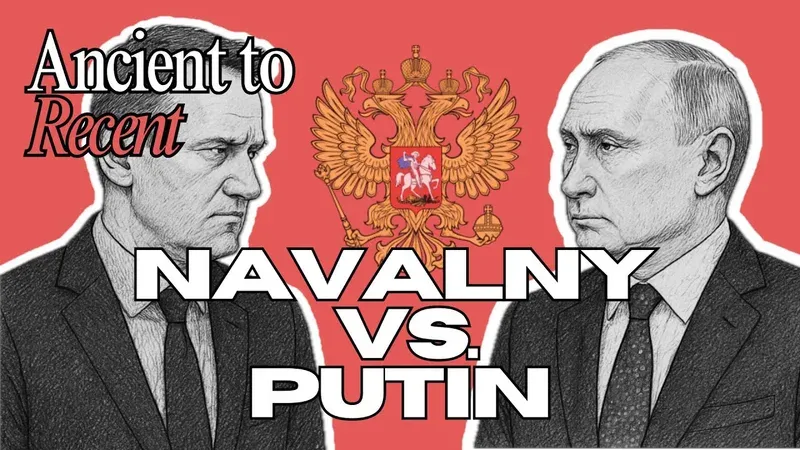
Navalny vs. Putin — Part 1
1 August 2025 · 1 hr 2 min
 Watch on YouTube →
0:001:02:52
Also on
Rate the show
Ratings are how new listeners find the show. It takes a minute and it makes a real difference.
There was no warning. Just radioactive rain and the beginning of a story that shaped modern Russia. In this premiere episode of Ancient to Recent, we explore how the Chernobyl disaster, the fall of the Soviet Union, and the chaos of the 1990s led to the rise of Vladimir Putin and the emergence of his most dangerous opponent: Alexei Navalny.
Follow the origin story of a man who dared to speak the truth in a country where that can cost you your life.
📍Part 1 of Navalny vs. Putin - A Tale of Two Tsars
🎧 New episodes every Friday, 8PM CET
📲 Follow on Spotify, YouTube & Instagram @AncientToRecent
This episode is sponsored by World of Whiskey – the UK’s leading platform for collectible and investment-grade whisky. Want to check out World of Whiskey? Click here!
This is not financial advice. Whisky investments are not regulated and carry risks. Must be 18+ to invest. Drink and invest responsibly. Terms & conditions apply.
#publicidad #ad #sponsored
Read transcript
This transcript is automatically generated, so it may contain typos and misheard names.
There was no alarm, there was no warning, there was no indication that anything at all had gone wrong. For the villagers of the hamlet of Zalisa, some 20 kilometres away from the Chernobyl nuclear power plant, it seemed like any ordinary day. They were sent by the Soviet officials into the local fields to harvest potatoes, digging into the already radiation laced soil with their hands and their fingers as radioactive particles rained down upon them and their children. The Chernobyl power plant was a symbol of progress. It was a symbol of the future, of the promise of abundance that was given by the Soviet state to its people. The luckiest people in the world, Chernobyl, was to produce ever greater quantities of ever more affordable renewable energy that would power the economic juggernaut of the Soviet Union and create ever greater standards of wealth and prosperity for the Soviet citizens. That was the promise.
That's what Chernobyl symbolized to the vital role that Ukraine played within the Soviet system. And the Ukrainian Communist Party was incredibly proud of this. In April 1986, a routine safety test was to be conducted on reactor 4 of the Chernobyl power plant. The Chernobyl reactor was an RBMK reactor, a unique miracle of Soviet design. So unique that the RBMK reactor was used in no other country in the world. Incredibly cheap to produce, incredibly easy to maintain, said to be so safe that it's inventor boasted that it could be installed in Red Square itself.
But there was a reason why the RBMK reactor was not used in any other country. It had a serious design flaw. You see, the operator couldn't actually tell what was happening in the core itself. In the event of a safety test, if the reactor needed to be shut down for fear that it might meltdown, there was no way of knowing when the emergency safety valve was pressed whether whether it would release the pressure or whether it would cause the nuclear kettle to boil over, pushing it into meltdown and causing a disastrous chain reaction. Every single day with the RBMK reactor was a game of Russian roulette.
The very senior officials within the Soviet Union knew of the problems of the RBMK reactor. You see, in Leningrad, modern day Saint Petersburg, in 1975, there had been an event very similar to the Chernobyl disaster that would happen in 1986. The reactor had almost melted down by sheer lock. Disaster had been avoided. You would have four in a normal country that lessons would be learned. But this is the Soviet Union, and the Soviet authorities couldn't face up to the reality that their pride and joy was not a miracle technology, but was a ticking nuclear time bomb ready to go off at any minute.
So what did the Soviet Union do? They covered it up. They silenced anyone who wanted to speak about it. The population was not told. The accident was not reported. The investigation into the near catastrophic events that occurred in 1975 in Leningrad led to several recommendations. None of them were implemented. And so in 1986, the engineers of the Chernobyl power plant had never even heard of the events that had occurred in Leningrad 11 years before.
They were totally unaware of the problems with the RBMK reactor. As the test spiralled out of control, the panicking engineers pressed the override button that caused the reactor to meltdown. Graphite rods were inserted into the core, which is supposed to lower the temperature, but instead they got stuck, which led to a spike in energy evaporating the water that cooled the core, leading to an explosion. The roof was torn off and graphite rained down in the fields outside of Chernobyl. A bright blue light lit up the sky and an eerie orange glow could be seen by the townspeople of Zalesia and Pripyat. The events of April 1986 would lead to the deaths of 9000 people in Ukraine, Russia and Belarus, and would be one of the major contributing factors to the collapse of the Soviet Union.
Only five years later. The disaster of Chernobyl would be a central event in the lives of two men, one of them Alexei Navalny, a lifelong campaigner for honest government, freedom, democracy and against corruption, and the other one, Vladimir Putin, a former KGB Colonel. In this series we will be telling the story of Alexei Navalny. We'll be telling the story of how one man stood up or how one man demanded the right to do the one thing you cannot do in modern Russia, the one thing it is impossible to do in the face of Putin's dictatorship.
He demanded to tell the truth. Welcome to Ancient Theresa. My name is Joseph Parkinson, and before we deep dive into the important, thrilling and essential story of Alexei Navalny's battle with Vladimir Putin for the heart and soul of Russian democracy, I have an exciting announcement to make. This episode of Ancient Theresa is brought by is brought to you by our brand new sponsors at World of Whiskey, the UK's leading destination for rare, collectible and exceptional whiskeys. There's nothing I enjoy more than diving into the pages of of a history book with a glass of whiskey by my side. And the World of Whiskey curates A stunning range of bottles, from iconic distilleries to to rare investment grade fines. Whether you're a collector, or whether you're a collector, a curious newcomer, or someone who just loves a glass of whiskey, there's something special waiting for everyone. To explore more, visit worldofwhiskey.co.uk and remember to drink and invest responsibly. Terms and conditions apply.
Alexei Navalny was born on the 4th of June 1976 in Bhutan, 30 miles from Moscow. His father was an army officer and the family moved quite a lot. Whenever the father was posted to a new position, young Alexi and his mother would have to move with him, but it tended to always be in and around the Moscow area, so the moving wasn't so arduous. Alexi's family is half Russian and half Ukrainian, and he would spend many of his summers in Zalisa, not far from the Chernobyl nuclear power plant.
His grandparents both worked at the local collective farm. When the Chernobyl disaster happened, the Soviet authorities had been desperate to avoid both panic and embarrassment. Navalny is quite a common name in the north of Ukraine. It's a bit like Smith or Jones is in England or Wales. This would have disastrous consequences for many people. When Russia invaded Ukraine in February 2022 After Russian troops withdrew from the north of Kiev in April of 2022, Ukrainian authorities and international human rights organisations began discovering mass graves of Ukrainian villagers who had been massacred by retreating Russian troops.
One of these was in the village of Buka, where a grave was uncovered with 400 Ukrainian civilians buried in it. These people had had their hands tied behind their backs and many of them shot in the back of the head. One of these was the second cousin of Alexei Navalny, 61 year old Ilya Navalny. He had gone to a friend's house to have some food and then on the way home had run into Russian troops who had taking his passport and seeing that his last name was Navalny, had murdered him.
They shot him twice in the back, once in the head, dumped his body in the street and left his passport open on the page with his name. The Soviet Union collapsed on the 26th of December 1991. So catastrophic was the failure of the Soviet economy that when the last Soviet premier, Mikhail Gorbachev, signed the document that actually dissolved the Soviet Union, he couldn't even find a Soviet pen to sign it with. The Soviet economy was so dilapidated, corrupt and incompetent they couldn't even produce pens. He had to borrow, in a moment of supreme irony, a pen from a visiting American CNN camera crew who were there to document the collapse of America's great rival and America's triumph in the Cold War.
The Soviet Union was a failed system. It was a dream that was never fulfilled. For all of the lofty propaganda and promises of a life of endless abundance that we were all collectively working towards, the reality was somewhat more tawdry and shabby. There were long bred queues. There were empty shelves. There were consumer goods produced in factories that didn't work. There were toasters that came off the assembly line, were put into their boxes, were loaded onto trucks that were then immediately taken to the landfill and just dumped in them.
Because the consumer goods produced by the Soviet economy were useless, there was no incentive to produce anything. There was a central plan handed down by the Soviet Politburo, and as long as the factory could fill in the forms that say that it produced as X number of toasters or fridge magnets or toothpicks or whatever, whether those things were actually any good and whether they can actually bring any value to anyone's life was completely irrelevant.
But for all of the shabbiness of the Soviet Union, the Soviet system provided 2 essential things to people. The first thing it provided was stability. Today was like yesterday, and tomorrow will be just like today. We will be no richer. We will be no poorer. We will have just enough to eat, never as much as we want, but always enough to get by. We will have a roof over our head. You will have a job. You will have a paycheck.
You will have a certain guaranteed standard of living. You will never be comfortable, but you'll be OK. The second thing the Soviet Union provided is something that I think is incredibly underrated by many people narrative. It provided a story that placed the citizens of the Soviet Empire within history, and it placed them as the good guys within the Soviet story. The Soviet Union was a society forging forward, creating a better world, standing up against poverty and injustice and oppression, and Soviet citizens believed in this to some degree or another.
The Soviet Union was the nation that had paid the butcher's bill to defeat Nazi Germany. This was the mythology of the Soviet state, and as with all mythology, there is some truth to it, and there are generous helpings of lies and distortions. When the Soviet Union disappeared, both of the two essential promises that the Soviet Union made to its people banished overnight. They were told that what they would get instead were new promises. Instead of stability, they would have opportunity. Instead of the mythology of solidarity, they would get freedom and democracy.
Well, Russia in the 1990s was the pregnant widow. The past was dead, but the future had not been born. The stability was gone and replaced with lawlessness and anarchy. Yesterday was totally different from today, and tomorrow would be worse. Yesterday you were a doctor, your significant other was a teacher. Your children could aspire to lives as civil servants or university professors. Now you and your partner made a living selling your furniture on the street. The money that you had, that you had saved over years for your retirement was absolutely worthless, couldn't even buy you a cup of coffee.
And your children, to make ends meet, were prostitutes. That is the level of the collapse of Soviet society. That is the price that ordinary people paid, ultimately, for the failure of Lenin's dream. To go with this terrible economic shock that ordinary citizens lived with was the loss of the sense of purpose. Life now was anarchy, and you were the losers. You weren't part of a glorious struggle to emancipate the proletariat from the evils of capitalism. You were just the fools who had been duped by discredited economics and deluded fanatics into subjecting your country for 8 decades into the stupidest and most pointless human experiment that had ever been conducted.
And you'd let it happen. And what did you got for it? Nothing. The Soviet Union lost its empire in Eastern Europe, was driven out of Afghanistan, and then it collapsed. The legacy of the Roman, of czars broke away. Latvia, Lithuania, Estonia, Ukraine, Moldova. The humiliation, the defeat was felt by every single citizen, by every single patriotic Russian. Russia in the 1990s was a Wild West society. All of a sudden you swam or you sank, and some people swam.
For some people, there were new freedoms and opportunities. Some people could travel abroad, they could own their own homes. They could buy newspapers. Some people were well positioned to take advantages of the freedoms that the post Communist Russian Federation did offer. Russia never really became a truly democratic society, but it was a more democratic and a more free society than the Soviet Union was from the early 1980's.
The KGB, long before the Soviet Union collapsed, realised that the Soviet Union could not persist in the form that it took. That if the Soviet Union was to continue it's fight with the West, then it was going to have to transition beyond the command economy to a capitalist economy. And the KGB had begun the process of training up mid level officials to position themselves to help the Soviet system in making this transition. Those people were coming of age just in time for the collapse of the Soviet system, and they were people who were able to use their education, their ruthlessness and their connections to very quickly become fabulously wealthy. When the private industries of the Soviet state were being sold off, the Soviet government issued shares to the workers who, officially speaking, owned the factories and the power plants and the oil refineries.
However, these people, first of all, had no culture of capitalism, and secondly, were incredibly poor people living through a time of unbelievable economic turmoil. They weren't thinking of investing, They were thinking of how they were going to feed their families. So they were issued with these certificates giving them shares in the local factory that they didn't really understand what they were or what to do with them.
Along came these officials trained up by the KGB who were able to purchase the shares of these workers and for a kiss and a promise, mid ranking KGB agents who had been living in small 2 bedroom apartments in Leningrad high rises where the central heating doesn't work and the tap never stops dripping. All of a sudden, 18 months later, we're driving Mercedes-Benz and marrying supermodels. This is where we got the emergence of the oligarch class and how the Soviet Union and incredibly egalitarian society, everyone was equal, equally poor, that is transitioned into one of the most unequal societies in human history.
The disaster of the transition to capitalism, the humiliation that people felt created a wellspring of resentment and anger that the old Communist Party, which had been dissolved as a Soviet Communist Party and reconstituted as the Russian Communist Party, began to genuinely take advantage of, began to say, look, this is what capitalism is like. This is what we have been shielding you from for so long. You told us nobody believed the the posters and the propaganda that we told everyone. But hey, maybe it was right what we were saying. And a lot of people in 1990s Russia started to think, well, maybe they were actually right.
Maybe capitalism is actually terrible. And maybe we should go back to the good old days where my daughter didn't have to work as a prostitute in order for us to be able to afford to eat. Maybe we could do that. So at a time when the Russian system was, I'm not going to say democratic, but the most democratic it has been, there was a surge in support for the old Communist Party, and this began to worry a lot of people in the new oligarch class and also within the Russian security services.
The KGB had been renamed the FSB, and also in Western governments as well. They didn't want to see the Soviet Union being re established, Communism being re established. This sense of anarchy and poverty was only made worse by the then Russian President Boris Yeltsin. Yeltsin had campaigned against the abuses of the Communist Party in the 1980s and had prevented the Communist Party from seizing power in 1991 where there was intempted coup, which was very brave of him.
However, Yeltskin didn't understand democracy and didn't really believe in it either. He was a somewhat authoritarian thug, nowhere near as bad as Putin would become. However, the big thing about Yeltskin was not so much that he was a thug, but that he was incompetent, that he was a drunk, and his clownish and buffoonish behaviour on the international stage at a time when Russian people were feeling humiliated, were wondering what was their place in history, only further added to the sense of loss that average Russians felt.
There's one particular example, which is in September 1994, Yeltsin was flying back from the United States, and he needed to stop and refuel the presidential jet in the West of Ireland. This was a unannounced visit by the president of Russia, one of the biggest and most powerful countries in the world, and the Irish political establishment was in many ways was thrilled. This is incredible. We're going to be visited by Boris Yeltsin, one of the supposed great statesman of the age. So at Shannon Airport in the West Coast of Ireland, the Irish Taoiseach was there.
The Taoiseach is the Irish Prime Minister, along with dignitaries and officials and ministers from the Irish government. There's a guard of honour from the Irish Defence Forces. There's a military band all ready to meet Boris Yeltsin who's going to be touching down in Ireland. It's going to be a wonderful moment to be present with one of the great men of the age. The Irish delegation wait on the runway, and they wait, and they wait.
The Russian plane has arrived. It is circling and circling and circling for hours and hours and hours over the Shannon airport. And all the while everyone is just waiting. By the time Yeltsin's plane finally lands, officials from the Russian team get off and they say to the gathered dignitaries, thank you very much for your guard of honour. This is all very, very nice. Mr. Yeltskin will not be taking any questions or having any visitors on the plane, which causes consternation. What?
What do you mean? This is a visit by the the Russian President to Ireland. We, of course we can. We, we have to talk to him a little bit. And they're told, no, no, no, no, miss President Yeltsin is, he's sick, he's tired, he's sick and tired. He can't possibly come and talk to you and you can't come and talk to him. So when the Irish Prime Minister says, can I just go onto the plane and say hello to the president of Russia, they're told absolutely not.
The reason for this is that Yeltsin was so drunk on the plane that he could not possibly have been in any state to meet anyone or carry out any public function. And from this day forth, the phrase circling over Shannon has actually become a euphemism in Irish culture to mean someone who is completely and utterly drunk. As the Soviet Union collapsed, Navalny finished school, went to university, fell in love and started out in life.
He studied law, then got a second degree in securities from a financial university, graduating eventually in 2001. During the 1990s, he worked in the banking sector and he experienced first hand the endemic corruption that so typified Russia, that affected Russian people every single day. And this engendered in him a deep hatred of corruption, A hatred that would bring him ultimately into conflict with Vladimir Putin. While on holiday in Turkey, he met a young woman called Yulia from Moscow.
They fell in love and they married in the year 2000. Having their first child in 2001 and their second in 2008, Navalny was beginning to form a coherent set of political beliefs. He was appalled by communism, also equally appalled by the rampant corruption that typified Yeltsin's cowboy capitalism of the 1990s and the rise of the oligarch class. And so he was drawn towards one of the few genuinely liberal political parties that actually believed in Rule of law that wouldn't sell it's principles out, which was called Yabloko. And this was led by Giorgi Yavlinsky who was a resolute campaigner against corruption in Russian public life. The catastrophe of early and mid 90s Russia that ruined the lives of so many people led to many ordinary Russians coming to the conclusion that a return to communism could be the only way to restore some sort of stability and order in their lives.
This terrified many of the new oligarch classes, who allied themselves with Yeltskin and the security services, the FSB, the organization that had previously been the KGB. They worked together to rig the 1996 Russian presidential election. From this moment onwards, the brief experiment in democracy in Russia was effectively aborted. By the late 1990s, Yeltsin was finding it increasingly difficult to deal with his demons.
He was aging. He was drinking heavily. He had never been particularly competent, but he was failing visibly in front of the eyes of the entire world. And the question then became who would replace him? And this was a very active question because his family had engaged in what we would today describe as corruption. Now, it is interesting when we look at the figures that especially his daughter is said to have stolen from the Russian state coffers, and we compare them to the amounts of money that are regularly stolen by Putin and Medvedev and Shogun and Lavrov. They're absolutely piffling.
Yeltsin family stole monies in their millions. The current leaders in Moscow, they only steal in the billions. But with Yeltskin's health failing, with his inability to do the job, and with a fear that once Yeltsin was no longer in power that he might be prosecuted, this LED Yeltsin and those around him to start casting a bow for someone who could replace him and be trusted not to prosecute Yeltsin. The first choice was a man called Boris Nemtsov.
He was a handsome, witty, tall physicist, the man who'd actually coined the phrase oligarch, and Yeltsin had appointed him as his Deputy Prime Minister. But in August of 1998, the ruble crashed, and this destroyed Nemtsov's reputation. In the years that followed, Nemtsov would be a vocal critic of Putin, especially of Putin's invasion of the Crimea in 2014. And it was in 2015 that Nemtsov would be shot dead in the streets of Moscow.
A few days after he was murdered, his office was ransacked by the Russian police, who confiscated his documents and his computers. His killers were never brought to justice, and it is widely believed that his murder was ordered by the FSB, the Russian state security services. So a new candidate was needed, someone who could be trusted, someone who could be relied upon, someone maybe without too many ideas of their own. And just such a person was available in Vladimir Putin. Putin was born in Leningrad in 1952. He was brought up largely in poverty and he had always dreamt of being a K GB agent.
He had actually gone to the remarkable steps of applying to join the KGB. You do not apply to join the KGB. You are selected. Eventually he got his wish and was accepted. In the 1980s he was sent to Dresden in East Germany, then called Carlmarchstadt, where his role was to liaison with organisations that were carrying out terrorist attacks in Western Europe. Bardemainhoff, the Red Army Faction, also with some Middle Eastern terrorist organisations.
He supplied money and weapons with them. He worked at the epicentre of a Nexus of Western Front companies, many of whom still exist, whose job is to funnel money and technology to Russia. He rose the ranks of being a Colonel, a sort of fairly mid level within the KGB. He was in Dresden when the building war fell. He experienced the collapse of Russian Empire first hand. He recounts vivid memories of being locked in the Stasi, the East German Communist secret police's headquarters, alongside Stasi agents and colleagues from the KGB, frantically burning files to prevent them from getting into the hands of protesters. In the 1990s, Putin returned to Leningrad, renamed St. Petersburg, where he again positioned himself as a useful interlocutor.
This time he was someone who worked on the dock fronts, which were a crucial part of the smuggling operation in Saint Petersburg, liaising between the FSB, the reconstituted KGB and the emerging Russian mafia. He ended up getting into politics, where he was appointed the deputy mayor of Saint Petersburg before then being ushered up to the position of the head of the FSB, putting himself in a position where he could then be selected to be the candidate best positioned to protect the interests of Yeltsin and his family and the oligarchs. And it was this ability to position himself adjacent to power without at the same time appearing to have any ideas of his own, that made Putin such an appealing candidate to be the next president of Russia.
In the period post 1996, as Russia began it's real slide into authoritarianism, the liberal opposition to Yeltsin and the oligarchs was deeply divided. The liberal parties had tried to arrange public debates. They had tried to highlight corruption in Russia at a time when Russia still had a Free Press. But the parties fared poorly at elections, and there was a great disagreement between Alexei Navalny and the leadership of the liberal parties as to how to proceed.
It was at this moment, when the liberal opposition seemed to hit rock bottom, that Navalny made possibly the biggest mistake in his entire life. Casting around for anyone who could offer organised resistance to Putin, he decided to throw in his lot with the Russian far right. Before we dive back into our episode, a quick word from our sponsor, World of Whiskey. Some things only get better with age, and a fine single malt is one of them.
That's why Whiskey Cask Investment holds such serious allure. With World of Whiskey, you can own a share of Scotland's most iconic export. You'll receive full certification of ownership, delivery orders and access to rare expressions few will ever get to taste. And in the UK, there's no capital gains tax when you sell. This is not financial advice. Investment carries risks and you must be over 18. Remember to drink responsibly and invest responsibly.
To learn more, click the link in the description or scan the QR code at the bottom left corner of your screen. Under Yeltsin, public life in Russia was chaotic and violent. Putin restored order, but he didn't end the violence, He channelled it. After Putin came to power, he immediately set about dismantling the democratic institutions of Russian society, such as his independent judiciary and free media. One of the catalysts of this was the Kursk submarine disaster of August 2000.
A torpedo exploded inside a Russian submarine, sinking it to the bottom of the Baltic. It was an international effort. There was an outcry for an international effort to be made to save the submarine and the crew, but Putin refused to allow any assistance to help rescue the trapped sailors. There was huge waves of criticism directed against Putin in his incompetent and cruel handling of this terrible tragedy. Putin attempted a brief moment of trying to reach out to the families, only for them to harangue him and demand that he do something about this.
One old lady approached Putin, insisting that every effort be made to save her son. She was immediately grabbed by a police officer who stuck a needle in her, injecting her and forcing her to faint. The liberal opposition to Yeltsin and the rise of Putin had failed miserably and Putin immediately set about the process of destroying the serious opposition parties on centre left and centre right. But Putin was willing to allow the Communist Party and also the extreme far right fascist political parties, He was willing to allow them to continue because they provided him with something that was very useful, the appearance of opposition and Putin's ability to present himself as being the reasonable adult in the room compared to all these other crazy people. And you wouldn't want to let any of them in charge. So you have to allow me to stay in charge. And so a lot of people who had seen the Jack boot come down on the liberal centrist political parties started to turn to these extremes as the only channel that could oppose Putin. And Alexei Navalny was one of these. He began associating himself with far right cultural nationalist political parties in Russia. He began attending meetings and marches and rallies by people that, if we're really honest, we would describe today as being fascists, Nazis.
These are some pretty unsavory far right skinheads, but they were really the only show in town for opposing Putin and a debate exists. A question exists as to how much Navalny actually shared these people's convictions. Navalny began associating himself with these fascists. He started appearing in these bizarre, poorly put together videos that were being made by these extreme right wing organisations in which he would talk about foreigners as being cockroaches. There was one where he appeared as a comedic dentist operating on the evils of immigrants.
There's another truly shocking video that's still available on YouTube in which he appears to kill someone dressed as a Muslim. These are not unserious accusations that it's perfectly reasonable to ask questions about. What exactly was he thinking? He was driven to associate with these people that he would later very much so distance himself from on account of his desperation to find any organization that could offer serious opposition to Putin. And he also made a point of refusing to delete the videos that are still available on YouTube to this day, because I suppose in his arrogance he would have argued that this is part of the public record.
One of the reasons that the far right was so powerful within Russia in the early new Millennium is that far from the image that Russia projects of itself in the West as being a white Christian country, Russia is actually an incredibly diverse, multicultural country. And one of the biggest live issues in Russia is immigration. Moscow alone officially has 2 million migrants. The number unofficially is said to be maybe as much as double. And these migrants are drawn mainly from Central Asia, Uzbekistan, Kazakhstan, the Far East and the Caucasus, where these migrants do low paid jobs that Russians don't themselves want to do.
The two groups that attract the greatest sense of hatred and ire within Russian society are Chechens and Dagestanis from the Caucasus. They are hated for being too brown, too Muslim, and the Chechens especially are despised for humiliating the Russians in the first Russo Chechen War of the 1990s. Putin had wanted to win popularity and popular approval in his early days in office, and he saw the Chechens as being the perfect hated bogeyman that he could use to rally the country around the flag and in doing so, around himself. In September 1999, there was a series of mysterious apartment bombings that started to occur in Moscow and various other cities.
Over 300 people would die and Putin would publicly blame this on terrorists from Chechnya. There has long been suspicion that these bombings were actually carried out not by Chechen terrorists, but actually by Russian state security. One member of the Russian parliament, the Russian Duma, caused a particular moment of concern and his name was Vladimir Zinorovsky, a pro Putin ultra nationalist. When standing in the Russian Duma, he talked about the tragedy of a bombing in the city of Volgodonsky in which a dozen people had lost their lives. There was only one problem with him doing it. He made this statement three days before the bombing. Putin used the excuse of the apartment bombing to unleash hell against Chechnya.
The Russian Air Force bombed Chechnya into the Stone Age, including bombing civilian targets, bombing refugee columns that were being observed by the United Nations. The STP, the Society for Threatened People, an independent think tank based in Germany, estimates that in the Second Russo Chechen war, up to as many as 80,000 people in Chechnya were killed by Russian mass bombing. After Navalny's dalliance with the far right, he then turned to associate himself with the far left.
He was flailing around to associate himself with any movement that he could find. Today the fascists, tomorrow the communists, anyone who he could bring together to oppose Putin's system of corruption and ever increasing terror, violence and oppression. Did he have racist tendencies or? He certainly associated himself with racists. There's no denying that no matter how much people admire Navalny, he made himself a bedfellow with people who really were.
However, Navalny at this time also took up an opportunity to study in the United States of America, and it was while studying that he found himself in an incredibly cosmopolitan environment. It would have been very easy for him to associate himself only with some of the more hard right elements that were available on US campuses. But he consciously went out of his way to actually make friends with people from diverse backgrounds, from the global South. And he had many associates from African, Middle Eastern and Asian backgrounds that would become long term friends with him.
And when they were asked in years to come, would they say that Navalny was a racist? They uniformly said absolutely not. Putin continued his rise to power. But there's one particularly interesting quirk about Putin is that though he has a contempt for the rule of law, he has a need a yearning for the appearance of legality. And one of the problems for Putin was that the Russian constitution officially limits the president of Russia to only two terms in office.
And by 2008, Putin was completing his second term. So what Putin did was he anointed his own successor, a man by the name of Dmitri Medvedev. Now, Medvedev had two outstanding qualities that made him a perfect candidate to be the new president of the Russian Federation #1 he had absolutely no ideas or ambition of his own. He was a total and utter empty suit. And the second, which was very important for the incredibly vain Vladimir Putin, Medvedev was short.
He was 5 foot 4. So he was one of the very few people that Putin, who is a modest 5 foot seven, could actually tower over. This was an outstanding quality for Dmitri Medvedev to possess and made him more than qualified to govern one of the nations with the world's largest stockpile of nuclear weapons. Dmitry Medvedev was elected in March of 2008 and immediately appointed one Vladimir Putin to be his Prime Minister. Medvedev would serve one term where he was. From the beginning, Medvedev tried to present himself as a liberal reformer, much to the delight of Western governments. In the post Soviet era, Western governments fell over themselves to ingratiate themselves and accommodate Russia. They desperately wanted to bring Russia into the G7, which briefly became the G8, to integrate Russia into the World Trade system and to take advantage of Russia's vast supplies of oil and gas that could fire their ailing, struggling economies.
The Clinton administration had turned a blind eye to Russia's hideous crimes in Chechnya. The Bush administration had eulogised about what a man of principles and honour Vladimir Putin was. George Bush junior once said that he had looked into the eyes of Mr. Putin and seen that he was a true Christian. Vladimir Putin, of course, is not a Christian by any stretch of the imagination. But there are few governments that went so far in their fawning over Vladimir Putin, then the administration of Barack Obama. Obama publicly campaigned on the idea of a reset, even mocking Mitt Romney in the 2012 presidential debates. When Romney cited Russia as one of the United States, America's biggest challenges.
In November 2011, there were elections to the Russian parliament, which is called the State Duma. Putin and Medvedev left nothing to chance. There was massive fraud and corruption. Voters were bussed in. Ballot boxes were stuffed. Opponents were intimidated. Nothing was to stand in the way of another glorious triumph for the United Russia party, the party of Vladimir Putin. But this was an interesting moment because it was just after the release of the iPhone.
So all of a sudden hundreds of thousands of people around Russia had in their pockets the ability to film and upload video onto the Internet. And the Internet was flooded with videos of rampant electoral corruption. The results that came out were so obviously ridiculous and ludicrous. The corruption was so blatant that it was felt by many people to be insulting of their intelligence. When Chechnya, a part of Russia that Putin only 10 years beforehand had bombed into the Stone Age, returned a vote of 99.48%, it was laughable.
It was obvious that these were clearly not free and fair elections, and this lead to mass protests in Moscow, the first major protests to take place in Russia since the collapse of the Soviet Union. Navalny was one of the stars of these protests, taking to the stage and giving a brilliant speech laced with wit, sarcasm and irony. And this was something that Putin, Medvedev and the United Russia party could not take. He was arrested and manhandled.
But this was a huge mistake for Putin because Navalny, who at that point was an obscure Blogger known within the intellectual circles of the Russian opposition, he went into prison as a figure little known, and he came out of prison as a figure of hope and opposition to the corrupt system presided over by Medvedev and Putin. Upon his release on Christmas Eve 2011, in -5° freezing temperatures in Moscow, up to 120,000 people rallied wearing white ribbons against corruption and against the rigged elections.
Navalny was blogging to expose corruption and double dealing. But now he had been risen to a new platform. He had become a national figure. And maybe a potential presidential candidate. Maybe for the first time, Putin had someone who could actually oppose him. A few days after the rallies, Putin held his annual press conference, where he sits in front of a room of tame journalists, all of which work for the Russian state media.
One after the other, ask him questions about what his diet tips are, why he's such a genius, What did Russia do to deserve such a wonderful, brilliant, beautiful president? And isn't he so fabulous and your hair looks so wonderful today? And to which no one ever interrupts anything that Putin says or calls at any of his obvious lies. And it was while he was on the stage, Putin ranted and raved about the CIA and the MI 5 and Mossad and all these people who are responsible for all these rallies and seeing that they're white ribbons were actually just used condoms. And to say that they were all perverts and degenerates campaigning against the dignity of Russia, etcetera, etcetera, etcetera.
But nothing that Putin did could bring Navalny down. Putin gritted his teeth. He fulminated as Navalny * rose and rose and rose. So Putin unleashed the tame Russian media against Navalny. The usual accusations were thrown at him. Tax fraud, being a foreign agent, being a Freemason, being a sexual pervert, on and on. Images of Navalny were photoshopped and published to show that Navalny was palling around with Boris Borosovsky, a oligarch from the 1990s who ironically had been one of the key sponsors of Putin's rise to power.
And the narrative was that Navalny was a corrupt figure who was only going to act in the interests of the oligarchs when Putin would stand up for the little man, etcetera, etcetera, etcetera. And Navalny did the one thing that no one had ever done to Putin. He laughed in his face. He made fun of him. The one thing that dictators and dictatorships can't stand being mocked, being ridiculed. Tyranny is an absurd system.
It is a ludicrous, laughable system. And the corrosive acid that destroys it is mockery and laughter. So Navalny would create his own photoshopped images of him having a drink and sharing a laugh with Putin, with Stalin, with Elvis, with ET, with whoever, and would share them widely to the mocking and derision of the Russian people. And Navalny * rose and rose. His popularity increased and increased. In Russia, there is no rule of law.
There is rule by law. There is the appearance of legality. Instead of saying you can't have free speech, what there is instead is legal technicalities. You are, of course, not being arrested because you criticize the government. We've just found out that you cheated on your taxes. There's always some technical loophole by which you can be arrested, you can be harassed, you can be thrown in prison. The political parties that exist outside of the puppet parties that are only there for the appearance of competitive elections, they are not shut down. What happens instead is they're harassed. They are prevented through endless legality from ever being able to genuinely compete freely and fairly in elections. When the Russian Liberal Party, Yabliko under Grigori Yablinsky, an actually genuine liberal political party, wanted to campaign for Yablinsky to stand in the upcoming March 2012 elections where Putin was to be anointed as the new president of Russia, they were required to collect 2 million signatures just to stand. 2 million people had to put their names on a register to say yes.
They wanted Yublinsky to campaign against Putin. And even then, even when the Russian Liberal Party was able to do that, they were still disqualified. Navalny blogged about this. He spoke about it. He railed against it. Navalny's weapon that he was able to use against Putin was the law itself. He was able to say, I am campaigning for the rights of Russian citizens that exist in the Russian constitution. It says corruption is illegal in this country, and yet people are engaging in corruption. I'm not opposing the state by saying that corruption is wrong. I'm supporting it.
It says in this country that we have free and fair elections. It says in this country that we have human rights. The Constitution of the Russian Federation says that we have free elections, free speech and the rule of law. Well, I am demanding that these things are enforced. And these were the weapons that he wielded against Putin again and again and again. What grounds was Putin going to use? What was the accusation that Putin was going to come up with? What was Putin going to say to allow him to destroy Navalny? He couldn't come up with one in the March 2012 presidential elections, which were prepared in every conceivable way for Putin to be anointed as the new president. No chances were taken.
Opposition candidates who could actually oppose Putin were disqualified. The media covered Putin and Putin only and in glowing terms. What a genius he is. Hasn't he lost weight? What are your diet tips, Mr. Putin? My goodness, you look wonderful. On and on it, on it goes. The other candidates who stood against Putin were a. Joke. There was Gennady Zignoyev, the geriatric leader of the Russian Communist Party. There was Mikhail Prokhorov, an oligarch presented as someone standing up for the interests of the rich. Vladimir Zoranovsky, an extreme ultra fascist and Nazi, considered 2 bonkers even for the Russian far right, and Sergei Moronov, a candidate selected for his one supreme quality to oppose Putin.
No one had ever heard of him or knew who he was. In March 2012, Vladimir Putin was, quote, UN quote, elected President of the Russian Federation. Mass protests broke out again, and yet again, Alexei Navalny was arrested. And it was at this moment that Navalny came up with a brilliant idea. He would create an official foundation for highlighting corruption and abuse of power within Russia. Truth would be his sword. The laws of the Russian Federation would be his shield. He would campaign apolitically for the rights of the citizens of the Russian Republic.
The stage was now set. Now Russia had two SARS, one of truth and one of lies, 1 of honesty and one of corruption. And the more that Putin threw against Navalny, the more his * rose. My name is Joseph Parkinson. This episode of Ancient to Recent has been brought to you by World of Whiskey. Visit worldofwhiskey.co.uk for amazing options for whiskey investment. Next week's episode of Ancient to Recent we will look at how Alexei Navalny became Vladimir Putin's biggest problem.
Episodes of the Ancient Recent podcast are out every week. 8:00 Central European time for Ancient to Recent on Spotify, YouTube and on Instagram at Ancient to Recent.