
#11
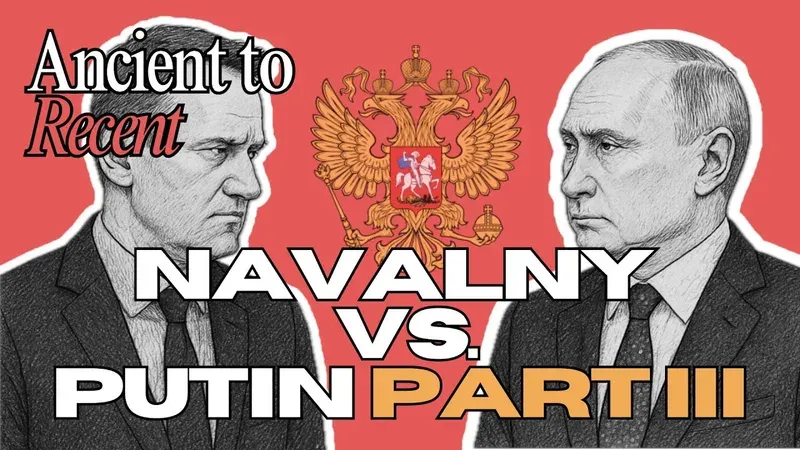
Navalny vs. Putin — Part 3
15 August 2025 · 55 min · Season 1
 Watch on YouTube →
0:0055:22
Also on
Rate the show
Ratings are how new listeners find the show. It takes a minute and it makes a real difference.
In this powerful final chapter of our Alexei Navalny series, we follow Russia’s most prominent opposition leader from the 2017 acid attack that scarred him, to his poisoning with Novichok, his defiant return to Moscow, and his slow death inside Putin’s prisons. Through corruption exposés, political trials, and the relentless brutality of the Russian state, Navalny’s life became a test of whether truth could survive in a country built on fear. From investigative breakthroughs to the Wagner mutiny, we explore the forces shaping Putin’s Russia and the enduring flame of the Russian democratic tradition.
🎧 New episodes every Friday, 8 PM CET
📲 Follow on Spotify, YouTube & Instagram @AncientToRecent
Sponsored by World of Whisky. Some things only get better with age. With World of Whisky, you can own a share of Scotland’s most iconic export. You must be over 18. Investing carries risks. Drink responsibly. Invest responsibly. This is not financial advice.
👉 Learn more: https://tr.ee/ZaBoYD
#sponsored #publication
Read transcript
This transcript is automatically generated, so it may contain typos and misheard names.
It burnt. That's what made this time different, because most of the time it doesn't actually burn. In April 2017, while walking down the street, a man approaches Alexei Navalny and threw a vial of miscellaneous liquid directly in his face. Now, this wasn't the first time this had happened to Navalny, and it wasn't the first time that this had happened to figures from the Russian opposition. This is actually very common.
But most of the time it doesn't burn. Most of the time the thugs of the FSB use a chemical called Zolianca. It causes irritation, discomfort, discolouring, but it doesn't actually cause burns. But they clearly mix something new, something different into the formula this time. The reason that the FSB do this is to send a message. They show that we can reach out, we can touch you, we can get you whenever we want. So wise up, watch out because the next time it's not going to be Solanka. The next time it's going to be something more deadly. And the next time was this time.
Welcome to ancient, to recent. My name is Joseph Parkinson and today we are doing the final episode on the heroic and tragic story of Alexei Navalny, the man who took the fight to Vladimir Putin and his corrupt regime within Russia. This episode of Ancient Recent is as ever brought to you by our friends at the World of Whiskey. worldofwhiskey.co.uk is the place to go for Whiskey cask investment. You can check out their website at worldofwhiskey.co.uk.
But more from them coming up after telling our amazing story of Alexei Navalny. Episodes of ancient to recent come out 8:00 PM Central European time every Friday. You can follow us at ancient to recent on Instagram. You can also listen on YouTube, Spotify or Apple podcast. Navalny travelled to Spain for medical treatment to help him recover from his attack. And while he was out of the country, the Navalny Foundation pressed for there to be some sort of investigation into the assault that had happened.
A senior prominent public figure has been attacked with what is essentially a chemical weapon whilst walking down the street of Moscow, a major European city, in broad daylight. But despite the best efforts of the Navalny team to push the authorities, despite the prominence of the person who was attacked, no arrests were made. The Navalny team managed to get hold of the CCTV footage that showed the attack and Moscow is one of the most heavily recorded cities in the world and they were able to identify 2 figures who participated in the attack.
One of them was a former Moscow police major called Alexei Kolakov and the other one, the person who threw the acid in Navalny's face was a man called Alexander Petranka. Both of these were identified as members of an organization called Serb. Serb is a far right pro Kremlin militia that spends most of it's time beating up political opponents of the Kremlin, desecrating memorials to the victims of the Soviet dead, attacking pro democracy rallies, and generally intimidating and threatening anyone who might be seen as being a potential threat to the rule of Vladimir Putin.
When this evidence was presented to the Russian authorities so that they could easily arrest the people who'd carried out a potentially deadly attack against a incredibly prominent public figure within Russian life, the authorities were not particularly grateful for the information. Navalny recovered in Spain and then returned to Moscow to continue the fight. He assumed that he was too high profile to be killed. He was a well known international figure of opposition to the regime of Vladimir Putin, so he wasn't someone who Putin could just kill without there being a international reaction.
However, life expectancy for Putin's critics is never too long and they are never too far away from accidents and tragedies. It was on the 20th of August 2020 that Navalny was flying back from Siberia. He had been making a documentary about corruption, exposing the double dealings and the shoddy fraud that was so common in Putin's system of corruption that he calls a government. It was while he was on the flight back from Siberia that he suddenly became incredibly I'll howling in pain, raging stomach cramps, writhing in agony. The plane was forced to make an emergency landing so that he could receive immediate medical attention. However, after the plane landed, a bomb threat was then called into the airport, thus preventing the ambulances and the emergency services from getting to the airplane to evacuate Navalny and get him quickly to the hospital for the treatment that he'd so desperately, so obviously needed in order for the police to quote UN quote, evacuate the airport as soon as Navalny arrives at the hospital. The hospital is a scrum of massive police presence, huge numbers of journalists.
Navalny's wife tries to get to him, but she's denied the opportunity to see him. And the Russian state Kremlin backed media goes into OverDrive. Navalny's not sick. He's drunk. He's an alcoholic, he's when drinking moonshine, he's a drug addict. He's this, he's that. He's everything other than he could possibly be sick. Navalny slips into a comet, but he pulls through due to the dedicated attention that is given to him by the doctors at the hospital. It's at this point that it's very interesting to look at the fate of the doctors who treated Alexei Navalny, and there's a running theme of people who do things for Navalny suddenly having terrible accidents.
Anyone who gets anywhere near Navalny in a positive case all of a sudden has their career prospects or their life expectancy suddenly drastically shortened. In October 2017, the deputy head of the hospital, Anatoly Kalinchenko, suddenly resigns. In December of 2017, the head of trauma, Dr. Ruslav Agachev has a stroke. And in February 2018, Doctor Sergei Max Emission died from a heart attack. So all of a sudden, all of the doctors within only a few months of treating Alexei Navalny have either resigned or died while in a coma.
Navalny is taken to Germany to recover and receive proper medical treatment away from the prying eyes and grasping hands of Vladimir Putin's police state. While in Germany, the medical team that is overseeing the Valley's recovery does a series of tests and they find in his hair, in his skin, in his urine, on his clothes, in his blood, traces of Novichok. Novichok is a nerve agent, a chemical weapon developed during the Soviet Union, and the only country in the world that is known to possess this particular chemical is the Russian state. The trail LED immediately directly back to the door of Vladimir Putin and to the FSB.
Was the FSB being brazen? Was it just being incompetent? Had it been lazy in its efforts to kill Putin, going to the well yet again to use the old favorite that is Novichok? Alternately, was it the case that what the FSB was trying to do was to make sure that everybody knew? It doesn't matter how high your profile. It doesn't matter what the international community thinks of you. It doesn't matter how many people know who you are. We will kill you if you oppose the system of Mr. Putin. Shogun Lavrov and the other criminals who run the Russian state.
It's at this point that in steps a brilliant investigative journalist called Christo Grossev. He began to research the poisoning of Alexei Navalny. One of the things that really defines Russian society under Mr. Putin is the vast corruption. Russia is ranked internationally as only slightly less corrupt than Taliban Afghanistan. Now, most of the time that works against the interests of justice and ordinary Russian citizens.
But sometimes that sword in the right hand can actually be swung in the name of truth itself. And so Kristo Groszev was able to use the fact that with enough money and enough determination and the right connections, you can buy anything in modern Russia to track down data that might help shed some light on the poisoning of Alexei Navalny. And it was whilst doing that that Gross F came across the Signal Institution. Now the Signal Institution, based in Moscow, officially is a company that just develops sports nutrition drinks.
Officially this is a company that is working on Russia's version of Leukosaid. But there's something very particular about the hiring requirements of working at the Signal Institute. Wanted to work on development of new flavour of Doctor Pepper. Must have experienced developing sarin gas. The Signal Institute only employs scientists with extensive experience in the development of chemical and biological weapons, a rather strange requirement for a soft drinks company.
Grasab was able to use Russia's corruption against itself by purchasing the phone records of the employees of the Signal Institute. And he was able to use an app that, once you load the phone records onto this app, tell you what those numbers show up on the phone that they are calling. What is the name that is attached to that number? And so he was able to see immediately that many of the people who were calling into the doctors and the scientists who worked at the Signal Institute, their numbers were saved under names such as Alexi Dr. from FSB.
Grazev was able then to purchase the flight records around the time of Navalny's trips to Siberia and various other cities, and to cross reference these phone numbers to the Signal Institute with people who had been flying in and out of different places that Alexei Navalny had been travelling to. And he was able to identify a number of figures who for some reason were always travelling to places that Alexei Navalny was going just before he got there and leaving just after he left.
He was able to identify Alexi Alexandrov, Ivan Osipov and Vladimir Paniyazer, all of them officers of the FSB, the same people who for some reason are in constant contact with an institution that develops chemical weapons, of following Alexei Navalny around Russia. And those same men were in Tomsk, the city that Navalny had been visiting, exactly when Navalny was there. Navalny woke from his coma, and after a brief convalescent, he decided again that he was going to go back to Russia. For Navalny.
He was given a choice. If you are going to be a politician who is actually relevant to the lives of Russian people, who can actually make a difference within Russia, the crucial battleground is the battleground within Russian society. For Russian public opinion, the only way you can do that is to be in Russia. You can have a very comfortable life travelling from the Hay Literary Festival to Aspen, from London to New York, writing columns in the Guardian, appearing on the BBC, appearing at literary festivals, talking about the wickedness of Vladimir Putin. You can do that.
Will that have any difference within Russia? Will any of that get to ordinary Russian people? Will any of that get to the one group of people that Vladimir Putin actually fears, which is not the EU or the UN or the CIA or the FBI or MI 5? It's none of those people. The one group of people that Vladimir Putin actually really, genuinely fears, that keeps him up at night, that he is terrified of, are ordinary Russian people.
And who is to reach them? Then? He had to be in Russia itself, and that is why he went back. He went back out of his sincere desire to fight the system and to fight the monster who ran it. Navalny boards his flight on the 17th of January 2021 from Berlin back to Moscow. When he touches down, he is swamped. Friends and foe, supporters, allies and enemies, police officers. He's harassed, he's jostled. It is a scene of anarchy straight away from the second he arrives. People who were there to support him are beaten, attacked, arrested and carted off.
The second that he reaches passport control, he is immediately arrested. The charge? Failure to attend a parole hearing while he was in a coma, brought about by being poisoned by the same people who are running the parole hearing. He was arrested and he disappears into the Russian prison system, never to emerge alive again. Two days after Navalny arrives back in Russia, the Navalny team release a new documentary and expose about Putin and his vast personal wealth.
And the documentary that is available right now on YouTube is called Putin's Palace. In this movie, Navalny tracks Putin's rise from Leningrad to being a lonely KGB Colonel stationed in Dresden through the 1990s to today being one of the richest men not just in the world, but the richest man possibly who has ever lived. The movie focuses primarily on Putin's role as the deputy mayor of Saint Petersburg in the early 1990s, after the collapse of the Soviet Union and the Soviet command economy. It was genuinely feared by Boris Yeltsin, the new president of Russia, that there could be real hunger, real starvation, potentially even a famine that could sweep through Russian society and people could actually die. So Russia needed to have some means to buy the food that it required to feed its people.
Russian regions and cities were encouraged by the central government in Moscow to set up programs where they could trade whatever natural resources they had, coal, fish, timber, gold, whatever it was on the international market in return for food to feed the people of that region or city. The person who's responsible for doing just that in Saint Petersburg in the early 1990s was deputy mayor of Saint Petersburg, Vladimir Putin. He administered this project.
But instead of the man who likes to present himself as such, a ginormous patriot and lover and defender of the Russian people, doing his job and trading the resources in return for getting the food, what Putin did was he traded the resources in return for hard cash that went straight into his bank account and the bank account of the peoples around him, of his supporters and allies. And this was the beginning of him constructing a team of loyalists that would follow him all the way from the dockyards of Saint Petersburg in the early 1990s straight to the Kremlin. Putin also got himself involved in The Dirty work. As a government official, he had connections with the police, but he also, as a K GB man, had connections with the secret police and with organized crimes. Any honest police officers or nosy journalists who asked too many questions or got too close to the truth ended up in the hospital or in the morgue.
One of the things that you've got to understand about Vladimir Putin is you've got to understand the story that he tells the Russian people. He tells the Russian people that the 1990s were a period of democracy and of free independent media, and they were also a period of unbridled anarchy, turmoil and uncertainty. And that that's what you get with a democratic system. That's what you get with the Free Press. You get anarchy, you get starvation, you get uncertainty.
You get tomorrow will be completely different and we won't know what's going to happen. Your life will fall apart. That's the story that Putin tells. But the irony, of course, is that it is people like Putin who made the anarchy of the 1990s, who took advantage of it, who promoted it, who caused it, who were the beneficiaries of it. These are people who start the fire and then run the fire department and insist that you need them. The irony is that they present themselves as a cure for the very same cancer that they actually caused in the 1st place.
Vladimir Putin hadn't stopped the anarchy, he had simply institutionalized it. He had channelled it in such a way that he could be the sole beneficiary of it. The high point of the movie is Navalny's expose of Putin's personal estate. Now Vladimir Putin officially is a public servant. Officially speaking, Vladimir Putin has a state salary of 140 thousand U.S. dollars a year. He is the president of a country that is slightly richer than the Netherlands, slightly poorer than Italy, and yet Vladimir Putin has as his personal estate custom built in the year 2005 and actually built twice over because the first time it was constructed it was so poorly constructed they had to tear it down. All at taxpayers expense of course. A personal estate that is 39 times larger than the principality of Monaco.
It is 17,691 square meters large. It has a 2500 square meter greenhouse that employs 40 gardeners. It has its own oyster farm, tea house, underground hockey ring, Turkish bath, dessert shop, casino, Aqua disco, cinema, stained glass windows, hooker room, theatre, gold gilded bedrooms with custom made furniture and a solid gold toilet brush. Worth 700 U.S. dollars. All of this was designed by an Italian architect called Lanfranco Carrillo, and it was designed on purpose to look like the Palace of Versailles.
And all of this in a country with some of the most staggering and stark inequality of any country in the history of the human race, where the average citizen is poorer than the average Bulgarian. And I know what a lot of people are going to say. Doesn't the president of the United States of America live in the White House? Doesn't the king of England live in Buckingham Palace? That is absolutely true. The King of England doesn't own Buckingham Palace. That belongs to the British government. He just gets to live there because he inhabits an office within the state, and that's the official resident of the king. The President of the United States of America doesn't own the White House.
He just lives there because that's a resident of the President of the United States of America. This is a house that has been custom built for Vladimir Putin. It is not something that will be handed over to his successor. It is his. And the question Alexei Navalny asked is, how is it that a man whose official salary is 140 thousand U.S. dollars is able to afford the biggest and most luxurious palace that has ever been built in the history of the human race? Navalny had returned to Russia out of a sense of patriotism, out of the idea that a different Russia was genuinely possible. But as soon as Navalny arrived, his supporters began to experience increasing levels of harassment. Their houses and their offices were raided. They were arrested.
Protesters who turned up to the courtroom to support Alexei Navalny were roughed up and arrested themselves. Navalny's trial begins on the 2nd of February 2021, and it descends into a farce, A sham, a kangaroo court immediately, where the prosecution are basically allowed to do whatever they want and Navalny is hardly allowed to say anything at all. He's given a 2 1/2 year sentence, which he is to begin immediately. He goes into prison a healthy man in the prime of his life, but the conditions of his incarceration are intentionally made as harsh as possible.
He is denied access to a doctor, He's denied sleep. He's woken up as many as 8 * a night, and this harsh treatment immediately starts to manifest itself. He begins to experience partial paralysis in his right leg in April 2021 when 6 doctors and two CNN reporters attempt to visit Navalny. They are arrested and it is to highlight the fact that he is now being consistently denied medical attention that he is allowed under the laws of the Russian constitution that he begins a hunger strike.
The only medical treatment he's given is 2 ibuprofen. The paralysis then starts to spread into his hands. His doctors managed to get hold of a sample of his blood in mid-april and it reveals an alarming deterioration in his health. This leads to an international outcry to improve the conditions of his that results in him being moved from prison to a hospital. Despite the international outcry over his conditions whilst incarcerated, Navalny increasingly found himself isolated, isolated politically within Russia and also isolated from his support network in the West. He was exactly where Putin wanted him to be. But it was only by being exactly where Putin wanted him to be, ironically, that he could be most dangerous to Vladimir Putin.
Before we dive back into the story of Alexei Navalny's battle with Vladimir Putin for the heart and soul of Russia, a quick word from our sponsor, World of Whiskey. Some things only get better with age. A fine single malt is one of them. That's why whiskey cask investing has such serious allure. With World of Whiskey, you can own a share of Scotland's most iconic export. You'll get full certification of ownership, delivery orders and access to rare expressions few ever taste.
And in the UK, there's no capital gains tax when you sell. This is not financial advice. Investing carries risks and you must be 18 or over. Drink responsibly and invest responsibly. A great place to start is with Whiskey Cask Investment with worldofwhiskey.co.uk. In summer 2021, Vladimir Putin wrote a long essay on the history of brotherhood and unity between the peoples of Ukraine and Russia. How the Ukrainians and Russians, really far from being separate nations, were in fact one joined at the hip, bound together. They were one entity.
They weren't separate in any way. That their whole history was a history of joint struggle, of unified striving against foreign invaders. In this idea that there's this thing called being a Ukrainian is really just a nefarious invention that came about as a result of the Bolsheviks and the CIA, etcetera. There's only one problem with Mr. Putin's long Grambling essay. It's completely and utterly factually devoid of any contact with reality whatsoever.
You can go online and read it, and you can also read the responses by serious professional historians who tear it apart. It is not a true, honest telling of the history of the people of Russia and Ukraine. It is a effort by an imperialist to deny the very existence of Ukrainian national identity. That is the purpose of this essay. It is a attempt to set the intellectual ground to justify the invasion of Ukraine that Putin would launch in 2022. At the same time, in prison, Navalny was writing his own essay.
It was outlining the failures of the free Western world. After Russia invaded Ukraine, the Western world rushed to place sanctions on the Russian government, the Russian economy, people connected with the Russian state. But Navalny pointed out that for 30 years the Russian government had been bombing Chechnya, bombing Syria, interfering within the domestic affairs, the elections of Georgia and Latvia and Lithuania, undermining the democratic institutions within Ukraine. The huge amounts of stolen money from Russian oligarchs and secret policemen had been sloshing through financial institutions in London.
That the rich and powerful from Moscow and Saint Petersburg people who in 1990 were mid ranking Communist Party bosses and then two years later were multi billionaires, all of a sudden with vast fortunes, had been buying up hotels and real estate and businesses and banks and football clubs in the West. And for decades and decades Western institutions, Western governments, had ignored the vast wellspring of corruption flowing out of Russia and infecting Western institutions from football clubs to banks. He pointed out the hypocrisy of this, that it took a war, a European war, to make people sit up and pay attention. For the first time for decades, Western governments had turned a blind eye to the corruption and human rights violations, had tried to accommodate the Russian state even as it turned into a totalitarian dictatorship, because Western governments wanted the money, they wanted the investment, They wanted the cheap oil and the cheap gas.
They were willing to accommodate a dictatorship because what did they care about Armenia and Georgia and Latvia and Lithuania and Ukraine? Weren't these places terribly far away? Whereas low electricity prices, the ability of people in Berlin and Birmingham to heat their houses and the ability of Western politicians to say, look, I've brought you these lower oil and gas prices. Look, isn't it great that Chelsea are being such a successful football club now? They have huge amounts of money flowing into them from Roman Abramovich.
Let's not ask Roman Abramovich how he all of a sudden got so much money. They wanted all this. They didn't want to ask the questions and they wanted also to believe the mythology. They wanted to believe the post Cold War feel good factor that we're free markets when free institutions would emerge and behind them would come free people. They wanted to believe this fantasy. But it turned out in Russia that Russia could have capitalism, could have free markets without having free institutions, and that instead of our values flowing from West to East, the values of the Russian autocracy could flow from east to West. In some ways, this essay from Navalny was a desperate attempt to recapture some of the luster that his image used to have. His profile was declining.
Amnesty International had stripped Navalny of his prisoner of conscience status, citing his previous links with Russian Neo Nazis and the Russian far right. Many of the calls for him to be stripped of his status came from Western far left pressure groups. And this created an immediate argument within Amnesty International. When the Russian branch of Amnesty International was trying to point out to the rest of Amnesty International as a global institution why Navalny had associated himself with the far right in the 1st place. Not out of sincere conviction, but instead out of desperation to find some organised opposition to Putin's dictatorship.
And to also point out the fact that many campaigns and institutions of the far left in the Western world are financed by the Russian government, in the same way that many of the institutions of the far right and many far right political parties and campaigns are also financed by the Russian state. For exactly the reason that what the Russian state wants to do is to empower the extremes on both left and right to hollow out democratic societies. Navalny is then denied the Nobel Peace Prize in November 2021, and after the invasion of Ukraine in February 2022, it becomes even harder for Navalny to get any attention. Navalny tries to speak out against the war, to talk about the injustice of the war, but all too often his previous unfortunate comments about Crimea being a sausage sandwich and seeming to omen are a little bit about the annexation of Crimea.
And, well, now it's part of Russia, so I guess it's kind of has to be part of Russia from now on. Navalny's inability to take a clear moral stance on this position leads to the decline of his profile and allows Putin to further isolate him. Putin brings new charges against Navalny. In March 2022. Navalny is charged with embezzlement and he is given a nine year prison sentence. He's then charged with a new criminal offence, extremism, in May 2022, which could potentially, if convicted, carry a further 15 year prison sentence. And all the while, Navalny is being moved from one prison to another, and every one of them is a deterioration of his conditions.
He's being moved further north and further east, deeper and deeper into the Arctic Circle and into Siberia. In his new prison, he is woken up at 5:00 AM every morning, where the mattress is taken away from him and the only thing he has in his room is a single table and two cameras that watch him at all times. Pictures of Navalny at this time show that he's drastically lost weight. Messages that Navalny manages to somehow smuggle out of prison tell that he is now constantly being kept almost permanently in solitary confinement. His incarceration being made more brutal, more harsh. At every conceivable opportunity, the Navalny organization decides to go global. It's been driven out of Russia.
It's Russian operations have been completely closed down. It now operates in the neighboring Baltic states, the USA, the UK and various other places. And it publishes a list of 6000 people who have taken bribes in the West connected with Putin's invasion of Ukraine in January 2023. Navalny is seriously ill with the flu, in solitary confinement. And yet that doesn't lead to any lessening of his prison conditions. He is now in permanent solitary confinement. In August 2023, he is given a further 19 year prison sentence for, and I quote, rehabilitating Nazi ideology. And all of this by a government that has a programme of stealing ethnically pure Ukrainian children to bring them up as Russians.
But no matter what happens to Navalny, he doesn't ever seem to be able to gain any traction, any attention in the international stage. No matter how much his supporters seem to try and raise his profile. He seems to be a man who's just disappearing further and further into the gulag. The war in Ukraine is taking all the attention of the world, and it's very hard for Navalny to get any. And it becomes increasingly hard for Navalny to have any relevance within the broader narrative of the tragedy that's unfolding in Donbask and Luchansk and all these other places.
But it's not just Ukraine that takes all the attention. In June 23, there is a coup. The Wagner Group, A paramilitary organization run by a man called Yevgeny Prejoygen, attempts to do the unthinkable. They attempt to overthrow, through force of arms, the government of Vladimir Putin. Prejoigin was Once Upon a time, a close associate of Vladimir Putin, maybe even a friend. They were so close that Prejoikin was actually Putin's personal chef.
Prejoikin had started out as a small time criminal turned cook, lackey, swindler and eventually warlord. He had led the Wagner Group in it's war crimes in Ukraine, Syria and even Mali. And he was someone who wasn't shy of the camera. He was a person who was very keen to promote himself and to raise his public profile. Back in the days of the Soviet Union he'd been a small time criminal and he'd served a decade in prison for a street robbery. But in the anarchy of the 1990s, men with no moral scruples and a proficiency for violence had many opportunities to rise. He'd been able to take advantage of the anarchy of the 1990s to get various government contracts to swindle the state out of money, for the provision of books to schools, to equipment, to the armed forces.
And by the new Millennium, he had found himself an incredibly wealthy man. He had a palace, he had a private jet, He had a yacht. But of all the roles that he played for Vladimir Putin, the most important was his role as a reliable and loyal thug, a dispenser of violence that he played with true relish. One of the pictures that Projoigin had framed in his house was a pile of severed African heads with the soil around them bright red.
The blood in the pictures was fresh. This was a man who loved to hurt people. This was a man who was known had a reputation for his random acts of violence. For Yevgeny Prejoygan, violence was always an option and the stories of his violent behaviour are legendary. When one of his palaces was being built that he nicknamed the Versailles of the N 2, construction workers complained about being stiffed on their payout, so he beat them up. Then he took them into the basement and beat them up again. His personal driver was once driving too slowly, so whilst sat in the back seat he kicked the man full force in the back of the head.
In 2004 a 25 year old man gate crashed one of his parties so projoigin beat him so badly that when he collapsed into the pool he drowned. The Wagner Group was largely A mercenary organization. Wagner would raise troops from the vast system of prisons and gulags that exist in Russia with the promise that just a few months of frontline service could lead to the forgiveness of any crime, no matter how serious. Murder, rape, you name it, you're in prison for 20 years. Hey, why don't you fight in Ukraine for six months and you'll be a free man.
The problem with this was that the Russian military largely treated the Wagner Group as an afterthought. Their troops were treated as cannon fodder and will also back of the line when it came to the provision of ammunition, food and everything else. They were sent in to soak up Ukrainian bullets before the professional Russian troops came in to do the heavy fighting afterwards. Because what did the Russian army care about these Wagner grunts? They didn't give a damn about them. They don't give a damn about their own soldier. They're going to care even less about Wagner troops. This led to Prejoygen becoming furious. He saw his troops as a kind of Russian version of the SA, as a potentially crack force.
The people that you go to to get it done. And to see this army, this private army that he had built, being torn to shreds and used as cannon fodder was something that outraged him. To see them not being given the equipment they needed to fight made him turn on the ministers in Moscow. And increasingly, he would film videos in which he would talk about how the people who are back in Moscow, who started this war, your kids are all at school in Switzerland, in Paris. And we, the Wagner troops, we are out there on the front line fighting to defend Mother Russia. This started to create a lot of problems because he was very good at raising his profile and he started to build a following separate from Putin, separate from Shogun and Lavrov, separate from the official state ideology on the far right. These are the very people that Putin has cultivated so long as his die hard supporters.
And more and more prejoy Gin started to turn his ire from the generals in the Russian army to the ministers in the Russian government. And then he started to turn his ire to Putin. He started directing it straight up, the Don Corleone, the Tony Soprano of the Russian state, and that was a line that you do not cross lightly. Eventually Prejoygan decided that he was going to be all in and he takes his troops. They leave the front line and they start heading directly for Moscow.
Columns of highly motivated, battle hardened troops are advancing on Moscow in 2023. As the Wagner troops pass through one town after another, through 1 checkpoint after another, the panic in the Kremlin grows. And then Prejoyin does the unthinkable. He's just attempted A coup, and yet, 100 miles outside of Moscow, he stops, turns round and heads back to the front. Why had he done that? What had happened? Why is it that suddenly a man who decided that he was so furious that he was going to overthrow the government of Russia and that he maybe would do a better job, a man who turned from the from the closest ally to Putin's deadliest foe, decided to give up, decided that he was going to go home?
There are a number of theories as to why Projoigin decided to abort his own coup. One of them is that the FSB got to Projoigin's family and told him that we will kill your children if you continue what you're doing. I don't know what the truth is, and to be honest, I think the likelihood is that we are never, ever going to know. Projoigin seemed to believe that Putin was going to forgive him because they were all mates. Putin could overlook the minor indiscretion, but Projoigin had shown just how weak Putin was.
A bunch of mercenaries had just turned around and almost got all the way through to Moscow. He had exposed the system. He had shown that the Emperor indeed had no clothes. There was no going back here. There was no being forgiven. There was no hey, let's just shake hands and forget all about it. But for whatever reason, Prijoykin thought there would be. On the 23rd of August, only two months after Projoigin had attempted to remove Vladimir Putin from office by force of arms, Projoigin is on his plane with a number of his closest associates as it flies from Moscow to Saint Petersburg and midair, it explodes, killing everyone on board.
In October 2023, Putin began again to tighten the noose around Navalny. He'd already imprisoned him, denied him medical attention, closed down his organization, driven his supporters either on the ground or abroad. Now he began arresting Navalny's lawyers. Navalny was moved again and again, always E, always N Finally he was moved to a gulag deep in Siberia and within the Arctic Circle, 1200 miles North East of Moscow.
This is the very ends of the world itself. Navalny's health continued to decline, but until the very end, his spirit was never broken. Until the end, he maintained A belief that one day good would defeat evil. But this is Putin's Russia. And in Putin's Russia there are no happy endings. On Valentine's Day 2024, Alexei Navalny sent his wife Yulia a message. I feel that you are with me every second. The next day, Alexei Navalny was dead.
Navalny's family were denied access to his body until they signed a death certificate stating that he had died of natural causes. As his parents attempted to arrange his funeral, The FSB did everything they possibly could to inconvenience them, to deny them dignity even in death. It wasn't enough to just kill Navalny. They had to erase him. They had to remove his memory. It wasn't enough that he no longer lived, he had to never have lived. So even as Navalny's parents were trying to contact funeral homes and undertaker's, they would find that one after the other would be all of a sudden fully booked that day or would have no space.
One of them even went so far as to tell Navalny's parents that they couldn't possibly bury him because they had been told by the FSB that there would be consequences if they did. So Eventually Navalny's parents were able to arrange for him to be buried. On the 1st of March at the Church of the Icon of the Mother of God Who Soothes My Sorrows. In Moscow, a service was said in memory of the life of Alexei Navalny. If you judge the measure of a man by how many people who turn up to pay their respects when they're gone, then Alexei Navalny truly was a Titan.
Hundreds and thousands of people turned up to remember one man who stood up in the face of unimaginable barbarism, who told the truth when telling the truth was the most radical thing that anyone could do. There was a massive police presence. And you have to remember that these people, by showing up in a totalitarian dictatorship, are declaring themselves enemies of the state. For every one of them, there would be consequences.
They would be harassed, arrested, fired from their jobs, denied loans, kicked out of their houses. During the service, Navalny was allowed an open cask, but as soon as it ended, the undertaker slammed it shot to make sure that as fewer people as possible could take pictures of his body. Navalny's wife and two children were not allowed to attend. They had to watch via YouTube. And across Russia, people showed their support and solidarity for Navali's message by turning up to monuments that had been constructed during that brief moment in the 1990s where there really was some element of freedom, some element of hope, however chaotic, however anarchic, when people were actually able to put up monuments to victims of the horror of the Soviet Union.
And on the day of Navalny's burial, people gathered around Russia to lay flowers on those very monuments. And for doing so, hundreds of people were arrested, thrown into prison, beaten up. So many people came to Navalny's grave that it turned into almost a shrine. It became a mountain of flowers and wreaths, people paying their respect for maybe giving them a little bit of hope that a different kind of Russia was actually possible.
But in the endless pettiness of Putin's Russia, the bin men would move in as soon as the flowers had built up to take them away and throw them in the rubbish. The priest. The Russian Orthodox priest who presided over the service for Laci Navalny was called Dmitri Safranov. In Russia there is no separation of church in the state. The Church is officially run by the government of Russia. The Orthodox Church is a branch of the Russian state and the Russian state is the FSB.
So the Orthodox Church, within Russia at least, is a branch of the FSB. For having the temerity to give a man a Christian burial, Father Dmitri Safranov was suspended from performing services, demoted from being a priest to being a Psalm reader, was given three years of penance, moved to a different parish, and was informed that if he ever did anything like this ever again, if he ever gave any sucker to the enemies of the state, that he would be defrocked and expelled from the Russian Orthodox Church.
Vladimir Putin loves to talk about family values. Vladimir Putin loves to present himself as a defender of Christianity and of tradition. He eagerly adopts the garbs of the Western culture wars. He will rail against wokeness and gender neutral toilets and transgendered people. But just like in the 1980s when people pretended to be communists, and in the 1990s when they pretended to be Democrats, in the 21st century, Putin and the FSB, men around who run the modern Russian state, pretend to be conservatives. They adopt the garb of conservative traditional Christian family values because they know that this has an audience in the West whose grievances that they can exploit, all the while funnelling huge amounts of money into radical far left organizations who can create the grievances for them to exploit in the 1st place. So they play both sides.
The objective is the grievances. The reality of Putin is fundamentally different. Putin is not a Christian. He's not a conservative. He is a nihilist. He is a postmodernist. He's someone who believes in power and wealth and that the ends justify the means. He is a vastly corrupt mass murderer, an embezzler of hundreds of billions of U.S. dollars stolen directly from the people of Russia who live a life of poverty. He has slaughtered people in Georgia and Chechnya and Ukraine and Syria, and he sent untold numbers of young Russian men to die pointlessly in his wars that are not fought for Russia.
They're fought for him. Alexei Navalny. He was a deeply flawed man. He flirted with the far right. He failed the moral test of the war in Ukraine. He could be arrogant, short sighted, naive, but ultimately Navalny was a decent human being. He was a decent man. He was someone who really believed that Russian people deserved something better. They deserved a different life. They didn't have to be fleeced and then used as cannon fodder. Navalny was failed by the West.
He was failed by his friends. He was failed by a W that was desperate for Russian money, that was complicit in Russian corruption, and that didn't wake up to who Vladimir Putin really was until the tanks rolled in to Ukraine in February 2022. In the end, Navalny failed. He couldn't bring about a free and democratic Russia. But throughout Russian history, as much as Russia has been defined by totalitarianism, by autocracy, there has always been that flame that continues to burn. From the Decemberists through to the brief moments of genuine democratic reform in 1917, through to the men and women who stood in the streets of Moscow in 1991 and prevented the hardliners of the Communist Party in the KGB from seizing power and resurrecting their dead empire, there is a Russian democratic tradition.
That tradition started before Alexei Navalny, and that tradition continues after him. And it is still alive. It is still alive today in the hearts of Russian liberals and activists and intellectuals. It is alive in every person who chooses to live in dignity rather than in despair. It is the dream of free people everywhere. It is alive when no secret policeman, no Czechist, no KGB man can ever reach. It is alive in the dark and distant corner of the soul of every Russian who hopes for a better life for themselves, for their children, and the untold, uncounted unborn generations of Russians yet to come.
It is alive in the one place that Vladimir Putin can never reach. My name is Joseph Parkinson. This has been Ancient to Recent. Episodes of the Ancient to Recent podcast are out 8:00 Central European time every Friday and are available on YouTube, Apple Podcast, Spotify. You can follow us at Ancient to Recent on Instagram.