
#5
Road to Unity — Part 1
4 July 2025 · 54 min · Season 1
 Watch on YouTube →
0:0054:40
Also on
Rate the show
Ratings are how new listeners find the show. It takes a minute and it makes a real difference.
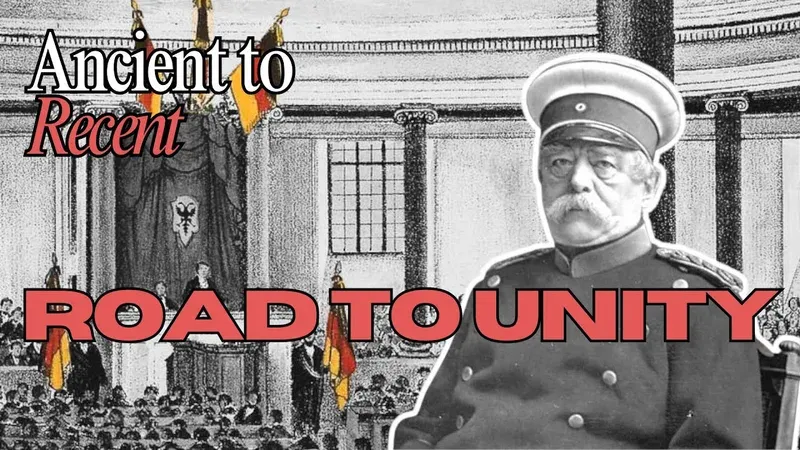
From Napoleon to Bismarck, this is the story of how Prussia unified the German states through diplomacy, war, and ruthless ambition culminating in the creation of the German Empire in 1871. Based on Iron and Blood by Katja Hoyer.
Part two out 11 July at 20:00 CEST
Read transcript
This transcript is automatically generated, so it may contain typos and misheard names.
On a bright, cold winter's morning in 1871, Wilhelm the First, the King of Prussia, had a moment of crisis. Tomorrow will be the unhappiest day of my life. We are going to witness the burial of the Prussian monarchy and this calm Bismarck is all your fault. The 73 year old king was an unlikely candidate to be Kaiser of a unified Germany. But on the 18th of January 1871, hundreds of officers from every regiment of the new unified German Army that had fought and won the Franco Prussian War so decisively gathered in the Hall of Mirrors in the Palace of Versailles and proclaimed Wilhelm Kaiser.
But the journey ahead would not be an easy one, and in Wilhelm's mind, he would always first and foremost remain the King of Prussia. His chancellor, Otto von Bisnock was also not a German nationalist. He was a Prussian first and foremost. And even the day of the proclamation of this new German Reich was actually chosen as the Prussian National Day. You see, Bismarck saw Germany as an extension of Prussia. It would take tremendous efforts to forge the squabbling, disparate people of this new German state into a nation.
How can you take Catholics and Protestants, Yunkers and Socialists, Bavarians and Prussians and Saxons and Hessians with their deep regional differences, never mind Danes and Poles, and forged together a single nation? And yet that had been the life's work of Otto von Bismarck. Would Germany survive? Many had doubted that Germany was even possible in the 1st place. Could Germany overcome its deeply held regional, class, ethnic and religious tensions? Could Germany ascend to be one of the great nations of Europe? Could Germany project out onto the world its power and might? Would Germany be able to find through a colonial empire, some way of letting go of some of its internal difficulties? Would Germany be able to find at last a place in the sun? That is the topic of today's episode of Ancient to Recent, where we will be doing a two-part episode first today and the next next Friday on what's called the Hohenzollernreich, the Wilhemina Reich, the Bismarck Reich, the story of the Second German Reich.
We're going to look first of all, at the creation of Germany, how dozens and dozens of squabbling tiny little states divided by their regional and cultural identities came together to create a single Germany. And then in the next episode, we're going to look at Germany at its imperial height from 1871 to its collapse in 1918. My name is Joseph Parkinson. This is the Ancient to Recent podcast. You can follow us at Ancient to Recent on Instagram, and you can listen as well on Spotify and YouTube. So let's dig deep.
Let's dig deep into the history of the German people. Let's look at the road that led to the creation of the German state. To understand this, as with so many things, we have to start with one man. And that man is Napoleon Bonaparte. Napoleon in his rampaging across Europe, redrawing the maps, crushing one nation, an empire, toppling one king after another, had unleashed forces that he could never possibly understand.
Prussia was the largest of the German states, but it was maybe 1/3 of the size of present day Germany. It had been a major player in European politics, but it was never as Champions League level country. It was a second rate power. It was the ally of a bigger power always, whether that was Russia or Austria or Britain. Even under Frederick the Great, Prussia had struggled to stand alone. When Prussia came up against Napoleon Bonaparte, Prussia fared no better than any other country. Prussia was blown away by Le Grande Armagh in the joint battles of Jana Ostadt in Eighteen O 6, then was forced to accept the humiliating piece of Tilsit where the weak Prussian king Friedrich Wilhelm the Third gave half of Prussia to France and half of his population as well. Prussia felt absolutely humiliated. The Germans felt humiliated by their conquest and to a certain extent colonization by the French. Germany has a very long and difficult history with France, and throughout most of that history France has been the aggressor.
Whenever France had wanted to fight wars in Central Europe against Russia or against Austria, they always fought them in Germany. And France had stripped the German states of economic resources, of foods, of young men press ganged into the French army. Huge amounts of the French army that had invaded Russia in 1812 had actually been German conscripts who were taken from their homes and musket is pressed into their hands and forced to fight for a country that they aren't part of, for an empire that they don't identify with.
And huge numbers of them were never to return. The experience of French occupation had been absolutely humiliating for the German people. So in 1812, when Napoleon is defeated in Russia and is forced to flee back through Central Europe, Friedrich Wilhelm takes the opportunity to issue this famous proclamation called I'm Mine Folk to my people, urging them to rise up and to strike a blow against the French occupiers. This would be the foundation. This combination of humiliation at the hands of the old foe and this romantic struggle by German people to finally rise up and deal a blow to the historical oppressor in 1813 and 1814 would found the romantic myth of German nationalism and it had its greatest expression at the Battle of Leipzig, which is known today as the Battle of the Nations. It was the biggest battle in European history before the First World War 500,000 people took part in it. Germans were on both sides, but it was in this cataclysmic battle that a Prussian, Austrian and Russian army surrounded and dealt A ginormous defeat to Napoleon, crushing what was left of Napoleon's army.
In this Titanic struggle, a huge role had been played by volunteer, almost amateur soldiers called Land Fair units, who had signed up out of pure romantic patriotism. Their uniform was comprised of black cloth, red trim and gold brass buttons, and these would go on to form the flag of the German Republic that exists today and the flag of German nationalism. After the Napoleonic Wars finally end in 1815, there is something called the Congress of Vienna. The nations of Europe gathered together to basically attempt to put Humpty Dumpty back together to try and undo everything that had happened over the previous 25 years since the French Revolution, Try and restore as much as conceivable on Scion Europe, just to pretend that Napoleon had really never happened in the French Revolution had never happened. We could just go back to the good old days of absolute monarchy and no constitutions, an arbitrary law, and the power of the crown and the church unchecked by anything, but it wasn't possible to completely undo everything. You couldn't really put the genie back in the bottle. The ideas of the French Revolution had been carried everywhere by French troops.
Everywhere Napoleon went, he hadn't just conquered, he'd also reorganized. He'd systematized. He'd rationalized. He'd torn down trade barriers. He'd rewritten constitutions. He'd created assemblies. Most of them were simply to serve French and Napoleon's cynical needs. But the idea still travelled. People realized actually something different was actually possible. The Allies also saw the end of the Napoleonic Wars as an opportunity to maybe do a little bit of a tidying up. I'm sure we wanted to restore as much of the old order as possible, but there is some parts of the old order that even the Allies didn't want.
One part of it was a region called the Rua. This had been connected to what was called the Austrian or Hapsburg Netherlands, which were sort of quasi territories, quasi colonies of the Austrian Empire, but they're separated by the entire landmass of present day Germany. They're on the other side of Europe, and it's full of annoying, squabbling Dutch and Belgian people that the Habsburgs didn't really want to have to spend their time actually administering. And then tacked onto that is this region called the Rua. It just seemed like a tremendous pain for the Austrians to have to continue to administer this.
So they were kind of happy to actually sign this over to the Prussians and say, hey, you know, we don't get anything out of this. You can run the Rua. This would have huge consequences because underneath the roar are vast amounts of precious metals and coal. These weren't of that much significance in the pre industrial economy, but in the 19th century as the industrial revolution takes off, these will be the natural resources that willpower the rise of Prussia and then the rise of Germany after the Napoleonic war. The genie was out of the bottle.
The shared struggle, the shared sacrifice, the sense of romantic nationalism that had swept through the German people that that maybe some people started to think, well maybe we are Germans as opposed to Bavarians and Hessians and Saxons and Prussians. These ideas started to percolate. However, any hopes of a unified German state very soon dissipated. Austria, the dominant power within Germany, had no intention of allowing its smear of influence to come together and form a body that could oppose it.
But what was created for the Germans to try and organize their affairs was something called the German Confederation. And this comprised 39 separate independent states, some of them big like Prussia, and some of them just city states like Darmstadt. And the reality is that it really had no real power. It was a sort of consultative body. It was really kind of a Congress of diplomats from the separate German states. Plus, on top of that, the chairmanship of this body was permanently reserved for the most powerful of all the German states, the Austrian Habsburg Empire.
Throughout German society, the ideas of German nationalism continue to percolate. You started to see people starting to write romantic novels and fairy tale books like the Brothers Grimm. You started to see the formation of German nationalist student societies to promote the ideas of German unification. And I think it's a very important to talk about this idea of nationalism. You see, when we think about nationalism in the 21st century, we think about World War Two, we think about Hitler, we think about Mussolini, we think about people wearing lots of black and giving funny salutes. But nationalism was a very different idea in the 19th century.
It didn't have the racial connotations. There wasn't this idea of we are Germans because we have German blood. It was about culture, it was about language. And the opposition to nationalism was absolutism. So nationalism was seen as a rational system based on culture and identity that was founded on law and constitutions and elections on parliament. It was it was seen as a ruled based system and the alternative was the power of the church, the power of the king and the power of absolute authority, arbitrary rule.
This is one of the things that made nationalism so appealing for so many people, not just the romantic mythology of it, but the idea of a more reasonable, rational system of government. Now, as the new German entity, the German Confederation, had been brought together, it had very, very few powers. But Prussia began the process of putting together a customs union. It began the process of putting together, at the very beginning, some semblance of some infrastructure that could help the German state begin to coordinate just a little bit. And it was able to draw upon the vast economic resources of the RAW to begin a boom of railway construction for the first time, knitting together these small German States and all roads leading to Berlin, not to Vienna. But economics alone wasn't going to bring about a unification of the nearly 40 German states.
What was needed was an outside threat. And in 19th century Europe, there was no lack of them. The French monarchy, the Bourbon monarchy that had been restored after the overthrow of Napoleon, collapsed in 1830, and the Olionist branch of the French royal family came to power under a man called Louis Philippe, who promised that he would be a constitutional monarch. But Louis Philippe was always under tremendous pressure. The monarchist movements in France were divided between people who wanted the Bourbon monarchy, the monarchy from before the French Revolution, people who wanted the olionist monarchy of Louis Philippe, a different branch of the French royal family, people who wanted a restoration of Napoleon, who were called Bonapartists.
And there was a tremendous vogue for Napoleonic nostalgia in the 1830s and 40s and 50s. People in France pined for the good old days of Napoleonic glory, of Austerlitz and Marengo, and people in Paris would grow their beards long to make them look more like the old guard from the Grand Almay. These people, who were already squabbling amongst each other, were contrasted then with Republicans who rejected the entire monarchical system. So the way that one French government after another tried to overcome the deep, deep divisions within French society was essentially to project French power outwards. As long as France was constantly getting into scraps, the French would all come together, rally round the flag, rally round the king to defend the idea of France. But there's a problem with that, which the French would discover in a really big way in about 40 years, which is that only works as long as you're always winning. So in the aftermath of the for the Bourbon monarchy and the rise of Louis Philippe, France gets herself involved in Egypt. France starts to try and manoeuvre to maybe take a control and share in Egyptian domestic events. But that doesn't work out and this causes tremendous humiliation to France.
And so the French Prime Minister, a guy called Adel Tier, decides well time for another crisis. So he picks a fight with the German Confederation because why wouldn't they? They don't really take the Germans very seriously. France is a superpower and Germany's this loose confederation of nothing little states that squabble and fight with each other. Yes, maybe these Germans had got one over on the French at the end, but that was a one nil last minute victory with a penalty due to a dodgy refereeing decision.
There was no way that the these Germans were going to stand up to the French. So Adeltiere demands that the new border between France and the German Confederation is set at the Rhine. It's pushed way, way to the east. And of course, this would mean large chunks of Germany and many, many German speakers would become French citizens. Nationalist fever breaks out on both sides of the border and France mobilizes half a million troops. But in this instance the fever itself serves the purpose and calmer heads prevail.
Things calm down a little bit and war is averted. With the receding of the crisis of the 1840s, Over The Rhine also was fading the legitimacy of the leaders of the German nationalist movement. Younger, more radical voices were emerging, and they pinned their hope, very much so, on Prussia. This was a period where we were seeing the real rise of more liberal politics, and liberalism, which had been a dirty word associated with French Revolution, was losing that image of the Prussian King Wilhelm the Third. At this point, we're starting to get a bit old. And he had promised a constitution again and again and again.
He promised the idea that there would be. I'm willing to talk about the idea that maybe there are some rules I have to play by. But he never went through with it, and eventually he died and he was replaced by Friedrich Wilhelm the 4th. There's something about hohenzollers naming their children Friedrich Wilhelm or Friedrich Wilhelm. I don't know what it is now. The problem with Friedrich Wilhelm the 4th is that he wasn't very good at the politics side of being a king, which seems to be quite a considerable part of the job.
He was a ditherer. He was someone who was indecisive. He would give hope to one side, then betray it, then give hope to the other, then betray it, and he would manage to just about annoy everyone. He could never ever read the route in the 1840s, even though pressure was on the rise, it was a period of intense economic hardship. Friedrich Wilhelm never really knew how to deal with this. Once the harvest failed and economic hardship and unemployment then was wed to real hunger, this created the conditions that could potentially lead to a revolution.
When demonstrators gathered outside the royal palace in Berlin in 1848 to protest for work, for political reform, for bread, Friedrich Wilhelm didn't know what to do. But his brother, he did. But his brother Wilhelm, he knew exactly what to do. He was more of a decisive man. But just because he was decisive doesn't mean that what he actually did was in any way good. And he decided to send the troops to disperse the crowd.
They gathered in front of the palace, told the crowd to disperse. They didn't respond. So they fired into the crowd. Dozens of people were killed. Now, very often this would be all. People would simply go home, but in the conditions of economic hardship, of heightened nationalist tension and of hunger, instead of dispersing the crowd, it inflamed them. Barricades went up, riots broke out. On the 18th of March, hundreds of civilians and hundreds of soldiers were killed in running battles throughout the streets of Berlin. It was at this moment that the King, Wilhelm the Third thought I may need to do something because this is getting out of hand.
So the next day as the funeral cortege passed in front of the royal palace in Berlin, Wilhelm the Third goes onto the balcony, looks at the people as they walk by and he takes his hat off. He tips his cat to them and this gives an indication maybe the king is with us. He then further fans these beliefs by the next day as there's more funerals happening, he rides out to join the procession and he wraps himself physically wraps himself in the black, red and gold flag of German romantic nationalism. Was reform now actually going to happen? Was this really possible, that maybe we could have some real and meaningful changes?
Parliamentary elections were held across the many German states, and very often, even with the incredibly limited electorate, they returned very, very liberal parliaments, and these parliaments immediately began to draw up constitutions and plans for the creation of a unified German state. However, the king had been playing them. In a rare moment of political cunning, he realized he had to defuse the situation by seeming to side with the reformers and then gather his strength. And as soon as his strength could be gathered, then he could strike a blow.
He waited until the Prussian Assembly became divided, until the Assembly for the German Confederation broke down in open bitter dispute about the nature of this Germany. A lot of people agreed that there should be a Germany, But what should this Germany look like? Soon as the possibility of it came about, that's when any unity on the part of the liberals disappeared. He took the opportunity of this anarchy to push the Prussian Assembly to physically leave Berlin.
When the Frankfurt Assembly, the assembly of all of Germany, offered him the crown, he declined. He said, how can I possibly accept a crown from a bunch of squabbling liberal politicians? You don't have a right to give me a crown. Kings are made by gods, not by votes in elections and people wearing bad suits. My rule is divine. And so this was the point in German history, the turning point, where Germany didn't turn, the moment when a unified liberal Germany was genuinely possible, and it was an opportunity that was missed.
In 1815, Otto von Bismarck was born. He was what is called a yunker. The Yunkers are the Prussian aristocracy. They are the landed Gentry. He was incredibly cunning, but also deeply conservative. However, in the early years of Bismarck's life, he had been a bit of a dandy, bit of a waste roll. He was a drinker and a philanderer and a gambler and a fighter. He's the kind of guy who would, after about 6 or 7 pints, wants to meet you in the car park.
He got into 28 separate sword fights and he actually had such a reputation around Pomerania, where he came from, of being a scoundrel, that he earned the nickname The Crazy Yunker. By 1847, he started to settle down a little bit, got himself married, and the decision came, well, what am I going to do with my life? He tried the civil service, he thought about the army, he thought about just being a professional aristocrat doing a bit of farming, and he find all of them incredibly boring and tedious.
But fate intervened, and one day he was invited to sit in for a friend of his who was ill in the Prussian parliament. He found straight away the scheming and the plotting and the conniving and the maneuvering appeals deeply to his cunning personality. So he embarked upon a career in Prussian politics. Now he was a deeply conservative man. He believed in the king, in the church, in the aristocracy, and he was appalled by the sight of seeing Friedrich Wilhelm the Third donning the rebel rag of German nationalism, the black, red and gold.
After the King played the Prussian liberals, he worked desperately on reassuring royal authority, and this led to him having quite a good relationship with Friedrich Wilhelm the Third. In 1851 he was appointed by the king to be Prussia's representative at the German Confederation. Straight away he knew who the big enemy would be, and it would not be France or Russia or Britain, but it would be Austria. Austria had dominated the German states for a long, long time, and if Prussia was to ascend to a unified German state, which again Bismarck basically saw as a projection of Prussian power, he was going to have to outmanoeuvre the Hapsburgs.
And the Hapsburgs have been playing this game for a long, long time. But Austria decided that maybe it wanted to actually join this customs union. Bismarck was able to convince the other German states to reject this proposal. It wasn't just outmaneuvering the Austrians. He also wanted to provoke them. He wanted to make them make mistakes. He wanted to present them as irrational, unreasonable, old fashioned compared to modern, aspirational Prussia.
One of the things he did was in the parliament of the German Confederation, there was a rule that said that only the representative of Austria was allowed to smoke. So he would sit in the chambers and he would light his cigars, draw deeply on them and blow big smoke rings just so everyone could see. Just as he sat there basically giving the finger to the Austrian, saying, you know, I don't accept your authority. The Austrians presented many opportunities for this young, ambitious, uncouth, younger aristocrat to provoke them. In 1853, the Crimean War is raging, and Austria is not part of this, but it's right next to it. Britain and the Ottoman Empire in France and Piedmont, a small Italian state, are struggling against Russia on the Crimean Peninsula.
Austria has stayed out, much to the annoyance of the Russians, but Austria is very concerned that this conflict could spill over into Central Europe. Austria mobilizes its army and it then calls upon the German states to mobilize their army in support. And the German states think to themselves, why? Why are we being dragged into this conflict? This doesn't have anything to do with us. Bismarck rallies the German states to send a clear message. Absolutely not.
We are not going to be mobilizing our armies to fight Austria's war. That's just not going to happen. This further isolates Austria and diminishes Austrian influence within Germany. Friedrich Wilhelm dies and he is replaced by his brother Wilhelm. Very imaginative. The Hohenzollern royal family are on their names. He's somewhat more liberal and again, liberalism is on the rise during this period. He doesn't necessarily have a great relationship with Bismarck.
Bismarck is kind of banished. These are the wilderness years. This is the difficult second album for Bismarck. He is during this period that he becomes Russia's ambassador to Paris, to Saint Petersburg. Still very, very high status role. They allow him to make some very, very interesting contacts. However, it's not the height of power. Bismarck's career seems to be being derailed. But Bismarck would get lucky yet again. You see, Wilhelm the first had a problem. You see Wilhelm the first had a problem, and that was that he was living in a bad neighborhood. He had to his W France, and he had to his E Russia. So if Prussia was going to survive, nevermind aspires greatness, it needed to be a serious military power. However, the Prussian parliament controlled the military budget and the Prussian parliament was comprised mostly of liberals. And they remembered 1848 when the Prussian army had been used to crush liberal aspirations.
Plus, on top of that, the Prussian army was very heavily drawn from these landfair units. And these landfair units were voluntary units comprised of people who were politically liberal and who very often joined for romantic German nationalist reasons. So Wilhelm the first thought to himself, I have a small army. Prussia's army was only 100,000 men, half of the size of France and a seventh of the size of Russia's, and I have a politically unreliable army.
If I actually need these troops in the event of another revolution, if I actually have to do 1848 again and send the troops in the streets to crush an uprising, are these romantic German nationalist, liberal leaning progressive soldiers? Are they going to side with me, the Prussian king, or are they going to side instead with the Prussian parliament? And that was the kind of thing that kept him up at night. So if he was going to solidify his control over the army, he's going to have to get rid of these land fair units.
And if he was going to make Prussia a great power, he was going to need to expand the military considerably. But he couldn't do that as long as the parliament controlled the budget and was populated by liberals. So he called Bismarck back from exile and he said, this is my problem and I need you to solve it. And Bismarck who tried in the early days to butter Wilhelm the first up. But Wilhelm was somewhat more of a liberal and he viewed Bismarck as a a fossil really.
Bismarck leapt at the opportunity. He saw this for what it was. This was his chance. This was his shot at the big time. He became the minister president of Prussia, essentially the Prime Minister. He decided that if the parliament wasn't going to give him what he wanted, he would ignore the parliament. I've got the king in my back pocket. The king will support me. To hell with what the parliament has to say. He decided to draft and enact a law expanding the Prussian army and just announce that this was going to be the case.
This caused outrage amongst Prussian liberals. What Bismarck did is he approached the liberals and he said, I'll make you a deal. I will agree to never do this ever again if you ratify this one bill. And as they had reached an impasse, the Prussian liberals agreed. They went along with it. Now Bismarck viewed the liberals as his enemies, but they were just one of many. There was also the rising socialist movement and the socialists working class trade unionists very often found themselves allied to middle class progressive liberals. Bismarck wanted to split this alliance. He knew that if they ganged up against him then he might not be able to stop them.
He was a very canny politician. And what he would do is he would make overtures to socialist political leaders such as Ferdinand Lassall, who is a rising Social Democrat, and they would arrange to have secret private talks. But the whole point of the secret private talks is that they wouldn't stay secret or private. He'd make sure that the details got out. And this would then immediately shock the liberals who would think to themselves, well, now we're going to be outmaneuvered.
If the conservatives and the socialists align with themselves, then we can't possibly fight against that. Which would then mean that what he really wanted, which of course was to isolate the socialists. And new to the Liberals, he could do that because the Liberals would then become more pliable, because he could always play the Liberals and the Socialists off against each other. He was someone who was rigid in what he wanted, but flexible by the means by which he sought to achieve it. He took this pragmatism, some could say, immorality, others might say, and he applied it to foreign policy as well. He'd been working diligently to isolate Austria, and he presented the rising Prussian power to all of the other major powers in Europe.
As always being a strengthening ally, never a threatening foe. He would form alliances quietly with one power or another, help it earn a favour from it, and in turn would pocket that favour always to be deployed against the great foe of Austria. Poland had been a major power within Europe as the Polish Lithuanian Commonwealth, but it declined and had been partitioned a number of times between Austria, Prussia and Russia until it disappeared, was then reestablished by Napoleon as the Grand Dutchie of Warsaw. Then was wiped off the face of the earth again and became a strange entity called Congress Poland where it was a vassal state of Russia.
It was called Congress Poland because it had a Congress. Idea was that Poland was technically an independent country, but it wasn't really. It was actually run by Russia. It's parliament was a Potemkin organization. In 1863, Poland rose in opposition to Russia. Russia reacted in an incredibly heavy-handed manner. The Russian army marches in and begins slaughtering people, lining rebels up and shooting them. There are battles against the Polish rebels. 10s of thousands of people are killed. The Russians wreak a terrible revenge against the Poles. They round up into Port.
Polish civilians, Polish women and children shipped them off to exile in Siberia. And the memories of this live very, very deeply in Polish society to this day. It's just one of many rebellions that the Poles had against the Russians, and the Russians reacted with brutal violence. Bismarck had colluded with the Russians to help them crush the rebellion and this allowed him to have in his back pocket a favor. You see, after the Napoleonic War, there was something called the Holy Alliance between Austria, Prussia and Russia, and they basically made a pact which was they would always act as as the armed wing of conservative reaction. Anytime a revolution broke out anywhere in Europe, you could always rely on these three countries breathing down your neck.
In 1848, as the revolutions had spread throughout all of Europe, one of the biggest sources of revolution had been Hungarian revolution led by a guy called Kashut Laosh against the Habsburg Austrians. It was at this point that the Habsburgs had turned to the Russians and said we are part of the Holy Alliance. You help us destroy revolutionaries and we have revolutionaries in our in our midst, within our own empires now.
So you need to send the Russian army to crush the Hungarian revolutions. And the Russians went, yeah, sure, on our way, marched over, massacre people in Hungary, crushed the revolution. But a few years later, in the Crimea, where Russia was fighting against Britain and the Ottoman Empire appeared one in France, the Russians had said to the Austrians, hey, buddy, we're friends. Remember that time, like five years ago when you asked us to do you a favor and March into Hungary and, you know, kill all those people? Yeah, Right.
Well, you know that you owe this one. Well, we're cashing that check now. So if you can now join us in our war against France and Britain and the Ottoman Empire and Piedmont, that would just be great. It was at that moment that the Austrians went. Yeah. So about that, we were thinking we were not going to help you with that one. This left the Russians furious. And really this is the breakdown in relationships between the Hapsburg, Austria and Romanov Russia.
And it's I think, is one of the less appreciated steps on the road to the First World War. From that point, Austro Russian relations, they simply never recover. And Russia was very keen to pay back Austria's ingratitude. But now Prussia in Russia's moment of need, where Russia needed to March into Poland and do a bit of hanging. Oh, those wonderful pressions had been so helpful with our hangings, thought the Russians. This further isolates Austria within Central Europe, but there's more steps that are needed. It's not just Austria that's a problem. There is the most complicated question of 19th century politics to be addressed, and this is called the Schleswig Holstein question.
To put into context how complicated the Schleswig Holstein question is, is a quote from the British Prime Minister, Lord Palmerston, who said there's only three people who understand the Schleswig Holstein question, the Prince Consort who's dead, a German professor who's mad, and myself and I've forgotten all about it. To try and sum up the Schleswig Holstein question, here's the best that I can do. Holstein was populated largely by Germans.
Schleswig is populated largely by Danes, and they were both attached unofficially to Denmark. But Holstein was also in the German Confederation, and Denmark wasn't because it's not German. The king of Denmark decided that he wanted to absorb. Schleswig and Holstein officially into being part of Denmark. This would mean wrenching part of the German Confederation, part of the German nation out of Germany, and subjecting in perpetuity Germans to minority status ruled over by foreigners. This was considered in the atmosphere of 19th century romantic nationalism to be absolutely and utterly unacceptable.
So the German Confederation turned to Austria and Prussia and said we need you to step in to defend our brother Germans living in Holstein. And so they declared war on Denmark in 1864. Joint Austrian and Prussian armies March in. This is 2 of the major powers of Europe facing off against tiny Denmark. Denmark didn't really stand a chance and they inflict A crushing defeat on the Danes. Schleswig and Holstein are annexed to be run by Prussia and Austria respectively.
However, there was a disagreement as to how these territories were going to be administered and this led to the Austro Prussian War of 1866. Now, the Prussians had been working diligently to encircle and isolate Austria. They had been diminishing their influence amongst the German states. They had proven themselves to be wonderful friends to the Russians. They'd also made an alliance with the rising Italian state and promised Italy Venice in the event of a war.
Tensions rise, war breaks out. Most of the north German states side with Prussia, the southern ones mainly I think for cultural and religious reasons. The South of Germany is very Catholic side with Catholic Austria. This leads to the battle of Königgrätz where the Prussian army crushes the Austrian army. They kick Austria out of the German Confederation, which they then dissolve, and they create a new institution called the North German Confederation, which is a more formal military alliance, a tighter, tighter union.
They also form defensive military alliances with the southern German states. They formerly annexed Hanover and Frankfurt, which allows Prussia to become a unified state. For the first time. The rule had actually been separated off from the rest of Prussia. This is a tremendous step forward for German unification. They have humiliated and defeated the Austrians. There's no argument as to who the dominant state within Germany is now.
It is pressure, but you can only hide the rise of a superpower for so long. There began to be a concern that a new state was actually emerging. Germany adopted a new flag. The old black and white Prussian flag was now superseded by a new black, red and white flag. The red and white of the North German states with the black of Prussia were combined. But Bismarck told Napoleon Third, nothing to worry about here, nothing to see.
It's this is just, you know, come on, this is just it's confederation, you know, we we've changed the flag. We'll change the name, but you know, it's it's the same thing, right? The French were starting to get nervous at this point, however, even though Bismarck was successful in kicking the Austrians out, bringing Schleswig Holstein into Germany, unifying some parts of Germany, bringing Hanover and Frankfurt into Prussia, and creating defensive alliances that had ever closer economic and military links, the southern states still guarded their independence jealously, and they still especially viewed the idea of Catholic Bavaria being governed by Protestant Prussia from Protestant Berlin was something that a lot of people in the South did not see as appealing at all.
Something else was needed. He needed them to want to become part of Germany. In order to do that, they needed to be a common foe. And who's the big bad wolf of German history? What is the birth of German Romantic nationalism? Where does it come from? Who are the heroes of German paintings and poetry and stories? Who are they romantically dying, giving their last drops of blood, their last ounces of bravery to defend German maidens against the French?
Always the French. There's a famous song called The Watcher on the Rhine. It's a part of German mythology where a young man is stood watching the other Bank of the Rhine. Who's on the other Bank of the Rhine? The French are. So if there's going to be a unified Germany, the only man that can bring it about is Napoleon, the Third emperor of France. But how to do this? You can't just write the French letter and say, dear France, please declare war on us. They have to cooperate in some way. This came from the most unexpected source conceivable. It came from Spain.
Isabel the second Queen of Spain had been overthrown in 1869, and the question then became who was going to be the new Spanish monarch In the 19th century, whenever there was a throne, it was always, well, let's find some German Prince. That always happened. We need a king for Norway. Let's find a German Prince. We need a king for Greece. German Prince. It was the tradition, it was the vogue. Isabel the Second is overthrown and the Spanish government approach a German Prince called Prince Leopold. Prince Leopold Hohenzollern of the Prussian royal family, he thinks about it, he considers it, maybe I can get a bit of a promotion, bit of a pay rise, maybe run Spain for a bit. Not bad.
Look at this from a French perspective. The French are already starting to think, OK, right, pressure starting to become a problem now. Now we can have a situation whereby on one side of the French border you've got ho in Solas, and then on the other side of the French border, on the other side of the Pyrenees, you've got ho in Solas. This will make Spain not a serious major power at this point, but a serious inconvenience. If it wanted to be allied to Prussia, it would mean that in any future war that France would be facing conflict on two sides. In the summer of 1870, the throne is offered to the Prince and Napoleon.
The third makes it known very publicly that this is not acceptable, that this would be considered an existential threat to France and an insult to French dignity. When Leopold accepts, tensions skyrocket. There's a series of meetings, a series of telegrams go back and forth. The French formally ask Leopold to withdraw his candidacy, but further to that, the French government ask Wilhelm of Prussia to publicly state that no German Prince will accept the Spanish throne.
And this is a step too far. This is groveling. The French are expecting the Germans to abase themselves in front of France. Bismarck applied every ounce of his cunning, his opportunism, immorality, some people would say to the situation. He saw this for what it really was. This was the chance that he had wanted for so long. He took the telegram, which is referred to as the EMS telegram that responded to Napoleon, in which Leopold agrees to withdraw his claim to the Spanish throne, and he edits it. He makes it sound like Wilhelm the First, the King of Prussia has dismissed the French ambassador, has treated him like he's a joke.
How dare you even come into my presence? This sparks exactly the reaction that Bismarck is looking for. The French take this as a personal affront, directed against their ambassador, directed against the person of the Emperor, and directed against France herself. How dare these Germans spit in the face of France? How dare they dismiss her concerns? Who do they think they are? Maybe they needed to be reminded of their place. Maybe they needed to be reminded that this was France that they were dealing with, just to make sure that there's no possibility of cooler heads prevailing.
Bismarck even leaks the telegram to the press. Nationalist fever whips both sides into a frenzy. France's honour has been insulted. On the 19th of July 1870, Napoleon Third declares war on Prussia. He falls directly into the trap that has been prepared for him. The German armies are prepared. They are ready and the French is not. There's also a huge outpouring of sympathy from countries around the world for Germany as Kenny, as Bismarck was.
Napoleon the Third was a blunderer. He had successfully isolated, of his own volition, France. He had sought to win legitimacy for his rule by engaging in one foreign excapade after another. He had fought on the side of the Italian states against Austria, thus alienating Austria. Then he had abandoned the Italian states because he basically lost interest in Italian unification, thus alienating Italy. He'd fought on the same side as the British against Russia, thus alienating Russia, and he'd even invaded Mexico to force an Austrian Duke on the Mexican people, which really annoyed the Americans.
He really didn't have a lot of friends. A lot of people considered France at this time to really be a rogue state in many ways, and we're perfectly happy to see the Germans, the plucky German underdogs, giving the French a bloody nose. There's no denying the sympathy that countries like Britain and the USA had in the Franco Prussian War. They were overwhelmingly for Prussia. On the 2nd of September 1870, the combined German armies met the French army at the Battle of Sedan and dealt it a crushing, crippling, decisive defeat.
Germany would surround him, bombard Paris. On the 1st of March 1871, the unthinkable would happen. A victorious German army would parade through the streets of a defeated, humbled and humiliated Paris. The German states had shown their might, have proven their worth by uniting. They had done the one thing that Germans alone had never been able to do. They had defeated France. They had shown what Germans could do if they just came together.
This is exactly what Otto von Bismarck wanted. The clamour for a unified German state led by Prussia was now unstoppable. Kaiser Wilhelm was declared the Kaiser of the new German Empire. But it's one thing to create a country, it's another thing to run it. This new German state was still a deeply divided society. Tensions of a class and region, deep seated religious differences. We're going to be hard to overcome. You can create a national anthem and a flag and a parliament, but that doesn't make Bavarians and Brandenburgers and Hanoverians into Germans.
In our second episode, we're going to look at this period of German history from 1871 to 1918, the Hohenzollern, or Bismarckian Reich, and we're going to see how Bismarck and those who came after him tried to overcome these problems, try to heal these rifts, the decisions they made, the mistakes that they made, their achievements and ultimately their failures. My name is Joseph Parkinson. This has been ancient to recent. We have been talking about the events that lead to the unification of Germany and the history of the Second German Reich, which we'll be talking about in the next episode, which will be out next Friday.
You can follow Ancient to Recent on Instagram at Ancient to Recent. Thank you very much for listening to Ancient TO Recent and look forward to the next episode out next Friday. Episodes are out every Friday, 8:00 Central European time.