
#4
The Death of Mahsa Amini and the Fight for Freedom in Iran
27 June 2025 · 43 min · Season 1
 Watch on YouTube →
0:0043:20
Also on
Rate the show
Ratings are how new listeners find the show. It takes a minute and it makes a real difference.
When Mahsa Amini died in police custody in 2022, her name became a rallying cry across Iran. This episode traces the roots of the Iranian regime's oppression from the 1979 revolution to modern-day censorship, protest, and resistance. A powerful story of women, workers, and minorities standing up to authoritarianism.
Read transcript
This transcript is automatically generated, so it may contain typos and misheard names.
Welcome to Ancient to Recent My name is Joseph Parkinson and this week we will be covering What Iranians Want, a brilliant book by Arash Aziz. I thought that considering events in the news in the last few days, it might be a good idea to look deep into the heart of Iranian society and look at some of the key issues affecting Iranian people. To get a deeper understanding of what it is that Iranians want, what the future holds for Iranians and how we got to this very moment in our history. On the 13th of September 2022, Masa Amini got off the metro in central Tehran.
It was a week before her birthday. She was from a town in the West of Iran and she had come to shop and have fun, but as she left the train station she was spotted by the Guidance patrols, the special police force responsible for enforcing public displays of morality. Her hijab was considered to be inappropriate and she was arrested. She was bungled into the back of a van with other women who were perceived as violating the completely arbitrary codes of dress in force in Iran, and she was to be taken to a detention centre for re education and to be forced to sign a pledge. This was, at the very least, going to ruin her day. It was her big day out and she protested and in response to her protest she was brutally beaten on the journey to the detention centre.
Once she arrived, she fainted and was taken to hospital. That day she was declared brain dead and a few days later she died. She hadn't come to Tehran to be a hero. She didn't want to be a martyr. She didn't want to be Rosa Parks or Rosa Luxembourg. She didn't want to be a symbol at all. She was a young woman about to celebrate her 22nd birthday who wanted to just have a fun day out, wanted to enjoy an experience that women all over the world take completely for granted. She had just been accepted into university. She had a whole life ahead of her and she was planning for her future.
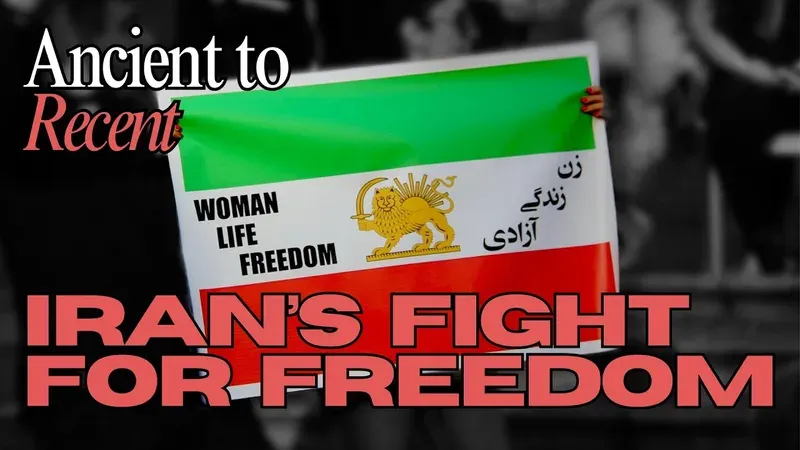
And instead she was murdered. The death of Masha Amini touched a nerve deep within Iranian society. It sparks outrage and opposition to the Islamic Republic of Iran. Protests swept through Iran in its towns and cities and villages. Protests swept throughout Iran. And her name became the most tweeted hashtag in all of Internet history. A new cry rose up. Women, life, freedom. And this encapsulated everything that people in Iran had been fighting for for decades.
In response to this, people cut their hair as a sign of mourning, which is very traditional within Iranian society. And they burnt their headscarves. People filmed themselves giving the middle finger to pictures of the Ayatollah. This reaction surprised the world. Women in Iran had endured the veil for 40 years. Iran had the strictest dress code of any country in the world, even stricter than Saudi Arabia, which had at that point began liberalising. But to understand these events, we have to delve deep into the history of modern Iran.
In 1979, there was a revolution that overthrew the Iranian monarch, the Shah. The symbol of this revolution was Ayatollah Khamenei. He was determined to reshape Iran as a Islamic theocracy. Even though people from all over society, from trade unions to communists to liberals to moderates to conservative Islamists, had participated in the opposition to the Shah, he positioned himself as the ultimate supreme leader. In the decades leading up to the overthrow of the Shah, women had been making tremendous strides.
Legislation had been passed to emancipate women, to give them the opportunities. Women had risen to positions of doctors, judges and government officials, even government ministers, but women had still participated in the opposition to the Shah. Women didn't just want the basic human rights, they wanted freedom, they wanted democracy. It was great that they were able to not be confined to the roles of simply mothers and wives, though those things are of course very honourable things to be, but they wanted the opportunity to do other things as well.
However, within this revolution, as defined by Harmony, there was no role for women. There was certainly no role for their rights. The Ayatollah Harmony had for decades spoken out against the emancipation of women. He considered it to be puerile, immoral, colonial, western, materialistic. He believed that the purpose of women was to pray, make children and make sandwiches. He'd even opposed women being primary school teachers in the 1960s, and in the weeks leading up to his return to Iran in 1979, he was interviewed by a female Iranian journalist called Nushabe Amir. And she was the embodiment of everything that he despised. Secular, emancipated, progressive, Western. They sat down at the interview and she said, You have accepted me into your presence.
And he immediately gave her an icy cold glance and said, who said I have accepted your presence? She asked him about the fear that more moderate, more secular people within Iran had about his return, a fear that they would simply be replacing 1 tyrant with another. He and his supporters reacted with outrage. How dare this woman ask the Ayatollah this question? The interview was cut short and she was threatened throughout the whole interview. He dismissed her concerns and smirked straight into her face. This was a man who held her and everything that she believed in in absolute and utter contempt.
A man full of spite and rage and hatred and intolerance. And he was the man that was coming to Iran to wool over them. But he had been the most vocal symbol of opposition to the Shah. And if your only concern is the overthrow of the Shah, he was the person who could unify the secular moderates with the more Islamists. And it was that combination that was needed to remove the Shah. And the 1st of February 1979, he returned. Within two weeks, the last PM of the Shah fled and the path was clear for the creation of a new regime. No time was wasted on the part of of Khomeini. Former officials of the previous government, including female ones, were purged, put on trial trials that lasted barely minutes and were taken out and executed. Laws protecting women rights were repealed. Women began to protest.
They began to organize. They saw immediately what was coming. Khomeini immediately began to clamp down. Khomeini had spoken the language of human rights and democracy in the months leading up to the revolution in the hope of fooling gullible Western idiots who didn't really care because they weren't going to have to live there, it wasn't going to be their home. They just wanted to embrace any form of revolutionary tourism.
And there are plenty of these people in the West. Unfortunately, Khomeini was able very often to use progressive voices against women's rights, both Western ones and within Iran. The Iranian regime immediately went on the offensive against women's rights from his mosque. I mean, he railed against makeup and the way women dress, saying they walked around naked. He described women's rights as colonial Western, Western constructs of capitalist imperialism mobs called Hezbollah.
He attacked feminists in the streets, but women rallied, women marched, women organized. Women began to fight back. They chanted. We didn't make a revolution to go back in time. They hurled against the authorities slogans like won't cover my hair, won't be smacked on the head. As Islamists laid foundations for their new state, women were their most determined opponents. The interim government after the overthrow of the Shah was a mixture of liberals, progressives, left wingers and Islamists, and they were desperate to hold together their fragile coalition. For them, they said, the hijab is not a priority. If Khomeini insists upon compulsory veiling, well, we'll just kind of go along with this.
Many Western and Iranian left wing intellectuals, socialists, communist, liberals were more interested in protecting the revolution than they were in protecting the women. And they smeared and criticised and slandered protesters within Iranian society. They said this is going to split the revolution. You demanding the right to not have to wear a hijab is going to undermine the revolution. You're going to bring about the collapse of the government.
You're going to bring about the return of the Shah as the rights of women were rolled back, as women's rights activists, feminists were beaten in the streets, arrested, thrown into prisons, abducted and disappeared, People who should have been their most natural allies said nothing. The regime made some concessions with women's rights activists, but these concessions were never intended for the purposes of actually winning over the support of women.
They weren't good faith concessions. They had one purpose and one purpose only, which was to split the feminist movement. They did exactly that. As soon as these concessions had been put into effect, as soon as they'd had the effect the government wanted, as soon as they had undermined the unity and the solidarity of these movements, it'd split off enough people from the movement to make them think that maybe how many could be negotiated with.
They immediately roll back on the concessions. Going to the beach was banned. Western entertainment was banned, Drinking was banned, Islamic dress was enforced, make up was banned, and anyone who didn't cover their hair was subject to 74 blows of the lash. As soon as Khomeini had crushed the women's rights movement, he immediately turned on the other groups. 10s of thousands of people in the next years were arrested and slaughtered by the Iranian government.
The communists, the liberals, the socialists, the secularists, all of them were 1 by 1 crushed. In 1980, Iraq invaded Iran. Iran was not in any way prepared for this. Iraqi troops poured across the borders. The Iranian government used the one resource that it had and had in great abundance, which was the lives of young Iranians. Waves after waves of Iranians, poorly armed, poorly trained, were sent to stop Iraqi tanks. Children with nothing but a hand grenade were sent against prepared Iraqi positions.
Young Iranian kids, 678 years old, were told to link arms and March across minefields just to clear the way for the advancement of Iranian tanks and troops. This is the callousness, the contempt that Khomeini and the Iranian government held the lives of Iranian people with. Just they treated it as if it was nothing, absolutely nothing. Who could care, Who could possibly care less about the lives of Iranian children? They certainly didn't.
The trauma of the war was used by the Islamist government to further justify cracking down. Intellectuals were purged from the government and society was further reformed along the lines that Khomeini saw in his most strict and stringent interpretation of Shia Islam. This was how people in Iran had to live. Even after Khomeini died and the current Supreme Leader, Ayatollah Khamenei came to power, Iran remained an incredibly repressive society.
However, things start to change a little bit in the late 1990s. In 1997 there was elections and a reformist cleric called Muhammad Hatami won. Well to understand the Iranian elections and understand the Iranian system and government. Iran is a mixture of a rigged democracy with a autocracy with a absolute monarchy. There are elections in which different parts of the regime compete against each other, sort of No one from obviously from outside the regime is allowed to participate in anything. It it is reformists versus moderates. And even then when you form a government, you still have to get any legislation you want to pass beyond the Guardian Council, which is appointed by the Supreme Leader, then to the supreme Leader.
It's a kind of rigged democracy with an absolute monarchy. But Muhammad Hatami was allowed to come to power. This ushered in a period of liberalisation. There was new newspapers, there's new books, there was more organising, there was more public discussion. But very, very quickly, harmony began the process of fighting back. Activists started being arrested, starting being disappeared, starting being tortured. This began a process of disillusionment. Reformists started to realize that really reform within the political system was essentially impossible. Even though Mohamed Hatami had said, and I quote, in civil society, people decided things, not the government. On the 8th of March 1999, International Women's Day was celebrated for the first time since 1979 and this became a huge moment in the calendar every single year and it kind of became a barometer for how much reform within the Iranian regime was actually possible.
In 1999, Hitami won the parliamentary elections. He was able to begin the process of passing some modernisation, removing some restrictions on female address. Over 30 bills were passed promoting women's rights, but these bills would just go to the Guardian Council that would then throw them out. People within the more progressive side of the Iranian regime started to push for Iran to join something called SIDOR, the Convention of the Elimination of All Forms of Discrimination against Women, which was adopted by the United Nations in 1979, and it was something that even Saudi Arabia had agreed to.
Hatami sponsored signing SIDOR in 2001 and it was hoped that it would be adopted in 2003, but again it was simply thrown out by the Guardian Council. After six years of the Hatami government, a lot of people within the women's rights movements began becoming very frustrated and this led to a split. Some people thought, well this is really the best that we're going to get. We have made some progress, let's keep working with this.
And other people thought, ultimately, every time we make a step forward, there's then a step or two back because whenever legislation is passed, it ultimately gets to the desk of Khomeini, who then just says, no, Atami had never, ever stood up to Khomeini. In 2009, there were new elections in Iran. And I used the phrase elections loosely. And these were contested by a conservative called Mahmoud Ahmadinejad. And within a few hours of the poll closing, he was immediately declared the winner. Everyone went to vote, the polls close, Hey, presto, tada, we've done with the counting.
He's the winner even by the standards of Iran's obviously ludicrously rigged elections. This was just such an insult to the Iranian people. There really wasn't even the pretence that they had even bothered to count the votes. You know, they, they, they held the elections. He just won. That was that. This led to huge protests. People poured into the streets. The reaction of the regime was the way the Iranian regime always reacts to people protesting against it.
Mass violence, The storm troopers were on the streets. Tear gas, batons, rubber bullets and real bullets. Mass arrests, people hurled into prison. This brings to an end the reforming period of Iran from 1997 to 2009. There had been a brief moment where it seemed that maybe Iran could actually change, that maybe some latitude would be given, that maybe there could be a conversation. But it was now immediately apparent that the people who really held power within the Islamic Republic of Iran, the Ayatollah and the Guardian Council, really had no interest in changing whatsoever, and they were not listening. And As for Sidor, it remained unsigned. Iran is to this day one of only five countries in the world and the others are Somalia, Sudan, Tonga and the Vatican City who have never signed Sidor.
It was in this climate that this young 21 year old girl Masha Amini was born and grew up. It is the failure of the regime to listen that would ultimately lead to her paying with her life only one week short of her 22nd birthday. As the Isfahan steel workers marched off the job on the 15th of November 2022, they remained silent. It was this silence that shook the Islamic Republic to its very core. The Isfahan steelwork had been founded in 1967. It was one of the largest industrial corporations in Iran, employing 16,000 people.
It was the jewel in the crown of the Shah's campaign of modernization. But the industrial working class had played a huge role in bringing down the regime of the Shah. It was feared that one day the workers could do exactly the same to the Islamic Republic. That caused this unnerve within the government in Tehran. In the weeks leading up to the protest, the management of the steelworks had tried to buy the workers off with their single large payment. It hadn't worked.
The workers marched and they marched for women, life and freedom. And strikes all over Iran broke out. Truck drivers refused to carry their loads. Oil workers went on strike. And this is particularly important because it was the oil workers throwing in their support to the protests in 1979 that had dealt the final blow to the Shahs regime. Steel workers, cement workers, aluminium workers, truck workers, Petro chemicals, even shopkeepers went on strike. 45 cities across Iran, from the Caspian Sea to the Pakistani border, went into the streets to demand their rights.
Even shoe stores and pizza restaurants joined in. They would go on silent strike. People would come in and the staff would say, please don't buy anything, we're on strike. But retribution was very swift. Government thugs would spray paint We are watching you on the windows and doors of striking shops. The problem that the trade unions had is that they basically had no support. There was no faction within the regime that had any sympathy for trade unions, even the progressive liberal factions and. Again, progressive fractions within the Islamic Republic of Iran, we're being pretty euphemistic here. They were pretty committed to a quite aggressive form of free market economics, and they saw trade unions as the very best being a nuisance.
But Iran had a very deep, proud, long history of trade unionism going back to the 1940s and 1950s. Iran had a very large Communist Party called the Tudor Party that had supported Mohammed Mozaddek who'd been the Prime Minister in the 1950s who was overthrown in 1953 by AUS backed CIA coup. Over the decades of the Shah, the Iranian trade union movement had been cracked down on and then was basically completely driven underground by the government of the Islamic Republic.
During the reforming period under Hatami, you started to see flickering back into life trade union activism. Workers started to organise again and there was also an attempt to bring back to life trade union culture. There would be community centres that would show movies like Spartacus to give people an idea of what they could do if they began to organise. The Iranian regime reacted in the way that it reacted to everything, with heavy violence.
Union offices were broken into, union activists were beaten up, union documents were stolen, activists were kidnapped and tortured. And so, even as teachers and cement workers and truck drivers and taxi drivers and bus drivers began to organise more and more and more, even then the reaction was always incredibly heavy-handed. On the 20th of November 2022, Katayun Rihahi, a 60 year old actress, was the unlikely subject of a vast police manhunt. She had been on the run for several months. This was because she had voice support for the Women Life Freedom movement.
In an Instagram post where she had shown herself with her long hair without a head covering, exposing her long dark hair. She was from an artistic family. Like most actors, she had had to sit the austere era of the 1980s out. However, she had become famous in the 1990s mostly by playing wholesome female roles. But in the early new Millennium, her roles became a little bit more transgressive. However, they were hardly radical.
She knew ultimately that her career progressed at the sufferance of the senses, that she would be allowed to perform her craft as long as she did so within some very tight restrictions. However, on the 16th September 2022, she had posted this infamous image of herself without her headscarf on Instagram and also a picture of Masha Amini. The regime reacted by sacking her home but she fled before this could happen. However, on the 20th of November, the house that she was staying in was surrounded and she was arrested.
As if the Iranian regime was hunting down Pablo Escobar as opposed to a 60 something TV actress. This is a massive manhunt to try and find Iran's version of Martha Stewart. Many of the people within, many artists within Iran had avoided taking a public stance because they knew, again, that their careers were entirely in the hands of the censors. The second that they stepped out of line, their days of making plays and films and acting and music was simply over. They could simply just be denied television. And for a very, very long time, Iran had imposed incredibly stringent restrictions on what could actually be said, what could actually be depicted, what could actually be performed. The Iranian regime was very, very interested in everything from poetry to art to painting.
In 2023, Iran actually ranked 4th last in the entire world for press freedom. Only North Korea, China, and Vietnam have less press freedom than Iran does. Iranian press censorship is to stare into the face of madness itself. No woman can be portrayed without being fully covered from head to toe. No ankles, no wrists can be shown for fear of being too provocative. A mother cannot hug her son, and a woman cannot shake hands with a man.
Censors must approve every script, every poem, every painting, every play, every single scene of a movie. In 2018, Amir Maddie Julie, a comedian, created a campaign to highlight the absurdity of censorship in Iran. He created a hashtag called Hashtag Me and the Censor. He asked people to send in the most absurd examples of censorship, and he was immediately flooded. He decided that he would go first once a censor asked for a scene to be cut from a series. Because the shape of a woman's ear could be just about made out under her headscarf, actresses in Iranian movies are forced to put plasters on to stick their ears to the sides of their head so that people cannot make them out. A scene where a woman ate a cucumber had to be removed. This doesn't just extend to movies and plays, it even extends to sport.
One time, Carlos Pouyamol, the former Barcelona legendary defender, was brought onto Iranian TV to comment on some football. However, only hours before his appearance, he was cancelled because he had long hair and tattoos and this was considered immodest. When Persepolis scored in the Asian Champions League a 89th minute goal against a Qatari team called Al Saad, the censors cut the feed because the striker who scored the goal removed his shirt in celebration and this was considered something too sexually arousing. These are some of the tamer and less absurd examples. In fact, my personal favorite is a nature documentary had to be censored because the scene of a water Buffalo emerging from a river and shaking the water off it's mane and hide was considered too provocative and sexually arousing to show on television.
Even football shirts are blurred. The the shirt of FC Roma, an Italian Serie R football team, shows two children suckling on the teats of a wolf, which is reminiscent of the story about the foundation of Rome, Romulus and Remus. Children abandoned are protected by a wolf. This again the sight of male baby children suckling a wolf was considered sexually arousing. These are some of the lighter and more modest examples of the repression of personal freedom and artistic liberty within Iran after the Islamic Republic was formed in 1979. The purging of Iranian artists was incredibly intense, with many artists simply disappearing and dying, dying in car crashes, falling down the stairs, having sudden heart attacks, and it was believed that this is something that was organised by the government to crush people who were considered to be too untrustworthy to be allowed to practice their craft within the Islamic Republic of Iran.
After Masha's death, protests erupted throughout Iran. One of the areas of particular disturbance was the southeast of Iran, an area called Baluchi. The people of Baluchi tend to be Sunnis in a overwhelmingly sheer society, and in society that takes its ideological foundations as being a particularly rigid interpretation of Shia Islam. The Sunnis, they don't really fit into how the Iranian state sees itself. Because of this, they have tended to be very heavily discriminated against and overwhelmingly lived in poverty. In the weeks before the death of Massa, a 15 year old Baluch girl had been kidnapped and raped by a police commander. This led to a prominent imam called Abdul Hamid speaking out against the persecution of the Baluch. He called for the trial of the local police chief. There was widespread outrage and protests against this terrible violation of the rights of a a young woman. This led to protesters gathering outside the local police station.
These protests were largely peaceful, however they were met with fire from snipers shooting dead as many as 96 people in the streets. This massacre ended up being called Bloody Friday and it played into the larger wave of protests that were taking place within Iran. The Sunnis have long been an oppressed people within Iran. Officially, they're not even really allowed to practice their religion. There is no Sunni mosque in Tehran, even though there are hundreds of thousands of Sunnis that live there. But as bad as the Sunnis are treated, they are treated nowhere near as bad as the Bahais, who are a religion that came about in the 1840s.
One of the things that was really remarkable about Abdul Hamid is that when he spoke out against the abuse of this young girl, he also made a point of talking about the abuse that the Baha'is have faced within Iran. He raised issues of the treatment of Christians and Jews and Zwaterians and how actually none of this is in any way necessary. It is perfectly possible for people to live within peace. But one of the tactics that the regimes has always used has been to play the religious minorities off against each other.
The Bahais are the most persecuted religious minority within Iran. There is no official recognition that their religion even is a religion. They are not allowed to attend universities. Whereas Christians, Jews and Zootarians are recognised as non-muslim minorities within Iran and have seats reserved for them within the Iranian parliament, even if the Iranian parliament, of course is not particularly democratic. The Bahais are one of those religious minorities that do not even have this. The story of the Islamic Republic is a story of a particular interpretation of Shia Islam, as understood by the clerics of Tehran.
For that reason, as bad as the Shia are treated in Iran, and of course the Shia are the principal victims of the Islamic Republic of Iran. The Sunnis, the Christians, the Jews, the Sawhitarians have it worse, and the Bahais have it even worse than that. They do not have a voice in their own society. They are considered bottom of the rung. There are many invisible communities. In fact, whole swathes, whole sections of Iranian society are effectively invisible.
Women are meant to be invisible, the Bahais are invisible, the Sunnis are invisible, but one of the most invisible peoples are refugees. Iran borders Afghanistan and the Afghans are culturally somewhat similar and linguistically very similar to the Iranians, but ethnically they are different. Afghanistan has had a terrible history, being invaded by the Soviet Union in 1979, experiencing a long and terrible war of independence until the Soviets finally left in 1989, which was then simply followed by a civil war, which was then followed by the US invasion in 2001, and then a long grinding conflict. Wave after wave after wave of Afghanis have fled from Afghanistan and have found themselves living in Iran. Afghanis experience terrible restrictions and prejudice within Iranian society.
There are restrictions on where they can live, there are restrictions on what work they can do, their university qualifications are effectively considered worthless, and most men can only really get menial jobs. Afghan women are preyed on sexually So intense are the racist attitudes towards Afghans that up to 40% of Iranians when polled in 2019 said that they wanted to see Afghans deported en masse. Afghan children, even ones born in Iran, are banned from attending schools and Afghans are rounded up by the Iranian regime to be shipped off to fight in various overseas adventures, especially in Syria where they have died in their thousands.
They have no rights. They are subject to random arrests and deportations that they are not eligible for bank cards or public transportation cards. When COVID-19 broke out, Afghans were very often denied healthcare, with many of them being turned away from hospital and dying. The Afghans are very often press ganged into fighting in one of the Islamic Republic's many overseas conflicts. The most costly of all of these has been the determination of the regime in Tehran to keep in power Bashar al-Assad, the dictator of Syria.
During the course of the civil war, over 2000 Iranian soldiers were killed and many Iranian people asked themselves why is Iran spending huge amounts of money propping up a hideous dictatorship? Why is Iran sending so many of its young men to fight and die in this pointless war when at the same time Iranians face unemployment, poverty, lack of public resources, hunger, economic sanctions? The Iranian government has an endless amount of money to keep Bashar Assad in power, but not an endless amount of money to feed its own people. That question kind of answers itself because foreign adventures are used as an excuse to justify the shortages, as an excuse to justify the hardship that people are living through. The Iranian state thinks that if it can project onto other countries it's vision of a society that will somehow allow Iran to escape some of its pressing social problems. On the 18th of September every year the Iranian regime celebrates could stay Jerusalem Day which is massive anti Israeli protests.
This has never really been particularly popular within Iran. It's always a sort of forced demonstration of manufactured hatred against Israel. This became a major event under Mahmoud Ahmadinejad, who would always take this as an opportunity to take the microphone so he could deny the Holocaust or call for the destruction of Israel, a country that is over 1000 kilometers away from Iran that Iran doesn't share a border with.
This has led to a lot of anger. The championing of the Palestinian cause, which is a noble and decent cause to champion, has led to accusations from Iranians who say, well, you talk about the oppression of Palestine, but at the same time you're oppressing us. You want to emancipate other peoples, but you don't want to emancipate us. These demonstrations are sometimes broken up by people who chant neither Gaza nor Lebanon.
I give my life for Iran. When the Arab Spring happened, the Iranian regime at first didn't really know how to react. On the face of it, some people within the regime thought this may be quite a good thing because it caused problems for regimes like Egypt that were sympathetic to the US and had close relations with Israel. But very soon this spread to Syria, and Syria was a client state of Iran. The Iranian dictatorship had an internal discussion as to how to think about this, but came to the conclusion very quickly that if they were to lose Assad then that would majorly undermine their support for Hezbollah. It would be a major, major foreign policy disaster for them.
They decided that no matter what the cost, they would support Bashar Assad, they would keep him in power. They basically wrote a blank cheque to the IRGC under Qasem Soleimani, the leader of the Islamic Revolutionary Guard. Do whatever you need to do. We don't care as long as Bashar Assad stays in power. Though Iran was able to play a role in the Syrian civil war, it wasn't able to play a decisive one. Iran was able to keep Assad in power, but Assad had so little support within the country that they could prevent him from falling, but they could never win the war for him. Even massive Russian air power wasn't able to win the war for Bashar Assad.
It kind of became a worst case scenario for the Iranians. Every year, Iran would spend billions and billions and billions and billions of dollars just to keep Assad in the game for another week, another month, another six months. Every year, Iran would send thousands of young Iranian soldiers to be killed on the battlefield, none of this getting Assad anywhere near closer to victory. And of course, it all played out in disaster, the tail end of last year, whereby as soon as Russian air power was withdrawn, it all fell apart. What is Iran spending all this money doing? Like, what's the point of all of this? It further creates questions within. Iranian society like why is Iran engaging in all of these foreign policy excapades?
Why is Iran supporting Hezbollah and Hamas and the Houthis? Why is Iran spending massive amounts of money to support Bashar al-Assad? What do? What do Iranians actually gain out of this? It costs them a huge amount of money. Huge amounts of people die. But at the same time, Iran gains nothing from this, and this is a live issue amongst Iranians. Iran is approaching a significant turning point, the most important moment in Iranian history since 1979, and I think it will probably come with the passing of the current Ayatollah. Iran is like the pregnant widow.
The past is dead, but the future is yet to be born. The current system of the Islamic Republic has failed. It is not capable of either delivering on a life that Iranians either economically or culturally consider to be worthwhile having. It is not able to meet their aspirations. The promise of the construction of a grand Iranian Persian Empire that Iran has pursued, or the establishment of Iran as a nuclear power is almost certainly unattainable. We have seen the collapse of Hezbollah. We have seen the collapse of Bashar Assad. We have seen the work of Qasem Soleimani being undone in recent years.
We have only in the last few days seen the terrible exchange of fire between Iran and Israel, which has seen so many people tragically die, and Iran's nuclear weapons project pursued over 20 years at the cost of hundreds of billions of dollars to a country in grinding poverty with staggering inflation. Yet it's all gone up in smoke. Iran is approaching that turning point where a new society will have to come into being, where what Iranians want will have to come to the fore.
If you want to know more about what Iranians really do want, then I would recommend reading Arash Aziz's brilliant book by that very title to get a deeper understanding of life in Iran and the aspiration of the Iranian people. I hope that the day does come where the Iranian people are free, but I fear until that day there will be more mass Aminis, more people who never had any desire or intention of being martyrs or heroes, of being symbols of anything, who are going to tragically be sacrificed on to the pointless altar of the megalomania of the Iranian government.
My name is Joseph Parkinson. This has been Ancient to Recent. New episodes of the Ancient to Recent podcast will be out every Friday at 8:00, and you can follow on Instagram at Ancient to Recent and followers both on Spotify and YouTube.