
#36
The Haitian Revolution — Part 1
7 February 2026 · 40 min
 Watch on YouTube →
0:0040:49
Also on
Rate the show
Ratings are how new listeners find the show. It takes a minute and it makes a real difference.
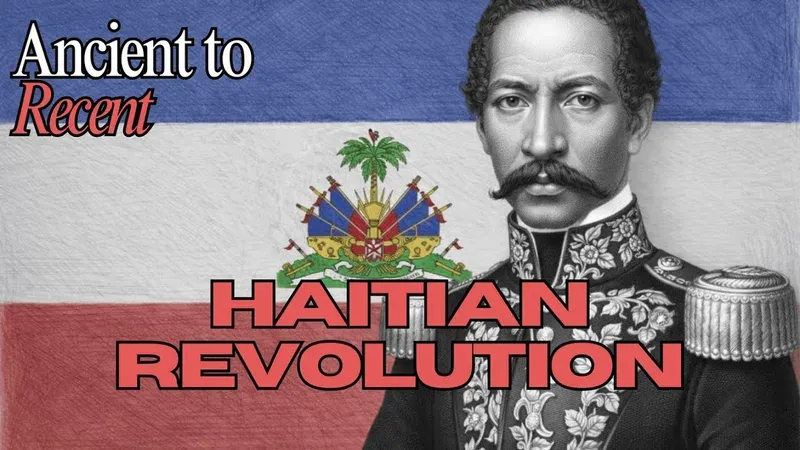
In this episode of Ancient to Recent, we begin one of the most radical and world-changing revolutions in history: the Haitian Revolution.
At the end of the eighteenth century, the French colony of Saint-Domingue was the richest place on earth. Powered by sugar, coffee, and the relentless exploitation of enslaved Africans, it generated staggering wealth for France and sat at the heart of the Atlantic economy. Yet beneath its prosperity lay a society built on terror, racial hierarchy, and systematic violence.
This episode traces the deep roots of Haiti’s revolution, from the destruction of the Taíno people and the rise of plantation slavery, to the creation of one of the most unequal societies ever known. We explore how the Atlantic slave trade, the Code Noir, and the brutal logic of profit shaped everyday life for enslaved people, free people of colour, and white colonists alike.
As Enlightenment ideas spread and the American and French Revolutions challenge old assumptions about power and liberty, Saint-Domingue becomes a pressure cooker. Free people of colour demand rights, plantation owners tighten their grip, and enslaved people endure conditions designed to crush both body and spirit. Maroon communities grow, repression hardens, and fear begins to rule the colony.
Out of this violent and unstable world, the conditions are quietly set for the emergence of Toussaint Louverture, a former slave who will soon rise to challenge empires and redefine the meaning of freedom.
Join Joseph Parkinson as Ancient to Recent begins a new series on the Haitian Revolution, the only successful slave revolt in history and one of the defining events of the modern world.
🎧 New episodes every Saturday
📲 Follow on YouTube, Spotify & Instagram @AncientToRecent
…
#HaitianRevolution #Haiti #ToussaintLouverture #Slavery #AtlanticWorld #FrenchRevolution #Enlightenment #ColonialHistory #HistoryPodcast #AncientToRecent
Read transcript
This transcript is automatically generated, so it may contain typos and misheard names.
I was born slave at nature, given the soul of a free man, Toussaint le Mature. The late 18th century was a time of turmoil, a time of transition, an old world, the world of Thrones and dominions of church and crown. The aristocrat and the Parson were not just being challenged, it was being violently torn apart. Everything that seemed only yesterday to be set in stone was all of a sudden turning to dust. In 1775, the 13 English colonies clinging to the eastern coast of British North America rose in opposition to the royal government.
With a cry of no taxation. Without representation, these colonies would win their liberty to become a self governing Republic. In 1789, an angry mob, ground down by economic stagnation and driven forward by the growls of empty stomachs, stormed the Bastille, the symbol of royal terror that so dominated Paris, beginning the French Revolution with its motto of liberte, Egalite and fraternity. But it wasn't just political change.
The world had seen many wars and revolutions before, but these new conflicts did not simply seek to redraw lines on a map or change one divinely appointed ruler for another. These revolutions challenged everything. The Industrial Revolution was transforming how people worked, how they slept, how they ate, drank, and what they wore. New ideas like democracy, nationalism, and equality were changing how people thought about the world around them.
Old ideas about property and rank were being challenged by new concepts that seemed almost unthinkable a generation before slavery, the oldest institution in all of history, practiced in almost every society and for many it's simply unquestionable reality of life. A natural order was being called to justify itself. There is one event that, above all, brings together all of these different currents. But it was not the Founding fathers in Philadelphia, nor was it the firebrand speakers of the French National Assembly who were the vanguard of this revolution.
The brightest fires burned not in the US or France, but on the small Caribbean island of Hispaniola, especially the French part called San de Man, or as we would today call it, Haiti. Welcome to Ancient to Recent. My name is Joseph Parkinson and today we start a brand new series on an event so seismic it would change the world forever. The Haitian Revolution of 1791 episodes of Ancient to Recent are every Saturday and are available on YouTube, Spotify and Apple Podcasts. The island of Hispaniola is the second largest in the Caribbean, surpassed in landmass only by Cuba. It is also the most populous, with some 23 million people across it's two sovereign nations as of 2026. On the western third of the island there is the Republic of Haiti, population roughly 12 million. The eastern 2/3 of the island are taken up by the Dominican Republic, with approximately 11,000,000 citizens. Pre the advent of European colonization, the island was inhabited by many peoples, with the largest group being the Taino, part of a family of tribes who spoke a similar Arawak language, the Tyno had migrated to the island they refer to as a Haiti.
Starting in roughly 400 BC and being completed around 1200 AD, the indigenous peoples had a rich culture complete with complex religious and political structures. Christopher Columbus arrived on either the 5th or 6th of December, 1492. Columbus would say of the island. Hispaniola is a marvel. It's hills and mountains, fine plains and open country, are rich and fertile for planting and for pasturing, and well adapted for building towns and cities.
There are very lofty and beautiful mountains, great farms, Groves and fields, more fertile both for cultivation and for pasturage. Of the Tyno, Columbus said the inhabitants are all destitute of arms which are entirely unknown to them, not an account of any bodily deformity, for they are well made-up, but because they are timid and full of terror. But when they see that they are safe, and all fear is banished, they are very guileless and honest, and very liberal in all they have. They might become Christians, and inclined to love our King and Queen and Princess, and all the people of Spain. Sadly, it would be all downhill from here for Spanish tiny relations.
Columbus left behind a small contingent of sailors returning the next year. He found they had all been killed and buried nearby, with a local chief claiming it had not been he who had been charged with the sailor's protection by Columbus, but rather a rival clan that had done The Dirty work. Maybe so, maybe not. We will never know. The Thai nose were sadly for them to find out. There were plenty more Spaniards on the way. It would not take the Spanish with their steel swords, crossbows, muskets and cavalry too long to subjugate the indigenous people.
What awaited the Tinos after defeat was the incommeter system of forced labour, slavery and dispossession where indigenous peoples would be cared for or as we would say, exploited by Spanish land owners who worked them to death. Estimates of the Tinos population vary considerably, with some putting the population as low as 250,000 and others as high as 3,000,000 pre Columbus. What we do know for a fact is what the indigenous population was shortly after the arrival of the Spanish. By 1514 only 29,000 Tainos were left. By the mid 16th century the Taino population had all been vanished.
Some Spanish officials actually reported that the Taino had ceased to exist. It was not quite a total extirpation, but certainly a mass population and cultural collapse, with a few survivors marrying and integrating into Spanish society and adopting Spanish customs, language and religion. Hispaniola was, as Columbus had previously noted, a rich and fertile land, ripe for planting and perfect for the growing of cash crops.
But in order to take advantage of this potential bonanza, the island would need labour, and lots of it. People came and they came from all over, from Spain and Portugal, from Naples, Rotterdam, from Antwerp and Glasgow. They came voluntarily, and they also came as slaves from the West Coast of Africa. 10's and hundreds of thousands came to toil in the back breaking sun, to till the soil, to labor, to suffer and to die.
The importation of African slaves had actually been suggested as a perverse act of altruism. As the native population collapsed, it was believed that Africans could be brought to do the back breaking toil that seemed to devastate the native peoples. Sugar cane had been introduced by the Spanish in 1493, and by the early 1500s colonists had begun establishing plantations and sugar mills. By the mid 16th century, Hispaniola had become the most economically malleable colony in the world. More land was turned over to production, more mills founded, more sugar cane grown, and as demand for sugar rose, so too did demand for African slaves.
The island also served an important strategic purpose for Spain and its ambitious empire building exploits in the Americas. It was from Hispaniola that expeditions will be launched to conquer Cuba and provide a valuable staging point for missions to mainland South America. The Spanish had initially only settled the eastern part of the island. In the early 17th century. The French arrived at the western part, establishing their own plantations, mills and bringing their own slaves. The French were no allies of the Spanish, nor were they the only competition.
Hot on French heels came the English 1st as pirates seeking to steal as much Spanish booty plundered from the Aztec and Inca civilizations the Spanish were busy ransacking in the 16th century. Then as settlers, traders and colonists themselves. French, English, Dutch, Danes, Swedes, as well as the Latvians and Scots all set up colonies in the Caribbean and Central America in the 17th century. The French name for their colony on Hispaniola was Saint de Man.
It's fields were worked initially by a mix of both black and white labourers, black slaves who toiled till death did them part, and white indentured labourers who had sold themselves into a period of servitude in return for transportation to the new world to be released after they had served their time. The main focus of the French colony was sugar. Sugar had once been a luxury for Europeans, imported at Greek expense from the Middle East.
Persia and India carried on the great trade route that was the Silk Road. But with the European colonization of the Americas, Europeans could now cultivate their own supply and cut out the Arab traders who jacked up the prices. By the late 17th century, sugar was in mass demand, and with mass demand came mass production. With the demand for sugar surging, so too did the need for labour. In the dying days of the 17th century, white workers outnumbered blacks in sand demand.
But with the need forever greater human toil, the quickest and most economic approach to satisfy demand was the importation of ever greater numbers of black slaves. By the mid 18th century, the black population outnumbered the white by nearly 12:50. But for many whites, Sandomang turned out to be anything but a land of milk and honey. With the French loss of Canada to the British in 1760, Sandomang became the destination of choice for Frenchmen seeking to escape poverty at home. Many of them came with neither skills nor connections and found only alive of renewed destitution awaited. Some took to forming armed bands that terrorized colonial authorities and rendered parts of the island lawless. In the early 18th century, a new cash crop began being cultivated in Hispaniola, Coffee.
Coffee had all the advantages of any drug, highly addictive and thus creating its own demand. But unlike the other Class A substance of the 18th century, sugar, coffee required very little start up cash to begin growing and could be grown in more mountainous climbers. As intoxicating as either coffee or sugar were taken separately, mixed together and administered orally, they created a potent cocktail that would power the industrial revolution. Demand for coffee sky rocketed by the eve of the French Revolution in 1789.
San Damang was producing half of the world's coffee and exporting more sugar than Brazil, Cuba and Jamaica combined in the global race for market share. That was the game of empire. The French had in San Damang a money making machine. So important did Saint-Domingue become to the French economy that one in 25 Frenchmen earned a living directly tied to the fate of the colony, and a full 15% of the French parliament was invested in colonial affairs by the eve of the French Revolution.
As the money flowed in, Saint-Domingue took on the trapping of a boom town. Bars and salons opened, a theatre was constructed, churches erected, public baths, newspapers established, even a wax museum was opened. A daring adventure if there ever had been considering the tropical climate with temperatures reaching 35° C. The port was crowded with workers unloading manufactured goods shipped in to increase the comfort of the booming white land owning class and raw materials shipped back to France. Sandomang was also home to a growing free black community. Slavery was not necessarily a permanent state for Africans on Sandomang.
Some were able to purchase their freedom, others were set free by their masters. By the 1780s there was a free black community of around 30,000 people. The lives of black slaves were governed, at least officially, by the Code Noir, which had been introduced in 1685 by royal decree. The Code Noir regulated the our slaves could work the conditions of their labour and mandated that slave masters must provide food, clothing and shelter whilst offering protection from abuse.
Though nice in theory, the reality is that in San demand, some 4500 miles away from France, these rules were all too often simply ignored and masters did to their slaves as they so desired. Further efforts were made to improve slaves lives by creating a system where slaves could report abusive masters. Punishment was outlined by arbitrary violence towards and murder of slaves, but any attempt made by reforming governments in Paris to improve the lot of enslaved blacks on Sandomang were either violently resisted or simply ignored. It was not just the treatment of slaves that caused tension between colonists and government officials. As a French colony, Sandomang had to accept limits placed on economic activity by the French government. There were strict rules governing trade, with economic exchange between Saint Damang and the colonies of Britain and Spain so tantalizing the close forbidden yet again. Orders from Paris were often ignored with smuggling, especially with nearby Jamaica common. Many French colonists envy their British neighbors with their elected assemblies and believed their economic interests may well be better served under the shade of the Union Jack, with some going as far as to advocate annexation by London. A slaves day began before dawn and would continue till nightfall, sometimes longer if there was a full moon. To keep the slaves working, the masters employed drivers, often black themselves, whose favorite motivational tool was the whip and whose job it was to deal out the beatings to those believed to be slacking.
Newly arrived slaves, often weak from the punishing sea voyage, would be put to work growing vegetables or engaging in other forms of somewhat light labor. Those at full fitness would be given the more arduous task of digging canals or harvesting sugar cane. To extract the juice from the cane, slaves would feed the cane into a contraption, a set of interlocking wheels that would crush the cane. The machine was powered either by water or a mule.
If an exhausted slave had the misfortune of getting their finger caught as they fed the sugar cane into the press, they too would be dragged in fingers 1st till their body had been crushed to a pulp. Many slaves lost hands or arms in this manner. Many slaves would be used as domestic servants, becoming cooks or coachman. This had both advantages and disadvantages. Domestic slaves were more likely to form bonds with their masters and thus to be emancipated, but female slaves would often find themselves powerless in the presence of their male owners and subject to sexual violence. Slaves would be given small plots to grow their own land, thus saving the masters the trouble of feeding them. Slaves had Sunday and part of Saturday off to tend to their plots and with their masters permission, the opportunity to travel to town to sell excess food or handcrafts and also to attend religious services.
Local churches would have separate religious ceremonies for blacks and whites. Slaves lived off a diet of spinach, potatoes, squash and any other food they could scavenge such as oysters and even crocodile eggs. Slaves that resisted their masters were subject to a range of punishment. Whipping was most common as it was not reduced the slaves ability to labour. Open wounds could be rubbed with hot Peppers, salt, lemon, or ash to increase the pain. Other punishments, such as having gunpowder inserted into the anus, the burning of genitals with hot coals, or even in extreme cases, being buried alive, also occurred. Many slaves kept their head down, but some resisted. Some ran away, escaping either to the mountains and forests or into the towns where they could blend into the free black population.
Passes were required for All Blacks, which any white could demand to see, but such passes were easy to forge. Slaves resisted in other ways. Strikes occurred, and masters did not always react with uniform brutality. Some chose to accommodate slaves by removing particularly unpopular overseers in the jungle. Slaves formed bands collected together from runaways, and they became a major problem sometime raiding plantations.
These bands carried many names, but were commonly referred to as maroons. The colonial authorities were worried not just by raids, but also by the example these maroons gave to those still enslaved. Officials came up with an ingenious solution. They turned poacher into gamekeeper by enlisting the maroons to capture and return runaway slaves. In return for being left alone. Slaves will be branded upon arrival and each time they were resold.
Some slaves were branded repeatedly as they passed from the hands of 1 owner to another. Life was cheap, and so were slaves. Plantation owners calculated that maintaining slaves with decent food, shelter, clothing and medical care was more expensive than simply replacing them, especially as the physical toll of labour meant that a slave began losing their value as soon as they started working. Mortality among slaves was around 5% per year, with infant mortality running at a staggering 50%, so fresh slaves were constantly needed to replace those worked to death.
Most slaves in Sandomang were from Senegambia or Benin and many had been sold by rival African kingdoms after being captured as prisoners of war. Roughly 50% of slaves could expect to die within five years. Between 10 and 20,000 fresh slaves were imported legally into St. Damang in the 1730s. By the 1780s that had risen to 40,000, peaking at 48,000 in 1790. Roughly 680,000 slaves arrived in Saint Damang in the 18th century, with a further 100,000 dying on the journey from Africa. These are only the official figures. There was widespread smuggling of slaves. The true figure is somewhere between 800,000 and 1,000,000 people brought to slavery, with untold hundreds of thousands dying on the journey.
In total, San de Mang was the destination of a full 10% of all those transported in the transatlantic slave trade. In the late 18th century, questions began to emerge not just about the viability of slavery, but rather about it's morality. The 1685 Code Noir outlined circumstances that may lead to the emancipation of slaves. Once a slave was free, but with their legal status to be now they're free, then certainly they had rights.
Would a former slave then be a a citizen? This grew into a pressing issue as free people of colour took up more positions of authority within the colonial government. And yet, despite the growing prominence of black faces within the regime, if admittedly at low levels, any suggestion of further political rights was violently resisted by the slave owners. The Code Noir stated that once a slave was freed, they would be granted the same rights as anyone else. The only noticeable difference was that they would be expected to show respect to their former masters and could also be subject to re enslavement as a potential punishment. But this would not apply to their children who had never been enslaved.
The racial discrimination was endemic on a day-to-day basis. There were an early 18th century sand demand. No legal restrictions placed on people simply for being of African descent. Free blacks could live anywhere they liked, travel as they pleased and take up any profession they so chose. As the 18th century progressed and questions about the morality of slavery increased, so too did legal restrictions placed on persons of African descent.
Increasingly, official documents registered an individual's race and the state sought to categorize people by the colour of their skin and their ancestry. Discrimination along racial lines became systematized with ad hoc legislation combined into a structure of legal racial oppression. A raft of new laws designed to strip people of colour of their rights was passed. In 1763. Black people were banned from participating in medicine, performing surgery or being pharmacists. This was for the next year by a law that forbade blacks from being notaries or practising laws, which was followed itself by a 1773 law that forbade black spouses or children of mixed marriages from taking their white parents or partners last names.
Soon there were laws forbidding blacks from riding in carriages, owning similar furniture to whites, or even dressing like whites. But the eve of the French Revolution of 1789, the legal system of Saint-Domingue had been thoroughly racialized. What happened? Why had a society that only a generation before saw free whites and blacks mixed, live together, start families, all of a sudden place such restrictions on the liberties of free blacks?
The answer is sex, or rather the byproduct of sex. You see, in the early decades of white settlement in black enslavement in Saint Demag, there were very few white women, so sex between white men and black women had been common. As such, the island suddenly had a large number of mixed race children. These children, as the descendants of the first man who had been part of the sugar and coffee rush, often had wealthy fathers, and many of these fathers were happy to hand their property and with it their wealth to their multi ethnic offspring.
As such a new class begin to emerge, a class that was landed wealthy and brown white men coming to the colony often found themselves marrying up when they took brown skinned wives, with many of them bringing nothing but their white skin to the marriage. Many whites who came to the colony saw themselves all of a sudden the social and economic inferiors of those they considered themselves to be inherently better than. The sense of resentment was especially strong amongst French women who found the task of landing a husband much harder as all too often French men chose black women over white. A lively discussion began as to why so many white French men were choosing black wives, with one theory suggesting that as white families often employed black wet nurses, that white boys were somehow infected with lust by being breastfed by black women.
The children of multiracial unions were sometimes sent to France for education and refinement and came back with all the airs and graces of fine Parisian ladies and gentlemen. Noticeably different from the uncouth manners of working class whites on Saint de Mang, some mixed race families became very wealthy indeed, with land, property, and slaves all of their own. Blacks increasingly took up positions in the government, including positions of authority in the police, militia, and French army.
The social advancement of blacks, even in the face of greater legal restrictions, undermined the very logic of slavery itself. The late 18th century was the age of the Enlightenment. It was the age of reason, logic, and science. All around. Superstition and convention were being challenged by radical thinkers such as Kant, Smith, Hume, Russo, and Voltaire. I have a favorite quote from Voltaire, an outspoken atheist. On his deathbed he was asked by a priest if he renounced Satan, to which Voltaire applied. My dear man, now is not the time to making enemies in the coffee shops of Paris, London, and Philadelphia. The great and the good, ferociously debated. Where does political power come from? Is there a God?
What is the source of the legitimacy of the king? What is society? Of all the arguments, few were quite as emotive as those over the ideas of race and slavery. Abolitionism began to gain ground in the 18th century. In the early 18th century, much opposition to slavery came from religious groups such as the Quakers, but the banner was taken up by Enlightenment thinkers as the century progressed. In 1772 there was the Somerset Case, a landmark legal ruling in Britain, where Lord Mansfield ruled that slavery had no legal basis in English common law, resulting in the freeing of a black slave by the name of James Somerset and establishing that any slave brought to Britain could not be held against their will, though notably this did not apply to British colonies. In 1775, the Pennsylvania Abolition Society, the first anti slavery body founded in the American colonies, was established, with early members such as future President Benjamin Franklin amongst its ranks. Vermont abolished slavery in 1777, and Pennsylvania passed the first Gradual Abolition Act in 1780, allowing for children born to enslave parents after the 1st of March to be freed at the age of 28.
In 1787, the Society for the Effective Abolition of the Slave Trade was founded in London, led by William Wilberforce, which staged debates, collected signatures for petitions, organized boycotts of products produced by slaves, and relentlessly campaigned for the end of the slave trade in Paris. The Society de is Amaze des Noir, Society of Friends of the Blacks was established in 1788 by Jacques Pierre Bisot, which advocated the abolition of slavery and gradual emancipation of slaves. But it was not all one way.
Business interests rally to the defense of slavery and often found a sympathetic ear in government circles. In the 1780s, new laws were introduced in France against black people living in Paris, requiring them to carry documentation proving their rights to residents, and new legislation was introduced criminalizing interracial sex. In 1788, King Louis the 16th, facing a spiralling economic crisis brought on by France's participation in the American Revolution, turned in desperation to the Estates General. To call an Estates General was a radical step indeed need as it was a clear indication of just how desperate the situation was. No monarch had called an Estates General since Henry the 4th in 1614.
Louis ruled as an absolute monarch. His will was law. But some crises are too much even for God's anointed king, and Louis reasoned that as measures were certain to be unpopular, best share the blame. The body was comprised of the three estates of the realm, the first estate, the clergy, the second the aristocracy, and the third the plebs. The affairs of the realm were to be discussed at length, reforms passed, and fingers crossed France would emerge from the crisis.
That was the plan, at least. The Assembly was deluged with petitions, initiatives, requests, demands, and a few threats. Essays were composed by the society. There's Amis, there's Noir regarding the moral imperative of the abolition of slavery and sent to every single attending delegate regardless of rank. The king had encouraged the compiling of lists of grievances. 49 would relate to slavery. When the assembly gathered, many delegates delivered fiery speeches against the injustice of slavery.
But not everyone was swept away by the spirit of the age. Powerful economic interests rallied to block off anyone who sought to undercut the rights of merchants and plantation owners. In July 1788, the French plantation owners of Saint-Domingue send their own representatives to the Estates Generale to speak on their behalf. They demanded both permanent representation within the Estates General and a colonial assembly for Saint Demang that would be free of the meddling of the bleeding hearts of the Parisian coffee shops with their ridiculous talk of equality and emancipation.
Though the white plantation owners had sent delegates to speak for their interests, they had neglected to invite the free blacks to join them on the island. As royal authority collapsed, white colonists began to organize to seize power. It was a 2 pronged approach, pressure at the heart of the empire and changing the facts on the ground. In Saint Demag, the plantation owners were leaving nothing to chance. In July 1789, the Saint Demag representatives arrived to press their case at the Estates General.
There was one problem. The King had called representatives from across France, not across the Empire. The 17 plantation delegates showed up uninvited and unwelcome. A discussion was held as to what was to be done with them. They had, after all, come from half a world away, and were they not French citizens? The delegation was granted admission to the Chamber, but was denied voting rights, as the Estates General said about its business Tempest flat. In a grand gesture, the clergy in the aristocracy, seeing things could take a decidedly ugly turn, one that was highly unlikely to be in their favour, renounced their privileges. In this atmosphere of heightened revolutionary tempers, demands even went forth that if the business of the Estates General is the dismantling of privilege, then what greater privilege could there be than the right of a man to own his brother on account of the colour of their skin? But still abolitionists, even in the bedlam of liberty, were in the minority.
There was a simple reality to slavery. The business of slavery was, well, business. And cold, hard cash, even in the midst of a revolutionary Tempest, was still king. There were too many fortunes tied up with the coffee and sugar plantations of Sandomang, too many jobs, too many merchants. And those merchants had no lack of friends in the halls of power. A ferocious pamphlet war erupted with pro and anti slavery publishing houses churning out material that range from the cold and considered to the downright salacious. In the end, it was coin that spoke loudest. Discussions stalled in the assembly and arguments by plantation owners and merchants that emancipation or further rights for free blacks could set up a chain reaction that could lead to slave rebellions and with it, economic ruin carried the day.
With France having lost Canada and been driven out of India with his economy in a desperate state, national prestige and the economist's balance sheet trumped humanitarian concerns. Plantation owners were many things, but sloppy was not one. Their approach to the preservation of racial hierarchy and the wealth they derive from it was brutally thorough. They had taken their case to Paris to see off radical calls for emancipation. They had set about establishing their own assemblies in Saint Demagne to make sure the levers of power were to rest in their hands.
But how to prevent word of the Revolution getting to the slaves? Surely all this talk of liberty was going to be bad for business once it made its way across the Atlantic. The plantation owners swung into action. All publications and correspondence coming from France were confiscated. Blacks who had been in France during the Revolution were forbidden from returning. Rigorous though these efforts were, such steps could only delay the inevitable, and they did not apply to whites. Words travelled, despite the best efforts to muffle the call of freedom.
When word of the fall of the Bastille got back to Saint Daman, it was white mobs, not blacks, that celebrated with drunken riots. Such scenes made covering up what was happening in the mother country decidedly challenging. Colonists began setting up their own assemblies as the royal government collapsed, borrowing from their British neighbors. Elections were to be held and unlike in France, no property qualification was to be required to cast your lot.
But there was to be two restrictions. Firstly, a voter had to be male and secondly they had to be white. Free blacks, even those who held government positions and commanded considerable wealth, were to be barred from deciding the affairs of the state. In May 1788, articles appeared in Saint Demang that attacked slavery and talked through the creation of the abolitionist movement in Britain. A great stir was caused in the colony. What could it mean?
Was this the end of slavery? What would be the fate of the plantation owners? The colonial assembly's clamped down ever harder. Anti slavery whites were arrested and thrown in jail. Passengers arriving from France would be questions. Tensions rose as ever more restrictions were required. But the cat was already out of the bag. Plantation owners entertained their wildest fears. We should be ruined. Worse, we should be killed. There will be a rebellion.
The slaves shall cut our throats. The three blacks will lead the massacre against us. We must defend ourselves. In the nearby colony of Martinique, word of the revolution had indeed sparked an uprising. Slaves had killed their masters and tried to throw off the shackles of oppression. On San Damang. The plantation owners bolted their doors shut at their windows, took a musket and sword and prepared for the worst. Fear quickly turned to violence as angry white mobs beat blacks and any white who was believed to harbour abolitionist opinions in the streets.
Despite the best efforts of the plantation owners, a delegation of free blacks managed to scramble aboard a ship bound for Paris. They would take their demands for liberty to the heart of the Revolution itself. In Paris, the free black delegation arrived in 1789 to press the demands. They called not for the end of slavery, but rather for the lessening of restrictions placed on free blacks in the colony and the right to have a say in colonial affairs. Debate raged in Paris, often descending into ugly farce. The pro slavery lobby harnessed every resource to press their case.
Planters insisted that it was all well for fine gentlemen of lofty principles to speak of liberty. In the coffee shops of Paris, such men have never stepped foot in the Corneys. Such men drew not just their fortunes, but the luxuries that they indulge to every turn from the economy of slavery. If they hated slavery so much, will they give up their coffee? No. Will they forgo the sugar they consume in cakes and tarts?
No. What will they say to those ruined by the end of slavery? Hard luck? Too bad. Will they pay for the upkeep of those they have deprived of their livelihood? No. And what if the risk? These fine gentlemen dismiss the dangers of slave uprisings and do so from thousands of miles away? It is not their homes that will be destroyed. Their wives and Dorses defiled. The liberals of Paris, so the planters argued, was simply opining of subjects that they did not actually understand and playing with fire when they seem to not even know that fire was hot.
They should keep their fine ideals to themselves. But it was those who lived in the colonies who lived and breathed the perils of the plantation, and who therefore understood the issue. They should set the law. Unless, that is, France wished to repeat the mistakes of Britain and lose her American colonies to rebellion, not of the black slaves, but of the white plantation owners. Radical shot back. What was the revolution for?
Had one system of oppression been overturned simply to be reincarnated in a new and more despicable form? Is a new aristocracy to emerge? 1 Not of property, but of race? How can France speak of liberty if so many of her children were ground to dust under the lash of the overseer? If the corruption of the colonies and the sin of slavery is the price for the retention of sand man, then there is no prize at all, and France would be better off without.
Fine rhetoric and lofty ideas may raise the hearts of men, but they pay few bills. More and more the debate shifted in the plantation owners favour. The Estates General sided with the plantation owners. In the end, a new law was proposed. The Constitution of France would guarantee rights and liberty to all men, but the Constitution would not be applicable in the colonies. The Planters had their way. Seeing no hope in pursuing their rights through the legislative path, Free blacks began to take a page from the planters book. They began to arm themselves.
Vincent Oje had been the leader of the Free black delegation to Paris. Dejected, he met with British abolitionists and began to arrange for shipments of weapons. If the whites would not give the blacks liberty, then the blacks would take it for themselves. Arriving back in Santa Man in 1790, Ogier quickly assembled a band of several 100 armed supporters and demanded the assemblies admit all men, regardless of race. If his demands were refused, they would be blunt.
The plantation owners had not come this far, had not over decades dismantled the rights of blacks and manoeuvred to free their hands of Parisian meddling just to give up. Now, as they sat on the cusp of vesting all political and economic power in their own hands, the plantation owners responded with force. The militia crushed the uprising. O'Shea fled to Spanish controlled San Domingo on the other side of the island, but was extradited on the demands of the plantation owner.
O'Shea was shown no mercy. He was broken on the wheel and along with twenty other conspirators, executed. Their heads were mounted on Pikes and bodies displayed just in case any of the blacks wish to discuss their rights. Not too many years before, free blacks had seen in the white population their natural allies in maintaining a system they both benefited from at the expense of the slaves. O'Shea and the free blacks had not entertained the idea of the abolition of slavery and had viewed black slaves as inherently suspicious. They had sought not to overturn the system, but rather to guarantee their place within its power structures. Now the message had been heard loud and clear by free blacks. Their blackness was what made them outsiders, untrustworthy, and less in the eyes of the whites. The free blacks now saw in the slaves not a class to be feared and exploited, but a force to be harnessed against their mutual white oppressors.
The National Assembly had managed to achieve the worst possible outcome. White colonists spared the imminent abolition of slavery and with it not just the destruction of their way of life, but their certain murder. The free blacks had placed their faith in the institutions of the French state such as the Estates Generale, but regardless of the fine oratory, they had found their demands for human dignity gone unheeded. The legislative Rd. had come to an end, but the desire for freedom had not.
The flame of liberty burned brighter than ever. The blacks of Sanderman, both free and slave, now knew if they were to be free, it would be through their own endeavours alone that liberty would be won. Thank you for listening to Ancient to Recent. Next week we will continue the story of the Haitian Revolution. Episodes of Ancient to Recent are out every Saturday and are available on YouTube, Spotify, an Apple Podcast.