
#35
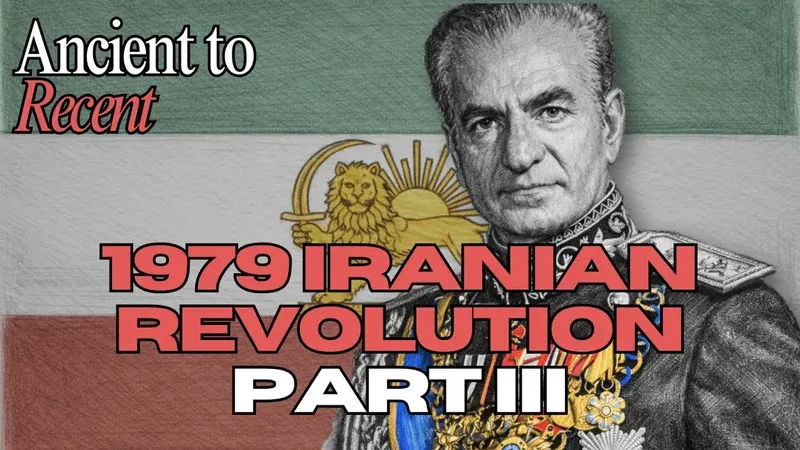
The Shah and the Iranian Revolution — Part 3
1 February 2026 · 1 hr 0 min · Season 1
 Watch on YouTube →
0:001:00:18
Also on
Rate the show
Ratings are how new listeners find the show. It takes a minute and it makes a real difference.
In this episode of Ancient to Recent, we follow Iran through the decisive year of 1979, the moment when a crisis becomes a collapse, and a monarchy that once looked unshakeable disintegrates in a matter of weeks.
As protests intensify and strikes paralyze the economy, the Iranian state begins to lose control of the streets. Police forces buckle, government authority evaporates, and law and order gives way to uncertainty, fear, and momentum. What begins as unrest becomes something far more dangerous: a revolution no longer contained by the institutions meant to stop it.
At the same time, Washington is divided. Inside the Carter administration, officials argue over what the United States should do, whether to push reforms, back the Shah to the end, or prepare for a post-monarchy Iran. Some cling to the belief that the army can restore stability. Others warn that the regime is already beyond saving. As these divisions deepen, American policy becomes reactive, uncertain, and fatally slow.
Meanwhile, the Shah’s last pillar of power, the Iranian military, begins to fracture. Orders are ignored, morale collapses, and commanders hesitate at the moment of decision. When the army ultimately withdraws from political conflict, the monarchy loses its final instrument of control, and the revolution surges forward unchecked
Into this vacuum steps Ayatollah Ruhollah Khomeini. Returning from exile as the symbol of resistance, he rapidly outmaneuvers rivals, overwhelms moderate voices, and transforms revolutionary energy into political power. In the chaos of state collapse, Khomeini doesn’t just return to Iran, he seizes the future of it.
Join Joseph Parkinson as Ancient to Recent continues its series on the Iranian Revolution, and traces how 1979 became the year Iran’s old order vanished, and a new one rose from the ruins.
🎧 New episodes every Saturday
📲 Follow on YouTube, Spotify & Instagram @AncientToRecent
#IranianRevolution #Iran1979 #Khomeini #Carter #CIA #Shah #ColdWarHistory #MiddleEastHistory #HistoryPodcast
Read transcript
This transcript is automatically generated, so it may contain typos and misheard names.
Victory has 1000 fathers, but defeat is an orphan. Count Galazzio Ciano. Iran in 1979 was a land of rumour and innuendo. A state authority collapsed. Fact and fiction blended into one. The mythical and improbable became interchangeable with the mundane. A seismic event was upon the nation, a tectonic shift. But would it be for the better or the worst? People reported fantastical sights, including seeing the face of exiled Ayatollah Ruhala Khomeini on the moon. Thousands took to the rooftops to peer up. Is it there?
Do you see it? What could it mean? A population fed on a steady diet of rumours, conspiracy theories by the state controlled media of the Sharp that blamed every occurrence on the Kremlin, CI AM I5 or the much vaunted Red Black Alliance had destroyed the very notion of truth. Now the more fantastical the claim, the more people believed, the more probable the explanation, the more they distrusted The Shah, never one for sharing the limelight, had sought to make himself the source of all that was good.
In doing so, it meant there was no one else to blame when things went wrong. If the Shah was an all powerful genius and something went catastrophically wrong, then it can only be that such an outcome must have been intended. As Iran spiralled out of control, it's economy tanked due to low oil prices, years of bureaucratic excess hollowing out the state law and order began to collapse. As the Iranian state began to lose control of the streets, mobs surged, smashing shops and burning cars.
Tragedies like the Cinema Rex fire where hundreds were killed. It was not the perpetrators, Islamist revolutionaries, who all too often owed their allegiance to Ayatollah Ruhala Khomeini, but rather it was the Salvag that the finger of blame was pointed. They must be responsible. They had brought this upon us all in the name of their leader, the Shah. It was not just the working class who believed such rumors as the Shah state trying to warn just who exactly Ayatollah Khomeini was.
The secular liberal classes refused to believe when women were assaulted for not wearing the veil or ethnic minorities were set upon by Islamist mobs. It was believed, of course, to be the work of Safak. And who was to blame for the latest cassettes or proclamations from Khomeini, where the clerics seem to Rage Against the profidity of the Jew, the immorality of women, or the filth of ethnic minorities? Obviously, this could never be Khomeini.
He would never say such things. It must be yet more lies from the Shah. We're not falling for the Shah's tricks. Not this time. That's what they thought. It couldn't be that Khomeini really thought these things, said these things, believed these insane ramblings, right? Very soon the people of Iran would discover if what they heard about Khomeini was fact or fiction. Welcome to ancient to recent. My name is Joseph Parkinson and in this episode we will conclude our story of the Iranian Revolution. 1979 episodes of Ancient Theresa around every Saturday and are available on YouTube, Spotify and Apple Podcasts.
The Shah appointed a new Prime Minister, Gholam Raja Ashari, and he seemed to be getting a handle on things. Iran had been rocked by rolling demonstrations. People would come onto the streets, be confronted with deadly force which would lead to a period of 40 day mourning, which in turn would result in a new wave of demonstrations. Each protest brought fresh martyrs and with more martyrs in turn, fresh protests. Ashari ordered the police to avoid the use of deadly force at all costs.
Thus it was assumed that without fresh bloodshed the protests would die down. This logic seemed to work as gradually the demonstrations diminished. The economy was in a shambles, but Khomeini seemed to be incapable of taking advantage of the workers disquiet. On the 12th of November 1978, Khomeini had called for the workers to take to the streets. The authorities braced for impact. And yet the date came and nothing. The streets were clear.
Was Hermione losing his grip? Had the storm broken? The Shah's officials held their breath. Oil workers in the South began trickling back to work. Production gradually climbed to 6,000,000 barrels a day. The economic crisis seemed to lessen as Jari took advantage of this break to try and reach out to the moderate opponents of the Shah. More civilians were to be brought into the government. Reforms were in the pipeline.
Elections, Free Press, a parliament, a real parliament accountable to the people would be created. Or if the moderate opposition would come off the streets and into the Cabinet Office, it seemed to work. Some opposition figures who only weeks before had been calling for revolution, started to contemplate compromise, even keeping the Shah as a constitutional monarch, of course. But maybe he could stay in the rogue palace. The Shah was fed a diet of rumours and half truths by his own advisers.
There was a communist conspiracy. Her Majesty the moms are backed by the CIA. The Americans are angry that you pushed the oil price up. They are punishing you. As so often was the case, the Shah, the only person within the system with real power, was being given the wrong information. The Shah oscillated between different comforting conspiracy theories, but always, as was his nature, try to avoid responsibility. He turned to the US again and again for advice, but the advice coming from the Carter administration was muddled and based on near total ignorance of Iran. In Washington, confusion reigned. The Carter administration considered every option and settled on none.
The Shah should make a firm stand, send the troops onto the streets, but also should offer concessions. The generals should be sanded out about a coup, and more civilians should be brought into the halls of power. The shark would ride out the storm, but should also consider abdication. Maybe Khomeini wouldn't be so bad. Let's reach out to him. But also, Khomeini is obviously a communist stooge. Washington advisers from across everybody, the CIA, Pentagon, NSC, Diplomatic court and State Department could not even agree within their own organization what the policy should be, never mind across the administration. The only thing they had in common was a shared ignorance of Iran and Iranian politics.
The Carter administration was constantly being caught off guard. William Sullivan, U.S. ambassador to Tehran, had consistently dismissed reports of trouble and assured Washington that all was well. You can only imagine the shock when he suddenly began to openly speak about the Shah's abdication and the need to preserve US interests in a post Shah Iran at exactly the moment when the Shah needed the US the most and a clear policy lined, whatever it was, could at least lessen the damage, maybe even save the Shah's throne. The Carter administration descended into bitter recrimination.
Accusations of backstabbing, ass covering and double dealings reverberated through the halls of the White House as one branch of the intelligence community actively tried to undermine the others. In the late 1970s, such anarchy in the US intelligence community was not limited to policy on Iran. The intelligence community was in a state of open civil war. The debacle of Vietnam, The Dirty dealings of the Nixon administration and the Church Committee that exposed an intelligence apparatus that had been a law unto itself for decades had led to a crisis.
Some were keen on reform to consign the bad old days of assassinations and dirty wars to the past. Others within the system struggled to keep together what they viewed as a vital tool for fighting an ideological war that still needed to be won. This division that a turf wars between competing factions who squandered scarce resources, launched their own fact finding missions, often reaching radically different conclusions, and avoided sharing intelligence. Thus, decision makers were presented with contradictory or incomplete findings.
The situation was further complicated by a lack of focus. The Carter administration's attention in 1978 were a long way from Tehran. The Camp David summit had delivered a lasting peace between Israel and Egypt, and the White House was deep in the woods of the Strategic Arms Limitations Talks or SALT 2A series of negotiations with the Soviet Union to reduce nuclear weapons stockpile. A dysfunctional and distracted intelligence community fell back on lazy Cold War thinking. Washington didn't have the capacity or interest to understand Iran and instead simply assumed that everything fit into a neat Cold War dynamic. If the Shah was pro W, then his opponents must be pro Soviet. Therefore Khomeini and his movement must be a communist front.
Fear of a communist takeover was further heightened by the 1978 coup in neighboring Afghanistan which brought a pro Soviet government to power. Was Iran to be next? Ultimately, the responsibility for governing Iran fell not to the CIA or the Pentagon, but to Muhammad Reza Palafi. He was the Shah after all. the US were his allies, but he did not rule on their behalf. He ruled for the Iranian people. In this moment of crisis, the Shah seemed listless, fatalistic and sank into depression. Withdrawing to his private quarters, He often went days without meeting his advisors.
Unbeknownst to the US or even to those closest to the Shah, he was fighting another battle. In August 1973, two French doctors had flown into Tehran on the pretext of seeing the Shah's minister, Asador Alam. Upon arriving, it was not the minister they would inspect, but the Shah himself. After examining the monarch, they discovered he was suffering from leukemia. The Shah began receiving secret treatment, but this internal battle against an invisible foe sapped both his energy and his spirits.
By the late 1970's, the Shah knew he was dying. Ayatollah Khomeini was a man in a hurry. He had a vision of his imminent death, and possessed by a conviction that he was God's emissary on earth, he pressed ahead with his plans. By December, the small French village Khomeini was living in was overflowing with his supporters. Young men, old mullahs, black clad women and eager Western journalists jostled and struggled for a chance to catch a glance or exchange a few words with the Ayatollah. Khomeini was growing concerned the nationwide strike on the 12th of November had failed to materialize. The oil workers were going back to work, and the Shah's government continued its efforts to peel the more moderate elements away from the hard line opposition. Worse than that, moderate clerics in Iran were trying to insert their control and push Khomeini to the side. These moderate clerics called for their own protests, which, just weeks after Khomeini's failed attempt, brought hundreds of thousands onto the streets.
Khomeini's advisers urged A3 pronged approach. They needed to focus on three separate groups, the Iranian military, the Shah's foreign allies and the silent majority of Iranian people. Khomeini called on demonstrations to back the oil workers in their strike, even though the striking workers were heading back to work. This led to panic buying and long lines at petrol stations. Blame went not to Khomeini, but to the Shah.
Khomeini issued a steady stream of demands, each targeting a specific section of the economy designed to cause as much disruption and panic as possible, knowing that in turn it would be the Shah who would be blamed and further discredited. Khomeini's advisers urged that protesters take a different approach to confronting soldiers. Instead of violence, they should look to the example of the civil rights and anti war marches in the USA. Protesters began singing to soldiers, placing flowers in their gun barrels and appealing for them to join their side. More and more protests were joined by women and children. The morale of the army began to crack. A trickle of deserters soon turned to a flood. Khomeini's advisers became convinced that without the people or the army, the US would be forced to conclude that the Shah's position was untenable and the last pillar of the Shah's regime would crumble.
Khomeini gave a series of interviews to Western journalists to soften his image. The same themes were trotted out again and again. Human rights, democracy, the corruption of the Shah's regime. Khomeini promised to protect women's rights, the rights of minorities, and to hold free and fair elections. To make sure that there were as few surprises as possible, the advisors around Khomeini insisted that all interview questions be submitted beforehand so that suitably cuddly, inhumane answers that would burnish Khomeini's images in Iranian Yoda could be prepared, despite the best efforts of the translators to soften the edge of Khomeini's rhetoric.
This is Ayatollah Khomeini we're talking about here, and he could not be relied on to stay on script. The translators dealt with Khomeini's murderous version of Tourette syndrome by simply saying whatever they thought the journalists wanted to hear. In another incredible twist, nobody from any of these Western news outlets thought it might be a good idea to bring someone with them who could speak. Farsi Khomeini was able to successfully launder his image and present himself as an uncorrupt Gandhi figure concerned with little more than feeding the poor.
The journalists and even some in the State Department fell for it hook, line and sinker. A backroom dialogue began between some of Khomeini's more respectful advisors and members of the Carter administration. The advisors such as Ibrahim Yasti, an Iranian born but Texas based pharmacist who held AUS passport, insisted that all Khomeini wanted was democracy, freedom, unicorns, ice cream, rainbows and children with gum brought smiles. Skipping to school, Yazdi insisted that though the Shah and the monarchy would have to go, the US could still have influence in a post Shah Iran.
Yazdi also warned that staying by the side of the Shah would alienate the new Iranian government and would be a disaster for US interests. U.S. intelligence weren't entirely willing to sign up to Khomeini. As Iran's doctor came just yet and began amassing intelligence on the Ayatollah, U.S. officials began collecting sermons and articles that Khomeini had written over his more than a decade and 1/2 in exile. Surely 5 minutes of listening to the unvarnished ravings of Khomeini would have disabused them of this fantasy. But there was one problem.
All of these articles and speeches were in Farsi, and it never occurred to U.S. intelligence that it's operatives in Iran might want to learn the local language. The intelligence piled up, collecting nothing but dust. Only one CIA officer had the findings transcribed and translated into English, but due to intelligence turf wars, the CIA refused to share their findings with other branches of the intelligence community. After dark, Tehran echoed to the chanting of the mob baying for blood.
Death to the Shah. Death to America could be heard within the walls of the royal palace. The Shah tried to distract his family by taking them skiing. Whilst there they spotted on the slopes in graffiti. Death to the Shah, the decision was made. The children would be taken from the country and spirited away to the US till things died down. It was not just the sound of the palace that was changing, but the sights too. Staff that had been with the royal couple for years now wore head scarves or grew their beards long.
A chill filled the air of the royal palace. Even within their own home, Khomeini was ever present. Confusion reigned in the White House. In early December, Carter was asked at a press meeting if he thought the Shah would survive. Stumbling over the question, he replied, I don't know. I hope so. Hardly a ringing endorsement the embattled monarchs so desperately needed. A few days later, Carter issued a statement that was a full throated, wholehearted endorsement of the Shah's rule. Instead of clearing air, it simply made things worse. Carter had questioned the Shah's viability, encouraged the Shah's opponents, then seemed to double cross the Shah's enemies by reinforcing the Shah, but only had succeeded at presenting the Shah as an American puppet.
This is a level of incompetent gymnastics that few would consider humanly possible. On December the 23rd, an American oil executive called Paul Grimm was shot dead in the city of Shiraz. News quickly spread through an already tense expat community. The next day, mobs rampage through the streets of Tehran, smashing shops and setting upon foreigners and those considered sympathetic to the Shah. An attempt was made to storm the US embassy, which was seen off with liberal doses of tear gas. Iranian security forces, under orders to avoid confrontation with protesters at all odds, sat back and did nothing. Many foreigners feared for their lives, packed their bags and headed home.
Embassies were packed with people seeking visas. Flights were crowded and airport waiting lounges became jammed with those desperate to depart. With the situation spiralling out of control, the Shah decided to make a bold move. He would dismiss the Prime Minister and appoint a new one. Someone out of left field. Someone conspicuously not part of the old guard, the Shah turned to Shapoor Bhaktiyar. Few people could have been as obviously distant from the Shah's previous lackeys. Bhaktiyar came from a family that had long opposed the Palabi dynasty.
He had spent some six years in the prisons of SAVAK, and members of his own family had met their ends at the orders of the Shah. Bhaktiyar, who had fought in the French army in World War 2 and had later joined the resistance, may have had little time for the Shah, but he was appalled by the thought of Iran trading a monarchical dictatorship for a theocratic 1. Bakhtiar had a series of clandestine meetings with Queen Farah and U.S. embassy staff to sound him out about the possibility of becoming Prime Minister. With Prime Minister agile in falling health, Bakhtiar was invited to meet the Shah and enter into an agreement. The Shah would install Bakhtiar as Prime Minister, empower him to bring order and stability to the nation. Whilst Bakhtiar was setting things right, the Shah would go on a prolonged holiday outside the country. If this seemed vague, that was the point. Was the Shah abdicating?
Would it be coming back? Would the monarchy be abolished? Would the throne be handed to Crown Prince Reza? Nobody knew. The Shah, however, did insist on keeping his position as commander in chief of the armed forces. Baktia didn't mind. It was an honorary position. Let the Shah have his medals and braid. Baktia would be in charge. That may have been how Baktia saw it, but his colleagues in the opposition took a very different view.
The Shah had left Iran in both 1953 and 1963 at the moment of crisis, but he'd been able to return due to his command of the army. Would the same happen? Would things blow over in the Shah? Reassert control? Bhatia was viewed by many in the opposition as a traitor and was expelled from the Iranian National Front. In France, Khomeini grew frustrated with events. Momentum was being lost. He was being pushed to the side. The government was rallying.
He had to make a move. On the 4th of January, an American businessman called Leonard Freeman came to meet Khomeini. Freeman was to deliver a message to the US on behalf of the Ayatollah. The next day, Freeman travelled to Paris to meet embassy staff and inform them that Khomeini sought the establishment of a regime on humanistic values and that Khomeini had no animosity towards the United States in the Carter administration.
Some seemed eager to drink the kool-aid. Maybe Khomeini was someone we could work with after all. Maybe a religious government wouldn't be so bad. They would certainly be anti communist. This was a clever move by Khomeini. Khomeini's advisers became increasingly concerned by the prospect of a military coup. But a coup could only succeed with US support. Khomeini needed to plant the seed of doubt in the Carter administration and then he could let that indecisiveness and incompetence to the rest.
In Tehran, the Shah dragged his feet. Bakhtiar was the Prime Minister. But the Shah, rather than making for the airport, came up with an endless list of excuses. When Bakhtiar asked the Shah when he planned to leave, the Shah gave a simple yet not reassuring answer. Soon, days turned to weeks. Still, the Shah lingered. In Washington, the debate raged. Bakht the Shah support a coup, give Bakhtiar's government a chance, or support Khomeini?
Everyone had an opinion. Nobody had an answer. When President Carter was pressed on the matter, he insisted it was not his place to decide the government of foreign states. A rather convenient time for the President to discover the concept of national sovereignty. The royal palace was increasingly empty. It had already taken on the air of a mausoleum or monument to a bygone era. Of all the exhibits, the Shah himself was the living main attraction.
Under pressure from Bakhtiar and the US Ambassador William Sullivan, the Shah made the decision to say farewell. The royal archives would be sealed and shipped out of the country. The Shah took a vase, filled it with soil from the garden, and packed it away to carry a little of a ran with him wherever he went. On the morning of the 16th of January 1979, the Shah announced that he and Queen Pharaoh were leaving, to the stunned surprise of their advisors and staff. As they descended the ornate royal staircase, staff lined the hall to wish them well, some sobbing, some faced the moment with grim determination.
The Shah assured them that one day he would return. 2 helicopters took the royal couple, each travelling separately to a nearby airport. The Shah, ever a stickler for protocol, waited to the completion of the session of the Iranian parliament that would confirm Bhaktiyar as Prime Minister and the creation of a Regency council to rule the nation in his place. At the end of the parliamentary session, Bakhtiar made his way to the airport to witness the emotional scenes. Even he was incapable of holding back the tears. During the Shah's wait, word got out of his departure. Well wishers, advisers, ambassadors and friends made their way to the airport to see the monarch cough. One army officer fell to his feet and tried to kiss the Shah's shoes.
No, please, that is over now, he said as he pulled the man up. The Shah piloted the plane himself, setting off at 1:18 PM. At the precise moment of his departure, an earthquake struck the North East of Iran that measured 6.7 on the richer scale, killing hundreds. A seismic moment in more ways than one. As word of the Shah's departure got out, Iran erupted. Millions took to the streets. Statues of the Shah were toppled, anything with a royal symbol was smashed in a fit of ecstasy mixed with rage in France, Khomeini did not react. This was only the first step.
Khomeini met with foreign journalists and stated that victory was only achieved with the destruction of the interim government and the establishment of an Islamic Republic. Khomeini also issued a warning all those who sought to and the rule of God would be crushed. The Shah had departed Iran, but instead of making his way to the United States where his children were, he stopped over in Egypt. The Shah was a long time friend of Egypt's President Anwar Sadat and was greeted with full military honors. As a visiting head of state, the Shah lingered in the region, further adding fuel to the suspicion that he had not departed the scene but was merely bidding his time to make a comeback.
Why Egypt of all places? Egypt had recently signed a peace treaty with Israel. Was that part of the plot? Was the Shah seeking to enlist the Israelis in an attempt to return to power? Would he ride an Israeli tank all the way back to the throne? Rumours swirled of plots and conspiracies. With the Shah gone, the Carter administration's options have now dwindled to three support Khomeini, back Bakhtiar, or encourage a military coup.
In true Carter style, they chose none. And all at the same time. The White House decided to dispatch Robert Heiser to sound out the generals about the possibility of a coup. Heiser was a senior commander of U.S. forces in Europe. He was ordered at short notice to get to Tehran as quickly as possible. The mission did not start well. It was only when he was in the air that Heiser, who had only brought one change of clothes, realized he'd forgotten his passport.
Carter also in classic fashion, directed that contact be made with Khomeini as well. Back channels with the Khomeini camp were opened through the diplomat Warren Zimmerman, who met with Khomeini advisors. Zimmerman was urged to tell Carter not to back a coup. Zimmerman conveyed to the Khomeini advisors that EU s s principal concern was to prevent a communist takeover. This must have made Khomeini's advisers chuckle, and so is very little chance of that happening.
And it showed just how blind the Americans were. But Khomeini's advisers were keen to play at the communist threat in an effort to win support from the US and sideline any effort to support Bhaktiyar and the generals. Khomeini took the hint. He started making statements denouncing the eels of communism, further playing the Carter administration off against itself. Through the sowing confusion and with confusion paralysis, Kaiser met the generals. Immediately it became apparent at just how nervous the generals really were.
They raged to Kaiser about their inability to act and the mixed messages from Washington. Some talked to fleeing the country, others spoke openly of military rule. Kaiser asked him if they had made a plan. How did they see the situation moving forward? He was greeted with a wall of silence. These were men who products of the Shah system, where all direction came from the monarch. They hadn't been instructed to make a plan, so they hadn't. Again, the message from the Americans sowed confusion. Hyzer told the generals that they should support the backyard government and also prepare a coup just in case it fell, as a last resort.
What's a last resort? Things seem pretty crazy out there. I think we have reached the stage of last resort. Are we not at last resort now? What do you mean? The monarchy has fallen, The Shah has fled the country, there's moms on the street, and you're telling us we aren't at last resort yet? Different parts of the Carter administration played their own counterproductive game. Just as Heiser was trying to put some steel into the generals to support the back to our government, U.S. ambassador William Sullivan was writing the provisional government off as a blusted flush.
The Carter administration was trying to preserve the back to our government ferment, appeal to overthrow the back to our government and prevent Khomeini from coming to power, whilst building bridges with Khomeini to have influence in a Khomeini post revolution Iran and prevent a communist takeover that wasn't happening all at the same time. Bhaktiyar himself was not waiting for the Americans. He seemed to react positively to the pressure and made a series of defiant statements about his determination to wield power. This made a change from the paralysis of the Shah, but he was constantly on the back foot.
The Justice Minister and 15 members of parliament resigned on Khomeini's call and Khomeini was threatening to name his own rival government. Bhaktiyar counted that those named would be immediately arrested. On January the 21st. The newspapers carried an extraordinary story. Khomeini was on his way. A challenge was being laid down to Bakhtiar. Bakhtiar Khomeini were a direct collision course. The Shah stayed in Egypt. He seemed to drift in and out of depression, incapable of summoning himself to any endeavour. Queen Farah was still in touch with generals within Iran, but all too often a depressed Shah ignored their calls and declined opportunities to give them direction. There were already those within Iran who plotted the Shah's return, if only the Shah would give them the direction they so desperately needed.
If the Shah left the region, his influence would further diminish. If he went to the US, he would confirm his image as an American puppet. But the chances of the Shah being let into the US were slim indeed. The Carter administration was in full on damage limitation mode and saw no further use to the Shah. What mattered now was preserving US influence. Allowing the Shah into America would only damage US Iranian relations further.
King Hassan of Morocco extended an invitation to the Shah to come and stay, and the Shah found new comfort by the shores of the Atlantic. The Qatar administration was delighted. The last thing they wanted was to fend off questions as to why they were sheltering the Shah. Amidst demands for his extradition to Tehran, Khomeini delayed his return to Iran. Some feared a return to Iran would lead to a showdown with Backti on the generals, which could spark a civil war. There were some small signs of hope that stability may be restored with a shark on.
The sting seemed to come out of the protests. More and more workers returned to work, shops opened and Bryant's died down. Iran had been in a state of near constant turmoil for a year now and many just wanted to get back to a normal life. Bhaktiyar seemed to be gaining confidence which was further boosted by 250,000 people who turned out to a pro government and pro military rally in Tehran. Bhaktiyar began pressuring the French government not to allow Khomeini to return, but Bhatia then made a mistake. He sent a letter to Khomeini asking for him to stay in France and telling Khomeini that he would instead come to France to meet with the cleric.
The story leaked to the papers and it seemed to show the Prime Minister seeking the approval of the cleric. This further cemented the image of Khomeini as the true power and Bhaktiyar as a passing figure. The image was only strengthened by Khomeini publicly dismissing the suggestion and saying he would only meet Bhaktiyar if he resigned his position as Prime Minister. Bhaktiyar played the time hoping that Khomeini would lose power and the opposition would fracture.
U.S. officials continue to offer contradictory advice and encourage contradictory courses of action. Heiser insisted that Carter either support backtier or back a coup. But make up your mind Soon. Sullivan insisted that time had come to get behind Khomeini. Carter, as ever, chose none of the above. Khomeini decided to forge ahead. At 9:15 AM on the 1st of December, an Air France jet carrying Ayatollah Ruhala Khomeini touched down in Tehran. The Ayatollah, who had been in exile since 1963, was back. On board the flight were 120 foreign journalists eager to document every moment.
When Khomeini was asked what he felt after finally returning to Iran, he replied nothing. Images of the Ayatollah descending the stairs, taking the arm of an air flight France attendants were broadcast around both the world and around itself. The army had established a perimeter around the airport and would take Khomeini to the edge of the city. But so fast was the crowd that they could hardly make any progress. Hundreds of thousands had come to see the Ayatollah and a helicopter had to be brought out to transport him.
The surging crowd almost caused a disaster by people holding onto the landing gear, almost leading the helicopter to crash. Khomeini was flown to a graveyard where he delivered a rage filled tirade against his enemies. Bakhtiar, the Shah, American imperialism. His performance made his intentions quite clear. Clear, that is, to those who could speak. Farsi, the US intelligence team sent to listen to his speech, still had no idea what he had said days later and had to rely on translations provided to them that the Khomeini government then dismissed as lies and distortions.
They insisted that yet again, Khomeini had made another speech reaffirming his commitment to democracy and human rights. Within the Carter administration, the idea of Khomeini as a moderating force gained further ground. Some became so committed to the idea of working with Khomeini that when, on the 3rd of February, the Washington Post ran a story that highlighted some of the blood curdling statements Khomeini had spent much of the previous 15 years making, the State Department rushed to Khomeini's defence, saying it was all a SAVAK smear job.
On the 5th of February, Khomeini held a press conference. Khomeini announced the formation of his rival government to be staffed by his loyalists. Khomeini also announced that there would be a new constitution and a new legal system. This would be based on divine ordinance and would be known as the Veliante Farquhi or Guardian of the tourist. From now on, it would be the will of God that would guide the law and Khomeini himself who would interpret it. Those that oppose the law were guilty of blasphemy and enemies of God.
On Friday the 9th of February, fighting broke out on an Army base between Pro Khomeini and Pro Bakhtiar troops. More soldiers were sent to stop the fighting, but people from the nearby working class neighborhood, a hotbed of Pro Khomeini sentiment, descended on the base and looted it's arsenal. Now mobs of Khomeini supporters, armed to the teeth of the latest weapons, roamed the streets. More bases, military checkpoints and police stations were stormed. More weapons.
Take it The whole districts of Tehran slipped from the government's control. The authority of the Baktia government seemed to disintegrate. Scrambling to maintain control, Baktia ordered a curfew and demanded the arrest of 200 prominent opposition figures. The curfew was ignored and the army and the police found themselves, instead of enforcing order, fighting, running battles or pinned down by armed mobs. Bhakti Art, faced with disaster, had an admirable trait of never backing down.
He did not give in to depression, but instead swung into action. He called the generals to confer with him, but it was too late. They never arrived. His increasingly desperate calls went unanswered. The generals, They had arranged their own meeting. They had been talking with Khomeini's advisors, but now they had to make a decision. These men were the most loyal of the Shah's servants. They were committed monarchists and wanted nothing more than to uphold the authority of the crown. But the Shah was gone.
How should they act? They had sworn an oath of allegiance to uphold the Constitution of Iran, but the heart of that constitution was the crown, and loyalty was to the person of the Shah. With the monarchy abolished, so the order they owed their allegiance to had passed. Thus they were not on a bound to preserve the government of Bhaktiyar. The generals had three options. Stage a coup which would require the shedding of much blood.
Uphold the Bhaktiyar government which they had no allegiance to and was, if anything, a repudiation of all they had sworn loyalty to. Or neutrality, return the troops to base and wait for the dust to settle. At 1:15 PM on the 11th of February, the news was announced on television. The army had declared neutrality and was withdrawing it's troops from the streets. The game was up back to yard. Seeing the writing on the wall, headed to his helicopter and went into hiding in Washington.
Yet again the Carter administration had been blindsided. Yet again they struggled to decide a course of action. The Shah was gone. The generals had declared neutrality. The back to our government had collapsed 1 by 1. The Carter administration was running out of options. Things continued to spiral out of control in Tehran. The streets were now entirely in the hands of heavily armed pro Khomeini mobs. 26 U.S. military personnel found themselves trapped in an Iranian Army base only three miles from the US embassy. The base was surrounded by an angry mob chanting death to America.
Ambassador Sullivan contacted Hermini's advisors and begged them to help save the personnel. It was at this moment when U.S. officials seem to have realised just how unstable the situation was. They started destroying classified documents. During repeated interviews in France, Khomeini had insisted that he had no intention of punishing members of the onsen regime. As soon as he was back in Iran, he immediately went back on his promise. But who was a member of the onsen regime as far as Khomeini? The self appointed conduit of the will of God? Anyone he said, though suspected of having supported the Shah, was set upon by mobs, beaten, lynched and stabbed. Purges began immediately, with many of the generals who had ordered their troops back to base soon confined to prison cells.
Sullivan was still desperately trying to enlist moderates in the Khomeini regime to help get his people out of the Iranian Army base. Eventually, at 5:00 AM, under armed guards by pro Khomeini loyalists, the US personnel made a three mile journey to the American embassy. U.S. officials realized that the 7000 American citizens in Iran would have to be evacuated immediately. They set about arranging their departures at a frantic pace before things got even worse. On Christmas Eve, a mob tried to storm the US embassy but was fought off by Iranian troops and a small contingent of 22 marines.
Sullivan tried to speed up the evacuation of American civilians as quickly as possible, whilst also destroying as many classified documents as he could. 25 years of CIA SAVAQ collaboration, along with lists of names, intelligence assets and the details of operations went into the furnace and a frantic pace. At 10:30 in the morning of the 13th of February, a storm of gunfire ripped across the US Embassy compound window smashed. The walls ricocheted with bullets as desperate U.S. officials dived for cover. 75 gunmen tried to climb the walls as Marines put up a desperate stand to hold them off. Sullivan made his way to the communication room to try and reach his contacts within the Khomeini regime. Ibrahim Yazdi, the US citizen and Iranian revolutionary, rushed the team to relieve the embassy staff and calm the situation.
A standoff ensued but eventually order was restored. 2 attackers and one Iranian member of U.S. embassy staff had been killed. On the 12th February, an ad hoc court was set up in a girls school to try former members of the Onsion regime and deliver swift revolutionary justice. One by one, the who's who of the Shah's government, generals, advisors, courtiers, governors, ministers were dragged bound and bloody to meet their fate.
The proceedings were televised for all the nation to see. The men were tried as enemies of God. The charges espionage, Freemasonry, Zionism, corruption on earth, heroin smuggling amongst others. No testimony was taken, evidence examined or appeals listened to. The trials lasted mere minutes, the executions carried out immediately. Moderates in the regime urged restraint. Bloodshed would only damage the regime's reputation and alienate international opinion.
Khomeini relented. Of the 24 defendants sentenced to death, only four were executed that day. With the Shah and Bakhtiar government out of the way, the opposition coalition now begin to fight itself. The opposition had always been a broad church, with Islamists, liberals, communists, socialists, and many others within the Khomeini big tent. Now the different factors with newly acquired weapons from the Iranian army began fighting each other in the streets. Even Khomeini struggled to exert control, realizing the danger that armed young men settling scores in broad daylight posed for any government, he commanded that weapons seized must be returned to the government.
The Carter administration, now in a desperate last attempt to Curry favour, offered full diplomatic recognition to Khomeini, with those in the CIA and Pentagon consulting themselves that at least Iran hadn't gone communist. Khomeini continue to tighten his grip on power. In March, a referendum was held on the constitutional nature of the new state. The question asked was as straightforward as it gets, it read on the ballot paper.
Islamic Republic yes or no? And the answer was as emphatic as a result was dubious. 98.2% yes. The flood of foreign and native born peoples out of Iran now turned into an exodus. Khomeini may have declared a moratorium on executions, but he was only one cleric. Ad hoc tribunals were being set up around the countries by clerics who handed out death sentences to anyone they disliked. On the 1st of April, Khomeini gave a speech. We started on a positive tone but soon went off track with a cleric launching into a strange tangent demanding to know why we have trials anyway.
The guilty or guilty, we know who they are, they must be killed immediately. The brief pause and executions was soon lifted and the hangman got to work with relish. Within the Carter administration, the question of sanctuary for the Shah became a burning issue. Some press that a former US client must be granted entrance. After all, what message does it send to American allies, many of whom themselves dictators, if the US abandons the Shah in his hour of need? Others council denying the Shah entry to the Usus Iranian relations are in flux and a spark that set things off. There are still thousands of American citizens and hundreds of staff in Iran.
Allowing the Shah on American soil could endanger their lives. It would all empower the radicals and their anti American agenda and lose the US what influence it still had. If the Carter administration thought it still had any influence in Tehran then 5 minutes of listening to Khomeini would have disabused them of that particular fantasy. Khomeini took 2 long winded freestyle tirades against the Great Satan, blaming the US for everything from unemployment to prostitution. The Shah had moved on from Morocco, this time settling in the Bahamas.
His moves ever W may have convinced enemies in Iran that he was not coming back, but by always moving close to the US, he did nothing to convince his adversaries he was not in the pay of Washington. In Iran things got even worse. Unemployment surged to 35%. Risings in the north by Kurds and other ethnic minorities were met with brutal repression from the government. The prisons overflowed and the sounds of the firing squad plying it's deadly vocation filled the air night and day. Khomeini's government gave a new meaning to the word revenge. No slight, too petty, no offence, too removed by time, no sin, too venial, not too met with punishment. Khomeini ordered the executions of people from his childhood that he had known decades before. A new body was formed, the Islamic Revolutionary Guard Corps, to be the Praetorian Guard, the s s of the revolution, to crush any foe that threatened the guardianship of the jurist.
Still, Carter hoped to make a deal, hoped to reserve something from the wreckage of 26 years of US foreign policy. In May, the US Senate issued a condemnation of the flagrant and widespread violations of human rights being carried out by the Khomeini government. The reaction was instant. Crowds gathered outside the US Embassy in Tehran on the 24th of May. The next day, the crowd surged to 100,000. Defending the compound was only 13 U.S. Marines.
In June a new constitution was announced. It seemed at first glance to closely resemble the nineteen O 6 constitution. There were a few tweaks. The monarchy was obviously gone, but there was, to the great relief of liberals, no mention of the Guardian Council. Khomeini seemed to urge adoption. This was a welcome sign in Washington where some believed that once tempers calmed that Khomeini would lose power and it would be business as usual. In August, elections were held for a National Assembly of experts to finalize the Constitution. It was at this moment that the left and centrists made a mistake that must have made Khomeini not believe his luck. They boycotted the elections, allowing a clean sweep for the most radical clerics to control the body. The document they produced was radically different from the one drawn up along the lines of the 19 O 6 Constitution. On August the 7th, religious authorities invoked new press laws, closing leading newspapers as blasphemous mass protests broke out.
But Khomeini denounced the protesters and warned them that opposition will be shown no mercy. This was not the Shah and SAVAK who worried about civilian casualties and cycles of bloodshed. This was an entirely different kind of government, and they would allow no opposition. Khomeini's grip grew ever tighter. More newspapers were closed, opponents arrested, the IRGC let loose to beat up and kill as they pleased. Iran was descending into a tyranny much worse than anything the Shah had ever presided over.
In the Bahamas, the Shah's cancer advanced. He had started chemotherapy, but his life was in constant flux and he needed advanced care not available to him. He moved to Mexico, but by late summer his health was rapidly deteriorating. His treatment was not helped by his insistence on secrets. He would not even allow his doctors to carry out a blood test. He consented to allowing himself to be assessed by an American Doctor Who insisted the Shah needed immediate treatment that could only be provided in the US.
The news the Shah was a death store and had to be allowed into the US was the first news the Carter administration had about the monarchs failing health. Some consider this a convenient story. Carter didn't care, and he found the entire issue simply annoying. Pressed once too often, he exploded. I don't give a damn what happens to the Shah. In Tehran, the Assembly of Experts released their amended constitution. Liberal, secular Iran, the same Iran that had benefited so much from the Shah's rule and turned on the Shah, convinced that everything said about Khomeini was a lie, was horrified. It was the stuff of their nightmares. The new state is to be a theocracy, ruled by clerics, presided over by the Supreme Leader, who had unlimited power and who would rule for life.
In other words, it was a religious dictatorship 1 infinitely more brutal than that of the Shahs. A referendum would be held in December 1979 and the outcome 99.5% Yes. The fix was in the last. Freedoms or pretenses of either democracy or liberty were consigned to the dustbin of history. The Shah was rushed to the US for emergency treatment. The US tried to convey to Khomeini's government the difficulty of the situation, but Khomeini did not believe them.
On October the 23rd, the plane carrying the Shah was rushed into emergency surgery. His spleen was removed and he was diagnosed with lymph node cancer. A regiment of intensive chemotherapy was begun to slow the progression of the disease. Word soon got out about the presence of the Shah, with protesters gathering outside the hospital to serenade the monarch with chance of death to the Shah. Well wishes from previous US administrations visited the Shah in hospital, but none from the Carter administration that had once professed such friendship and whose bungling had done so much to cost the Shah his throne. Khomeini turned up the anti American rhetoric urging the youth to attack any symbol of the United States. A group of students took the Ayatollah's advice to heart and began to plan an attack on the US Embassy. Their original plan was to scale the walls, take the staff hostages just long enough to comb the files and find evidence of how the US had wronged Iran.
The whole thing was to last no more than a few days. At 11:15 on the 4th of November 1979, students stormed the US embassy, starting a stand off that would last for 444 days. The worst fears of American policy makers had come to pass. The causes of the Revolution of 1979 are many and their roots deep. There is an eternal tendency to reduce such complex historical events to a single turning point, assign blame to 1 bad actor, or to assume that they must have been in some ways inevitable, preordained or written in stone. The reality is that no one thing, not the CI AM I5 coup of 1953, nor the White Revolution of 1963, nor the sudden collapse of oil revenue which caused Iran's economic problems in the 1970s, individually led to the revolution. It was, as ever, a complicated story and Mohammed Reza Pahlavi was a contradictory figure.
A man at once ambitious and self assured whilst also racked with self doubt. He had great dreams but was also prone to paralysis at the very moment of crisis. He presided over possibly the greatest time in modern history for the Iranian people. During his reign, Iran finally got a fair share of its natural resources. New rights were granted to Iranian women. Millions benefited from healthcare and education that would have been beyond the wildest dreams of their ancestors. The Iranian economy grew at an extraordinary rate. In Iran, which had been so diplomatically insignificant to not even merit an invitation to the Tehran Conference of 1943, became a major world player.
But the Shah constructed a state bureaucracy around himself that, though capable of great things, was doomed to fail. The state machinery valued loyalty and obedience, not dynamism and competence. Information loops and a lack of accountability meant that those who knew about problems lacked any power or incentive to address them, and those who had the power were often kept in the dark. As such, the state was gradually hollowed out and it lost its ability to deliver even a basic standard of living.
The Shah wanted to be seen as the benevolent leader of his nation, from which all good things flowed. He did not want to share the limelight with other lesser figures such as prime ministers. This meant he received much praise for his accomplishments. But we'd also have to carry the blame for any and all failures. A controlled media and the Shah's willingness to play up to conspiracy theories, even if the most bizarre that blamed secret communist plots or the machinations of his own American allies for all ills.
Plus his strange unwillingness who addressed even the most outlandish accusations levelled against him by his opponents meant a culture of distrust settled over a rap where anything the and his official said was simply assumed to be a lie. This allowed a man such as Ayatollah Ruhala Khomeini, a violent, bigoted and hateful thug determined to take Iran back to the Stone Age to launder his reputation and be passed off to gullible left wingers both in Iran and globally as a source of Islamic version of Yoda rather than a fire breathing megalomaniac he really was.
Khomeini, though obviously a terrible human and one of the most evil dictators in history, played his cards well. He knew exactly when to press an advantage and when to Curry favour. He understood the weaknesses of the Shah's regime and that he had to present a kind of face on his ascent to power, aided by liberal and left wingers who he would then slaughter as he constructed his vicious totalitarian regime. Then there's the United States.
The incompetence of successive administrations, most notably the Castro administration, though breathtaking, is surpassed by the arrogance and stupidity of the various branches of the US diplomatic and intelligence bodies. It is fair to say that decades went by where nobody of any position of authority in any branch of the US government had really any idea whatsoever what was happening in Iran. U.S. intelligence gathering in Iran was nearly non existent.
the US hardly ever spoke to Iranian opposition figures and accepted without question the reports of SAVAQ. U.S. officials lived entirely parallel lives to Iranian people, knowing next to nothing about Iranian history, culture, customs or norms. It never occurred to U.S. officials at the State Department, CIA, National Security Council that it might be worth a few American officials actually learning Farsi that the ability to just read a local newspaper or have a conversation with an Iranian who hadn't already been vetted by Savaq might be a good idea. the United States collected hundreds of sermons of Ayatollah Khomeini, both on tape and in print.
But because no U.S. officials ever learned Farsi, nobody bothered to listen to or read them. Thus, when it became time to understand who exactly Ayatollah Khomeini was, nobody knew. the United States was caught in a Cold War worldview that assumed that anyone who opposed AUS backed regime must by default be a communist. Thus, the US failed to understand what Islamism was, and even senior figures in the Carter administration urged accommodation with Khomeini, even as Khomeini declared his intention to destroy the United States.
The Carter administration, one of the most dysfunctional in U.S. history, coupled a complete ignorance of Iran with endless paranoia, backstabbing and a total lack of ability to contemplate the situation at hand, paralysed the Shah. Within months of Khomeini's seasoned power, Iran would be at war with its neighbor, Saddam Hussein's Iraq. The Iran Iraq War would last for eight terrible years and claim the lives of somewhere between 1 and 2 million people, making it one of the most bloody conflicts of the 20th century.
The Iran Iraq War would allow Khomeini further cover to eliminate his foes. With constant show trials and executions, including the 1988 mass execution of over 30,000 political prisoners, Khomeini would preside over a system of brutal repression that stripped women of their rights, executed homosexuals, banned trade unions, haunted down and killed it's political opponents at home and abroad. Khomeini would rule Iran with an iron fist till he died of a heart attack on the 3rd of June 1989.
The Kashi administration bungled the Tehran hostage crisis just as badly as it had bungled the Iranian Revolution. U.S. embassy staff would remain in Iranian custody for 444 days in which Carter ordered a rescue attempt, which in true Carter fashion turned into a fiasco with eight US servicemen losing their lives along with one Iranian civilian. Carter, utterly humiliated his administration, would never recover and would go on to be defeated by Ronald Reagan in 1981 by 489 to 49 electoral votes, the second most devastating defeat of AUS sitting president in all of American history. Muhammad Reza Pahlavi left the United States after his cancer treatment and moved to Panama, whose dictator Omar Torrios made clear to the Shah that he had only allowed the Shah entry due to pressure from the US.
Torrios kept the Shah as a virtual prisoner and took to taunting the fallen monarch, even appointing A Marxist professor as the Shah's bodyguard who would lecture the Shah on how he deserved his fate. All the while, Khomeini pressed the government of Panama to extradite the royal family to stand trial in Tehran. Shah's medical condition continued to decline as he was unable to receive the standard of attention that he required in Panama. Eventually, the Shah would move to Egypt, accepting an invitation from his friend Anwar Sadat. He received urgent treatment, but during an operation his pancreas would be injured, which would lead to an infection. The Shah weakened, slipped into a coma, and at 9:15 on the 27th of July 1980, died.
The Iranian Revolution was brought about by a catalog of incompetence, stupidity and cynicism that midwived one of the most repressive systems of government. Humans have ever had the misfortune to live under this system, riddled with corruption, sustained by brutal violence, has long since lost any legitimacy in the eyes of the Iranian people. Staggers on, sustained only by fresh infusions of misery, poverty and blood.
Thank you for listening to Ancient Theresa. My name is Joseph Parkinson. Episodes of Ancient Theresa are out every Saturday and are available on YouTube, Spotify and Apple Podcasts.