
#16
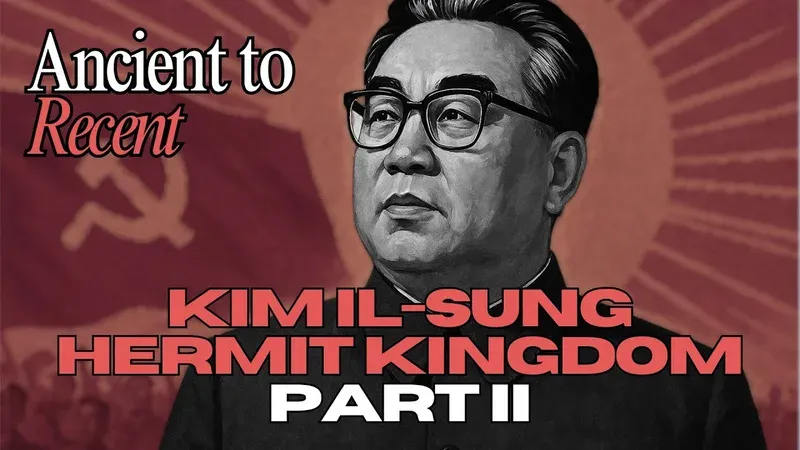
Kim Il Sung: The Still Birth of North Korea — Part 2
20 September 2025 · 1 hr 27 min · Season 1
 Watch on YouTube →
0:001:27:01
Also on
Rate the show
Ratings are how new listeners find the show. It takes a minute and it makes a real difference.
The Korean War erupts in a storm of artillery, but Kim Il Sung's plans for a swift victory unravel as UN forces push back the North Korean advance. As the conflict descends into a brutal stalemate, Stalin's death and a changing geopolitical landscape create an opportunity for Kim to solidify his rule.
This episode takes you through the pivotal battles of the Korean War, the power struggles within the North Korean Communist Party, and Kim's ruthless purges that paved the way for a totalitarian state and a society defined by a strict caste system.
🎧 New episodes every Friday at 8 PM CET
📲 Follow on Spotify, YouTube & Instagram @AncientToRecent
Sponsored by World of Whisky – Some things only get better with age. With World of Whisky, you can own a share of Scotland’s most iconic export. You must be over 18. Investing carries risks. Drink responsibly. Invest responsibly. This is not financial advice.
👉 Learn more: https://tr.ee/ZaBoYD
Read transcript
This transcript is automatically generated, so it may contain typos and misheard names.
The sky lights up with a flash of artillery. The earth shakes with the Thunder of explosions, the rumbles of tanks. The bugle blows as wave after wave of North Korean infantry advance across the 38th parallel. At 4:40 AM on the 25th of July 1950, the Korean War has begun. Welcome to Ancient Recent. My name is Joseph Parkinson, and in today's episode we're doing Part 2 of the History of North Korea under Kim Illinois Sung.
We're going to focus on the Korean War and then Kim's rise to absolute power. Episodes of Ancient Teresen are out every Friday and are brought to you by the worldofwhiskey.co.uk, the number one place for whiskey cask investment. That's the worldofwhiskey.co.uk. The South Korean army was taken by complete surprise. It took four hours for frontline commanders just to inform the president of South Korea's Sigmund Rhee, who was relaxing at that very moment on a fishing trip in the North.
Kim gathered together his cabinet and informed them that the South had attacked the North rather than the other way around, and that he had ordered the North Korean People's Army to retaliate in defence of the People's Republic of North Korea. Even though technically at this moment, Kim wasn't the absolute supreme leader, Kim was the first amongst many. He was the most recognisable face of the North Korean government, but he wasn't all powerful and he, technically speaking, didn't have the power to order the North Korean army to launch a full frontal assault against South Korea. No one in the room also seems to have asked the slightly teething question of how exactly is it that North Korea having just been subject to a surprise attack, it has been able to deploy the entirety of the North Korean armed forces's army, Navy and Air Force for a sweeping counter offensive against the South within literally hours of being attacked? It seemed like a good idea for no one to bring that question up.
The war was a crucial moment in the rise of Kim Illinois Sung to being the supreme leader in North Korea. It increased his profile. He became a more recognisable face of the North Korean state. And it is during the war that newspapers in North Korea start to refer to Kim as the leader. As the Northern army advance South, they expected to be greeted as liberating heroes. North Korean soldiers had endlessly been told by propaganda that the South was oppressed by Japanese and American and South Korean capitalist imperialism, that the workers were groaning under the jackboot of the landlord in the bourgeoisie.
But rather than being greeted as heroes, South Korean civilians fled in the face of the advance of the North Korean army. After a few days of fighting, it became very apparent that the Soviet armed North Korean People's Army was superior to the South Korean army in every way. And by the 28th of June 1950, only days after the war had started, Seoul, the capital of South Korea, fell to the Army of North Korea. But instead of pushing S, instead of pursuing the South Korean army, the North Korean army stopped in Seoul and waited for three crucial days.
Because the generals of the North Korean army had actually promised the North Korean troops that after taking Seoul, they'd have Three Days Grace to party and celebrate. This was a crucial missed opportunity to end the war there and then. It allowed the South Korean army to escape, to reorganize and prepare for the next phase of the war. Already things were starting to go wrong for Kim, Illinois Sung and the invasion of South Korea on the diplomatic front. On the diplomatic front, things were also going badly for the North Koreans.
The Soviet Union at that time was boycotting the United Nations. The reason being that the UN was refusing to recognise Mao's China and was instead continuing to insist that the government of Shanghai Chaek that had fled to Taiwan was actually the legitimate representation of the government of China. The Soviet Union wasn't actually present in the United Nations to block resolutions and motions condemning North Korea's invasion.
This allowed the USA and other Western nations to pass through resolutions condemning the invasion and to also pass AUN resolution calling for an Expeditionary force to go to South Korea and help the South Koreans. Only days after the war began, the USA began using its massive air power based in Japan to start striking targets in North Korea, with AUN resolution passed and AUN task force on the way, now US air power hammering targets in North Korea, and with the South Korean army having escaped total annihilation, the northern leadership began to realise that maybe they'd made a big mistake. And they began to ask themselves whether they should ask China and the Soviet Union to join the war on their side. In the occupied parts of South Korea, locals began being conscripted, press ganged into the North Korean People's Army and local officials and government dignitary representatives of the South Korean government were tried and executed.
Land was redistributed. Peasants were forced to engage in rallies where they praised North Korea and praised Kim Illinois Sung. But none of this was organic. This was all being forced upon the South Korean people and it created tremendous resentment. By mid August the northern advance had ground to a halt and on the 15th of September 1950 the US and the UN was able to launch a major amphibious landing at Inchon behind the North Korean lines that took the Northern army by surprise. Kim and the northern commanders were in a state of near total panic.
It looked like their gamble had failed and on the 21st September, the North officially asked China for assistance. Literally only months into a war that they have been planning for years that they thought that they would win in weeks. And they're already having to go to beg the Soviets and the Chinese to bail them out because it looks like it's going to go disastrously wrong. On the 20th of September 1950, Seoul is retaken by the Army of the United Nations.
The UN continues to push north, and by the 1st of October, Stalin realises that the situation is starting to get desperate for Kim, and he asked Mao to come to the rescue. But on the 2nd of October, Mao, who had told Kim before the war that if it all goes wrong, don't worry, I will come to your assistance. He's changed his mind. He's decided, well, I've actually been in power in China for less than a year. I'm not even technically controlling all of China. I'm still consolidating my control. Can I really get into a foreign war? Immediately?
Mao fears World War Three. He fears fighting the United States of America and the other UN forces. So even though he's told Kim that he will come to the rescue, and even though Stalin is asking him to, Mao refuses. Mao was willing to let the North be defeated, and Kim was in absolute desperation. He feared the end. South Korea believed that it was on the point of victory, to the point whereby the government of South Korea starts printing special celebratory postcards featuring images of Pyongyang flying the South Korean flag, celebrating the unification of North and South Korea under Sigmund Ree.
But Mao changes his mind, and on the 8th of October, at 6:00 AM, he sends Kim a telegram. Help was on the way. Stalin had pressured Mao, but Mao was an enigmatic figure. One minute yes, the next minute no. And so Mao again changes his mind. And on the 12th of October, he tells Stalin he won't be sending any troops after all. Stalin summons Chou En Lai, the second in command of Communist China. And he promises Chou En Lai that if China intervenes on the side of North Korea, the Soviet Union will provide all of the material support the Chinese army will need.
And with this guarantee, Mao is willing to commit to saving North Korea. By mid-october 1950, only a few months into the war that the North was convinced would last no more than 27 days and would end with total victory, the Northern army is in full retreat. But the North has a slight problem. Over the past five years, the North Korean Communist Party has been relentlessly purging all parts of North Korean Society of anyone who could possibly oppose the rule of Kim, Illinois, Sung and the Communist Party. Farmers, aristocrats, bankers, bourgeoisie, land owners, priests, Japanese collaborators, poets, artists. The prisons of Pyongyang are full. Are they going to let all these people fall into the hands of the South Korean government?
What the North decides to do? They separate the prisoners into two categories. Some they force to engage in death marches, starved and beaten, barely alive, dragging themselves northwards, many of them dying along the way, and others they simply execute before leaving. The northern government flees Pyongyang in mid-october, but on the 19th of October the Chinese army begins to cross the border into North Korea. Help is on the way and the Chinese army launches a major counter offensive in late November. Now it is the South Urim retreat. Now it is the North that is on the verge of victory yet again. They're not going to make the same mistake that they made before.
There'll be no pausing to celebrate in Seoul. They push the UN and Southern army back over the 38th parallel. They retake Pyongyang and they keep going. The Chinese are led by a general called Pengduhui, and he has a very difficult relationship with Kim. Kim resents him tremendously. He hates the idea of having to beg the Chinese for help in the 1st place, but Peng doesn't pay him any respect. Peng thinks that Kim Illinois Sung is a joke.
He thinks the North Koreans are amateurs, and he thinks that China is going to pay in Chinese blood for the vainglorious dream of this idiot. And so Peng insults Kim Illinois sung to his face. Tell me, Comrade Kim, who was it that started the war? Why did the war happen? Was it American imperial aggression? Or maybe it was your own hubris. He would say things like that to his face in a room full of Kim Illinois Sung's lackeys and supporters, and they couldn't do anything.
And Kim would just sit there and grind his teeth. You can't humiliate Tony Soprano, Michael Corleone, the mob boss, in the presence of his kappos. And that's exactly what he did on the 4th of January 1951, Seoul, the capital of South Korea, force to the communist forces yet again. And the situation becomes so desperate for the UN and the South that the UN even plans to evacuate the government of South Korea and form a government in exile. However, there's a turn in momentum yet again. A new general is appointed AUS general called Matthew Ridgway and he rallies his troops Leeds a counter offensive that drives the communists back and Seoul falls to the southern and UN forces yet again in April 1951.
Eventually the front lines begin to stabilize almost exactly to where they were when the war began in June 1950. At this point, Mao and Stalin, they start to consider that may be this war which has gone on for a year and already consumed hundreds of thousands of lives. Maybe some conversations could begin about how we could end this diplomatically. And so in July 1951, there's the very beginning of negotiations. The UN and the North begin negotiations at a place called Kaesong. But there's two really big issues. The 1st is the border.
Is the border going to be the 30th parallel, as it was at the beginning of the war, or is it going to be along the lines of the current frontline? And the second issue is the issue of prisoner returns. The North wants all prisoners taken to be returned. The UN, on the other hand, wants to return the prisoners who want to return, but the ones who actually don't want to. Many of the North Koreans. And of course, you have to remember that the North Koreans have also press ganged many S Koreans into joining their army.
Many of them don't particularly want to go back. And so there's this disagreement over these two major issues and talks breakdown. The fighting goes on, the killing goes on. But now it's a static trench warfare like World War One, the days of sweeping assaults up and down the Korean Peninsula. They're over, and the Korean War has settled into a grinding conflict, into a meat grinder. Very quickly after the initial talks breakdown, they actually resume at a place called Panmunjom. the US exerts pressure on the North by engaging in a massive campaign of aerial bombardment. Huge B52 bombers flying from their bases in Japan, Rome over North Korea, dropping hundreds of tons of incendiary bombs on North Korean cities and towns and villages. These incendiary bombs cause massive fires that consume humans and crops and animals and buildings alike. By the end of the war, 3/4 of all of the buildings in North Korea have been damaged or destroyed. But the war grinds on and grinds on. The North is able to call upon limitless material support from the Soviet Union and limitless manpower from China, but the South is able to call upon limitless firepower from the United States of America.
And so even with this tremendous exertion and tremendous loss of life, neither side is able to deliver the knockout blow that would bring victory. But there's one man who has an idea for how to break the deadlock and it's AUS general called Douglas MacArthur. The USA at this point has a weapon that no other nation in the world has ever possessed, and it is a weapon that the United States of America has used to end a war before atomic bombs.
The Soviet Union and China are working at breakneck speed to acquire this deadly device, but they don't have it yet. It is still the complete monopoly of the United States of America. And so Douglas MacArthur says, why don't we use atomic bombs? We can nuke the North Koreans, maybe even nuke the Chinese, he suggests. Win the war. Mercifully this idea is not taken seriously and Douglas MacArthur is dismissed through his position because quite reasonably, it was feared that if the US did decide to actually use nuclear weapons that would start World War 3 that would bring the Soviet Union in.
The negotiations continue in the background whilst the killing continues in the foreground. The question of prisoners continues to wrangle, but by this point Stalin's actually quite happy for the war to keep going. He doesn't care how many N Koreans or South Koreans get killed. He doesn't even care how many Chinese people get killed. But it does provide Stalin with one thing, which is it provides him with a distraction.
It keeps the West and the USA focused on Korea, which is a backwater that Stalin couldn't care less about. And it keeps their eyes off Germany, Czechoslovakia and Poland, which Stalin cares about very much so. But in 1953, Stalin dies. The man who had led the Soviet Union for two decades, the man who'd led the Soviet Union through the Second World War, is no more, and he's replaced by a collective leadership. This collective leadership wants to consolidate Soviet control over Eastern Europe and focus on rebuilding the Soviet Union after the devastation of the Second World War. They see the Korean War as being a sideshow, but a sideshow with the potential to lead to a World War. So they want to push for negotiations. Now the last thing they want to do is to get into an actual shooting war with the USA over Korea, which they couldn't care less about.
Actually, during the Korean War, Russian and American pilots did actually fight each other. But when the USA shot down Migs that had Russian pilots who bailed out. What the USA would do is they would spirit them back across the lines to the North, because ignoring the fact that the Soviet Union was actually actively participating in the Korean War was an easier thing to deal with than actually having to face the consequences of acknowledging this.
So they just pretended they never fought any Russian pilots. After Stalin's death, the negotiations really pick up pace. The question of prisoners is solved unilaterally by the South, who simply release all the prisoners who want to be released. So therefore there's really no more prisoners left who don't want to go back to North Korea. And the border between the North and South has agreed to be the frontline as of July 1953, with the North losing a little bit of territory at 11 minutes past 10.
On the 27th of July 1953, representatives of North Korea, China and the UN signed the Armistice agreement at Pam Wenjiang. The South actually refused to sign. The agreement enters into force at 10:00 PM the same day the war is over. Over 1.2 million people have lost their lives in a war caused by Kim Illinois Sung that he knew he'd lost within weeks, and the border hardly moved. Before we dive back into the story of Kim, Illinois Sung and the foundation of North Korea, a quick word from our sponsor. Worldofwhiskey.co.uk Some things only get better with age. A fine single malt is one of them. That's why Whiskey cask investment has such serious allure.
With World of Whiskey, you can own a share of Scotland's most iconic export. You'll get full certification of ownership, delivery orders and access to rare expressions few ever taste. And in the UK, there's no capital gains tax when you sell now. This is not financial advice. Investment carries risks and you must be over 18. Remember to drink responsibly and invest responsibly. And a great place to start is with whiskeycaskinvestment@worldofwhiskey.co.uk.
Many consider the Korean War to be a pointless waste of lives, but one man did benefit greatly, Kim Illinois Sung. He gained greater autonomy from Soviet control. His prestige rose within North Korea, and it put him in a place to assume total and absolute control of all of the levers of power. With the war over, the rebuilding began, and the reconstruction of North Korea was largely financed by the Soviet Union and China.
This also benefited Kim, a man who'd spent many years living as a partisan, living in camps, living in fairly rudimentary accommodation in the newly independent North Korea. But now, all of a sudden, Kim had built for him a series of splendid mansions and villas. He also had his own special State Farm to provide him, of course free of charge, the nothing but the finest food and drinks. And everywhere he went, a truck would travel with all of the amenities that he could possibly need, stocked up with every luxury to suit every need and whim and demand of the leader of the North Korean Communist Party.
I guess, after all, nothing is too good for the working class. After the war, Kim sought greater political independence from the Soviet Union. Kim knew that he was the point man for the USSR in North Korea, but that ultimately power rested with the Kremlin, that they could, if they want, simply remove him. And so he knew that he needed to build his own power base within North Korea free of the influence of either the Kremlin or of the Chinese.
The North Korean leadership was comprised of four separate groups, Korean Chinese with links to the Chinese Communist Party, Soviet Koreans with links to the Soviet Communist Party, and then two further groups, people who have been part of the Communist underground within Japanese occupied Korea, and people who've been part of the underground and the partisan movement in Manchuria. 1 by 1, Kim sought to isolate and destroy these different groups within the North Korean Communist Party. Kim sought to promote those loyal to himself and sideline those he couldn't trust.
Enemies of Kim began being arrested, forced to flee, denounced, or even turning up dead. But Kim's enemies began to manoeuvre against him and the opposition to Kim centred around two people, PAC Chung OK, who is the deputy premier, and Kim Do Bong, the former head of the SBA, the Supreme People's Assembly, the North Korean parliament. They tabled a motion in the Supreme People's Assembly in April of 1955 calling for the resignation of Kim. There is nothing set in stone to say that Kim would remain in power indefinitely.
In Bulgaria and Hungary in the 1950s, Stalinist leaders were overthrown within internal coups within the Communist Party. But Kim rode the storm out. The first thing he did was he postponed the discussion and then he proposed that there be a run off between himself and the most incompetent member of the North Korean parliament, thus forcing many people to back him. He was able not to control the outcome of the administrative process, but to control the boundaries, the rules by which any motion placed before the North Korean parliament to remove him would take place. Kim continued to purge his enemies. He focused on Koreans with links to the Chinese and Soviet Communist Party, and he was able to also harness another very important force within Korean society, Korean nationalism. The Korean language had adopted many words from Japanese, Chinese and also from Russian, and he led a campaign to Koreanize the Korean language and to get rid of these expressions.
This allowed him to present himself as a Korean national hero and it gave him his own power base within the North Korean Communist Party. Kim also tried to appeal for support and to present himself as the hero of the very large number of Koreans who had emigrated to Japan, Japan being the former colonial imperial master of Korea that had governed Korea for 30 years. Very large numbers of Koreans had been drawn to Japan for economic reasons.
And so there existed within Japan this large Korean community, but that now, since the collapse of the Japanese Empire had lost their Japanese citizenship. Under the Japanese Empire there was no such thing as being a Korean citizen. You were a subject of the Japanese Emperor in the South. Sigmund Reid, the South Korean premier, was violently anti Japanese. He hated Japan with a vengeance, to the point whereby he refused Japanese support in the Korean War, and so he didn't really want a bunch of Koreans who he swore as being too Japanese, as being unreliable, tainted with the ways of the Japanese colonial enemy. But Kim didn't care so much, and he was able to present himself as the champion of this poor, benighted group of Korean people so abandoned and let down by the South Korean government and the Japanese government.
He was able to harness the emotional appeal of Korean nationalism for his own benefits. Kim had to be very careful with the steps that he took to weaken Soviet control over North Korea. But there's one thing that Kim Illinois Sung had been his whole life. He was very lucky. On the 17th of June 1955, the Soviet Union appointed a new ambassador, Vasily Ivanov. Vasily Ivanov was a former deputy PM of the Russian Republic within the Soviet Union.
So why it's someone who held such a lofty position within the Soviet system been sent to become the ambassador to North Korea? Well, there was one reason he was being punished. This was the beginning of a new policy that the Soviets began pursuing from the mid 1950s, which is to take high-ranking disgraced officials, people too drunk, too incompetent, too corrupt or too untrustworthy to be trusted with a job in the Soviet metropole, and to send them to being ambassadors in far off small or irrelevant countries. But this was incredibly useful to Kim Illinois Sung because he was now constantly faced with Soviet diplomats who were disinterested, disgraced, or incompetent, and he was able to manipulate them to weaken Soviet control within North Korea. Kim was set on reshaping North Korea in his own image. He had a romantic nostalgia for the Soviet Union under Joseph Stalin, so he began implementing all of the Stalinist greatest hits.
Agriculture was collectivised. The economy was centrally planned. A5 year plan was published. The impact was immediate and predictably, it was disastrous. Grain production slumped. Malnutrition began to emerge. But Kim reacted not by acknowledging that any of these policies were mistaken or wrong headed, but with greater crackdowns, ever greater exaltations to staccanavite levels of labour that through sheer hard work and determination, any policy, no matter how disproven or disastrous, could be made to work through force of will.
On the 25th of February 1956, the communist world changed forever. The new First Secretary and the Soviet Communist Party, Nikita Khrushchev, gave a secret speech in which he denounced his predecessor Stalin, the former Living God of the Soviet world of the Communist world, idolized and attributed almost superhuman magical powers and levels of genius by true believers across the world, was denounced as brutal and egomaniac and guilty of building a cult of personality. This sent a shockwave through the communist world and it paved the way for liberalising forces within communist parties from Hungary to China to begin to move. The shock was felt in North Korea too. Some saw this as a green light to move against Kim and the conspiracy centred around Chong Chong IK, a figure with links to the Chinese Communist Party.
He began to openly talk about the perils of the cult of personality, and to warn that such a cult was emerging within North Korea, centred around Kim Illinois Sung. But Kim decided that he needed to get ahead of this reformist movement. So he himself denounced the growing cult of personality, Not of himself, but he pointed the finger directly at his enemies within the North Korean Communist Party, and he used this as an opportunity to remove them from power. But his enemies continue to manoeuvre against him too. Kim still wasn't all powerful.
To remove Kim, the opposition needed 36 votes within the Central Committee. But most of the members of the Central Committee, which had about 75 members, had been appointed by Kim or were supporters of Kim. Many of them were themselves true believers in the Stalinist system, and many of them saw this talk of reform and change as being deeply unsettling. And they saw Kim as a steady hand, as someone who is committed to the one true faith, not just of Marxism, but of Marxist Leninism and of Stalinism. The opposition also committed a number of serious tactical mistakes.
What they should have done is they should have outwardly appeared loyal to Kim, but at the same time going to the one real source of power and also vulnerability that Kim had, which was the Soviets, if they could convince the Soviets to abandon Kim and Kim was finished. But what they did instead is that they were vocal, speaking up in meetings, in Politburo discussions, in meetings of the Central Committee and of the Communist Party plenum, denouncing Kim but without Soviet support.
This meant that Kim could see them coming. Kim wasn't very popular with the Kremlin, the new reformists around Nikita Khrushchev. They were in power now, and they thought of Kim in the same way that Peng Du Hue thought of him, as a thug and a bit of a con man. Kim was actually summoned to the Kremlin for a dressing down in 1956, for building a cult of personality and neglecting the interests of his own people. But dressing down is not the same as abandoning. It was one thing to say that Kim Illinois Sung didn't cut the mustard.
It was another thing to say that the people who came after him we're going to be any better. So the Soviet Union wasn't quite yet willing to throw Kim overboard. The final battle for control within the North Korean Communist Party took place on the 30th of August 1956. At a plenum of the Communist Party. Members of the opposition, one by one, stood up and gave speeches against Kim, denouncing him for his cult of personality, for his neglect, for his avarice.
But Kim still held a majority within the Central Committee. As opposition figures stood to give their speeches, they were interrupted, denounced. The plenum descended into chaos. Abuse was hurled both ways, but Kim still had the upper hand. He was in his administered positions that allowed him to control the items on the agenda and the rules by which votes would take place. And he still had his supporters. The enemies of Kim were denounced as traitors and class enemies as agents of the USA and the plenum adopted a resolution not condemning Kim but condemning his opponents for factionalism. After the plenum, the opposition was over. They had failed to remove him.
Their naivety had prevented them from making the quiet steps, preparing the ground, positioning their people in places where they could really move against Kim Illinois Sung. Now that they had failed, Kim had the opportunity to destroy them once and for all. Some of them made a break for the border, fleeing into China on the Soviet Union to live the rest of their lives in exile. Others we're not so lucky. And for them, what awaited was the torture chamber, the prison cell or the bullet. But Kim still wasn't completely in control. He still was reliant on the Soviets. They still had the ability to bring his rule to an end. After the death of Stalin, the Soviet Union went through a period of collective leadership.
And the Soviet Union also started to encourage its satellites to do the same. It started to encourage it's satellites not to concentrate too much power in the hands of one man and to share different positions out to try and avoid a situation where the head of the party was also the head of the government and the head of the army, which had basically happened under Stalin in the USSR. Kim was the chairman of the party and he was the premier at the same time. And as long as he kept those two positions, he had nearly unlimited power.
But Kim was faced with a disinterested Soviet Union and with second rate Soviet diplomats. So even when instructions came down from the Kremlin, Kim began to test the waters. Under Stalin, if you were told to do something by the Kremlin, you did it. There was no questioning. There was no discussing, there was no arguing. The Communist parties took their marching orders from the Kremlin all over the world. But with such incompetent figures sent by the Kremlin to Pyongyang, Kim began to push the boundaries a little bit.
He suggested maybe giving away one of his positions, but giving them only to loyalists. He saw how that idea sat with the Soviets and they didn't react. And then he suggested that he maybe was just thinking that he would keep the positions both for himself. And again, even though the Soviets had given him an instruction and he had now gone against it, they didn't react. If he could ignore direct instructions from the Soviet Union, that was a sign to supporters of the opposition.
Who placed in the USSR their last hope of opposing Kim, that the Soviet Union would not come to their aid? From this point on in the mid 1950s, when Kim directly defied instructions from the Kremlin, Soviet influence within North Korea rapidly diminished. Kim's worries still weren't over. Even if he'd isolated the opposition, even if he had diminished the power of the Soviets, he still had the Chinese. In 1957, four years after the Korean War had ended, the Chinese army still had bases in North Korea.
But by this point, Mao had lost interest. He didn't really care about what was happening in North Korea. North Korea served its function for Mao. It kept a nice little boundary between China and South Korea, dominated by the USA. That was enough for him. What actually went on within the domestic politics of North Korea, Mao Zedong couldn't look at less. And so by November 1958, the last of the troops of the Chinese People Army have left North Korea.
Kim Illinois Sung and isolated, defeated or discredited every source of opposition to his rule within North Korea. He was now in near total control. And he was now free to reshape not just the North Korean economy, but North Korean society in his own image. North Korea rapidly became a very different place. Kim implemented a new system that was to define the lives of the people of North Korea. On the 30th of May 1957, the North Korean government officially designated all members of the North Korean population as belonging to one of three categories. Some could even say classes for a communist society, but it's actually not so much a class system as it's closer to the Hindu caste system.
At the top you had what was called the Nucleus Force, in the middle you have the imaginatively named Middle Force, and at the bottom you had the people of counter revolutionary components, those who are not to be trusted. Each of these three groups was originally meant to roughly correspond to about 1/3 of society, but over a long enough period of time the elite got smaller and the enemies of the state got bigger. Which group an individual belong to had a huge effect on their life.
Those put in the last group would be subject to much harsher treatment if they committed a crime, their careers would be limited and basically any chance of going to university would be ruled out. Kim called a party conference to crown his victory over the opposition. It convened in early March 1958. All opposition leaders were removed from their positions and within a short period of time they were expelled from the party, then haunted down, arrested, imprisoned for life, or executed.
Kim then moved on to purge Korean society. There were large parts of Korean society that had business or career or family links, especially with the Soviet Union after so many people had been driven north and become refugees. Not just over the Korean War, but also over the long period of Japanese opposition, many Koreans had made their home in Manchuria like Kim's family or in the Soviet Union. These people were politically and trustworthy, and they were purged, too many of them fleeing or simply being murdered. So extensive was the purge of the North Korean political class that one quarter of delegates elected quote UN quote to the SPA, the Supreme People's Assembly just in 1957, by 1958 have been imprisoned or murdered. As the terror campaign intensified, Kim presided over the creation of a vast prison system. This is often compared to the Gulag system that was founded by Lenin and then reached it's sadistic high under Joseph Stalin.
That's actually not a good comparison because in the Soviet Union under Stalin, vast numbers of people were sent to the Gulag, but people were also released. There was this huge churn of the population constantly being sent and amnestied in and out of the Gulag. There's a number of key differences between the slave labour camps that exist in North Korea and Soviet Gulag. The first is the only way you leave the gulag in North Korea is if you die. There are no amnesties.
If you are sent to prison, you are sent to prison forever. And the second is that in the North Korean system, it is a system of collective punishment. If you commit a imaginary crime, you insult the dear leader, you don't praise him loudly enough. You are not just sent to prison for life or just killed, but if you are spared the death penalty and you are condemned for life, then you are not condemned alone. Your spouse goes, your parents go, your children go, your extended family goes. They're all punished.
And within the North Korean system, your family is punished for three generations. There are people alive in North Korea today who have been born in the North Korean slave labour camp system because their grandparents committed a crime. It is a system of intergenerational collective punishment. Kim sought to extend his total control of every part of society to the very last corners of the North Korean economy. He implemented 2 doctrines that forced the ultra centralization of the economy in his own hands.
The first was that agriculture was to be directly controlled by local party officials and the second was that industry was to also be directly and solely in the hands of local appointed Communist Party officials appointed by Kim Illinois Sung. The purpose was to enforce personal control of the North Korean economy. Kim began setting arbitrary goals for productivity. These were unrelated to the resources that were available to the needs of the people, to the possible itself. And to deal with this, many North Korean officials, to deal with these completely unreasonable targets, many North Korean officials just simply forged the paperwork. They just simply pretended.
You said as a target, we overfilled it 10 times over. Why not? The bigger the number we give you, the happier going to be. Why not? North Korea's economic problems were further hindered by the arrests of so many skilled workers and engineers swept up in Kim, Illinois Sung's purges. This meant that very often agriculture and industry is simultaneously having completely arbitrary figures set as targets and at the same time the very same people who are needed to hit those targets are being shot or sent to concentration camps. This further leads to a breakdown in food production and the manufacturing and consumer goods, making the lives of everyday N Koreans endlessly worse. But Kim wasn't done with hindering the North Korean economy.
He developed a new hobby, which was to engage in spot checks. He would drive around North Korea visiting factories and plants and farms to give his, quote UN quote, expert advice on production, often completely disconnected from the actual reality of what it took to run a farm or a factory or an office or a school. Kim Illinois Sung would just turn up and say, you've got to do this. You've got to do that. That's what you're doing wrong.
And people would have to enact these policies. Now, very often the officials in these factories and farms would have been given forewarning. So they would make a point of putting on a Potemkin show of how wonderful this is and how we're over fulfilling our production. So the Dear leader comes, gives a bunch of instructions that don't correlate to reality in a factory that is dressed up to look completely different from it does normally.
He's told things that aren't true, he tells them things that are absurd, and everyone just goes on with their day. But you have to actually enact the crazy things that Kim Illinois Sung has actually said. It just becomes a completely insane self defeating system. More and more, Kim was living in this almost alternative reality, endlessly presented with processions of smiling children, euphoric crowds, and pristine schools and factories. And so his grasp on reality becomes increasingly tenuous. In the meantime, South Korea is experiencing a period of political anarchy.
Sigmund Rhee, who had been the president of South Korea for some 15 years by 1960, attempts to rig the vice presidential elections. This triggers mass protests which forces even parts of his own government to turn against him as well as the US ambassador, and Rhee is forced to resign, where he emigrates to the USA, never to return. In May 1961, there is a military coup that dissolves the government, which then itself is overthrown by another military coup led by a general called Park Chun Hee.
Park would rule South Korea for 18 years, during which he would preside over a period of breakneck industrialization and economic growth. But to Kim, caught up in his fantasyland bubble reality, the events of South Korea seem to present an opportunity. He can see a society that is in anarchy, protests, military coups. Maybe a revolution was possible. To Kim Illinois Sung, South Korea seem to be a society ripe for liberation, and who better to deliver it than Kim Illinois Sung himself?
So maybe now 1961 was time for round two. Maybe it was time to answer the prayers of the poor benighted people of South Korea for unification under the genius rule of Kim Illinois Sung. Maybe it was time to invade South Korea again. In the 1960s, tension between communist China and the Soviet Union began to boil over. The two sides represented two different traditions, China still very much so in the Stalinist mold under Chairman Mao, the Soviet Union under Khrushchev heading in a more reformist direction. And both of them were also superpowers. The days when China would bow to the Kremlin were long gone, and they both viewed themselves as the natural leader of the communist world.
Kim, distressed by the reformist direction that Khrushchev was taking the Soviet Union in, decided to side with Mao, and he also wanted to win support from Mao for a second invasion of South Korea in the autumn of 1965. Kim informs the Chinese that he wants to attack the South and asks them if they will participate. But Mao remembers how costly the war was. Huge numbers of Chinese soldiers had been killed and it could have led to World War Three. Mao refuses straight up after Mao refuses to support North Korea.
The friendship between North Korea and China vanishes, but there's a further event that also sours the relationship. In May 1966, the Cultural Revolution begins in China. Chairman Mao is having his own internal domestic problems within the Chinese Communist Party, and so he unleashes the enthusiasm of the young Red Guard, the zealous young members of the Communist Party, the to destroy the last examples of Confucianism or feudalism. And he also uses that violent enthusiasm to direct it against his own enemies within the Chinese Communist Party. This appalls Kim not because Kim Illinois Sung has discovered humanitarianism, but because it's anarchic St. violence that Mao is able to direct but not quite exactly control. Kim is a Stalinist.
He favours state terror, state terror directed by him against other people. He doesn't favour mob rule. And so, caught between a reformist Soviet Union and an anarchic China, North Korea becomes increasingly isolated. And now tensions begin to rise between China and North Korea. They rise so much that there are actually border clashes between Chinese and North Korean troops after North Korea erects a series of anti Maoist posters along the border.
North Korean children are even brought to the border to hurl stones at the other side. Kim's concerns about the Cultural Revolution further increase after Chinese students in Korea begin to riot in Pyongyang, and Kim sees this as a fifth column that owes its loyalty to Mao and the Chinese Communist Party. So Kim starts to probe the USSR constantly shifting back and forth, one minute supporting the Soviet Union, the next minute supporting China.
Back and forth goes Kim Illinois Sung. He arranges to meet with the new leader of the Soviet Union, Leonard Brezhnev. After the fall of Nikita Khrushchev. Brezhnev is a more status quo figure. Khrushchev had wanted to change things, had wanted to reform, had wanted to liberalise. But Brezhnev wanted to keep the show on the road. Kim was prepared to criticize Mao and offer his support to the Kremlin. But in return, he demanded not just economic aid, he also demanded the sharing of sensitive intelligence. And he wanted to continue in the Soviet press his vendetta against Nikita Khrushchev.
This was something that Brezhnev wasn't interested in, and so the relationship between the Soviet Union and North Korea went back into the freezer. In October 1966, Kim convened another party conference. His cult of personality would continue to intensify, and he was elevated to a new, even more lofty position of general secretary of the North Korean Workers Party. This conference is very significant in the remodeling of the state.
Kim would no longer be known as the leader, but now Kim took on the moniker of being the spiritual head and director, the guide of every facet, not just of the North Korean state economy or industrial policy, but now of every single aspect of the life of every North Korean person. Kim wanted to position North Korea as being an ideological alternative to Maoist China or Soviet Russia. And so in 1966 that we start to see the emergence of this new nebulous concept promoted as the official state ideology of North Korea called chuche. Now you might ask at this moment, what exactly is chuche? Well, let me read the official description of the ideology of chuche.
This is the description of Chuche Thought from the Grand Encyclopedia of Korea, a document published by the North Korean government and it's state as follows. The Duche thought is formed from the philosophical principle and socio historical fundamentals from guiding doctrines of revolution and construction. The philosophical principle is an important component of the Duche thought. Among the philosophical principles of the Duche thought, the most important ones are the ones which set man into a place in the world and the ones which show man's fundamental qualities. Among the philosophical principles of the ducce thought, the most important one is the one which shows the role which man plays in the world.
That principle, that man is the master of all things and decides everything. Well, I'm glad that's clear for everyone then. That couldn't have been clearer. We now all of us know exactly what Chu Che thought means and how to apply such a crystal clear philosophy in our everyday life. The North Korean government actually put great effort into trying to promote Chu Che thought around the world. North Korean embassies would arrange study groups where people could gather together and idiotically learn and recite the pearls of wisdom that came out of the mouth and other orifices of Kim Illinois Sung as facets of Juche thoughts. However, tragically, this never seems to particularly have caught on, and North Korea never really developed anything approaching A definitive ideology that distinguished itself from China or the Soviet Union. As for South Korea, Kim didn't give up. Kim took inspiration from North Vietnam. The Vietnam War was raging in the 1960s and 70s, and Kim thought to himself, well, why can't we do the same thing as Ho Chi Minh?
Kim instructed his Secret Service to carry out terrorist attacks in the South and to arm various terrorist organizations in the hope that they could grow into being a South Korean version of the Viet Cong. The North Korean intelligence services attempted to assassinate Park Cheng Hai, the president of South Korea, and on the 21st of January 1968, a group of North Korean intelligence officers dressed as South Korean troops who had crossed the border into the South approached the official residence of the South Korean president. But they were intercepted by police at the time, and after questioning, the South Korean police started to be concerned that these supposed South Korean soldiers actually might not be what they appeared to be.
A firefight was started and almost all the North Korean commandos were killed. 1 managed to get away to return to the North, but one was captured and after serving a prison sentence decided to continue to live in South Korea. On the 23rd of January, the North Korean Navy seized the USS Pueblo. the US naval crew were badly beaten and humiliated. They were kept in inhumane conditions until eventually being released in December of 1968.
On the 9th of December 1968, North Korean commandos murdered a nine year old South Korean boy called Li Song Bok on his birthday. This at the time was actually believed to be an inside job in South Korea. Many people blamed the military government, but in the 1990s, after the military government had fallen and under a left wing government, documentation was released from the South Korean files that showed indeed it was actually carried out by the North Koreans. On the 5th of April 1969, the North Korean Air Force shot down AUS reconnaissance plane, killing 31 American servicemen. And on the 11th of December 1969, a South Korean plane was hijacked, flying from Japan to South Korea, forced to detour to North Korea.
Eventually, 39 of the 51 passengers were returned to the South. However, the crew were not and have never been seen since. The 1960s and 70s were a period of tremendous frustration for Kim Illinois Sung. The Vietnamese were receiving unflinching support from the Chinese and from the Soviet Union. But what was even more frustrating for North Korea was that there was so much popular support in South Vietnam for the Vietcong, the reason that South Vietnam ultimately loses the war. Is only partly because of the support of the Chinese and the Soviet Union.
The other factor is that so many people in South Vietnam supported the North. The fact that that wasn't actually repeated on the Korean Peninsula infuriated Kim Illinois Sung. That Hanoi had been able to do the very thing that Pyongyang had failed to do to defeat the Americans and force AUS withdrawal was something that would always stick with Kim Illinois Sung. And so when Saigon fell on the 30th of April 1975 and the government of North Vietnam was able to finally defeat the South and unify Vietnam, the newspapers in North Korea barely covered it because it was seen to be too embarrassing, too humiliating. It got a tiny little mention in the corner of the front cover of the newspaper, with the rest of the front page being covered with what a wonderful person Kim Illinois Sung was. And didn't his new haircut look fantastic and isn't he so brilliant, etcetera, etcetera.
But the humiliation stuck with Kim Illinois Sung. Kim continued to solidify his control over North Korean society with the introduction in 1967 of the Singular Thought System. From now on, Kim Illinois Sung would act as a guide for every facet of the life of a North Korean citizen. Kim had already risen to be the leader, then the hero, then the Supreme Marshall, and now Kim was to be elevated to the state of a living God.
His cult of personality was to surpass that even of Stalin's, and it's most ridiculous. In 1974, all N Koreans that had the name Kim Illinois Sung, which was a relatively common name, were forced to change their names so that they could be only one Kim Illinois Sung. When Kim Illinois Sung's name appeared in writing, it had to be set in a different typesetting, either bold or italics, to make it stand out on the page. If you were to cross out a sentence that had Kim Illinois Sung's name in, you had to cross out all the words before and all the words after, and then draw a box around Kim Illinois Sung's name.
You were not allowed to draw a pen line through the name of Kim Illinois Sung, and even Korean grammar had to be changed to elevate Kim IL Sung's name and give it the proper respect that such a genius, heroic figure as Kim Il Sung himself truly deserved. So a simple sentence such as Kim Il Sung has published journals and articles in several countries that was no longer appropriate. It was no longer acceptable because it didn't give dignity and honour and respect to the name in the person of Kim Illinois Sung, the heroic leader.
So now the grammatical structure had to be changed to give particular honour and reverence to the dear leader Kim Illinois Sung. So such a sentence Kim Illinois Sung has published journals and articles in several countries would now have to be rewritten as the Great Leader. Comrade Kim Illinois Sung Immortal classical works, newspapers, journals and media of several countries have been published, so now you have to talk about Kim Illinois Sung as if you're Yoda. Kim gained new and ever more fawning titles and descriptions. The Dear Leader, the great leader, the unsurpassed, genius, respected and beloved leader, Great Marshall, son of the nation.
But my personal favorite, my personal best title, which I hope one day can be adopted to be used for myself, would be. And bear in mind, this is one title. The great thinker, theoretician and philosopher whom our nation came to deeply venerate for the first time in its half 10,000 years of history. Peerless patriot, legendary hero, excellent military strategist, ever victorious iron willed, brilliant commander. The one who is deeply adorated by each and every person in the world.
The great man amongst the great ones, respected and beloved leader, Comrade Kim Illinois Sung. The 15th of April, Kim Illinois Sung's birthday, became a national holiday. It's a day for gift giving. It's now a sort of North Korean Christmas. The calendar had to be changed because Korea traditionally would use the Chinese calendar. But as 1912, the year Kim Illinois Sung was born, was the Year of the Rat, that wasn't exactly appropriate. Portraits of Kim were mass produced, placed in every classroom, household, office, and factory in a family home. You must have one designated wall just for pictures of Kim Illinois Sung.
Now, of course, Kim Jong Illinois and Kim Jong Un are allowed to join on that wall. And on that wall you are not allowed to hang any other pictures. When children receive their breakfasts in school or when people are cured in hospital, they must bow to a picture of Kim Illinois Sung to thank the Dear Leader for their daily bread or their deliverance from disease or injury. Stealing or throwing away a picture of Kim Illinois Sung is punishable with the death penalty.
All photos of Kim Illinois Sung are to be taken from the left side to hide the benign humor on the back of his head. During visits from Kim to factories or schools, all of his comments are to be recorded and the visit is then to be celebrated annually Thereafter. Everything that Kim Illinois Sung touches is sanctified like Padre Pio. Chairs and benches and pens are all preserved because they have been held in the loving hands of of Kim Illinois Sung.
A chair has had the wonderful bottom of Kim Illinois Sung perched so daintily upon it. There even are things called veneration shelters, which are special locations where objects that Kim Illinois Sung has graced by holding tissues that he has sneezed into, chopsticks that he has eaten with glasses that he has drunk from that they can be stored in public for people to go and give offerings to. Actors who play Kim in movies are banned from playing any other roles. Songs and poems and books are made in his honour. In North Korea, under Kim Illinois Sung, no author was allowed to have their name on a book, as all books were attributed to the glory of Kim Illinois sung and Offices and factories regularly hold idiotic sessions where people gather round to share their happiest memories of Kim Illinois Sung in their.
The greatest achievements of Kim Illinois sung and the proudest moments of Kim Illinois Sung and how much Kim Illinois Sung makes them feel wonderful. The history of Kim Illinois Sung his family has been completely rewritten, so he's no longer presented as being someone who comes from a middle class Korean intellectual family of Protestants. Instead, he has to be remembered as someone from generation after generation after generation of heroic Korean freedom fighters for the independence of Korea. The system of control is ever tightening. Travel certificates are introduced in 1967. Not passports for leaving the country, which of course is completely banned, but certificates for leaving the county for simply going from one city to the next requires the official permission of the local Communist Party branch. You have to get a stamp in your internal passport saying where you're going and when you'll be back. People are not allowed to stay over in the houses of friends or relatives.
Before you sleep in a house other than your own, you must get permission from the local Communist Party officials and the police stage random raids to check if there are any unauthorized guests staying over in other people's houses. Citizens are subject to relentless criticism and self criticism sessions where people are required to find the most minute faults with themselves and with others. Not washing your hands often enough.
Not brushing your teeth often enough. Being late for work. These sessions are accompanied not just with verbal criticisms, but sometimes with physical violence, and they are also, of course accompanied with relentless praising of Kim Illinois Sung and the reading of Kim Illinois Sung's thought. In North Korea. All citizens under Kim Illinois Sung had to join the armed forces and serve at the pleasure of of Kim Illinois Sung.
All foreign media is banned and radios that are manufactured in North Korea under Kim Illinois Sung and still to this day are specially designed to only be able to pick up radio signals from within North Korea. So isolated with citizens of North Korea under the system that Kim Illinois Sung created and is sustained to this day, that people within North Korea did not know that the moon landings had taken place until the early new Millennium, a decade after the death of Kim Illinois Sung. Any literature that wasn't by Kim Illinois Sung for Kim Illinois Sung or about Kim Illinois Sung was deemed to be foreign imperialist propaganda.
So from the 1960s onwards, even the works of Marx and Lenin were removed from North Korean libraries and homes because they weren't written about or for Kim Illinois Sung. The secrecy continued to descend. From the 1960s onwards, no economic statistics were published. The people who were quote UN quote elected to the North Korean parliament, their names were no longer published. And the secrecy went to such an extent that government buildings are not allowed signage outside of them. So when you walk down the street and you see buildings, they have no notification at all, no indication as to what is actually going on in them.
After Stalin died and the Soviet Union went through its period of reform, Kim was shocked by just how quickly Stalinism was rejected. And it made him concerned something similar could happen in North Korea. And so Kim started to turn his thoughts towards succession. Kim saw economic aid to prop up his regime. He sought loans from the Soviet Union, from China and other socialist countries. When they weren't forthcoming to the extent that he needed, he turned to the West and he started borrowing money from the UK, from Japan, from the USA.
He could borrow large amounts of money. It didn't matter. He had no intention of paying any of it back. So why not just borrow what he can while he can? After the rejection from Brezhnev, Kim again tries to improve his relationship with China. He ended up not getting the aid that he wanted from China, but he did get an idea in 19. In 1969, Mao announced his successor. For the first time, a communist state was not going to hold a plenum where the Central Committee, the Communist Party, would get together and elect whoever would be the new leader, as it happened in the Soviet Union, as it happened in other communist countries, when leaders had died or fallen.
Instead, Mao had hand picked almost like a monarch who his successor would be, and it would be Lin Biao. This gave Kim an idea. Now it didn't work out so well for Lin Biao. Mao eventually turned against him and Lin ended up dying in a plane crash in Mongolia under rather suspicious circumstances. But the idea still stuck with Kim. Kim had already promoted many of his relatives to important positions within the North Korean state, but it was still unclear as to who would be the new leader. There were two main candidates, Kim Song A Kim's wife, or Kim Jong Illinois, Kim's son.
But in 1974, Kim Jong Illinois, at the age of 33, was able to emerge victorious, and at the 8th Plenum of the Central Committee, it was announced that Kim Jong Illinois would succeed Kim Illinois Sung. He was elevated to the position of a membership of the Political Council, second only to Kim Illinois Sung himself. But interestingly, the announcement was made internally within North Korea, but it was not made to the international press, and until that happened, it still gave Kim Illinois Sung the opportunity to change his mind. In the 1980s, North Korea set its sight on gaining entry to the United Nations, and one of the ways that North Korea sought to do this was to win favour with many countries in Africa to act as sponsors.
One of the services that North Korea offered was that the North Korean People's Army would train up African armies in return for this diplomatic favour. Now it might be noticed by a more cynical person. Of course, the North Korean People's Army has never actually won a war, but that's by the by. Kim Illinois Sung has now chosen Kim Jong Illinois to be his successor. But Kim Jong Illinois isn't quite home and hose yet, not until the international press has been informed. And in the 1970s, it does appear that Kim Illinois Sung changes his might.
The North Korean press had been pouring on the praise, had been talking of the magical, supernatural, genius level abilities of Kim Jong Illinois, but all of a sudden it stops. Kim Jong Illinois disappears and in 1978, all of the portraits of Kim Jong Illinois are suddenly removed. But in July 1979, it seems that Kim Illinois Sung changes his mind again and Kim Jong Illinois is yet again to be the successor. While this is happening, South Korea is changing rapidly. On the 26th of October 1979, the president of South Korea, President Park is assassinated by the head of the South Korean intelligence services.
He is succeeded by Choi Puha, who is then very quickly overthrown by General Chun Duhuan. More turmoil in South Korea. Could this be an opportunity for North Korea? Kim Jong Illinois is the appointed successor. He's the Crown Prince, but he's not secured just yet. In October 1980, Kim Illinois Sung arranges a plenum of the Central Committee, the North Korean Communist Party, and it is at that plenum that Kim Jong Illinois is officially announced to be his successor.
The line of succession is now secure, but the world around North Korea is changing. In 1976, Mao dies after a brief power. After a brief power struggle, Deng Xiaoping, a reformist figure backed by the Chinese military, emerges and begins to transform China, doing away with the old Maoist Stalinist system and unleashing the forces of free market capitalism. It doesn't matter if the cat is black or white, as long as it catches mice, announces Deng Xiaoping, showing that China was effectively abandoning socialism. With the elevation of Kim Jong Illinois to a position of effectively Co leader, things begin to change quietly, gradually.
Kim Jong Illinois is less hardcore hardline than Kim Illinois Sung. North Korea starts to invite foreign investment starts to announce joint ventures between North Korean state companies and foreign companies. About 50 of these are announced. They're all largely a failure. In 1986, Kim Illinois Sung suffers a heart attack and slips into a coma. It seems that the Dear Leader is going to die. Kim Jong Illinois begs the Soviets to send doctors and Kim Illinois Sung's life is saved.
In South Korea in 1987, military rule finally comes to an end. Demonstrations bring down the government of Chung Duhuan after he refuses to allow elections. And it's not just in Asia that the winds of change are blowing. In 1985, Mikhail Gorbachev becomes the new premier of the Soviet Union and he announces 2 policies, Glasnost and perestroika, openness and reform The Soviet economy is to be reformed in the direction of a more liberal model and people are to be allowed greater freedom of speech. Gorbachev informs the communist dictatorships of Eastern Europe that the days when the Red Army will come to the rescue to bail out unpopular regimes are over, and that now, if they wish to stay in power, they will have to do so with the support of of the people that they rule over.
With the threat of Soviet military intervention removed, very quickly the countries of Eastern Europe begin to throw off communist rule. But even within the Soviet Union itself, Gorbachev releases forces that he doesn't understand, and very quickly the reform process gets out of control. Gorbachev assumes that if he gives people freedom to speak openly, they will want to fix the system. But many people, especially in the ethnic minorities, the Ukrainians, Georgians, Armenians, Estonians, Latvians, Lithuanians, didn't want to be part of the Soviet Union in the 1st place.
They hadn't joined because they wanted to. They were forced into it. And so seeing a window to leave, they jumped for it straight away. And this is one of the factors that brings the Soviet Union crashing down in 1991. This has a huge impact upon North Korea. Even with the massive aid provided by the Soviet Union, to a lesser extent China, the lives of the people of North Korea are still grindingly terrible. But now the Soviet Union is gone, and the government in Moscow isn't going to hand over huge amounts of money and crops and fuel and. Spare parts to a North Korean government that it owes absolutely nothing to.
Yet again, the people of North Korea suffer. By the early 1990s. Kim Illinois Sung is an old man. He has lived 40 years in a bubble of endless adulation. He is totally disconnected from the lives of the people that he has ruled so cruelly for the best part of half a century. As he gets older, he plays less and less of a role in the day-to-day running of North Korea and more of these tasks are handed over to his successor, Kim Jong Illinois.
He spends his day not thinking about the state of the nation, the lives of the people, the collapsed 'cause that he's dedicated his life to in the form of international communism. But most of his days are spent reminiscing about his childhood in Manchuria and colonial Korea. In 1992, there is an attempted military coup by officers within the North Korean army. These officers had trained in the Soviet Union and were inspired by the ideas of glasnost and perestroika.
And so their plan is that during a military parade, one of the tanks will have loaded a live round and they will turn the turret to the stage where Kim Illinois Sung and Kim Jong Illinois, alongside the Central Committee, will be there to take the salute, fire and kill the entire North Korean elite in one moment. But chance has it that the unit that was going to participate in the parade at the last minute is swapped out so the attack never goes ahead.
Eventually, the coup is uncovered and the officers are haunted down. Kim unleashes A vicious purge of the North Korean armed forces to make it even more loyal and make sure nobody has any idea about removing him or his son. In 1994, Kim Illinois Sung is 82 years old, but he still seems pretty healthy. In the summer of 1994, Kim decides to invite the new Democratic President of South Korea, Kim Young Sam, to visit Pyongyang between the days of the 25th and the 27th of July for the first ever Inter Korean conference. This is going to be a historic moment in normalising the relationships, improving the relationships between the Democratic South and the communist N. Only a few days after the announcement, on the 7th and 8th of July, a huge storm sweeps through North Korea, drenching the country in rain.
Kim Illinois, Sung at the time, is at his mountain retreat and he's taken sick. No medics are available to him. A team of doctors in Pyongyang are sent to take care of him, but the storm is so severe that the helicopter carrying them crashes and they all die without medical assistance. At 2:00 AM on the 8th of July in 1994, Kim Illinois Sung, the man who has ruled North Korea from its very inception in 1945, dies. On Saturday, the 9th of July, North Korean TV announces that there will be a special announcement at noon. The nation is shocked to hear that the Dear Leader Kim Illinois Sung has passed away.
What are we to make of the legacy of a man like Kim Illinois Sung? Unfortunately, I don't think there's anything really good to say about him and even many historical figures who maybe 1 judges to be more bad than good have some achievements. But Kim Illinois Sung rose through a combination of cunning and luck and determination. He used the ideology of communism that he really never had any understanding of or particular interest in, other than in so far as it could advance his own cause of his personal power and enrichment. And he built a system as close to George Orwell's 1984 as has ever been constructed in the history of the human race. He built a system of pornographic violence and oppression where a nation of slaves are forced to give ever greater amounts of themselves in heaping praise on the man who tortures them, the man who starves them, the man who imprisons them.
And that is the legacy of Kim Illinois Sung. Even if you wanted to offer some tepid defence of say Soviet communism or Chinese communism, for all of its blood stained horror that you maybe could come up with some things. But in the case of North Korea, it is the most perfect totalitarian system that has ever been produced. It is a system where the citizen is the property of the state, where everything that isn't forbidden is compulsory.
It is a system of pornographic cruelty and violence. And Kim Illinois Sung presided over and directed the creation of this system that still to this day enslaves 20 million people. And he did it all for his own personal glory, sat in his palace with his vintage cars and his Michelin star food and his armies of prostitutes to see to his every need while his people starved, froze and died. Thank you for listening to Ancient the Recent My name is Joseph Parkinson. Episodes of the Ancient the Recent podcast are out every Friday and are available on YouTube, Apple Podcast and Spotify.
This episode is brought to you by the World of Whiskey, the number one place to begin your investment journey. Visit worldofwhiskey.co.uk.