
#15
Kim Il Sung: The Still Birth of North Korea
12 September 2025 · 1 hr 4 min · Season 1
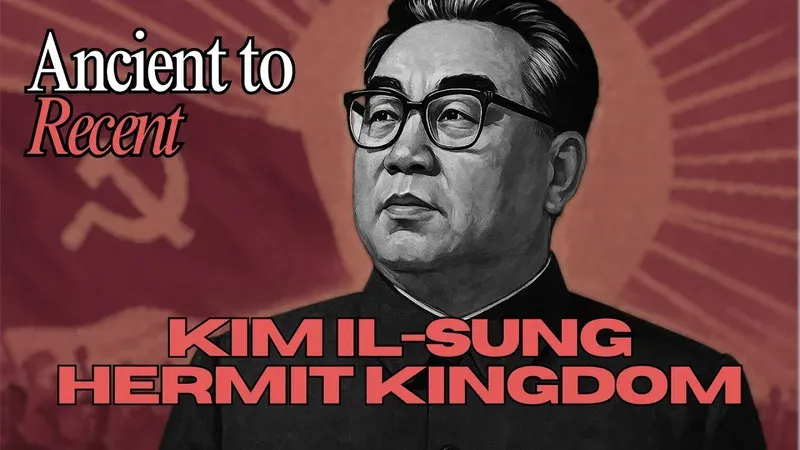 Watch on YouTube →
0:001:04:33
Also on
Rate the show
Ratings are how new listeners find the show. It takes a minute and it makes a real difference.
In the early days of the 20th century, Korea was under the grip of Japanese imperial rule, a period that reshaped the peninsula forever. Out of this turmoil emerged Kim Il Sung, a partisan fighter who would go on to become the founding leader of North Korea.
In this episode of Ancient To Recent, Joseph Parkinson takes you through Kim’s early life, the struggles of Korean nationalism, the Japanese occupation, and the Soviet-backed rise of the Democratic People’s Republic of Korea. Discover how colonial rule, war, and ideology combined to shape one of the most secretive and repressive regimes in history.
🎧 New episodes every Friday at 8 PM CET
📲 Follow on Spotify, YouTube & Instagram @AncientToRecent
Sponsored by World of Whisky – Some things only get better with age. With World of Whisky, you can own a share of Scotland’s most iconic export. You must be over 18. Investing carries risks. Drink responsibly. Invest responsibly. This is not financial advice.
👉 Learn more: https://tr.ee/ZaBoYD
#sponsored #publication
Read transcript
This transcript is automatically generated, so it may contain typos and misheard names.
At the beginning of the 20th century, the Korean Peninsula was impoverished and undeveloped backwater of the Asian landmass. Korean society had rejected the ideas of economic and technological development, preferring instead the perfection and purity of Confucianism. But in 1910, the rising power in East Asia, the Japanese Empire, had annexed the Korean Peninsula. The Japanese saw the Koreans as being uncivilized, ignorant Barbarians desperately in need of salvation from the benign hands of Japanese imperialism. So the Japanese appointed a Governor General, Taruchi Masatake.
Masatake underwent a programme of introducing compulsory education, improving standards of hygiene, improving town planning and transportation, and as a result, over the years, standards of living began to rise. Now the coming of the Japanese had a profound effect on Korean society. Some Koreans saw the benefits of Japanese civilization, technology, education, economic development. They saw it as a means of modernizing Korean society. But other people were furious.
Other people saw Japan as a conquering imperial bully that looked down upon and sneered at the Korean people. And those people decided that the day would soon come where Japanese power would have to be challenged, and the fate and future of Korea would have to be once again in the hands of the Korean people. On Monday the 15th of April 1912, little over a year after the coming of the Japanese, on the very same day that the Titanic sank in a small village called Chilgol, near Pyongyang, a child was born.
And that child was called Kim Song Jew, or as history would remember him, Kim Illinois Sung, the founder of the Democratic Republic of North Korea. Welcome to Ancient to Recent. My name is Joseph Parkinson, and in this new podcast series, we'll be talking about the foundation of North Korea, the Cold War, and the life of Kim Illinois Sung. This episode of Ancient to Recent is sponsored by the World of Whiskey, the premier place for whiskey cask investment.
Go to worldofwhiskey.co.uk to start your journey into the world of whiskey cask investment, but more from the world of whiskey soon. Let's delve deep into the story of Kim Illinois Sung and the foundation of the most secretive and repressive regime in all of human history. Kim was the second oldest of four sons. His father, Kim Hyun Jik, was a teacher affiliated with the Protestant Church. Very little is known of his mother. All we really have is a name, Kan Bang Sock, and very little is known of their early life within Korea. But we can glean some small details about what Kim Illinois Sung was like as a small child because one of their neighbors by the name of King Hyong Sock kept a diary and he would go on to become a prominent university professor in South Korea. Kim Jong Sock remembers Kim Song due the future Kim Illinois Sung to be a sporty, active and cocky child who would often take part in football games and demand to be captain of the team. Kim Illinois Sung was born into a Protestant family, a religion that had been brought to Korea by Christian missionaries in the mid to late 19th century.
Now Christianity held a particular appeal, especially for Korean nationalists, because it allowed Koreans to assert a unique identity separate from Buddhist, Taoist or Confucius Chinese, whilst also being separate from the Shinto Japanese. In 1916, when Kim Illinois Sung was four years old, a new Japanese Governor General was appointed, Hasegawa Yoshimichi. Now Yoshimichi had been a former Garrison commander in Korea. He had seen many of the reforms that previous liberal governor generals had implemented and he disapproved of them. He was a hard liner.
He believed in the stick, not the carrot. He believed all these reforms were a waste of time. Why are you trying to civilize these barbaric, backwards, savage Koreans? And so he implemented a much harsher and more ruthless programme of Japanisation and colonisation. His policies resulted in a massive backlash. In March of 1919, there was an uprising that caused alarm and panic in Tokyo. This uprising became known as the 1st of March Movement, and Kim Illinois Sung's father was an active participant.
Yoshimichi reacted with characteristic brutality, calling in military and police forces to put down the uprising with brutal violence. This LED Kim Il Sung family to flee from Korea and settle in Manchuria in the northeast of China. Now China in the early 20th century was going through a period of political and social turmoil and large parts of China were no longer controlled by the central government based in Nanjing, but instead were run as a semi autonomous states by local warlords.
However, the Kim family, as educated middle class Koreans with a good grasp of Chinese, were able to live fairly comfortably in Manchuria, away from the prying eyes and grasping hands of the overbearing Japanese authorities. Just after the First World War, there was growing criticism of the ideas of colonialism. There had been Woodrow Wilson and his 14 points that stressed the rights of all people to national self determination.
And there was growing criticism of Japanese colonialism, even domestically within Japan. But the reaction of Japanese liberals, and Japan at this time was still a quasi democratic state, was not to abandon the idea of imperialism, but was to try and present colonialism as a more benign force, as a more liberalizing, helping, civilizing idea. And so, under pressure from liberals in Tokyo, Yashimura was forced to resign and a new Governor General for Korea was appointed, Saito Makoto. Now, Saito was a retired Admiral and was a political liberal. He believed in the ideas that Japanese imperialism would bring benefits to the Koreans.
So he ended segregation school. He allowed for religious freedom, especially for Christians. He allowed for criticism of the colonial authorities to be published in Korean newspapers. And he even, controversially, in the eyes of even many Japanese liberals, allowed for the establishment of the first ever Korean universities. Now, Japanese rule in the 1920s was only a decade or so old, and so many Koreans remembered the time before the Japanese came, and they remembered it as a time of poverty and backwardness.
And they saw the benefits the Japanese rule had brought them. And under the more benign and liberal rule of Saito Makoto, many of them were won over. Maybe this wasn't so bad. Maybe if we're getting a bit of education, a bit of economic development, hygiene is improving, and now the Japanese aren't being so hard on us, maybe we can make this work. Maybe this could possibly be a good thing for some sections of Korean society. And the economy gradually continued to improve. The Japanese poured money in to develop the infrastructure, the railways and the roads and the ports. Some Korean people felt that maybe they could live with this. However, Kim Illinois Sung's family were not those people. His father was an ardent Korean nationalist, and they wanted nothing to do with Japanese rule. So the Kim family stayed in Manchuria, in the northeast of China.
Kim Illinois Sung had an unusual childhood for a Korean in the early 20th century. He was brought up in an environment that mixed Christianity with Korean nationalism, but he was educated outside of Korea, and he was exposed to a whole host of political and religious ideas. And this unique environment, this witch's brew of different ideas and ways of seeing the world, shaped his personality. Manchuria in the 1920s was experiencing a time of tremendous change, in turmoil after a period of anarchy.
A local warlord called Zhang Zulai seemed seemed to bring a sense of stability. But Manchuria was located at the crossroads of empires. It was just next to Korea, run by the Japanese Empire, in the northern extremes of China, and just South of the newly established Soviet Union. And so it became a perfect place for radicals, revolutionaries, and spies. Just far enough away from Tokyo, Moscow, and Nanjing. The Korean community in Manchuria continued to grow rapidly, bolstered by many fleeing from Japanese occupation, determined to wrench Korea from the grasping hands of the Japanese Empire.
And some of these Koreans were attracted by the new ideas of communism. In 1917, the October Revolution had taken place, overthrowing the provincial government and establishing a government in Saint Petersburg, then called Petrograd, under Vladimir Ilitch Ulyanov, or his history would know him, Lenin. This was the establishment of the first ever communist government inspired by the ideals of Karl Marx in all of human history, and communists emphasized their opposition to imperialism, the rights of small people to national self determination.
These were ideas that many Koreans, stranded on the wrong side of the Korean border, but eager to one day go back and liberate their homeland from Japanese imperialism, found incredibly appealing. On the 4th of June 1928, Zhang Zolin, the warlord who ran Manchuria, was assassinated by the Japanese. The Japanese wanted a more pliant neighbor, someone maybe a little bit more sensitive to Japan's needs and interests. However, after a brief power struggle, they ended up instead with his son Zhang Sri Lank.
Manchuria during this period of time never quite achieved the stability it previously had under Zhang Zuling. It continued to be a source of friction and tension in North East Asia. It was during this time of rapid change that Kim Illinois Sung enrolled in middle school and this made him stand out in China. He was a Korean and also someone from a Christian family, but also someone who is enrolling in school at a time when most Chinese children were illiterate.
And it was during his time in middle school that Kim Illinois Sung encountered for the first time the ideas of communism. Kim Illinois Sung read Lenin, and he found Lenin's ideas of opposing imperialism appealing, but by all accounts he doesn't seem to have had a particularly deep technical understandings of the more finer points of Marx and Engels. In later years, in meeting with Soviet officials, it would often be noted that Kim Illinois Sung didn't really seem to actually understand much about Marxism. Kim's father, Kim Hojik, died in 1926 and Kim became the man of the house.
In 1929, Kim Illinois Sung joined the Communist Society for Korean Youth and he began his journey into a world of partisans, espionage, and his ascent that would lead him to becoming the Kim Illinois Sung who founded the Democratic Republic of North Korea. After a few weeks of activities, he was arrested by the Chinese authorities and given a 5 month prison sentence. Instead of this seeming to deter him, he actually seems to have become more determined, more committed to the cause of Korean independence that he best saw expressed through the ideas of Marx and Engels, even if he didn't particularly grasp them very well.
So he became committed to the institutions and the ideals of the Communist Party without necessarily being wed to the ideals of Marx and Engels. He became increasingly active in the Korean partisans fighting against Japanese occupation, and in the late 1920s a move was made to unite all of the Korean anti Japanese factions under one umbrella. This would be a rainbow coalition from the right to the left. But at this point, with China in a state of turmoil and Japan seemingly all powerful in the Korean Peninsula, it didn't seem that there was much of A way forward for the Korean partisans and the Koreans who dreamt of an independent career free of Japanese rule, what they needed was an opportunity. What they needed was a chance.
What they needed was a turn of events. And just such a turn of events was round the corner because in 1931, Japan invaded Manchuria. In the early 20th century, as Japanese industry grew, as the Japanese economy forged ahead, Japan became increasingly reliant on raw materials that were not readily available within the Japanese homeland, specifically rubber and oil. But a Japan that was reliant on importing raw materials from other countries was perceived as being a country forever vulnerable to having those supplies cut off. So the only way it was believed by many people within the Japanese High Command that Japan could secure it's long term economic stability and it's long term defence was by militarily securing those sources of raw material for the acquisition of a colonial empire stretching the length and breadth of the Far East.
There was also another factor. Lady Luck seemed to be smiling on Japan. Japan was being offered a historic opportunity. Japan's 2 great neighbors are Russia and China, both nations with vastly larger land masses and populations. Japan must always be wary of these two states, but in the early 1920s and into the early 1930s, Russia, reconstituted as the Soviet Union, was going through a period of terrible turmoil after the Revolution and the Russian Civil War, and China was on the verge of collapse.
Could it be that history, that fate itself, has presented Japan with an opportunity to solve the vulnerability that comes about from its reliance on imports of raw materials from other countries and to also carve out a vast empire in East Asia? That would mean that Japan would no longer have to worry about the might and power of Russia and China. But Japan needed an excuse. And if an excuse wasn't forthcoming, Japan was going to make one.
And there were two Japanese army officers, Colonel Sashiro Itagagi and Lieutenant Colonel Kanji Ishawara came up with a plan. They were going to stage a false flag operation, an incident in Manchuria. They were going to sabotage a section of the Manchurian Railway and claim that Manchuria, the province of North East China, was descending into anarchy. And then the Japanese army in Korea, called the Kwantung Army, was going to claim that steps needed to be taken to guarantee peace and stability in Manchuria, and that only the Kwantung Army could do this. They were going to engineer an excuse to invade China. The Kwantung Army quickly overran Manchuria, and they carved out a new state that they called Manchukwo, placing on the throne Puyi, the last emperor of China to be Japan's UET. But the government in Tokyo wasn't actually part of any of the planning of this operation.
This was an operation that was launched entirely by these two Japanese officers in the Kwantung Army. So the government in Tokyo was just reacting to events as and when they happened. And as the Kwantung Army had so much success almost overnight conquering this vast stretch of Asia that it then handed to the Japanese emperor, they felt that they kind of had to go with it. They had to own the process, but the newly established League of Nations refused to recognise Manchukwo as an independent state and saw it for what it was, which was it was a vassal state of the Japanese Empire.
This ironically ended up being seen as a humiliation for the Japanese civilian government in Tokyo. The Japanese army was able to argue. Well, we did our bit. We got the empire, we carved out this vast area and we handed it over to the emperor and said there you go, it's you civilian politicians. Your job was then to get the approval and the legitimacy and you failed. So the fact, of course, that the civilian politicians had absolutely nothing to do with the Manchurian incident was irrelevant, but they're the ones who got the blame for failing to bring international recognition, which led to the collapse of the civilian government in Japan and the military becoming even more powerful.
Now, at this time, Kim Illinois Sung was increasing his activities within the Korean partisan movement, and this is when he officially changed his name from Kim Songju to Kim Illinois Sung, his nom de guerre. By the early 1930s, Kim Illinois Sung was an active member of the Korean Partisans. But he was a political officer. He owed his position not to his military abilities but to his zeal, to his commitment to the cause.
And it was his job to guarantee that the Korean partisans, who really at this time were a ragtag band of militia with few weapons and little organization, maintained their ideological purity. In August 1936, the situation for Korean partisans seemed to deteriorate even further. A new Japanese Governor General was appointed, called the Jiro Minami. Now, Minami was a militarist and a hardliner, and he was also a Japanese chauvinist.
He cancelled many of the freedoms that Koreans had previously enjoyed, and he set out to erase Korean identity and to make the Koreans into Japanese people. Minami reduced education in Korean and eventually banned it. Minami closed Korean newspapers, encouraged Koreans to take Japanese last names, and even discouraged the use of the word Korea. Minami also encouraged something that is to this day very controversial both in Korea and also in Japan. He encouraged the recruitment of what were called comfort girls, or as you and I would know them, prostitutes. Korean women who were enlisted to care for the sexual needs of Japanese soldiers.
Many of these women were enlisted against their wishes. This was forced sex slavery of Korean women by Japanese men. As the regime became more ruthless, what little opposition disintegrated. By this time, a generation of Koreans had been born under Japanese rule, and with the Japanese Empire expanding on all fronts and experiencing 1 military victory after another, the chances of independence seemed decidedly limited. And under relentless Japanese oppression, the Korean partisan movement seemed to fracture and break, and internal fighting and a wave of paranoia swept through the movement as the partisans turned against each other.
But Kim's career continued to rise. He was promoted from a political officer to become the commander of the 6th Division of the Second Korean Home Army. Now that sounds incredibly grand, but really these formations existed in little more than name only. But there was a pivotal moment in Kim's life and that came on the 4th of June 1937, when he led a raid of 200 partisans against a Japanese police station on the Japanese Manchurian border in the village of Pushchombo.
This was a daring attack just at the moment when it seemed like the Korean partisans were down and out to be able to rally together 200 fighters and lead them in a surprise attack that completely caught the Garrison off guard. It let the Japanese know that the Korean partisans, they weren't done just yet. The Garrison was taken by surprise, but they rallied quickly, called for reinforcements. Most of the partisans got away, but some of them were captured, and under interrogation they began to talk of one man of Kim Illinois Sung.
Shocked by this event, the Japanese decided that the time had come to finally clear out the last of this bothersome irritant that was the Korean partisan movement. They were going to get rid of the last remnants of any resistance, and they had just the man to do it, Nazoa Maseroni, a Japanese army officer, and he took a carrot and a stick approach. Those who surrendered and who assisted the Japanese in their hunting down of the partisans would be pardoned and paid off. Those who didn't will be punished. Nazoa was very successful.
Many partisans switched sides, but in 1937 full scale war broke out between China and Japan. Japan under the Kwantong army had originally just taken Manchuria, but Shanghai Chek, the leader of China, had decided to try and localize the conflict, not react. He knew that China, still divided still with so many warlords ruling so many areas, still at civil war with itself, wasn't ready to take on the might of the Japanese Imperial Army.
But that didn't matter because by 1937, the might of the Japanese Imperial Army was ready to take on Shanghai. CHEK and full scale war broke out in 1937 as Japanese troops poured over the border, landed in places like Shanghai to try and pick the ripest apple in all of East Asia, that of the Republic of China. In 1930, Kim Illinois Sung met his first wife, Han Sang Hoi. She was a commander of the female partisans, but only a few months into their marriage she was arrested by the Japanese and with no word of what happened to her, Kim Illinois Sung assumed that she was dead.
So Kim married again to a woman called Kim Jong Sook, who looked almost identical to Han Sang Hoi. They married in 1940, when she was 21 years old. At this moment, the partisan movement was down and out. There seemed to be no hope. They had been crushed. They had been haunted down. They seemed to have been defeated and under orders from the Soviet Union, the partisans retreated into the USSR. Kim crossed into the USSR on the 23rd of October 1940 where he was detained by Soviet secret police, the NKVD, for interrogation and instruction.
What next for the Korean partisan movement and what next for Kim Illinois Sung? Before we dive back into the story of Kim, Illinois Sung, and the foundation of North Korea, a quick word from our sponsor, World of Whiskey. Some things only get better with age, and a fine single malt is one of them. That's why whiskey cask investing has such serious allure. With World of Whiskey, you can own a share of Scotland's most iconic export. You'll get full certification of ownership, delivery orders, and access to rare expressions few ever taste. And in the UK, there's no capital gains tax when you sell. Now this is not financial advice, investment carries risks and you must be over 18 years.
Remember to drink responsibly and to invest responsibly. Visit worldofwhiskey.co.uk or click the link on my bio to see a link to worldofwhiskey.co.uk to see some of their fine collections and great options for Whiskey Cask investment. Kim had another reason to want to flee the partisan life in Korea. His wife, Kim Jong Sook, was pregnant and on the 16th of February 1941, she gave birth to their first son being born in Russia.
Their child was given a Russian name, Yura. But history and fans of Matt Stone and Trey Parker's brilliant movie Team America know Yura by a different name. He's remembered as Kim Jong Hill. What was left of the Korean partisans that crossed over into the Soviet Union was settled in two camps where they could be re educated and retrained. And this was fine as far as Kim Illinois Sung was concerned because after years of parts and life, constantly on the move, constantly being hunted, he was very happy for an opportunity for a bit of stability and a bit of a chance to settle down into a normal routine.
In April 1941 the Soviet Union and Japan had signed a neutrality pact, but Japan at the time was also allied with Nazi Germany. But on the 22nd of June 1941, Nazi Germany invaded the Soviet Union. The partisans would continue to train and launch small scale intelligence gathering operations into Manchukwo. They learned that there was no opposition to the Japanese in any meaningful sense, and the process of Japanification was advancing at rapid pace. But Kim continued to climb the career ladder with one promotion after another.
However, just when it seems like Kim's career was advancing effortlessly, it almost all came crashing down. In July 1944, Kim was accused by a fellow political officer from China of killing civilians. Some of them being communists and of being a bandit in the 1930s. Kim did not deny the events, however, his defence was that the people he murdered were Trotskyites and therefore not real communists, and he instead was a loyal devotee to the cult of Joseph Stalip. Kim's superiors decided not to pursue the matter, and Kim seemed to get away with it.
Just when it seemed that he'd lost everything. In 1944, Kim had another son, again given a Russian name, Sora, short for Alexander. Meanwhile, as Kim sat out, much of World War Two in the Far East, the war in Europe, the Titanic struggle between Nazi Germany and the Soviet Union played out. The German assault on Moscow petered out in the dying months of 1941. The Germans were then defeated at the Battle of Stalingrad in February 1943 and then crushed the Battle of Kursk in August 1943. From that point on, the Red Army of Joseph Stalin and the Soviet Union would roll up the empire of Adolf Hitler and chase the Nazis all the way back to Berlin. On the 7th of December 1941, Japan had launched a surprise attack against the US Navy at Pearl Harbour, hoping that they could knock the United States of America out of the Pacific theatre and keep all of the spoils of Asia for themselves. But instead of this being a decisive blow that would cripple the US Navy, it simply stirred the United States of America into action and brought the USA into the war against Japan. After the Battle of Midway in June 1942, the United States of America gradually pushed the Japanese Empire back and back, one island after another.
In February 1945, as the war seemed to be winding down, the Big three, Churchill for the British Empire, Stalin for the Soviet Union, and Roosevelt for the United States of America got together to plan the future of the world after the conclusion of the Second World War. They agreed that after Hitler was defeated in Europe within three months, the Soviet Union should join the war in the Far East against Imperial Japan.
The Korean partisans had spent the months in the years of the war other than launching small scale intelligence gathering operations, training and brushing up on their Marxist Leninism, and the Soviets had planned that they were going to use the Korean partisans as part of their offensive against the Japanese. But on the 6th of August 1945, the United States of America dropped an atomic bomb on Hiroshima, wiping an entire city off the face of the earth.
Two days later the USSR declared war on Japan, and on the 9th of August the Red Army began it's offensive against Japanese positions in Manchukwo. But the very same day, the United States of America dropped a second atomic bomb on the Japanese city of Nagasaki. Japanese surrender was imminent, but the USA was worried that the Red Army would be able to conquer all of Manchukwo and sweep down all the way to the bottom of the Korean Peninsula. If the USA was going to occupy Japan and the USSR was going to occupy all of the Korean Peninsula, that would mean there would be a very short jumping off between the South of Korea and the Japanese homeland, which would mean the USSR would be in a perfect position to threaten Japan in a future conflict between the Soviet Union and the United States of America. So it was decided that instead, there would be spheres of influence.
In the northern part of the Korean Peninsula, the Soviet Union would be dominant, and in the southern part of the Korean Peninsula, the United States would be dominant. But there was a problem. There's not really any natural boundaries, rivers or mountain ranges that naturally divides North and South Korea from each other. So it was left up to 2 middle ranking U.S. Army officers to decide where the Korean Peninsula would be divided, George Bonesteel and Dean Rusk.
So what they decided to do was they literally took a map from a National Geographic and they divided the Korean Peninsula along the 38th parallel. A country that had been united as a single political and cultural entity for 1000 years was ended along a largely arbitrary line by two mid ranking US officers. With the stroke of a pen, on the 15th of August 1945, Emperor Hirohito of Japan announced on the radio that Japan was going to surrender to the United States of America. Events have not precisely developed to our interests, he famously said.
As for Kim, events had unfolded so quickly that his unit had actually participated in the war, in the liberation of Korea, in his whole objective that he'd spent his whole life fighting for. Not at all. So he must have had very mixed feelings at this moment. Yes, Korea has been freed from Japanese imperial rule. No, he didn't actually participate in any of this. And Korea, was it going to be deciding its own future? It had now been divided into the Soviet North and the American South. And now new foreigners were going to be calling the shots in this new divided Korea.
But would the division be forever or would this be a temporary arrangement? The last Japanese Governor General of Korea, Nobayoki Abe, informed local officials in Pyongyang to arrange for local Koreans to begin setting up a series of bodies to take control of government affairs. These bodies were to be called People's Committees, and they were to be formed of partisans, land owners, local elites, anyone who wanted to really have a say in the running of Korean affairs. As the Japanese authorities pulled out that these bodies were not trusted by the Soviets because they were politically independent.
However, nobody had told the Soviet commanders what they were actually supposed to do in Korea. They knew they were in charge, but they just hadn't been given any instructions from Moscow as to what to actually do. On the 20th of September, the Red Army in Korea finally received its instructions from Stalin. Instead of creating a one party communist dictatorship, Stalin instructed Soviet officials to create a bourgeois democratic system and that the government was to be formed of a rainbow coalition of all anti Japanese political factions.
Other political parties began to be founded. There was the Social Democrats, there was the right wing Democratic Party. They were to join government with the new founded Communist Party in the running of a new career. So it seemed at this point that Korea maybe could be drifting in the direction that Austria took. There was nothing inevitable about the permanent division of North and South Korea in the post World War Two period.
Austria was occupied in the West by the US and the British, and it was occupied in the East by the Soviet Union. This is a situation that continued in 1955, but then Austria was reunited on the condition that Austria would be in neutral state. Something similar could potentially have happened on the Korean Peninsula, too. As early as September 1945, Moscow had instructed the Soviet commanders, who really are the only people with any say in anything, to begin constructing some early nucleus of governmental institutions. Now, the unification of Korea was very much so on the table. The USSR and the US began to negotiate what that would potentially look like.
However, until then, the Soviets still needed to administer the part of Korea that they controlled, and they were going to need local Koreans to help them do that. There was a number of potential candidates for the job, and Kim was just one of many faces in the room that were being considered. Kim was sent to Pyongyang where he was meant to be the deputy commandant for Pyongyang City. But on his arrival, he actually impressed the Soviet officials quite a lot. And the fact that there were not really any outstanding candidates.
There were many mediocrities, but no one who really stood head and shoulders above everyone. Korea also had a unique problem. When you think of all the countries that fell into the Soviet empire after the Second World War, whether it's Poland or Bulgaria or Romania, all of these countries had a pre-existing Communist Party, but Korea didn't. The last thing that approached the Communist Party had actually been dissolved by Comminton. The Communist International, the body based in Moscow that was supposed to coordinate the cooperation of all communist parties around the world to make sure that they were all doing Moscow's bidding, had been dissolved in 1928 due to internal swobbling, so there was no communist organization either.
That had fled into the Soviet Union, or alternately that had gone underground that the USSR could actually draw a leader from. So Kim kind of ends up ascending to the position of being the most recognisable face, if not the leader of the communists in Korea on the basis of his unique background. He is just Korean enough. He's a Korean. He was born in Korea to a Korean family, but he's also just Soviet enough. He spent time in the Soviet Union.
He's an officer in the Red Army. So he kind of ticks all the boxes. There's nothing particularly outstanding about him, but he just covers enough of the bases to be the kind of consensus candidate. So he gets promoted to a position of authority on a temporary basis until someone who's actually kind of outstanding maybe emerges. It's just that that never really happens. Soviet control over the northern part of Korea was solidified on the 11th of October 1945, when Soviet officials issue an order to Korean people.
All political organizations are to be registered with the Soviet officials and all partisan units are to be disarmed and dissolved. The Soviet Union begins to reorganize and reestablish the Communist Party in Korea. It doesn't actually create a separate Communist Party for North Korea. The Communist Party of Korea is actually based in Seoul, the traditional capital of Korea. But Seoul is in the South, which is in the US area of interest.
That's not really going to work for Joseph Stalin. So what happens is on the 13th of October 1945, the Northern branch of the Communist Party of Korea is established with it's HQ in Pyongyang and Kim is appointed the leader again. And he's being picked not because he's outstanding or a genius or a brilliant organizational figure, he's just the best of a bad bunch of people who happen to be in the room at the time. And I guess Kim will do.
That should be the slogan of the North Korean communist pie. I guess Kim will do. But there's a little problem, which is So the Soviet Union has decided that Kim will do for now, and he's going to be the recognisable face of the Communist Party in Korea. But no one in Korea's ever heard of this guy. The Korean people don't know about him. There's some whispers about some partisan figure called Kim Illinois Sung, but nobody really knows that much about him. The average Korean peasant has never heard of this bloke. The Soviets decide that they need to raise Kim's profile, so they're going to reveal, as if it's like a reality TV show, the new leader of the Korean Communist Party at an event where he will be presented by the Soviet Union. Tadar, here's your new leader, and we'll give a short speech, and everyone can clap and say how wonderful he is. At this event, Kim comes out, gives a short speech. There's a problem, though.
He has to give a speech in Korean. And even though he's a Korean, his parents are Korean, and he was born in Korea. He's not lived in Korea for like 20 years at this point, so he doesn't really speak Korean as his first language, he speaks Chinese or Russian. So he sort of stumbles through this pre prepared statement, staggering over words to try and make himself understood to a bunch of bewildered peasants who were looking and thinking who's this guy? But again, Kim will do the official slogan of the North Korean Communist Party.
Kim will do somebody's got to do this job. This guy's in the room. That's the guy who's going to do it. Kim will do the Korean party. It needs a leader. Somebody's got to start running Korea, or at least someone has to start appearing to run Korea because it would look awkward if the Soviets kept doing it. And at this time, Korea, North and South, is a total mess. The economy has collapsed, the trains have stopped running, the infrastructure is crumbling, the factories have closed, the agriculture isn't being harvest, and Soviet troops are running amok. They are drinking, raping, beating people up. They're out of control.
Plus, we've got the question of the Japanese settlers. There's all these Japanese civil servants, Japanese government officials. There's hundreds of thousands of Japanese soldiers, and there's also hundreds of thousands of Japanese colonists who've been consciously settled to Japanify Korea over several decades. What's going to be done with them? So the Soviet officials gather up all of the Japanese settlers, shoved them in ghettos, cramped living conditions, not on the food, bad sanitation.
Disease breaks out. Some of them start dying. It's a crisis. The soldiers are going to be decommissioned and shipped back to Japan. But also these Japanese settlers who have, many of them been born and brought up in Korea, are now just wrenched out of their homes and they're going to be shipped off back to Japan, a country they've never lived in before. In late December 1945, the foreign ministers of the big three powers, the United States of America, James Bond, the UK, Ernest Bevan and the USSR Molotov meet in Moscow and they agreed that they're going to place Korea under a trustee ship.
The four big powers, the three of them plus China are going to have a say in ruling Korea for the next 5 years. And while that's happening, the US and the USSR can basically hammer out what a provisional government that's going to run a unified Korea is going to look like. So the option of going down the Austrian Rd. of yes, the country is divided, but we can figure out the differences. It will be neutral at the end of the day, and then it can be an independent country in both the US and the USSR are going to pull out. That's still very much on the table. There's no decision has been taken at this time to permanently divide Korea into North and South. But this decision of a trusteeship is really unpopular with Koreans because it means another five years of foreign rule in the north of Korea.
Stalin instructs that the various political parties have to form a coalition government. He wants them all to merge together to form 1 rainbow coalition because that way it provides the veneer of democracy whilst actually basically allowing the Communist Party to take over all of the different political parties. The other political parties don't immediately agree. So in time, on the tradition of the Soviet Union, it's purge time.
They arrange a purge, they start arresting people. But the Soviets still need to provide the veneer of legality, of legitimacy. So in February 1946, the Soviets organised a conference of all the various political parties and social groupings to get together and agree the creation of a provisional government. And this provisional government is going to be called the Provisional People's Committee for North Korea, the PPCNK. And who's going to be running it? You guessed it.
And who's going to be running it? Who's going to be in charge? We need someone. All they need to do is be good enough. And who's good enough? Kim's good enough. So Kim Illinois Sung gets the job yet again. But the thing about the PPCNK is that it is a puppet organization. It's completely controlled by the Soviet Union and by Soviet officials. It's rulings are even issued in Russian and then are translated into Korean, but they're actually translated into Korean verbatim. They're translated into Korean without any leeway being made for the grammatical differences from Russian to Korean. They'd literally just translated word for word into Korean and then they're signed off.
Because as long as it appears to be legitimate, the Soviets don't care whether it is legitimate or not. It's the appearance that matters. In May 1947, the PPCNK is reformed and is changed into the Directorate of the Soviet Civil Administration, the DSCK. And under the DSCK, North Korea starts to follow similar lines as to other countries that fall under Soviet occupation in Eastern Europe. The North Korean governing bodies, because you wouldn't really call them a government as yet, they start to engage in collectivisation, property starts to be confiscated and they start to arrange for the deportation of all Japanese soldiers and civilians.
Now the Japanese had invested heavily in industry in North Korea, unlike the South of Korea which was largely agricultural. So North Korea has a bit of a head start. North Korea even has a new currency issued which is replacing the Japanese yen and it is the North Korean won, and this currency is printed in the Soviet Union. Initially the DSCK has some popular support. They engage in land reform, taking land off the aristocrats and sharing it out amongst landless peasants.
But at the same time, there is a lot of opposition. There are conservative nationalists, Christians who don't particularly care for the atheistic nature of the Soviet occupation, and there are landlords who were annoyed that their land is being taken from them. There are even peasants who are annoyed that they're getting free land because they feel like they're receiving stolen goods. But the stiffest opposition comes from right wing nationalists who begin to form underground organizations to oppose Soviet occupation. And this is led by a man called Kim Jong Hoy and he founds an organization called the White Shirt Society. They start planning terrorist attacks and they even begin to plot to kill Kim Illinois Sung.
But their attempt fails and the NKVD, the Soviet secret police, punt them down and to put them all to concentration camps, kill them all the usual tricks of the trade that you'd expect from the NKBD. On the 30th of May 1946, Kim Illinois Sung's first daughter is born and she again is given a Russian name, Tatiana. In July of 1946, Kim Illinois Sung is summoned to Moscow to meet with Stalin. During this meeting, Kim is commanded to turn North Korea into a communist state. The Northern branch of the Communist Party changes its name to the Communist Party of North Korea on the 22nd of May 1946. And the usual tactic that is deployed in all of the Soviet satellite states in the post war era of forcing non political parties to join a new political organization with the Communist Party in a coalition government.
But with all of the important positions. The minister of media, the minister of the interior, the minister of the armed forces that actually allow the real levers of power within the state are reserved, of course, for the Communist Party, thus allowing the absorption of the other political parties by the Communist Party take place. As Kim's career seems to be rising and rising almost by default, the late 1940s are actually a period of personal tragedy for him. His youngest son, Sora is playing in a swimming pool when he drowns and this sense came into a spiral of alcohol fueled depression.
He is inconsolable at the loss of his young son, as you can imagine any human being would be, but he tries to deal with this by throwing himself more into the cause of the Communist Party and the unification of the Korean Peninsula under communist rule. By 1947, the negotiation for the unification of Korea have broken down, and the North Korean government drops the word provisional from its name. The 38th parallel, which was originally meant to simply be a demarcation zone between where the area of Soviet influence ends and the area of US influence begins, gradually starts to transform more into a formal border between two separate states, and border clashes begin between North Korean troops and South Korean troops.
Very often provoked by the South Korean troops. North Korea also begins to take on the imagery of a state. They already have a separate currency, the one printed in the Soviet Union, but they need a flag. The flag that Korea has historically used, the flag that was used for a unified Korea is the flag of the yin and Yang, the flag that South Korea uses now. But as that was a flag that had hundreds of years of history, Soviet officials considered it to be a symbol of feudalism.
So they decided that they were going to design a new flag for North Korea, and North Korea became the only communist state that didn't design its own flag. It was designed in Moscow and simply sent out to the North Koreans. The institutions of a separate state begin to be founded. In February 1948 the North Korean People's Army is established and the same month the Party of the Young Friends of the Heavenly Way, the last non communist political party existing in North Korea, is banned.
By the spring of 1948 all hope for the unification of Korea in a peaceful manner is gone and in April 1948 North Korea issues its own constitution. In May 1948, South Korea holds its first elections under the leadership of Sigmund Rhee, a South Korean Christian nationalist who is vehemently anti communist. On the 10th of July 1948, the Soviet Politburo instructs the Red Army officials to implement North Korea's constitution. The old flag of a unified Korea is lowered for the last time and the Soviet flag of the new North Korea is raised. Now, no communist state would be completed without the right of the people to elect free and fairly their own representation. So the Soviet Union established a body, a parliament, one could say, to represent democratically the will of the people of North Korea.
And this parliament was called the Supreme People's Assembly, the SPA. And elections for the SPA take place on the 25th of August 1948. And the participation rate officially, it's absolutely staggering. 99.97% of the population of North Korea participate. The people of North Korea are given a vast and diverse list of parties that they can choose from to represent themselves. The list is as follows. Option #1 The Communist Party of North Korea, Pyongyang, claimed the elections for the SPA also took place in the South.
Apparently, 77.52% of the people of South Korea turned out to vote in the elections that were illegal. Now, no evidence for this has ever been produced. But these figures that were reported by North Korean officials to the Soviet Union were taken at face value. They didn't question them. They simply said, well, the people of South Korea are so desperate for unification with North Korea, are so desperate for liberation at the hands of the Red Army, that they're willing in their hundreds of thousands and millions to vote in the legal election just because they so want representation in the Supreme People's Assembly of North Korea.
Therefore, the people of South Korea must be crying out for liberation. They must be ripe for rebellion and surely they would welcome the arrival of a liberating army. The first session of the SPA is opened on the 2nd of September 1948. The cabinet is selected entirely by Soviet officials and guess who is the premier? You guessed it, it's Kim Illinois Sung in the South of Korea. On the 1st of December 1948, the Communist Party is officially declared illegal. The division between North and South, between Pyongyang and Seoul, previously united and indivisible for 1000 years, is deepening.
But Kim didn't only have political concerns, he began to look for his first wife. Han Songhu, who'd been captured by the Japanese in the 1930s and was believed to be dead, had actually been released and remarried. Kim Illinois Sung tracked her down and found that she had married a Korean farmer and that she was very happily married and had no desire to get back with him. And so he actually did the decent thing. He thanked her, respected her wishes and wished her the best, and the two of them actually remained friends for many years.
Unfortunately, his relationship with his second wife was not so good. He was constantly unfaithful, and in September 1949, she died in childbirth along with the child. Tragedy had struck Kim Illinois Sung yet again, but he always reacted in the same way. The more personal tragedy experienced, the more he threw himself into his work, the more he committed himself to his goal, the unification of Korea under his leadership.
Stalin was a bit ambivalent about what was happening in Korea. Korea seemed like such a sideshow to Stalin. The main event was in Europe, was in Poland, was in Germany. What was happening in Korea didn't really matter too much to him. It was one of the big shocks the historians experienced in the 1990s when they opened up the Moscow archives and found out all of this correspondence talking about how little Joseph Stalin actually cared about what was happening, when it was always assumed that Stalin was the architect of the Korean War, that Stalin was the man who drove it forward, but actually wasn't. It was Kim Illinois Sung.
Before Kim Illinois Sung could launch his invasion of the South Korea, he needed the approval of Joseph Stalin. And Stalin initially wasn't in favour of it. Stalin had ordered Soviet officials to carry out an assessment of the respective armed forces, the North Korean and the South Korean. And after doing that, they come back to Stalin and said probably not a good idea. And he gave the whole operation the thumbs down.
But Kim kept pushing. He kept talking about it. He kept rallying. He kept saying. That the people of South Korea are groaning under capitalist American imperial rule and they're calling out for the liberation, the workers and the peasants of South Korea. They need their brothers in North Korea to ride to their rescue. And Kim sensed that there seemed to be a changing in the attitude of Stalin and Soviet officials that had been so frosty towards the idea of a northern invasion in South Korea. So what was it that maybe began changing Stalin's mind? Well, in December 1945, Chairman Mao emerges victorious in the Chinese Civil War.
The forces of Shanghai CHEK are forced to leave mainland China and relocate to Taiwan. So maybe time to keep the ball rolling, time to keep the momentum up. Maybe time has come after there's been so much negotiation to try and get the Americans to leave South Korea. Maybe now's the time for force. On the 30th of June 1950, Stalin telegraphed Soviet officials in North Korea saying that if an invasion was to be launched, there must be meticulous preparation. This was Stalin giving the green light. Kim was delighted.
Kim travelled to Moscow in March 1950 to finalise the invasion plans. Stalin informed Mao that the invasion was confirmed. Mao gave a promise to Kim Illinois Sung that if the Americans got involved, China would climb into the ring as well. The invasion was set for June 1950. Soviet generals had actually wanted to push the date of the invasion back. They thought the North Korean army wasn't prepared, but Kim had resisted because he knew that delaying the invasion would mean that it would have to take place during Korea's rainy season and that would make the roads impassable. So he insisted on an earlier June 1950 date. From the 12th to the 23rd of June 1950, North Korean troops began to move into place on the 38th parallel. The North Korean high command estimated with supreme confidence that it would take them between 22 and 27 days. That as the North Korean troops March S, they would be greeted by delighted South Korean peasants and workers who would rise up to greet them as their liberators, who would be just as eager to be liberated by North Korean troops from the South Koreans and from the Americans as they had been to be liberated from the Japanese.
They were supremely confident that victory and unification was at hand. This was Kim Illinois Sung's moment, the moment that he had waited his entire life to finally unite and liberate Korea under his leadership, to drive the foreigners out and to achieve his destiny. On the 24th of June 1950, divisional commanders received their orders. The war would begin the next day. Thank you for listening to this episode of Ancient to Recent, My name is Joseph Parkinson.
In our next episode we will be covering the Korean War and also the period post war where Kim Illinois Sung tries to build a workers paradise. Episodes of Ancient to Recent come out every Friday. You can listen on YouTube, Spotify or Apple Podcasts and are brought to you by the worldofwhiskey.co.uk To check out the World of Whiskey's amazing range of options for whiskey cask investment, just click the link on my bio to see a link to their website.