
#7
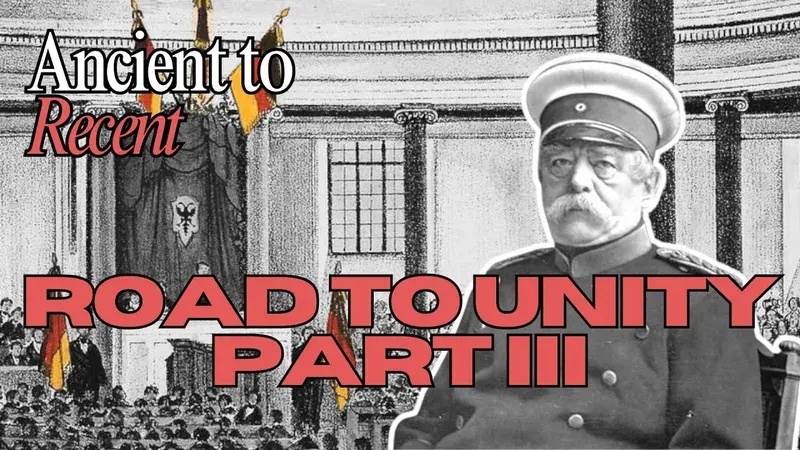
Road to Unity — Part 3
19 July 2025 · 46 min · Season 1
 Watch on YouTube →
0:0046:45
Also on
Rate the show
Ratings are how new listeners find the show. It takes a minute and it makes a real difference.
In this episode of Ancient to Recent, we unpack the turbulent reign of Kaiser Wilhelm II and the dramatic transformation of Germany from 1890 to 1914.
From Bismarck’s calculated power structures to Wilhelm’s impulsive foreign policy and volatile personality, we explore the roots of Germany’s growing isolation and instability. Learn how economic booms, social upheaval, colonial ambitions, and a series of scandals pushed the German Empire toward the brink of war, and how a single man’s ego may have helped light the match.
New episodes every Friday at 8:00 CET. Available on YouTube, Spotify, and Apple Podcasts.
Follow @ancienttorecent on Instagram, TikTok and YouTube
Read transcript
This transcript is automatically generated, so it may contain typos and misheard names.
The Kaiser is like a balloon, if you don't keep hold of the strings, you don't know where he will be off to. Otto von Bismarck, Germany, 1890 through 1914 In the late 19th century, Otto von Bismarck had consciously constructed a German constitution that left considerable power in the hands of the German monarch. The Kaiser was not like monarchs in countries like Belgium or Denmark or the UK or Sweden, whose jobs are largely to kiss babies, shake hands, cut ribbons, drink tea and be figures of adulation.
Instead, in Germany, Bismarck had consciously constructed a system where large amounts of power would reside in the hands of the Kaiser, and this had worked very well for him under Wilhelm the First, the monarch immediately after German unification. Because Wilhelm the First really wasn't in any way particularly interested in actually running the affairs of the state, and he left things down to Bismarck. But Bismarck could always rely on the support of Wilhelm the First whenever he got into arguments with the German parliament, and as long as Bismarck had supported the Kaiser, then Bismarck would always be able to get his way.
However, the system no longer worked after Kaiser Wilhelm the First died, was briefly replaced by Friedrich the Third, who died 99 days later, and then eventually is replaced by Kaiser Wilhelm the Second. Because from a very early moment, Wilhelm the Second wanted to actively play a role in German politics and saw Kai and saw Bismarck as potentially a threat to that role. Ultimately, the relationship between Bismarck and Kaiser Wilhelm the Second would breakdown over new legislation that Bismarck was introducing to try and suppress the trade unions and the socialist movement. Wilhelm the Second would use this as his opportunity to dismiss Bismarck, not out of any particular love for trade unions or the socialist movement, but because he didn't want his reign to start with blood on the streets and German soldiers shooting German civilians for protesting. He wanted to be popular, and this desire for popularity would be one of the things that really defy Wilhelm the Second's time in office.
After the long period of Wilhelm the First and then of Bismarck, Germans were feeling both incredibly optimistic, but also wanted something kind of new. Germany was a nation that was forging ahead in the late 19th century, and Wilhelm the Second, young, energetic, with a clear vision for how he wanted Germany to be, seemed to in many ways embody this new sense of German confidence. As such, the Kaiser really caught the imagination of many German people.
In many ways he was quite like this new German state, young, energetic, aggressive, very keen on modern technology. He made a point of drawing a contrast between himself and Wilhelm the First and also Bismarck. He travelled around Germany, he visited factories and universities and schools. He was very keen to be seen and to be experienced by his new subjects, which contrasts greatly with Wilhelm the First, his grandfather, who was very austere, very Prussian, very sort of Olympian in his reserve.
His psychology seems to have been formed greatly by the ideas and the environment that he was born into. Confident, militaristic, nationalistic, aggressive, some could say, but also somewhat immature. Wilhelm the First was quite a complex man. He had been born with great power and great privilege. He had tremendous ambition and energy, but he also had some very deep insecurities. He was deformed from birth. His mother had experienced a very difficult birth but had wanted to avoid his caesarean section, and so this led the doctor to grab Wilhelm's arm and to physically yank him out of his mother's womb, which led to permanent damage in his shoulder, which left his left arm completely useless, withered and deformed. And this caused a tremendous insecurity within Wilhelm. He hid this deformity his entire life. This was one of the things that fed into his macho, aggressive brashness, his desire to overcome his physical inability. Further playing into this is the relationship that he had with England.
So the British royal family are 300 years removed, descendant from German aristocracy and there had been considerable intermarrying between the different royal families of Europe. Queen Victoria, who was Wilhelm's grandmother, was married to a German Prince. Prince Albert and Wilhelm looked up to and admired Queen Victoria. He looked up to and admired Britain as well. He envied many of the things about Britain, which was also a very modern country.
It was the leading nation in the world at the time. He envied English aristocratic culture. He envy Britain's vast empire, it's powerful Navy, it's wealthy economy. And he spent much of his youth in England, where he would sit watching the ships of the British Navy pass in and out of Portsmouth and dream to himself of one day raising Germany under his leadership to be the true power in the world. He both admired and feared Britain and all of these factors, The environment that he was born into, his desire to be the embodiment of his nation, his desire to overcome his physical inability and his peculiar relationship with Britain would shape the role that he would play in leading Germany from 1890 to 1914 and the disastrous events of the outbreak of the First World War.
Welcome to ancient to recent, my name is Joseph Parkinson. In this episode we will be covering the imperial height of the Second German Empire, the period between 1890 and 1918, the collapse of the German Empire. Episodes of the Ancient to Recent podcast are out every Friday 8:00 Central European time, and you can listen to them on YouTube, Spotify, Apple, anywhere you get your podcasts. In the late 19th century, Germany was racing ahead.
New trams and glittering department stores could be seen in Berlin, a city that by 1905 had risen to having a population of 2 million people. The German economy was experiencing massive growth. Between 1895 and 19 O 100 it increased by a third. Exports went through the roof. Hamburg became the third busiest port in the world. But this was only part of the story. For everyone who surged ahead, there were more who fell further and further behind. And as this happened, this created ever increasing anxiety and anti capitalist sentiment.
Rapid population growth plus the onset of new technology that led to mechanization LED in many cases to workers losing bargaining power, and so every time there was a hiccup in the economy it would lead to huge spikes in unemployment, especially in 19 O 7 and 1913. The inability of German workers to bargain meant that wage growth actually stagnated for many people and fell behind wage growth in place by Britain and France even as the German economy grew.
And a lot of people started to ask questions where is the wealth actually going? They can all see that Germany is becoming richer and more technologically advanced and more prosperous, but it's actually not trickling down to help normal people. Germany had a growing super rich population, a booming banking sector and this led to resentment that expressed itself as socialism on the left which is perfectly reasonable, and anti-Semitism on the right which is perfectly unreasonable. One of the groups that suffered the most was rural workers who saw that new technology led to ever increasing levels of production which therefore led to falling prices and they became an especially motivated source of resentment against changing society.
A lot of people saw a way out of this through imperialism. You had the foundation of the German colonial society at this time, and you had a sense that Germany was being left behind. France and Britain had these huge colonial empires, and that's really what defined a country as being successful. If Germany wanted to be a truly powerful nation, it needed the colonial empire, so the argument went. Plus, it was also assumed that by acquiring land overseas, this would provide export markets for German companies.
It would provide a place where Germany's export population could be resettled, and it would also provide the raw material that Germany desperately needed for its growing industries. Bismarck was replaced by someone called Leo von Caprivi. He was appointed Chancellor without the Reichstag being informed in any way by Wilhelm. Caprivi was a Prussian general and Wilhelm saw Caprivi as essentially a stand in. This was someone who was going to allow Wilhelm to gain more and more experience to put himself in a position to do what he eventually wanted to do, which was for Wilhelm to become an absolute monarch. But unfortunately, one of the things about Kaiser Wilhelm the first is that he was an absolutely terrible judge of character.
All of the qualities that Caprivi was meant to have of being a subservient, pliant, easy to manipulate figure, he actually didn't have any of those things. He was a very different man from Bismarck, but he was very much his own man. He had fought in the Franco Prussian War. He had then transferred from the German army over to the German Navy. He'd actually so opposed the expansion of his own branch of the military that he had resigned in protest.
He was a bachelor, he didn't smoke, he read history, he spoke fluent English, and he was a reasonable, sober compromiser. He didn't want to be like Bismarck, a confrontational, cynical figure. He believed that the way to solve Germany's social problems was through compromise. The 1890 elections had returned the SPD as the largest political party. He understood that if he was going to achieve the things that he wanted to do in terms of the expansion of the German land armed forces, which he was committed to as opposed to the Navy, and he was going to have to work with the SPD. So he allowed the anti socialist legislation to first of all go unenforced and then to lapse.
He also wanted to work with the Catholic Centre Party, the Zentrim party, to alleviate some of the legislation that persecuted Roman Catholics. So he would allow for example, the Speaking of Polish in Polish majority schools. He also introduced legislation to protect workers, women, children, to limit Sunday trading. This all was very welcome. However, there was blowback against this. Allowing the SPD, the socialist movement, to express itself didn't immediately buy them off, it just allowed them to put forward their concerns.
There was huge poverty. Even amongst the growing wealth, there was huge inequality. There were people living in slums that didn't have proper sanitary toilets, that were working in inhuman conditions. And so it became quite a shock to the Kaiser that a Caprivi's efforts to win over the workers, instead of being greeted with tremendous gratitude, was greeted with the next list of demands for improving their lives. Plus on top of this the ability of the trade unions and the SPD to express themselves led to increased rises in strikes, in social unrest, in conflict with industrialists which then led to counter strikes which then lead to which then lead to anti socialist sentiment rising, fighting on the streets and rising tension.
This created a sense of anarchy that was very unwelcome amongst the German conservative establishment who thought that Caprivi was compromising with socialist rabble rousers. At the same time, Caprivi struggled to deal with Germany's foreign policy. At this time, Bismarck had negotiated a series of Byzantine treaties, secret treaties, especially with Russia. In terms of mutual defence, Caprivi couldn't publicly announce that he was going to renew them or at the same time allow them to lapse, because allowing them to lapse would drive Russia into the arms of France, but renewing them would potentially alienate Austria, both of which he required. Now if you are a generational genius, as also von Bismarck was, you can square the circle, but it was unfortunately beyond Caprivi.
In 1893, there was further success for the SPD, which led to further demands for the power, further disruption and Caprivi's inability to buy off the SPD with new legislation in return for the passing of an increase in the budget for the German armed forces. By this point, Kaiser Wilhelm the Second, who had been so determined to win the approval of the workers, became bored with the endless demands, this turmoil, the bargaining, the buying people off, even to be greeted with another list of demands tomorrow.
So he decided to sack Caprivi. Both Bismarck and Caprivi had failed to do the one thing that was really required of them, which was to unify the German people. Wilhelm became increasingly convinced that the solution to this problem was to look out of Germany, was to look externally, was to look at the acquisition of a colonial empire, and he turned to the man he thought could help bring this about, which is a man called Prince Hoen Lawyer.
Now Hoen Lawyer was considered acceptable because he was southern, moderate and Catholic, but at the same time he wasn't beholden to the papacy and he had been an advocate for a Prussian dominated Germany for a very long time. However, Hoen Lawyer didn't actually want the job. He saw the task as being essentially impossible. He'd previously been the governor of Alsace the Rain, where he would done a reasonable job, not particularly brilliant, but his mediocrity was one of the strengths that the Kaiser saw in him. Because ultimately the objectives the Kaiser had was the creation of an absolute monarchy. And so Hoenn Loyer wasn't someone who was going to stand up to him as the Kaiser thought.
Hoenn Lawyer is charged with passing new anti socialist legislation through the Reichstag. But this is a Reichstag where 1/4 of its delegates are SPD members. And at every single election the SPD gets bigger and stronger and more confident. The legislation is put to the Reichstag and is defeated. And this leads the Kaiser to fly into a rage and to even actually consider a military coup. Hoenn Lawyer explains to the Kaiser that the end result of this will be a civil war.
So the Kaiser, a man who had appointed Hoen Lawyer to be a pliable tool, ends up having to back down when confronted with Hoen Lawyer. The Kaiser couldn't force through legislation, but what he could do was he could appoint ministers. In the German system of government, the ministers were not responsible to the Reichstag. They were responsible to him as the emperor. And so he began the process of placing high up within the German state people he believed would carry out his will. And one of these people was Bernard von Bulow, who is appointed in 1897 to be the secretary of foreign affairs. And he was basically instructed to create a vast Navy and to begin the process of constructing a colonial empire. He was joined in this by Alfred von Turpitz, who is the head of the Navy.
And they presided over the rapid expansion of the German Navy, which began the tension with Britain. Now, Bismarck hadn't been keen on Germany building a colonial empire, but the reason he went along with it is that he needed the support of the German nationalists and the German conservatives who were themselves very keen on this if he was going to pass legislation in the teeth of opposition from the SPD. And so this was just a SOP that he had to give to them. Under Bismarck, Germany acquired Togo, Cameroon and Germany East Africa.
Bismarck had been keen to emphasize to the British and the French that Germany was not in the process of building a global colonial empire that had any intention of challenging them. But then after Bismarck fell and the rise of Vonbulo, very different noises started to come out of the German government. Vonbulo gave bombastic speeches about how Germany deserved its place in the sun, and Germany was a rising power and Germany was the nation of the 20th century.
And so Britain, which was already concerned that Germany was catching up economically and industrially, now saw a German state that very overtly set its eyes on the construction of an empire that would challenge the British Empire. Von Bulow in 1898 introduces the First Naval Law, which is a budget that massively expands the financing of the German Navy. This further leads to increasing tensions with Britain and it manifests itself in the 19 O 4 signing of the Anton Cordio von Bulow's reckless foreign policy.
And Wilhelm's naive dreams of empire have now driven the most powerful, most industrialized nation in the world into the arms of France, Germany's most deadly enemy. Wilhelm tried to drive a wedge between the two nations, especially in the 19 O 5 Moroccan crisis where he called for the partitioning of Morocco, believing that this would weaken French holdings in North Africa, which would therefore benefit the British. This was seen as German meddling in another empire's internal affairs and actually further isolated Germany. The isolation then becomes a vicious cycle itself. As Germany becomes more isolated, it therefore needs to spend more money on its Navy, which therefore leads to increased tensions, which therefore lead to Britain becoming closer allies with France and Italy and Russia. So Germany was having to throw ever expanding amounts of resources at its Navy to simply fall further and further behind and become ever more politically isolated. Britain then announces the construction of the Dreadnoughts, A revolutionary new kind of battle cruiser that will render all ships currently in service obsolete. So then Germany has to do the same. So then Britain does more.
So then Germany does the same and eventually gets to the point whereby Germany is actually falling further behind Britain. In 1912, the Germans decide that this is a path that they really need to abandon. They begin scaling down the expansion of their Navy and trying to improve relations with the British. But by this point it is too late. Germany's pursuit of a colonial empire and a massive Navy has been totally and utterly contradictory. They have acquired some colonies that have very very limited economic benefits to the German nation itself and are actually in most cases loss makers.
Germany has closer economic ties to British colonies than it has to it's own colonies. Germany has now acquired a massive Navy that it basically can't use anything for, and all it's got in return for these is to encircle and isolate itself with the most powerful nations in the world who are all viewing Germany with ever increasing fear and suspicion. Now the colonial policy may not have reaped Germany any economic or diplomatic benefits, but it had a huge impact on German culture. For the first time, German people began to really enjoy in large quantities exotic products like tropical fruits, coffee, tea, sugar, spices, chocolates that have never really been available to the average man or woman on the street. Germany became the third largest coffee consuming country in the world, not so far behind the United States of America, despite having a vastly smaller population. And Germans also felt a tremendous pride in their empire.
Hadn't they ascended to being one of the truly great nations of the world? And this was felt by all different stratas of society, not just by the Super rich. But a really ugly side of this was the rise in what I suppose you would say, the popular conception of racist beliefs. Some people, when they sought to explain why it was that Germany had been able to achieve the things it had and what it's right to rule over other people, started to turn to theories of racial and ethnic superiority. This was in the wake of the work of Charles Darwin and the bastardization of that work by so-called intellectuals who started to bandy around ideas of racial superiority that gained currency within certain parts of German society. However, Germany at this time was an increasingly confident society.
Germany was a a contradiction. It was experiencing turmoil, anxiety, loss, expansion, a growth of confidence and also a loss of itself. Simultaneously, Germany was experiencing colonial expansion, industrial expansion, new technologies, new lifestyles, new food. Simultaneously, Germany was also going through tremendous social reform. New legislation was introduced to limit working hours and people were finding new ways to enjoy themselves. One of the ways that people were experiencing their new freedom was through art.
So you started to see the rise of things like the postcards. Postcards really hadn't really been something with any popular currency, but they were a way for poor people to have access to some concept of art. They had started to rise in popularity during the Franco Prussian War, when people who were serving in the front in the Prussian army and the various of the German armies would send home to their loved ones letters written on the back of pictures. And this began A trend for normal people enjoying art in their homes and putting pictures up, brightening their living environment.
We also saw educational reforms in the late 19th century that gave Germany incredibly admirable 99% literacy rate. Between 1850 and 1900, the number of people who said that they were avid readers rose from 5% to 30%. We saw factories starting to install factory libraries to encourage workers to experience literature, and much to the chagrin of the Kaiser and people in the cultural elite, these workers didn't choose to enjoy Goethe and Scherner, but instead it was novels based around crime and romance, adventure and drama, and a particularly German fascination for Wild West stories. The elite also wanted to be part of this new culture, and they saw promoting art as a way of creating a national culture and national mythology that they thought they could heal some of the social rifts and bind different parts of society together.
This expressed itself through theatre, through music, through art, but also through the building of monuments and across Germany you saw monuments depicting Bismarck, Frederick the Third, Wilhelm the First, springing up in their hundreds in every town and city in village square. These also seem to play into the national mythology of romantic militarism. On the 17th of October 1900, Ben Hunt von Bulo becomes the Chancellor and he inherits A Reichstag that is deeply divided.
He doesn't seem to be able to do anything to stop the feared rise of the socialist SPD party. Bulow has to unite the other political parties in order to allow for the passing of budgets to fund the military, especially the Navy. But military expenditure is mushrooming out of control and no matter how much money is thrown at the armed forces, it always requires more. Now there's no disagreement within Germany that the Navy should be expanded, but there is constant disagreement as to how to finance this expansion.
And so Bulow decides to introduce tariffs on food imports in 19-O2. Now the idea behind this is taxing food imports will allow from Bulow to be able to finance the armed forces. But the consequence of this is that it drives up food prices. This disproportionately affects the poor, but it also effects the middle class as well. So it doesn't just encourage more people to vote SPD, it also it directly encourages more people from the central party and from the conservatives to switch to the SPD.
In 19 O3 the SPD win a breakthrough victory 31.7% of the vote. And this kills the idea of any more tariffs being introduced. But the army is still expanding and Navy is still expanding. It still needs more money. So what Vumbulo decides to do is to introduce taxes on the rich. For the first time ever. Yonkers and aristocrats and industrialists are going to have to give up some of their income to finance military expenditure and also some of that is going to be peeled off to finance social expenditure.
So Bulow's attempt to isolate the SBD and fund rise in military expenditure actually backfires. The SBD are able to pressure Bulow into introducing state pensions, introducing for the first time ever payments to Reichstag members who beforehand had been amateur. And therefore that had made it harder for working class people to be Reichstag members because they had to do it on days that they had taken off from work. Also to introduce comprehensive education packages. The SPD were able to further increase their influence within the Reichstag when they blocked funding for colonial policies after the German army brutally crushed the uprising by the Herrero people in West Africa.
And the SPD said there will be no more funding unless we directly have a say in how that funding is spent. Now, in 19 O Six, there was a brief downturn in food prices. And so von Bulu immediately called an election, and he made the election a referendum on colonial policy. And in this period of heightened patriotism and nationalism, this was a blow to the SPD, who lost half of their seats and allowed von Bulo to form a coalition of liberals and conservatives, which would be called the Bulo Coalition and stayed in power until 1909, when von Bulo is forced to resign.
We will touch upon that very soon. He's replaced by a man called Bettman von Hovig. He again is required to preside over this balancing act of rising social costs and rising military expenditure. At the same time, he is so traumatized by the idea of having to do this that he actually bursts into tears upon his appointment. Food prices continue to rise, costs continue to rise, strikes continue to rise, and in this period of political turmoil, the SPD are able to win 1/4 of the seats of the Reichstag. The German electoral system is tilted towards over representation for rural constituencies. It is specifically designed to disadvantage exactly SPD voters, and yet they still managed to win 1/4 of the seats. They are the largest constituency and the SPD is divided between a reformist wing and a radical wing. The SPD owes its roots really to revolutionary Marxism, and so they are viewed with absolute fear and terror by by conservatives and liberals, and so conservatives become more reactionary.
Thus the rise of the SPD causes more intransigence on the right, which means less compromise, which means less capacity to actually deal with the problems, which means the problems get worse, which means the ISPD benefit by rising even more. So the question then had to be asked, how do we get out of this never ending cycle? And many people started to think that what the Germans needed to bring them together to create a sense of unity was the same thing that they had in 1871, a foreign enemy, a war. All the while we have the figure of Kaiser Wilhelm. The second opinion these days is divided on the legacy of Wilhelm.
Was he a tragic, misunderstood, manipulated figure? Or was he a megalomaniac? He had tried to be the people's monarch. He had been the riser Kaiser, the travelling emperor, the man who couldn't wait to show his face at every school and hospital and factory and shake hands and do whatever he could to bring society together, even when so often his instincts as to what to do were so misplaced. He was a figure who often shot from the hip, who spoke from the heart, and who would find himself giving a speech that he hadn't planned on giving, that he hadn't written, that he was making up on the fly in front of some crowd of bemused workers or students. The most notorious of these was when he was addressing troops who were being deployed to China to crush the Boxer Rebellion, and he notoriously referenced the Huns, the forces of Attila the Hun in the late Roman Empire, saying that the German soldiers in China should show no mercy, take no prisoners and make sure that for 1000 years no Chinese ever looks the German in the eye ever again.
This is then reported in the press and it gives him a bit of a bad reputation. You can imagine the scene of advisers running around trying to tell some bemused journalists, well, the Kaiser actually meant to say this when he was saying, yeah, go to China and go absolutely berserk on Chinese civilians. What he really meant was this is a a tremendous source of embarrassment. But Kaiser Wilhelm is still a popular figure, and Republicanism is very much a fringe phenomenon.
However, despite his avuncular character, despite his capacity to put his foot in his mouth, none of this ever seems to have any really long lasting damage to him. He's just viewed as old as Kaiser Willy being a bit of a character. Again, there's a bit of a roll of the eyes there he is. What's he done now? However, the scandals of 1907 and 1908 they do have a lasting impact upon him. In 19 O 7, there's something called the Ehlenberg scandal, where a journalist called Maximilian Harder accuses Kaiser Wilhelm of being a pacifist and also accuses him of being part of a secret homosexual society that is throwing gay orgies that the Kaiser is apparently participating in. Wilhelm was always someone who was a very aware of his public depiction.
He cared a lot about what people thought of him. He would scan the newspapers for hours and hours seeing how his speeches, how his appearances had been written up, who'd said nice things about him, who'd said bad things about him. And so he was furious at this. He was accused of being a pacifist and being a homosexual. This is obviously the early 20th century and people had very different attitudes towards these things. But at the time that was an absolutely scandalous thing to be accused of.
And so he sued the journalist Maximilian Harder for daring to say these things about him. It it led to five separate court cases. But for some reason, the stench seemed a little bit harder to scrub off this time. And one of the things that Wilhelm decided to do to distance himself was he dismissed some of his closest and most trusted civilian advisors. Sean of these supporters, he now needed to find a new support network. And he found that amongst the officer corps, amongst the German military high command, who were themselves deeply steeped in ideas about Germany's strategic weakness. It's impending supposed collisions with Russia and France, the inevitability of conflict with these nations and the desirability to be aggressive in dealing with Germany's strategic problems.
The Kaiser Wilhelm is surrounded by people who are absolutely convinced of the necessity of an even more aggressive foreign policy and of military action as a way out of Germany's difficulties. Whilst Wilhelm was still reeling from the Oldenburg scandal, another scandal broke. In 19 O 8A British newspaper called the Daily Telegraph published an article which was based on a private conversation that Wilhelm had had. Wilhelm had been on holiday in England with a gentleman called Edward Montague Stuart Motley and he had spoken at great length about Anglo German relations. Motley had written this up and sent a copy to the newspaper. Well, the Daily Telegraph wasn't going to publish the words of the German Emperor without the approval of the German government.
So the Daily Telegraph sent the interview to the German government in Berlin. The Kaiser, burned by his previous experience, decided that he didn't want to have anything to do with it and he would leave it to von Bulow. Von Bulow was on holiday, so this was then passed to another advisor who was also on holiday. So it was then passed to the desk of a junior clerk. And this junior clerk took one look at this and thought, well, I'm not in a position to alter the words of the German Kaiser. So he sent it back to the Daily Telegraph and said, publish as is.
These are the words of the German Kaiser. You go ahead and publish unedited. This was absolutely explosive. In this interview, Wilhelm had said that the English were mad that he was responsible for winning the Boer War for the British, that he had prevented intervention in South Africa in the Boer War by Russia and France. That German foreign policy in the Far East was aimed at stopping aggression and expansion by Japan. That the German people were overwhelmingly Anglophobic. But this just about managed to go through the tick list of annoying everyone.
Absolutely everyone from the Tsar of Russia to the President of France to the Prime Minister of Britain to the King of Britain to the Emperor of Japan. He managed to annoy just about everyone. Who's anyone. This shattered the relationship that Bulo had with the Kaiser, and it led to Bulo resigning. The Kaiser is now reeling from these two scandals. The second one especially hurt him because he felt that he'd done nothing wrong.
He did a private conversation. He had decided, I'm not going to touch this. This has been sent to the German government. I won't interfere. People complain about me interfering, OK? You don't want me to interfere, right? I'll stay out of it. You deal with it. He trusted the people around him and they had let him down so much. He was absolutely shocked by the negative press that came his way. The final straw came at a hunting party.
He was with his new pals, the militarists of the German high command that he was now hanging out with, and he was drawing on them for their advice. And he's at this party and he's quite glum. He's quite downcast. One of the German officers who's a gruff old infantry commander called Dietrich von Hudson Hessler, decides that he wants to cheer up his beloved Kaiser. He slips out of the room, and he slips into something a little bit more comfortable, which is a pink ballerina's Tutu. And he comes into the room full of German officers drinking and talking and he starts twirling and cavorting and curtsying in this pink ballerina Tutu.
Everyone in the room finds this outrageously funny. 1st the glum Kaiser cracks a smile, then he starts to chortle, then he starts to laugh, then he's roaring with laughter and everyone in the room is rolling around laughing at how ridiculous and absurd this scene seems to be. Until this old portly German infantry commander suddenly stops, still grabs his heart, collapses onto the floor and dies. And all of a sudden a bunch of people who have just been accused of being part of a homosexual cabal that engage in gay orgies are now going to have to explain why a German infantry commander has died whilst wearing pink lingerie in the presence of the Kaiser.
And they all just sit there in silence. What are we going to tell the press? They end up having to strip his body and hide the Tutu, but it still gets out into the media and fillhelm just things. OK, that's enough for me. He has a nervous breakdown and he withdraws from public life. He's not seen for months. His reputation as the young, brash, arrogant, avuncular Wilhelm the Riser Kaiser, the living embodiment of the confidence of this new expansionist state, is shattered. He withdraws from public life for months on end. For years he is a diminished figure. Von Bulow, Bismarck, All of the chancellors that Germany has had from 1871 all the way through to 1914 have singularly failed to solve the social problems that Germany has. There has been tremendous economic growth. There has been tremendous wealth. Many people have pushed ahead.
Many people have also been left behind. Rising expectations have led to great disappointment. The social divisions are more intense than they have ever been, and the harder the German political class tries to solve them, the bigger these problems seem to be. Germany now has a Kaiser who is isolated, diminished, withdrawn, his confidence shattered, increasingly dependent on the advice of people who see the only way out of Germany's strategic problems. It's diplomatic isolation and it's relentless political polarisation as being armed conflict. That is where Germany finds itself on the eve of the First World War.
My name is Joseph Parkinson. This has been ancient to recent and in the next episode we're going to look at how Germany goes to war and what the experience of Germany is during the cataclysm that is the First World War. What are the events that lead to Germany's involvement in the war? It's defeat and the collapse of the German monarchy and the second German Empire. Episodes of Ancient or Recent are out 8:00 Central European time every Friday. You can listen on YouTube, Spotify, or anywhere else that you get your podcasts.