
#19
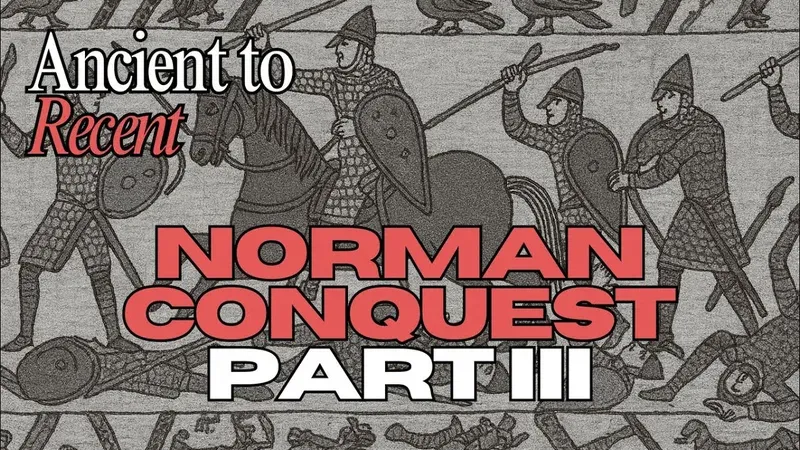
Norman Conquest
10 October 2025 · 1 hr 5 min · Season 1
 Watch on YouTube →
0:001:05:05
Also on
Rate the show
Ratings are how new listeners find the show. It takes a minute and it makes a real difference.
As the smoke of Hastings clears, William the Conqueror’s work has only just begun. From the burning towns of Sussex to the frozen wastes of Northumbria, England descends into chaos. The Godwinsons rise from exile to challenge the Norman invader, rebellions erupt from Devon to York, and the Vikings return one last time to stake their claim.
But William answers rebellion with terror, slaughter, famine, and fire in a campaign so brutal it will be remembered as the Harrying of the North. This is the dark aftermath of 1066, when England’s old world died, and a new one was born in blood.
🎧 New episodes every Friday at 8 PM CET
📲 Follow on Spotify, YouTube & Instagram @AncientToRecent
Sponsored by World of Whisky – Some things only get better with age. With World of Whisky, you can own a share of Scotland’s most iconic export. You must be over 18. Investing carries risks. Drink responsibly. Invest responsibly. This is not financial advice.
👉 Learn more: https://tr.ee/ZaBoYD
Read transcript
This transcript is automatically generated, so it may contain typos and misheard names.
I attacked the English of the northern shires like a lion. I ordered their houses and corn with all their belongings to be burnt without exception, and large herds of cattle and beasts are burdened to be destroyed wherever they were found. It was there I took my revenge on masses of people by subjecting them to a cruel famine and by doing so, alas, I became the murderer of many thousands of that fine race, William, Duke of Normandy. Welcome to Ancient to Recent.
My name is Joseph Parkinson and on today's episode we complete our story of the Norman Conquest and the Battle of Hastings. Episodes of Ancient to Recent are out every Friday and are brought to you by World of Whiskey, the premier place for whiskey cask investment. You can visit worldofwhiskey.co.uk to see the great range of investment options and listen to new episodes of the ancient recent podcasts that are out every Friday on YouTube, Spotify and Apple Podcast. The late summer of 1066 was a time of immense frustration for William, Duke of Normandy.
His army had been ready by August, but bad weather in the notoriously temperamental English Channel had delayed his departure. As days turned to weeks and supplies ran out, William must have grown desperate. But then the winds changed, men and horses packed into wooden ships that sat low in the water, weighed down by food, tools, fodder and weapons for a journey into destiny, one which could only end one of two ways, in victory or death.
William's fleet put to sea on the 12th or 13th of September, but immediately it almost ran into total disaster, sailing directly into bad weather. The Norman fleet didn't end up in England, instead only just down the coast, a place called St. Vilaise. But it could have been so much worse. Some of his ships were lost and it seems that at that moment some of his men seem to lose heart and deserted. By mid-september Williams plans were hanging by a thread and with it his claim to the English throne.
By this time, William had heard that Harold had disbanded the English army and that William too knew that with winter coming, the weather was only going to get worse. His window of opportunity to claim the English throne was closing. William had to weigh out an agonizing further fortnight, waiting for the weather to turn in his favour. But then the weather changed. The Normans scrambled to ready their ships and to set sail for England and Destiny. Once the ships hit the open sea, they immediately dropped anchor. Why?
Well, there's two reasons. Firstly, to make sure that they could stay together in a tight formation, but secondly, they didn't want to reach the shore before dawn. If they did that, they would open themselves up to an attack. But it seemed that tragedy had struck, because when the sun rose the next morning, William's ship was nowhere to be seen. This was also a tragedy for William. Where was his fleet? But instead of panicking, William remained calm. He sat down to a leisurely breakfast, and by the time he had finished, the Norman ships had appeared. The panic had passed.
Around 9:00 AM on the 28th of September 10th, 66 the fleet of William, Duke of Normandy arrived at the port of Penversey in East Sussex. Now this was probably intentional, as though the town was not substantial or particularly strategically important, it had two big advantages. The first is that it was a former Roman Fort and that allowed the Normans some protection. They could quickly reinforce the old fortifications that were already in place, but there was also the presence of a large Bay that would allow the Norman ships to beach themselves and to therefore unload man horses and supplies quickly. Having occupied Pembsey, the Normans then raced to a nearby town called Hastings, a dozen miles away. The big advantage of Hastings is that it had an Iron Age Fort which the Normans could quickly take over allow them further protection in this dangerous unknown in mysterious country. Meanwhile, Harold was in York after winning the Battle of Stamford Bridge on the 25th of September. Harold was busy burying his brother Tostic. News of the Norman landing would probably have reached Harold sometime around the 1st of October. Harold seems to have risen S as quickly as possible, leaving much of his army in the north, just taking his mounted men with him and sending messages to London to assemble a new army. Now William would not have known about the arrival of Tostig and Harald Hadrada, nor the result of the Battle of Stamford Bridge.
Robert Fitzpatrick, a Norman who had served Edward the Confessor, seemed to have passed a message to Duke William with news of the battle. The news must not have been encouraging. Harold had won, and won decisively against one of the most fearsome warriors of the age. And now Harold was marching S Harold knew of William's arrival, and William knew the Harold was coming. It seems that the two must have exchanged messages, as we are told that William offered to let Harold hold his Oldham of Wessex if he resigned the English throne. Harold, on the other hand, somewhat less generously, promised to let William return to Normandy unmolested if he agreed to pay the damage his army had already caused. While William had been in France, he had forbidden his troops from raiding the countryside, but once they arrived in England, William let his troops loose on a local population.
The Normans laid waste to the countryside around them, creating as much terror and fear as they possibly could. They wanted to use psychological warfare as part of their strategy. They were going to terrorize the English people and force the hand of the king of England, Harold Godwinson. Why did William do this? Partly to supply his troops, but also by raising the countryside around. William would put pressure on Harold to March South and seek battle.
If battle was not joined soon, then William, who only had limited provisions and only controlled a very small part of England, was going to run out of food pretty quickly. Harold had the opportunity of sitting back a little bit because he had all the vast resources of one of Europe's richest countries behind him. So William knew he had to force Harold's hand and that's why he inflicted such a campaign of terror and violence against the people.
Harold rushed to London, but it seems that he was warned that he was moving too fast. Was he fully prepared? Had he fully recovered not just from the bloody battle he just fought, but also the 200 mile force March from the north of England? Was his mind clear? Was he thinking straight? Was he making the right decisions? His advisors begged him to wait, but with the Normans laying waste to the countryside, the pressure was on. And what was worse is that the land that William was destroying was Harold's own earldom.
It wasn't just that he was king, but the people who were being killed were Harold's people, and it was his home that was being destroyed. But there was another reason, a tactical reason. Harold had won Stamford Bridge by taking the Vikings by surprise, and Harold was maybe hoping to do just the same to William. But this time William knew that Harold was coming. Harold seems to have set out from London on the 11th of October and reached Hastings by the 13th.
William ordered his army to stand to attention waiting for the attack. Harold's army was 7 miles away, north of Hastings at a place known today simply as Battle. On the morning of the 14th of October, William hoped to launch an ambush on the English. Harold also had wanted to surprise William, but William seems to have got the jump on his English adversary. Both sides were exhausted. Williams army had been standing to prepared for a surprise attack all night. Harold's had just completed a long March down from London. Though taken by surprise initially, Harold seems to have seen William coming and both sides rushed to prepare themselves for battle.
William had advanced from Hastings to some high ground known as the Ridge. The English had taken a nearby hill. The English dismounted and left their horses in the rear. They formed a solid formation, a single shield wall, and Harold took his place in the centre of the line, standing there with his battle standard flying. William formed his army into 3 lines, the foot soldiers with bows and crossbows at the front. The second line were men of arms with heavy swords, axes and clubs.
And then the third and final line were the Knights mounted on horseback. And that's where William, Duke of Normandy, took his place. The two armies, the two claimants to the English throne, finally, at last, face to face in the fields of Hastings. The battle began around 9:00 AM, with a blaring of trumpets and both sides exchanging a Halo. Arrows and other projectiles smashing into Shields, piercing flesh, The air filling with the sounds and smells of death.
The anguished cries of men and horses, the last desperate prayers of those readying themselves for the next life. The despair of men seeing their friends and comrades collapse. Hands pressed gaping wounds, shrieks of pain. But it was the Normans who were a tactical disadvantage. They were firing uphill, leading many of their Archers to either overshoot their targets or for their arrows to harmlessly bounce off the impregnable English shield wall.
Though the English shield wall took some casualties, it stood steady, stood firm, not giving any ground, not allowing any gaps to form, not giving the Normans anything that they could exploit. Seeing the shield wall holding and knowing that he had to win the day, a decisive victory had to be his. Before the sunset, William sent his foot soldiers forward. They had to dislodge the English from that hill, and they had to do it face to face, eye to eye, man to man, sword to shield. Forward.
They advanced, the Norman soldiers in their male shirts, the English steady, watching, waiting, arrows still landing on both sides, Men falling, The shrieks, the sweat, the loss of nerve, men losing control of their bodily functions, literally soiling their pants. The tension in the air as the long, steady line of Norman troops marched forward, inexorably, closer and closer. The mass of Norman troops crashes into the impregnable English shield wall.
The fighting is ferocious. Javelins hurled, stones tossed, the clash of sword and shield of steel slicing through flesh, The crunch of bone under the blow of an axe. Fists and teeth, fingers in eyes. The sheer animal hatred of men, the grunts of men in desperate struggle, determined to kill, kill, kill. The wounded finished off with knives thrust into eyeballs and jugular veins and throats, the spurts of blood from open wounds, the last desperate moans of panic before fading limp into the next World. The Norman attack faulted the English shield wall still held as the Norman foot soldiers threw themselves against it again and again and again to no avail. The ground grew slippery with the gore and blood of both sides.
The dead littered the field, but the English line held. William seeing that nothing was working. The Archers had veiled. The heavy infantry had taken terrible casualties, and knowing that this was his one and only chance, sent forward his heavy cavalry. Both sides exerted themselves with every inch of their strength and determination and fury not to give a single inch of ground. One Norman knight, Port Telephor, is said to have stood in front of his own line, daring the English to come at him. One English soldier, enraged by the insult, came out to meet him, only to be run through by the Norman Knights Lance, to cheers of the Norman soldiers, as Telephor lend down to hack off the Englishman's head and hold it up to his fellow Norman's.
A rare moment of triumph In those early hours of the Battle of Hastings. The Norman Knights attacked on horseback, but again they could make no progress. The Knights could only ride up to the shield and hack away with their broad swords. But in doing so they exposed themselves to the Spears and javelins thrust and hurled by their English adversaries that claim so many Norman lives. The battle dragged on for hour after hour with no Norman success. And then the decisive moment.
Some troops on the left of the Norman army appeared to break and flee. A rumor flew through the ranks of the Norman troops that William himself had been killed. It looked like the Norman army would disintegrate. William, in a moment of immense personal bravery, rushed into the fleeing troops and showing himself, exposing himself to the arrows in the balls, any number of which could have struck him down. But his brave display worked and he rallied his fleeing men. William had one big advantage desperation. The Normans have nowhere to go.
The English were on their own ground. They could theoretically fall back, regroup. They could lose and then win again another day. But for the Normans, there was no tomorrow. If they were not victorious, they would be a defeated army in a foreign land where they had already carried out terrible atrocities. They knew there would be no mercy. They knew there would be no quarter. They knew that if they were defeated, they would surely all be killed.
And this gave the Norman troops a surge of resolve. The fleeing Normans rallied. They had been pursued by some of the English troops who had broken from the shield wall. And the Normans turned and slaughtered their English pursuers, hacking them to pieces with tremendous ferocity. Some say this happened by chance, but others say that the Normans had used this as a strategy, that the Normans had pretended to retreat to lure the English out of their impregnable shield formation. Norman sources say that this was a ruse that the Normans had worked on beforehand, and that they repeated this throughout the battle, advancing on the English, falling back, and each time drawing English troops from the safety of the shield ball and again turning on them and hacking them to pieces. Is this true?
We will never know, but we do know that substantial numbers of English troops had broken from the shield war, made their way down the hill and been killed by the Normans. And we do also know that feigned flight is a tactic that the Normans had used in previous battles to great effect. But also claiming that the retreat was a clever ruse may also be an attempt to save face by Norman propagandists. It would sound kind of bad in the official telling of the story if the Normans had to admit that a lot of Norman troops had lost heart and run away out of self preservation or maybe even cowardice. Whatever happened, and whatever the reasons it happened, the English line had been greatly weakened, and the English line was now no longer a single solid formation. The Normans were able to fire volley after volley into the spaces left behind by the men who'd surged down the hill, and English casualties began to mount. As the English line bent and buckled under Norman pressure, a deathly blow was tells to English resolve. King Harold was struck down.
The battle was fought from 9:00 AM till dusk. When exactly Harold was killed within the battle, we don't actually know. It seems by most sources that Harold may have been killed later in the day. The Bayer tapestry seems to show a figure believed to be Harold struck with an arrow in his eye. As ever when drawing from sources from nearly 1000 years ago, accounts do differ. Some say Harold was indeed killed with an arrow to the eye, others that he was hacked to pieces by Norman Knights.
Others still say that William himself killed Harold. The most likely story is the arrow to the eye, but it also has to be noted that this would also be the the most convenient. William had risked it all to take the throne of England, and if Harold had survived the day then it was entirely possible that Harold would have been able to rally another army and fought on. So William needed Harold to die that day. But hacking Harold to death on the field would have been a bit of APR disaster.
It would have been received badly throughout the courts of Europe by Williams, friends and foe alike. So an arrow to the eye combines being decisive with also being impersonal. It's not cold, bloody murder, but it still gets the job done. The English army, badly mauled, casualties mounting, its defence is broken and now the king is dead, disintegrates and takes to flight. Groups of Englishmen in isolation rally and fight on, only to be overwhelmed and slaughtered by their Norman pursuers. Ferocious Normans show no mercy to English soldiers who had cut down their comrades so helplessly before the Shield War only hours before.
As the English army fled, William unleashes his Knights on their heavy horses to chase them down, Slashing with swords, swinging with axes, hooves crushing those fallen to the ground. Lance is piercing the backs and sides of Englishmen, desperately making their escape. The night after the battle is almost as terrible as the day itself. Those who could have fled, but those who couldn't too badly crippled, maimed and wounded, were left stranded to await their fate at the end of a Norman sort. But the pursuit was even a disaster for the Normans as well.
The Normans pursued the English, but they didn't know the lay of the land and it seems that some of them, riding their heavy horses, rode straight into a ditch called Malphos, with one Norman horseman after another laden down with heavy army, tripping into the ditch, only to be crushed by the next one who fell after, and the next, and the next, until the ditch is filled to the brim with the dead and the dying. Back on the battlefield, the dead were stripped of their values, gold, cloth, armour, their corpses to rot and their flesh to be eaten by crows and wild animals.
The Normans after the battle buried their dead while leaving the English to rot in the fields. Harold's body was found stripped of its valuables and badly hacked. Harold standard was presented to William as a battle prize. Harold was dead. William was victorious, but William's claim to the throne was far from assured. William had won a victory, a great victory, but he had no support in England. The English nobility had backed Harold even though they knew of Williams claim and the English nobility was sure to resist him.
And all the while they would be able to draw upon the vast support of a country that saw William as a foreign invader. There was, after all, no rule that said that just because you had killed the king that that made you a king. So what next for William, Duke of Normandy? Before we dive back into the story of the Norman Conquest, just a quick word from our sponsor, World of Whiskey. Some things only get better with age.
A fine single malt is one of them. That's why Whiskey Cask Investment has such serious allure. With World of Whiskey, you can own a share of Scotland's most iconic export. You'll get full certification of ownership, delivery orders and access to rare expressions few ever taste. And in the UK, there's no capital gains tax when you sell. Now, this is not financial advice. Investment carries risks. You must be 18 or over.
Remember to drink responsibly and invest responsibly. And a great place to start with is World of Whiskey. In London, the streets were filled with warriors. Some summoned by Harold but had not arrived in time for Hastings. Others were troops who had fled the battle itself. Words of the catastrophic defeat of the English army at Hastings and the death of King Harold had reached the capital city. The clamour went out for a new king. Edgar Etheling was proclaimed.
He was the grandson of Edward the Confessor, and he was supported by Earl Edwin and Morchar and Steigen, the Archbishop of Canterbury. Meanwhile, William withdrew to Hastings, waiting to receive the English surrender, but none came. So William decided to March on London, stopping in typical Norman fashion at village in town and farmstead, one after the other, burning and destroying everything he could and wreaking a terrible revenge upon the English people that he felt should have welcomed him and recognized him as their king.
William made his way to Dover before moving on to London. 1 by 1 cities and towns offered their surrender, many bringing presence of gold and trembling before the might of the blood spattered warrior that was William, Duke of Normandy. By now William had heard of this new king, Edgar Etheling, and this sent William into a rage. William set out to take the City of London and assert once again his rightful claim to the English throne. But the English weren't done yet with William. They had still plenty of fight in them. English and Norman troops clashed at South Walk, where English troops had advanced out of London to attack a party of Normans.
The Normans fought the English back but were unable to storm London Bridge and gain entry into the fortified city that was the beating heart of the English state. William, consumed by fury, raised the countryside. He knew he could not directly attack London, and he knew also that he couldn't allow it to continue to resist him. The longer London held out, the more likely English resistance would stiffen. He knew he was still in a very vulnerable position. Sir William decided on a policy of terror, unleashing his troops to slaughter, rape and burn, to strike fear into the hearts of every English man and woman and child until they submitted to his rightful claim.
Everywhere he went the Normans laid waste. Sussex, Kent, Hampshire, Hertfordshire were totally destroyed and much of the population put to the sword. The Normans then turned north and dealt out the same treatment to Berkshire and Oxfordshire before stopping at Wallingford, a place they could cross the Thames without the assistance of boats or bridges. It was here that William received the submission of Steigen, the Archbishop of Canterbury, who renounced his allegiance to Edgar Etheling.
Anything to stop the terror, to stop the killing, to stop the rape, anything to bring the violence to an end. The submission of the Archbishop was significant, but it did not in itself signal the ends of English resistance. And as that resistance continued, so too did the slash and burn tactics of William. William now turn NE his men pass through Buckinghamshire, Hertfordshire before establishing A fortified camp. By now two of the Earls, Edwin and Morca, had deserted the people of London, returning to their Oldham in the north and taking their troops with them.
The English cause seemed to be unravelling under the sheer weight of the violence that William was unleashing. Many now began to question, are they really going to fight a child king? Are they really going to bet on Edgar against William, an experienced, victorious and ferocious warrior? Spirits collapsed and Edgar and many of the nobles made their way to Berkhamster where they offered their surrender. William promised that he would be a gracious king and a just Lord if they would simply submit themselves to him. And so they did.
William made his way to London. The city was incredibly tense. This had been a place that was the beating heart of opposition to William's claim to the English throne. Fighting even continued as the Normans entered the city. There were some people who really were willing to go down with the ship, to go down swinging, anything to prevent this foreign Norman usurper from becoming King of England. But the Normans prevailed and on Christmas Day 1066, less than four months after arriving in the South Coast of England, William was crowned king at last, triumphant at the newly built Westminster Abbey. A crowd of Norman and English nobles attended the coronation. Most of the people of London probably stayed at home, but we do know that many armed Normans, not able to fit into the Abbey, gathered outside.
The ceremony was carried out according to the English coronation rituals, which makes sense. I mean, they're crowning the king of England. But these rituals are unfamiliar for the Normans, and much of this is taking place in a language they don't understand. In the English coronation ceremony, the Archbishop asks the assemble crowd if they accept this king, and the assemble crowd must answer twice on Mass. We do. We accept this man to be our king. Unfortunately, the guards gathered outside, unfamiliar with this practice, unfamiliar with the language and tents inside a hostile city they had only just fought their way into. They thought that what they were hearing, the sudden cries from inside the church, was one last desperate attempt by these ungrateful, barbarous Englishmen to prevent the crowning of the rightful claimant, William, Duke of Normandy. Maybe this was an attempt to assassinate William. Maybe the people of London we're going to rise up. Maybe this was a sign to kill all the Normans. And so panicked, these heavily armed, bloody men went on a rampage of violence, burning, raping, murdering, destroying huge swathes of London burned to the ground. The tragedy for the English people continued, and it only got worse in defeat.
Now this is the Norman version of events. But what's strange about the way the Normans tell this story of their own men going berserk during the coronation ceremony is it doesn't mention them doing one thing that you would presume you would do. If you're a you're a soldier and you fought your way all the way from the South of England to London just to make your Lord the king, and you think he's being murdered, the first thing you would presumably do would be to rush to defend him. But even in the Norman version, it doesn't actually include that.
There's no mention of the Norman Knights storming into Westminster Abbey to protect William. So there's a suggestion that maybe this could be further Norman propaganda, that maybe this claim of crying from within the church, panicking the Norman Knights, maybe that's just completely made-up. Maybe it was just that the Normans were such a bunch of bloodthirsty maniacs that they just couldn't pass up an opportunity and a bit of stabbing and burning and pillaging.
We will never know. All we know is that during the coronation ceremony there was a lot of fighting going on. The churchmen inside must have been terrible at the exact moment when the Archbishop had called upon God, beseeched the Lord Jesus Christ to empower William to be their protector and grant the people of England peace under William's benevolent and righteous rule. At that exact moment, William's troops had been near feet away, murdering and burning.
Would this be an omen for what's in store for England under the newly crowned King William? But many of William's Norman supporters, they expected their share of the booty. Some of them were Normans, some of them were mercenaries, some of them were here because they just loved a bit of killing. Some of them were here out of loyalty to William, and some of them were here for the money. And so William said about distributing the booty, many rewards were given to the church, the Norman church, not the English church.
And who was the people who were going to be paying for these wonderful gifts for the Norman clergy, their English brethren? Pope Alexander, who had given his papal blessing to this genocidal campaign of mass murder launched by William. He was also lavished with gold and silver and relics and ornaments. He even received the personal battle standard of Harold Godwinson taken at the Battle of Hastings. As for the English, what did life look like under their new kink?
Well, William was very quick to let them know what things were going to be like. William imposed a heavy tax on the English nobility and common folk in order to pay his men. He was going to tax the English until they couldn't be taxed no more. The coronation over, William withdrew from London. He withdrew to Barking and there he was visited by Earls Edwine and Morca, who's seeing how William dealt with those who opposed him, offered their submission, their loyalty, their fealty.
The only thing to do in this situation, it seemed, was to get on board with William. He was the only show in town now, and those who opposed him didn't tend to live very long. William accepted their submission, but only in return for tribute and hostages. He needed a bit of insurance. It's one thing for you to say how happy you were that William was the king, but William seemed to remember that yesterday you weren't so happy and you were busy killing his men.
So pardon me if William doesn't exactly believe you now that you're here to kiss the ring. William continued to distribute lands and money taken directly from the English to his Norman supporters. William was especially keen on creating a new Norman ruling class. A ruling class personally loyal to him that was invested in the conquest that he had just presided over. They would act as his regions. They would act as his guarantors of power. They would never be able to rebel against him because they knew the English aren't going to support them. So they were bound to him, wed to him, come what may. William hadn't been in England for a few months and he decided to make a trip back to Normandy.
William made his way back to Pembsey, the very place that his army had landed. William took Edgar, the briefly proclaimed King of England, and Archbishop Steigen with him back to Normandy, making sure that the most recognisable figures of resistance could be his hostages, that there would be no one left in England to rally around. Oh, and he also left a large Norman army to keep watch over these newly conquered English subjects.
On his return to Normandy, William was greeted as a conquering hero. People lined the streets of the Norman capital of Rouen to welcome him, and there was public feasting and Thanksgiving for many days. William stayed a while in Normandy, feasting and celebrating, but word got back to him that not everyone was willing to let sleeping dogs lie. A conspiracy was afoot. The relatives of Harold Godwin were back in England. Peasants were being pressed to build a string of castles for the Norman occupying forces, the Normans. Even though they were now victorious, none of their behaviour improved.
They didn't calm down in any way. They continued their pitiless raiding and raping and rampaging at will. The resentment of the English people continued to grow as throughout the year 1067 there were several risings against Norman rule in Herefordshire. A local thing called Edwig the Wild fought back against the Norman occupying Garrison by fighting a guerrilla war. Edrick's forces joined with two Welsh kings, Bledding and Ruwallan, to take the fight to the Normans.
They ravaged Herefordshire and burned Shrewsbury to the ground in their effort to dislodge the Normans, but a more serious rebellion took place in the southeast. In Kent. Local nobles sent messages to Eustace, the Count of Boulogne, encouraging him to land in Dover and to March on London to claim the English throne. Now Eustace knew Dover quite well. It was here that he, as a relative of Ed with the Confessor, had been set upon by supporters of Harold Godwinson that had led to the expulsion of the Godwins from England.
In 1051 Eustace assembled an invasion army and sailed across the Channel. But even though many of the Norman troops who were meant to be garrisoned at Dover Castle were away, the Norman forces were still able to Sally out of the castle, meet Eustace in battle and defeat him. There was also trouble in the north of England in Northumbria. At the time, Northumbria was still officially run by Earls Morcar and Edwin, but these two Earls had been considerably weakened. Due to their capitulation to William and they were being forced to share their power with someone called Copsick, a former ally of Tostig.
Copsig was not a northerner, he owed his position to William. He was William's man in the north. But within a few weeks of arriving in Northumbria, Copsig was ambushed and murdered. In 1067, William returned to England where he learned of the conspiracy organized by the remnants of the God Wine family. William was told that a general uprising was planned where his Norman troops were going to be suddenly massacred. William Spies informed him that the conspiracy was based in the southeast of England, in a place called Exeter, and in 1068 messages have been sent from the conspirators to other cities asking them to join in their planned uprising, only for these messages to be intercepted.
William sent a message of his own. He demanded that the citizens of Exeter declared their loyalty to him, and we don't know exactly who was behind this plan, but it is strongly suspected that it was planned by Gaither, the mother of Harold. Gaither had lost three sons at the Battle of Hastings, Harold and his two other brothers. She'd also lost Tostig at the Battle of Stamford Bridge, and her last son, Walthnorf was still rotting in a Norman jail.
So her bitterness and resentment, especially directed towards William and the Normans, must have been incredibly intense. But even though the God Wine family had been decapitated, there was still more God Wines. Harold had married relatively young. He'd married a woman called Edith Swannack and they had three children, all sons, and these children with teenagers. In 1066, after the Battle of Hastings, they had fled to the West and they were now planning a comeback.
The surviving Godwinsons had sent emissaries to the Irish and the Danes in hope of gaining support to repeat the last Godwin comeback. The Godwins had faced disaster before. In 1051 they had been out manoeuvred by Edward the Confessor and driven into exile in Flanders, only to return gloriously in 1052. Maybe they could repeat the feat. Maybe they could repeat the trick. Maybe this was just a blip in the story of the ascent of the Godwin family. As Williams army approached Exeter, a delegation from the city came out to meet him to negotiate. They swore oaths of allegiance and handed over hostages, and William must have thought that maybe that was it, no need for any fighting.
But once they returned to the city, they continued their preparations to resist. However, the rebels weren't a unified force. They were different factions. Some of them were last ditches, some of them were hardcore, Some of them were committed loyalists to the Godwins and they hated William. They would never submit to him. But others were not. William had levied heavy taxes on the English and that was the real source of the resentment.
That plus the redistributing of lands to Norman Magnes. If William could maybe relent on some of that, then maybe they could be convinced to go along with William being the King. But it seems within Exeter the debate was carried by the hardcore opponents of William. As William approached the city with his army in an effort to terrorize the people of Exeter into submission, he ordered one of the hostages to be brought out in front of the army and in full view of the people.
He ordered the hostage to be blinded. The people of Exeter responded to this by one person standing on the ramparts, turning round, dropping his trousers and farting loudly in the direction of William, King of England. I think William pretty much got the message there. William attacked the city and a bloody siege ensued that lasted for 18 days, but then Gaither and the God Wines fled the city. With Gaither on the God Wines gone, the more moderate faction within the city seemed to prevail and they began to negotiate with William. The city would surrender in return for some of the harsh attacks is being raised, and it does seem that William agreed to these terms.
However, William wasn't much of a man for forgiving and forgetting, and William continued his process of confiscating lands from English Earls and Lords and distributing them to his own supporters. And now with the God Wine family fled, he had access to all of their remaining lands to hand out. By Easter 1068, William seemed to be pretty settled in power. He even felt confident enough to send for his wife to join him in England for the first time.
But the redistribution of land was still causing great outrage. A whole class of English Earls had lost everything. All who had fought against William Hastings had had their lands confiscated from them, as well as a vast number of Englishmen. Not for political reasons, not for being punished for disloyalty, but simply William kept slapping new taxes on them. And every time he slapped a tax on you, if you couldn't pay it, he would just confiscate your land. And so William has now not just created a class of Norman rulers loyal to him, he's also dispossessed the previous English aristocracy, who are now a bubbling cauldron of resentment and hatred towards him and Norman rule. William continued to tighten his grip on power, creating a string of fortifications along the border with the troublesome Welsh, the very area that Edridge the Wild had continued his guerrilla war.
But William also created another problem for himself. He refused to allow his daughter to marry any of the English noblemen and so feeling slighted, Edwin and Moorcar in 1068, suffering under heavy taxes, land confiscation and now deny the opportunity to maybe marry into this new Norman ruling class. They staged A rebellion to throw off the Norman yoke. They were joined by Earls from across the north of England and kings of Wales.
But the most important person to join this rebellion was Edgar the Etheling, the grandson of Edward the Confessor. The legitimate claimant to the English throne in many people's eyes, the man who'd been proclaimed king after Harold had died at Hastings, Edgar was a figure that people could rally around. William raised an army and he marched N building fortifications as he went. The building of castles allowed him to control the the land, to divide the area up and exert a greater amount of force even with relatively small numbers of troops.
But as William continued to March N he went back to that old tactic that he had practiced time and time again that had been so successful for him. Terror. The Normans raped and hacked and burned and plundered their way, leaving behind them smouldering ashes and rotting corpses. Under the sheer weight of the terror. The English rebellion soon collapsed. But while William was preoccupying himself with the North, the three sons of Harold, Godwin, Edmund and Magnus, they began their bid to restore the Godwin family back to his position of pride and to unseat William.
They landed in Somerset. However, their invasion got off to a bad start straight away. They failed to capture the city of Bristol and they returned to their ships. They raided along the South Coast before they were confronted by local troops. The Godwins emerged victorious from the battle, but they were bloodied by it and so they decided to continue to raid before sailing back to Ireland with their booty. Maybe the God wines were done.
This effort had failed. Harold was dead. Tostic is dead. The other boys are dead. Maybe the God wines are a spent force. The North was still a problem for William, however. The rebellion may have fallen apart, but rather than submitting to William, many of the rebels fled to Scotland. William decided that he needed to take charge in the north of England, and so he appointed a man just like himself, a man called Robert Cumin. We don't know a lot about him, but we do know two things. The first is that he was blemish and the second is that he was brutal.
He had a troop of Flemish soldiers somewhere between 5 and 900, we don't know exactly, and he led them into the north of England and they travelled Norman style, burning and killing and raping and murdering absolutely everything in their way. Robert Cumin's March of terror was so ferocious that many people were preparing themselves to flee. But just as they were getting ready to go, a heavy snowstorm descended on the north of England, cutting off roads and keeping people where they were.
Without the potential to flee to Scotland and stuck with Robert Cumin, many people decided that they have no choice but to fight back. Cumin entered Durham and he continued to subject the city to terror and violence. These are places that have surrendered. They've already laid their arms down. And yet it's not stopping the troops sent by William the Conqueror from murdering and killing everything in their path. So the people of Durham rose up against the Flemish troops led by Robert Cuman.
They beat them back through the cities, forcing Robert Cuman and his final few men to take refuge in the house. The people of Durham set the house ablaze and anyone who tried to get out was hacked to pieces by the angry mob, and Robert Cumin was consumed by the flames. A new rising broke out in the north, with many rebels returning from Scotland. Edgar the Ethylene was at the forefront of the rebellion, leading a rebel attack on York, but William yet again rushed N, forcing the rebels to retreat and forcing Edgar to return to Scotland.
All the while William continued his dual campaigns. Terror on the one hand, castle building on the other. Violence plus subjugation, fear plus control. William only knew one way to rule, and that was with the sword. In the summer of 1069, the sons of Harold returned. Landing in Devon yet again they had little success. They were quickly defeated in battle by the local Norman supporting count. So they boarded their ships and sailed back to Ireland.
But the God wines were not done yet. Gaither, the mother of Harold, had sailed to Denmark to win the support of the Danish king, Swine Estrigson. By 1069 it was clear that the Normans were struggling to hold on to power in England. Even after Williams brutality in castle building, there were constant rebellions, small and large, and wherever the Normans weren't, they didn't control. So Swine became convinced that he would be welcomed as a Liberator, especially in the north, which had such strong cultural ties with Scandinavia. The Danish king began assembling an invasion force. Troops from all over Europe, from as far away as Saxony in Poland joined his army and Swine even began promoting the idea that he'd been promised the throne by Edward the Confessor. I guess even Vikings need an alibi. Late in the summer of 1069, Swine and his Danish fleet set sail for England.
They arrived sometime late August, early September, and the Vikings began their tried and tested strategy of raiding and burning their way along the East Coast of England. This posed the most crucial threat to Williams rule since his victory at the Battle of Hastings. At the River Humber. The Vikings were joined by their English allies, led by Edgar Etheling, but strangely Swine decided not to take command of the army himself, but he handed it over to his brother Asbjorn. The rebel leaders amassed a large number of English followers and it seemed that a combination of local support and foreign intervention could finally bring an end to Norman rule.
William was hunting when a messenger came to him warning of the Viking landing and William quickly sent riders to York to warn the Norman Garrison. But the Norman Garrison in York sent assurances to William that they could hold out against the Viking and English army, only to then lose their confidence as they saw it massing in front of them. On the 19th of September, the Norman Garrison in York set fire to the houses nearest to the castle in an attempt to deny the advancing English and Viking army the use of the Timbers to fill in the Moat around the castle.
Unfortunately, the fire got out of hand and set alight to a large part of the city. William must have thought to himself that he had to do everything himself. His own troops are setting fire to their own city without even the help of the Vikings. Two days later, with the city still burning, the Normans decided that it was probably too much of A ruin for them to defend. So what they would do is they would March out and they would confront the Viking and English army.
But they were decisively defeated and maybe as many as 3000 Normans were killed. York was then, in time honoured Viking tradition, plundered. Just because the city's on fire is not going to put the Vikings off from plundering it. Having plundered what was left of the city, the Vikings then returned to their ships. William raised an army and set out to confront the combined English and Viking army, which was then camped in Lincolnshire at a place called the Isle of Axon Home. As William prepared to attack the English and Viking army, Wood reached him of.
A further rebellion in the southwest of England was in rebellion, but the Norman castle of Shrewsbury in the northwest of England was also being besieged by English and Welsh forces. England was in a state of near total anarchy. This was a war to the knife. This was a war of massacre and counter massacre. This was a war when no quarter was asked and none was given. The Normans practiced a tactic of of slash and burn and of state terror, and the English wreaked their revenge, taking no prisoners, giving no mercy. William seemed to have reached the moment of crisis where all his enemies were rising up to attack him at the same time. William was a man of action.
Though William was a decisive man. William focused his attention on putting down the rebels starting in the West Midlands, leaving the English and Viking army to its own devices. William fought and defeated a rebel army at the Battle of Stafford, and that allowed him to begin the process of getting a handle on the situation. William then turned his army N to face the Viking and English rebels, and in early December he took the City of York.
But no matter what he did, he couldn't seem to force the Vikings to give him battle. So what were the Vikings doing? If the Vikings weren't going to seek out a decisive battle against William, what was their strategy? What were their objectives? Well, I think we can probably take some hint from the fact that the King's Swine is not actually with the Viking army. So what's probably happening here in 1068 is that the army of Asbiorn is simply softening the north up and hoping to occupy and wear down William in the hope of the coming of another Viking army with King Swine next year. By this moment, William must have been exhausted and frustrated.
He was constantly fighting 1 battle after another, raising one town, village after another, massacring one group of people after another. But no matter how much he destroyed, and no matter how many people he killed, as soon as he left, he lost control of any territory. He would take a city, slaughter the people, leave a Garrison, March on, only to then find out the Garrison he's left behind have been massacred. So William decided that he couldn't fight this many enemies at the same time time, and he came up with a plan. He sent the Danes a message.
He offered them two things. The first was a large cash payment, and the second was freedom. The freedom to do what Vikings love the most. The freedom to burn and kill and rape and steal and murder. He told Asbiorn that that if he would leave, he would give them a large sum of cash and he would leave the people that he is supposed to be ruling over. William is the king of the people of the North of England, and he has sworn an oath to protect them. And William is now giving his word to a Viking invader that that Viking can have his way with the people of the north of England on the condition that when he's done, he will go home. The Danes must have thought that all their Christmases had come at once.
They agreed, and they filled their stockings with as much terror and violence as they possibly could. But this freed William up. He was able to turn his attention to face the rebels, laying waste to the land as he went. The crops, the herds, the cattle, the food, everything was stripped from the local people. Anything that could support a rebel army was taken and burnt. If it couldn't be burned or stolen, it was killed.
Anything to deprive those who dared question his right to the English throne. William was determined that this time, with the last time, this rebellion, with the last rebellion, William was going to teach the people of the North of England a lesson the likes of which they would never forget. This episode in English history has gone down in infamy. It is called the Harrying of the North. In modern parlance, we would describe this as a genocide.
It is nearly a war of extermination that's not fought against armies. It's fought against villages and town people. It's fought against peasants and farmers. It's fought against not just men, but against women and children. It's fought not just on the battlefields, but it's fought on the empty dinner tables and the empty stomachs of every last woman and child in the north of England. It's estimated that the population of England in the 11th century was something between 2 and 2.5 million.
Something in the area of 100,000 people died of famine brought about by Williams slash and burn policies. 100,000 human beings were killed to prevent the North from ever troubling King William ever again. The famine was said to be so severe that people were reduced to eating cats, dogs, horses and even were reduced to cannibalism. Some people were so desperate that they sold themselves into slavery just to guarantee a meagre amount of food to keep them alive. The fields of the North of England were littered with the emaciated bodies of men and women and children starved into submission by a pitiless king determined to hold on to power no matter what the cost.
In 1071, William defeated the last rebellion of the North. Earl Edwin was betrayed by his own men and killed. Earl Morkar was captured and imprisoned. In 1072, William invaded Scotland, defeated King Malcolm, and forced him into vassalage. As part of the deal, Malcolm agreed to expel Edgar the Ethylene, the last living survivor event with the Confessor and the English royal family. Edgar the Ethylene would travel to Flanders and would live out the rest of his life in exile.
Those sporadic rebellions would break out from time to time over the next two decades or so of William's rule. Never again would William be seriously challenged. The last hope of the English people to restore their Anglo-Saxon freedoms and throw off the yoke of Norman oppression was over. William promised by Edward the Confessor a throne as an effort to deny the the God whines the bitter, hated enemies of Edward. The chance to be king had fulfilled his half of the bargain, but it had taken a terrible toll on the people of England.
William had at last his crown, but at what cost? Thank you for listening to Ancient to Reason, my name is Joseph Parkinson. Episodes of Ancient to Reason are out every Friday and are available on YouTube, Spotify, an Apple podcast.